
Market Overview
| Study Period | 2020 - 2031 |
|---|---|
| Forecast Data Period | 2026 - 2031 |
| Historical Data Period | 2020 - 2024 |
| Market Size (2026) | USD 38.81 Billion |
| Market Size (2031) | USD 52.59 Billion |
| Growth Rate (2026 - 2031) | 6.27 % |
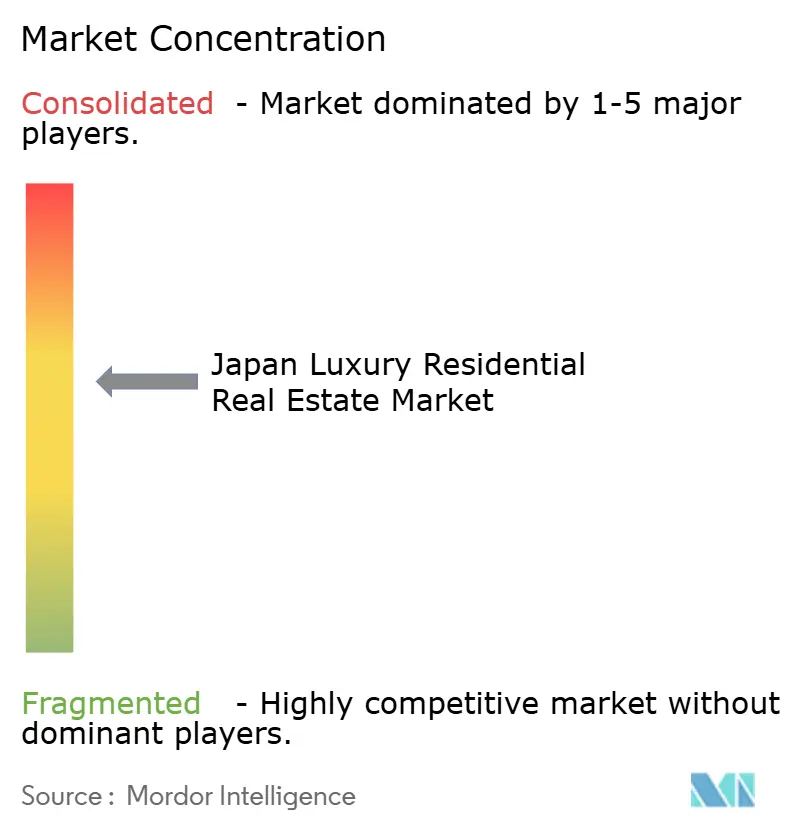
| Market Concentration | Medium |
Major Players *Disclaimer: Major Players sorted in no particular order Image © Mordor Intelligence. Reuse requires attribution under CC BY 4.0. | |

Japan Luxury Residential Real Estate Market Analysis by Mordor Intelligence
The Japan Luxury Residential Real Estate Market size is estimated at USD 38.81 billion in 2026, and is expected to reach USD 52.59 billion by 2031, at a CAGR of 6.27% during the forecast period (2026-2031). Currency depreciation, finite land supply in Tokyo’s core wards, and redevelopment pipelines that embed advanced seismic engineering combine to keep pricing firm despite demographic headwinds. Offshore capital benefits from a yen that stayed near 150 per USD through 2025, effectively discounting trophy assets by as much as one-third for dollar-denominated investors. Developers with integrated land banks are absorbing construction-cost inflation, while branded-residence operators widen the rental pool and lift service expectations. Demand spillovers from infrastructure projects in Nagoya and Osaka are diversifying geographic exposure within the Japan luxury residential real estate market, even as natural-hazard and demographic risks temper sentiment outside prime metros.
Key Report Takeaways
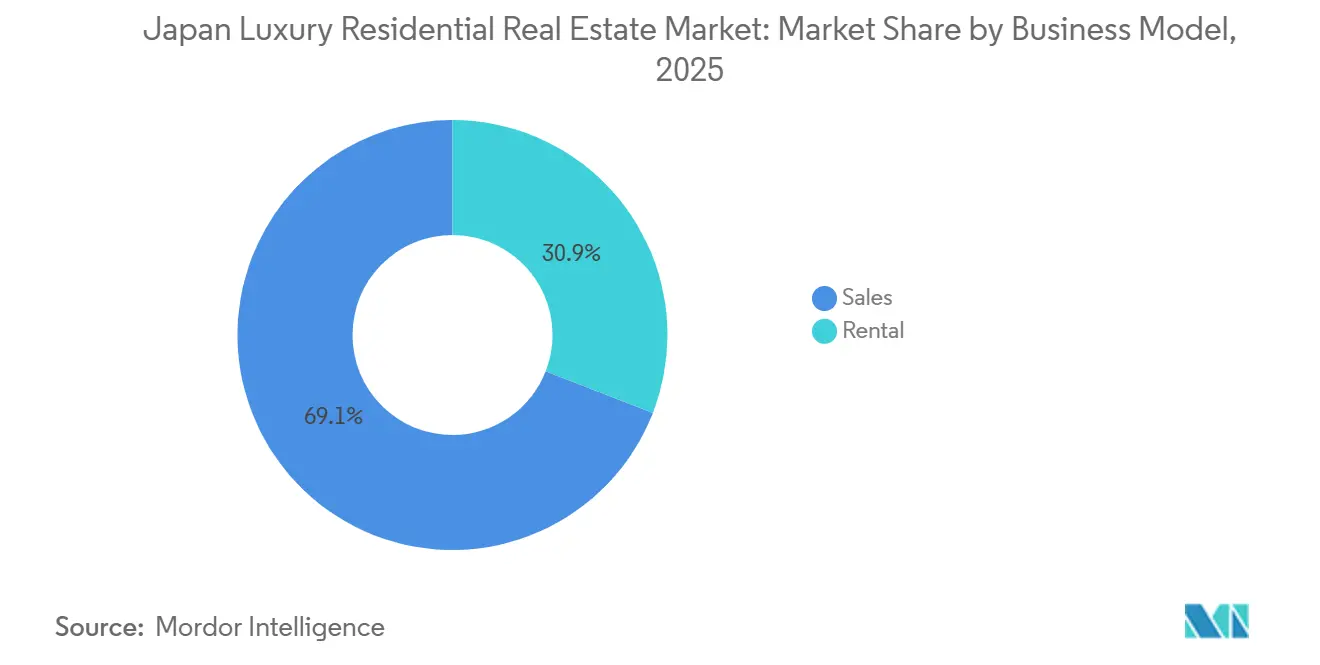
- By business model, the sales segment accounted for 69.1% of the Japan luxury residential real estate market share in 2025, whereas rental is forecast to grow at a 7.31% CAGR to 2031.
- By property type, apartments and condominiums held 77.4% of the Japan luxury residential real estate market size in 2025, while villas and landed houses are projected to expand at a 7.82% CAGR between 2026-2031.
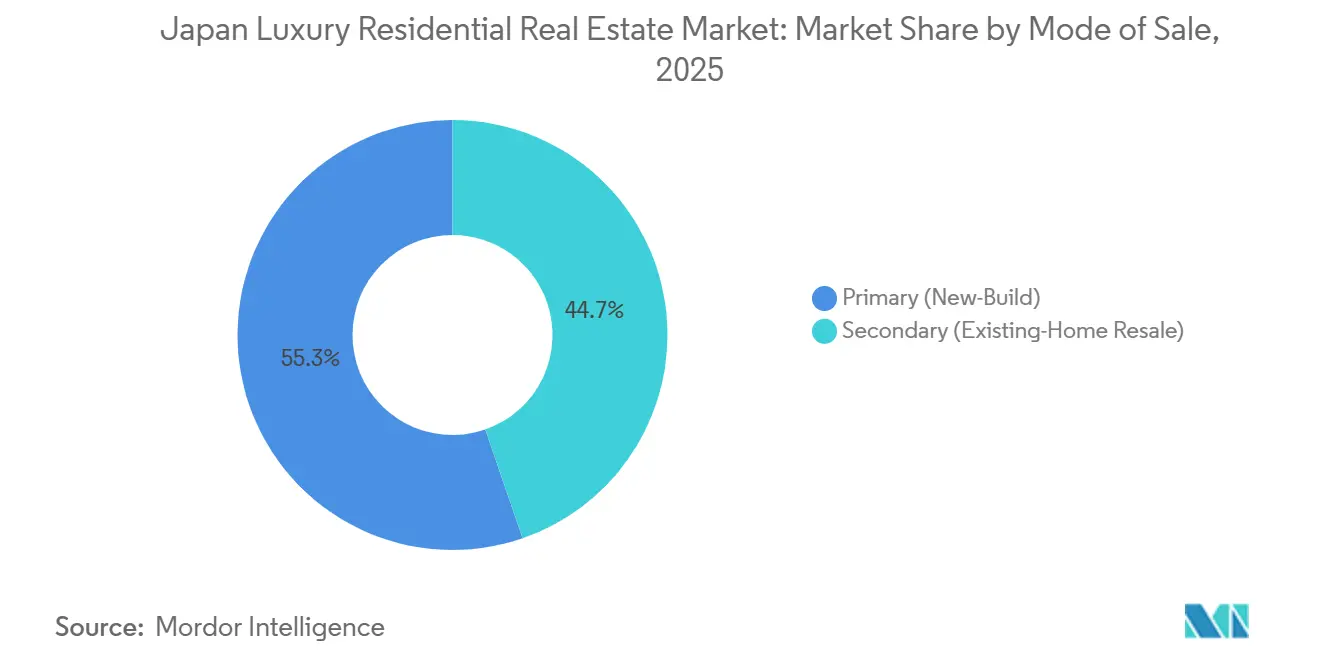
- By mode of sale, primary new-builds captured 55.3% of sales in 2025; the secondary channel is advancing at a 6.95% CAGR through 2031.
- By geography, Tokyo led with 50.2% revenue share in 2025, while Nagoya is on track for the fastest 8.06% CAGR through 2031.
Note: Market size and forecast figures in this report are generated using Mordor Intelligence’s proprietary estimation framework, updated with the latest available data and insights as of January 2026.
Market Trends and Insights
Drivers Impact Analysis of Japan Luxury Residential Real Estate Market*
| Drivers | (~) % IMPACT ON CAGR FORECAST | Geographic Relevance | Impact Timeline |
|---|---|---|---|
| Yen weakness boosts foreign HNWI purchasing | +1.5% | Tokyo, Osaka, Kyoto, Niseko | Medium term (2-4 years) |
| Scarcity of prime land and view corridors | +1.2% | Tokyo (Minato, Chiyoda, Shibuya) | Long term (≥ 4 years) |
| Safe-haven appeal of Japan | +1.0% | National, concentrated in Tokyo | Long term (≥ 4 years) |
| Redevelopment and teardown-to-custom rebuild | +0.9% | Tokyo core wards, Osaka central districts | Medium term (2-4 years) |
| Rise of branded residences | +0.8% | Tokyo, Osaka, Niseko | Short term (≤ 2 years) |
| Source: Mordor Intelligence | |||
Scarcity of Prime Land and View Corridors Supports Price Resilience
Net new residential zoning in Minato, Chiyoda, and Shibuya wards averaged below 0.5% of total land area each year from 2023-2025, creating a structural ceiling on fresh supply. Multi-generational owners hold many of the best parcels, making site assembly slow and expensive. Asahi Shimbun recorded an 8.2% year-on-year land-price jump in Minato for 2024, the steepest since 1991, as developers compete for scarce plots with unobstructed bay or palace vistas[1]. Upper-floor units commanding landmark views now achieve 25-35% premiums over mid-tier stock, double the spread seen in 2020. The Tokyo Metropolitan Government has no plans to enlarge residential zoning in these wards through 2031, locking scarcity into the outlook.
Yen Weakness Boosts Foreign and Expat HNWI Purchasing Power
The yen’s slide to 150 per USD in mid-2024 sliced headline prices by roughly 30% relative to 2021 levels for dollar and euro buyers. Foreign direct investment in Japanese real estate hit USD 14 billion in fiscal 2024, up 42% year-on-year, with luxury housing absorbing close to one-fifth of that flow[2]. Resort markets such as Niseko saw international buyers secure nearly 60% of new-build units in 2024, versus 45% two years earlier. Policy risk emerged in late 2025 when officials floated foreign-buyer screening thresholds, but no formal cap has yet been enacted. Monetary-policy divergence suggests currency support will remain in place at least into 2027.
Redevelopment and Teardown-to-Custom Rebuilds Command Premiums
Flagship mixed-use towers are redefining price ceilings. Mori Building’s Toranomon-Azabudai Hills delivered branded Aman units that cleared at USD 100,000 per sq m, roughly double non-branded peers in Minato. The Second Roppongi Hills project, under construction, will add 1,200 apartments atop a transit hub by 2027. Custom rebuilds of aged villas integrate base-isolation and net-zero systems, but push construction budgets above USD 10,000 per sq m. These premiums compensate for higher risk and material costs while recycling under-utilized parcels into ultra-prime inventory.
Rise of Branded Residences and Serviced/Hotel Hybrids
Hospitality brands - Aman, Four Seasons, Ritz-Carlton - lend cachet and turnkey services, accelerating sell-outs among time-constrained global buyers[3]. Aman Residences Tokyo sold its 91 units within 18 months, 40% to non-resident purchasers. Serviced-apartment portfolios in Tokyo and Osaka posted 90%+ occupancy and rising average daily rates in 2024, evidence that corporate relocations favor flexible, amenitized living. New rules adopted in 2025 require hotel licenses when short-stay use exceeds 30% of room-nights, nudging operators to fine-tune mix but not dampening structural demand. Growth momentum in branded stock is set to outpace the broader Japan luxury residential real estate market through 2031.
Restraints Impact Analysis of Japan Luxury Residential Real Estate Market*
| Restraints | (~) % IMPACT ON CAGR FORECAST | Geographic Relevance | Impact Timeline |
|---|---|---|---|
| Demographic headwinds and thin liquidity outside core metros | -0.8% | Regional cities, suburban Tokyo | Long term (≥ 4 years) |
| Rising construction and fit-out costs | -0.6% | National, most acute in Tokyo | Medium term (2-4 years) |
| Natural-hazard exposure and insurance friction | -0.5% | Coastal wards, reclaimed-land areas | Medium term (2-4 years) |
| Source: Mordor Intelligence | |||
Demographic Headwinds and Thin Liquidity Outside Core Metros
The share of residents aged 65+ reached 28.9% in 2024 and is on course to top 30% by 2030, reducing household formation in prefectures beyond Tokyo, Osaka, and Nagoya. Luxury transactions in Shizuoka and Niigata fell 12% year-on-year during 2024 as local buyer pools shrank. Estate disposals by aging owners are flooding regional markets with dated stock, stretching selling periods, and pushing discounts. Institutional and foreign investors, who could provide liquidity, remain focused on core metros, leaving secondary markets exposed to price drift. Without a demographic reversal, exit options for non-prime high-end assets will stay constrained through the forecast horizon.
Rising Construction and Fit-Out Costs Compress Feasibility
Overall construction costs increased roughly 15% from 2023-2025, propelled by labor shortages and pricier imported materials. Revised 2024 building codes added requirements for 20% energy savings versus 2013 baselines, lifting mechanical and envelope budgets by USD 1,300–2,000 per unit. Seismic-isolation mandates that withstand 0.5g ground motion add another 8-12% to structural cost. Smaller developers lacking balance-sheet depth migrate toward partnerships with the major conglomerates, narrowing competitive diversity. Cost pressure should moderate post-2028 as prefabrication improves, but near-term feasibility hurdles persist.
*Our forecasts treat driver/restraint impacts as directional, not additive. The impact forecasts reflect baseline growth, mix effects, and variable interactions.
Japan Luxury Residential Real Estate Market Segment Analysis
By Business Model:
Rental Momentum Narrows the GapSales transactions dominated with a 69.1% share of the Japan luxury residential real estate market in 2025, yet rentals are rising on the back of expatriate inflows and branded-residence offerings. Rental stock posted 90%+ occupancy across key Mori Living properties and average lease tenures extended to 24 months in 2024, signaling stickier demand. Elevated sales pricing above USD 100,000 per sq m in ultra-prime towers narrows the buyer pool, prompting developers to pivot toward build-to-rent pipelines. The rental segment’s 7.31% CAGR to 2031 exceeds the overall Japan luxury residential real estate market size trajectory, suggesting investors will allocate more capital to income-producing models.
Flexibility and turnkey services differentiate rental offerings, especially among international assignees who value predictable monthly outgo over large down payments. Branded-residence leases often include concierge, housekeeping, and wellness amenities bundled into the rent, raising achievable yields. Tax rules also permit depreciation benefits that shelter rental income for certain investor profiles. As corporations adopt hybrid working, executives favor centrally located, fully serviced apartments over suburban ownership, reinforcing rental demand. This evolution indicates that rentals could approach parity with sales by 2031, reshaping revenue mix for integrated developers active in the Japan luxury residential real estate market.
By Property Type:
Villas Capture Privacy PremiumApartments and condominiums captured 77.4% market share in 2025, reflecting vertical urbanism in Tokyo, yet the villa segment is on course for the fastest 7.82% CAGR through 2031. Orders for custom villas priced above USD 2 million rose 18% in 2024 at Sumitomo Forestry, as buyers sought outdoor space and net-zero designs. Teardown-rebuild activity in Setagaya and Meguro converts obsolete houses into modern, low-rise luxury that commands premiums approaching high-rise pricing per square foot, narrowing historical gaps.
The villa push dovetails with policy incentives: revised 2024 codes offer expedited permits and lower property taxes for energy-efficient low-rise construction, making suburban plots more attractive. Smart-home integration, EV-charging, and extensive landscaping further elevate appeal. While apartments remain predominant in the Japan luxury residential real estate market, the privacy trend signals a bifurcation, requiring developers to field both vertical and low-rise capabilities to serve diverging buyer priorities.
By Mode of Sale:
Estate Turnover Energizes Secondary MarketPrimary new-builds held 55.3% of 2025 volume, but the resale channel’s 6.95% CAGR is closing the gap. Brokerage divisions at Tokyo Tatemono and Mitsui Fudosan Realty reported double-digit growth in 2024 resale deals, aided by currency-advantaged foreign buyers seeking immediate occupancy. Discounts between pre-owned and new units in Minato narrowed to under 5%, evidence that location and building reputation trump age in buyer calculations.
Secondary liquidity benefits from Japan’s aging demographic: estate disposals inject well-located stock that often needs only cosmetic upgrades to meet modern standards. Developers are launching renovation-and-resale programs that retrofit energy systems and digital amenities, effectively blending primary and secondary business lines. Rising construction costs also nudge budget-minded buyers toward proven, slightly older inventory, sustaining upward momentum in the secondary slice of the Japan luxury residential real estate market.
Geography Analysis
Tokyo retained 50.2% of 2025 spending, supported by scarce land, diverse expatriate services, and integrated mixed-use projects such as Toranomon-Azabudai Hills that raised average central-ward condo prices by 8.2% year-on-year. Yet Nagoya is set to grow fastest at an 8.06% CAGR to 2031, catalyzed by the 2027 maglev line that will connect it to Tokyo in 40 minutes and by major auto-industry relocations seeking lower operating costs. Early evidence came from Daiwa House’s Grand Maison Fushimi launch, where 80% of units were reserved within six months, underscoring pent-up demand.
Osaka, with 22% 2025 share, benefits from Expo-driven infrastructure, a burgeoning financial district, and the Yumeshima integrated resort that elevates executive housing needs. Rents in Sumitomo Realty’s Osaka portfolio increased 6% in 2024, supported by 92% occupancy. Kyoto leverages cultural-tourism recovery to market refurbished machiya townhouses as niche luxury residences. Resort markets such as Niseko remain volatile - prices jumped 35% between 2022-2024, but transactions dipped 18% in 2025 after cost spikes and regulatory chatter on foreign ownership. Policy signals still prioritize infrastructure in the Tokyo-Osaka-Nagoya corridor, implying sustained capital magnetism to these hubs.
Peripheral cities face liquidity risk as population declines weigh on buyer waves, though improved Shinkansen links and digital-nomad inflows provide selective support. Investors, therefore, overweight core metros in portfolio allocations within the Japan luxury residential real estate market, using regional exposure sparingly for yield lift and diversification.
Regulatory Landscape
Japan luxury residential transactions sit within a layered framework covering property rights, construction standards, energy performance, and foreign-transaction oversight. On the building side, MLIT-led code tightening has elevated compliance demands, including the April 1, 2024 enforcement step under the Act on the Improvement of Energy Consumption Performance of Buildings, which has pushed developers and owners to document energy performance more rigorously in new-build and major renovation workflows.
On the ownership and capital-flow side, policy attention on foreign land acquisitions increased in 2026. A Cabinet Office Ordinance amending the Regulation for Enforcement of the Act on Review of Important Real Estate took effect on April 1, 2026, and a government expert panel began meetings in March 2026 to discuss potential proposals during the parliamentary session ending in July 2026. In June 2026, the LDP policy panel submitted a proposal calling for tighter controls on foreign acquisitions in security-sensitive areas. For luxury residential assets, these changes raise due diligence requirements around buyer disclosure and property location screening, especially for trophy inventory near designated facilities.
Value Chain Analysis
The value chain is led by vertically integrated developers (Mitsubishi Estate, Mitsui Fudosan, Mori Building, Sumitomo Realty and Development, Tokyu Land) that control land acquisition, planning, design coordination, delivery, and post-handover operations, which helps them underwrite long-cycle redevelopment in supply-constrained wards. General contractors and specialist designers execute high-spec builds, while property management arms and operating partners sustain premium positioning through concierge, leasing, and building services, a model reinforced by branded and serviced-residence formats.
Capital and distribution flow through developer balance sheets, bank financing, and institutional channels, complemented by brokerages and corporate-housing platforms that match expatriate and executive demand to prime stock. Recent large-project delivery and openings illustrate the chain in practice, including Mori Building completing Azabudai Hills (Residence B) in October 2025 and Mitsui Fudosan opening mixed-use assets with rental residences such as Omotesando Grid Tower in phases from February 2026. With construction and fit-out costs elevated, the chain increasingly favors scale players that can lock in contractors, standardize procurement, and monetize assets through a mix of sales, rentals, and managed living services.
Competitive Landscape
A moderate-concentration structure defines the Japan luxury residential real estate market: five vertically integrated conglomerates—Mitsubishi Estate, Mitsui Fudosan, Mori Building, Sumitomo Realty & Development, and Tokyu Land—control prime land banks and bundled design-build-manage capabilities. Mitsui Fudosan delivered 3,200 luxury units in 2024 with average project sizes exceeding USD 333 million, showcasing financial heft that smaller rivals lack. Mitsubishi Estate’s Marunouchi tower pipeline embeds residences into office-retail ecosystems, diversifying income and locking in tenant synergies.
Strategic focus tilts toward large-scale redevelopment requiring multiyear capital and stakeholder coordination. Mori Building partnered with Aman for the Aman Residences Tokyo, achieving a full sell-out in 18 months and highlighting the pricing upside of hospitality branding. Technology adoption is growing: Sekisui House and Daiwa House integrate AI-driven energy-management and IoT sensors to meet sustainability mandates and attract eco-conscious buyers.
Entry barriers rise as construction inflation and strict codes demand scale and cash reserves. Niche players find openings in suburban villas, resort towns, and renovation-and-resale programs where agility matters more than land bank size. Partnerships between local developers and overseas capital—such as Daiwa House’s 2025 Nagoya venture with a Singapore family office—signal a collaborative path in otherwise concentrated terrain.
Japan Luxury Residential Real Estate Industry Leaders
-
Mitsubishi Estate Co. Ltd.
-
Mitsui Fudosan Co. Ltd.
-
Mori Trust Co. Ltd.
-
Mori Building Co. Ltd.
-
Sumitomo Realty & Development Co. Ltd.
- *Disclaimer: Major Players sorted in no particular order
Japan Luxury Residential Real Estate Market Companies Covered in this Report
- Mitsubishi Estate Co. Ltd.
- Mitsui Fudosan Co. Ltd.
- Mori Trust Co. Ltd.
- Mori Building Co. Ltd.
- Sumitomo Realty & Development Co. Ltd.
- Tokyu Land Corporation
- Daiwa House Group
- Tokyo Tatemono Co. Ltd.
- Nomura Real Estate Holdings Inc.
- Daikyo Incorporated
- Sekisui House Ltd.
- Sumitomo Forestry Co. Ltd.
- Itochu Property Development Ltd.
- NTT Urban Development Corp.
- Obayashi Corporation
- Hulic Co. Ltd.
- Keio Realty & Development Co. Ltd.
- Mitsui Home Co. Ltd.
- Westbank Corp. (Japan Projects)
- Nakano Corporation
Read Analysis of Japan Luxury Residential Real Estate Companies
Market Opportunities and Future Outlook
Opportunities cluster where luxury demand intersects with mixed-use redevelopment pipelines and branded living formats that broaden the addressable renter and buyer pool. Tokyo continues to show pricing headroom for top-tier stock, with the average price of newly built condominiums in Tokyo's 23 wards reported at 136.13 million yen in 2025 (Real Estate Economic Institute, published February 2026), supporting ultra-prime differentiation through energy performance, seismic engineering, and hotel-grade services rather than incremental specification upgrades.
Osaka and central Tokyo redevelopment districts provide visible whitespace for new luxury residential formats tied to hospitality and destination infrastructure. Examples in the 2026 pipeline include Mitsui Fudosan's Tokyo Midtown Nihonbashi redevelopment featuring Waldorf Astoria Residences Tokyo Nihonbashi, with overall completion scheduled for September 2026, and ORIX Real Estate's plan to begin sales for GRAND GREEN OSAKA THE SOUTH RESIDENCE in late October 2026 as the final residential component of the Umekita 2nd Project. At the same time, 2026 policy activity around foreign ownership transparency and screening raises the premium on compliant transaction structuring and institutional-grade documentation, creating an execution advantage for major developers and brokerages that can standardize buyer vetting, disclosure, and cross-border settlement.
Recent Industry Developments in Japan Luxury Residential Real Estate Market
- June 2026: The Liberal Democratic Party policy panel submitted a proposal to the government calling for tighter controls on land acquisitions by foreign nationals in security-sensitive areas. The proposal underscores rising scrutiny of buyer identity and location-specific risks, which raises due diligence needs for high-value residential deals near designated facilities.
- February 2026: Mori Trust announced the launch of 1 Homes Tokyo at Akasaka Trust Tower, positioning residences on the 38th to 43rd floors, with move-ins beginning in March 2026. The project expands premium, service-oriented urban living supply in central Tokyo and signals continued developer emphasis on managed high-end residential offerings.
- July 2024: Mori Trust invested in a luxury detached housing project, Malton Gates Krungthep Kreetha 2, in Bangkok in collaboration with Major Development Public Company Limited. The investment highlights a regional growth angle for Japanese real estate groups, while also building experience in luxury housing formats and partnerships that can feed back into Japan-focused product design and operations.
Japan Luxury Residential Real Estate Market Report Scope and Research Methodology
Market Definition and Coverage
This methodology covers the transaction value tied to luxury residential homes in Japan. The scope focuses on high-end units that are marketed and priced as premium housing in key cities and resort-linked locations.
Scope exclusions: Standard mid-income housing stock and public housing are excluded. We also exclude commercial real estate and pure land-only transactions where a luxury home sale cannot be reasonably inferred.
Segments Covered in This Report
- By Business Model
- Sales
- Rental
Data Sources, Market Sizing, and Validation
Desk Research
Desk research was used to anchor the market to observable housing and finance signals in Japan, before any assumptions were applied. We referenced public datasets such as the Statistics Bureau of Japan, MLIT housing and land statistics, Bank of Japan releases on lending and rates, and official FX series from the Bank of Japan or Japan Ministry of Finance publications.
Alongside these, we reviewed transparency-driven sources such as REINS market snapshots and land and price indicators published by public agencies. We also reviewed peer-reviewed papers on Japan housing cycles to understand typical drivers of premium pricing. Company filings, investor presentations, and reputed press were used to sanity-check project pipelines and premium amenity positioning. Where disclosures were thin, we used a paid subscription for company financials and news intelligence selectively. This list is illustrative, and many other sources were also used for data collection, validation, and clarification during the study.
Primary Interviews and Surveys
Primary work focused on interviews and short surveys with developers, brokerage and advisory professionals, property managers, and financing-side experts who track luxury deal flow. We used these inputs to clarify what "luxury" means in practice by city, how primary versus secondary deals behave, and how foreign-buyer and domestic high-net-worth demand shifts when the yen and mortgage rates move.
Distribution of primary research fieldwork respondents
| Company type | Respondent position |
|---|---|
| Top tier: 37% | CXOs: 12% |
| Mid tier: 48% | Functional/Unit leaders: 37% |
| Smaller Players: 15% | Managers: 51% |
Market-Sizing & Forecasting
Sizing was built using a top-down and bottom-up approach. We started with the luxury demand pool by major cities, then translated it into value using observed price levels and transaction intensity. In practice, we reconstructed value using indicators such as luxury price per square meter ranges, the share of high-value transactions within total residential deals, new launch absorption patterns, and the split between primary and secondary sales.
To keep the model grounded, we also ran selective bottom-up checks. These used sampled project pricing, broker-validated deal sizes, and a simple ASP x transaction-volume build for a limited set of representative micro-markets. Totals were adjusted where gaps were consistently flagged. When deal data was patchy, we used conservative ranges agreed in interviews, then stress-tested those ranges against publicly visible price indices and financing conditions.
For forecasting, we used scenario analysis because the market can swing with FX and rates, and those drivers do not move in straight lines. Key forward inputs included yen-to-USD conversion timing, new supply from redevelopment pipelines, high-end mortgage availability, foreign buyer activity signals, and premium inventory tightness in Tokyo and other core cities. Field feedback was used to validate these inputs before finalizing the outlook.
Data Validation & Update Cycle
We triangulated model outputs against independent signals, including macro housing indicators, price index direction, and financing trends. We then checked whether the implied transaction values stayed realistic for each city context. Outliers were reviewed in a second pass, and where variance could not be explained by a clear factor, such as a one-off large development, assumptions were revisited and re-tested.
Before sign-off, the work is reviewed in steps to keep unit logic, currency conversions, and growth drivers consistent with the market narrative. Reports are refreshed annually, with interim adjustments when material events occur, such as sharp FX moves, major policy shifts, or a visible break in transaction activity. Right before delivery, we do a final update pass so clients receive the most current view available.
Mordor Intelligence's Japan Luxury Residential Real Estate Market Size Compared With Other Published Estimates
Published market sizes for Japan luxury residential real estate often do not match because "luxury" is not a single fixed threshold. Some studies also blend different time periods and transaction types into one number. Differences also come from how prices are averaged, whether secondary sales are treated consistently, and how currency translation is handled when reporting in USD.
A refresh-led difference is usually the FX and ASP treatment. A fast-moving yen can change USD value even when local prices look stable. By re-checking price benchmarks and converting using consistent period averages before finalizing the current-year value, Mordor Intelligence reduces timing noise that can inflate or depress the market in volatile quarters.
Benchmark comparison
| Source | Market Size | Gaps in Research Methodology |
|---|---|---|
| Mordor Intelligence | USD 38.81 B (2026) | |
| Industry Publisher A | USD 16.97 B (2024) | Uses an earlier base year and may apply a narrower luxury definition that leans on select property types, which can understate value when prime-city secondary transactions are counted in the broader market. |
| Specialist Research Group B | USD 3.00 B (2025) | Represents Tokyo-only luxury market value, which is directionally useful for benchmarking but is not comparable to an all-Japan estimate that includes other cities and resort-linked demand. |
The table shows that the widest gaps are explained by year alignment and geographic coverage first, and then by how luxury price levels are converted and averaged. Once the scope is matched by Japan coverage, primary plus secondary deal treatment, and a consistent currency timing choice, the remaining differences tend to narrow to reasonable ASP and volume assumptions that can be re-checked.
Key Questions Answered in the Report
How large is the Japan luxury residential real estate market in 2026?
The market is valued at USD 38.81 billion in 2026 and is set to expand to USD 52.59 billion by 2031.
What is driving foreign investment into Japanese luxury housing?
Yen weakness near 150 per USD gives foreign buyers up to a 30% price edge versus 2021 levels, spurring cross-border acquisitions.
Which Japanese city is forecast to grow fastest for luxury residences?
Nagoya leads with an expected 8.06% CAGR through 2031, helped by the upcoming maglev link and corporate relocations.
Why are branded residences popular in Tokyo?
They bundle hotel-grade concierge, maintenance, and leasing services, offering turnkey ownership that appeals to time-pressed global buyers.
What risks could slow market growth?
Demographic decline outside major metros, escalating construction costs, and potential foreign-buyer restrictions are the main headwinds.