
Japan Industrial Press Machines Market Size and Share
Market Overview
| Study Period | 2020 - 2031 |
|---|---|
| Forecast Data Period | 2026 - 2031 |
| Base Year Market Size (2025) | USD 0.9 Billion |
| Market Size (2026) | USD 0.95 Billion |
| Market Size (2031) | USD 1.09 Billion |
| Growth Rate (2026 - 2031) | 2.79 % |
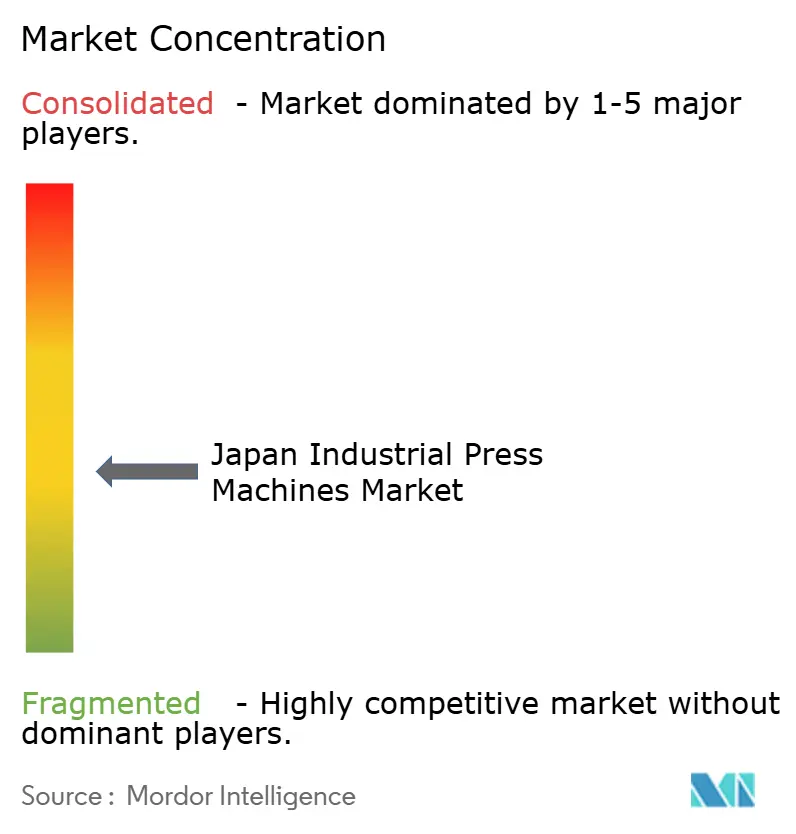
| Market Concentration | Medium |
Major Players *Disclaimer: Major Players sorted in no particular order Image © Mordor Intelligence. Reuse requires attribution under CC BY 4.0. | |
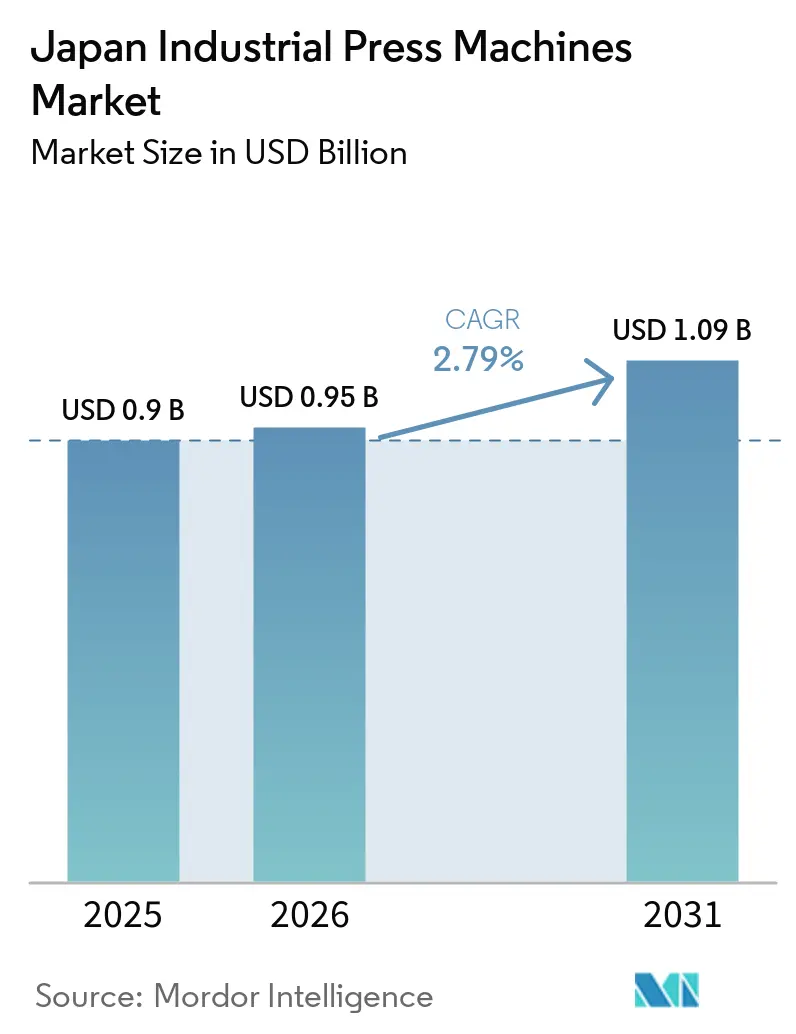
Japan Industrial Press Machines Market Analysis by Mordor Intelligence
The Japan industrial press machines market size was valued at USD 0.9 billion in 2025 and estimated to grow from USD 0.95 billion in 2026 to reach USD 1.09 billion by 2031, at a CAGR of 2.8% during the forecast period (2026-2031).
The Japan industrial press machines market is supported by demand for equipment that can form battery cases, motor cores, and lighter vehicle structures. Semiconductor investment is also increasing demand for precision stamping, lead-frame forming, and metal-shield blanking equipment. Updated safety standards and an aging installed base are making replacement decisions more urgent for many factories.[1]Japan Finance Corporation, “133rd Survey on SME Manufacturing Equipment Investment Trends, Planned Investment for Replacement and Maintenance in Fiscal Year 2025,” Japan Finance Corporation, jfc.go.jp. Competition centers on servo controls, connected equipment, application-specific systems, and long-standing customer support. The Japan industrial press machines market also faces slower approval cycles when buyers must fund foundations, power upgrades, and die qualification before a new line can begin production.
Key Report Takeaways
- By drive or actuation technology, hydraulic presses held 30.3% of the Japan industrial press machines market share in 2025, while servo-mechanical presses recorded the highest projected CAGR at 5% through 2031.
- By press force or capacity, the 101-500-ton class held 33.2% of the Japan industrial press machines market share in 2025, while presses above 2,000 tons recorded the highest projected CAGR at 4.3% through 2031.
- By application or process, stamping, blanking, and punching accounted for 30% of the Japan industrial press machines market size in 2025, while assembly, press-fitting, and joining recorded the highest projected CAGR at 4.7% through 2031.
- By end-use industry, automotive and transportation held 42.8% of demand in 2025, while medical and precision manufacturing recorded the highest projected CAGR at 5.5% through 2031.
Note: Market size and forecast figures in this report are generated using Mordor Intelligence’s proprietary estimation framework, updated with the latest available data and insights as of January 2026.
Japan Industrial Press Machines Market Trends and Insights
Drivers Impact Analysis*
| Driver | (~) % Impact on CAGR Forecast | Geographic Relevance | Impact Timeline |
|---|---|---|---|
| EV Battery-Case and Lightweight-Component Forming | +0.65% | Aichi, Kyushu, and Kinki industrial corridors, and national | Medium term (2-4 years) |
| Servo, Electric, and Connected Press Adoption | +0.55% | National, with early concentration in Kanto and Tokai | Short term (≤ 2 years) |
| Semiconductor and Precision-Electronics Capacity Expansion | +0.45% | Kyushu, Hokkaido, Kanto, and Hiroshima | Medium term (2-4 years) |
| Aging-Equipment Replacement and Safety Modernization | +0.35% | National, with the strongest relevance in SME-dense Chubu and Kansai | Short term (≤ 2 years) |
| Skilled Die-Maker Scarcity and Closed-Loop Process Control | +0.30% | National, with the greatest pressure in aging industrial clusters | Medium term (2-4 years) |
| Localization of Fine-Blanking and Battery-Case Tooling | +0.25% | Kyushu, Tokai, and Kansai battery supply-chain corridors | Long term (≥ 4 years) |
| Source: Mordor Intelligence | |||
EV Battery-Case and Lightweight-Component Forming
Japan’s battery manufacturing expansion is raising demand for dedicated high-speed deep-draw presses and wide-area motor-core stamping lines. These requirements differ from those of general-purpose press configurations because battery cases and motor laminations have distinct material, speed, and accuracy needs. METI allocated JPY 350 billion (USD 2.24 billion) in battery supply assurance support under the Economic Security Promotion Act, with the program targeting domestic capacity growth from 80 GWh to 120 GWh a year.[2]Ministry of Economy, Trade and Industry, “Economic Security Promotion Act, Battery Supply Assurance Certifications and Capital Subsidy Allocations for Domestic Battery Production Capacity,” Ministry of Economy, Trade and Industry, meti.go.jp. The Japan industrial press machines market benefits when cell and component producers add equipment designed for cylindrical battery cases. AIDA introduced the DIS Former for cylindrical storage-battery cases in June 2025, and the company stated that the machine had an SN value 1.7 times that of conventional presses. Motor-core production also requires presses that can process very thin silicon steel across wide dies while maintaining close parallelism. This demand favors suppliers that can combine press frames, motion controls, tooling support, and production-line integration.
Servo, Electric, and Connected Press Adoption
Servo-mechanical presses give manufacturers greater control over slide speed, dwell time, and reversal than systems with fixed motion profiles. This flexibility can support thin-material blanking and reverse-motion drawing without physical changes to the die. It can also help manufacturers handle growing material complexity in electrified vehicles and precision components. In the Japan industrial press machines market, proprietary motors and control systems help builders differentiate their machines and maintain service relationships after installation. Connected presses can send slide-force, parallelism, and energy-use data to manufacturing systems, supporting quality records and maintenance planning. The value of this capability rises where an unplanned stoppage can disrupt deliveries across assemblers and component suppliers. Komatsu Industries markets its H1F-2 AC servo press with a servo drive and connected machine features, illustrating the importance of equipment integration in this product area.
Semiconductor and Precision-Electronics Capacity Expansion
Japan’s semiconductor policy is creating demand beyond the construction of fabrication plants. Precision stamping cells, lead-frame equipment, and metal-shield blanking lines are needed throughout the semiconductor supply chain. METI committed up to JPY 536 billion (USD 3.43 billion) to support Micron Technology’s advanced DRAM production research and capital spending at Hiroshima, with commercial mass production targeted for 2028. NEDO also approved Rapidus Corporation’s FY2025 plan and budget for a 2nm semiconductor project in Hokkaido, with pilot-line work advancing toward a 2027 mass-production target. These programs support demand for equipment used to form small and precise metal parts. The Japan industrial press machines market can gain as component suppliers and packaging companies add capacity alongside major fabs. Demand is most relevant for press-force ranges used in precision lead frames, substrate carriers, and related components.
Aging-Equipment Replacement and Safety Modernization
Aging machinery is increasing the need for equipment replacement in Japanese manufacturing. The Japan Machine Tool Builders’ Association described a long-running issue in which more than 60% of production machinery had been used for over 10 years. The Japan Finance Corporation reported that equipment replacement and maintenance accounted for 37.3% of planned manufacturing investment by SMEs in FY2025. JIS B 6411-1:2025, JIS B 6411-2:2025, and JIS B 6411-3:2025 set updated press-machine safety requirements aligned with ISO 16092 safety standards.[3]Japan Forming Machinery Association, “JIS B 6411-1:2025, JIS B 6411-2:2025, and JIS B 6411-3:2025, Safety Standards for General, Servo-Mechanical, and Hydraulic Press Machines,” Japan Forming Machinery Association, j-fma.or.jp. The standards matter particularly for older machines that cannot be upgraded economically with new guards and documentation. New servo-electric systems can also lower energy consumption under comparable operating conditions, which improves the economic case for replacement. These conditions create a broad renewal opportunity for the Japan industrial press machines market across capacity classes and industrial regions.
Restraints Impact Analysis*
| Restraint | (~) % Impact on CAGR Forecast | Geographic Relevance | Impact Timeline |
|---|---|---|---|
| High Capital Cost and Long Approval Cycles | -0.45% | National, with the greatest relevance for SME buyers across manufacturing regions | Long term (≥ 4 years) |
| Cyclical Automotive Capital Expenditure | -0.35% | Aichi, Tokai, Kyushu, and Kinki automotive manufacturing clusters | Medium term (2-4 years) |
| Legacy-Factory Data Integration Friction | -0.25% | National, with the greatest relevance in older SME press shops outside urban corridors | Medium term (2-4 years) |
| Concentration of Specialized Commissioning Expertise | -0.15% | National, with the greatest shortage outside major metropolitan regions | Long term (≥ 4 years) |
| Source: Mordor Intelligence | |||
High Capital Cost and Long Approval Cycles
The purchase of a large servo or hydraulic press requires more than the cost of the machine itself. Buyers may also need foundation work, electrical upgrades, staged installation, and die qualification. These requirements can extend procurement timetables for presses above 500 tons, especially for SMEs with limited capital budgets. Japan’s Ministry of Finance reported that corporate capital spending declined 0.2% year over year in the fourth quarter of FY2024. The report also stated that manufacturers’ recurring profits fell 11.5% in the April-June 2025 quarter, reducing the funds available for machinery decisions. Subsidy programs can reduce part of the acquisition cost, but administrative processes can still delay purchase approvals. The Japan industrial press machines market, therefore, depends not only on technical demand but also on buyers’ ability to commit capital over a long installation period.
Cyclical Automotive Capital Expenditure
Automotive and transportation accounted for 42.8% of end-use demand in 2025, so changes in automotive investment affect press orders directly. The Japan Automobile Manufacturers Association stated that U.S. tariffs imposed from April 2025 created an annual operating-profit exposure of JPY 3.6 trillion (USD 23.04 billion) for major Japanese automakers. The Bank of Japan stated in August 2025 that U.S. tariffs could lower corporate profits and postpone capital spending plans. A deferred body-shop expansion or powertrain retooling project can reduce new press orders for 12 to 24 months. Press builders may then face lower utilization while their production capacity remains in place. The Japan industrial press machines market is therefore exposed to automotive profit cycles even as electric-vehicle programs create longer-term equipment needs.
*Our forecasts treat driver/restraint impacts as directional, not additive. The impact forecasts reflect baseline growth, mix effects, and variable interactions.
Segment Analysis
By Drive / Actuation Technology: Servo Momentum Within a Hydraulic-Led Mix
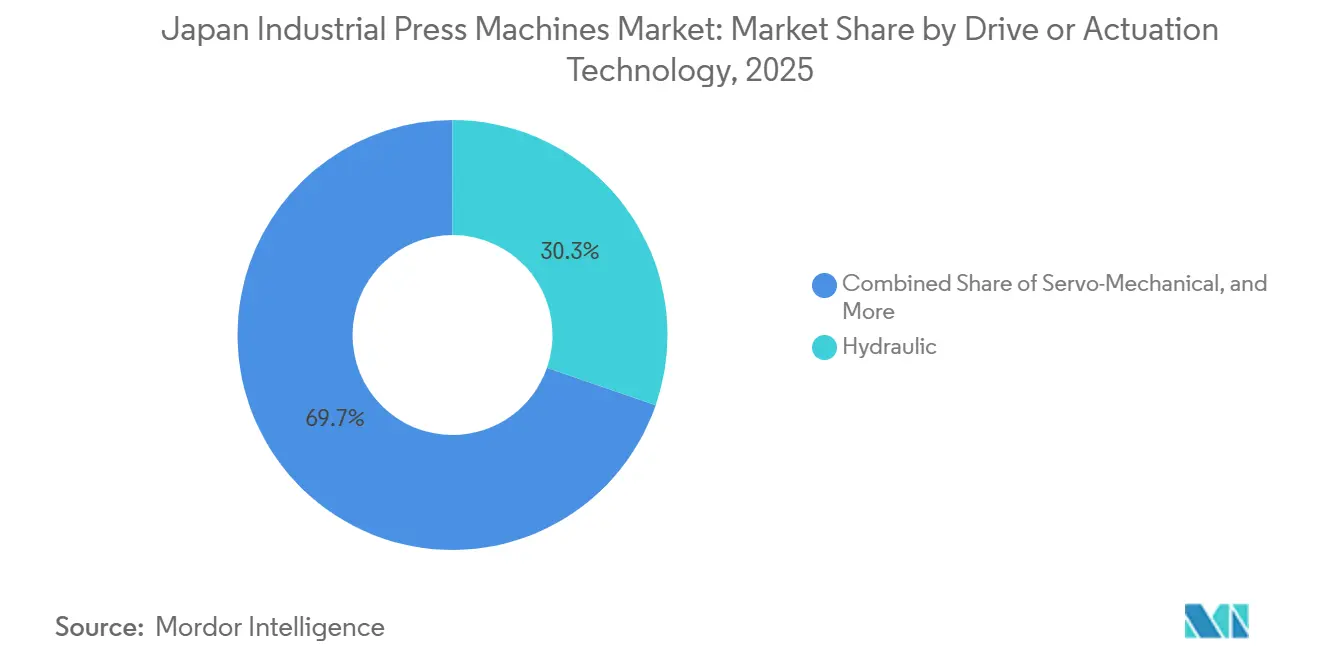
Hydraulic presses held 30.3% of the Japan industrial press machines market share in 2025. Their position reflects a strong fit with deep drawing, large structural-part processing, and work that requires controlled force buildup. Hydraulic designs remain important for aerospace structures, automotive door panels, and heavy-industry forging. They are also favored in the above-2,000-ton range, where high-pressure oil circuits remain a practical solution for very large forming forces. Conventional mechanical presses retain a substantial installed base in high-volume progressive-die stamping.
Servo-mechanical presses are forecast to grow at 5% CAGR through 2031. Their growth is linked to motor-core lamination, battery-case production, and the need for programmable slide motion. The Japan industrial press machines market continues to need mechanical presses for long production runs involving thin connector materials. Pneumatic presses serve precision assembly, staking, and insertion work in electronics and medical device manufacturing. Their compact format and clean-room compatibility support demand in applications where very large press forces are unnecessary. Other and hybrid systems, including servo-hydraulic configurations, are becoming relevant for brownfield sites seeking more control without a full frame replacement. This approach can suit SME buyers that need force-profile programmability but face high replacement costs. The shift toward servo-electric designs also reflects the value of lower noise, lower maintenance needs, and better energy use. Buyers can therefore select equipment around the process requirement rather than treat press architecture as a fixed choice. The installed base will continue to support demand for conventional machines, while new precision and battery work supports a more mixed technology profile. Komatsu Industrie's H1F series combines precision motion control with connected machine functions, showing how product design is moving toward integrated controls and service support.


By Press Force / Capacity: Large Presses Draw New Investment
The 101-500-ton class held 33.2% of the Japan industrial press machines market share in 2025. This capacity range serves standard progressive-die operations, automotive structural stampings, motor housings, and electronics chassis. Its versatility makes it a heavily contested range for equipment suppliers. These applications require machines that can provide very high force while meeting process-specific requirements. Large-frame projects also have long lead times because installation and qualification are complex.
Presses above 2,000 tons are forecast to expand at 4.3% CAGR through 2031. Their demand is linked to aerospace structures, battery-module press-fitting, and forging for wind and nuclear energy equipment. The 501-1,000-ton and 1,001-2,000-ton bands serve the overlap between large automotive-panel stamping and structural forming. These classes can gain demand as electric-vehicle body structures use more aluminum parts in place of steel components. The up-to-100-ton range includes a wide number of stock-keeping units and supports smaller precision applications. It also faces stronger price pressure from lower-cost Asian competitors. Equipment replacement affects all capacity bands because a significant portion of Japan’s production equipment has been in service for more than 10 years. Safety upgrades and energy requirements add to the replacement case for old presses. Large projects create high-value orders, but smaller upgrades can provide a broader flow of demand across the installed base. Suppliers must therefore balance long-cycle large-press work with equipment suited to more frequent factory renewal. The Japan industrial press machines market, therefore, has opportunities in both high-capacity projects and routine modernization across smaller plants.
By Application / Process: Stamping Provides Volume While Assembly Grows Faster
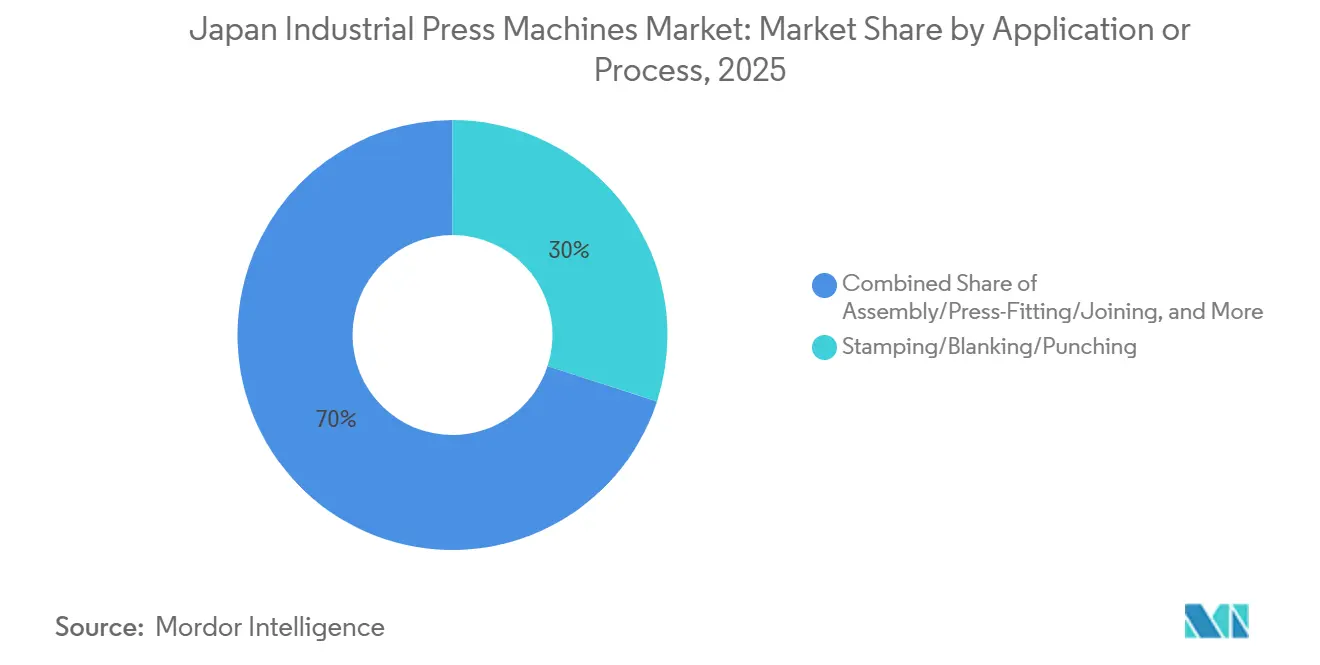
Stamping, blanking, and punching accounted for 30% of the Japan industrial press machines market size in 2025. This result reflects the high production volumes associated with motor-core laminations, automotive body panels, and electronic connectors. These processes often use multi-station progressive dies that require accurate and repeatable press motion. Japan’s die-manufacturing capability remains important where tight tolerances are needed. In each of these tasks, forming accuracy affects downstream production quality.
Assembly, press-fitting, and joining are forecast to grow at 4.7% CAGR through 2031. Their growth is tied to position-control needs in electric-vehicle drivetrain staking, battery-module assembly, and semiconductor lead-frame handling. Deep drawing and sheet forming remain central to battery-case and automotive-panel production. Servo and hydraulic machines compete in these applications according to material type, part geometry, and output requirements. Forging supports defense, aerospace, and industrial transmission components. Japan’s defense investment program also supports demand for capacity used in ordnance, landing gear, and naval structural components. Compression molding, powder compaction, and specialty processes support motor powder-metallurgy parts and industrial machinery applications. These applications provide a base of demand that is not dependent only on the electric-vehicle transition. Production users increasingly need press equipment that matches the accuracy needs of each forming and joining step. This makes tooling compatibility and process support as important as the machine’s rated force. The Japan industrial press machines market consequently combines high-volume stamping with smaller application areas that require greater process specialization.
By End-Use Industry: Medical Precision Outpaces a Changing Automotive Base
Automotive and transportation accounted for 42.8% of 2025 end-use demand. The sector is moving away from conventional high-volume cold stamping of steel body parts toward forming aluminum structures, battery housings, and power-electronics heat sinks. Each of these products can require a different press configuration from the machine it replaces. This change supports demand for application-specific equipment rather than only general-purpose lines. Japan’s medical device sector remains among the world’s largest, which supports the relevance of this end-use for precision-forming equipment.[4]U.S. International Trade Administration, “Japan, Medical Devices Country Commercial Guide,” International Trade Administration, trade.gov.
Medical and precision manufacturing are forecast to grow at 5.5% CAGR through 2031. The demand base includes an aging population, traceability requirements under the Pharmaceuticals and Medical Devices Act, and precision device-component work. Electrical and electronics manufacturers are another growing source of equipment demand. Semiconductor back-end equipment producers, connector manufacturers, and PCB-component suppliers use precision forming equipment for small parts. Domestic chip investment can therefore create demand beyond the main fabrication sites. Industrial machinery, aerospace and defense, and energy and power equipment add end-use diversity to the Japan industrial press machines market. These fields can reduce the effect of a single automotive spending cycle on overall equipment demand. Their requirements also favor suppliers that can provide specialized force control, large frames, or dedicated tooling support. Customers in these fields also value repeatability, traceability, and support for more specialized production tasks. The end-use mix is becoming more varied as manufacturers respond to electrification, semiconductor capacity, and precision production requirements.
Geography Analysis
The Japan industrial press machines market is concentrated in major manufacturing corridors, with Chubu and Tokai centered on Aichi forming the largest press-intensive area. The region has dense automotive production and supplier activity, which supports both machine volumes and demand for higher-tonnage equipment. Press investment in this area is linked to electric-vehicle platform plans at Toyota, Honda, and their suppliers. Toyota’s domestic battery-cell deliveries were scheduled to begin in November 2026, creating a multi-year basis for related equipment planning. Kansai, led by Osaka and nearby prefectures, has demand from battery-material processors and precision-electronics manufacturers. Kanto, including Tokyo, Kanagawa, and Saitama, remains an engineering center for low- and mid-tonnage precision presses used in medical devices and electronic components.
Kyushu is a fast-growing equipment-demand area because semiconductor investment has expanded its advanced manufacturing base. NEDO’s approval of Rapidus’s FY2025 plan supports Hokkaido’s role as another precision-manufacturing location, with pilot-line work directed toward 2027 mass production. Kyushu’s component suppliers need lead-frame stamping and metal-shield blanking equipment as local semiconductor production expands. Mazda signed an agreement in September 2025 for a 10 GWh cylindrical lithium-ion battery module plant in Yamaguchi Prefecture, creating another battery-supply-chain equipment node. The plant was Mazda’s first new domestic facility since 1992 and was scheduled to begin operating in fiscal year 2027. These investments broaden the geographic base of the Japan industrial press machines market beyond established automotive areas.
Hiroshima is also gaining relevance through Micron’s supported DRAM expansion and the resulting investment by local component suppliers. The Development Bank of Japan reported that 9 of Japan’s 10 major regions planned capital-spending increases in FY2025. The same survey showed national manufacturing capital spending rising 21.4%, marking the fifth consecutive year of growth. This broader investment pattern supports equipment demand outside the main automotive and semiconductor clusters. Regional demand is not uniform because local equipment needs continue to reflect the presence of automotive, battery, electronics, or precision-manufacturing supply chains. Even so, wider capital spending makes the national opportunity less dependent on a small number of established industrial centers. It also gives press suppliers a wider set of regional customers for replacement, precision, and specialized forming machines.
Competitive Landscape
The Japan industrial press machines market is moderately concentrated at the technology frontier. AIDA Engineering, Amada Co. through Amada Press System, and Komatsu Industries have long customer relationships, proprietary servo-drive systems, and precision frame-machining capabilities. Sumitomo Heavy Industries and Mitsubishi Heavy Industries serve large-tonnage forging and structural work in defense, aerospace, and energy. Amino Corporation has a position in servo-hydraulic and multi-action forming systems for electric-vehicle battery-case programs. Competition depends on the depth of servo-motor and control-system technology. It also depends on connected equipment, remote service capabilities, and the ability to supply dedicated forming systems instead of standard machines.
AIDA has used product development and manufacturing changes to address demand for specialized presses. In February 2026, the company issued a medium-term management plan that concentrated high-speed press manufacturing at its Tsukui Plant and expanded midsize and large-press capabilities at its Sagami Plant. The move responded to increased bookings for large presses in the second half of FY2025. AIDA’s June 2025 launch of the DIS Former also targeted cylindrical battery-case production with a dedicated high-speed deep-draw machine. These actions show the value of matching production capacity and product design to battery-related applications.
Amada Press System displayed its SDEW-8010iIII GORIKI integrated progressive press automation system with ALFAS-03KR peripheral controls at INTERMOLD Nagoya 2026. Amada Co. also participated in IMTS 2026, where it presented digitalization and automation technologies for press machines aimed at labor and skilled-worker shortages. These examples show that automation is being positioned as a response to labor constraints as well as a way to improve equipment integration. Competitive opportunities remain in servo-hydraulic retrofit packages for SMEs, low-volume precision cells for battery and semiconductor applications, and maintenance contracts tied to energy performance. Such offers address customers that need better process control but cannot justify a complete new production line. Lower-cost Chinese servo-press suppliers are placing pressure on pricing in technically demanding applications, including fuel-cell bipolar-plate work. Established Japanese suppliers retain an advantage where buyers need system integration, die qualification, and long-term service support.
Japan Industrial Press Machines Industry Leaders
AIDA ENGINEERING, LTD.
AMADA CO., LTD.
Komatsu Industries Corp.
Kojima Iron Works Co., Ltd.
Mitsubishi Heavy Industries, Ltd.
- *Disclaimer: Major Players sorted in no particular order

Recent Industry Developments
- February 2026: AIDA Engineering released a new medium-term management plan reorienting toward midsize and large press production. AIDA Engineering concentrated high-speed press manufacturing at the Tsukui Plant to shorten lead times, while expanding midsize and large-press capabilities at the Sagami Plant, citing increased large-press bookings in the second half of FY2025.
- September 2025: METI committed up to JPY 536 billion (USD 3.43 billion) in subsidies to Micron Technology for research into advanced DRAM production and capital expenditures at its Hiroshima facility, with commercial mass production targeted for 2028.
- September 2025: Mazda Motor Corporation signed an agreement with Yamaguchi Prefecture and Iwakuni City to construct a new cylindrical lithium-ion battery module plant with a maximum annual capacity of 10 GWh. Construction was to begin in November 2025, and operations were targeted for fiscal year 2027.
- June 2025: AIDA Engineering launched the DIS Former, Model DIS-1600, a dedicated high-speed deep-draw former for cylindrical storage-battery cases with an SN value 1.7 times higher than conventional presses and continuous no-load stroke rates of 40-90 strokes per minute.


Japan Industrial Press Machines Market Report Scope
| Conventional Mechanical Presses |
| Servo-Mechanical Presses |
| Hydraulic Presses |
| Pneumatic Presses |
| Other and Hybrid Presses |
| Up to 100 Tons |
| 101–500 Tons |
| 501–1,000 Tons |
| 1,001–2,000 Tons |
| Above 2,000 Tons |
| Stamping, Blanking, and Punching |
| Deep Drawing and Sheet Forming |
| Forging |
| Straightening and General Forming |
| Compression Molding |
| Powder Compaction |
| Assembly, Press-Fitting, and Joining |
| Other Press Applications |
| Automotive and Transportation |
| Aerospace and Defense |
| Industrial Machinery and Equipment |
| Electrical and Electronics |
| Appliances and Consumer Durables |
| Construction and Heavy Equipment |
| Energy and Power Equipment |
| Metal Products and General Manufacturing |
| Medical and Precision Manufacturing |
| Other End-Use Industries |
| By Drive / Actuation Technology | Conventional Mechanical Presses |
| Servo-Mechanical Presses | |
| Hydraulic Presses | |
| Pneumatic Presses | |
| Other and Hybrid Presses | |
| By Press Force / Capacity | Up to 100 Tons |
| 101–500 Tons | |
| 501–1,000 Tons | |
| 1,001–2,000 Tons | |
| Above 2,000 Tons | |
| By Application / Process | Stamping, Blanking, and Punching |
| Deep Drawing and Sheet Forming | |
| Forging | |
| Straightening and General Forming | |
| Compression Molding | |
| Powder Compaction | |
| Assembly, Press-Fitting, and Joining | |
| Other Press Applications | |
| By End-Use Industry | Automotive and Transportation |
| Aerospace and Defense | |
| Industrial Machinery and Equipment | |
| Electrical and Electronics | |
| Appliances and Consumer Durables | |
| Construction and Heavy Equipment | |
| Energy and Power Equipment | |
| Metal Products and General Manufacturing | |
| Medical and Precision Manufacturing | |
| Other End-Use Industries |


Key Questions Answered in the Report
What is the 2026 value of Japan’s industrial press machines sector?
The sector is estimated at USD 0.95 billion in 2026 and is forecast to reach USD 1.09 billion by 2031. The outlook represents a 2.79% CAGR over the 2026-2031 forecast period.
What is driving demand for industrial press equipment in Japan?
Battery-case forming, motor-core production, semiconductor components, machinery replacement, and updated safety requirements are supporting demand. These needs favor equipment with precise motion control, application-specific tooling support, and reliable service.
Which press technology is growing fastest in Japan?
Servo-mechanical presses are forecast to grow at 5% CAGR through 2031, supported by battery cases, motor cores, and programmable slide motion. Their controls can accommodate custom speed, dwell, and reversal sequences for demanding forming work.
Which capacity range has the largest demand?
The 101-500-ton class held 33.2% of demand in 2025 because it serves automotive, electronics, and standard progressive-die operations. It covers a broad mix of structural, motor-housing, and chassis applications.
Which end-use sector is expanding fastest?
Medical and precision manufacturing is forecast to grow at 5.5% CAGR through 2031, supported by traceability needs and precision component production. The sector also benefits from demand for specialized medical and diagnostic components.
Why do buyers delay new press purchases?
Large systems can require foundations, electrical upgrades, installation, and die qualification, which lengthen approval and procurement cycles. These commitments can be especially difficult for SMEs with limited capital and engineering resources.
Page last updated on:


 Your data is secure and never sold or shared.


