
Industrial Press Machines Market Size and Share
Market Overview
| Study Period | 2020 - 2031 |
|---|---|
| Market Size (2026) | USD 19.63 Billion |
| Market Size (2031) | USD 25.89 Billion |
| Growth Rate (2026 - 2031) | 5.69 % |
| Fastest Growing Market | Asia-Pacific |
| Largest Market | Asia-Pacific |
| Market Concentration | Medium |
Major Players *Disclaimer: Major Players sorted in no particular order Image © Mordor Intelligence. Reuse requires attribution under CC BY 4.0. | |
Industrial Press Machines Market Analysis by Mordor Intelligence
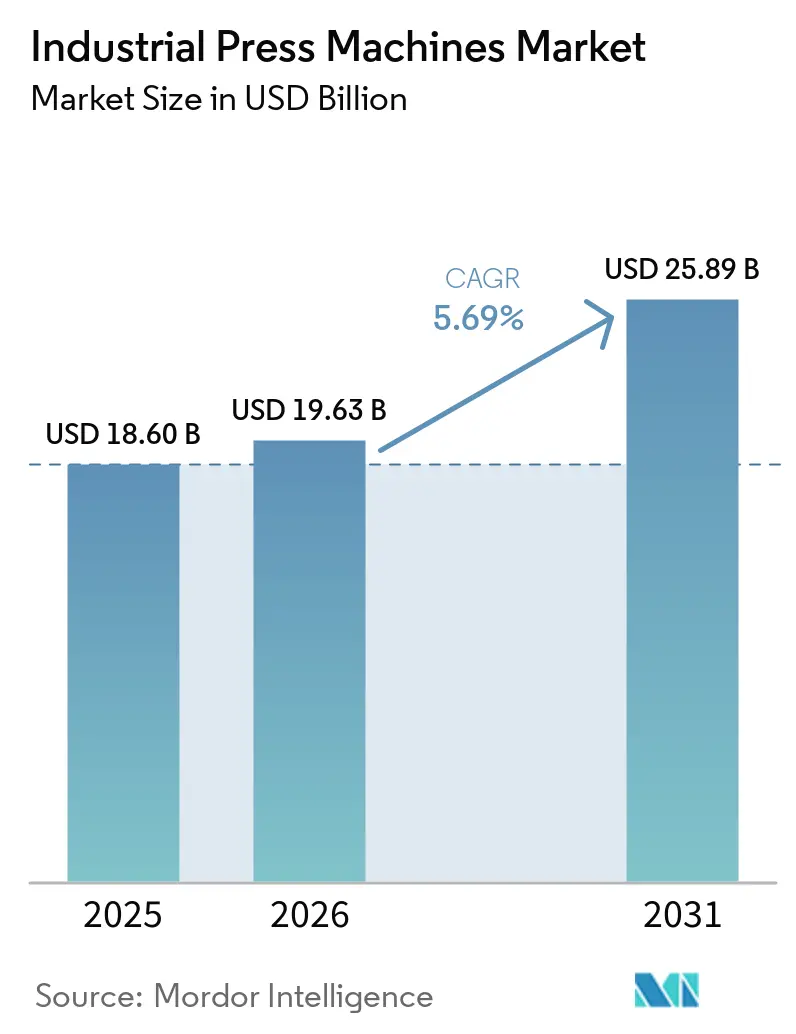
The Industrial press machines market size was valued at USD 18.60 billion in 2025, and is estimated to grow from USD 19.63 billion in 2026 to reach USD 25.89 billion by 2031, at a CAGR of 5.69% during the forecast period (2026-2031).
The Industrial press machines market is supported by electric vehicle production, factory automation, and demand for lighter, precisely formed components. Automotive retooling is changing equipment specifications because battery enclosures, motor housings, and multi-material parts require more controlled forming processes. Manufacturers are also using services, controls upgrades, and monitoring systems to reduce reliance on new machine orders. Nearshoring and local-content policies are encouraging press investment outside China, while China remains central to electric car production. The Industrial press machines market, therefore, has opportunities in advanced systems, retrofit programs, and integrated press lines, although large capital requirements and long replacement cycles continue to limit purchasing by smaller manufacturers.[1]International Energy Agency, “Manufacturing and Trade,” Global EV Outlook 2026, published 2026, iea.org
Key Report Takeaways
- By drive technology, conventional mechanical presses held 34% of the Industrial press machines market share in 2025, while servo-mechanical presses are projected to grow at a 9.5% CAGR through 2031.
- By press capacity, the 101–500-ton category accounted for 34% of the Industrial press machines market size in 2025, while presses above 2,000 tons are forecast to expand at a 6.8% CAGR through 2031.
- By application, stamping, blanking, and punching accounted for 30% of the Industrial press machines market share in 2025, while assembly, press-fitting, and joining are expected to record a 7.2% CAGR through 2031.
- By end-use industry, automotive and transportation held 38% of the Industrial press machines market size in 2025, while medical and precision manufacturing are forecast to grow at an 8.0% CAGR through 2031.
- By geography, Asia-Pacific held 46% of global revenue in 2025 and is projected to record the highest regional CAGR at 6.4% through 2031.
Note: Market size and forecast figures in this report are generated using Mordor Intelligence’s proprietary estimation framework, updated with the latest available data and insights as of January 2026.
Global Industrial Press Machines Market Trends and Insights
Drivers Impact Analysis*
| Driver | (~) % Impact on CAGR Forecast | Geographic Relevance | Impact Timeline |
|---|---|---|---|
| Automotive Electrification and Lightweight Components | +2.0% | Global, with core impact in China, Germany, the United States, India, and South Korea | Medium term (2-4 years) |
| Automated Stamping and Forming Lines | +1.5% | Global, with advanced adoption in the United States, Japan, Germany, and South Korea | Medium term (2-4 years) |
| Aging Press Base Modernization | +1.0% | North America and Europe, with selective gains in Asia-Pacific and South America | Long term (≥ 4 years) |
| Electronics, Electrical, and Precision Components | +0.8% | China, Japan, South Korea, Vietnam, India, and the Middle East and Africa | Short term (≤ 2 years) |
| Manufacturing Capacity in Emerging Markets | +0.6% | India, ASEAN, Mexico, Brazil, and Turkey | Medium term (2-4 years) |
| Energy-Efficient Servo and Advanced Presses | +0.5% | Global, with faster adoption in Europe and East Asia | Short term (≤ 2 years) |
| Source: Mordor Intelligence | |||
Automotive Electrification and Lightweight Component Manufacturing
Electric vehicle production is creating a retooling cycle for the Industrial press machines market. Global electric car production reached 17.3 million units in 2024, and China produced 12.4 million units, or more than 70% of global output. Battery electric vehicles need 15–20 stamped parts for battery integration, compared with 8–12 components in conventional vehicles. Aluminum, advanced high-strength steel, and multi-material assemblies also require programmed ram motion that mechanical presses cannot consistently provide. This requirement moves procurement toward servo equipment and specialized transfer systems. Meleghy Automotive commissioned a 2,000-ton twin servo transfer press in January 2025 for EV platform components, including the Volkswagen ID.3, after investing EUR 10 million (USD 11.76 million).
Growth in Automated Stamping and Forming Lines
Automated handling, die monitoring, and controls upgrades are improving the economics of existing press shops. The Industrial press machines market benefits when automation investments lead operators to reconsider older, less flexible production lines. ANDRITZ Schuler installed Metris Smart Monitoring on a 1,600-ton transfer press at Metalúrgica Nakayone in Brazil during 2025. The system provides continuous data on press force, vibration, and temperature, making real-time die protection more practical for automotive stamping. Flexible lines also support shorter model cycles because they can accommodate faster die changes and a wider mix of parts. These operating needs favor tandem and transfer configurations that protect throughput during model transitions.
Replacement and Modernization of Aging Press Installed Base
Older equipment in North America and Europe creates an ongoing replacement and modernization opportunity for the Industrial press machines market. Operators may choose a control and servo-hydraulic retrofit when the press structure remains suitable for current production. Japan’s press system orders reached JPY 130.9 billion (USD 838.0 million) in the latest fiscal-year survey, with small, ultra-large, and hydraulic press peripheral categories reporting gains.[2]Japan Forging and Press Machinery Association, “Fiscal Year Order Survey Results,” J-FMA, published April 2026, j-fma.or.jp The pattern indicates that modernization remains relevant even in a mature manufacturing base. Rebuilds, safety upgrades, and controls programs can extend an OEM relationship well beyond the initial machine sale. As a result, service and aftermarket revenue can provide stability when full press orders fluctuate.
Electronics, Electrical, and Precision-Component Manufacturing
Semiconductors, power electronics, 5G devices, and EV power modules require accurate, small-tonnage forming equipment. This demand expands the Industrial press machines market beyond automotive body-panel applications. TOWA plans to launch its INNOMS compression molding equipment commercially in August 2026. The company stated that the system targets a 50% reduction in mass-production cost per semiconductor package, with power consumption reduced by 50% and consumable material use reduced by 25%. These requirements support demand for press equipment with reliable positioning, clean manufacturing compatibility, and documented process control. Medical component manufacturers are also placing greater importance on traceable force and displacement records as quality requirements increase.
Restraints Impact Analysis*
| Restraint | (~) % Impact on CAGR Forecast | Geographic Relevance | Impact Timeline |
|---|---|---|---|
| High Capital and Installation Costs | -0.9% | Global, most acute for small and medium-sized enterprises in India, ASEAN, and South America | Long term (≥ 4 years) |
| Long Equipment Replacement Cycles | -0.5% | North America and Europe | Long term (≥ 4 years) |
| High Tooling and Die Costs | -0.3% | Global, especially during model changeovers | Medium term (2-4 years) |
| Tool-and-Die and Controls Workforce Shortages | -0.2% | North America and Europe, with emerging constraints in India and ASEAN | Short term (≤ 2 years) |
| Source: Mordor Intelligence | |||
High Capital and Installation Costs
Presses above 500 tons require substantial spending on equipment, foundations, electrical infrastructure, and commissioning. These costs limit access to the Industrial press machines market for smaller operators, particularly in emerging economies. Nearly 40% of industrial facilities surveyed by the IEA identified energy-efficiency improvements rather than equipment replacement as their first response to higher energy costs.[3]International Energy Agency, “Unlocking the Potential of Energy Efficiency,” Gaining an Edge, published 2025, iea.org Industrial energy-intensity improvement averaged less than 0.5% annually since 2019, reflecting a wider slowdown in capital reinvestment. In many cases, operators delay full replacement and pursue efficiency measures or partial upgrades instead. The need for purpose-built foundations and extended commissioning raises total ownership cost beyond the machine purchase price.
Skilled Tool-and-Die and Controls Workforce Shortages
A limited supply of experienced technicians can delay installation, maintenance, and production changes on advanced press systems. The United States employment of tool and die makers is projected to fall from 55,200 in 2024 to 49,300 by 2034, while the occupation is expected to generate 34,200 replacement openings over the period.[4]U.S. Bureau of Labor Statistics, “Machinists and Tool and Die Makers,” Occupational Outlook Handbook, published 2025, bls.gov The Industrial press machines market needs workers who understand die work, CNC programming, controls, and predictive maintenance. Machinery manufacturing employed 12,880 tool and die makers in 2025, indicating a limited pool for a specialized industrial base. Workforce constraints can prolong service response times and increase the cost of operating connected press lines. Equipment suppliers are therefore likely to place more importance on training, remote diagnostics, and easier control interfaces.
*Our forecasts treat driver/restraint impacts as directional, not additive. The impact forecasts reflect baseline growth, mix effects, and variable interactions.
Segment Analysis
By Drive / Actuation Technology: Servo Systems Gain Importance in New Investment
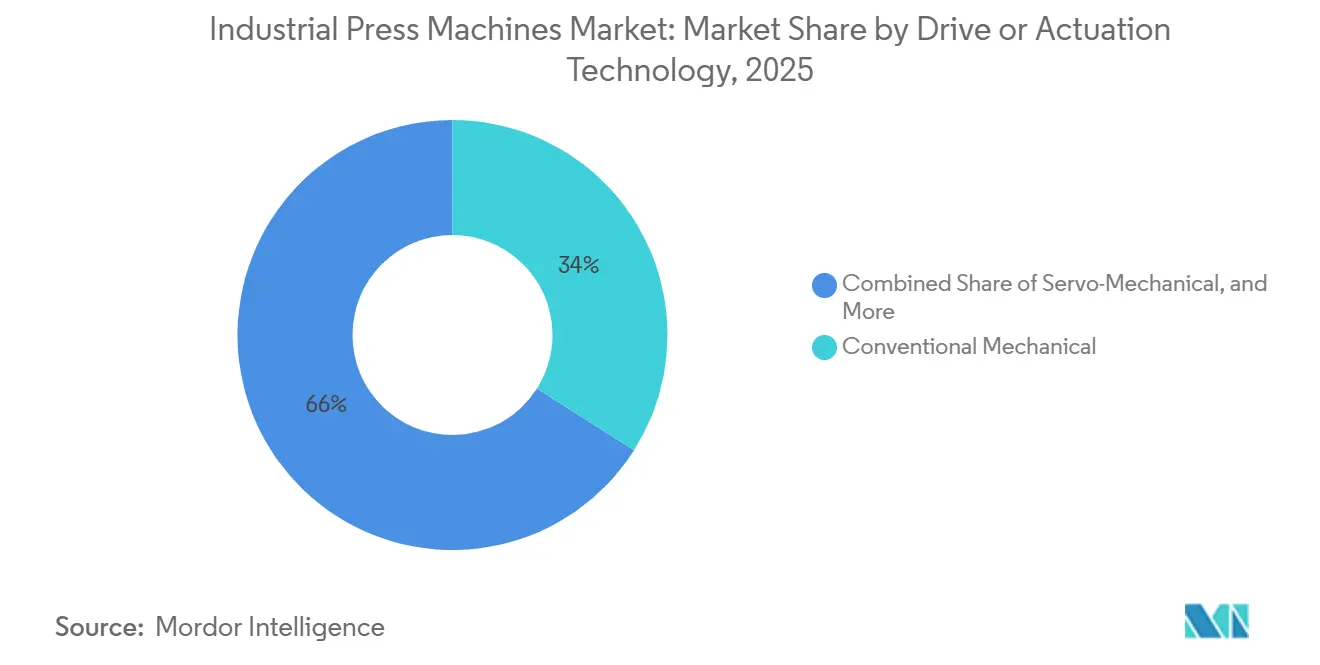
Conventional mechanical presses held 34% of the Industrial press machines market share in 2025. Their position reflects a large installed base in automotive body-panel stamping and general fabrication, where flywheel-driven machines provide established throughput. Hydraulic presses remain important for deep drawing, forging, and composite forming because they allow controlled force through the stroke. Pneumatic presses serve lower-tonnage, high-cycle assembly work, while hybrid systems address specialized geometries requiring combined operating characteristics.
Servo-mechanical presses are projected to grow at a 9.5% CAGR through 2031. Their programmable RAM motion is suited to aluminum stamping, high-strength steel, and battery enclosure production. ANDRITZ Schuler introduced the HFA plus+ fineblanking series in January 2026 with servo-controlled hydraulic pump drives and speeds of up to 85 strokes per minute. The company stated that the drives improve energy efficiency by a double-digit percentage. The IEA identifies variable-speed drives as a key tool for industrial motor-system efficiency, strengthening the case for servo systems where energy performance and process flexibility both matter. This combination is changing the technology mix within the industrial press machines industry.



By Press Force / Capacity: Large Presses Support New Forming Programs
The 101–500-ton category accounted for 34% of the Industrial press machines market size in 2025. Automotive body panels, appliance structures, and electrical enclosures support demand in this range. Presses up to 100 tons remain relevant for electronics, medical devices, and precise components. The 501–1,000-ton range serves structural automotive parts, while 1,001–2,000-ton machines support transfer and forging-preform operations. Each capacity band follows different replacement cycles and investment thresholds, giving the Industrial press machines market exposure to high-volume and specialized manufacturing.
Presses above 2,000 tons are forecast to grow at a 6.8% CAGR through 2031. Demand is linked to large structural forming, EV gigacasting programs, and heavy forging contracts in defense and energy. ANDRITZ Schuler’s 6,500-ton GLK 6500 forging press entered production at Maxiforja in Brazil in July 2025. Its kinetic energy recovery system reduces power demand by up to 40% compared with equivalent conventional forging presses. Larger presses have longer purchasing cycles, but their energy, scale, and domestic manufacturing roles can make them strategic capital projects. These factors sustain a specialized growth path for the Industrial press machines market.
By Application / Process: Assembly and Joining Are Expanding Faster
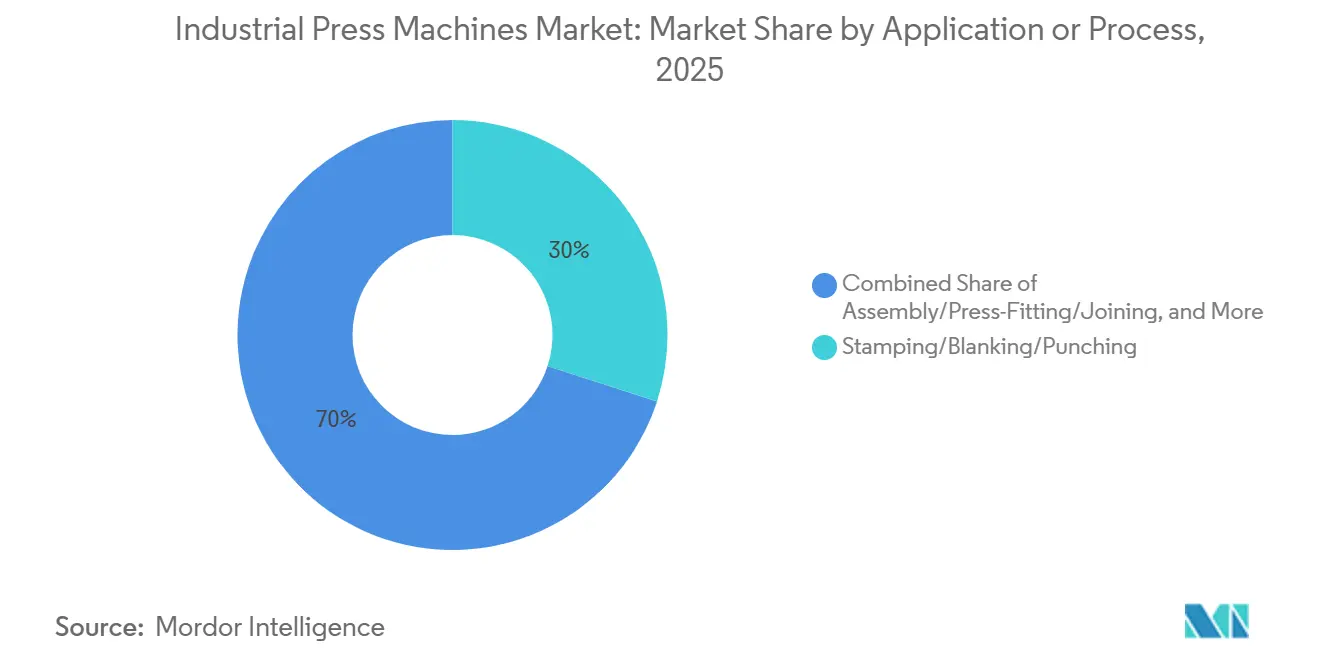
Stamping, blanking, and punching accounted for 30% of 2025 application revenue. These processes remain central to automotive body-in-white production, where progressive and transfer dies handle high part volumes. Deep drawing and sheet forming are used for battery trays and appliance housings. Forging supports crankshafts, knuckles, and structural beams. Compression molding, powder compaction, straightening, and general forming serve composites, sintered metals, and tube products. This established range of processes provides the operating base for the Industrial press machines market.
Assembly, press-fitting, and joining are projected to grow at a 7.2% CAGR through 2031. EV motor laminations, battery cell processes, power-module encapsulation, and electronics interconnects are increasing the demand for controlled joining operations. TOWA’s planned INNOMS launch in August 2026 targets lower semiconductor packaging costs and reduced energy and material use. Manufacturers in precision applications are also requiring clearer process documentation and repeatable force control. These needs raise the value of integrated forming and joining systems. They also broaden the Industrial press machines market beyond conventional metal stamping.
By End-Use Industry: Medical and Precision Manufacturing Grows Fastest
Automotive and transportation held 38% of end-use revenue in 2025. The sector remains the largest customer group because each vehicle program needs a broad set of formed parts and dedicated production equipment. Traditional body-panel demand is increasingly joined by servo and transfer lines for aluminum-intensive EV platforms. Aerospace and defense require large forging and forming systems for airframes and landing gear. Electrical and electronics, appliances, industrial machinery, and metal products support a steady demand for mid-range mechanical and hydraulic systems across a broad customer base.
Medical and precision manufacturing are forecast to grow at an 8.0% CAGR through 2031. The segment requires precisely formed implants, surgical instruments, and diagnostic housing. Aging populations and chronic disease prevalence support this need for tightly controlled production. Energy and power equipment also benefits from grid modernization, while construction and heavy equipment track infrastructure investment in India, ASEAN, and the Middle East. Medical production standards are increasing the need for validated and audit-ready process records. This requirement supports equipment upgrades and specialized service demand across the Industrial press machines market.
Geography Analysis
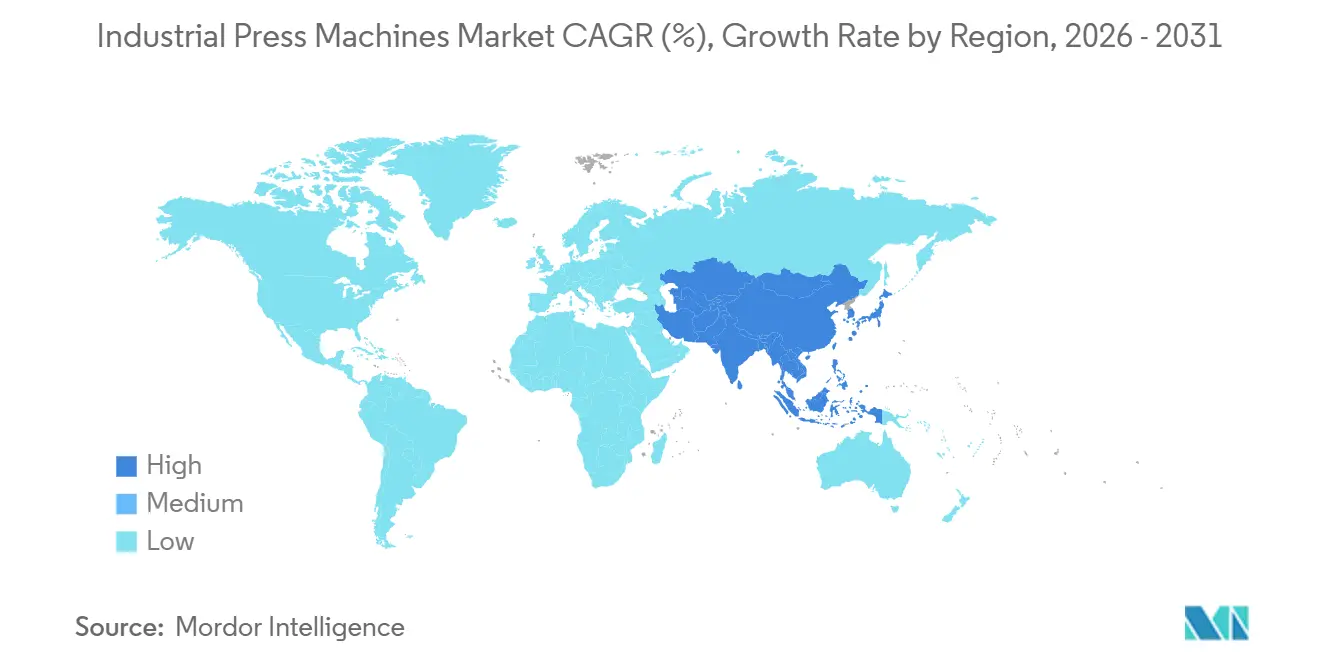
Asia-Pacific held 46% of the Industrial press machines market share in 2025 and is projected to grow at a 6.4% CAGR through 2031. China accounted for around 70% of global electric car production in 2025, which supports demand for battery enclosures, motor housings, and busbar stamping lines. AIDA Engineering reported 11.4% growth in total orders in its fiscal year ended March 2026, supported by service revenue and the consolidation of Dallas Industries despite softer EV investment and United States tariff uncertainty. India is expanding its stamping base, with Gestamp operating 14 stamping lines across 5 plants, including 5 hot-stamping lines and 2 more under installation. South Korea’s display, semiconductor, and EV battery production sustains demand for high-speed systems, while Thailand, Vietnam, and Indonesia continue to absorb relocated automotive and electronics manufacturing.
Europe and North America are the largest regional markets outside the Asia-Pacific. Germany, Italy, and France support European demand through automotive stamping and precision engineering. The EU Machinery Regulation 2023/1230 will replace the Machinery Directive from January 2027, encouraging upgrades to guarding, safety controls, and equipment documentation. Meleghy Automotive’s January 2025 installation of a 2,000-ton twin servo transfer press illustrates EV-related spending by European suppliers. North America combines replacement demand from its aging mechanical press fleet with new investment in EV, HVAC, electronics, and electrical component production. This mix supports retrofit work, service activity, and new press-line installations with different technical specifications.
South America, the Middle East and Africa, and the rest of Asia-Pacific are smaller but growing geographic groups. Brazil remains important because of its automotive supplier base, and Metalúrgica Nakayone ordered a fourth 1,600-ton ANDRITZ Schuler transfer press in 2025 for structural SUV components. In India, STAUFF India opened a hydraulic components facility in Belagavi in September 2026, adding local supply capability. Turkey is developing as a regional automotive stamping and press manufacturing center, while Saudi Arabia’s manufacturing diversification is beginning to attract EV-related component investment.

Competitive Landscape
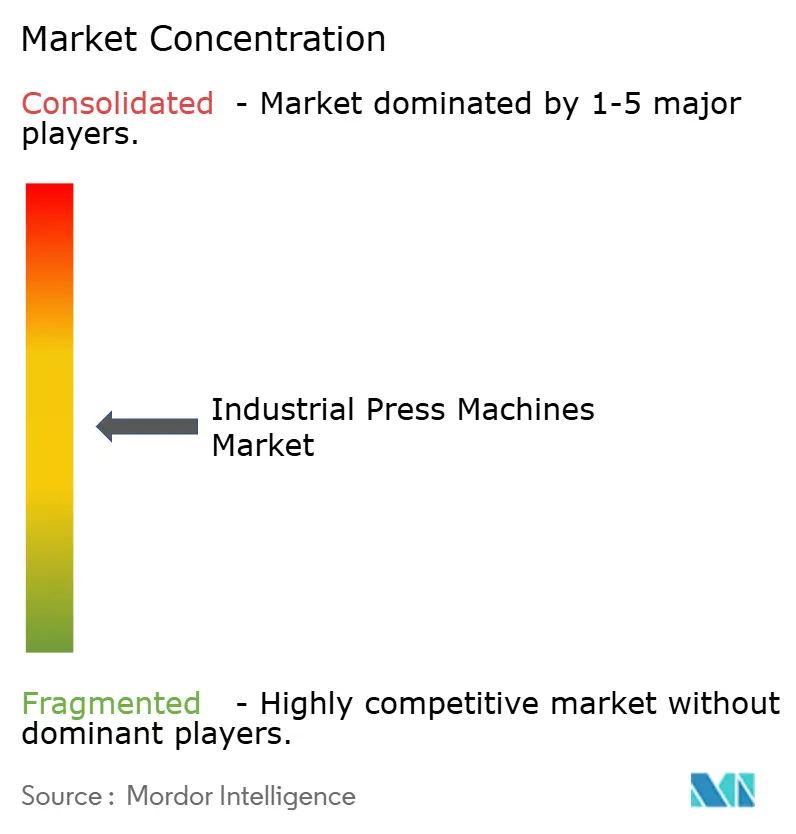
The Industrial press machines market is moderately consolidated in high-tonnage and specialized systems. Long engineering cycles, digital monitoring systems, and global service networks make entry difficult in this part of the business. The mid-tonnage mechanical segment is more fragmented, with Chinese suppliers competing strongly on price while adding servo capability and connected controls. This creates pressure on established Japanese and European suppliers, particularly in standard equipment. Established companies are responding through line integration, lifecycle support, specialized application knowledge, and proprietary monitoring platforms.
ANDRITZ formally renamed Schuler as ANDRITZ Schuler in March 2025, completing brand integration while retaining Schuler as a product sub-brand. The company pairs forming equipment with handling, digitalization, and service capabilities. Its Metris visual die protection system was used at Alzner Automotive across 3 servo presses to identify post-stroke anomalies and stop the machines. AIDA acquired Dallas Industries to expand its North American automation and aftermarket presence. The acquisition helped support total order growth despite weaker new press demand. Opportunity remains in modular systems for smaller manufacturers in ASEAN, India, and South America. Retrofit and controls upgrades are relevant for aging mechanical fleets in North America and Europe. Turnkey lines for medical and precision manufacturing offer another area for differentiation because process validation needs are high.
Industrial Press Machines Industry Leaders
ANDRITZ Schuler Group
AIDA Engineering, Ltd.
Komatsu Industries Corp.
AMADA PRESS SYSTEM CO., LTD.
Nidec Press & Automation
- *Disclaimer: Major Players sorted in no particular order

Recent Industry Developments
- September 2026: STAUFF India opened a new production facility at the AEQUS Special Economic Zone in Belagavi, Karnataka, expanding local hydraulic component supply capacity. The investment adds production infrastructure to India’s developing press machine component ecosystem
- January 2026: ANDRITZ Schuler launched the HFA plus+ fineblanking press series with servo-controlled hydraulic pump drives delivering double-digit energy efficiency gains, press forces from 3,200 to 15,500 kN, and up to 85 strokes per minute. ANDRITZ Schuler now supplies the presses directly as general contractor, while Feintool provides tooling expertise, expanding the company’s precision fineblanking offering for automotive and industrial customers.
- October 2025: AIDA Engineering signed an agreement to acquire Dallas Industries, a United States press automation and material handling company, to expand its aftermarket and automation operations in North America. Dallas consolidation contributed to AIDA’s 11.4% year-on-year total order growth in its fiscal year ended March 2026, despite new press order weakness.
- May 2025: ANDRITZ Schuler highlighted its Metris Visual Die Protection system at Alzner Automotive, where camera-based monitoring across 3 servo presses had reduced die damage incidents by automatically detecting post-stroke anomalies and stopping the machines. The application shows how digital monitoring can be packaged with press equipment and service support rather than treated as a separate controls purchase


Global Industrial Press Machines Market Report Scope
| Conventional Mechanical Presses |
| Servo-Mechanical Presses |
| Hydraulic Presses |
| Pneumatic Presses |
| Other and Hybrid Presses |
| Up to 100 Tons |
| 101–500 Tons |
| 501–1,000 Tons |
| 1,001–2,000 Tons |
| Above 2,000 Tons |
| Stamping, Blanking and Punching |
| Deep Drawing and Sheet Forming |
| Forging |
| Straightening and General Forming |
| Compression Molding |
| Powder Compaction |
| Assembly, Press-Fitting and Joining |
| Other Press Applications |
| Automotive and Transportation |
| Aerospace and Defense |
| Industrial Machinery and Equipment |
| Electrical and Electronics |
| Appliances and Consumer Durables |
| Construction and Heavy Equipment |
| Energy and Power Equipment |
| Metal Products and General Manufacturing |
| Medical and Precision Manufacturing |
| Other End-Use Industries |
| North America | United States |
| Canada | |
| Mexico | |
| South America | Brazil |
| Argentina | |
| Rest of South America | |
| Europe | Germany |
| Italy | |
| France | |
| United Kingdom | |
| Spain | |
| Russia | |
| Rest of Europe | |
| Asia-Pacific | China |
| Japan | |
| India | |
| South Korea | |
| ASEAN(Singapore, Malaysia, Indonesia, Thailand, Vietnam, Philippines, Myanmar, Cambodia, Laos, Brunei) | |
| Australia | |
| Rest of Asia-Pacific | |
| Middle East and Africa | Saudi Arabia |
| United Arab Emirates | |
| Turkey | |
| South Africa | |
| Egypt | |
| Rest of Middle East and Africa |
| By Drive / Actuation Technology | Conventional Mechanical Presses | |
| Servo-Mechanical Presses | ||
| Hydraulic Presses | ||
| Pneumatic Presses | ||
| Other and Hybrid Presses | ||
| By Press Force / Capacity | Up to 100 Tons | |
| 101–500 Tons | ||
| 501–1,000 Tons | ||
| 1,001–2,000 Tons | ||
| Above 2,000 Tons | ||
| By Application / Process | Stamping, Blanking and Punching | |
| Deep Drawing and Sheet Forming | ||
| Forging | ||
| Straightening and General Forming | ||
| Compression Molding | ||
| Powder Compaction | ||
| Assembly, Press-Fitting and Joining | ||
| Other Press Applications | ||
| By End-Use Industry | Automotive and Transportation | |
| Aerospace and Defense | ||
| Industrial Machinery and Equipment | ||
| Electrical and Electronics | ||
| Appliances and Consumer Durables | ||
| Construction and Heavy Equipment | ||
| Energy and Power Equipment | ||
| Metal Products and General Manufacturing | ||
| Medical and Precision Manufacturing | ||
| Other End-Use Industries | ||
| By Geography | North America | United States |
| Canada | ||
| Mexico | ||
| South America | Brazil | |
| Argentina | ||
| Rest of South America | ||
| Europe | Germany | |
| Italy | ||
| France | ||
| United Kingdom | ||
| Spain | ||
| Russia | ||
| Rest of Europe | ||
| Asia-Pacific | China | |
| Japan | ||
| India | ||
| South Korea | ||
| ASEAN(Singapore, Malaysia, Indonesia, Thailand, Vietnam, Philippines, Myanmar, Cambodia, Laos, Brunei) | ||
| Australia | ||
| Rest of Asia-Pacific | ||
| Middle East and Africa | Saudi Arabia | |
| United Arab Emirates | ||
| Turkey | ||
| South Africa | ||
| Egypt | ||
| Rest of Middle East and Africa | ||


Key Questions Answered in the Report
What is the projected value of industrial press machines by 2031?
The Industrial press machines market is forecast to reach USD 25.89 billion by 2031, compared with USD 19.63 billion in 2026. The forecast implies a 5.69% CAGR for 2026–2031 and reflects demand for equipment, modernization, and connected production lines.
Which drive technology is growing fastest?
Servo-mechanical presses are forecast to grow at a 9.5% CAGR through 2031. Their programmed ram motion supports aluminum, advanced high-strength steel, battery enclosures, and other applications that need flexible forming conditions.
Which press capacity category is expanding fastest?
Presses above 2,000 tons are forecast to expand at a 6.8% CAGR through 2031. Demand is connected to large structural forming, EV-related programs, and heavy forging contracts in defense and energy applications.
Which application is growing fastest for industrial presses?
Assembly, press-fitting, and joining are expected to grow at a 7.2% CAGR through 2031. EV powertrain integration, battery cell processes, power modules, and precision electronics all require controlled joining steps.
Which end-use sector will grow fastest through 2031?
Medical and precision manufacturing is projected to grow at an 8.0% CAGR through 2031. Manufacturers require precisely formed implants, surgical instruments, and diagnostic housings, with traceable production records becoming more important.
Which region leads global demand?
Asia-Pacific held 46% of 2025 revenue and is expected to grow at a 6.4% CAGR through 2031. China’s central role in electric car production, combined with manufacturing expansion across India and ASEAN, supports the regional position.
Page last updated on:


 Your data is secure and never sold or shared.


