
India Industrial Press Machines Market Size and Share
Market Overview
| Study Period | 2020 - 2031 |
|---|---|
| Forecast Data Period | 2026 - 2031 |
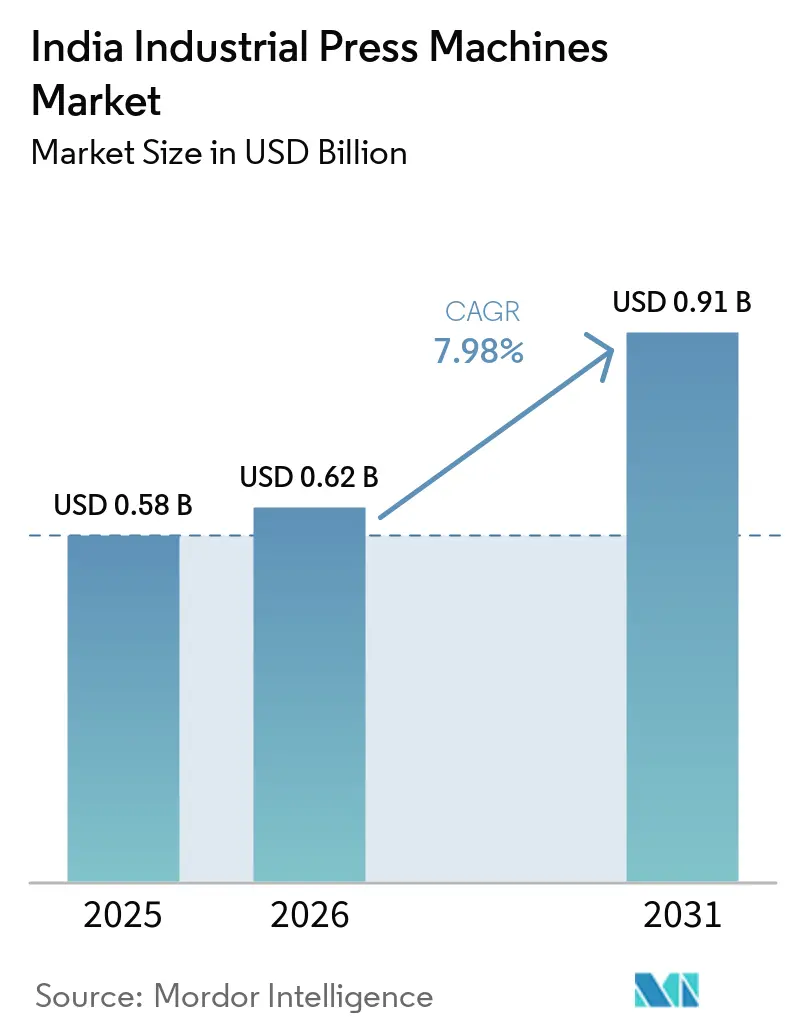
| Base Year Market Size (2025) | USD 0.58 Billion |
| Market Size (2026) | USD 0.62 Billion |
| Market Size (2031) | USD 0.91 Billion |
| Growth Rate (2026 - 2031) | 7.98 % |
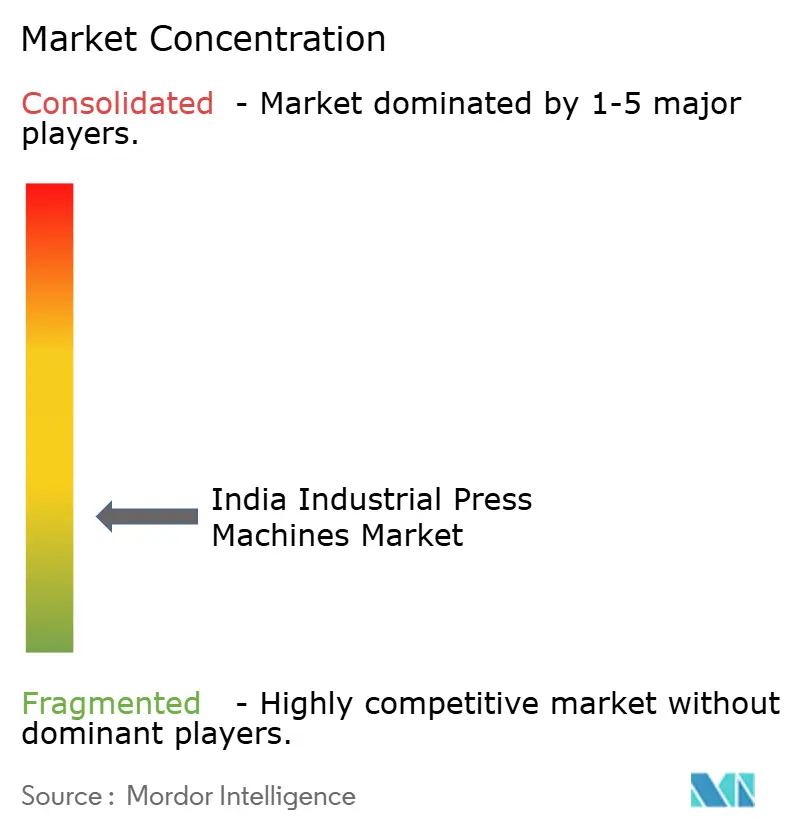
| Market Concentration | Low |
Major Players *Disclaimer: Major Players sorted in no particular order Image © Mordor Intelligence. Reuse requires attribution under CC BY 4.0. | |
India Industrial Press Machines Market Analysis by Mordor Intelligence
The India industrial press machines market size was valued at USD 0.58 billion in 2025, and is estimated to grow from USD 0.62 billion in 2026 to reach USD 0.91 billion by 2031, at a CAGR of 7.98% during the forecast period (2026-2031).
The India industrial press machines market is supported by industrial capital spending across automotive, electronics, defense, and heavy engineering. Production Linked Incentive programs had attracted investments above INR 2,160 billion (USD 24.0 billion) and generated production and sales above INR 20,410 billion (USD 227.2 billion) across 14 sectors by December 2025.[1]Press Information Bureau, “PLI Schemes: Investments, Production and Employment Status as of December 2025,” March 2026, pib.gov.in Automotive localization remains a central source of equipment demand, while electronics component production is increasing the need for more precise forming and joining operations. The India industrial press machines market also faces limits from imported control components, high equipment costs, and the shortage of specialists able to commission and qualify advanced lines. These conditions favor suppliers that can combine local service, application support, and dependable access to advanced technology.
Key Report Takeaways
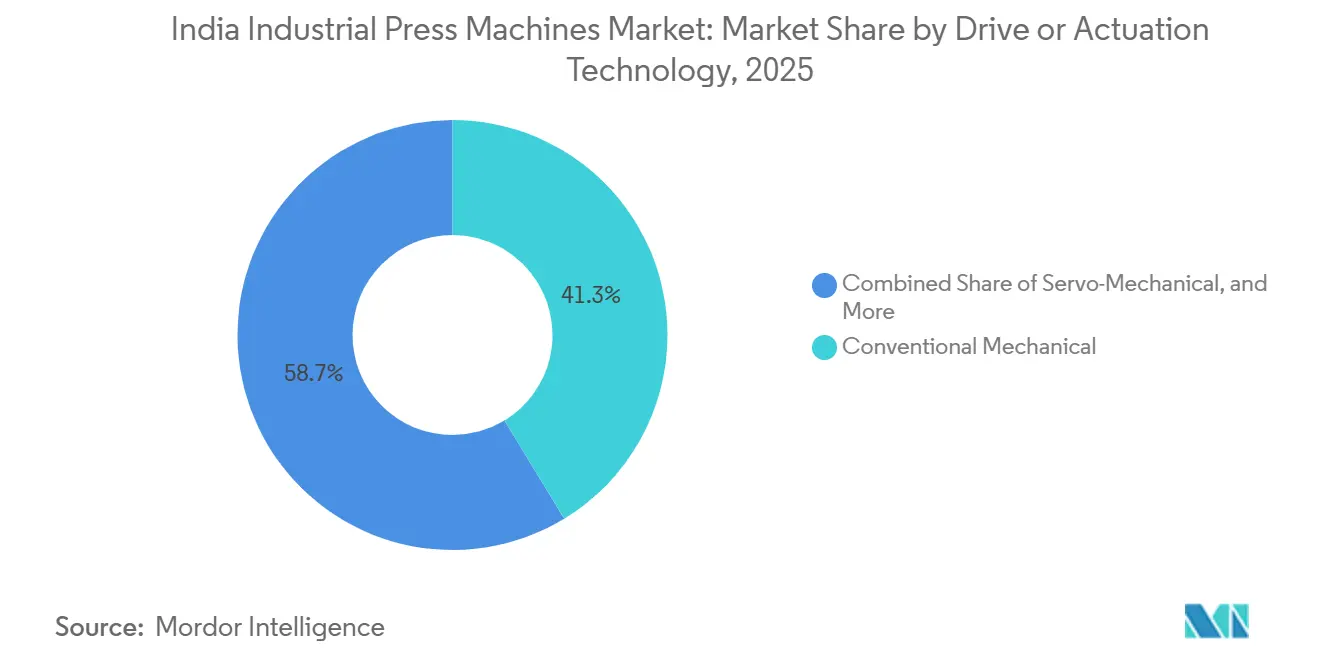
- By drive and actuation technology, conventional mechanical presses held 41.3% of the India industrial press machines market share in 2025, while servo-mechanical presses are forecast to expand at a 9.2% CAGR through 2031.
- By press force and capacity, the 101 to 500 ton range accounted for 37.2% of the India industrial press machines market size in 2025, while systems above 2,000 tons are forecast to grow at an 8.9% CAGR through 2031.
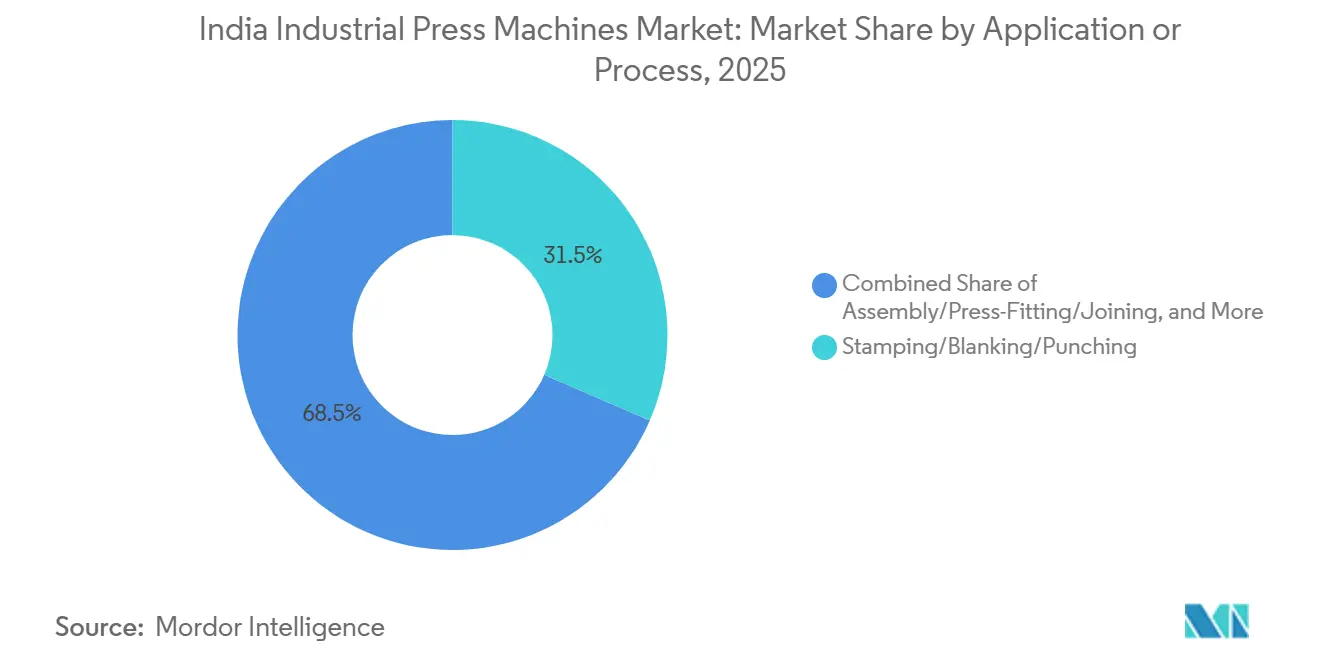
- By application and process, stamping, blanking, and punching held 31.5% of the India industrial press machines market share in 2025, while assembly, press-fitting, and joining are forecast to advance at an 8.9% CAGR through 2031.
- By end-use industry, automotive and transportation held 42% of demand in 2025, while medical and precision manufacturing are forecast to grow at a 9.5% CAGR through 2031.
Note: Market size and forecast figures in this report are generated using Mordor Intelligence’s proprietary estimation framework, updated with the latest available data and insights as of January 2026.
India Industrial Press Machines Market Trends and Insights
Drivers Impact Analysis*
| Driver | (~) % Impact on CAGR Forecast | Geographic Relevance | Impact Timeline |
|---|---|---|---|
| Automotive, EV, and Auto-Component Capacity Expansion | +2.1% | Maharashtra, Tamil Nadu, Haryana, Gujarat | Short term (≤ 2 years) |
| Electronics, Electrical Equipment, and Precision Component Manufacturing | +1.6% | Tamil Nadu, Karnataka, Maharashtra, and Andhra Pradesh | Medium term (2-4 years) |
| Adoption of Servo, CNC, and Automated Pressing Systems | +1.2% | National, with early gains in Pune, Chennai, Gurugram | Medium term (2-4 years) |
| Defense, Aerospace, and Heavy-Engineering Localization | +0.9% | Uttar Pradesh, Karnataka, Odisha | Long term (≥ 4 years) |
| Replacement, Retrofit, and Energy-Efficiency Demand | +0.7% | National, concentrated in Faridabad, Rajkot, and Coimbatore | Short term (≤ 2 years) |
| Export-Oriented Metal-Forming Capacity Development | +0.5% | Tamil Nadu, Maharashtra, and Gujarat export processing zones | Medium term (2-4 years) |
| Source: Mordor Intelligence | |||
Automotive, EV, and Auto-Component Capacity Expansion
The Production Linked Incentive scheme for automobiles and auto components had an INR 259.4 billion (USD 2.9 billion) outlay and had attracted INR 295.8 billion (USD 3.3 billion) in cumulative investment by March 2025, creating 44,987 jobs. Its 13% to 18% incentive tier for EV and hydrogen fuel cell components supports investment in advanced forming equipment, including servo-controlled systems suited to advanced high-strength steel structures. The PM E-DRIVE scheme has an INR 109 billion (USD 1.2 billion) budget through March 2028 and requires domestic production of specified EV components. Maharashtra, Tamil Nadu, and Haryana accounted for 139 of 225 approved PLI-Auto manufacturing units in July 2026, concentrating installation, tooling, and maintenance demand in established corridors. Mahindra and Mahindra plans to raise SUV and EV capacity to 82,000 units a month by March 2027 at Chakan and a new Nagpur facility. The India industrial press machines market benefits from new lines and from replacement purchases needed for changing part designs and tighter process requirements.
Electronics, Electrical Equipment, and Precision Component Manufacturing
The Electronics Component Manufacturing Scheme was approved in April 2025 with an INR 229.2 billion (USD 2.6 billion) outlay and covers components such as multilayer PCBs, SMD passives, lithium-ion cells, and connectors. The program is expected to attract investment above INR 590 billion (USD 6.6 billion) and support INR 4,560 billion (USD 50.8 billion) in production over 6 years. These products use precision blanking, stamping, and press-fitting processes, creating demand for equipment that can work at sub-0.1 mm tolerances. PLI electronics schemes had disbursed INR 155.5 billion (USD 1.7 billion) by December 2025, indicating that capital deployment was underway. Servo-electric and servo-hydraulic equipment can provide the repeatable force, speed, and position control needed for these operations. The India industrial press machines market can benefit when suppliers pair advanced equipment with local commissioning and service support.
Adoption of Servo, CNC, and Automated Pressing Systems
Buyers are placing greater emphasis on complete production cells that offer higher uptime, controlled forming, lower energy use, and less manual handling. These requirements are strongest in EV and electronics plants, where consistency and cycle time shape production economics. The India industrial press machines market is therefore moving toward systems with servo drives, CNC control, monitoring, and automated transfer functions. Suppliers must show how the press, tooling, controls, and material handling will work together in production. ANDRITZ Schuler launched its HFA plus+ fineblanking presses in January 2026 with servo-controlled hydraulic pump drives, higher stroke rates, and improved energy efficiency. These systems can combine steps such as embossing, coining, and in-die assembly into a single forming stroke, strengthening the case for equipment that improves both precision and process efficiency.
Defense, Aerospace, and Heavy-Engineering Localization
Defense and aerospace programs require high-force press systems with controlled heating, traceable processes, application-specific tooling, and qualified quality management. The supplied assessment identifies demand for ultra-high-tonnage capacity in defense-grade aerospace materials, which requires press suppliers to integrate mechanical equipment with process controls and documentation. Isothermal heating, closed-loop force control, and specialized tooling increase installation difficulty and extend the period from project selection to production. These requirements make defense procurement more complex than a standard stand-alone machine purchase. ISGEC Heavy Engineering approved an INR 2.2 billion (USD 24.3 million) Machine Building expansion in February 2026 for automobile presses, forging presses, defense presses, and nuclear-sector equipment. The India industrial press machines market benefits from these higher-value projects, although qualification and delivery cycles remain long.
Restraints Impact Analysis*
| Restraint | (~) % Impact on CAGR Forecast | Geographic Relevance | Impact Timeline |
|---|---|---|---|
| High Capital Cost and Limited SME Financing | -1.5% | National, most acute in Tier-2 and Tier-3 MSME manufacturing clusters | Short term (≤ 2 years) |
| Dependence on Imported Controls, Drives, and Precision Components | -1.0% | National, with concentrated exposure in the servo and CNC press segments | Medium term (2-4 years) |
| Shortage of Tool-and-Die, Controls, and Commissioning Specialists | -0.8% | National, with early gains in Pune, Chennai, and Faridabad hubs | Medium term (2-4 years) |
| Long Qualification Cycles for High-Precision and Safety-Critical Applications | -0.4% | Defense in Odisha, Uttar Pradesh, and Karnataka, aerospace in Bengaluru and Nashik | Long term (≥ 4 years) |
| Source: Mordor Intelligence | |||
High Capital Cost and Limited SME Financing
Auto OEMs and Tier-1 suppliers usually have defined capital budgets and banking relationships, while smaller stamping and fabrication businesses face more limited financing capacity. The Mutual Credit Guarantee Scheme for MSMEs offers 60% guarantee coverage for credit facilities up to INR 1 billion (USD 11.1 million) for machinery purchases, and its 2026 modification lowered the machinery-cost threshold from 75% to 60% of the project cost.[2]Press Information Bureau, “Union Budget 2025-26: MSME Credit Guarantee and National Manufacturing Mission,” February 2025, pib.gov.in Budget 2025-26 also raised credit-guarantee cover for micro and small enterprises from INR 50 million (USD 0.6 million) to INR 100 million (USD 1.1 million). A mid-range automated servo-mechanical line typically costs INR 20 million to INR 100 million (USD 0.2 million to USD 1.1 million). Technical appraisal and collateral needs can still restrict project finance for smaller buyers. The India industrial press machines market remains exposed because many such firms keep legacy conventional presses in service beyond their intended maintenance life.
Dependence on Imported Controls, Drives, and Precision Components
India remains a net importer of capital goods across manufacturing subsectors, and CNC controllers, servo amplifiers, precision ball screws, and linear guides are central to press accuracy, reliability, and cycle time.[3]Department of Heavy Industry, “Capital Goods Policy: India as Net Importer of Capital Goods Across Subsectors,” publication date not stated in supplied material, icpma.org.in The supplied assessment identifies Germany, Japan, and Taiwan as major sources for these components, creating foreign-currency exposure and longer equipment lead times. This reliance is greatest in servo and CNC systems because the imported elements determine core performance. NITI Aayog reported that India remained heavily import-dependent for components, including semiconductors, integrated circuits, and batteries, in Q2 FY2025-26, with integrated circuits accounting for 23.7% of electronics imports.[4]NITI Aayog, “Quarterly Trade Watch: July to September, Q2 FY 2025-26,” February 2026, niti.gov.in Domestic builders consequently face a higher cost base in advanced equipment and must manage local service and inventory carefully. The India industrial press machines market will remain constrained until domestic supply pathways for advanced control and drive components become more established.
*Our forecasts treat driver/restraint impacts as directional, not additive. The impact forecasts reflect baseline growth, mix effects, and variable interactions.
Segment Analysis
By Drive / Actuation Technology: Servo Transition Alters the Value Stack
Conventional mechanical presses held 41.3% of the India industrial press machines market size in 2025. Their position reflects the depth of the installed base in mid-tonnage automotive stamping. Replacement demand is important in this category because buyers often retain equipment until maintenance requirements rise or a new part calls for tighter tolerances. The fixed-crank design remains suited to many established stamping tasks. Hydraulic presses form the second major technology group and are used where full tonnage is needed at different points in the stroke. Defense forging, heavy-engineering forming, and deep drawing are important use cases for hydraulic systems. Pneumatic presses and hybrid systems serve light assembly and specialty forming applications. Their demand is linked to electronics and medical-device manufacturing, where force requirements may be lower but repeatability remains important.
Servo-mechanical presses are forecast to grow at a 9.2% CAGR through 2031. EV motor lamination stacking is a major application because it requires programmable bottom-dead-center control that fixed-crank equipment cannot provide. ANDRITZ Schuler's January 2026 HFA plus+ launch combined servo-controlled hydraulic pump drives with higher stroke rates and better energy efficiency. The product example illustrates the capabilities that automotive and electronics customers can include in equipment specifications. The business case for servo systems is increasingly based on energy savings and fewer process steps, not precision alone. Embossing, coining, and in-die assembly can be combined in one forming stroke when the product design allows it. This reduces tooling changes and may reduce the space required for a production cell. The India industrial press machines industry consequently has an opportunity to improve its position in higher-performance equipment through stronger application support and access to servo technologies.


By Press Force / Capacity: High-Tonnage Systems Command Fastest Structural Growth
The 101 to 500 ton range held 37.2% of the India industrial press machines market share in 2025. This capacity class serves passenger-vehicle body panels, structural crossmembers, and consumer-appliance housings. It has the deepest overlap between domestic press builders and global OEM subsidiaries. Competition is therefore active on both pricing and technology. The 501 to 1,000 ton and 1,001 to 2,000 ton ranges serve heavier structures such as frame rails, EV battery enclosures, and heavy casting cores. Demand in these bands follows new vehicle platform launches and the growing use of larger EV structural parts. The up-to-100-ton category supports precision assembly, press-fitting, and small-batch forming. Electronics subassembly and medical-device production support its steady demand.
Systems above 2,000 tons are forecast to grow at an 8.9% CAGR through 2031. Their growth is linked to defense forging and aerospace structural manufacturing. The supplied assessment identifies defense-grade aerospace material programs as a source of demand for domestic ultra-high-tonnage capability. India recorded engineering exports of USD 122.43 billion in FY2025-26, and industrial machinery and iron and steel products were among the leading export panels. Export-facing manufacturers can use high-capacity lines to support offshore demand for formed products. Across capacity ranges, servo drives, process monitoring, and robotic transfer are increasing the importance of full-system capability. These additions lift the value of the installed line beyond the rated force of the press. They also make uptime and engineering support more significant parts of the buying decision. The India industrial press machines market is therefore shifting toward suppliers able to integrate mechanical capacity with automation and service.
By Application / Process: Assembly Applications Rise on EV and Electronics Tailwinds
Stamping, blanking, and punching held 31.5% of the India industrial press machines market size in 2025. This was the leading process application because automotive body shops, electrical enclosure fabricators, and consumer-durables producers need high volumes of sheet metal parts. Deep drawing and sheet forming is another major applications. It is used for fuel tanks, oil pans, EV battery casing components, and white goods housings. Demand in this process group follows EV battery-pack manufacturing as OEMs localize cell packaging and module assembly. Forging is a lower-volume but high-value application. It is tied to defense and aerospace programs that need qualified titanium and nickel-alloy components. Isothermal and near-net-shape processes gain importance as material certification needs become stricter.
Assembly, press-fitting, and joining are forecast to grow at an 8.9% CAGR through 2031. EV powertrain production supports this demand because rotor-stator press fitting and battery-module joining require controlled and repeatable force-displacement profiles. Conventional mechanical equipment cannot consistently provide the same level of control for these tasks. Straightening and general forming serve rail, construction, and heavy-fabrication buyers. Compression molding and powder compaction address composites and sintered metal components. These applications gain relevance as aerospace structural capacity develops. The Electronics Component Manufacturing Scheme also supports PCB subassemblies and connector manufacturing. It reinforces demand for precision blanking and press-fitting equipment in electronics-related processes. The India industrial press machines market benefits because the most rapidly expanding applications need accurate, force-controlled systems as well as conventional forming equipment.
By End-Use Industry: Medical and Defense Pull Market Beyond Auto
Automotive and transportation held 42% of demand in 2025. This made it the dominant end-use group in the India industrial press machines market. Its position is reinforced by EV platform investment and the domestic value addition requirements associated with PLI-Auto. These conditions encourage Tier-1 and Tier-2 suppliers to localize forming operations that had previously been supplied through imports. Industrial machinery and equipment, together with electrical and electronics, represent the next meaningful groups of end users. They reflect the widening base of domestic capital goods and electronics production. Automotive demand remains important because vehicle platforms use high volumes of stamped panels, structural parts, and powertrain components. Changes in vehicle material choices and part design also create reasons to upgrade existing forming lines.
Medical and precision manufacturing are forecast to expand at a 9.5% CAGR through 2031. Surgical instruments, orthopedic implants, diagnostic-device enclosures, and precision electronic assemblies need fine tolerances and high-quality surfaces. Servo-controlled presses are more suitable for many of these requirements than basic mechanical equipment. Aerospace and defense are other important end-use groups, although their procurement cycle is longer and their equipment value is higher. ISGEC's February 2026 investment approval identified defense presses and nuclear-sector equipment within its planned Machine Building expansion. Aerospace supply chains also require traceable process documentation and established qualification records. Construction and heavy equipment, energy and power equipment, and appliances and consumer durables add demand linked to infrastructure spending and manufacturing localization. The India industrial press machines industry must therefore meet a broader set of operating and documentation requirements than those associated with automotive customers alone.
Geography Analysis
Maharashtra, Tamil Nadu, and Haryana held the largest concentration of approved PLI-Auto manufacturing units in July 2026. Maharashtra had 66 units, Tamil Nadu had 38, and Haryana had 35. This concentration makes these states the highest-intensity locations for procurement in the India industrial press machines market. Maharashtra's Pune, Nashik, and Aurangabad cluster combines OEM assembly facilities with extensive Tier-1 and Tier-2 supply chains. This structure supports recurring replacement and upgrade demand for stamping capacity. Haryana's Gurugram, Manesar, and Bawal corridor is a dense stamping belt for passenger vehicles and two-wheelers. The region benefits from close links between vehicle production, suppliers, and technical service providers.
Tamil Nadu's Chennai and Hosur zones bring together a multi-OEM automotive base and an emerging electronics manufacturing corridor. The state, therefore, creates demand for automotive stamping equipment as well as precision forming systems. The three leading states have a large organized base of technicians for commissioning, maintenance, and process support. This reduces ownership risk for buyers and supports repeat investments by global press OEMs. Karnataka and Gujarat form the next tier of demand, although their drivers differ. Bengaluru is focused on aerospace, defense electronics, and precision manufacturing. This supports specialized equipment requirements and lifecycle services for demanding applications. Gujarat's Rajkot, Ahmedabad, Sanand, and Vadodara areas have many small and medium-sized precision and general-engineering manufacturers. Rajkot is also a center for small hydraulic and pneumatic press production, serving tool rooms and job shops.
Uttar Pradesh, Odisha, and Rajasthan are developing as demand locations through defense and heavy-engineering localization. Large-scale forging requirements connected to defense supply chains support demand in Uttar Pradesh and Odisha. Defense industrial corridors in Uttar Pradesh and Tamil Nadu support the longer-term outlook for equipment procurement in these locations. Odisha is relevant to high-force forging programs and associated engineering capabilities. Smaller demand centers also remain in Coimbatore, Ludhiana, and Hyderabad. These clusters support auto components, aerospace fasteners, and industrial machinery exports. Their buyers often place greater weight on service proximity, financing, and retrofit support. Geography in the India industrial press machines market is thus shaped by the mix of vehicle production, precision manufacturing, defense programs, and the technical resources needed to operate advanced equipment.
Competitive Landscape
The India industrial press machines market covers distinct competitive groups across capacity and technology ranges. Competition is more concentrated in ultra-high-tonnage systems and automated lines, where projects need specialized engineering and qualification capability. The sub-500-ton standard and semi-custom segment is more fragmented. Global OEMs operating in India benefit from wider product ranges across conventional, servo-mechanical, and hydraulic systems. They can also draw on parent-company digital tools and established application expertise. ANDRITZ completed the rebranding of Schuler as ANDRITZ Schuler in March 2025. The integration made Schuler press systems available through a unified interface with ANDRITZ metals-processing and battery-production technologies. The combined offering supports digital monitoring, predictive maintenance, and remote process diagnostics.
ISGEC Heavy Engineering is a significant domestic heavy-press builder. The company has built more than 4,000 presses over 80 years and has dedicated mechanical-press production at Bawal and hydraulic-press production at Bhartauli. The board approved INR 2.2 billion (USD 24.3 million) for the Machine Building expansion, which is expected to add INR 3.8 billion (USD 41.7 million) in annual revenue by July 2027. The expansion targets automobile, forging, defense, and nuclear-sector equipment. It is a direct example of domestic capacity being prepared for higher-value applications. ANDRITZ Schuler's January 2026 HFA plus+ launch is another strategic move, showing the focus on servo-controlled hydraulic drives, energy efficiency, and higher stroke rates. Domestic capacity investments in complex forging equipment also reflect the move toward private-sector participation in defense-grade materials.
Regional fabricators and automation integrators compete in smaller and mid-tonnage systems through price, delivery speed, and local service. This part of the India industrial press machines market is price sensitive and typically has thinner margins. Suppliers are increasing their focus on after-sales contracts, retrofits, and predictive-maintenance services to create recurring revenue. Retrofit kits for legacy mechanical presses can be useful where customers need better controls without replacing a full line. Integrated hot-stamping lines and export-ready precision forming cells are other areas of opportunity identified in the supplied assessment. The Bureau of Indian Standards made Scheme X certification mandatory for relevant machinery and electrical equipment categories from September 2026. This requirement favors certified suppliers and raises the compliance burden for smaller manufacturers.
India Industrial Press Machines Industry Leaders
ANDRITZ Schuler Group
AIDA India Private Limited
ISGEC Heavy Engineering Limited
Komatsu India Private Limited
Godrej and Boyce Manufacturing Company Limited
- *Disclaimer: Major Players sorted in no particular order



India Industrial Press Machines Market Report Scope
| Conventional Mechanical Presses |
| Servo-Mechanical Presses |
| Hydraulic Presses |
| Pneumatic Presses |
| Other and Hybrid Presses |
| Up to 100 Tons |
| 101–500 Tons |
| 501–1,000 Tons |
| 1,001–2,000 Tons |
| Above 2,000 Tons |
| Stamping, Blanking, and Punching |
| Deep Drawing and Sheet Forming |
| Forging |
| Straightening and General Forming |
| Compression Molding |
| Powder Compaction |
| Assembly, Press-Fitting, and Joining |
| Other Press Applications |
| Automotive and Transportation |
| Aerospace and Defense |
| Industrial Machinery and Equipment |
| Electrical and Electronics |
| Appliances and Consumer Durables |
| Construction and Heavy Equipment |
| Energy and Power Equipment |
| Metal Products and General Manufacturing |
| Medical and Precision Manufacturing |
| Other End-Use Industries |
| By Drive / Actuation Technology | Conventional Mechanical Presses |
| Servo-Mechanical Presses | |
| Hydraulic Presses | |
| Pneumatic Presses | |
| Other and Hybrid Presses | |
| By Press Force / Capacity | Up to 100 Tons |
| 101–500 Tons | |
| 501–1,000 Tons | |
| 1,001–2,000 Tons | |
| Above 2,000 Tons | |
| By Application / Process | Stamping, Blanking, and Punching |
| Deep Drawing and Sheet Forming | |
| Forging | |
| Straightening and General Forming | |
| Compression Molding | |
| Powder Compaction | |
| Assembly, Press-Fitting, and Joining | |
| Other Press Applications | |
| By End-Use Industry | Automotive and Transportation |
| Aerospace and Defense | |
| Industrial Machinery and Equipment | |
| Electrical and Electronics | |
| Appliances and Consumer Durables | |
| Construction and Heavy Equipment | |
| Energy and Power Equipment | |
| Metal Products and General Manufacturing | |
| Medical and Precision Manufacturing | |
| Other End-Use Industries |


Key Questions Answered in the Report
What is the forecast growth rate for industrial press machines in India?
The India industrial press machines market is forecast to grow at a 7.98% CAGR from 2026 to 2031 and reach USD 0.91 billion by 2031.
Which press technology is growing fastest in India?
Servo-mechanical presses are forecast to grow at a 9.2% CAGR through 2031, supported by EV motor laminations and precision electronics applications.
Which capacity range has the highest growth outlook?
Systems above 2,000 tons are forecast to grow at an 8.9% CAGR through 2031, driven by defense forging and aerospace structural manufacturing.
Which application leads to demand for industrial presses in India?
Stamping, blanking, and punching led demand with a 31.5% share in 2025 because of use in automotive, electrical enclosures, and consumer durables.
Which end-use sector is the largest buyer of press machines?
Automotive and transportation were the largest end-use sectors with 42% of demand in 2025, supported by EV investments and local component production.
What limits adoption by smaller press buyers?
High equipment costs, limited technical project finance, and reliance on imported CNC and servo components slow adoption by smaller stamping and fabrication firms.
Page last updated on:


 Your data is secure and never sold or shared.


