
Asia-Pacific Industrial Press Machines Market Size and Share
Market Overview
| Study Period | 2020 - 2031 |
|---|---|
| Forecast Data Period | 2026 - 2031 |
| Base Year Market Size (2025) | USD 8.56 Billion |
| Market Size (2026) | USD 9.06 Billion |
| Market Size (2031) | USD 12.35 Billion |
| Growth Rate (2026 - 2031) | 6.39 % |
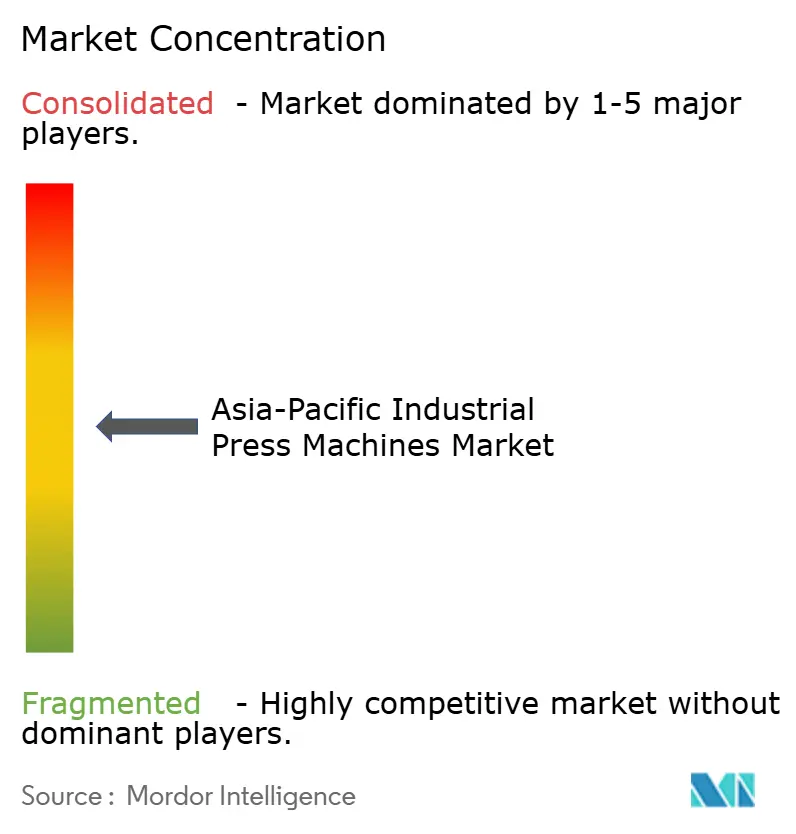
| Market Concentration | Medium |
Major Players *Disclaimer: Major Players sorted in no particular order Image © Mordor Intelligence. Reuse requires attribution under CC BY 4.0. | |
Asia-Pacific Industrial Press Machines Market Analysis by Mordor Intelligence
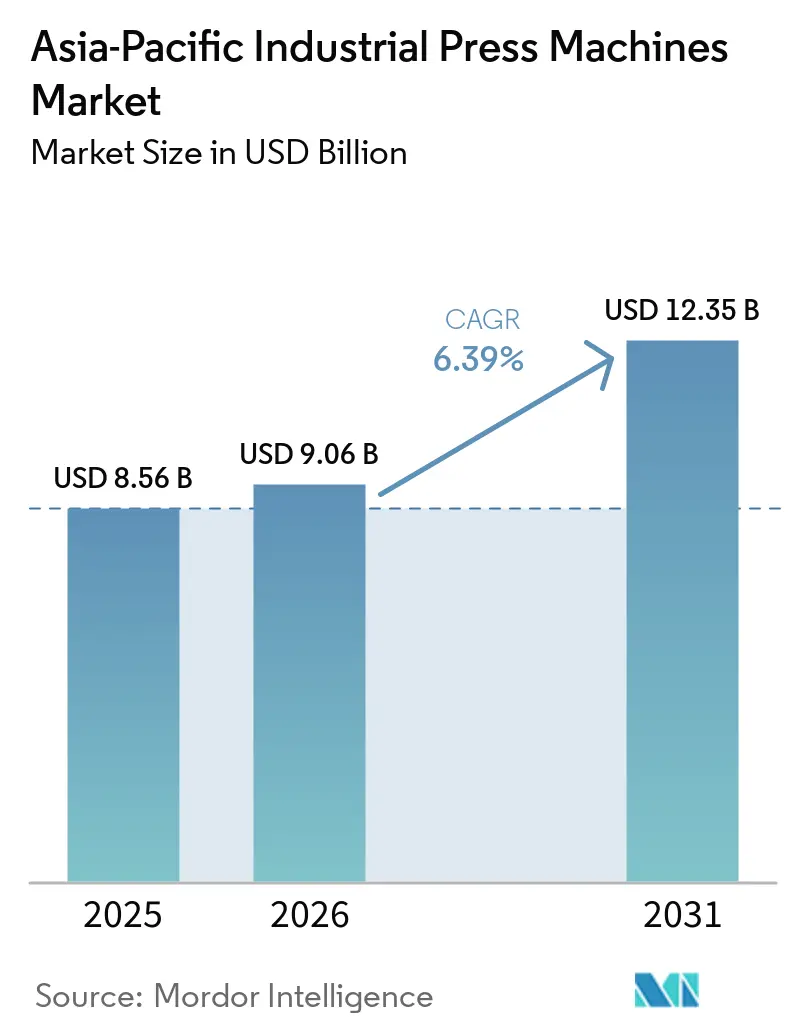
The Asia-Pacific Industrial Press Machines Market size is projected to be USD 8.56 billion in 2025, USD 9.06 billion in 2026, and reach USD 12.35 billion by 2031, growing at a CAGR of 6.39% from 2026 to 2031.
The Asia-Pacific industrial press machines market is supported by continued factory capacity additions across China, India, and Southeast Asia, particularly in automotive, electronics, electrical equipment, and general engineering. EV and battery manufacturing investments are further increasing demand for high-precision stamping, forming, and joining equipment, while automation is encouraging manufacturers to replace conventional hydraulic and mechanical presses with servo-driven systems offering programmable motion, tighter process control, and lower energy consumption. China remains a major production and supply base, with domestic manufacturers increasingly expanding into precision, high-speed, and large-tonnage press equipment, intensifying competition for Japanese and European suppliers. At the same time, manufacturers in India and Southeast Asia are increasing automation and localization of production to support expanding industrial supply chains. Imported control systems, foreign-exchange fluctuations, high upfront equipment costs, and shortages of skilled application and maintenance engineers continue to constrain adoption, particularly among smaller manufacturers.
Key Report Takeaways
- By drive technology, conventional mechanical presses held a 35.3% of the Asia-Pacific industrial press machines market share in 2025, while servo-mechanical presses are projected to grow at a 9.6% CAGR through 2031.
- By press force and capacity, the 101–500-ton segment accounted for a 33.4% of the Asia-Pacific industrial press machines market size in 2025, while presses above 2,000 tons are forecast to expand at a 7% CAGR through 2031.
- By application and process, stamping, blanking, and punching represented 29.6% of revenue in 2025, while assembly, press-fitting, and joining are projected to grow at a 7.5% CAGR through 2031.
- By end-use industry, automotive and transportation held 37.4% of revenue in 2025, while aerospace and defense is forecast to record a 7.5% CAGR through 2031.
Note: Market size and forecast figures in this report are generated using Mordor Intelligence’s proprietary estimation framework, updated with the latest available data and insights as of January 2026.
Asia-Pacific Industrial Press Machines Market Trends and Insights
Drivers Impact Analysis*
| Driver | (~) % Impact on CAGR Forecast | Geographic Relevance | Impact Timeline |
|---|---|---|---|
| Manufacturing Capacity Expansion in China, India, and Southeast Asia | +1.8% | APAC-wide, concentrated in China, India, Vietnam, and Thailand | Medium term (2-4 years) |
| Electrification and Battery Component Manufacturing | +1.5% | China, Indonesia, Malaysia, India, and Thailand | Short term (≤ 2 years) |
| Automation, Precision, and Energy-Efficiency Requirements | +1.2% | China, Japan, South Korea, and Taiwan | Medium term (2-4 years) |
| Automotive Lightweighting and Electric Vehicle Platform Changes | +0.9% | China, Japan, South Korea, and India | Medium term (2-4 years) |
| Regionalization of Electronics and Contract Manufacturing Supply Chains | +0.6% | Malaysia, Vietnam, India, Thailand, and Japan | Medium term (2-4 years) |
| Retrofit Demand from Installed Mechanical Press Bases | +0.4% | China, Japan, and South Korea | Long term (≥ 4 years) |
| Source: Mordor Intelligence | |||
Manufacturing Capacity Expansion in China, India, and Southeast Asia
China issued the Machinery Industry Stable Growth Plan for 2025 and 2026 in September 2025. The plan targets machinery-sector operating revenue above CNY 10 trillion (USD 1.4 trillion), and average annual growth above 3.5%. It also includes equipment renewal and industrial mother-machine technology goals. These measures support the procurement of stamping, forging, and hydraulic equipment within Chinese manufacturing clusters.[1] India’s FY 2026-27 budget proposed INR 12.2 lakh crore (USD 140.02 billion) in public capital outlay, while private investment in machinery and equipment expanded 6% in FY2025.[2] New factories under India’s production-linked incentive programs commonly need high-tonnage press lines 12 to 24 months after an investment commitment. Thailand, Vietnam, and Indonesia are adding specialized automotive and electronics capacity, which broadens the Asia-Pacific industrial press machines market beyond its established bases.
Electrification and Battery Component Manufacturing
Battery production uses press equipment in electrode compaction, cell-case forming, and module assembly. This range of uses favors suppliers that can provide equipment for battery-grade forming tasks. CATL and Indonesia Battery Corporation began a USD 5.9 billion battery integration project in Karawang, West Java, in June 2025. Its first phase targets 6.9 GWh of capacity by late 2026. Malaysia opened the ASEAN region’s first commercial lithium-ion battery separator facility in Penang in June 2025, supported by an RM 3.2 billion investment, equivalent to USD 760 million.[3] AIDA Engineering launched the DIS Former in June 2025 for cylindrical storage battery cases, with 15,380 joules of continuous working energy at 90 strokes per minute. These projects make battery supply chains a distinct source of demand for the Asia-Pacific industrial press machines market.
Automation, Precision, and Energy-Efficiency Requirements
China published its Digital Transformation Implementation Plan for the Machinery Industry in August 2025. The plan seeks smart manufacturing maturity Level 2 or above at 50% of enterprises by 2027 and calls for at least 200 exemplary smart factories. These targets encourage manufacturers to consider servo presses instead of conventional flywheel-driven systems. Programmable stroke profiles can reduce scrap in thin-sheet electronics forming and can support longer die life. Japan recorded 10.46 million manufacturing employees in 2024, and the small decline in employment increases the need for automated production equipment. Energy certification is becoming a normal requirement for premium equipment purchases in Taiwan and other advanced production locations. The Asia-Pacific industrial press machines market therefore benefits from demand for equipment that combines motion control, automation, and lower energy use.
Automotive Lightweighting and Electric Vehicle Platform Changes
Battery-electric vehicle platforms are changing equipment specifications across automotive supply chains. Forming advanced high-strength steel, aluminum alloys, and thermoformed composites requires equipment with greater capability than lines designed for mild steel. These materials can require press loads 30% to 40% above comparable mild-steel work. AIDA Engineering launched its MSP-4000-430 wide-area press in June 2024 for large EV motor cores that use ultra-thin adhesive-laminated materials. Yadon delivered a 3,500-ton multi-link transfer press in February 2025 with ±0.05 mm positioning accuracy for high-strength new-energy vehicle structural components. Gigacasting may reduce some conventional stamping work as vehicle makers consolidate stamped parts into die-cast structures within the Asia-Pacific industrial press machines market.
Restraints Impact Analysis*
| Restraint | (~) % Impact on CAGR Forecast | Geographic Relevance | Impact Timeline |
|---|---|---|---|
| High Capital Cost and Long Payback Periods | -1.5% | ASEAN, India, and Rest of APAC | Medium term (2-4 years) |
| Skilled-Service and Application-Engineering Shortages | -1.0% | Australia, Japan, South Korea, and ASEAN | Long term (≥ 4 years) |
| Imported Component Dependence and Currency Volatility | -0.7% | India, ASEAN, and Australia | Medium term (2-4 years) |
| Limited Standardization of Retrofit Interfaces Across Legacy Presses | -0.4% | China, Japan, and South Korea | Long term (≥ 4 years) |
| Source: Mordor Intelligence | |||
High Capital Cost and Long Payback Periods
Large-tonnage servo press lines can require capital commitments above USD 5 million when automation, tooling, and integration are included. This cost is difficult for mid-tier fabricators in Southeast Asia and South Asia to finance. Major equipment purchases are commonly assessed against 5 to 7-year payback periods, which can delay decisions where demand visibility is limited. Internal accruals represented 65.35% of total capital-expenditure financing in India during 2025-26, limiting heavy-equipment spending by smaller companies. Leasing and pay-per-use options could widen access to equipment for smaller stamping firms. Until financing becomes more accessible, acquisition cost will restrain adoption of advanced systems in parts of the Asia-Pacific industrial press machines market.
Skilled-Service and Application-Engineering Shortages
Servo lines with robotic handling and connected process controls require people with mechanical, electrical, and control-software skills. This mix of experience is limited in several Asia-Pacific manufacturing economies. Japan’s 2025 Manufacturing White Book reported a small-business manufacturing labor diffusion index of -18.2 in 2024, matching pre-pandemic tightness. Australia’s 2025 manufacturing technology skills summit identified an immediate shortage of more than 1,000 CNC operators and a need to attract and train more than 3,000 people over the following 2 years. Malaysia’s National Investment Masterplan 2030 identifies hands-on skills as necessary for machinery and equipment companies moving toward Industry 4.0. Where support is limited, buyers may prefer simpler mechanical systems over higher-value precision equipment in the Asia-Pacific industrial press machines market.
*Our forecasts treat driver/restraint impacts as directional, not additive. The impact forecasts reflect baseline growth, mix effects, and variable interactions.
Segment Analysis
By Drive/Actuation Technology: Servo Momentum Builds on a Conventional Foundation
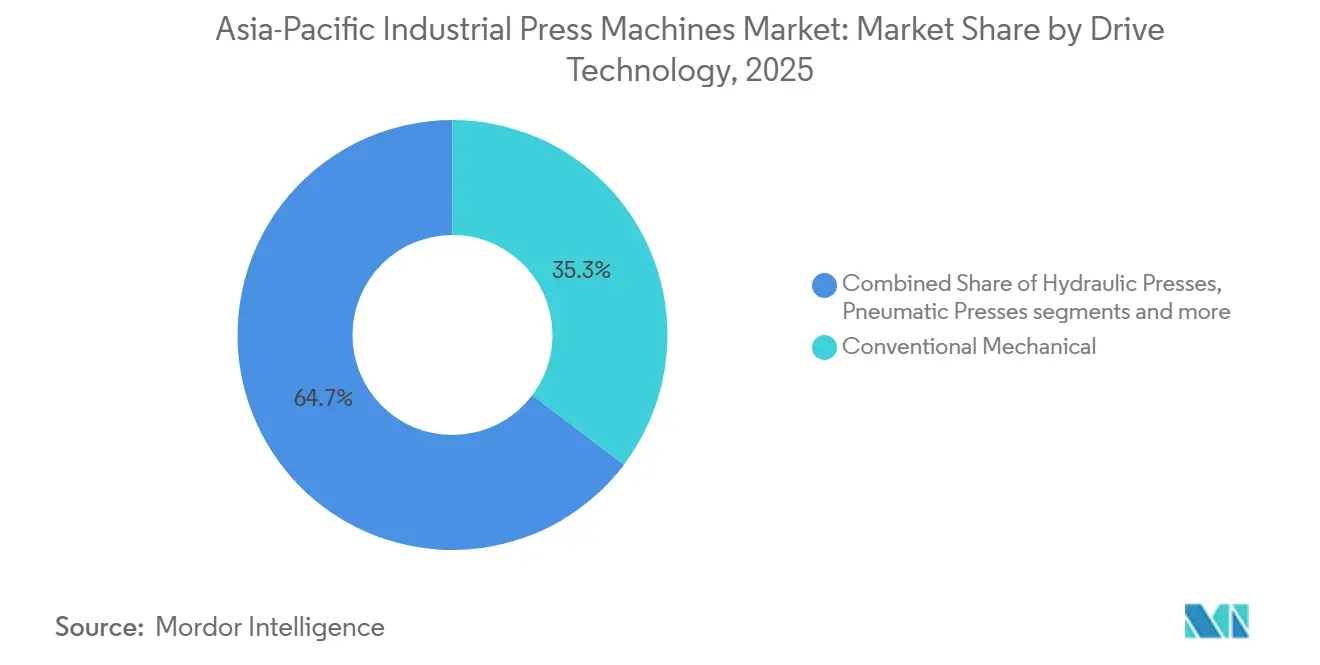
Conventional mechanical presses held 35.3% of revenue in 2025. Their lower purchase cost, simple operation, and fit with high-volume stamping underpin continued use in China’s automotive and appliance clusters. Hydraulic presses remain important where controlled force is needed over a long stroke. They are used in deep drawing, composite compression, and heavy forging applications that support India’s engineering base. Pneumatic presses serve electronics assembly and light fabrication at lower tonnage levels.
Servo-mechanical presses are forecast to grow at a 9.6% CAGR from 2026 to 2031. Other and hybrid presses combine servo-driven slides with hydraulic force amplification for tasks that need both force control and frequent cycling. SEYI demonstrated a 160-ton solid-frame servo press for ultra-thin metallic bipolar plate forming at MF-Tokyo 2025. SEYI’s SD1 and SNS2 presses received energy-conservation Gold Label certification in 2025 under a program aligned with ISO 14001. The next group of servo buyers in the Asia-Pacific industrial press machines market is likely to include second- and third-tier suppliers in China, India, and ASEAN that are replacing mechanical fleets.

By Press Force/Capacity: Mid-Range Tonnage Anchors Volume, Ultra-Heavy Presses Lead Growth
The 101–500-ton category held 33.4% of the Asia-Pacific industrial press machines market size in 2025. Its broad use in automotive body panels, appliance shells, and light commercial fabrication supports that position. Presses up to 100 tons serve electronics, medical devices, and precision hardware. This range is gaining steady demand in Vietnam and Malaysia as electronics production expands. The 501–1,000-ton range serves mid-tier automotive structural components, while the 1,001–2,000-ton range handles heavier vehicle and industrial machinery parts.
Presses above 2,000 tons are projected to grow at a 7% CAGR through 2031. Larger monolithic vehicle parts and high-strength steel battery enclosures are increasing the demand for this equipment. Yadon’s 3,500-ton press achieved ±0.05 mm worktable positioning accuracy at 8 to 30 strokes per minute in February 2025. The delivery showed that Chinese manufacturers can supply ultra-large presses that meet Japanese Tier 1 requirements. Gigacasting could moderate demand for 501–2,000-ton automotive stamping equipment in the Asia-Pacific industrial press machines market later in the forecast period.
By Application/Process: Stamping Anchors the Base, Joining Applications Outpace the Market
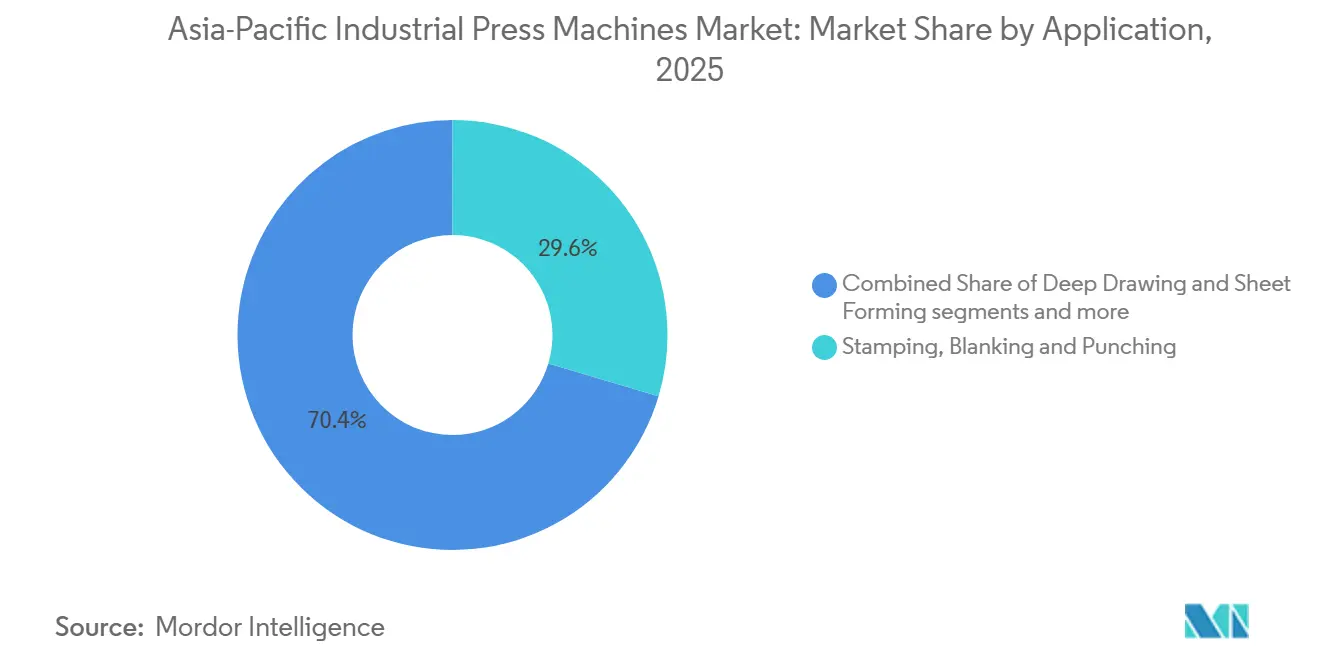
Stamping, blanking, and punching represented 29.6% of the Asia-Pacific industrial press machines market share in 2025. The process serves automotive, appliance, electronics, and construction producers that need high-speed blanking and progressive die work. Deep drawing and sheet forming are used for vehicle outer panels, cookware, beverage cans, and medical devices. Forging presses serve automotive powertrains, aerospace structures, and industrial machinery. Compression molding and powder compaction support ceramics, composites, and powder metallurgy components for batteries and electronics.
Assembly, press-fitting, and joining is forecast to expand at a 7.5% CAGR from 2026 to 2031. EV powertrain lines use precision press-fitting for motor lamination stacks, bearing housings, and battery module cases. These operations occur more often per vehicle than comparable internal-combustion assembly tasks. Other applications in the Asia-Pacific industrial press machines market include hydroforming and warm forming for specialized automotive and aerospace parts.
By End-Use Industry: Automotive Scale Endures, Defense Platforms Drive the Growth Edge
Automotive and transportation held 37.4% of revenue in 2025. Multi-press stamping lines and continued investment in vehicle platforms sustain demand in China, Japan, South Korea, and India. Industrial machinery and equipment, and electrical and electronics are the next-largest end-use groups. Appliances and consumer durables remain significant users, particularly in China and South Korea. Metal products, energy and power equipment, and construction and heavy equipment require hydraulic and forging presses for larger components.
Aerospace and defense is projected to grow at a 7.5% CAGR through 2031. Asia-Pacific military spending reached record levels in 2024, with India, Japan, South Korea, and Australia committing to multiyear budget increases. Aerospace forming requires equipment for titanium, aluminum alloys, and thermoformed composites at tighter dimensional tolerances than automotive work. Medical and precision manufacturing is a small but technically demanding niche in Japan and South Korea. Renewable-energy equipment also creates demand in the Asia-Pacific industrial press machines market for large hydraulic and forging presses used in wind turbine and solar tracker components.
Geography Analysis
China held 56% of the Asia-Pacific industrial press machines market share in 2025, supported by its large manufacturing base and policy support for automotive, electric vehicle, and electronics capacity. The Machinery Industry Stable Growth Plan targets machinery-sector revenue above CNY 10 trillion (USD 1.4 trillion), and average annual growth above 3.5%. Equipment renewal and digital transformation provisions support press procurement across Chinese factories. China remains the largest established country base in the Asia-Pacific industrial press machines market for automotive stamping and general metal forming.
India is forecast to record the fastest geographic CAGR at 8.2% from 2026 to 2031. The proposed FY 2026-27 public capital outlay of INR 12.2 lakh crore (USD 140.02 billion) represents a 4.2-fold increase from FY18. The National Mission on Manufacturing seeks to double manufacturing’s share of GDP from 12.9% in 2023. India’s machinery and equipment sector has 18.1% import dependence in FY2026. This creates room for local assembly and technical partnerships in the Asia-Pacific industrial press machines market.
ASEAN is expanding demand through battery investments in Indonesia, Malaysia, and Thailand. The ASEAN Framework for Integrated Semiconductor Supply Chain supports electronics supply-chain coordination. Vietnam and Malaysia are increasing precision press requirements alongside electronics assembly growth. Thailand’s EV assembly base requires stamping and forming lines. Japan and South Korea remain precision technology centers, while Australia is seeing aerospace and defense demand, and Taiwan contributes technical depth through energy certification. The rest of Asia-Pacific is building general fabrication capacity for electronics exports and regional supply chains, which broadens the Asia-Pacific industrial press machines market.
Competitive Landscape
The Asia-Pacific industrial press machines market exhibits a medium level of market concentration. Japanese suppliers, including AIDA Engineering, Komatsu Industries, Sumitomo Heavy Industries, and AMADA, lead in servo precision and application engineering. Taiwanese companies such as SEYI, Chin Fong, and LIEN CHIEH serve the technical mid-tier and maintain distribution across ASEAN and South Asia. Chinese producers, including Yangli Group, JIER Machine-Tool Group, Hefei Metalforming, Taitian, Jingda, Nantong Guosheng, Chongqing Jiangdong, and Yadon, compete in ultra-large-tonnage and servo-integrated equipment. Their pricing creates pressure in conventional mechanical and standard hydraulic equipment categories.
Yadon delivered its 3,500-ton multi-link transfer press to a Japanese Tier 1 automotive manufacturer in February 2025, showing that Chinese equipment can meet demanding accuracy requirements. AIDA launched the DIS Former for cylindrical battery cases in June 2025, offering equipment designed for a battery-specific forming task. SEYI demonstrated a servo press for metallic bipolar plate forming at MF-Tokyo 2025. Japanese and European suppliers are responding through servo, hybrid, and battery-forming systems. The Asia-Pacific industrial press machines market is also becoming more dependent on local service, application support, and integration capability.
Opportunities are visible in servo-hydraulic retrofit kits for conventional mechanical presses. Battery-forming systems for cylindrical and prismatic cells provide another route for product specialization. Flexible lines that process advanced high-strength steel, aluminum alloys, and composites can serve a broader range of vehicle programs. Connected process monitoring is becoming a standard buyer expectation for transfer press orders in the Asia-Pacific industrial press machines market.
Asia-Pacific Industrial Press Machines Industry Leaders
-
AIDA ENGINEERING, LTD.
-
Komatsu Ltd.
-
Schuler AG
-
Yangli Group
-
AMADA CO., LTD.
- *Disclaimer: Major Players sorted in no particular order
Recent Industry Developments
- June 2025: AIDA Engineering launched the DIS Former (DIS-1600) for cylindrical storage battery case forming, with an SN value 1.7 times that of conventional presses and 15,380-joule continuous working energy output at 90 strokes per minute, exhibiting at MF-Tokyo 2025.
- August 2025: Hunan Yuneng New Energy Battery Material Co. Ltd. committed to establishing its first Southeast Asian manufacturing facility in Negeri Sembilan, Malaysia, producing lithium battery cathode materials and creating over 200 jobs, reinforcing ASEAN's battery component supply chain ahead of EV assembly scale-up.
- June 2025: CATL and Indonesia Battery Corporation (IBC) broke ground on a joint USD 5.9 billion battery integration project in Karawang, West Java, targeting 6.9 GWh production capacity by late 2026 and creating substantial downstream demand for forming and pressing equipment across the EV battery supply chain.
Asia-Pacific Industrial Press Machines Market Report Scope
The Asia-Pacific Industrial Press Machines Market is segmented by drive technology (Hydraulic Presses, Pneumatic Presses, and more), By Press Force (Up to 100 Tons, 101–500 Tons, and more), By Application (Forging, Powder Compaction, and more), By End-Use Industry (Aerospace and Defense, Electrical and Electronics, and more), By Geography (China, Japan, India, and more ). The Market Forecasts are Provided in Terms of Value (USD).
| Conventional Mechanical Presses |
| Servo-Mechanical Presses |
| Hydraulic Presses |
| Pneumatic Presses |
| Other and Hybrid Presses |
| Up to 100 Tons |
| 101–500 Tons |
| 501–1,000 Tons |
| 1,001–2,000 Tons |
| Above 2,000 Tons |
| Stamping, Blanking and Punching |
| Deep Drawing and Sheet Forming |
| Forging |
| Straightening and General Forming |
| Compression Molding |
| Powder Compaction |
| Assembly, Press-Fitting and Joining |
| Other Press Applications |
| Automotive and Transportation |
| Aerospace and Defense |
| Industrial Machinery and Equipment |
| Electrical and Electronics |
| Appliances and Consumer Durables |
| Construction and Heavy Equipment |
| Energy and Power Equipment |
| Metal Products and General Manufacturing |
| Medical and Precision Manufacturing |
| Other End-Use Industries |
| China |
| Japan |
| India |
| South Korea |
| ASEAN(Singapore, Malaysia, Indonesia, Thailand, Vietnam, Philippines, Myanmar, Cambodia, Laos, Brunei) |
| Australia |
| Rest of Asia-Pacific |
| By Drive / Actuation Technology | Conventional Mechanical Presses |
| Servo-Mechanical Presses | |
| Hydraulic Presses | |
| Pneumatic Presses | |
| Other and Hybrid Presses | |
| By Press Force / Capacity | Up to 100 Tons |
| 101–500 Tons | |
| 501–1,000 Tons | |
| 1,001–2,000 Tons | |
| Above 2,000 Tons | |
| By Application / Process | Stamping, Blanking and Punching |
| Deep Drawing and Sheet Forming | |
| Forging | |
| Straightening and General Forming | |
| Compression Molding | |
| Powder Compaction | |
| Assembly, Press-Fitting and Joining | |
| Other Press Applications | |
| By End-Use Industry | Automotive and Transportation |
| Aerospace and Defense | |
| Industrial Machinery and Equipment | |
| Electrical and Electronics | |
| Appliances and Consumer Durables | |
| Construction and Heavy Equipment | |
| Energy and Power Equipment | |
| Metal Products and General Manufacturing | |
| Medical and Precision Manufacturing | |
| Other End-Use Industries | |
| By Geography | China |
| Japan | |
| India | |
| South Korea | |
| ASEAN(Singapore, Malaysia, Indonesia, Thailand, Vietnam, Philippines, Myanmar, Cambodia, Laos, Brunei) | |
| Australia | |
| Rest of Asia-Pacific |
Key Questions Answered in the Report
What is the forecast for the Asia-Pacific industrial press machines market through 2031?
The sector is forecast to reach USD 12.35 billion by 2031, growing at a 6.4% CAGR from 2026 to 2031. Factory additions in China, India, and Southeast Asia support the outlook.
Which drive technology is growing fastest in the Asia-Pacific press equipment?
Servo-mechanical presses are forecast to grow at a 9.6% CAGR through 2031. Their programmable motion, precision, and energy performance are relevant to demanding electronics, automotive, and electric vehicle component applications.
Which press capacity range has the largest share in Asia-Pacific?
The 101–500-ton range held 33.4% of revenue in 2025. It has a wide customer base because automotive panels, appliance shells, and light commercial products can be formed within this capacity range.
Which application is expanding fastest for industrial presses?
Assembly, press-fitting, and joining is forecast to grow at a 7.5% CAGR through 2031. Electric vehicle production requires precise joining of motor lamination stacks, bearing housings, and battery module cases.
Which country has the largest share of the Asia-Pacific industrial press machines market?
China held 56% of regional revenue in 2025. Its automotive, electronics, and general manufacturing activity sustain the country’s leading position.
Why is India important for press equipment suppliers?
India is forecast to grow at an 8.2% CAGR through 2031. Public capital spending and manufacturing policy create potential for local assembly and technical partnerships. Machinery and equipment import dependence of 18.1% in FY2026 indicates scope to localize supply and service.