
Market Overview
| Study Period | 2020 - 2031 |
|---|---|
| Forecast Data Period | 2026 - 2031 |
| Base Year Market Size (2025) | USD 2.77 Billion |
| Market Size (2026) | USD 2.93 Billion |
| Market Size (2031) | USD 3.92 Billion |
| Growth Rate (2026 - 2031) | 5.97 % |
| Market Concentration | Medium |
Major Players *Disclaimer: Major Players sorted in no particular order Image © Mordor Intelligence. Reuse requires attribution under CC BY 4.0. | |
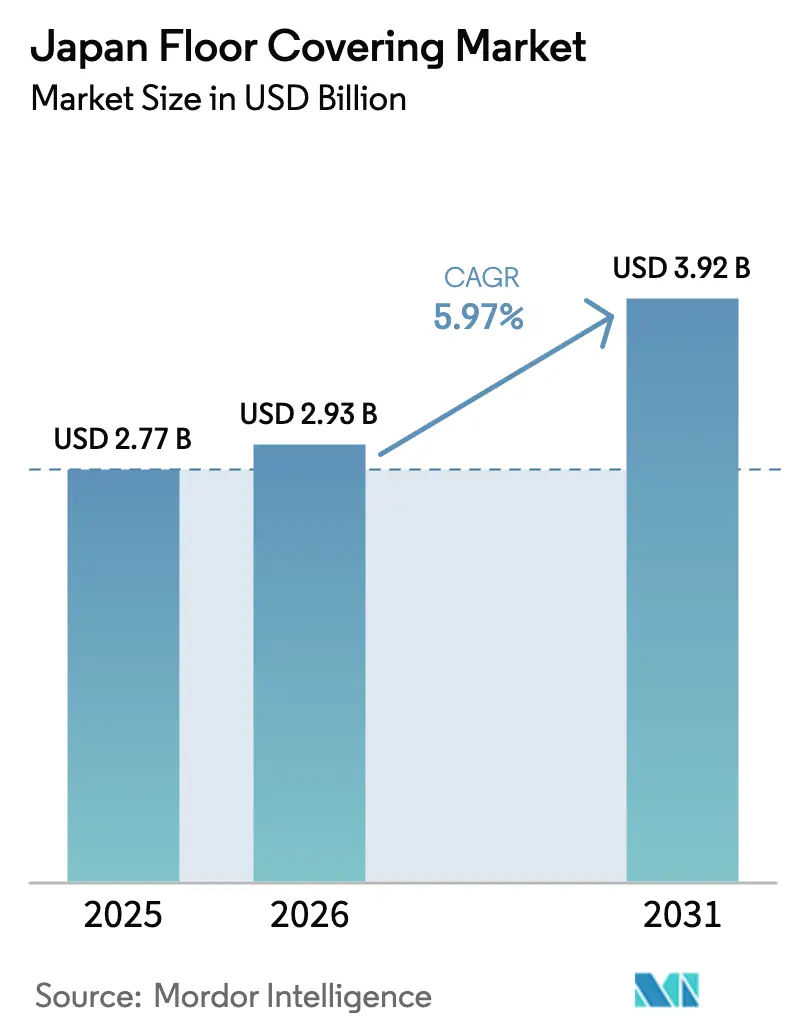
Japan Floor Covering Market Analysis by Mordor Intelligence
The Japan Floor Covering Market size is expected to grow from USD 2.77 billion in 2025 to USD 2.93 billion in 2026 and is forecast to reach USD 3.92 billion by 2031 at 5.97% CAGR over 2026–2031. The trajectory reflects a pivot from new-build activity to renovation-led spending as an aging residential and commercial stock drives systematic upgrades. Demand aligns with improvements in energy efficiency, indoor air quality, and safety in high-use environments, especially in metropolitan areas. Product mix shifts continue to favor modular, fast-install systems that reduce downtime and address labor constraints. Domestic incumbents consolidate share through logistics, technical support, and compliance capabilities that meet procurement standards across public and private projects. Competitive strategies in the Japan Floor Covering market emphasize reliable supply, circular materials, and verified low-emission performance to meet rising regulatory and ESG requirements. Redevelopment cycles around rail hubs and mixed-use corridors in Tokyo and Osaka sustain replacement demand as building owners refresh interiors for flexible use.
Key Report Takeaways
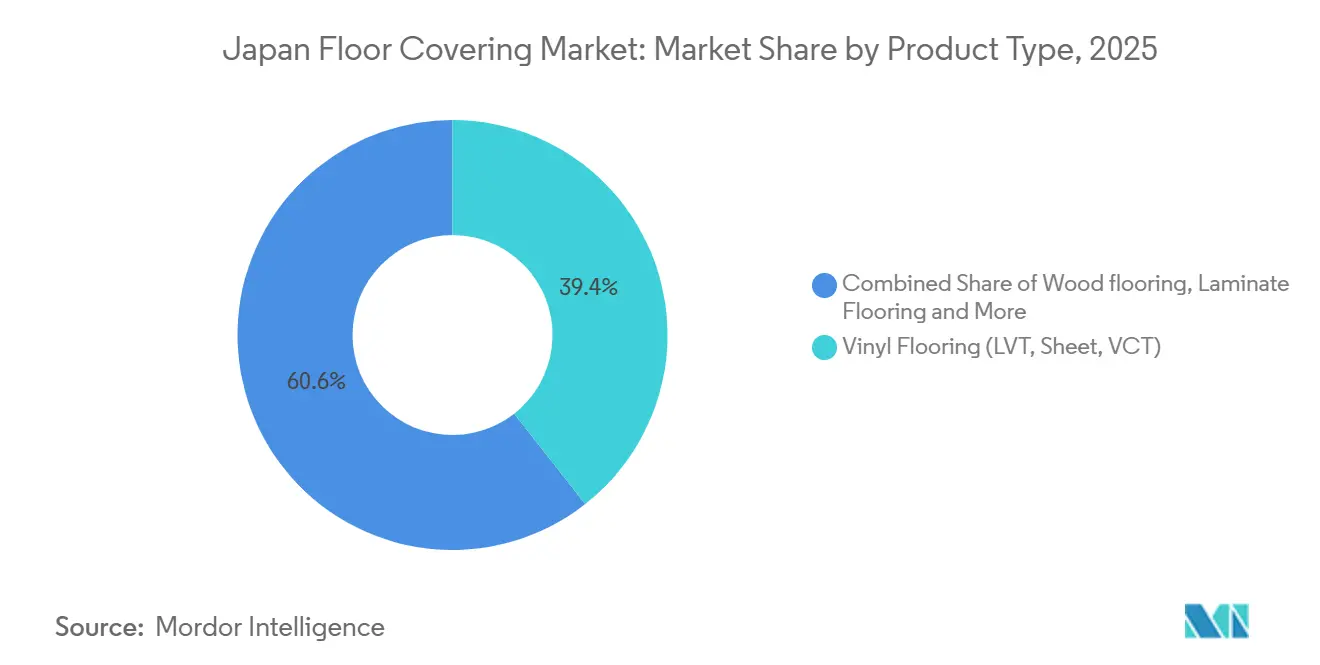
- By product type, vinyl flooring led with 39.35% of revenue in 2025, and Luxury Vinyl Tile is projected to grow at an 8.39% CAGR through 2031, indicating that the Japan Floor Covering market size for vinyl formats is set to expand alongside the fastest subcategory, while the same period confirms vinyl’s leadership in the Japan Floor Covering market share with its 2025 position.
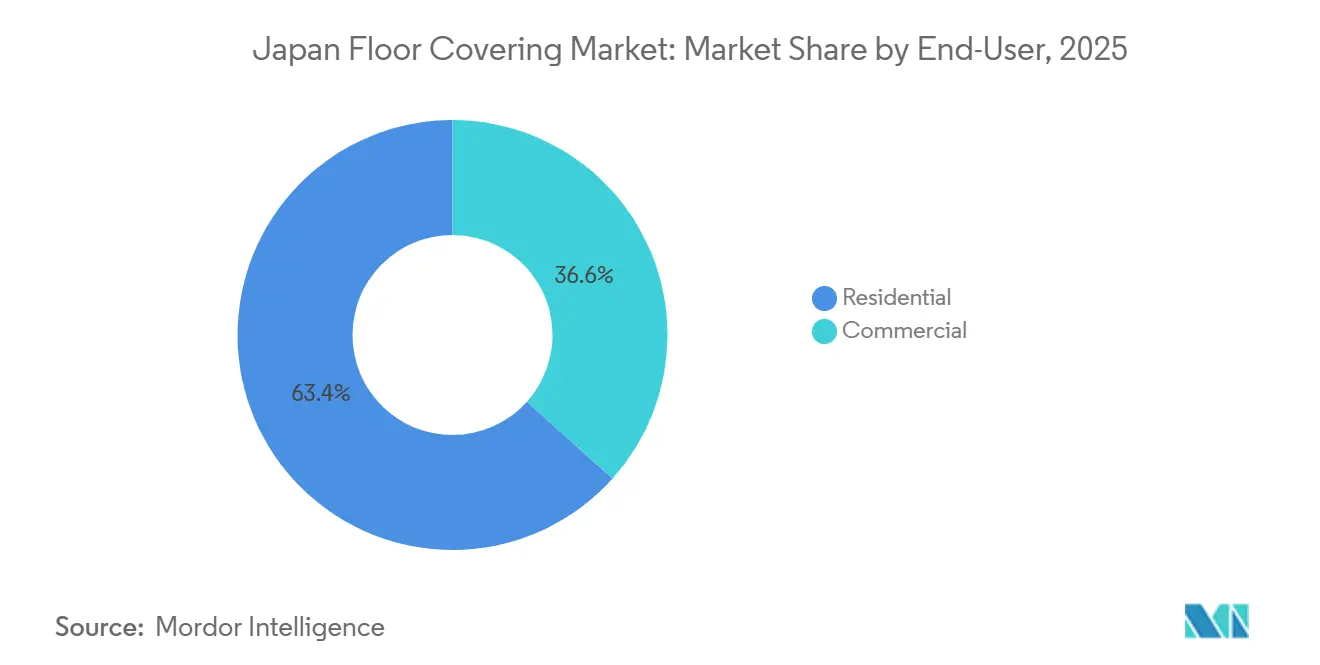
- By end user, residential accounted for 63.36% of 2025 volume, and the commercial segment is forecast to grow at an 8.35% CAGR between 2026 and 2031, which indicates that the Japan Floor Covering market size for commercial applications will advance faster over the forecast horizon, while residential retained the largest 2025 Japan Floor Covering market share.
- By distribution channel, B2C retail held 67.35% in 2025 and is expected to increase at an 8.98% CAGR, showing that the Japan Floor Covering market size within consumer channels is poised for strong growth, while the 2025 Japan Floor Covering market share remained anchored in retail-led sales.
- By geography, Kanto captured 41.44% in 2025, and Kansai is projected to grow at an 8.35% CAGR, which suggests the Japan Floor Covering market size in Kansai is set to expand fastest among regions, while Kanto retained the leading 2025 Japan Floor Covering market share.
Note: Market size and forecast figures in this report are generated using Mordor Intelligence’s proprietary estimation framework, updated with the latest available data and insights as of January 2026.
Japan Floor Covering Market Trends and Insights
Drivers Impact Analysis*
| Driver | (~) % Impact on CAGR Forecast | Geographic Relevance | Impact Timeline |
|---|---|---|---|
| Aging housing stock renovation demand | +1.2% | National, with early gains in Kanto, Kansai, and Chubu metropolitan cores | Medium term (2-4 years) |
| Large-scale infrastructure refurbishments tied to Osaka-Kansai Expo 2025 | +0.8% | Kansai core, spill-over to Chugoku | Short term (≤ 2 years) |
| Growing uptake of resilient flooring in healthcare and senior-care facilities | +0.7% | National, concentration in Kanto and aging rural prefectures | Medium term (2-4 years) |
| Consumer shift toward eco-friendly and low-VOC materials | +1.0% | National, strongest in Tokyo and Osaka metros | Long term (≥ 4 years) |
| Revival of tatami-look vinyl and hybrid floors | +0.3% | National, niche in traditional residential settings | Medium term (2-4 years) |
| Emergence of smart, IoT-enabled flooring solutions | +0.2% | Pilots in Tokyo, Yokohama, Osaka healthcare clusters | Long term (≥ 4 years) |
| Source: Mordor Intelligence | |||
Aging Housing-Stock Renovation Demand
Renovation-led demand has strengthened as policy and demographic realities channel investment from new builds into upgrades across major metros. MLIT data and government statistics confirm sustained periods of weakness in new housing starts through 2024 and into 2025, reinforcing the shift to stock enhancement programs that improve habitability and energy efficiency in existing homes and condos[1]. Corporate filings reinforce this pivot, with large suppliers reporting rising renovation sales contribution as owners prioritize floor replacement during multi-room updates to consolidate contractor mobilization and limit disruptions. Long-term industry commentary cites a sizable cohort of homes constructed during the 1990s now entering replacement windows for floors and other interior systems, which aligns with standard lifecycle practices in Japan’s housing stock. Public and private programs encourage barrier-free design and step-difference reduction as single-occupant and elderly households pursue safety-oriented upgrades that favor resilient surfaces and low-threshold transitions in living spaces. The Japan Floor Covering market benefits from this pattern because flooring replacement can be completed quickly with modular formats, enabling staged renovations while residents remain in place.
Large-Scale Infrastructure Refurbishments Tied to Osaka-Kansai Expo 2025
Government-led programs in Kansai achieved notable transit and access upgrades, with bridge works and a metro extension to the Yumeshima site completed on schedule, which helped trigger a wave of ancillary refurbishments in hospitality and commercial properties[2]. Official statistics show pronounced volatility in Osaka housing activity in late 2025, including strong spikes that reflect pre-Expo and tourism-related investment, which lifts near-term demand for fast-turn flooring solutions in hotel corridors and public pavilions. Design choices at the Expo featured durable and modular surface systems to handle heavy foot traffic and condensed construction windows, providing a reference for product durability and installation speed in high-traffic settings. Post-Expo plans designate parts of Yumeshima for continued commercial use, extending the replacement cycle as permanent facilities complete fit-outs in 2026 and 2027. Regional spillovers into Kyoto, Kobe, and Nara sustain demand for compliant, resilient floors that meet local fire and VOC standards, supporting a multi-year uplift in the Japan Floor Covering market across western Japan.
Growing Uptake of Resilient Flooring in Healthcare and Senior-Care Facilities
Senior-care and medical assets continue to attract investment, supported by government care frameworks that prioritize coordinated networks across clinics and long-term facilities, which in turn emphasize flooring that is hygienic, slip-resistant, and easy to disinfect [3]. Commercial carpet tiles and resilient sheets are widely specified for their maintenance advantages and acoustic performance in administrative zones and corridors, and product literature from major suppliers highlights antibacterial treatments and recycled content that align with ESG goals. Procurement standards in public and institutional projects favor Eco Mark and 4VOC compliance, steering orders to domestic producers with certified low-emission products and established supply continuity[4]. Hospital and care operators value reduced downtime during retrofits, and modular formats allow phased installation around patient occupancy, which helps maintain operations without extended closures. A combination of compliance-driven specifications and the practical benefits of resilient and modular systems in high-usage medical environments, therefore, buoys the Japan Floor Covering market.
Consumer Shift Toward Eco-Friendly and Low-VOC Materials
Indoor air-quality scrutiny has increased as studies document seasonal VOC concentration patterns in occupied homes, which raises awareness of adhesives and floor substrates that can impact indoor environmental health. Manufacturers have responded by clarifying compliance with 4VOC standards across new vinyl-sheet ranges, enabling eligibility for green procurement and adding clear labels for specifiers and public buyers[5]. Wood-oriented manufacturers emphasize the use of recycled and plantation-based inputs to reduce strain on tropical hardwoods and to align with corporate environmental roadmaps that target deeper emissions reductions by mid-century. Broader interior-products portfolios link flooring to larger renovation baskets that include kitchens and baths, reinforcing sustainability messaging and channel synergies that direct traffic into compliant flooring ranges. Recycling systems that collect used carpet tiles and regenerate backing have expanded in capacity, reflecting both policy momentum and end-customer demand for circular-economy solutions that document CO2 contribution rates within project reporting.
Restraints Impact Analysis*
| Restraint | (~) % Impact on CAGR Forecast | Geographic Relevance | Impact Timeline |
|---|---|---|---|
| Declining new housing starts in a mature construction market | -1.5% | National, acute in rural prefectures | Long term (≥ 4 years) |
| Volatility in PVC and petrochemical input prices | -0.6% | National, impacts vinyl producers | Short term (≤ 2 years) |
| Shortage of certified floor-installation labor | -0.4% | National, most acute in Kanto and Kansai | Medium term (2-4 years) |
| Seismic building codes limiting use of heavy tile and stone | -0.2% | Seismic Zone A, mitigated by lightweight innovation | Long term (≥ 4 years) |
| Source: Mordor Intelligence | |||
Declining New Housing Starts in a Mature Construction Market
Government data confirm intermittent declines in national housing starts through late 2024 and into 2025, which constrains new-build demand for floor coverings in detached homes and condominiums. This macro headwind intensifies in rural prefectures that face sharper depopulation and lower replacement rates, creating divergent regional baselines for suppliers. Renovation activity in major metros offsets some of the decline, but the new-build pipeline remains thinner than earlier cycles. Public investment in refurbishments and infrastructure helps stabilize related commercial demand in select regions. The Japan Floor Covering market adapts by aligning sales emphasis with renovation-focused channels and by packaging fast-install systems that reduce time on site.
Volatility in PVC and Petrochemical Input Prices
Price swings in core inputs, including PVC resins and logistics, have prompted wholesale price revisions by domestic firms, which lifted value even when physical volumes slowed. This volatility complicates tender pricing and inventory planning for vinyl formats, which remain a major share of installed floors in healthcare, retail, and residential replacement. Companies increasingly rely on diversified sourcing and recycling loops to buffer cost shocks over shorter windows. Buyers remain sensitive to price but will meet premium points for compliant low-VOC and recycled-content goods. The Japan Floor Covering market preserves margin in part through certified performance that justifies specification in public and institutional projects.
*Our forecasts treat driver/restraint impacts as directional, not additive. The impact forecasts reflect baseline growth, mix effects, and variable interactions.
Segment Analysis
By Product Type: Vinyl Commands, LVT Accelerates Amid Anti-Bacterial and Click-Lock Innovation
Vinyl flooring held 39.35% of 2025 product revenue, and Luxury Vinyl Tile is forecast to rise at an 8.39% CAGR through 2031, with wholesale figures showing robust value momentum in plastic flooring categories due to price revisions that offset softer shipment volumes. Strategic products within corporate portfolios, including modular carpet tiles and vinyl tiles, posted growth as contractors prioritized flexible and rapid installations during phased refurbishments that minimized downtime. Product catalogs emphasize low-VOC claims and recycling systems, with expansion of collection capacity for used carpet tiles and the horizontal recycling of special PVC backing, which supports ESG reporting for corporate buyers. Temporary supply suspensions following a supplier factory fire highlighted concentrated sourcing risk, but phased restoration timelines stabilized shipments over 2025, supporting recovery in vinyl sheet categories. The Japan Floor Covering market continues to rely on click-lock and other labor-saving innovations that reduce installation hours and support renovation rhythms across healthcare, hospitality, and residential replacement.
Carpet and area rugs remain significant in commercial settings, with wholesale values reflecting strong performance for domestic tufted tiles and ongoing preference for modular formats in offices and institutional corridors. Ceramic and porcelain tiles face more cautious use in high-seismic zones and multi-story retrofits that would require additional structural measures, which channels heavier usage to ground floors and areas where loads can be accommodated under code. Wood flooring maintains a design premium and thermal comfort appeal, and manufacturers highlight recycled and plantation substrates to satisfy procurement and sustainability thresholds, which guide choices in public and large private projects. Laminate serves cost-sensitive segments that demand improved moisture resistance, while stone remains a niche in luxury residential entryways and high-end hospitality. Overall, the Japan Floor Covering market shows a durable preference for resilient and modular categories that balance compliance, lifecycle, and installation efficiency.

By End User: Residential Leads, Commercial Accelerates on Healthcare and Corporate Flex-Space
Residential users accounted for 63.36% of the 2025 volume, reflecting deep stock and steady replacement cycles in urban and suburban areas as homeowners pursue manageable upgrades fitting around daily routines. Corporate filings report rising renovation contributions as integrated portfolios bundle floors with kitchens and baths, engaging homeowners in broader interior refreshes through a single procurement flow. Modular vinyl and sheet formats allow one to two-day installation timelines that reduce disruption and align with weekend or staggered contractor schedules. Safety-focused upgrades, including barrier-free transitions and slip-resistant surfaces, align with aging-in-place programs in detached homes and condominiums. The Japan Floor Covering market continues to serve residential demand with click-and-lock formats and low-VOC materials that balance speed and indoor air-quality priorities.
Commercial demand is forecasted to grow at an 8.35% CAGR from 2026 to 2031, driven by healthcare, offices, and select hospitality properties, which will consistently specify resilient and modular carpet systems to optimize maintenance and flexibility. Public and institutional tenders favor certified emissions profiles and recycling schemes that can be documented in ESG reporting, pushing selection toward domestic producers with proven supply continuity. Office retrofits in Tokyo and Osaka implement modular carpet tiles to enable hot-desking and frequent reconfiguration, which shrinks downtime and reduces waste during layout changes. Education and government buildings continue to seek durable, easily maintainable surfaces under budget constraints while observing emission and fire-retardancy norms. The Japan Floor Covering market captures these varied needs with a portfolio spanning resilient sheet, VCT, LVT, and carpet tiles targeted at specific commercial functions.
By Distribution Channel: B2C Retail Leads, Online Gains Share Amid DIY Surge
B2C retail captured 67.35% of distribution in 2025 and is projected to grow at an 8.98% CAGR as home centers and online platforms support manageable renovation projects with pre-cut vinyl, click LVT, and easy-lay carpet tiles. National household spending statistics include classifications for floor-covering purchases that align with steady household-led buying patterns, which support continued growth in consumer channels. Manufacturer-led digital tools that let consumers visualize rooms and order samples reduce friction in product selection and encourage upgrades that fit within family schedules. Integrated interior companies combine floors with kitchens and baths to create a seamless path from inspiration to purchase, helping consumers coordinate materials within one order flow. The Japan Floor Covering market, therefore, reflects an ecosystem where DIY-friendly products and digital journeys reinforce retail-led share.
Contractor channels remain essential for non-residential projects and large residential upgrades that require skilled installers, and dedicated manufacturer teams support major accounts with technical assistance and logistics. Wholesalers aggregate orders for renovation specialists and coordinate just-in-time site deliveries in constrained urban environments, which is a critical service component in dense metros. Workforce constraints push contractors toward fast-install systems to meet schedules under overtime limits, which helps modular formats gain share on job sites. Public-sector compliance requirements for low-VOC and recycled content channel specifications to brands with recognized certifications and product documentation packages. The Japan Floor Covering market continues to balance retail momentum with trade relationships that secure large project outcomes across institutional segments.
Geography Analysis
Kanto accounted for 41.44% of 2025 share, reflecting the region’s scale, density, and continuous renewal of its large condominium stock and corporate offices. Housing-starts data show that Greater Tokyo remains a dominant contributor to national volume even during periods of decline, underscoring the base of activity that supports steady replacement cycles. Healthcare operators and premium senior residences in Tokyo drive specifications for engineered wood in private units and resilient surfaces in common areas, reflecting a hybrid design approach that pairs aesthetics and maintenance needs. Smart-care platforms already deployed in eldercare properties establish the digital backbone that can accommodate on-floor sensing in the future as integration costs fall. The Japan Floor Covering market in Kanto remains anchored in renovation-heavy cycles with steady commercial refits around transit hubs and mixed-use corridors that value speed and compliance.
Kansai is projected to record the fastest regional growth at an 8.35% forecast CAGR, aided by the Osaka-Kansai Expo buildouts and the conversion of the Yumeshima site for continued commercial usage. MLIT documentation confirms the completion of core access projects and the reinforcement of the surrounding development fabric, which drives hotel and facility refurbishments in adjacent districts. Osaka statistics show pronounced movements in monthly housing starts that align with the unique timing of Expo-related activity, which informs suppliers’ capacity planning for modular, resilient materials. Regional tourism recovery and hotel renovations in Kyoto, waterfront redevelopment in Kobe, and cultural-facility upgrades in Nara amplify project volumes and diversify product needs across carpet tiles, vinyl plank, and specialized resilient sheets. The Japan Floor Covering market in Kansai benefits from projects that value rapid installation, robust hygiene performance, and low emissions to comply with metropolitan procurement norms.
Chubu represents a sizable share of the Japan Floor Covering market as Nagoya’s industrial base, logistics hubs, and corporate campuses underpin periodic office refreshes and facility maintenance. Official data indicate sharper drops in residential starts during certain months of 2025 across major metros, including the Greater Nagoya area, pointing to selective pockets where renovation must offset new-build softness. Detached-home prevalence and barrier-free conversions influence residential product choices as owners favor resilient sheet and vinyl transitions for flush thresholds and wet-area durability. Industrial flooring needs in factories and logistics zones add demand for heavy-duty resilient formats, epoxy coatings, and VCT in cost-sensitive areas. The Japan Floor Covering market across smaller regions beyond the three largest metros reflects varied demographics and economic profiles, with eldercare construction and municipal refurbishment programs providing localized growth platforms supported by compliant, durable products.
Regulatory Landscape
Floor coverings used in Japanese buildings are governed by the Building Standard Law framework administered by MLIT, including indoor air quality controls tied to sick house countermeasures and formaldehyde-emission classification for interior finishing materials (with restrictions on higher-emission categories in habitable rooms). This places emissions labeling and documentary compliance at the center of product specification in residential and institutional projects, alongside related rules for adhesives and interior components.
Technical compliance and performance verification are commonly anchored in Japanese Industrial Standards (JIS), including test and requirement standards for resilient and PVC floor coverings (for example, JIS A 1454 and JIS A 5705). On the environmental side, the Eco Mark Program criteria (including Category No. 123 for interior materials such as flooring and tile carpets) and public procurement under the Green Purchasing Law support demand for certified low-impact, asbestos-free materials and documented environmental performance. METI continues to update the JIS catalog through periodic national standardization cycles, including newly established and revised JIS publicly notified on May 20, 2026, which increases the need for ongoing standards monitoring by suppliers and importers.
Value Chain Analysis
The Japan floor covering value chain begins with upstream feedstocks and intermediates, including PVC and additives for resilient flooring, fibers and backing systems for carpet tiles, and timber-based substrates for wood and composite floors. It then shifts into domestic manufacturing and converting, with imports used for selected brands and premium categories. Product qualification and documentation, including JIS/JAS-based testing and MLIT-related indoor air quality requirements, operate as a practical gate to market and influence material selection, adhesive systems, and labeling across the chain.
Downstream, distribution splits between retail-led renovation purchases (home centers, specialty flooring stores, and online sample-to-order journeys) and trade channels serving contractors and institutional specifiers. Industry bodies support alignment on specifications and installation quality, including the Japan Flooring Association (JFA, 46 member companies) and the Japan Composite and Soundproof Flooring Industry Association (JAFMA, 55 member companies as of June 2024), which cover manufacturers, material suppliers, and installation or distribution firms. Installation capacity and skills development, supported by organizations such as AFTA, add a service layer, while government-supported renovation programs (for example, MLIT-linked long-term quality housing renovation initiatives) open additional demand pathways where flooring performance criteria and compliance documentation affect eligibility for subsidized or recognized works.
Competitive Landscape
The competitive field is moderately concentrated, with the top five companies holding a combined majority of market share, while the remainder is distributed among regional specialists, import brands, and private-label lines. TOLI reported net sales of USD 0.65 billion (JPY 102.47 billion) in FY2024 and record operating income, attributing the performance to price revisions and increased recycling capacity that support circularity for carpet tiles. Sangetsu recorded revenue of USD 1.28 billion (JPY 200.4 billion) in FY2024 and detailed the impact and recovery plan after a supplier fire temporarily constrained vinyl-sheet shipments, with phased resumption schedules stabilizing by late 2025. Suminoe maintains leadership in commercial carpet tiles and continues to highlight high recycled-content ratios and antibacterial options for healthcare and hospitality applications, which align with public procurement criteria. The Japan Floor Covering market rewards incumbents that link service quality, technical documentation, and certified compliance with reliable delivery.
Daiken integrates flooring within a broader housing-materials portfolio that emphasizes recycled and plantation-based substrates, improving the sustainability profile of engineered wood offerings and supporting public-sector eligibility. LIXIL formed the Living Business segment in April 2025 by consolidating wooden interior materials with kitchens and vanities to raise cross-category sales and the renovation ratio, which seeks to capture wallet share from homeowners executing comprehensive upgrades. Domestic portfolios are broad, with SKU coverage across resilient, carpet, and wood categories to support one-stop procurement strategies that appeal to specifiers and general contractors. Companies also invest in digital selection and sample logistics to accelerate decision cycles in both B2B and B2C contexts. The Japan Floor Covering market favors brands that can meet low-VOC, recycling, and fire-safety thresholds, with transparent documentation at bid time.
Channel and product strategies reflect three archetypes that remain stable across cycles. Vertical manufacturers leverage scale economics and recycling infrastructure to differentiate cost positions and circular credentials, as seen in carpet tile backing regeneration and JAIA 4VOC compliance across product launches. Asset-light aggregators offer breadth and service speed, aligning with project managers who prefer consolidated ordering and rapid fulfillment across multiple finish categories. Niche specialists dominate applications with high technical barriers, such as rail interiors, where long-standing safety and durability records drive selection over price-only considerations. The Japan Floor Covering market continues to balance consolidation at the top with a competitive mid-tier that serves regional and application-specific needs.
Japan Floor Covering Industry Leaders
-
TOLI Corporation
-
Sincol Co Ltd
-
TOYOTEX
-
DAIKEN CORPORATION
-
Hisamatsu Seito Co Ltd
- *Disclaimer: Major Players sorted in no particular order

Market Opportunities and Future Outlook
Carbon-neutral and recycled-content flooring represents an actionable opportunity in Japan, as public procurement and large private projects increasingly require auditable environmental attributes and low-emission documentation. Eco Mark (interior materials category covering flooring and tile carpets), JAIA 4VOC-related compliance expectations in interiors, and Green Purchasing Law-linked requirements for public works already provide procurement mechanisms that favor suppliers able to document recycled content, recyclability, and emissions performance.
Commercial renovation programs and resilience spending also create demand for fast-install, low-downtime floor systems that reduce site labor and shorten closures, especially in healthcare, offices, and public buildings. In FY2026, the First Medium-Term Plan for National Resilience is in effect, with a documented FY2026 allocation of JPY 1.55 trillion for infrastructure and building resilience projects, which supports a pipeline of refurbishments where durable, compliant interior materials are specified. Materials innovation adds another differentiator, with TBM Co., Ltd. showcasing carbon-recycling (CCU) floor materials at SusHi Tech Tokyo 2026 as a commercialization pathway for lower-embodied-carbon interior surfaces aligned with procurement and ESG reporting requirements.
Recent Industry Developments
- June 2026: TOLI Corporation reported higher sales volumes of vinyl floor coverings for the fiscal year ended March 2026, attributing the improvement to sales promotion for new products that incorporate higher value-added technologies. The update reinforces the role of differentiated, performance-led vinyl formats in Japan, particularly where renovation projects prioritize fast installation and compliance documentation.
- November 2025: Green-Flor introduced its flooring products in Japan by exhibiting at JAPANTEX 2025. The launch broadened the competitive set available to specifiers and distributors, adding more design and product-positioning options for renovation-led demand.
- March 2024: The Eco Mark Program maintained its interior materials category criteria (Category No. 123) covering flooring and tile carpets, reinforcing product qualification requirements tied to JIS and JAS conformance and environmental attributes. This continued emphasis on certified environmental performance supports procurement-driven differentiation among domestic incumbents and import brands.
Research Methodology Framework and Report Scope
Market Definition and Coverage
For this report, the market is defined as the value of floor covering materials sold for installation in Japan across residential and commercial buildings, counted at the point of sale into the country market.
Scope exclusions: We exclude installation labor, underlayment and adhesives sold separately, and non-floor surfacing materials such as wall coverings.
Segmentation Overview
- By Product Type
- Carpet & Area Rugs
- Wood Flooring
- Ceramic & Porcelain Tiles
- Laminate Flooring
- Vinyl Flooring ( LVT, Sheet, VCT)
- Stone Flooring
- Other Products
- By End User
- Residential
- Commercial
- Hospitality & Leisure
- Retail & Shopping Centers
- Healthcare Facilities
- Education
- Corporate Offices
- Public & Government Buildings
- Other Commercial Users
- By Distribution Channel
- B2C / Retail
- Home Centers
- Specialty Flooring Stores
- Online
- Other Distribution Channels
- B2B / Contractors
- B2C / Retail
- By Region
- Kanto
- Kansai
- Chubu
- Rest of Japan
Data Sources, Market Sizing, and Validation
Desk Research
Desk research was used to build the basic demand picture for Japan, and then to anchor model inputs that can be checked repeatedly over time. We mainly used public construction and housing indicators to estimate how much new build and renovation activity could translate into flooring replacement and new installations.
Sources reviewed included non-paywalled and official materials such as Japan's Ministry of Land, Infrastructure, Transport and Tourism construction and housing statistics, customs and trade statistics for relevant flooring categories, statistical releases from Statistics Bureau of Japan, standards and guidance published by the Japanese Industrial Standards system, and technical papers in peer reviewed building material journals. We also checked company filings and investor presentations for revenue mix cues, along with association websites and reputable press coverage for product shifts such as vinyl formats and modular flooring. In addition, we referred to paid subscriptions for company financials and intelligence, import and export shipment level checks, and patent databases to validate innovation and product transition signals. This list is indicative, and many other sources were also used for data collection, validation, and research clarification.
Primary Interviews and Surveys
Primary work was used to pressure test the model logic and remove weak assumptions that desk sources cannot settle, including typical renovation cycles, channel margins, and mix shifts between vinyl, laminate, wood, carpet, and tiles. We spoke with manufacturers, distributors, retailers, contractors, and commercial specifiers, and coverage was kept balanced across major demand centers in Japan and smaller prefecture markets.
These interviews helped us confirm realistic price bands and project timing, and where demand is being pulled forward or delayed by channel behavior. The results then fed into the final market totals and the forecast path.
Distribution of primary research fieldwork respondents
| Company type | Respondent position |
|---|---|
| Top tier: 33% | CXOs: 19% |
| Mid tier: 45% | Functional/Unit leaders: 31% |
| Smaller Players: 22% | Managers: 50% |
Market-Sizing & Forecasting
The market is sized using a top-down build that starts from Japan building activity and replacement demand, then converts that demand pool into value using product mix and pricing. In practice, we tie flooring demand to measurable drivers like new housing starts, repair and renovation outlays, commercial fit out activity, and the split between residential and commercial installations.
To keep the model grounded, a small set of fingerprints is tracked and updated each cycle, including the share movement between vinyl formats (including LVT and sheet), ceramic tiles, wood flooring, laminate, and carpet, the share of contractor-led versus retail-led purchases, and typical price ranges by product group. Where public data is not granular enough, gaps are handled through structured assumptions that are confirmed through interviews and then stress tested across different channel mixes.
For forecasting, we primarily use scenario analysis anchored on construction activity outlook and renovation intensity, then adjust for product substitution trends and pricing progression. We corroborate outputs with selective bottom-up approximations, such as sampled price times volume checks from channel conversations and supplier revenue sanity checks, and then fine tune totals when inconsistencies show up.
Data Validation & Update Cycle
Validation is done in layers so the final numbers stay traceable to real signals. We compare model outputs against independent indicators like construction starts, renovation spending direction, and trade flows for key flooring categories, then investigate any sharp deviations before sign-off.
Assumptions that materially move the result, such as product mix shifts, channel shares, and average selling price movement, are rechecked through follow-up calls when desk evidence and field feedback do not match. Reports are refreshed annually, with interim updates when material events occur, and a final pre-delivery review is completed so clients receive the latest consistent view.
Mordor Intelligence's Japan Floor Covering Market Size Versus Other Published Estimates
Published market values for Japan floor covering can differ even when they appear to describe the same space, because the included products, pricing points, and timing assumptions are not consistent across sources. Differences also come from how renovation demand is treated, since replacement cycles and channel mixes can change the yearly totals.
Some external estimates bundle adjacent interior finishing items or apply broad construction multipliers without separating flooring product groups and channels. In Mordor Intelligence, the value is counted only for floor covering product sales in Japan (such as carpet, wood, tiles, laminate, vinyl, and stone) and it excludes installation services and other building materials that sit next to flooring in project budgets.
Benchmark comparison
| Source | Market Size | Gaps in Research Methodology |
|---|---|---|
| Mordor Intelligence | USD 2.77 B (2025) | |
| Industry Association A | USD 3.15 B (2025) | Often reported as a broader interior materials total that can pull in installation-linked value or adjacent finishing categories, and then converted to USD using a single average exchange rate. |
| Global Consultancy B | USD 2.40 B (2025) | Frequently leans on conservative renovation assumptions and simplified product mix, which can understate vinyl format growth and contractor-led procurement in commercial fit outs. |
The spread across the table is mainly explained by scope and conversion choices, followed by how fast product mix and prices are allowed to move year to year. By keeping the calculation tied to clear demand drivers, explicit product coverage, and repeatable price and channel checks, the final number stays easier to track and update.
Key Questions Answered in the Report
What is the current size and growth outlook for the Japan Floor Covering market?
The market is USD 2.93 billion in 2026 and is forecast to reach USD 3.92 billion by 2031 at a 5.97% CAGR, reflecting steady renovation-led demand in major metros.
Which product category leads demand in Japan’s floor coverings?
Vinyl flooring leads with 39.35% of 2025 product revenue, and Luxury Vinyl Tile is projected to record the fastest growth through 2031 due to installation speed and compliance-friendly specifications.
How is end-user demand shifting across residential and commercial segments?
Residential remains the largest user at 63.36% of 2025 volume, while commercial is expected to grow faster through 2031 as healthcare, offices, and select hospitality drive resilient and modular specifications.
Which distribution channels are gaining share in Japan?
B2C retail accounts for 67.35% of 2025 distribution and is projected to grow at an 8.98% CAGR as home centers and online platforms support DIY-friendly products and digital selection tools.
Which regions are most important for floor covering demand?
Kanto holds the largest share at 41.44% in 2025, while Kansai is projected to grow the fastest on post-Expo buildouts and facility upgrades across Osaka, Kyoto, and Kobe.
What compliance factors shape product selection in Japan?
Low-VOC certification, fire-retardancy, green procurement eligibility, and recycling pathways are critical, with JAIA 4VOC, Eco Mark, and documented recycling programs influencing public and private procurement choices.