
Japan Credit Card Market Size and Share
Market Overview
| Study Period | 2020 - 2031 |
|---|---|
| Forecast Data Period | 2026 - 2031 |
| Base Year Market Size (2025) | USD 0.89 Trillion |
| Market Size (2026) | USD 0.96 Trillion |
| Market Size (2031) | USD 1.37 Trillion |
| Growth Rate (2026 - 2031) | 7.41 % |
| Market Concentration | Medium |
Major Players *Disclaimer: Major Players sorted in no particular order Image © Mordor Intelligence. Reuse requires attribution under CC BY 4.0. | |
Japan Credit Card Market Analysis by Mordor Intelligence
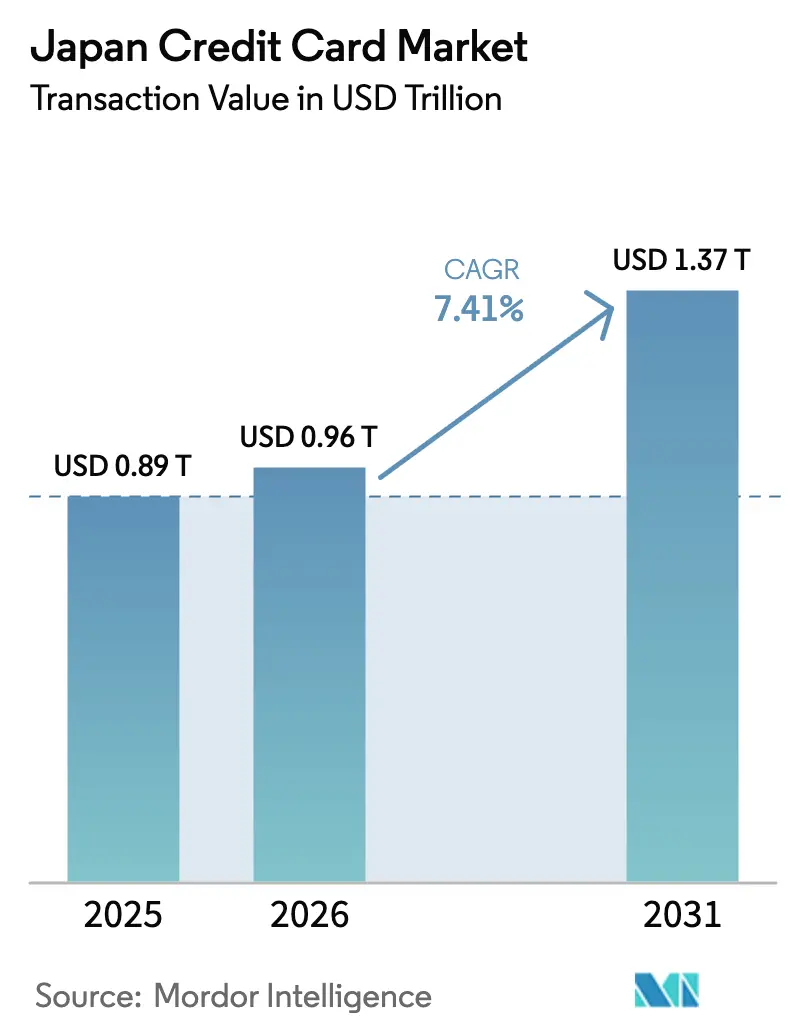
The Japan credit card market size was valued at USD 0.89 trillion in 2025 and estimated to grow from USD 0.96 trillion in 2026 to reach USD 1.37 trillion by 2031, at a CAGR of 7.41% during the forecast period (2026-2031). In 2024, the increasing reliance on credit cards as a primary mode of cashless transactions highlights the country’s ongoing transition toward a cashless economy. Despite this trend, the overall cashless payment ratio remains relatively low, indicating significant potential for growth in the adoption of digital payment methods. State-led digitalization programs, demographic shifts that favour contactless payments, and the integration of cards into super-app ecosystems continue to reinforce adoption momentum. Infrastructure modernization tied to the mandatory 3D Secure rule effective April 2025 is curbing fraud and raising merchant confidence, while inbound tourism recovery and embedded finance innovations are widening usage scenarios for both consumers and small businesses. Competitive dynamics remain intense, yet strategic alliances between banks, card networks, and fintech platforms are opening non-traditional distribution channels that extend the reach of the Japan credit card market.
Key Report Takeaways
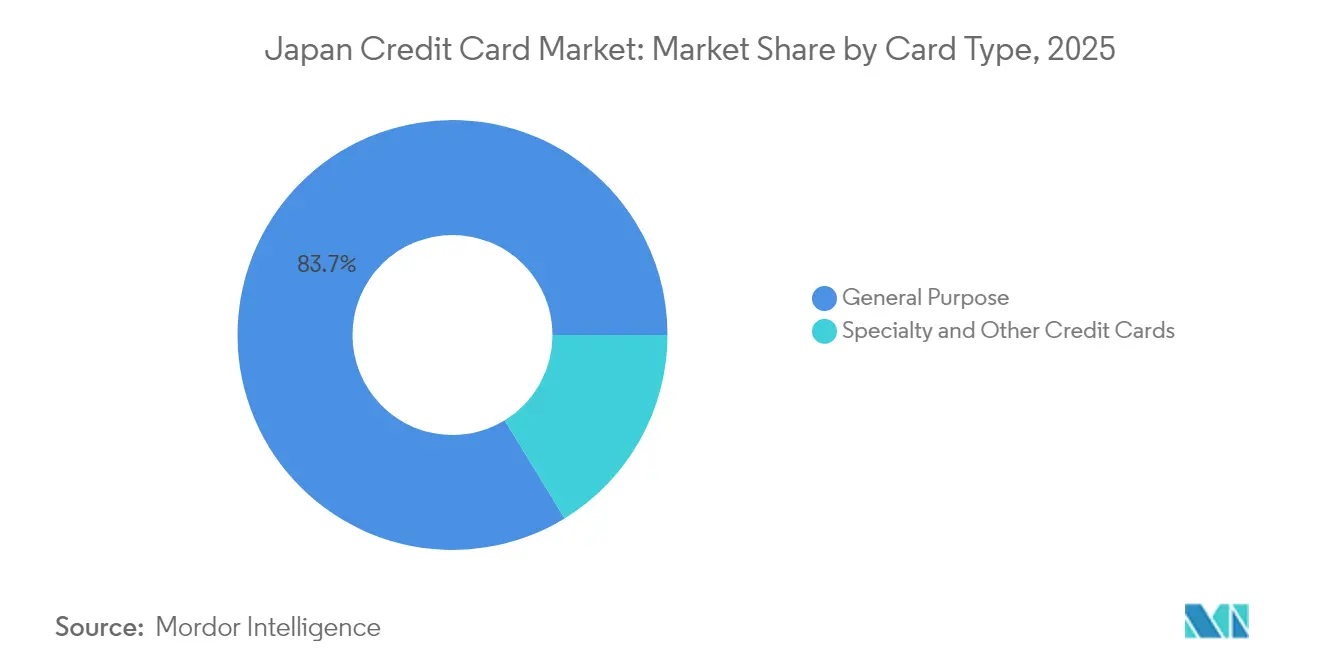
- By card type, general purpose cards held 83.74% of Japan credit card market share in 2025, while specialty & other cards are projected to expand at a 12.59% CAGR through 2031.
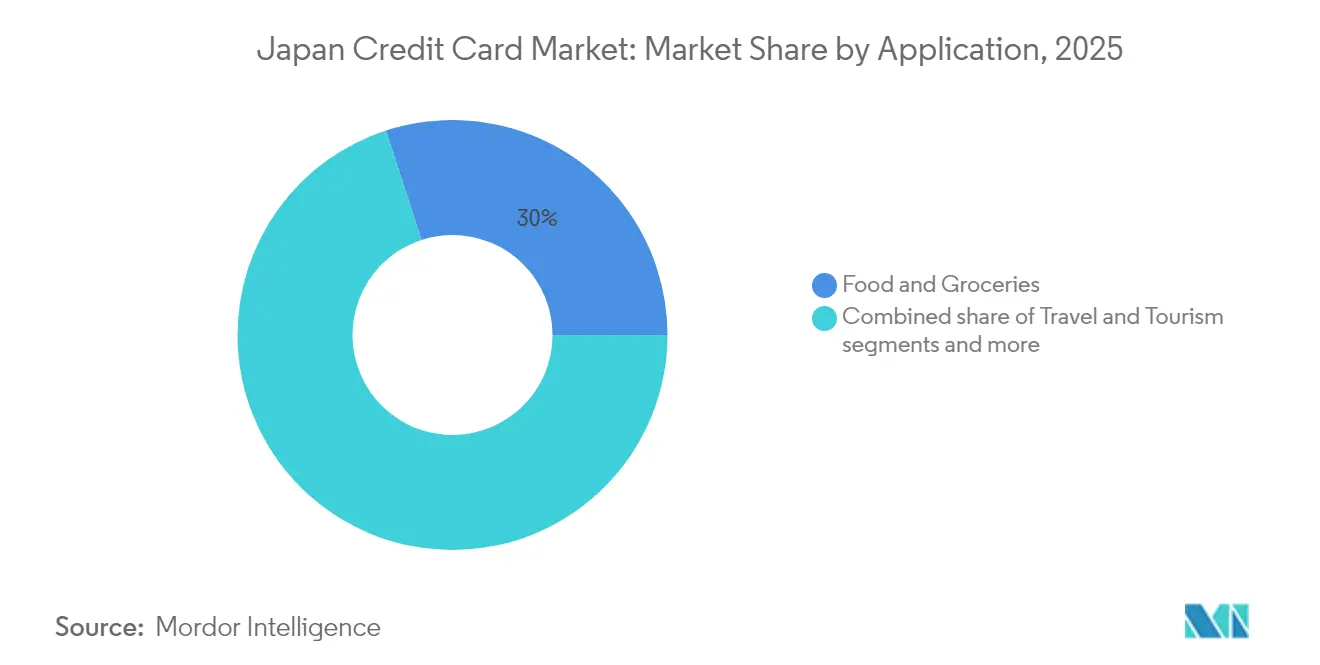
- By application, food & groceries captured 30.01% of Japan's credit card market size in 2025, whereas media & entertainment posts the strongest 10.18% CAGR through 2031.
- By provider, visa controlled 48.92% of Japan's credit card market share in 2025, yet discover-branded partners are on track for an 8.87% CAGR to 2031.
- By geography, the Kanto region accounted for 34.28% of Japan's credit card market size in 2025, and Kyushu & Okinawa show the highest 6.66% CAGR for the outlook period.
Note: Market size and forecast figures in this report are generated using Mordor Intelligence’s proprietary estimation framework, updated with the latest available data and insights as of 2026.
Worldwide, activity is shaped by contributions from multiple countries and regions, with Japan representing one among them. The global report on credit cards market by Mordor Intelligence reflects how these countries and regional layers combine into a single system.
Japan Credit Card Market Trends and Insights
Drivers Impact Analysis*
| Driver | (~) % Impact on CAGR Forecast | Geographic Relevance | Impact Timeline |
|---|---|---|---|
| Rising e-commerce penetration | +1.2% | Kanto and Kansai metro areas | Medium term (2-4 years) |
| Government-backed cashless push | +0.9% | Nationwide, strongest in Tokyo-Osaka-Nagoya | Short term (≤ 2 years) |
| Loyalty-program gamification | +0.7% | Urban centres | Medium term (2-4 years) |
| Pandemic-induced payment habit stickiness | +0.8% | Suburban and rural areas | Long term (≥ 4 years) |
| Integration into super-apps | +1.1% | Nationwide, spill-over to APAC | Medium term (2-4 years) |
| Growing BNPL-card hybrids | +0.6% | Urban markets | Long term (≥ 4 years) |
| Source: Mordor Intelligence | |||
Rising E-commerce Penetration Drives Transaction Volume Growth
Surging online retail activity funnels incremental spending onto cards, lifting transaction counts and average ticket sizes across the Japan credit card market. PayPay’s 7.46 billion transactions in 2024, equivalent to one-fifth of all cashless activity, illustrate how super-apps amplify card-linked volumes both online and at point-of-sale. The Bank of Japan closely tracks JCB Consumption NOW data to gauge private consumption, underscoring the macroeconomic importance of card flows[1]. Specialty products benefit disproportionally, as subscription-based gaming and streaming services underpin Media & Entertainment’s double-digit expansion. Transport operators in Kansai have already enabled tap-to-ride credit card payments, blurred category lines, and driven habitual card usage for low-value mobility transactions that once favoured cash.
Government-Backed Cashless Push Accelerates Infrastructure Modernization
The Financial Services Agency and the Digital Agency are coordinating policy, subsidy, and regulatory levers that speed merchant acceptance and strengthen cybersecurity. Required 3D Secure authentication from April 2025 is absorbing fraud losses that climbed to JPY 541 billion (USD 3.60 billion) in 2023, addressing a key bottleneck for digital uptake. My Number digital IDs will be wallet-ready by late spring 2025, enabling biometric verification and further streamlining checkout flows. The Expo 2025 Osaka pilot of facial-recognition payments will showcase next-generation use cases across 1,000 terminals, illustrating how public events can seed nationwide rollouts. Together, these measures establish a secure, standards-based environment that sustains Japan's credit card market growth amid rising transaction complexity.
Loyalty-Program Gamification Enhances Customer Lifetime Value
Issuers are layering game mechanics onto point ecosystems to deepen engagement. Rakuten Card’s neighbourly cross-service rewards underpin ownership among nearly 8 in 10 Japanese cardholders, proving that rich earn-and-burn loops drive front-of-wallet status. JCB’s POICHI service lets shoppers accrue multiple currencies in one scan, lifting frequency while offering retailers targeted promotions. Card-based investment capabilities—such as JCB’s mutual-fund sweep with SBI Securities—are broadening spend categories into wealth accumulation, reinforcing monthly activity even for older demographics. Ageing segments exhibit conservative borrowing but remain highly engaged where points convert to everyday savings, allowing issuers to harvest interchange rather than revolve balances.
Integration of Credit Cards into Super-Apps Expands Ecosystem Reach
PayPay, Rakuten, and new fintech super-apps rely on credit cards as both funding rails and loyalty conduits. Rakuten’s alliance with Mizuho and Orient Corporation connects 900,000 merchant nodes to bank infrastructure, enabling one-tap credit issuance at checkout[2]. SMBC’s capital link with Infcurion lets non-financial enterprises embed credit functions via APIs, already spawning more than 1.5 million corporate cards that ride the Visa network. Such network effects bind consumers into closed-loop environments, increasing data visibility for risk engines and cementing transaction share for platform-aligned issuers within the Japan credit card market.
Restraints Impact Analysis*
| Restraint | (~) % Impact on CAGR Forecast | Geographic Relevance | Impact Timeline |
|---|---|---|---|
| An ageing population’s lower credit appetite | -1.8% | Nationwide, the steepest in rural prefectures | Long term (≥ 4 years) |
| Intensifying debit & QR-code competition | -1.3% | Smartphone-dense urban hubs | Short term (≤ 2 years) |
| Stricter FSA affordability controls | -0.9% | Nationwide, focused on metro areas | Medium term (2-4 years) |
| Cyber-fraud surge at regional ATMs | -0.7% | Suburban ATM networks | Short term (≤ 2 years) |
| Source: Mordor Intelligence | |||
Ageing Population’s Lower Credit Appetite Constrains Expansion
Japan’s median age continues to climb, and older consumers generally avoid revolving balances, capping revenue potential for issuers. The senior demographic demonstrates a clear preference for card payments over cash transactions. Their card usage aligns more closely with debit card behaviour, underscoring a focus on transactional convenience rather than leveraging credit facilities. Rural depopulation compounds the issue, shrinking addressable volumes in regions where bank branch closures are already pronounced. Regulatory affordability guidelines further tighten underwriting, demanding more granular income validation for retirees. Issuers therefore pivot toward transaction-based economics, packaging generous points and cross-service bundles that resonate with frugal but digitally savvy seniors.
Intensifying Debit & QR-Code Competition Pressures Market Share
The market is witnessing a surge in rewards-focused debit cards and QR-code wallets introduced by banks and fintech providers, which are gradually diminishing the perceived benefits of credit cards. JCB has strategically partnered with regional banks to launch touch-enabled debit products, a move aimed at sustaining healthy network transaction volumes. However, these debit products generate lower interchange fees compared to credit cards, impacting revenue streams. In densely populated urban areas with high smartphone penetration, PayPay has established dominance in QR-based payment systems, particularly in convenience stores and quick-service restaurants. This trend is driving younger consumers to adopt mobile-native payment solutions. While these payments still rely on underlying card funding, they are compressing revenue margins for card issuers, signaling a shift in consumer payment preferences and its implications for the payment ecosystem.
*Our forecasts treat driver/restraint impacts as directional, not additive. The impact forecasts reflect baseline growth, mix effects, and variable interactions.
Segment Analysis
By Card Type: Specialized Products Outpace a Dominant Core
General-purpose cards represented 83.74% of Japan's credit card market size in 2025, reflecting their broad acceptance footprint and omnichannel utility. Specialty & Other cards are gaining ground at a forecast 12.59% CAGR as issuers court high-value niches with metal constructions, lifestyle privileges, and embedded finance options. JAL Luxury Card, launched August 2025, exemplifies ultra-premium positioning with annual fees up to JPY 599,500 (USD 3,990), targeting affluent travellers who demand exclusive lounge access. SME-focused products such as the forthcoming Orico-Aeon business card unlock working-capital lines for underserved corporate segments, illustrating how targeted propositions can widen participation without cannibalizing mainstream portfolios.
Fintech entrants’ experiment with creator-economy tie-ups, adding social identity layers that resonate with Gen Z. These novel formats exploit lean digital distribution to bypass costly physical channels, undercut fees, and gin up community engagement metrics. The diversification trend spreads issuer risk and incubates differentiated revenue streams, although scale remains centred on the stalwart General Purpose category that continues to anchor the Japan credit card market.

By Application: Consumption Patterns Shape Growth Focus
Food & Groceries commanded 30.01 of % Japan credit card market share in 2025, sustained by the supermarket sector’s broad contactless coverage and the rise of same-day delivery services. Media & Entertainment yields the highest expansion at a 10.18% CAGR, buoyed by subscription video, music streaming, and mobile gaming that generate stable monthly billings. Recent JCB-SBI Securities integration stretches card utility into investment contributions, hinting at a future where financial-services payments climb the application rankings.
Health & Pharmacy transactions benefit from digital prescription platforms and an aging population that values frictionless checkout in clinical settings. Travel & Tourism spending recovered briskly alongside the rebound in foreign arrivals, though regional disparities persist. Collectively, these patterns guide issuers to tailor category-specific bonuses and merchant co-marketing that reinforce loyalty and intensify spend concentration within the Japan credit card market.
By Provider: Visa’s Lead Faces Niche Network Encroachment
Visa processed 48.92% of all 2025 transaction value, leveraging an expansive terminal base and early contactless enablement in mass transit. Discover-branded partnerships are forecast at an 8.87% CAGR as Capital One’s acquisition resources accelerate acceptance, investments, and marketing. JCB safeguards domestic relevance with 56 million global acceptance points and new debit collaborations that lock regional banks into its rails. Mastercard emphasizes tokenization, pledging to retire static PANs by 2030 in favour of dynamic tokens and biometric passkeys, steps that may tighten merchant security requirements and influence issuer roadmaps.
Competition among providers is intensifying within digital channels, where issuers and super-apps must strategically decide between leveraging open-loop networks or adopting proprietary QR code frameworks. Robust backend capabilities, including advanced real-time fraud detection mechanisms, efficient token lifecycle management processes, and the availability of developer-friendly APIs, increasingly determine market success. These factors are becoming critical differentiators, surpassing the traditional reliance on the widespread distribution of physical card products.
Geography Analysis
Kanto accounted for 34.28% of Japan's credit card market size in 2025, anchored by Tokyo’s affluent consumer base and headquarters of global firms. Kyushu & Okinawa deliver the fastest 6.66% CAGR, lifted by tourism outlays and airport modernization. Kansai’s 40% contactless penetration outpaces most areas, proving that infrastructure density translates into usage frequency gains that amplify issuer returns. Hokkaido, Tohoku, and Chugoku-Shikoku regions derive spending boosts from nature-oriented travel, yet remain under-penetrated, signalling upside as hospitality providers upgrade terminals and loyalty tie-ins.
Japan’s diverse economic map produces distinct adoption curves for cards, necessitating nuanced go-to-market plays. Kanto leads in absolute volume, but its saturation requires issuers to chase wallet-share gains through premium tiers and bundled wealth products. Kyushu & Okinawa, buoyed by post-pandemic travel, view cards as gateways to tourist spend, thereby accelerating merchant acceptance upgrades across hotels and duty-free sites. Kansai’s embrace of transit tap-and-go indicates how public infrastructure can shift consumer psychology, presenting a template for other regions.
Chubu’s industrial backbone fuels B2B card uptake, especially as supply-chain digitalization mandates traceable expense controls. Issuers prioritizing aerospace and automotive supplier clusters can harvest volumes otherwise locked in bank transfers and paper invoicing. Geography-tailored outreach, such as local language concierge services and partnerships with prefecture-level banks, allows national brands to deepen relevance and defend share against regionally entrenched challengers.
Mordor Intelligence provides coverage of the credit cards market across other key regional markets, including Europe, each with their regulatory frameworks and demand patterns. Detailed country-level analysis extends to Hong Kong, Israel, and Canada incorporating local coverage and market participation, as required.
Regulatory Landscape
Japan’s credit card activity sits primarily under the Installment Sales Act framework, with the Japan Consumer Credit Association (JCA) operating as an accredited association that supports consumer protection practices such as payment-capacity surveys and card-number management. On the security side, the mandatory 3D Secure requirement effective April 2025 has become a practical compliance anchor for issuers and merchants in a market responding to online fraud that reached JPY 541 billion in 2023.
Regulatory scope is also shifting around adjacent payment rails and intermediaries. The Financial Services Agency (FSA) implemented new rules effective June 1, 2026 for electronic payment instruments and cryptoasset service intermediaries under amendments to the Payment Services Act, adding compliance requirements for regulated digital payment services. Policy attention has also moved toward payment-processing firms after the bankruptcy of provider Zentoshin, with the government considering a survey of credit card payment processing service firms that have historically fallen outside financial oversight under the Installment Sales Act because they do not extend credit to consumers.
Value Chain Analysis
The Japan credit card value chain runs from card networks and brands (for example, JCB and Visa) through issuers (banks and specialized card companies such as Mitsubishi UFJ NICOS and UC Card) to merchant acquirers and payment processors that route authorization, clearing, and settlement. Industry associations such as the Japan Consumer Credit Association (JCA) support operational standards and consumer protection practices that shape underwriting, account management, and card-number handling.
A key evolution in the downstream stack is the modernization of acceptance and processing technology among intermediaries. Japan Merchant Services (JMS) adopting a Tap on Mobile application provided by the Japan Card Network (CARDNET) illustrates how processors and acquirers are moving more capability into software-based acceptance, tightening integration between merchant onboarding, transaction routing, and risk controls. This increases the strategic importance of processors and platform partners in enabling new acceptance formats while maintaining compliance with card security and authentication requirements.
Competitive Landscape
The top issuers command a significant share of purchase value, endowing the market with moderate concentration but leaving headroom for agile disruptors. Rakuten Card’s symbiosis with the e-commerce giant yields formidable acquisition economics, while Mizuho’s alliance supercharges cross-sell into bank accounts and mortgages. Sumitomo Mitsui Card invests in biometric plastics through its LIFE CARD subsidiary to counter fraud fatigue and differentiate on security. SMBC Group’s tie-up with Infcurion unlocks white-label issuance for retailers and SaaS firms, signalling a shift toward platform-as-a-service models that abstract away traditional bank rails.
Mid-tier players exploit niche focus, as Season Card targets lifestyle segments and AEON Credit Service leverages its retail footprint for co-branded penetration. Fintech entrants like Nudge push user-centric design, while PayPay Card Corp unifies QR wallet funding and revolving credit within a single app, enabling data flywheels that refine underwriting. International networks partner selectively—Discover via domestic alliances and Diners through high-end hospitality like Hotel New Otani’s premium program, to stake claims within profitable sub-pools. Collectively, these manoeuvres intensify innovation velocity yet leave incumbents with scale economics that sustain their leadership within the Japan credit card market.
Japan Credit Card Industry Leaders
-
JCB Co. Ltd.
-
Mitsubishi UFJ NICOS
-
Sumitomo Mitsui Card (SMCC)
-
Rakuten Card
-
AEON Credit Service
- *Disclaimer: Major Players sorted in no particular order

Market Opportunities and Future Outlook
Embedded issuance and ecosystem distribution continue to create room beyond traditional bank-led acquisition. Platform partnerships that let non-financial brands and software platforms provide card-like credit functions via APIs align with shifts already visible in Japan, including SMBC Group’s relationship with Infcurion and the market push toward corporate and SME card programs tied to digitized expense workflows. Issuer moves to connect cards to investment and savings features also reinforce the card’s role as a recurring payment rail for wealth-building contributions, rather than only a retail checkout tool.
Cross-border premium propositions tied to Japan travel are another lever for issuers and networks. MUFG Bank and JCB signed an MOU on July 6, 2026 for a comprehensive strategic alliance in ASEAN, including plans to issue a premium credit card in Indonesia via PT Bank Danamon Indonesia Tbk (with concierge services oriented to travel to Japan) and a similar launch plan for Thailand via Bank of Ayudhya in fiscal 2027. In the Japan market, these programs broaden the pool of high-spend inbound visitors and link overseas customer bases to Japan acceptance, supporting travel-and-tourism card usage scenarios and premium benefits strategies at domestic merchants.
Recent Industry Developments
- June 2026: Mitsubishi UFJ NICOS expanded service benefits for the M-U-T (Emutto) comprehensive financial platform, including increased point rewards for Mitsubishi UFJ Card purchases at specific brands and improved credit card investment return rates. The update strengthens bank-wide wallet share and supports cross-sell into wealth and investment services.
- June 2026: Sumitomo Mitsui Card released the updated Purchase Plus corporate expense management service, incorporating enhanced digital financial information gathering and security features developed in collaboration with Visa Worldwide Japan and Infcurion. The rollout advances a platform-as-a-service approach for corporate customers and deepens data-driven security and compliance tools.
- May 2026: Mitsubishi UFJ NICOS partnered with Mitsubishi UFJ Bank and WealthNavi to introduce credit card-based automatic investment contributions using the Mitsubishi UFJ Card for WealthNavi for MUFG Bank. The arrangement extends the card ecosystem into automated wealth management and mass-affordable investing.
Research Methodology Framework and Report Scope
Market Definition and Coverage
This market is defined as the total value generated from credit card based payment activity in Japan, covering consumer and business usage where a revolving or deferred credit feature is present and recorded through card payment rails.
Scope exclusions: The sizing excludes cash withdrawals, pure debit transactions, stored value e-money, and account-to-account transfers even when a card-like interface is used.
Segmentation Overview
- By Card Type
- General Purpose Credit Cards
- Specialty & Other Credit Cards
- By Application
- Food & Groceries
- Health & Pharmacy
- Restaurants & Bars
- Consumer Electronics
- Media & Entertainment
- Travel & Tourism
- Other Applications
- By Provider
- Visa
- MasterCard
- Other Providers
- By Geography
- Hokkaido
- Tohoku
- Kanto
- Kyushu & Okinawa
- Rest of Japan
Data Sources, Market Sizing, and Validation
Desk Research
Desk research sets the base for the model by aligning definitions, time series, and currency handling before any interviews begin. We rely on public payment and consumer credit statistics to anchor transaction value movement, outstanding balances, and card issuance trends, followed by macro context that explains shifts in spend.
Typical inputs come from sources such as the Bank of Japan payment and settlement statistics, the Japan Consumer Credit Association statistics, Japan's Ministry of Internal Affairs and Communications for household spending and CPI, and the Cabinet Office for GDP and private consumption. We also use company filings, investor materials, and trusted press to understand product mix changes like contactless adoption and rewards intensity. Select paid subscriptions are used for company financials and for shipment-level trade checks where relevant to POS and terminal trends, and the mentioned sources are illustrative since many other references are used to cross-check and clarify assumptions.
Primary Interviews and Surveys
Primary work is used to pressure-test what the public data cannot fully show, such as mix shifts between credit, charge, and installment usage, as well as merchant category and channel behavior. We speak with issuers, acquirers, payment processors, merchants, and risk and compliance specialists across Japan, and then we use those inputs to confirm adoption drivers, pricing logic, and near-term outlook assumptions.
Distribution of primary research fieldwork respondents
| Company type | Respondent position |
|---|---|
| Top tier: 39% | CXOs: 18% |
| Mid tier: 42% | Functional/Unit leaders: 28% |
| Smaller Players: 19% | Managers: 54% |
Market-Sizing & Forecasting
The core model is built using a top-down demand pool where national card payment value and credit-related shares are reconstructed from official series and industry disclosures, and then split into credit card relevant flows. Once that scaffold is in place, results are checked through selective bottom-up approximations, such as sampling issuer reported card shopping value, applying realistic growth ranges, and validating with merchant acceptance and channel checks.
Key inputs that move the model include credit card shopping value trends, outstanding receivables, number of cards issued, consumer spending growth, and inflation effects on ticket size. Where a public series is in yen, we convert to USD using consistent annual average exchange assumptions so year-on-year movement is not distorted. Forecasting is done using scenario analysis supported by a simple multivariate regression overlay, where drivers like private consumption, CPI, and cashless policy momentum are used to keep growth rates reasonable. When bottom-up signals are missing for smaller cohorts, gaps are handled by using conservative ranges agreed during interviews, and then stress-tested against the full market totals.
Data Validation & Update Cycle
Outputs are validated through triangulation across at least three angles, which typically include official payment statistics, issuer disclosures, and expert checks on mix and pricing behavior. We run variance checks to spot jumps that do not match macro signals, and anomalies trigger a re-check of definitions, currency timing, and any one-off events.
Before sign-off, the model is reviewed in multiple steps by analysts so assumptions, formulas, and year mapping are consistent across the workbook. Reports are refreshed annually, and interim updates are made when there are material events like rule changes, sharp FX swings, or shifts in fraud and authentication requirements. Right before delivery, a final pass is done so clients receive the latest updated view.
Mordor Intelligence's Japan Credit Cards Market Sizing Compared With Other Published Estimates
Published market numbers for Japan credit cards often do not line up because the underlying measurement is not always the same, even when titles look similar. Differences usually come from what is counted as credit versus total card payments, whether values reflect transaction flow or outstanding balances, and how yen to USD conversion is applied for the chosen year.
Another common split is the handling of charge cards and installment or revolving components, plus whether the figures include cash advances and fees alongside purchase value. Some estimates also use a single-year headline with aggressive growth assumptions, while others spread growth using macro drivers and then smooth unusual years. The main gap comes from counting only credit card purchase value (and excluding debit and stored value payment flows) and then normalizing FX on a consistent annual basis, which is the approach applied by Mordor Intelligence.
Benchmark comparison
| Source | Market Size | Gaps in Research Methodology |
|---|---|---|
| Mordor Intelligence | USD 0.89 T (2025) | |
| Trade Journal A | USD 0.87 T (2024) | Uses total card payments value as a proxy and then applies a credit card share, which can understate or overstate credit-only value depending on the debit mix and the charge card treatment. |
| Industry Association B | USD 0.80 T (2024) | Anchors on issuer shopping value reported in local currency and may not fully align year definitions and FX conversion to USD, and it can exclude some cross-border and corporate spend components. |
The spread in the table is mainly explained by scope choices and by how the local currency series is converted and aligned to the study year. By keeping variables tied to observable payment and credit statistics, and then adjusting assumptions only after interview checks, our estimate stays repeatable and easier to reconcile with real-world signals.
Key Questions Answered in the Report
What is the current value and projected growth of Japan’s credit-card spending?
Aggregate purchase value is USD 0.96 trillion in 2026 and is forecast to reach USD 1.37 trillion by 2031, implying a 7.41% CAGR.
Which card type captures the most consumer spend?
General-purpose cards account for 83.74% of overall transaction value, reflecting their broad merchant acceptance and multi-category utility.
Which application segment generates the largest share of transactions?
Food & Groceries leads with a 30.01% share thanks to ubiquitous supermarket acceptance and high shopping frequency.
Which provider is expanding fastest, and why?
Discover-branded partners are on track for an 8.87% CAGR through 2031, buoyed by Capital One’s planned investment to widen merchant acceptance and bolster network technology.
How are biometric technologies changing everyday card usage?
Issuers are enhancing security and expediting checkouts by testing fingerprint-enabled plastics and deploying facial-recognition terminals, like NEC's initiative for Expo 2025 Osaka.
What impending rule will tighten card-payment security in 2025?
From April 2025 all issuers and merchants must adopt 3D Secure authentication, a mandate designed to curb online fraud that hit JPY 541 billion in 2023.