
Ireland Data Center Power Market Size and Share
Market Overview
| Study Period | 2020 - 2031 |
|---|---|
| Base Year For Estimation | 2025 |
| Forecast Data Period | 2026 - 2031 |
| Market Size (2026) | USD 331.68 Million |
| Market Size (2031) | USD 696.04 Million |
| Growth Rate (2026 - 2031) | 15.98 % CAGR |
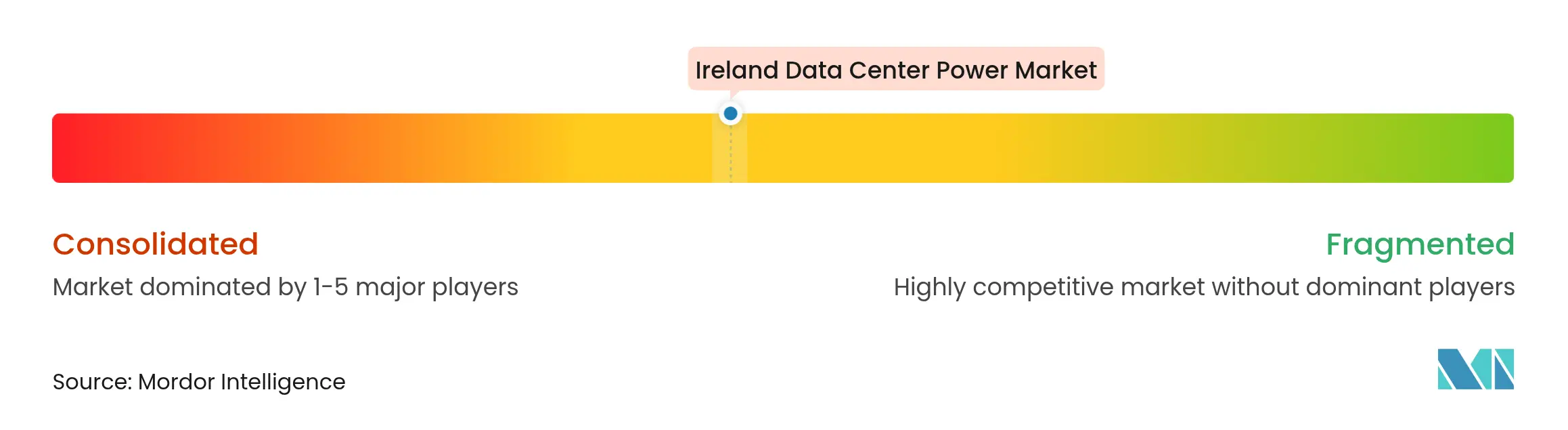
| Market Concentration | Medium |
Major Players *Disclaimer: Major Players sorted in no particular order. Image © Mordor Intelligence. Reuse requires attribution under CC BY 4.0. |
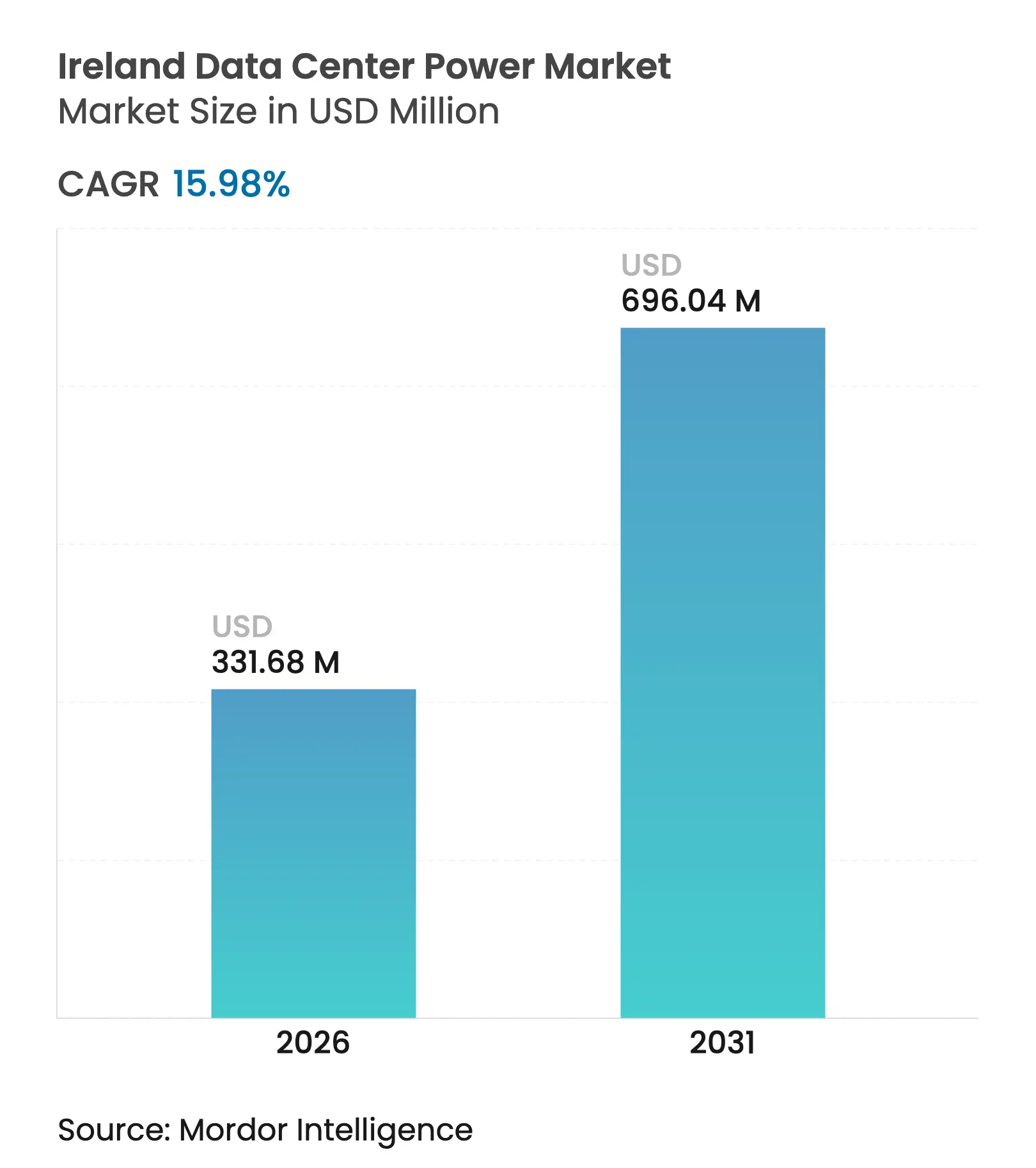

Ireland Data Center Power Market Analysis by Mordor Intelligence
The Ireland data center power market size was valued at USD 285.98 million in 2025 and estimated to grow from USD 331.68 million in 2026 to reach USD 696.04 million by 2031, at a CAGR of 15.98% during the forecast period (2026-2031). Rapid cloud adoption, AI-driven workloads, and new on-site generation mandates are stretching existing infrastructure even as operators chase growth. Demand is shifting toward grid-interactive uninterruptible power supplies (UPS) and high-density power distribution units (PDUs) that can manage power peaks linked to generative AI servers. At the same time, the moratorium on new grid connections in Dublin is steering investment toward locations with headroom for renewable generation. Competitive dynamics now hinge on who can deploy modular power blocks fastest, monetize waste heat, and align with stricter sustainability rules.
Key Report Takeaways
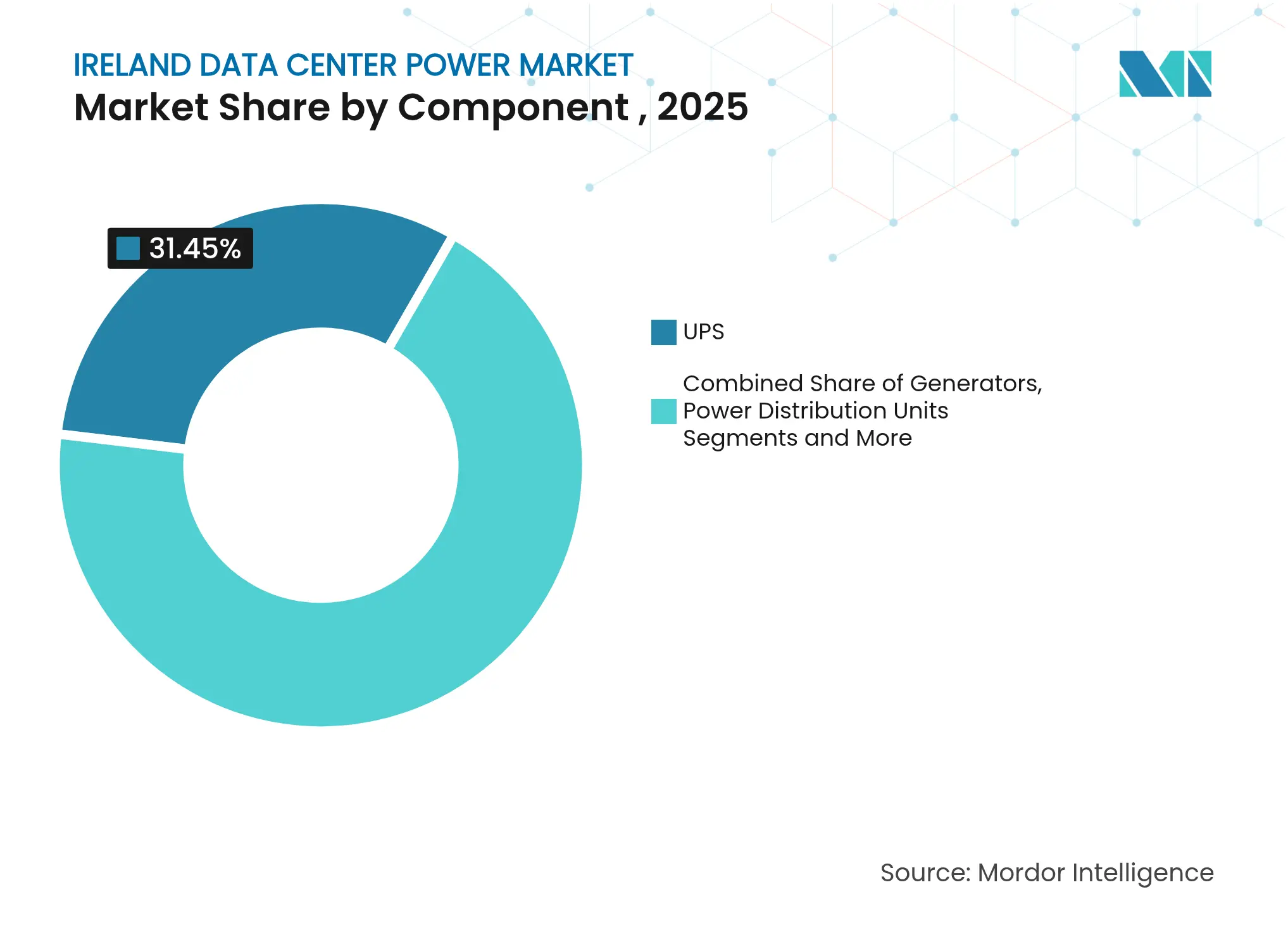
- By component, UPS systems led with 31.45% of Ireland's data center power market share in 2025; PDUs are projected to expand at a 16.92% CAGR through 2031.
- By data center type, the colocation segment held 34.62% of the Ireland data center power market share in 2025, while hyperscale/cloud sites are projected to post a 19.74% CAGR between 2026 and 2031.
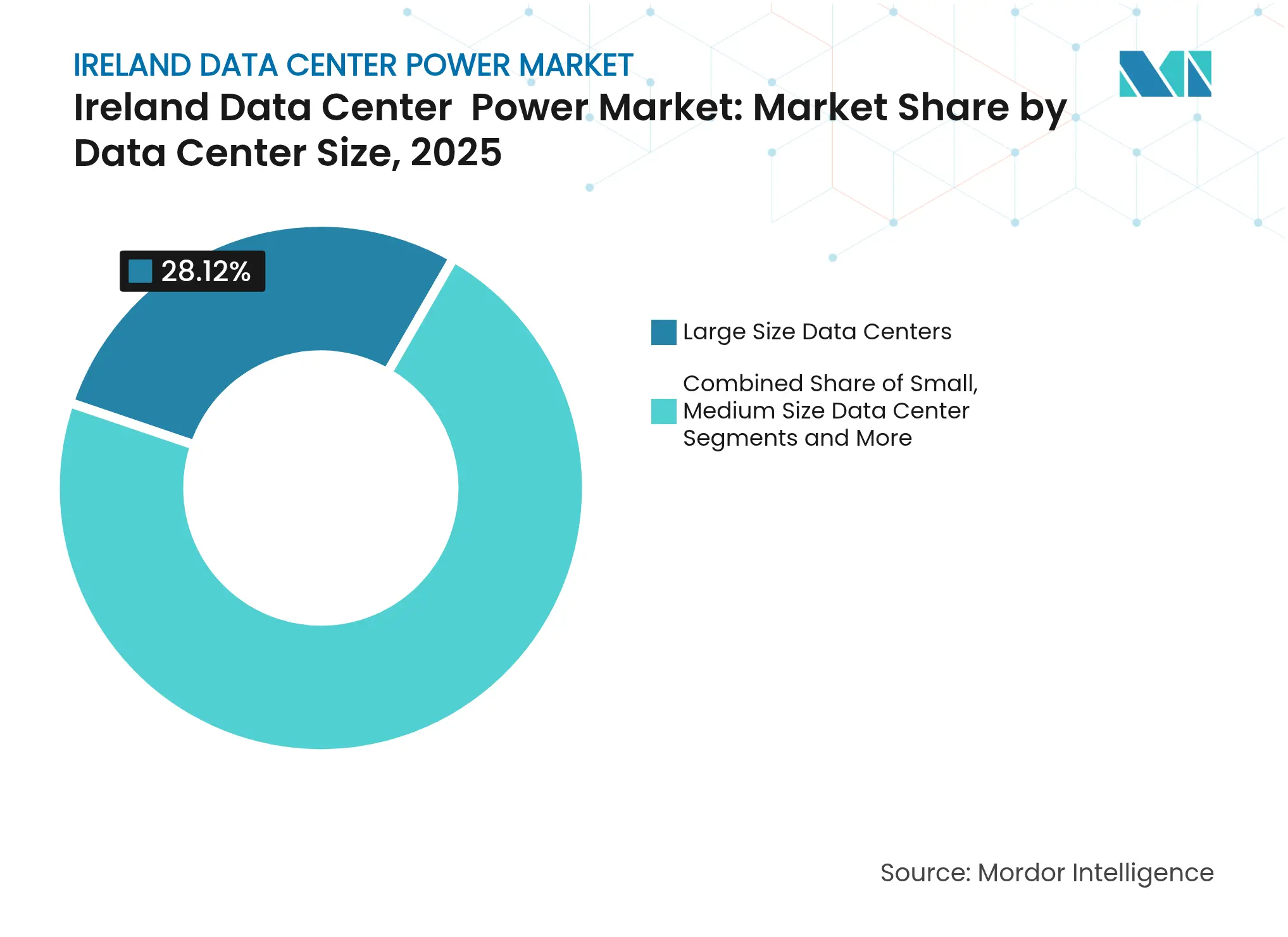
- By size, large facilities accounted for 28.12% of the Ireland data center power market size in 2025; mega centers are forecast to grow at a 21.06% CAGR to 2031.
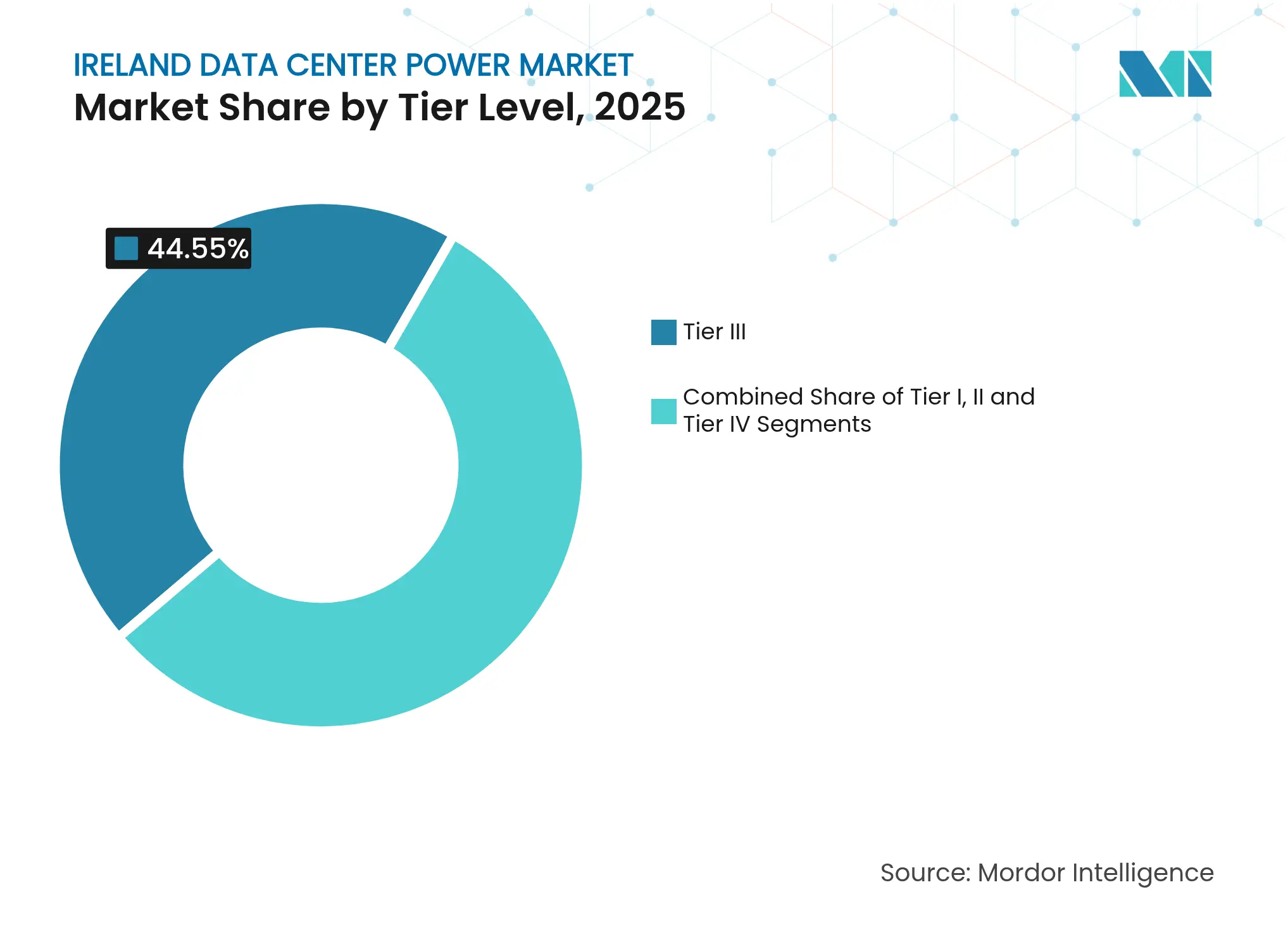
- By tier level, Tier III sites captured 44.55% of the Ireland data center power market size in 2025; Tier IV sites are advancing at a 20.58% CAGR through 2031.
Note: Market size and forecast figures in this report are generated using Mordor Intelligence's proprietary estimation framework, updated with the latest available data and insights as of 2026.
Ireland Data Center Power Market Trends and Insights
Drivers Impact Analysis
| Driver | (~)% Impact on CAGR Forecast | Geographic Relevance | Impact Timeline |
|---|---|---|---|
Hyperscale
and Cloud Expansion
|
+5.2%
|
National,
with concentration in Dublin
|
Medium
term (2-4 years)
|
Opex-reduction
Demand (High-Efficiency UPS, PDUs)
| +2.8% | National | Short term (≤ 2 years) |
AI/ML
Workloads Driving High-Density Power
| +4.5% | National, with concentration in Dublin | Medium term (2-4 years) |
Grid-Interactive
UPS and PPA Adoption
| +1.9% | National | Medium term (2-4 years) |
CRU
On-Site Generation Mandate Fuelling Micro-Grids
| +3.1% | National | Short term (≤ 2 years) |
Monetisation
of Waste-Heat for District Heating
| +1.4% | National, with early gains in Dublin | Long term (≥ 4 years) |
| Source: Mordor Intelligence | |||
Hyperscale and Cloud Expansion: Reshaping Ireland’s Digital Infrastructure
Dublin now hosts 5% of global hyperscale capacity, making it the third-largest hyperscale hub worldwide. Power densities in these campuses exceed those of enterprise sites, compelling operators to standardize modular 100 MW building blocks that can be energized quickly. Microsoft’s newest Dublin build is tailored to European AI demand and incorporates pre-fabricated power rooms that shave two years off construction schedules. Financing models increasingly bundle long-term renewable power purchase agreements (PPAs) to hedge rising electricity costs. Colocation players are upgrading older halls to compete on efficiency, often layering grid-support capabilities into UPS fleets to create fresh revenue streams. As hyperscalers scale outward, secondary cities now court projects by guaranteeing land, natural-gas access, and fast-track permits.
AI/ML Workloads: Redefining Power Density Requirements
Generative AI servers in Ireland draw three to four times the power of legacy CPU racks, accelerating a shift to liquid cooling and busbar-based distribution. The International Energy Agency warns that global data center demand could touch 945 TWh by 2030, with AI workloads representing one-fifth of that total.[1] Irish operators now specify rack densities above 70 kW, driving adoption of smart PDUs that report circuit-level draw in real time. Liquid-to-chip cooling loops are being paired with heat-recovery skids that supply district networks, exemplified by the Tallaght scheme that taps AWS waste heat to warm municipal buildings.
CRU On-Site Generation Mandate: Catalyzing Microgrid Development
Since 2025, new Irish data centers must match imported power with on-site generation or storage, effectively turning each campus into a micro-utility. Developers now integrate gas turbines, solar arrays, and battery energy storage systems (BESS) into the base design to satisfy the rule. Eaton and Siemens Energy’s modular 500 MW plant concept illustrates how packaged gas-plus-hydrogen solutions can be dropped into constrained grids and later converted to zero-carbon fuels.[2] Financing structures reward plants that trade surplus generation into the wholesale market, giving operators a hedge against volatile tariffs. The mandate also spurs collaboration with utilities to align dispatch schedules with national renewable peaks, minimizing curtailment.
Grid-Interactive UPS: Turning Loads into Grid Assets
Microsoft proved that a modern UPS fleet can deliver frequency-response capacity without jeopardizing uptime, unlocking new income via the DS3 ancillary-services program. A single 50 MW campus can dedicate up to 20% of its power budget to system-stabilization calls, a critical lever as data centers now represent 21% of Ireland’s electricity load and could hit 30% by 2030.[3] Vendors such as ABB and Vertiv embed grid-support logic into new UPS frames, synchronizing discharge windows with EirGrid’s dispatch signals. Participation allows operators to offset higher energy costs tied to AI racks while bolstering national grid resilience.
Restraint Impact Analysis
| Restraint | (~)% Impact on CAGR Forecast | Geographic Relevance | Impact Timeline |
|---|---|---|---|
High
Installation and Maintenance Costs
|
-2.1%
|
National
|
Medium
term (2-4 years)
|
Dublin
Grid Moratorium and Capacity Constraints
| -4.3% | Dublin region | Short term (≤ 2 years) |
Pending
Diesel-Genset Phase-Out Regulation
| -1.8% | National | Medium term (2-4 years) |
Li-ion
UPS Battery Supply-Chain Bottlenecks
| -1.5% | National | Short term (≤ 2 years) |
| Source: Mordor Intelligence | |||
Dublin Grid Moratorium: Reshaping Development Patterns
EirGrid’s freeze on new megawatt-scale connections in Dublin through 2028 affects the 82 facilities that already dominate national capacity. Operators lacking signed agreements are diverting budgets to counties Wicklow and Westmeath, where land banks can be coupled with private gas feeds. Echelon’s EUR 3.5 billion Wicklow campus showcases this pivot, combining wind PPAs and embedded generation to bypass urban bottlenecks. The moratorium also accelerates interest in subsea connectivity projects that anchor outside the capital, such as Amazon’s Cork landing station linking Ireland to the US.
Pending Diesel-Genset Phase-Out: Accelerating Backup Innovation
Ireland’s forthcoming rules that curb diesel standby units are pushing operators toward gas-fired sets, hydrogen-ready turbines, and battery energy storage. Lithium-ion prices now justify installing BESS blocks sized to ride through typical outage windows, complemented by renewable firming during off-peak hours. Some operators trial hydrotreated vegetable oil (HVO) in existing diesel fleets to cut emissions ahead of formal deadlines. Schneider Electric’s microgrid controller orchestrates these hybrids, ensuring seamless failover while reporting real-time emissions to meet compulsory annual disclosures.
Segment Analysis
By Component: Shift Toward Intelligent Power Platforms
UPS systems generated 31.45% of 2025 revenue, anchoring the Ireland data center power market as operators prize proven ride-through capability. The newest frames add lithium-ion batteries and grid-interactive controls, turning traditional backup into dispatchable capacity that earns ancillary-service fees. Vendors such as Eaton bundle predictive analytics that flag battery degradation early, cutting maintenance spend and averting unplanned outages. Intelligent bypass features also let technicians isolate modules without dropping load, a key factor for Tier IV contracts driving zero-downtime service-level agreements.
PDUs represent the fastest-growing slice, expanding at 16.92% CAGR as sensors and branch-circuit monitoring become compulsory in AI halls. Granular insight into sub-rack consumption supports dynamic load placement, helping to shave peaks that would otherwise trigger expensive grid-capacity charges.
Note: Segment shares of all individual segments available upon report purchase
By Data Center Type: Colocation Dominance Meets Hyperscale Momentum
Colocation vendors held 34.62% of 2025 revenue, capturing enterprises that prefer opex-friendly footprints over greenfield builds. Established grid contracts give these incumbents bargaining power in a constrained market, allowing them to resell capacity to newer entrants that lack permits in Dublin. Inter-connection density within carrier-neutral halls also attracts content providers that need low-latency hand-offs, making colocation a durable pillar of the Ireland data center power market.
Hyperscale operators, however, post the steepest growth at 19.74% CAGR to 2031 as generative AI drives server refresh cycles. Cloud giants increasingly co-locate dedicated power substations on campus to meet CRU’s one-to-one import rules, effectively securing control over their energy destiny. Many pairs of on-site turbines with wind PPAs to meet corporate carbon targets while navigating curtailment risks. This self-sufficiency model is reshaping supplier negotiations, with hyperscalers insisting on modular power skids that arrive pre-wired to compress deployment timelines.
By Data Center Size: Scaling Up for AI Era
Large sites accounted for 28.12% of the Ireland data center power market size in 2025, offering a practical bridge between legacy enterprise footprints and hyperscale campuses. These facilities often tap existing industrial feeders, avoiding lengthy transmission upgrades in Dublin’s urban core. Operators invest in AI-driven predictive maintenance that parses vibration and thermal signatures, extending asset life without sacrificing uptime.
Mega centers will log a 21.06% CAGR through 2031, propelled by multinationals consolidating European workloads. A single mega campus can require 100 MW of power, prompting developers to site projects near gas pipelines and wind corridors outside Dublin. The Ireland data center power market size for mega builds is set to climb sharply once Wicklow and Westmeath campuses reach full energisation, underlining the migration of capacity toward regions with grid headroom.
Note: Segment shares of all individual segments available upon report purchase
By Tier Level: Reliability Premium Intensifies
Tier III facilities captured 44.55% of the Ireland data center power market size in 2025, balancing cost with the N+1 redundancy most enterprises deem sufficient. Concurrent maintainability lets operators swap components without downtime, aligning with service-credit clauses in colocation contracts. Financing partners favor the proven Tier III template because design risk is lower and payback periods are clearer.
Tier IV footprints will expand at 20.58% CAGR as AI inference clusters, fintech trading engines, and sovereign-cloud mandates demand fault-tolerant environments. Double-bus UPS topologies, dual utility feeds, and mirrored switchgear grids drive capex but unlock premium pricing among latency-sensitive clients. The CRU’s generation rule accelerates Tier IV adoption of micro-grids that couple gas turbines, BESS, and potentially green hydrogen to guarantee uptime while staying within carbon budgets.
Note: Segment shares of all individual segments available upon report purchase
Geography Analysis
County Wicklow demonstrates the new playbook. Echelon’s EUR 3.5 billion campus will run hybrid gas-plus-wind micro-grids that export surplus energy, satisfying CRU’s import-matching requirement and monetizing excess through wholesale markets. Wicklow also benefits from planned subsea cables that will land outside Dublin, lowering latency to North America and the UK, a draw for hyperscalers seeking resilient routes.
Attention is shifting westward where robust wind resources and cool Atlantic air enable free cooling for much of the year. Counties Clare and Galway market available land close to high-voltage lines carrying renewable flows from offshore arrays, positioning themselves as future growth corridors. The government’s Climate Action Plan, targeting 80% renewable electricity by 2030, bolsters this pitch by prioritizing transmission upgrades that deliver clean energy to industrial clusters Over the next five years, the Ireland data center power market is likely to mature into a multi-node ecosystem that spreads load, supports higher renewable penetration, and reduces the capital’s grid strain.

Competitive Landscape
Market Concentration
Global power-infrastructure majors ABB, Eaton, Schneider Electric, and Vertiv anchor the supply side of the Ireland data center power market. Their portfolios span UPS, switchgear, DCIM, and micro-grid controls, allowing one-stop procurement for hyperscale clients. Recent strategy centers on embedding data-enabled services; Vertiv’s AI-ready UPS line launched in April 2025 adds neural-network algorithms that learn load patterns and optimize inverter performance. In niche segments, startups provide edge-scale power skids that can be delivered in containerized modules within 12 weeks, a value proposition for telecoms deploying distributed AI inference nodes.
Partnerships are multiplying as hardware and generation worlds converge. Eaton’s tie-up with Siemens Energy on a 500 MW modular plant targets developers who must meet on-site generation quotas fast, promising two-year schedule savings compared with bespoke builds. ABB teams with gas-turbine specialists to market hydrogen-ready backup blocks, aligning with anticipated diesel exit requirements.
Ireland Data Center Power Industry Leaders

*Disclaimer: Major Players sorted in no particular order
Recent Industry Developments
- June 2025: Eaton and Siemens Energy partnered to deliver modular 500 MW on-site generation plants that can operate on natural gas today and hydrogen tomorrow, compressing data-center build schedules by up to two years.
- May 2025: Red Admiral announced a 250 MW energy-independent data center in Westmeath, illustrating the geographic shift away from Dublin.
- February 2025: CRU confirmed new rules obliging large energy users to match import capacity with on-site generation or storage and to publish annual emissions reports.
- January 2025: Microsoft filed plans for three subsea cables linking Ireland to the UK to support expanding data-center estates.
Table of Contents for Ireland Data Center Power Industry Report
1. INTRODUCTION
- 1.1 Study Assumptions and Market Definition
- 1.2 Scope of the Study
2. RESEARCH METHODOLOGY
3. EXECUTIVE SUMMARY
4. MARKET LANDSCAPE
- 4.1 Market Overview
- 4.2 Market Drivers
- 4.2.1 Hyperscale and Cloud Expansion
- 4.2.2 Opex-reduction Demand (High-Efficiency UPS, PDUs)
- 4.2.3 AI/ML Workloads Driving High-Density Power
- 4.2.4 Grid-Interactive UPS and PPA Adoption
- 4.2.5 CRU On-Site Generation Mandate Fuelling Micro-Grids
- 4.2.6 Monetisation of Waste-Heat for District Heating
- 4.3 Market Restraints
- 4.3.1 High Installation and Maintenance Costs
- 4.3.2 Dublin Grid Moratorium and Capacity Constraints
- 4.3.3 Pending Diesel-Genset Phase-Out Regulation
- 4.3.4 Li-ion UPS Battery Supply-Chain Bottlenecks
- 4.4 Supply-Chain Analysis
- 4.5 Regulatory Landscape
- 4.6 Technological Outlook
- 4.7 Porter's Five Forces Analysis
- 4.7.1 Threat of New Entrants
- 4.7.2 Bargaining Power of Buyers
- 4.7.3 Bargaining Power of Suppliers
- 4.7.4 Threat of Substitutes
- 4.7.5 Intensity of Competitive Rivalry
- 4.8 Assessment of Macroeconomic Trends on the Market
5. MARKET SIZE AND GROWTH FORECASTS (VALUE)
- 5.1 By Component
- 5.1.1 Electrical Solutions
- 5.1.1.1 UPS Systems
- 5.1.1.2 Generators
- 5.1.1.2.1 Diesel Generators
- 5.1.1.2.2 Gas Generators
- 5.1.1.2.3 Hydrogen Fuel-cell Generators
- 5.1.1.3 Power Distribution Units
- 5.1.1.4 Switchgear
- 5.1.1.5 Transfer Switches
- 5.1.1.6 Remote Power Panels
- 5.1.1.7 Energy-storage Systems
- 5.1.2 Service
- 5.1.2.1 Installation and Commissioning
- 5.1.2.2 Maintenance and Support
- 5.1.2.3 Training and Consulting
- 5.2 By Data Center Type
- 5.2.1 Hyperscaler/Cloud Service Providers
- 5.2.2 Colocation Providers
- 5.2.3 Enterprise and Edge Data Center
- 5.3 By Data Center Size
- 5.3.1 Small Size Data Centers
- 5.3.2 Medium Size Data Centers
- 5.3.3 Large Size Data Centers
- 5.3.4 Massive Size Data Centers
- 5.3.5 Mega Size Data Centers
- 5.4 By Tier Level
- 5.4.1 Tier I and II
- 5.4.2 Tier III
- 5.4.3 Tier IV
6. COMPETITIVE LANDSCAPE
- 6.1 Market Concentration
- 6.2 Strategic Moves
- 6.3 Market Share Analysis
- 6.4 Company Profiles (includes Global level Overview, Market level overview, Core Segments, Financials as available, Strategic Information, Market Rank/Share for key companies, Products and Services, and Recent Developments)
- 6.4.1 ABB Ltd.
- 6.4.2 Eaton Corporation plc
- 6.4.3 Schneider Electric SE
- 6.4.4 Vertiv Group Corp.
- 6.4.5 Caterpillar Inc.
- 6.4.6 Cummins Inc.
- 6.4.7 Rolls-Royce Power Systems (mtu)
- 6.4.8 Legrand Group
- 6.4.9 Fujitsu Ltd.
- 6.4.10 Cisco Systems Inc.
- 6.4.11 Rittal GmbH and Co. KG
- 6.4.12 Kohler Power Systems
- 6.4.13 Huawei Technologies Co. Ltd.
- 6.4.14 Delta Electronics Inc.
- 6.4.15 Riello UPS S.p.A.
- 6.4.16 Piller Power Systems
- 6.4.17 Socomec Group
- 6.4.18 Hitec Power Protection
- 6.4.19 Aggreko plc
- 6.4.20 Tripp Lite by Eaton
- 6.4.21 Mitsubishi Electric Power Products
7. MARKET OPPORTUNITIES AND FUTURE OUTLOOK
- 7.1 White-Space and Unmet-Need Assessment
Scope and Methodology
Data center power refers to the power infrastructure, including electrical components and electrical distribution systems, that provide the power necessary to operate and support the devices and servers within the data center. It includes various components and technologies designed to ensure a reliable, uninterruptible power supply for data center IT equipment, including uninterruptible power supplies (UPS), power distribution units (PDU), backup generators, and other power management solutions tailored to the specific needs of data centers. Data center operators achieve data center redundancy through duplicated components to maintain uninterrupted operations in the event of failure of some components and to maintain uptime during maintenance.
The Irish data center power market is segmented by power infrastructure (electrical solutions (UPS systems, generators, and power distribution solutions (PDU, switchgear, critical power distribution, transfer switches, remote power panels, and others)) and services) and end user (IT & telecommunication, BFSI, government, media & entertainment, and other end users). The market sizes and forecasts are provided in terms of value (USD) for all the above segments.
| By Component | Electrical Solutions | UPS Systems | |
| Generators | Diesel Generators | ||
| Gas Generators | |||
| Hydrogen Fuel-cell Generators | |||
| Power Distribution Units | |||
| Switchgear | |||
| Transfer Switches | |||
| Remote Power Panels | |||
| Energy-storage Systems | |||
| Service | Installation and Commissioning | ||
| Maintenance and Support | |||
| Training and Consulting | |||
| By Data Center Type | Hyperscaler/Cloud Service Providers | ||
| Colocation Providers | |||
| Enterprise and Edge Data Center | |||
| By Data Center Size | Small Size Data Centers | ||
| Medium Size Data Centers | |||
| Large Size Data Centers | |||
| Massive Size Data Centers | |||
| Mega Size Data Centers | |||
| By Tier Level | Tier I and II | ||
| Tier III | |||
| Tier IV | |||
Key Questions Answered in the Report
What is the current value of the Ireland data center power market?
Why did EirGrid impose a moratorium on new data-center grid connections in Dublin?
How does the CRU’s on-site generation rule affect new data-center builds?
Which component segment is growing fastest in the Ireland data center power market?
More reports on data centers
Use this guide when power research is close, not exact.
