
Instrumentation and Controls Training Market Size and Share
Market Overview
| Study Period | 2022 - 2031 |
|---|---|
| Market Size (2026) | USD 4.02 Billion |
| Market Size (2031) | USD 6.07 Billion |
| Growth Rate (2026 - 2031) | 8.59 % |
| Fastest Growing Market | Asia-Pacific |
| Largest Market | Asia-Pacific |
| Market Concentration | Medium |
Major Players *Disclaimer: Major Players sorted in no particular order Image © Mordor Intelligence. Reuse requires attribution under CC BY 4.0. | |
Instrumentation and Controls Training Market Analysis by Mordor Intelligence
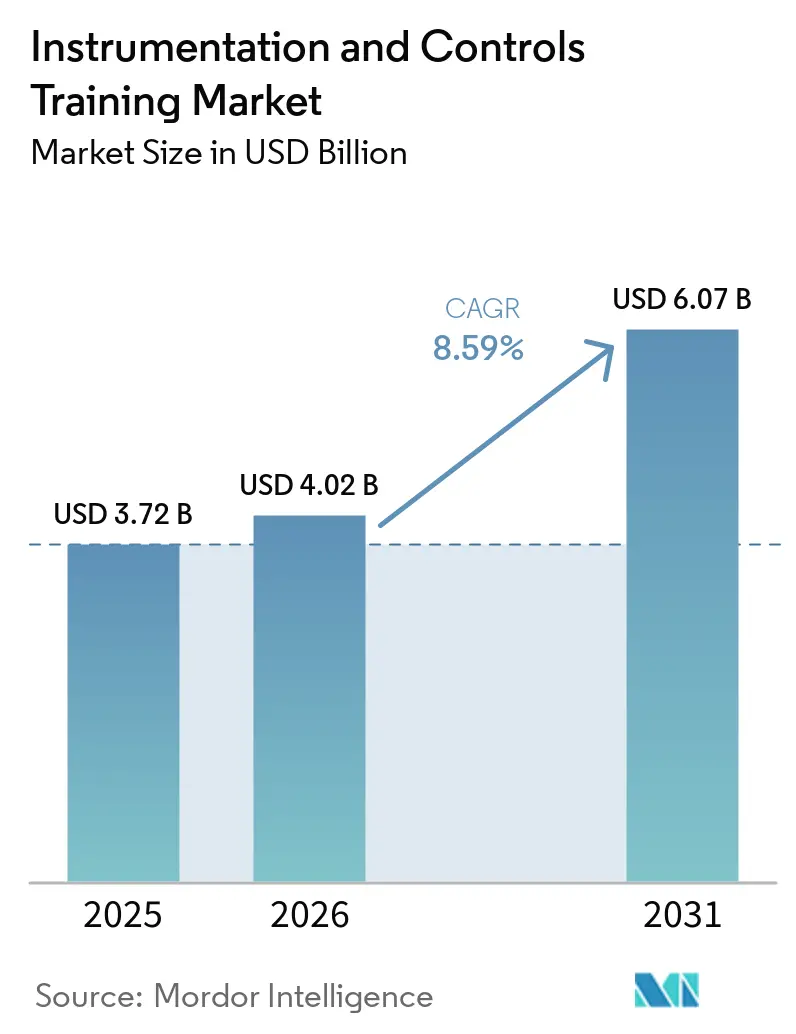
The Instrumentation And Controls Training Market size is projected to expand from USD 3.72 billion in 2025 and USD 4.02 billion in 2026 to USD 6.07 billion by 2031, registering a CAGR of 8.59% between 2026 to 2031.
The instrumentation and controls training market is being shaped by the closer link between operational technology modernization and workforce readiness, as industrial employers are treating technical training as an operating requirement instead of a discretionary expense. The shortage of qualified control technicians supports demand, the steady pace of brownfield upgrades, and the broader use of cybersecurity content in process control training programs. The instrumentation and controls training market is also benefiting from energy transition projects because hybrid control environments are making maintenance and operations roles more complex. The instrumentation and controls training market remains moderately consolidated, with OEM-linked academies benefiting from proprietary platforms while independent providers compete through cross-vendor breadth and more flexible digital delivery.[1]
Key Report Takeaways
- By training mode, instructor-led classroom training held 38.2% of revenue in 2025, while self-paced e-learning is projected to expand at a 12.4% CAGR through 2031.
- By system type, PLC training accounted for 44.4% of the instrumentation and controls training market share in 2025 and is also advancing at a 9.7% CAGR through 2031.
- By end user industry, manufacturing and discrete industries captured 22.5% of the instrumentation and controls training market size in 2025, while pharmaceuticals and life sciences is forecast to grow at an 11.2% CAGR through 2031.
- By geography, Asia-Pacific represented 32.7% of global revenue in 2025 and is expected to record the fastest regional CAGR of 11.0% through 2031.
Note: Market size and forecast figures in this report are generated using Mordor Intelligence’s proprietary estimation framework, updated with the latest available data and insights as of January 2026.
Global Instrumentation and Controls Training Market Trends and Insights
Drivers Impact Analysis*
| Drivers | (~) % Impact on CAGR Forecast | Geographic Relevance | Impact Timeline |
|---|---|---|---|
| Brownfield modernization needs dual-platform skills across legacy and new control architectures | +1.2% | Global, concentrated in North America's legacy process installations and European integrated manufacturing corridors | Medium term (2-4 years) |
| OEM certification tied to support access and warranty eligibility | +0.9% | Global, with early enforcement in North America and Western Europe, expanding into the GCC procurement requirements | Long term (≥ 4 years) |
| Persistent shortage of controls technicians and automation engineers | +1.8% | North America core, acute in Midwest manufacturing corridors, spreading to APAC manufacturing hubs in India and South-East Asia | Short term (≤ 2 years) |
| Remote operations expand demand for SCADA, IIoT, and secure connectivity skills | +1.3% | Global, with early gains in oil and gas Middle East, utilities in Europe, and mining in Australia | Medium term (2-4 years) |
| IEC 62443-aligned training becomes a contractual procurement requirement | +1.0% | Global, enforcement concentrated in EU industrial operators and the Gulf Cooperation Council procurement frameworks | Long term (≥ 4 years) |
| Digital twin-based training shortens time-to-competency and reduces onboarding incidents | +0.8% | Global, the strongest adoption in the chemical, pharmaceutical, and LNG process industries | Medium term (2-4 years) |
| Source: Mordor Intelligence | |||
Brownfield Modernization Requires Dual-Platform Competency Across Legacy and New-Generation Control Architectures
The installed base across refining, chemicals, power, and process manufacturing still includes a wide mix of older DCS platforms, earlier PLC generations, and newer digital layers, which keeps retraining demand active over longer replacement cycles. This creates a practical need for technicians who can work across legacy logic structures, newer software environments, and adjacent digital tools within the same plant. Honeywell’s April 2026 Dangote refinery deployment demonstrated how live-asset digital twin training is being used to prepare operators for complex process environments before they move on to plant systems, reflecting the wider need for multi-environment familiarity in upgraded facilities. Siemens also tied simulation-led capability building to major platform investment through its Erlangen Technology Campus expansion, where industrial metaverse and digital twin applications were positioned as part of core industrial use cases. In the instrumentation and controls training market, brownfield modernization extends demand beyond first-time installations, as each upgrade wave creates a new round of dual-platform training needs.
OEM Certification Pathways Tied to Support Access and Warranty Eligibility Create Recurring Certification Demand
The instrumentation and controls training market continues to benefit from the way OEM-led certification is embedded into installed-base support models and platform retention strategies. Large automation vendors operate branded academies and structured technical training systems that reinforce product familiarity and keep end users within the vendor ecosystem for longer. Siemens also invested USD 36 million in September 2024 in its Wendell, North Carolina, customer experience and training facility, including dedicated Power Academy classrooms for substation automation, protection, and control training. This recurring certification logic supports the instrumentation and controls training market because customers often return for version updates, advanced modules, and platform-specific refresher courses, given the long asset lifespans.
Persistent Shortage of Controls Technicians and Automation Engineers
The shortage of qualified technical labor remains one of the clearest demand drivers for the instrumentation and controls training market. The Manufacturing Institute reported in April 2024 that the United States could face a shortfall of 1.9 million manufacturing workers by 2033, with 3.8 million roles expected to open and nearly half of those roles likely to go unfilled. That gap is pushing employers, colleges, and OEM academies to treat training as a direct pipeline response rather than a secondary HR initiative. Rockwell Automation renewed its support for the University of Wisconsin-Milwaukee’s Connected Systems Institute in 2024 to strengthen manufacturing talent development in a major U.S. industrial corridor. The instrumentation and controls training market is therefore benefiting from a structural labor deficit that is unlikely to ease quickly, especially in plants that need job-ready automation technicians rather than general labor replacements.[2]
Remote Operations Expand Demand for SCADA, IIoT, and Secure Connectivity Skills
The move toward remote monitoring and distributed operations is widening the training scope required in oil and gas, utilities, mining, and water systems. Emerson’s May 2024 edge AI collaboration with SiMa.ai also highlights how remote operating environments are becoming more data-intensive and more dependent on trained field personnel who can interpret and act on real-time industrial information. As a result, the instrumentation and controls training market is seeing durable demand for PLC, SCADA, IIoT, and secure connectivity curricula that go beyond traditional control-room skill sets.
Restraints Impact Analysis*
| Restraints | (~) % Impact on CAGR Forecast | Geographic Relevance | Impact Timeline |
|---|---|---|---|
| Training budgets remain cyclical with plant CAPEX priorities | -0.8% | Global, most acute in mining, oil and gas, and commodity-sensitive verticals | Short term (≤ 2 years) |
| High capital cost of simulation labs and hands-on training infrastructure | -0.7% | Global, disproportionately affects SMEs and emerging-market operators in South-East Asia, South America, and Sub-Saharan Africa | Medium term (2-4 years) |
| Siloed vendor ecosystems limit cross-platform skill transferability | -0.6% | Global, most acute in North America and Europe where multi-vendor PLC and SCADA installations are prevalent | Medium term (2-4 years) |
| Credential fragmentation across competing certification bodies reduces employer clarity and procurement efficiency | -0.5% | Global, highest impact in North America and Europe where certification bodies are most numerous | Long term (≥ 4 years) |
| Source: Mordor Intelligence | |||
Training Budgets Remain Cyclical With Plant CAPEX Priorities
Training demand is structurally strong, but spending decisions still move with plant investment cycles in many industrial organizations. When customers delay equipment upgrades, plant expansions, or turnaround-related projects, training purchases are often deferred as well, even when the labor gap remains unresolved. This pattern tends to affect mid-market training providers more sharply because they do not carry the same balance-sheet support or installed-base pull that large OEM academies can use to soften demand swings. The relative resilience of OEM-backed programs is evident in continued capital commitments, such as Siemens’ September 2024 USD 36 million investment in the Wendell facility and ABB’s 2025 build-out of its Dubai training center. The instrumentation and controls training market, therefore, grows on a solid long-term base, but short-term budget timing can still slow course bookings and widen the gap between need and actual enrollment.
High Capital Cost of Simulation Labs and Hands-On Training Infrastructure
The cost of building credible hands-on training capacity remains a clear restraint for the instrumentation and controls training market. Providers need process simulators, hardware-in-the-loop rigs, PLC benches, DCS stations, and instructor support to deliver the practical training level expected in safety-sensitive environments. ABB’s November 2025 opening of a USD 2 million training center in Dubai underscores the scale of investment required for even a single regional facility serving 2,000 engineers and technicians each year. Honeywell’s deployment of a digital-twin-based refinery simulator in Nigeria also reflects the technical and commercial depth required to build advanced operator training systems. This makes geographic coverage harder to scale in secondary markets and emerging economies, where the instrumentation and controls training market often relies on a limited number of provider locations or on digital formats that cannot fully replace hands-on hardware experience.
*Our forecasts treat driver/restraint impacts as directional, not additive. The impact forecasts reflect baseline growth, mix effects, and variable interactions.
Segment Analysis
By Training Mode: Asynchronous Delivery Challenges the Classroom Stronghold
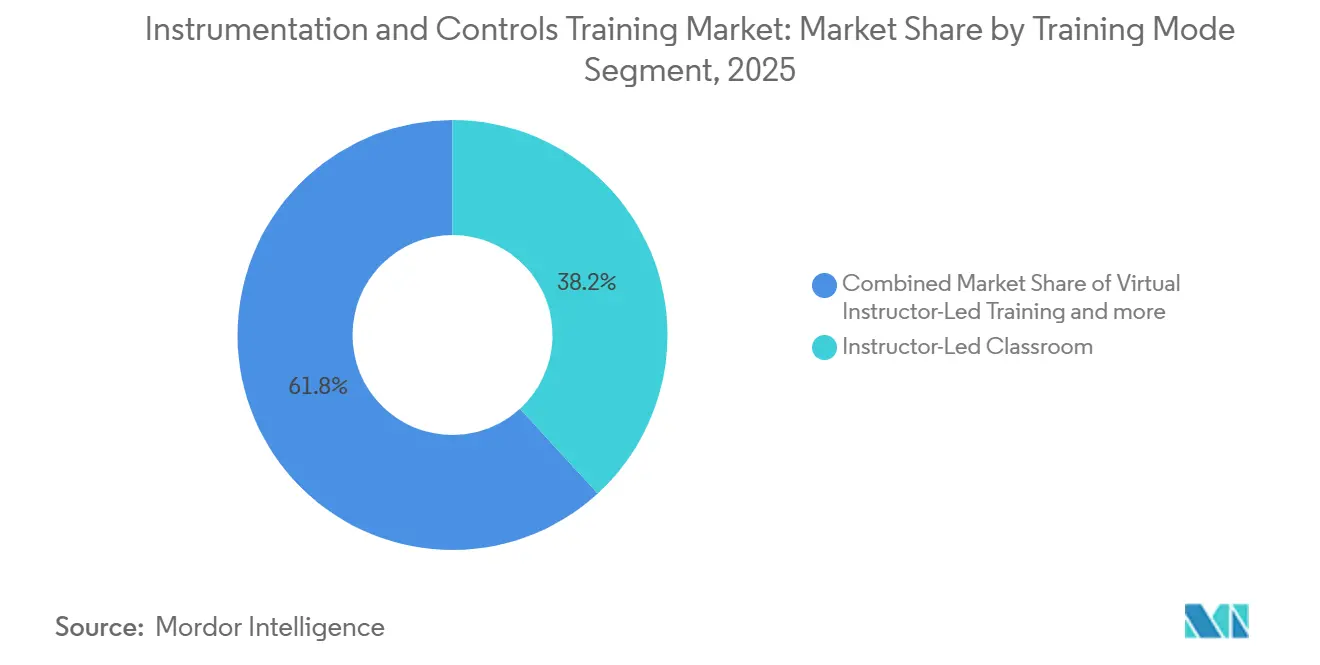
Instructor-led classroom training accounted for 38.2% of revenue in 2025, making it the largest delivery format in the instrumentation and controls training market. Employers continue to prefer this mode for initial qualification in hazardous, highly regulated environments where direct observation of physical task execution remains important. That preference is strongest in oil refining, chemicals, and pharmaceutical settings where procedural discipline and facility access rules shape how skills are assessed. The format also remains important for first-time learners who benefit from guided troubleshooting, supervised equipment handling, and immediate instructor feedback. For these reasons, classroom instruction still anchors a large base of the instrumentation and controls training market even as digital formats expand.
Self-paced e-learning is projected to advance at a 12.4% CAGR through 2031, making it the fastest-growing delivery mode in this instrumentation and controls training market. The model fits dispersed field workforces and rotating shifts because it reduces travel requirements and makes learning access easier across multiple locations. The World Economic Forum reported in January 2024 that Midea’s AI and VR-supported training program in Thailand reduced core-skill qualification time by 63%, from 8 days to 3 days, increased multi-skilled labor in the supply chain by 6%, and reduced employee turnover by 40%. Blended learning is gaining relevance because it combines this flexibility with scheduled lab exposure where hardware interaction still matters. Virtual instructor-led formats also support the instrumentation and controls training market by preserving instructor interaction while lowering travel and lodging costs for employers.

By System Type: PLC Breadth Drives Volume While SCADA Cybersecurity Lifts Value
PLC training accounted for 44.4% of revenue in 2025 and leads forecast expansion at a 9.7% CAGR through 2031, giving it both the largest instrumentation and controls training market share and the strongest growth profile within system type. PLC training benefits from the very broad installed base across discrete manufacturing, utilities, water, and process industries. It also remains foundational because PLC competence now covers programming, troubleshooting, integration, diagnostics, and basic cybersecurity awareness rather than only ladder logic. A 2024 scientific study published through Springer Nature supported the educational value of digital twin-linked PLC learning by validating a six-dimensional digital twin model for flexible manufacturing systems in engineering education. This keeps PLC education central to the instrumentation and controls training market, as employers need both entry-level and advanced skill refresh.
SCADA training is gaining value as remote monitoring, distributed assets, and secure connectivity requirements become increasingly important across infrastructure-heavy sectors. Dragos reported in 2026 that insecure remote access was the primary entry point for oil and gas OT exposure, and that VPN compromise or credential reuse occurred in 73% of incident response cases. That underscores the value of SCADA curricula that combine operations, networking awareness, and cyber hygiene rather than teaching visualization and alarms in isolation. DCS training remains critical across chemicals, refining, power generation, LNG, and life sciences because these environments require deep process control and accurate operator workflows. Honeywell’s LNG and refinery simulator investments show that DCS-linked operator training remains a major part of the instrumentation and controls training market, where live process familiarity is essential.
By End User Industry: Life Sciences Growth Outpaces Incumbent Industrial Verticals
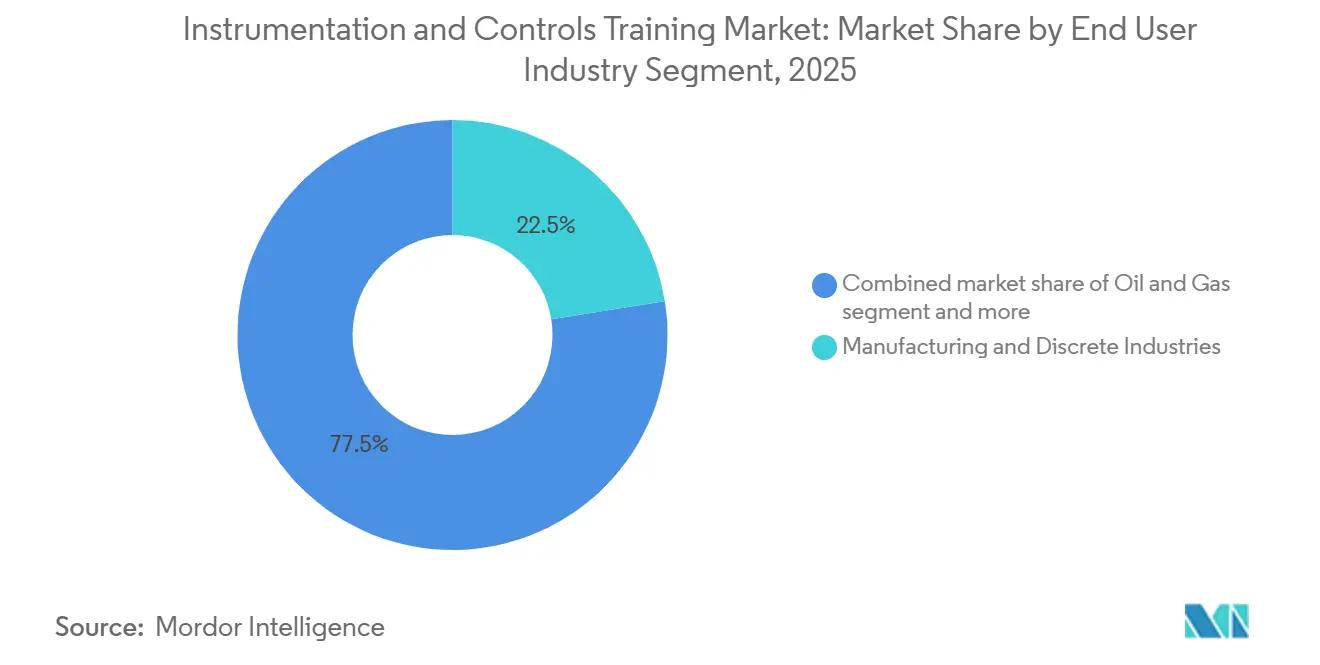
Manufacturing and discrete industries accounted for 22.5% of revenue in 2025, making them the largest end-user segment in the instrumentation and controls training market. Their scale reflects the broad presence of PLCs, SCADA systems, robotics, and mixed-vendor automation across automotive, electronics, and general industrial assembly. These facilities often run multiple brands of controls equipment within the same site, which creates a recurring need for onboarding, update training, and troubleshooting readiness. The shortage of manufacturing labor reinforces this demand because employers need faster pathways to bring technicians up to a practical operating level. The Manufacturing Institute’s April 2024 workforce report supports that backdrop by pointing to 3.8 million openings in U.S. manufacturing through 2033, with nearly half expected to go unfilled.
The pharmaceuticals and life sciences segment is expected to grow at a 11.2% CAGR through 2031, making it the fastest-growing end-user segment in the instrumentation and controls training market. Growth is tied to biologics and cell-therapy capacity expansion in the United States, Europe, and India, where automated production environments need compliant system handling and validation-aware operator training. In this segment, training carries greater commercial weight because underqualified personnel can lead to direct exposure to documentation errors, process deviations, and regulatory noncompliance. That underscores the need for structured learning on computerized systems, process controls, and data integrity, alongside standard automation topics. Oil and gas, water and wastewater, food and beverage, and mining and metals remain relevant contributors to the instrumentation and controls training industry because their installed asset bases continue to grow more automated and more dependent on secure, skilled operations.
Geography Analysis
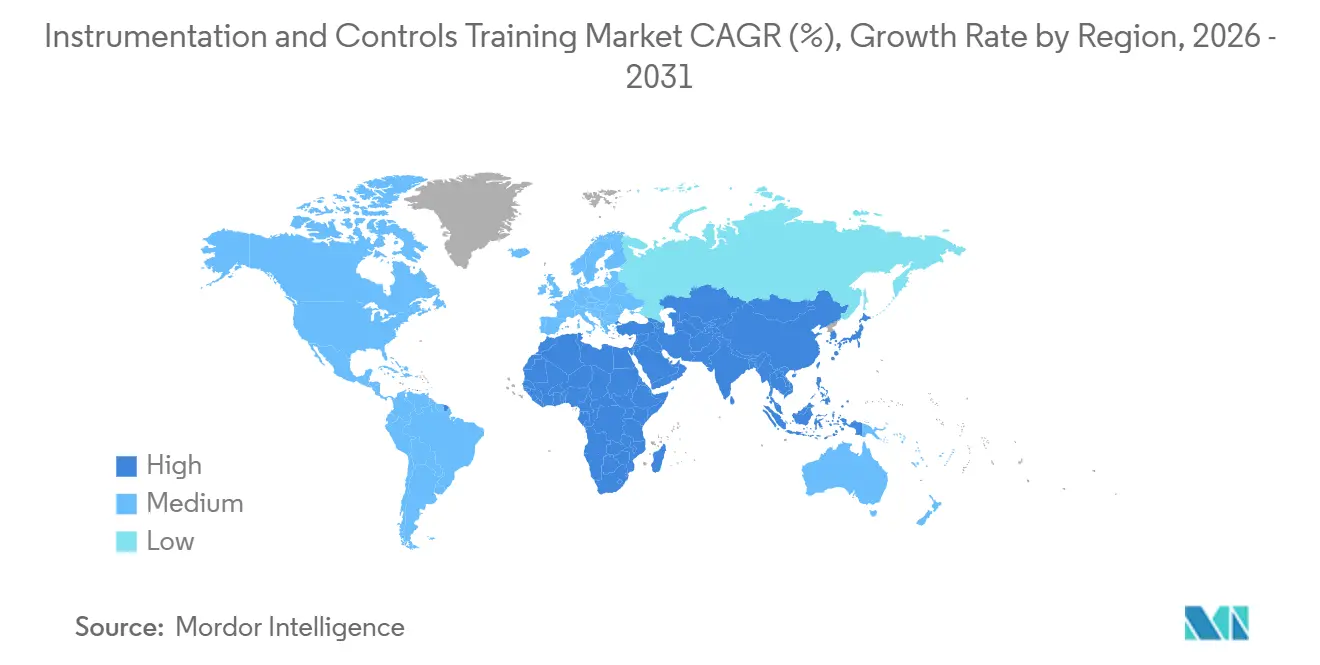
Asia-Pacific accounted for 32.7% of global revenue in 2025 and is projected to grow at a 11.0% CAGR through 2031, making it both the largest instrumentation and controls training market and the region with the fastest regional expansion profile. Rockwell Automation reported in its 2024 State of Smart Manufacturing study that 95% of APAC manufacturers now see digital transformation as essential to competitiveness, 71% plan to increase AI and machine learning adoption within 12 months, and 41% had already completed formal workforce reskilling in the previous year. Demand in the region is being supported by China's smart manufacturing push, India's pharmaceutical and semiconductor capacity additions, and industrial investment across Southeast Asia. Singapore's January 2024 training partnership led by LKH Precicon, Ngee Ann Polytechnic, and 8 industry partners, including Beckhoff Automation and Delta Electronics, points to the organized build-out of Industry 4.0 learning infrastructure in the region.
North America remains the second-largest regional market because the labor shortage is acute and automation intensity is high across process and discrete manufacturing. The Manufacturing Institute's April 2024 report on 1.9 million potentially unfilled manufacturing jobs by 2033 illustrates why employers are directing more resources toward technical training pathways. Rockwell Automation's 2024 renewal of its University of Wisconsin-Milwaukee collaboration and Siemens' 2024 investments in Wendell and wider U.S. workforce initiatives show how OEMs are trying to strengthen the technician pipeline through academic and regional partnerships.
Europe continues to generate re-certification demand from its dense installed base of legacy industrial assets and from the growing operational weight of industrial cybersecurity. The Middle East and Africa are developing through targeted investment, with ABB's Dubai center and Honeywell's April 2024 training deployment for Dangote's refinery showing how large-scale industrial projects are bringing training infrastructure into the region. South America remains smaller, but Brazil's oil and gas and agri-processing activity, together with mining modernization in Chile and Peru, continues to support specialized training demand over the longer term.[3]
Competitive Landscape
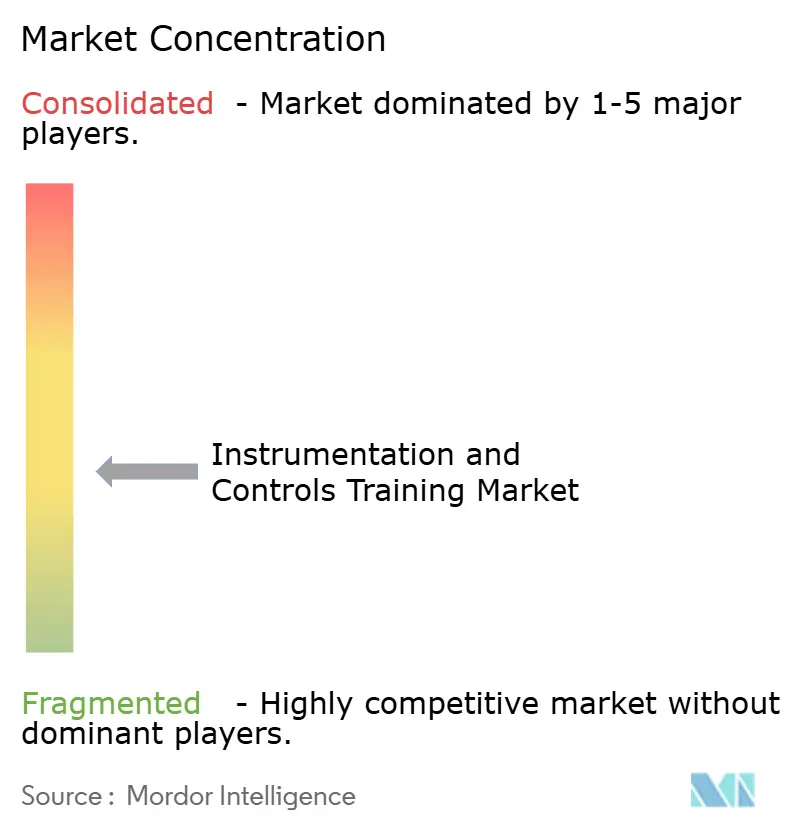
The instrumentation and controls training market is moderately consolidated, with the leading position held by OEM-affiliated academies such as Siemens SITRAIN, Rockwell Automation University, ABB Automation Academy, Honeywell Process Solutions training, and Emerson training systems. These providers benefit from installed-base access, platform-specific learning assets, and a stronger linkage between training, support, and lifecycle service. That combination gives them an advantage in customer acquisition because training is often sold alongside software updates, maintenance support, or broader system modernization. The instrumentation and controls training market still allows room for independent specialists. Still, they usually compete by offering cross-vendor breadth, flexible digital delivery, or better pricing on modular technical content. This balance explains why the market is neither highly fragmented nor concentrated enough for a few providers to shut out specialized rivals.
ABB’s November 2025 launch of its AI and digital solutions training center in Dubai is another example of scale-led expansion to strengthen customer proximity and technical certification coverage. Honeywell’s April 2026 Dangote deployment adds a third example, in which digital-twin-based operator training is tied directly to a major industrial site and a large workforce.
Independent providers continue to compete with employers that need broader course architectures spanning multiple control vendors and skill layers. ISA stands out because its standards-linked certificate structure gives it stronger relevance in OT cybersecurity and procurement-facing credentialing than a single OEM course can typically provide. The instrumentation and controls training market also offers opportunities for providers to lower delivery costs through cloud labs, modular e-learning, and vendor-neutral troubleshooting content. Over time, competition is likely to remain centered on simulation depth, credential credibility, and the ability to train across mixed installed environments rather than on a single product family.
Instrumentation and Controls Training Industry Leaders
-
Siemens AG
-
Rockwell Automation, Inc.
-
Schneider Electric SE
-
ABB Ltd.
-
Honeywell International Inc.
- *Disclaimer: Major Players sorted in no particular order
Recent Industry Developments
- May 2026: Emerson partnered with SiMa.ai to deliver Physical AI capabilities for real-time data analysis on Emerson's industrial PCs at the field edge, targeting the harshest remote-operations environments across oil and gas, factory, and remote site deployments. This integration extends the IIoT analytics competency requirement for Emerson's installed-base operators, directly broadening the scope of Emerson's workforce training obligation
- April 2026: Honeywell contracted to deploy Operator Training Simulators and digital-twin-based training solutions at the Dangote Petroleum Refinery in Lekki, Nigeria, the world's largest single-train petroleum refinery, employing over 3,000 Nigerian workers. Simulators replicate real-world process scenarios and emergency conditions, allowing operators to train in a risk-free environment and materially improving operational readiness.
- April 2026: Rockwell Automation demonstrated AI-orchestrated factory engineering with Microsoft at Hannover Messe 2026, integrating FactoryTalk Design Studio and Emulate3D simulation software with Azure OpenAI in a closed-loop design-and-validation workflow. This development has direct implications for the design of PLC programming curricula, as AI-native engineering tools alter the competency profile required of automation engineers.
- March 2026: Honeywell and IIT Bombay established a Centre of Excellence at IIT Bombay's Powai campus, targeting certification-based training for more than 100,000 students by 2030 in automation, control, and sustainability-related fields. The programme's pilot phase commenced training 250 students in curriculum aligned with real-world industrial deployment requirements.
Global Instrumentation and Controls Training Market Report Scope
| Instructor-Led Classroom |
| Virtual Instructor-Led Training |
| Self-Paced E-Learning |
| Blended Learning |
| PLC Training |
| SCADA Training |
| DCS Training |
| Oil and Gas |
| Power Generation |
| Chemicals and Petrochemicals |
| Manufacturing and Discrete Industries |
| Water and Wastewater |
| Pharmaceuticals and Life Sciences |
| Food and Beverage |
| Mining and Metals |
| Other End User Industries |
| North America | United States |
| Canada | |
| Mexico | |
| South America | Brazil |
| Peru | |
| Chile | |
| Argentina | |
| Rest of South America | |
| Europe | United Kingdom |
| Germany | |
| France | |
| Spain | |
| Italy | |
| BENELUX (Belgium, Netherlands, and Luxembourg) | |
| NORDICS (Denmark, Finland, Iceland, Norway, and Sweden) | |
| Rest of Europe | |
| APAC | India |
| China | |
| Japan | |
| Australia | |
| South Korea | |
| South East Asia (Singapore, Malaysia, Thailand, Indonesia, Vietnam, and Philippines) | |
| Rest of Asia-Pacific | |
| Middle East and Africa | United Arab Emirates |
| Saudi Arabia | |
| South Africa | |
| Nigeria | |
| Rest of Middle East and Africa |
| By Training Mode | Instructor-Led Classroom | |
| Virtual Instructor-Led Training | ||
| Self-Paced E-Learning | ||
| Blended Learning | ||
| By System Type | PLC Training | |
| SCADA Training | ||
| DCS Training | ||
| By End User Industry | Oil and Gas | |
| Power Generation | ||
| Chemicals and Petrochemicals | ||
| Manufacturing and Discrete Industries | ||
| Water and Wastewater | ||
| Pharmaceuticals and Life Sciences | ||
| Food and Beverage | ||
| Mining and Metals | ||
| Other End User Industries | ||
| By Geography | North America | United States |
| Canada | ||
| Mexico | ||
| South America | Brazil | |
| Peru | ||
| Chile | ||
| Argentina | ||
| Rest of South America | ||
| Europe | United Kingdom | |
| Germany | ||
| France | ||
| Spain | ||
| Italy | ||
| BENELUX (Belgium, Netherlands, and Luxembourg) | ||
| NORDICS (Denmark, Finland, Iceland, Norway, and Sweden) | ||
| Rest of Europe | ||
| APAC | India | |
| China | ||
| Japan | ||
| Australia | ||
| South Korea | ||
| South East Asia (Singapore, Malaysia, Thailand, Indonesia, Vietnam, and Philippines) | ||
| Rest of Asia-Pacific | ||
| Middle East and Africa | United Arab Emirates | |
| Saudi Arabia | ||
| South Africa | ||
| Nigeria | ||
| Rest of Middle East and Africa | ||
Key Questions Answered in the Report
What is the current outlook for demand for instrumentation and controls training?
The instrumentation and controls training market was valued at USD 3.72 billion in 2025 and is forecast to reach USD 6.07 billion by 2031 at an 8.6% CAGR, supported by labor shortages, brownfield upgrades, and rising OT cybersecurity training needs.
Which training mode is leading revenue and which one is growing fastest?
Instructor-led classroom training accounted for 38.2% in 2025, while self-paced e-learning is expected to grow the fastest at a 12.4% CAGR through 2031.
Why is PLC training so important for industrial employers?
PLC training accounted for 44.4% of revenue in 2025 and is also projected to grow at a 9.7% CAGR, reflecting its broad installed base across manufacturing, utilities, and process industries.
Which end-user segment is expanding the fastest?
Pharmaceuticals and life sciences is forecast to grow at an 11.2% CAGR through 2031 because automation training is becoming more important in biologics, cell therapy, and compliance-heavy production settings.
Which region offers the strongest growth opportunity?
Asia-Pacific held 32.7% of revenue in 2025 and is projected to grow at 11.0% through 2031, supported by digital transformation spending, manufacturing expansion, and structured workforce reskilling efforts.
How are leading companies strengthening their position?
Major suppliers are investing in training centers, digital twin simulators, and academic partnerships, as seen in ABB’s Dubai center, Siemens’ U.S. and Erlangen investments, and Honeywell’s refinery and university training programs.