
Corporate Workforce Development Training Market Size and Share
Market Overview
| Study Period | 2022 - 2031 |
|---|---|
| Market Size (2026) | USD 285.68 Billion |
| Market Size (2031) | USD 402.13 Billion |
| Growth Rate (2026 - 2031) | 7.08 % |
| Fastest Growing Market | Asia-Pacific |
| Largest Market | North America |
| Market Concentration | Low |
Major Players *Disclaimer: Major Players sorted in no particular order Image © Mordor Intelligence. Reuse requires attribution under CC BY 4.0. | |
Corporate Workforce Development Training Market Analysis by Mordor Intelligence
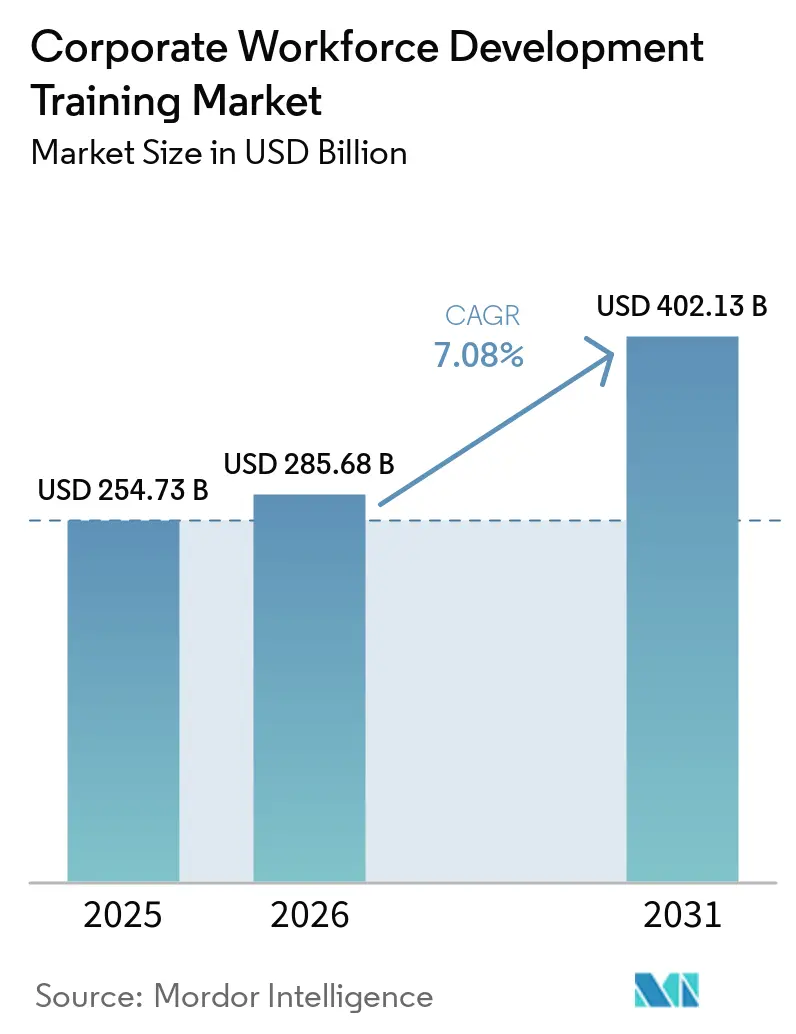
The Corporate Workforce Development Training Market size is expected to increase from USD 254.73 billion in 2025 to USD 285.68 billion in 2026 and reach USD 402.13 billion by 2031, growing at a CAGR of 7.08% over 2026-2031.
The workforce development training market is expanding as enterprise learning budgets move from periodic HR allocation to a continuous operating requirement tied to role redesign, compliance, and productivity improvement. Employers now face shorter skill-relevance cycles, which are increasing pressure to retrain workers before capability gaps begin to affect execution and risk control. The World Economic Forum reported that 39% of workers’ core skills are expected to change by 2030, up from the 35% disruption threshold recorded in 2016, which leaves companies with less time to respond to learning needs. The workforce development training market is also gaining support from AI literacy obligations and other regulatory training requirements, which are moving training spend into legal, risk, and operations budgets rather than leaving it fully exposed to discretionary cuts. The competitive environment remains moderately fragmented, with learning platforms, HCM vendors, and managed service providers all pursuing multi-year enterprise contracts by strengthening their content libraries, skills mapping, and outcome measurement.[1]
Key Report Takeaways
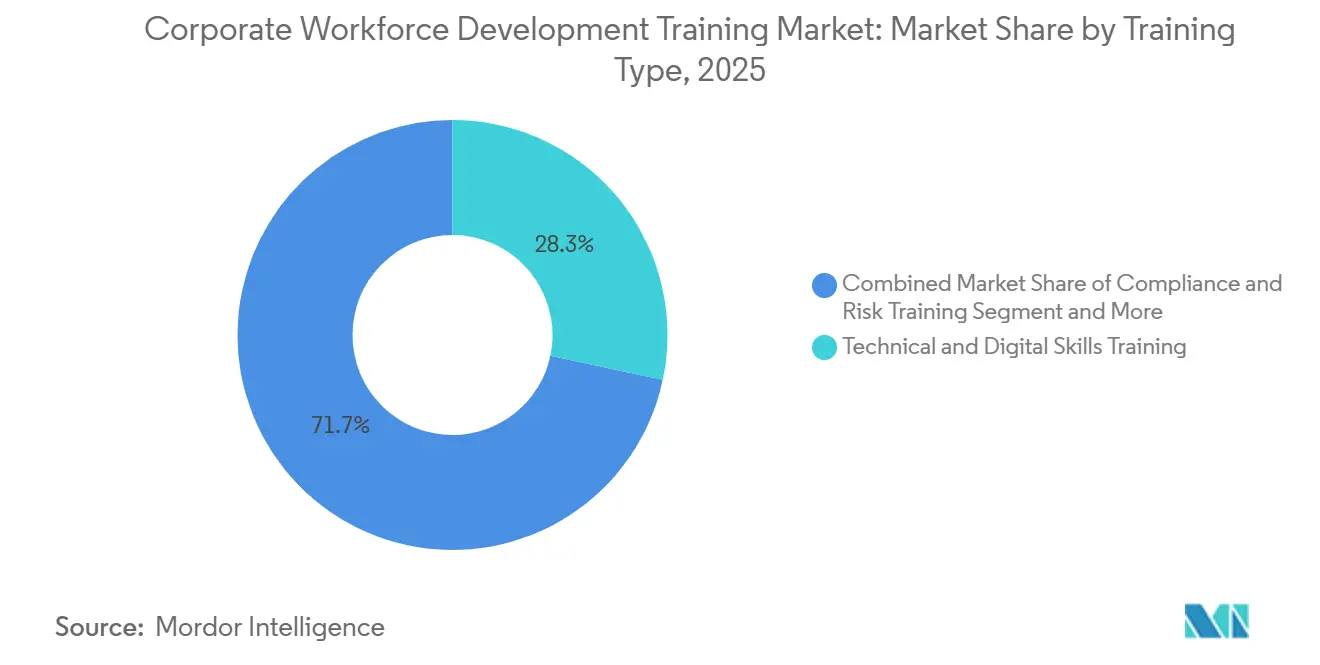
- By training type, Technical and Digital Skills Training accounted for 28.33% of market revenue in 2025, while Interpersonal, Culture, and Well-being Training is forecast to grow at an 8.56% CAGR through 2031.
- By learning format, Instructor-Led Training accounted for 42.91% of the workforce development training market in 2025, while Blended Training is set to grow at a 7.48% CAGR through 2031.
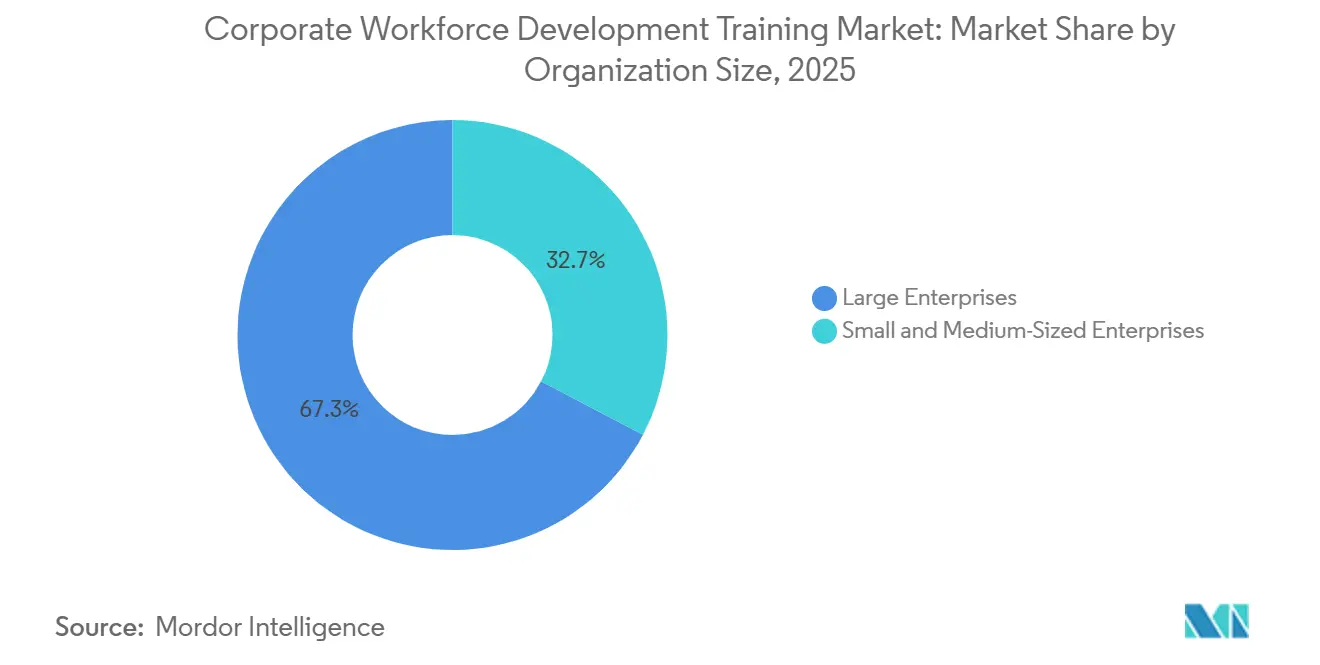
- By organization size, large enterprises captured 67.33% of market revenue in 2025, while small and medium-sized enterprises are expected to post a 7.92% CAGR through 2031.
- By industry vertical, Information Technology and Telecom held 22.46% share in 2025, while Healthcare and Life Sciences is projected to record an 8.19% CAGR through 2031.
- By geography, North America held 35.74% of the workforce development training market in 2025, while Asia-Pacific is projected to expand at an 8.84% CAGR through 2031.
Note: Market size and forecast figures in this report are generated using Mordor Intelligence’s proprietary estimation framework, updated with the latest available data and insights as of January 2026.
Global Corporate Workforce Development Training Market Trends and Insights
Drivers Impact Analysis*
| Drivers | (~) % Impact on CAGR Forecast | Geographic Relevance | Impact Timeline |
|---|---|---|---|
| AI-Led Skill Obsolescence And Enterprise Reskilling Demand | +2.0% | Global, highest concentration in North America and APAC | Short term (≤ 2 years) |
| Compliance And Risk Training Budgets Remain Non-Discretionary | +1.5% | Global, highest in BFSI and Healthcare-heavy markets across North America and Europe | Short term (≤ 2 years) |
| Career Development Programs Improve Retention And Internal Mobility | +1.2% | Global, highest impact in competitive labor markets across North America and Northern Europe | Medium term (2-4 years) |
| EU AI Literacy Obligations Create Recurring Employer Training Demand | +0.8% | Europe, with spillover into EU-linked global supply chains | Short term (≤ 2 years) |
| Retirement-Driven Knowledge Capture Needs Expand Structured Learning Spend | +0.6% | North America, Western Europe, Japan | Medium term (2-4 years) |
| Manager Capability Gaps Increase Demand For Coaching-Enabled Training Architectures | +0.7% | Global, highest urgency in high-growth organizations across North America and APAC | Medium term (2-4 years) |
| Source: Mordor Intelligence | |||
AI-led skill obsolescence and enterprise reskilling demand
The workforce development training market is being pushed forward by rapid AI adoption, which is changing how work is performed across knowledge, technical, and operational roles. BCG stated in 2026 that 50% to 55% of U.S. jobs are likely to be reshaped within two to three years, especially in roles where AI changes task mix rather than removing employment outright. Mercer also reported that 99% of C-suite leaders expect AI to drive headcount reductions of up to 20%, while the share of work performed only by humans is projected to fall from 50% to 35% over the next two years. Deloitte found that the AI skills gap is the leading barrier to enterprise AI adoption, which explains why learning investment is now treated as an operating requirement rather than a secondary HR decision. The workforce development training market is also benefiting from a delayed effect, as many firms that deployed AI tools early are now seeing performance gaps where training did not keep pace with rollout, generating both catch-up reskilling demand and new forward-looking programs.
Compliance and risk training budgets remain non-discretionary
The workforce development training market continues to receive stable support from compliance-linked budgets, because regulated training is harder to defer than general capability building. ATD reported in 2025 that mandatory and compliance learning remained one of the top three corporate learning categories in 2024, alongside new employee orientation and manager development. The EU AI Act adds a further layer of urgency, as violations of prohibited practice categories can carry penalties of up to EUR 35 million or 7% of global annual turnover. The workforce development training market is therefore drawing recurring demand from legal, audit, and risk functions as new frameworks, including GDPR, AI governance rules, Basel-related requirements, and sector-specific obligations in healthcare and energy, continue to expand the number of mandatory learning programs.[2]
Career development programs improve retention and internal mobility
The link between structured development and employee retention is also supporting the workforce development training market. Perceptyx reported in 2025 that 4 of the top 5 drivers of intent to stay were directly tied to career growth, which shows that learning has become part of the retention strategy rather than a separate HR activity. Employees planning to remain with their employer were 3 times more likely to believe they could achieve career goals internally and more than twice as likely to see meaningful development opportunities. LinkedIn found that companies with strong internal mobility retain employees 53% longer on average than firms with weak internal mobility, which has direct cost implications for hiring, onboarding, and knowledge continuity. Fuel50 added in 2025 that more than 75% of organizations consider internal mobility a strategic priority, yet fewer than 29% have tools that let employees explore internal career paths independently, which leaves structured training as one of the main ways to support movement and retention.
EU AI literacy obligations create recurring employer training demand
The workforce development training market is receiving a direct policy boost from AI literacy requirements in Europe. Crowell & Moring stated that Article 4 of the EU AI Act entered into force on February 2, 2025, and requires providers and deployers of AI systems to take measures so that staff have a sufficient level of AI literacy, including relevant contractors and third parties. The European Commission AI Office also clarified that AI literacy obligations must be proportionate to the context of use, the roles of affected staff, and the risk profile of the AI systems involved, which makes one-time awareness training inadequate. That requirement is pushing enterprises toward layered training models with different modules for leadership, technical teams, frontline users, and oversight functions. It also creates repeat demand because content must be refreshed as AI systems evolve, new use cases are introduced, and employees move across roles. The workforce development training market is likely to see continued pull from this requirement as the August 2026 enforcement approaches in EU jurisdictions and in global firms tied to EU supply chains.
Restraints Impact Analysis*
| Restraints | (~) % Impact on CAGR Forecast | Geographic Relevance | Impact Timeline |
|---|---|---|---|
| Difficulty Proving Training ROI to Finance And Business Leaders | -1.2% | Global, most acute in North America and Europe where budget scrutiny is highest | Short term (≤ 2 years) |
| High Platform, Content, and Localization Costs Strain SME Adoption | -0.8% | APAC, MEA, South America, and multi-country European SME markets | Medium term (2-4 years) |
| Digital Fatigue and Low Completion Rates Weaken Skill Transfer | -0.5% | Global | Short term (≤ 2 years) |
| Shrinking Apprenticeship Pathways Reduce Practical Learning Absorption | -0.4% | Europe, APAC, and North America | Long term (≥ 4 years) |
| Source: Mordor Intelligence | |||
Difficulty proving training ROI to finance and business leaders
The workforce development training market still faces resistance when L&D teams cannot translate learning activity into business outcomes that finance teams accept. Only a small fraction of organizations successfully measure the business impact of learning programs, underscoring the continued limited visibility into ROI even after years of investment in learning analytics. The problem is structural because training outcomes often sit across HR, operations, and finance systems, and many enterprises have not connected those data flows in a usable way. In 2025, BizLibrary found that 35% of HR and L&D professionals described ROI tracking as very difficult, and that securing leadership support becomes harder when the impact case is weak. The workforce development training market, therefore, tends to reward providers that attach measurement frameworks to delivery, because programs without a clear business case are more likely to face budget pressure during cost reviews.
High platform, content, and localization costs strain SME adoption
The workforce development training market does not expand evenly across organization size, because smaller firms face a much heavier cost burden for platforms, content production, and localization. Qurioos stated in 2026 that localizing a single one-hour training module through traditional workflows can cost USD 5,000 to USD 15,000 per target language and take 4 to 6 weeks, which makes multi-market deployment difficult for SMEs Training Magazine and LMSPedia reported that per-learner training costs for small organizations reached USD 1,091 in 2025, compared with USD 468 for large enterprises, which reflects a 133% premium driven by volume disadvantage OECD also noted in 2025 that cost and digital maturity barriers continue to limit SME adoption of AI and digital tools across the countries surveyed, with training-related issues appearing repeatedly in those constraints.[3] The workforce development training market may see some relief as AI-based localization reduces production costs. However, the barrier remains meaningful while adoption of new workflows is still at an early stage.
*Our forecasts treat driver/restraint impacts as directional, not additive. The impact forecasts reflect baseline growth, mix effects, and variable interactions.
Segment Analysis
By Training Type: Technical skills anchor spending; soft skills signal the next investment cycle
Technical and Digital Skills Training held 28.33% of the workforce development training market share in 2025, which made it the largest training type in the current structure. This position reflects enterprise demand for cloud, cybersecurity, agentic AI, and data engineering capabilities as AI deployment widens across business functions. Pluralsight reported in 2025 that 89% of organizations viewed upskilling existing employees as faster and more cost-effective than external hiring, which supports continued investment in technical capability building. Leadership and Management Training also maintained meaningful spending levels because organizations still need supervisors and functional leaders who can guide teams through skill and workflow change. Compliance and Risk Training remained resilient because training demand in this category is directly tied to regulatory requirements rather than voluntary development budgets.
Interpersonal, Culture, and Well-being Training is projected to expand at an 8.56% CAGR through 2031, and this segment of the workforce development training market is gaining ground as employers seek to reduce friction amid continuous change. Docebo reported in 2026 that learning leaders and employees both view communication, critical thinking, and creativity as essential alongside AI fluency, which is redirecting part of training spend toward human skills that had previously been treated as secondary. Harvard Business Impact found in 2025 that 43% of organizations run both internal and external leadership development programs, which shows that firms are expanding rather than narrowing the channels used for behavior-oriented learning. Sales and Customer Service Training continues to follow revenue performance metrics, while Professional and Functional Skills Training grows with AI-driven job redesign across corporate roles. The workforce development training industry is therefore moving toward a more balanced mix where technical depth remains central, but human-centered programs are gaining a clearer budget rationale.

By Learning Format: ILT holds the largest share; blended architecture becomes the structural default
Instructor-Led Training retained 42.91% of the workforce development training market in 2025, which kept it ahead of online-only and blended delivery. Live facilitation continues to matter in leadership development, complex compliance instruction, clinical training, and negotiation, where demonstration, discussion, and accountability improve learning transfer. ATD reported an average of 13.7 formal learning hours per employee in 2024, and instructor-led delivery still held a leading role in high-investment programs even as overall learning hours became more selective. This pattern shows that enterprises are not moving away from live delivery, where risk, judgment, and behavior change matter most. The workforce development training market still relies on instructor-led formats when firms want stronger completion, interaction, and near-term application.
Blended Training is forecast to grow at a 7.48% CAGR through 2031, and this part of the workforce development training market size is gaining favor as firms seek both scale and stronger engagement. A 2026 benchmarking survey found that 74% of companies planned to increase investment in blended learning over the next two years, and respondents cited an average 25% improvement in employee performance compared with single-format delivery. The draft also showed that passive self-paced programs often struggle with completion, which is why companies are trying to combine digital flexibility with live reinforcement. Online Training continues to expand in volume and reach, especially in fast-growth regions where instructor capacity is limited or distributed teams are harder to gather in person. The workforce development training industry is therefore moving toward hybrid architectures in which live, digital, and embedded formats work together rather than compete as separate models.
By Organization Size: Large enterprises anchor investment; SMEs accelerate from necessity
Large enterprises accounted for 67.33% of the market in 2025, which reflects their stronger budget capacity, broader compliance exposure, and ability to support multi-year learning programs at scale. The average annual training budget for firms with more than 10,000 employees reached USD 11.7 million in 2025, down from USD 13.3 million in the prior year, as portfolios were rationalized under cost-control measures. Even with that moderation, large organizations still drive the workforce development training market through large user bases, deeper vendor contracts, and more mature learning infrastructure. They also have broader regulatory and transformation requirements, which keeps spend active across technical, compliance, and leadership categories. This segment remains the anchor for market revenue because large companies can absorb both platform costs and content refresh cycles more easily than smaller employers.
Small and medium-sized enterprises are projected to grow at a 7.92% CAGR through 2031, and their share of the workforce development training market size is rising out of competitive necessity rather than surplus budget. RSM and the U.S. Chamber of Commerce found in 2026 that among middle-market firms facing hiring pressure, 62% ranked new skills training for existing employees as their top workforce investment priority. The source draft also noted that 82% of SME employees were willing to upskill, yet fewer than 1 in 3 received formal training in the past year, underscoring the extent of the unmet need. That gap is steering smaller firms toward modular, lower-cost digital platforms rather than full enterprise suites with high setup costs. The workforce development training market is therefore expanding faster in SMEs, even though adoption still runs into pricing, localization, and implementation barriers.
By Industry Vertical: IT and Telecom leads by share; Healthcare accelerates under convergent pressure
Information Technology and Telecom accounted for 22.46% of the workforce development training market in 2025, making it the largest vertical. The sector carries the highest concentration of AI deployment, frequent tool refresh cycles, and strong demand for frontline technical upskilling. The World Economic Forum reported that telecommunications and IT services expect training needs of 63% and 62% of their workforces, respectively, by 2030, placing these industries at the top of the learning demand profile across major sectors.[4] This vertical also faces tighter pressure from AI governance and role redesign, which keeps both technical and compliance learning budgets active. As a result, IT and Telecom continue to shape product design, skills taxonomy development, and enterprise buyer expectations across much of the market.
Healthcare and Life Sciences is expected to record an 8.19% CAGR through 2031, and this area of the workforce development training market is expanding as AI use, clinical compliance, and frontline capability gaps converge. FranklinCovey reported in March 2026 that healthcare workforce programs supported a 50% reduction in leadership turnover at Advent Health and a 52% reduction in perioperative incidents at a metropolitan hospital, which gives the segment a stronger operational return case than many other verticals. Manufacturing is increasing training tied to operational technology shifts and safety needs, while retail and e-commerce continue to spend to manage turnover and service consistency. Professional services firms are dealing with the apprenticeship gap created by AI automation in entry-level work. At the same time, energy, utilities, and public sector entities continue to fund structured capability-building linked to regulation and public frameworks. The workforce development training market, therefore, remains broad-based by vertical, but healthcare is accelerating because learning has a clearer connection to risk, quality, and operational outcomes.
Geography Analysis
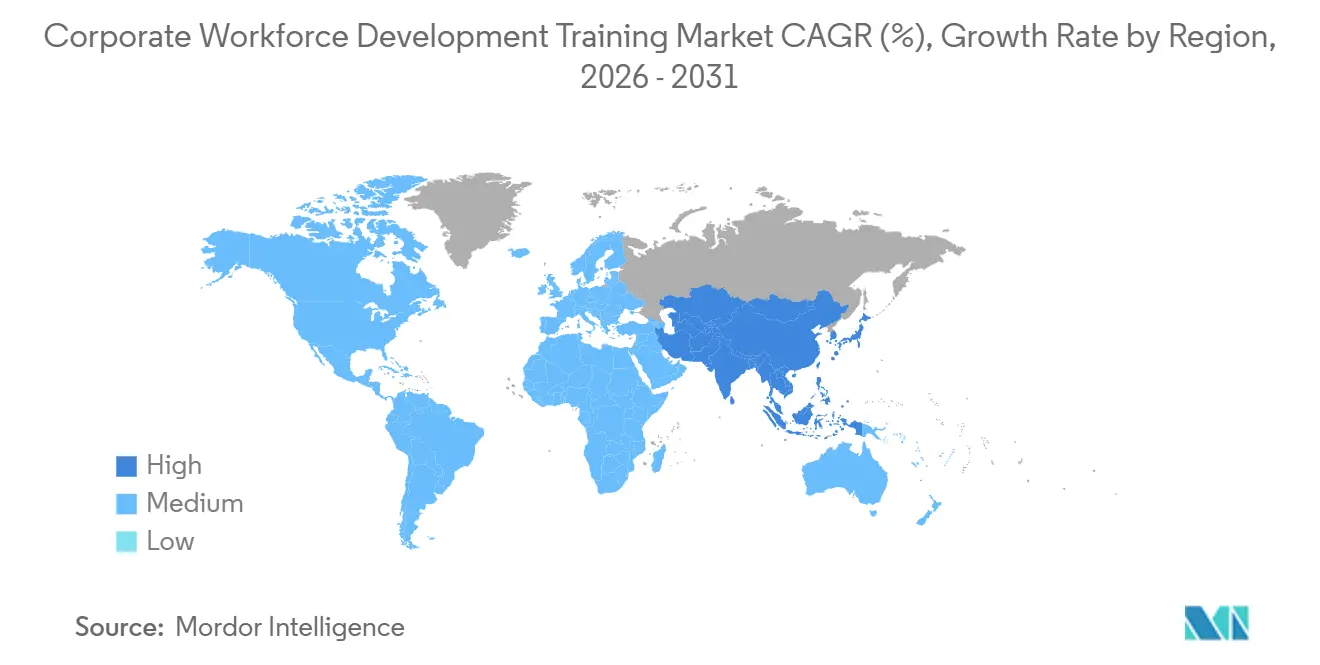
North America held 35.74% of the workforce development training market share in 2025, maintaining its global leadership. The U.S. training economy reached USD 102.8 billion in 2025, up 4.9% year on year, while spending on outside products and services rose 29% to USD 16 billion. ATD also reported that direct expenditure per U.S. employee averaged USD 1,254 in 2024 and that organizations allocated 2.9% of revenue to employee learning, which was the highest proportion recorded in five years. Canada is expanding its learning technology ecosystem with support from digital economy initiatives, while Mexico’s near-shoring momentum is driving demand for technical and frontline training in manufacturing and supply chains. In South America, Brazil remains the largest national training economy, and Chile, Peru, and Argentina are seeing a gradual rise in corporate learning investment alongside foreign direct investment in services, extraction, and industry.
Europe remains one of the most regulation-driven parts of the workforce development training market. Article 4 of the EU AI Act became effective on February 2, 2025, and it created verifiable AI literacy obligations for enterprises deploying AI systems in EU jurisdictions, with enforcement pressure set to intensify from August 2026. Germany and the United Kingdom remain the largest national markets. However, the drivers differ: Germany benefits from a dual vocational co-investment system, while the UK is shifting more activity toward provider-delivered formal training. The draft noted that UK manufacturing apprenticeship starts have fallen 40% since the Apprenticeship Levy began in 2017, which supports stronger demand for structured training providers. France adds a separate growth factor through the CPF system, which gives individuals direct purchasing power for personal development and supports externally sourced learning.
Asia-Pacific is projected to grow at an 8.84% CAGR through 2031, which makes it the fastest-expanding regional block in the workforce development training market. India stands out because only 2.3% of the workforce receives formal training, according to the SHRM India Skill Intelligence Report 2026 cited by Financial Express, and this gap is driving both enterprise and government-linked investment in structured learning. The same report noted that 62% of India’s population is of working age, which keeps the long-term scale opportunity high for providers that can meet affordability and localization requirements. China, Japan, South Korea, and Australia are more mature learning technology markets, and Rockwell Automation reported in 2026 that 41% of manufacturers in the region had participated in workforce reskilling programs during the past year. In the Middle East and Africa, the UAE and Saudi Arabia remain the primary investment centers through nationalization programs such as Emiratisation and Saudization. At the same time, South Africa and Nigeria continue to represent the largest sub-Saharan opportunities where regulatory levy structures support employer training spend.
Competitive Landscape
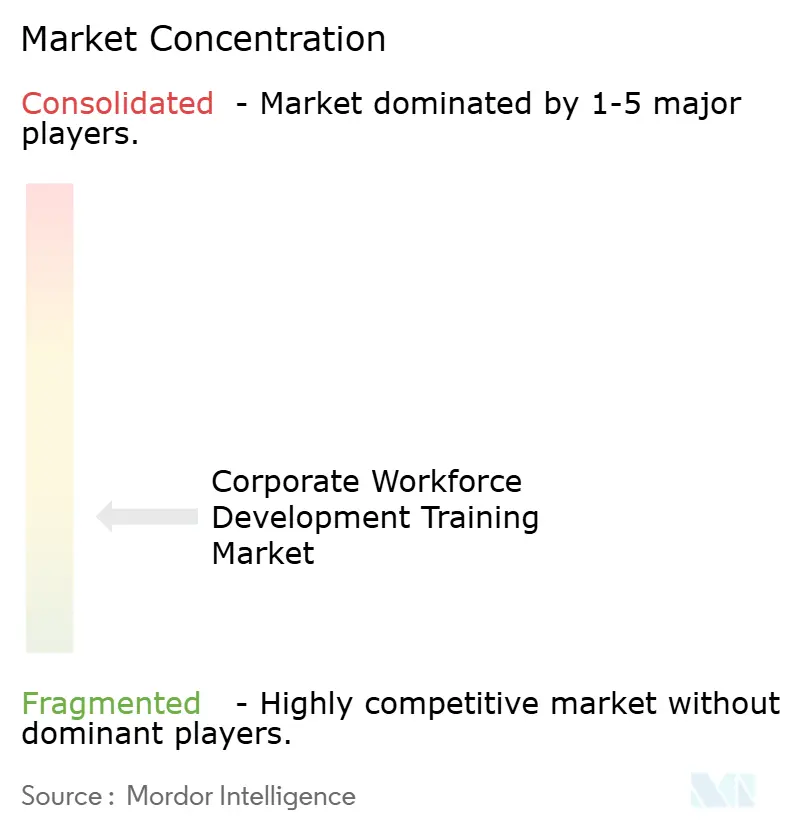
The workforce development training market is moderately fragmented, and no single provider controls the category across all training types, delivery formats, and geographies. Competition is increasingly organized around 3 broad models, namely AI-native skills platforms, HCM suite vendors with embedded learning, and managed learning service providers with multi-vendor coordination capability. Coursera’s all-stock combination with Udemy, completed in May 2026, was the most significant strategic move in the recent period because it created a combined platform with pro forma annual revenue above USD 1.5 billion, 95,000 creators, more than 315,000 courses, and a target of USD 115 million in run-rate cost synergies within 24 months. This transaction shows that scale, catalog breadth, and credential reach are becoming more important in enterprise buying decisions. It also signals that larger platforms want to combine marketplace depth with stronger enterprise distribution and verified learning pathways.
A second line of competition is forming around skills, intelligence, and workflow integration. Docebo’s January 2026 acquisition of 365Talents for USD 54.6 million showed how vendors are moving from simple course delivery to automated skills detection, talent analytics, and guided learning assignments. SAP, Workday, and Oracle are also reshaping the workforce development training market by embedding agentic AI into broader enterprise software environments rather than treating learning as a separate destination. SAP launched its Workforce Upskilling Assistant in May 2026 to deliver personalized micro-learning directly within collaboration tools, mobile, and desktop workflows, reducing dependence on standalone LMS logins. Workday expanded AI agents for HR and finance in September 2025, and Oracle introduced Fusion Agentic Applications in March 2026, both of which have implications for training assignment, workforce planning, and compliance execution. These moves matter because platform integration can make learning more continuous, more data-linked, and harder for point vendors to displace.
A third competitive space remains open around knowledge capture, proof of outcomes, and regulated workforce readiness. California Management Review noted in 2026 that tacit knowledge capture could become the next competitive moat, and this is relevant for providers that can turn expert know-how into role-based learning at scale. The market also continues to reward vendors that can connect training to measurable business results, because budget scrutiny remains high when programs cannot show operational or financial value. ISO 30414 and related disclosure expectations are increasingly influencing procurement, leading buyers to seek systems that can document, evidence, and report workforce development activities in an auditable way. That requirement favors larger, more integrated vendors, but it does not eliminate room for specialists who are stronger in content depth, localization, or industry-specific compliance. The workforce development training market, therefore, remains open, but competitive advantage is shifting toward platforms that combine content, skills intelligence, workflow delivery, and evidence of impact.
Corporate Workforce Development Training Industry Leaders
-
Udemy Business
-
Skillsoft Corporation
-
Coursera for Business
-
Docebo Inc.
-
NIIT Learning Systems Limited
- *Disclaimer: Major Players sorted in no particular order
Recent Industry Developments
- May 2026: Coursera completed its all-stock combination with Udemy, uniting a global ecosystem of 95,000 content creators and 315,000+ courses into a single platform with pro forma annual revenue exceeding USD 1.5 billion. The transaction targets USD 115 million in annual run-rate cost synergies within 24 months of closing and positions the combined entity to compete across enterprise skills development, AI-native personalization, and credential verification
- May 2026: Cornerstone OnDemand launched Cornerstone Workforce AI, an intelligence platform designed to consolidate skills optimization, workforce readiness insights, and agentic AI capabilities, directly competing with both dedicated skills-intelligence point solutions and adjacent enterprise HCM learning modules for multi-year talent infrastructure contracts.
- May 2026: Skillsoft entered into a definitive Sale and Purchase Agreement to divest its Global Knowledge instructor-led training business to an affiliate of Enduring Ventures, reflecting the company's strategic exit from ILT delivery and a focus on its AI-native digital skills platform.
- May 2026: SAP unveiled the Workforce Upskilling Assistant within SAP SuccessFactors at SAP Sapphire in Orlando, a Joule-powered agentic capability delivering adaptive micro-learning directly in collaboration tools, mobile, and desktop environments, with AI-driven content generation and reinforcement embedded at point of work.
Global Corporate Workforce Development Training Market Report Scope
| Technical and Digital Skills Training |
| Leadership and Management Training |
| Compliance and Risk Training |
| Sales and Customer Service Training |
| Professional and Functional Skills Training |
| Interpersonal, Culture, and Well-being Training |
| Online Training |
| Instructor-Led Training |
| Blended Training |
| Large Enterprises |
| Small and Medium-Sized Enterprises |
| Information Technology and Telecom |
| BFSI |
| Healthcare and Life Sciences |
| Manufacturing |
| Retail and E-commerce |
| Professional Services |
| Energy and Utilities |
| Public Sector and Government-Linked Enterprises |
| North America | United States |
| Canada | |
| Mexico | |
| South America | Brazil |
| Peru | |
| Chile | |
| Argentina | |
| Rest of South America | |
| Europe | United Kingdom |
| Germany | |
| France | |
| Spain | |
| Italy | |
| BENELUX (Belgium, Netherlands, and Luxembourg) | |
| NORDICS (Denmark, Finland, Iceland, Norway, and Sweden) | |
| Rest of Europe | |
| Asia-Pacific | India |
| China | |
| Japan | |
| Australia | |
| South Korea | |
| South East Asia (Singapore, Malaysia, Thailand, Indonesia, Vietnam, and Philippines) | |
| Rest of Asia-Pacific | |
| Middle East and Africa | United Arab Emirates |
| Saudi Arabia | |
| South Africa | |
| Nigeria | |
| Rest of Middle East and Africa |
| By Training Type | Technical and Digital Skills Training | |
| Leadership and Management Training | ||
| Compliance and Risk Training | ||
| Sales and Customer Service Training | ||
| Professional and Functional Skills Training | ||
| Interpersonal, Culture, and Well-being Training | ||
| By Learning Format | Online Training | |
| Instructor-Led Training | ||
| Blended Training | ||
| By Organization Size | Large Enterprises | |
| Small and Medium-Sized Enterprises | ||
| By Industry Vertical | Information Technology and Telecom | |
| BFSI | ||
| Healthcare and Life Sciences | ||
| Manufacturing | ||
| Retail and E-commerce | ||
| Professional Services | ||
| Energy and Utilities | ||
| Public Sector and Government-Linked Enterprises | ||
| By Geography | North America | United States |
| Canada | ||
| Mexico | ||
| South America | Brazil | |
| Peru | ||
| Chile | ||
| Argentina | ||
| Rest of South America | ||
| Europe | United Kingdom | |
| Germany | ||
| France | ||
| Spain | ||
| Italy | ||
| BENELUX (Belgium, Netherlands, and Luxembourg) | ||
| NORDICS (Denmark, Finland, Iceland, Norway, and Sweden) | ||
| Rest of Europe | ||
| Asia-Pacific | India | |
| China | ||
| Japan | ||
| Australia | ||
| South Korea | ||
| South East Asia (Singapore, Malaysia, Thailand, Indonesia, Vietnam, and Philippines) | ||
| Rest of Asia-Pacific | ||
| Middle East and Africa | United Arab Emirates | |
| Saudi Arabia | ||
| South Africa | ||
| Nigeria | ||
| Rest of Middle East and Africa | ||
Key Questions Answered in the Report
What is the projected value of the workforce development training market by 2031?
The corporate workforce development training market is projected to reach USD 402.1 billion by 2031, rising from USD 285.7 billion in 2026 at a 7.1% CAGR.
Which region leads revenue in workforce development training?
North America led global revenue with a 35.74% share in 2025, supported by mature enterprise learning infrastructure and strong external training spend.
Which region is growing the fastest in workforce development training?
Asia-Pacific is the fastest-growing region, with an 8.84% CAGR through 2031, supported by enterprise digitalization and large unmet formal training needs.
Which training type leads current spending?
Technical and Digital Skills Training led with a 28.33% share in 2025, driven by AI adoption, cloud migration, cybersecurity, and data-related upskilling.
Why are SMEs becoming more important in this space?
SMEs are forecast to grow at a 7.92% CAGR through 2031 because skills shortages are pushing smaller firms to retrain existing staff despite tighter budgets.
What is the main challenge holding back training investment?
One major constraint is weak ROI measurement, as only a small share of organizations can clearly demonstrate business impact, making budgets more vulnerable during reviews.