
Inorganic Scintillators Market Size and Share
Market Overview
| Study Period | 2020 - 2031 |
|---|---|
| Market Size (2026) | USD 452.78 Million |
| Market Size (2031) | USD 645.17 Million |
| Growth Rate (2026 - 2031) | 7.34 % |
| Fastest Growing Market | Asia-Pacific |
| Largest Market | North America |
| Market Concentration | Medium |
Major Players *Disclaimer: Major Players sorted in no particular order Image © Mordor Intelligence. Reuse requires attribution under CC BY 4.0. | |
Inorganic Scintillators Market Analysis by Mordor Intelligence
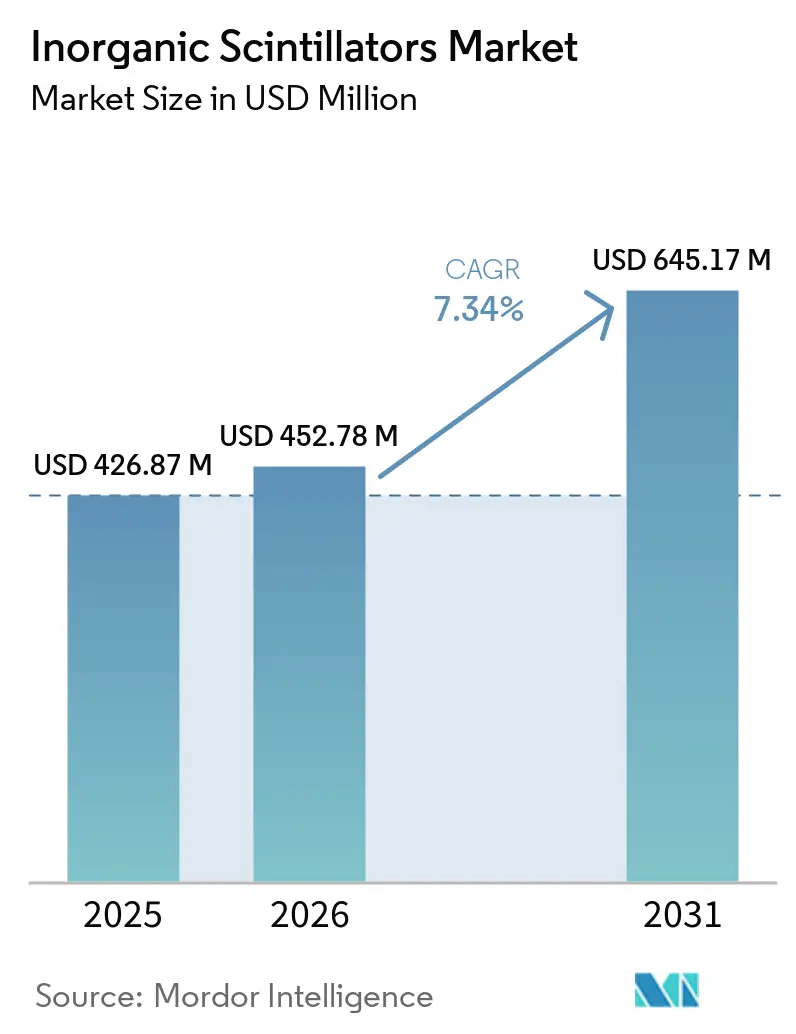
The inorganic scintillators market is expected to increase from USD 426.87 million in 2025 to USD 452.78 million in 2026 and reach USD 645.17 million by 2031, growing at a CAGR of 7.34% over 2026-2031. The inorganic scintillators market is being supported by sustained demand from PET and SPECT imaging, as cancer care programs, theranostics workflows, and imaging modernization continue to expand across hospital networks and research centers. The inorganic scintillators market is also shifting toward higher-performance crystal chemistries, as buyers place more weight on timing resolution, energy resolution, and compatibility with digital detector designs. Supply positioning now matters almost as much as detector performance, because premium crystal production still depends on specialized growth methods and concentrated access to rare earth inputs. The inorganic scintillators market is also seeing opportunity in research-grade imaging systems, integrated radiopharmaceutical infrastructure, and alternative lutetium-based or ceramic materials that can widen the supplier base over time. Competition remains strongest at the crystal tier, where a limited group of manufacturers holds durable process know-how, while downstream detector integration stays more open and application-specific.
Key Report Takeaways
- By type, sodium iodide (NaI) held 38.47% of revenue in 2025, while lutetium-based scintillators are projected to expand at a 7.84% CAGR through 2031.
- By form, single crystals accounted for 41.35% of revenue in 2025, while polycrystalline materials are forecasted to grow at an 8.17% CAGR through 2031.
- By detection technology, photomultiplier tube-based systems held 42.26% of revenue in 2025, while hybrid detection systems are projected to grow at an 8.56% CAGR through 2031.
- By application, positron emission tomography (PET) accounted for 39.62% of revenue in 2025, while nuclear medicine research is expected to advance at a 9.11% CAGR through 2031.
- By end-user, hospitals represented 43.37% of demand in 2025, while diagnostic imaging centers are forecasted to expand at a 7.56% CAGR through 2031.
- By geography, North America held 46.28% of revenue in 2025, while Asia-Pacific is projected to record the fastest regional CAGR at 10.24% through 2031.
Note: Market size and forecast figures in this report are generated using Mordor Intelligence’s proprietary estimation framework, updated with the latest available data and insights as of January 2026.
Global Inorganic Scintillators Market Trends and Insights
Drivers Impact Analysis*
| Driver | (~) % Impact on CAGR Forecast | Geographic Relevance | Impact Timeline |
|---|---|---|---|
| Rising Adoption of PET and SPECT Imaging for Early Disease Diagnosis | +2.1% | Global, most pronounced in North America and Western Europe | Medium term (2-4 years) |
| Growing Global Burden of Cancer and Chronic Diseases | +1.5% | Global, accelerating in APAC and Latin America | Long term (≥ 4 years) |
| Technological Advancements in Scintillator Materials | +1.4% | North America, Europe, East Asia | Medium term (2-4 years) |
| Expansion of Hybrid Imaging Systems | +1.2% | North America, Germany, Japan, China | Medium term (2-4 years) |
| Increasing Investments in Nuclear Medicine Infrastructure | +1.0% | APAC, Middle East, emerging economies | Long term (≥ 4 years) |
| Rising Demand for High-Resolution and Low-Dose Medical Imaging | +0.8% | North America, EU | Short term (≤ 2 years) |
| Source: Mordor Intelligence | |||
Rising Adoption of PET and SPECT Imaging for Early Disease Diagnosis
PET and SPECT imaging now sit much closer to routine diagnostic practice in major oncology settings, and that shift gives the inorganic scintillators market a more stable equipment demand base. Each installed scanner creates demand not only for the original detector array, but also for later replacement cycles that continue well after the first procurement decision. The long-term case for continued imaging demand remains strong because The Lancet projected global cancer incidence to exceed 30.5 million cases annually by 2050.[1] Theranostics is adding another layer to this demand, because Lu-177-based treatment pathways require repeated imaging for dosimetry, treatment planning, and response monitoring. SHINE Technologies received European Union marketing authorization for Ilumira in May 2026, which supports wider clinical use of non-carrier-added Lu-177 and can raise imaging volumes around treatment programs.[2] As a result, the inorganic scintillators market is benefiting from scanner utilization that is tied to both diagnosis and therapy follow-up, rather than to a single imaging event.
Technological Advancements in Scintillator Materials
Material performance has become a more direct purchasing factor in the inorganic scintillators market, because crystal selection now shapes timing, sensitivity, and compatibility with digital detector architectures. Research published in 2025 showed that 5th-generation LYSO: Ce crystals outperformed earlier generations in sensitivity, energy resolution, and coincidence resolving time. A 2026 study also found that LFS-3 lutetium-silicate crystals delivered competitive or better performance than clinical-grade LYSO in key metrics, which broadens the set of commercially credible materials for advanced scanners.[3] These material gains are shortening the useful life advantage of older PMT-coupled NaI systems in high-end imaging environments. The inorganic scintillators market is therefore moving toward a performance curve where incremental crystal improvements can directly influence upgrade timing at hospitals and research centers.
Expansion of Hybrid Imaging Systems
Hybrid PET and PET-linked imaging platforms are increasing their role in oncology infrastructure, and that gives the inorganic scintillators market a recurring source of demand from detector-heavy systems. DOI.ORG These systems require large crystal arrays, and their replacement cycles extend demand well beyond the year of first installation. The Journal of Nuclear Medicine also reported in 2025 that the intrinsic radiation of LYSO-based long-axial-field-of-view PET scanners is not a patient safety issue, which removes one procurement concern for advanced systems. Because a single hybrid platform can support oncology, neurology, cardiology, and theranostics monitoring, the inorganic scintillators market gains from higher average system use after installation.
Increasing Investments in Nuclear Medicine Infrastructure
Infrastructure spending is giving the inorganic scintillators market a more organized demand pipeline in Asia-Pacific and other emerging regions. India announced plans for a dedicated medical isotope reactor under a public-private partnership model, which points to a broader domestic buildout of nuclear medicine capacity. Australia is following a similar path, as ANSTO's 2025-2029 corporate plan is committed to sovereign nuclear medicine supply through targeted investment. Telix Pharmaceuticals then opened Australia's first integrated radiopharmaceutical manufacturing, research, clinical treatment, and imaging facility in Melbourne in July 2026. When isotope production and imaging capacity grow in parallel, the inorganic scintillators market gets stronger support from local scanner utilization rather than from one-time hardware placement alone.
Restraints Impact Analysis*
| Restraint | (~) % Impact on CAGR Forecast | Geographic Relevance | Impact Timeline |
|---|---|---|---|
| High Manufacturing Cost of Premium Scintillator Crystals | -0.7% | Global, most acute in cost-sensitive emerging markets | Medium term (2-4 years) |
| Supply Constraints of Rare Earth Materials | -0.6% | Global, most acute in North America and Europe | Short term (≤ 2 years) |
| Long Product Qualification and Regulatory Approval Cycles | -0.4% | North America, EU | Medium term (2-4 years) |
| Performance Trade-Offs Such as Afterglow and Hygroscopicity | -0.3% | Global | Long term (≥ 4 years) |
| Source: Mordor Intelligence | |||
High Manufacturing Cost of Premium Scintillator Crystals
Premium crystal production remains expensive, and that cost issue continues to limit how quickly the inorganic scintillators market can shift toward top-end chemistries. The Czochralski process used for materials such as LYSO and BGO requires costly capital equipment, high-purity feedstocks, and long growth cycles that keep production economics tight. Raw materials account for a large share of total cost in lutetium-based crystals, and lower yield rates push final pricing even higher for smaller producers. The gap between lower-cost NaI(Tl) and premium LYSO remains wide in 2026, which keeps many scanner fleets tied to more economical configurations outside leading academic centers. That gap also concentrates supply among manufacturers that can sustain better yields and absorb the fixed costs of advanced crystal growth. The inorganic scintillators market therefore, faces a structural cost barrier that slows adoption of premium materials even when clinical demand is clearly moving upward.
Supply Constraints of Rare Earth Materials
Rare earth availability became a more visible issue for the inorganic scintillators market after China introduced export licensing requirements in April 2025 for lutetium, gadolinium, yttrium, and other elements used across advanced crystal supply chains. Taylor Wessing's June 2025 analysis said China accounted for close to 90% of global rare earth refining capacity and that standard licensing review could take up to 45 working days. Licensing delays have already raised the risk of slower production schedules and tighter contract terms for some European manufacturers. This means the inorganic scintillators market can face supply stress even in periods when clinical demand remains solid.
*Our forecasts treat driver/restraint impacts as directional, not additive. The impact forecasts reflect baseline growth, mix effects, and variable interactions.
Segment Analysis
By Type: NaI Retains Scale Leadership, but Lutetium Chemistry Defines the Growth Frontier
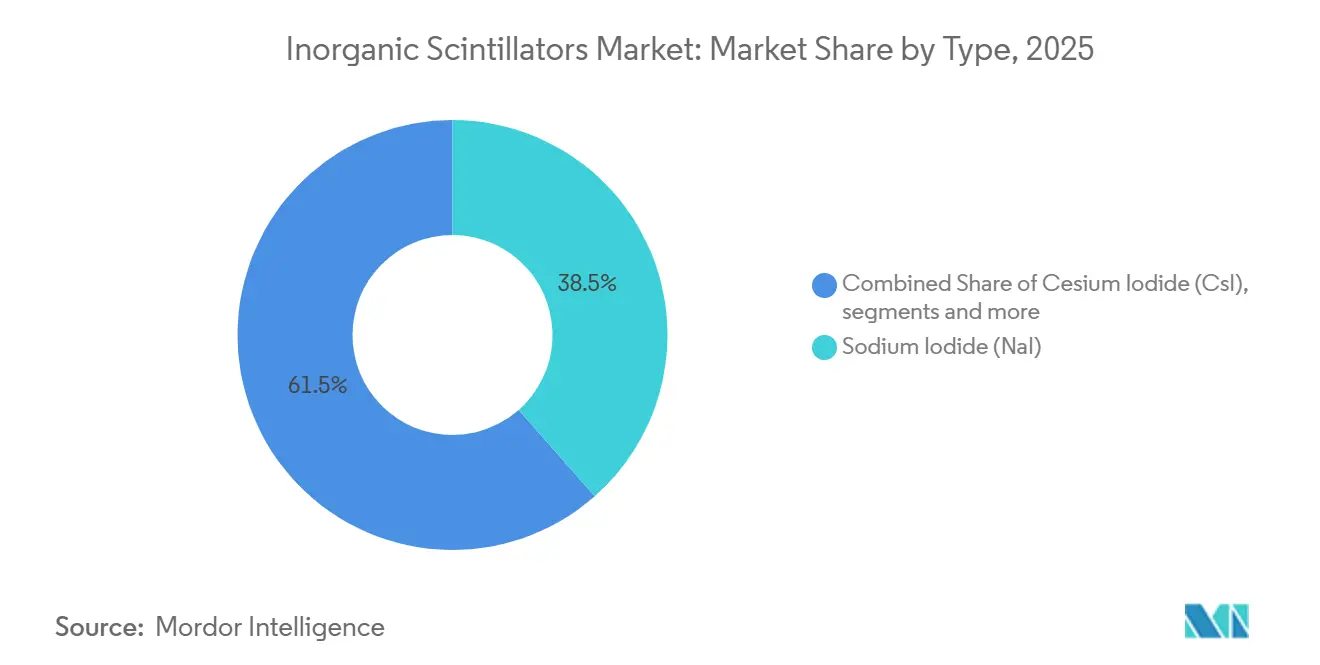
Sodium iodide held 38.47% of the inorganic scintillators market in 2025, and it remains central to gamma camera and SPECT workflows, where cost discipline still shapes buying decisions. Sodium Iodide continues to benefit from high light yield and from an installed base that is far larger than the newest premium detector segment. Lutetium-based scintillators are projected to expand at a 7.84% CAGR through 2031, which makes them the fastest-growing material group in the inorganic scintillators market. Time-of-flight PET requirements are pushing detector specifications upward, and that supports stronger demand for lutetium silicate chemistries that can meet tighter timing expectations in advanced platforms.
Cesium iodide remains relevant in flat-panel X-ray detectors and CT systems because mechanical flexibility still matters in those configurations. Gadolinium-based materials such as GAGG: Ce are also drawing interest in preclinical imaging and radiation therapy dosimetry, partly because they reduce direct dependence on lutetium-heavy supply chains.

By Form: Single Crystals Anchor Quality Standards, Polycrystalline Routes Drive Volume Expansion
Single crystals accounted for 41.35% of demand in 2025, and they still define the quality benchmark for precision detector arrays. Uniform energy resolution across large arrays remains a hard requirement in PET systems, so OEMs continue to rely on crystal formats with proven reproducibility. Ceramic scintillators already have a practical role in high-volume CT applications where scale and durability matter more than the tightest PET-level uniformity. Glass scintillators hold a smaller but defensible niche in fast-neutron detection and security screening, where brittleness can be a disadvantage for conventional crystal formats.
Polycrystalline materials are forecasted to grow at an 8.17% CAGR through 2031, and that makes form innovation one of the more active themes in the inorganic scintillators market. Transparent ceramics and related polycrystalline routes are advancing because they can support shapes and volumes that are harder to produce through traditional single-crystal growth.
By Detection Technology: Installed PMT Systems Hold the Base, but Hybrid and SiPM Designs Shape New Demand
PMT-based systems held 42.26% of revenue in 2025, and that installed base still gives them the largest role in current replacement demand. Many SPECT gamma cameras and legacy PET systems stay in service for long operating lives, which means their detector needs continue even when new scanner sales fluctuate. Hybrid detection systems are projected to grow at an 8.56% CAGR through 2031, and that reflects the appeal of blending performance gains with better cost control. In the inorganic scintillators market, these hybrid designs are especially relevant for hospitals that want stronger TOF-PET capability without moving fully to the highest-cost detector architecture.
SiPM-based systems are taking more of the new-installation opportunity because they support compact digital layouts and can operate in magnetic-field environments such as PET/MRI. Frontiers in Physics reported in 2026 that multichannel SiPM readout boards achieved timing results equivalent to single-channel setups even with 4:1 multiplexing. The inorganic scintillators market is therefore moving toward a period in which hybrid systems may serve as a transition step, while all-digital SiPM platforms gain more ground in premium installations.
By Application: PET Holds the Largest Base, while Research Uses Set the Fastest Pace
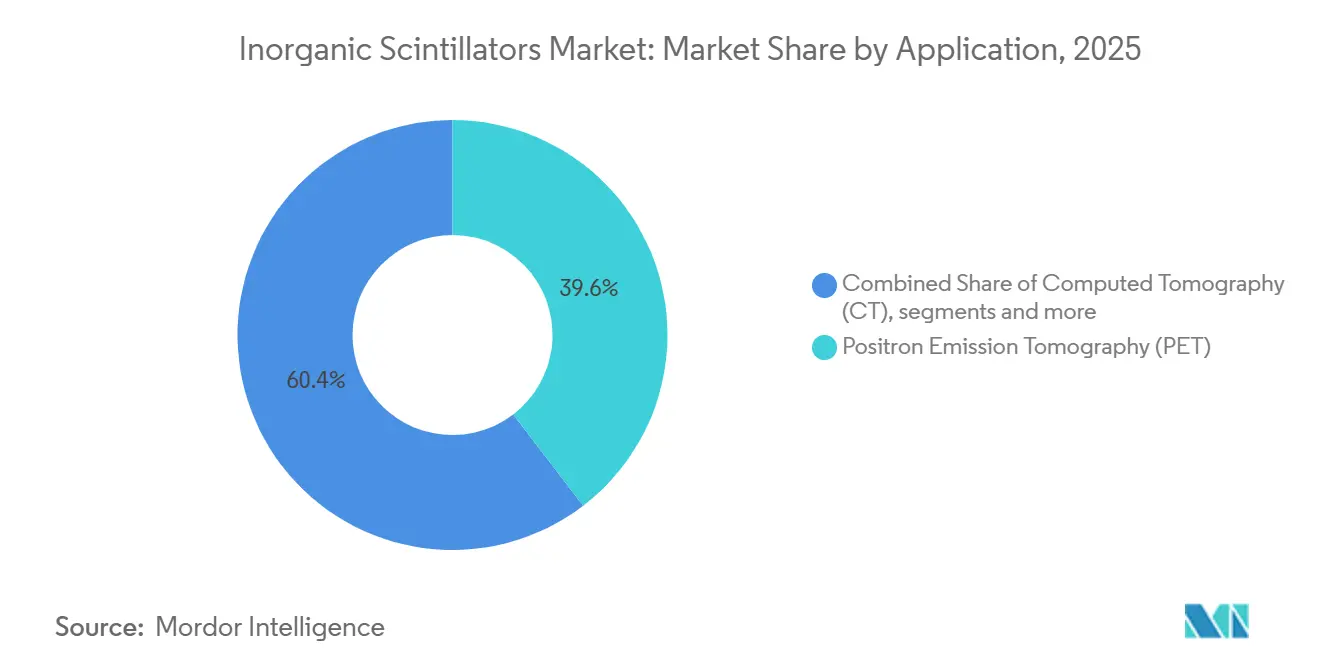
Positron emission tomography (PET) held 39.62% of revenue in 2025, while nuclear medicine research is expected to advance at a 9.11% CAGR through 2031, making it the fastest-growing application area in the inorganic scintillators market. That growth is tied to preclinical imaging programs, whole-body PET research systems, and theranostics clinical development that needs high-resolution crystal-based detectors. The rise of Lu-177 treatment pathways is adding repeat imaging cycles for dosimetry and follow-up, which lifts PET use beyond the first diagnostic scan.
The Journal of Nuclear Medicine reported in 2025 that intrinsic 176Lu radiation in long-axial-field-of-view LYSO PET scanners is not a patient safety problem. CT continues to consume large volumes of scintillator material because detector arrays are large and replacement cycles remain active. Radiation therapy dosimetry is also taking on more real-time scintillator-based monitoring roles in treatment settings.
By End-User: Hospitals Lead Current Volume, while Imaging Centers Add the Growth Delta
Hospitals accounted for 43.37% of demand in 2025, which kept them as the largest end-user group in the inorganic scintillators market. Tertiary hospitals and academic medical centers still concentrate the largest PET/CT and SPECT procurement budgets, and they house many of the nuclear medicine departments that shape technology adoption. Diagnostic imaging centers are projected to grow at a 7.56% CAGR through 2031, which makes them the fastest-expanding end-user group.
Premium crystal suppliers may therefore need more tiered pricing and performance-based supply structures as independent imaging networks expand. Cancer care centers are also becoming more important because repeated Lu-177 treatment cycles create repeated PET imaging demand around each patient's journey. As this mix changes, the inorganic scintillators industry is seeing more growth shift toward facilities that can turn faster patient throughput into higher scanner utilization.
Geography Analysis
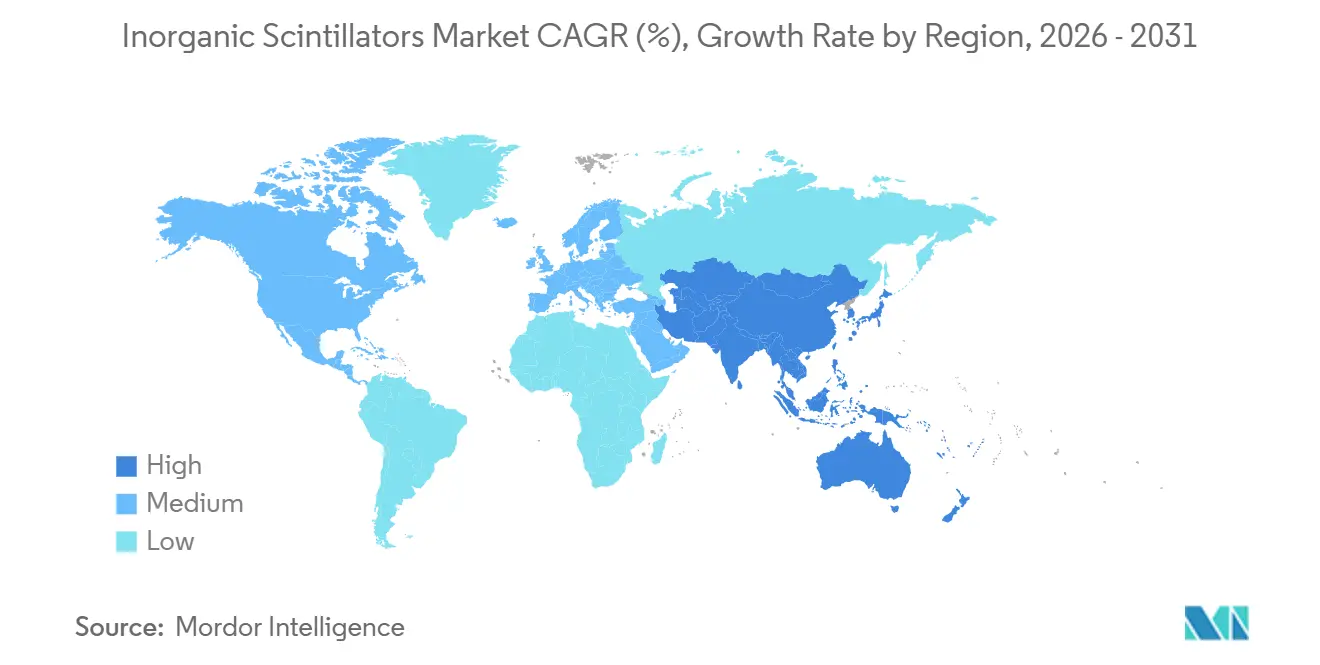
North America held 46.28% of the inorganic scintillators market share in 2025, which kept it as the largest regional base. The region benefits from a large installed base of PET/CT and SPECT systems, broad cancer care financing, and a dense academic nuclear medicine ecosystem. SHINE Technologies strengthened that position with USD 240 million in Series E financing in February 2026 and with the completed acquisition of Lantheus' SPECT business in January 2026.
Europe remains the second-largest regional cluster in the inorganic scintillators market, with procurement still shaped by multiyear national health budgets. Germany stands out in premium crystal demand because research-grade PET and whole-body imaging programs continue to attract public funding. In March 2026, HZDR and UKDD confirmed close to EUR 8 million in joint investment for a whole-body PET system, including close to EUR 5 million in EU co-funding. Spain, France, and Italy are also adding private diagnostic center demand for hybrid PET/CT capacity. China's 2025 export licensing requirements are creating a more difficult operating environment for European crystal manufacturers that rely on rare earth inputs refined in China.
Asia-Pacific is expected to record the fastest regional CAGR at 10.24% through 2031, making it the fastest-growing part of the inorganic scintillators market. China, India, and Australia form the main regional demand anchors because imaging infrastructure and radiopharmaceutical capacity are expanding together. India is moving through a coordinated buildout that includes a planned dedicated isotope reactor and a four-cyclotron agreement between IBA and Shreeji. Australia is reinforcing local demand through ANSTO's sovereign supply plan and through Telix's integrated Melbourne facility that opened in July 2026. Middle East and Africa remain early-stage opportunity areas, while South America is still advancing mainly through private oncology center expansion in Brazil and Argentina.
Competitive Landscape
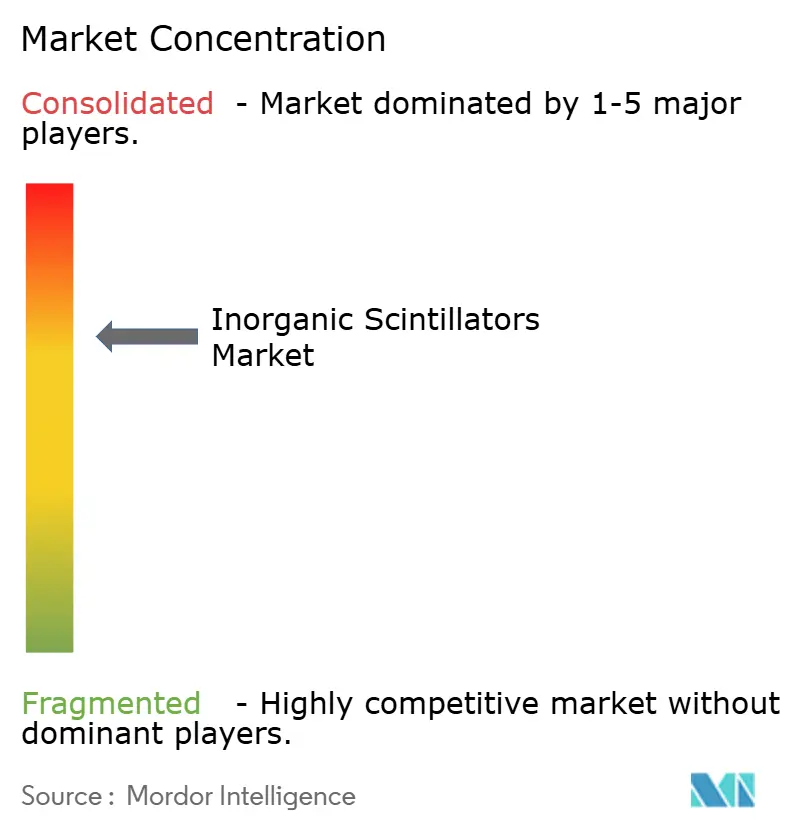
The inorganic scintillators market is moderately consolidated at the crystal manufacturing tier, where process capability still acts as the main entry barrier. Expertise in Czochralski and Bridgman growth, rare earth handling, and optical finishing is not easily replicated at commercial quality. That is why a limited group of producers continues to set the pace in premium crystal supply.
Excelitas said Luxium brought more than 170 patents, more than 650 customers, and seven global facilities across medical imaging, semiconductor, and defense-related photonics activity. That scale matters because the inorganic scintillators market rewards companies that can combine crystal science with broad application reach and dependable manufacturing output. Leading suppliers are also competing through incremental material gains rather than only through price. Research in 2026 then showed that LFS-3 could compete with or outperform clinical-grade LYSO in key detector metrics.
Competition is also moving into detector architecture, not just crystal chemistry. The inorganic scintillators market still leaves room for lower-cost regional producers, especially where domestic demand is rising, and buyers accept different performance trade-offs. White-space openings remain strongest in transparent ceramic manufacturing and in non-lutetium alternatives such as GAGG: Ce that can soften rare earth exposure. Recent strategic examples include SHINE building a more integrated nuclear medicine platform and Telix opening an end-to-end radiopharmaceutical and imaging site in Melbourne.
Inorganic Scintillators Industry Leaders
-
Saint-Gobain Crystals
-
Hamamatsu Photonics K.K.
-
Proterial Ltd.
-
Toshiba Materials Co., Ltd.
-
Mirion Technologies, Inc.
- *Disclaimer: Major Players sorted in no particular order
Recent Industry Developments
- July 2026: Telix Pharmaceuticals officially opened its Telix Manufacturing Solutions North Melbourne (TMSNM) facility, Australia's first site integrating radiopharmaceutical research, clinical manufacturing, patient dose administration, and imaging. The facility directly anchors domestic PET scanner utilization by eliminating transport-related isotope decay loss.
- July 2026: Radnostix, Inc. completed its acquisition of key assets from Lucerno Dynamics, LLC, including the LARA System technology platform and ELLEXA Explorer software. The transaction expands Radnostix's nuclear medicine device portfolio in dosimetry, uptake quantification, and drug delivery monitoring.
- May 2026: SHINE Technologies received Centralized Marketing Authorization in the European Union for Ilumira (non-carrier-added lutetium-177), unlocking the EU as a major market for Lu-177-based targeted radioligand therapy. The authorization followed SHINE's USD 240 million Series E financing in February 2026.
Global Inorganic Scintillators Market Report Scope
According to the report’s scope, the inorganic scintillators market comprises materials and components that emit light when exposed to ionizing radiation, enabling radiation detection and measurement across various applications. These scintillators are widely used in medical imaging systems, nuclear detection, security screening, high-energy physics research, and industrial inspection due to their high light output, radiation sensitivity, and energy resolution.
The inorganic scintillators market is segmented into type, form, detection technology, application, end-user, and geography. By type, the market is segmented into sodium iodide (NaI), cesium iodide (CsI), bismuth germanate (BGO), lutetium-based scintillators, gadolinium-based scintillators, and other material types. By form, the market is segmented into single crystals, polycrystalline materials, ceramic scintillators, and glass scintillators. By detection, the market is segmented into photomultiplier tube based systems, silicon photomultiplier based systems, and hybrid detection systems. By application, the market is segmented into positron emission tomography (PET), computed tomography (CT), digital radiography & fluoroscopy, radiation therapy dosimetry, nuclear medicine research, preclinical imaging, and other applications. By end-user, the market is segmented into hospitals, diagnostic imaging centers, cancer care centers, and other end-users. By geography, the market is segmented into North America, Europe, Asia-Pacific, the Middle East and Africa, and South America. The report also covers the estimated market sizes and trends for 17 countries across major regions globally. The report offers values (USD) for all the above segments.
| Sodium Iodide (NaI) |
| Cesium Iodide (CsI) |
| Bismuth Germanate (BGO) |
| Lutetium-Based Scintillators |
| Gadolinium-Based Scintillators |
| Other Material Types |
| Single Crystals |
| Polycrystalline Materials |
| Ceramic Scintillators |
| Glass Scintillators |
| Photomultiplier Tube Based Systems |
| Silicon Photomultiplier Based Systems |
| Hybrid Detection Systems |
| Positron Emission Tomography (PET) |
| Computed Tomography (CT) |
| Digital Radiography & Fluoroscopy |
| Radiation Therapy Dosimetry |
| Nuclear Medicine Research |
| Preclinical Imaging |
| Other Applications |
| Hospitals |
| Diagnostic Imaging Centers |
| Cancer Care Centers |
| Other End-Users |
| North America | United States |
| Canada | |
| Mexico | |
| Europe | Germany |
| United Kingdom | |
| France | |
| Italy | |
| Spain | |
| Rest of Europe | |
| Asia-Pacific | China |
| Japan | |
| India | |
| Australia | |
| South Korea | |
| Rest of Asia-Pacific | |
| Middle East and Africa | GCC |
| South Africa | |
| Rest of Middle East and Africa | |
| South America | Brazil |
| Argentina | |
| Rest of South America |
| By Type | Sodium Iodide (NaI) | |
| Cesium Iodide (CsI) | ||
| Bismuth Germanate (BGO) | ||
| Lutetium-Based Scintillators | ||
| Gadolinium-Based Scintillators | ||
| Other Material Types | ||
| By Form | Single Crystals | |
| Polycrystalline Materials | ||
| Ceramic Scintillators | ||
| Glass Scintillators | ||
| By Detection Technology | Photomultiplier Tube Based Systems | |
| Silicon Photomultiplier Based Systems | ||
| Hybrid Detection Systems | ||
| By Application | Positron Emission Tomography (PET) | |
| Computed Tomography (CT) | ||
| Digital Radiography & Fluoroscopy | ||
| Radiation Therapy Dosimetry | ||
| Nuclear Medicine Research | ||
| Preclinical Imaging | ||
| Other Applications | ||
| By End-User | Hospitals | |
| Diagnostic Imaging Centers | ||
| Cancer Care Centers | ||
| Other End-Users | ||
| By Geography | North America | United States |
| Canada | ||
| Mexico | ||
| Europe | Germany | |
| United Kingdom | ||
| France | ||
| Italy | ||
| Spain | ||
| Rest of Europe | ||
| Asia-Pacific | China | |
| Japan | ||
| India | ||
| Australia | ||
| South Korea | ||
| Rest of Asia-Pacific | ||
| Middle East and Africa | GCC | |
| South Africa | ||
| Rest of Middle East and Africa | ||
| South America | Brazil | |
| Argentina | ||
| Rest of South America | ||
Key Questions Answered in the Report
What is the projected value of the inorganic scintillators market by 2031?
The inorganic scintillators market is projected to reach USD 645.17 million by 2031 from USD 426.87 million in 2025 to USD 452.78 million in 2026, with a 7.34% CAGR over 2026-2031.
Which application segment leads, and which one is growing fastest?
Positron emission tomography (PET) led in 2025 with a 39.62% share, while nuclear medicine research is forecasted to grow the fastest at 9.11% CAGR due to increasing advancements in radiotracers, molecular imaging, and clinical research applications.
Which material type leads, and which one is growing fastest?
Sodium iodide led in 2025 with 38.47% share, while lutetium-based scintillators are forecasted to grow the fastest at 7.84% CAGR as TOF-PET requirements rise.
Why is Asia-Pacific expanding faster than other regions?
Asia-Pacific is projected to expand at 10.24% CAGR through 2031, benefiting from coordinated investment in isotope reactors, cyclotrons, sovereign supply planning, and integrated radiopharmaceutical facilities across India and Australia.