
Perovskite X-Ray Imaging Detectors Market Size and Share
Market Overview
| Study Period | 2020 - 2031 |
|---|---|
| Market Size (2025) | USD 98.11 Million |
| Market Size (2031) | USD 569.93 Million |
| Growth Rate (2026 - 2031) | 42.17 % |
| Fastest Growing Market | Asia-Pacific |
| Largest Market | Asia-Pacific |
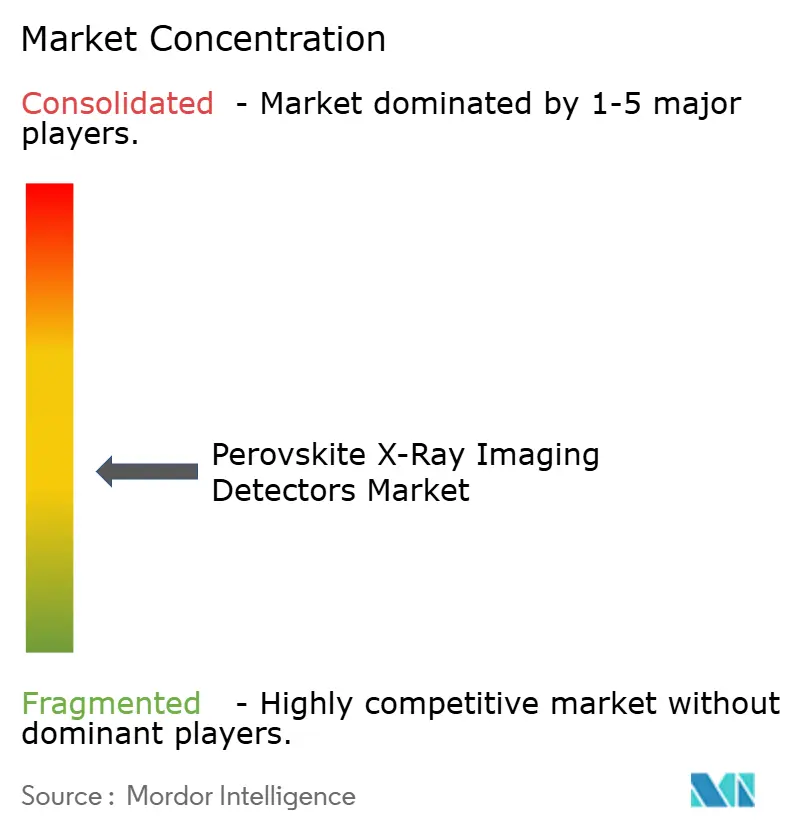
| Market Concentration | Medium |
Major Players *Disclaimer: Major Players sorted in no particular order Image © Mordor Intelligence. Reuse requires attribution under CC BY 4.0. | |
Perovskite X-Ray Imaging Detectors Market Analysis by Mordor Intelligence
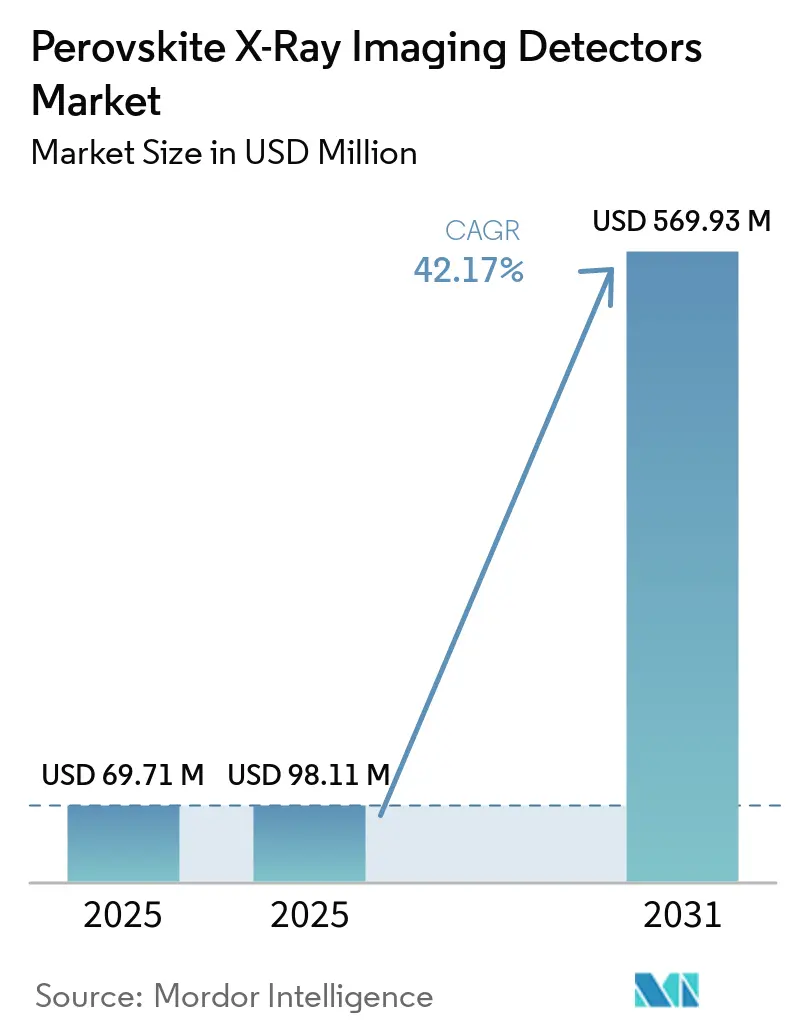
The Perovskite X-Ray Imaging Detectors market size was valued at USD 69.71 million in 2025 and is estimated to reach USD 569.93 million by 2031, at a CAGR of 42.17% during the forecast period 2026-2031. The Perovskite X-Ray Imaging Detectors market is supported by the need for lower-dose imaging without compromising image quality. Perovskite absorbers offer high X-ray sensitivity and can be processed at low temperatures, which supports new manufacturing options. Photon-counting CT adoption is creating a pathway for detectors that can distinguish photon energy and preserve spatial detail. Suppliers are working to connect laboratory performance with large-area panels, reliable readout electronics, and clinical qualification. Capacity for CMOS backplanes may become a supply constraint as advanced semiconductor production serves competing applications.
Key Report Takeaways
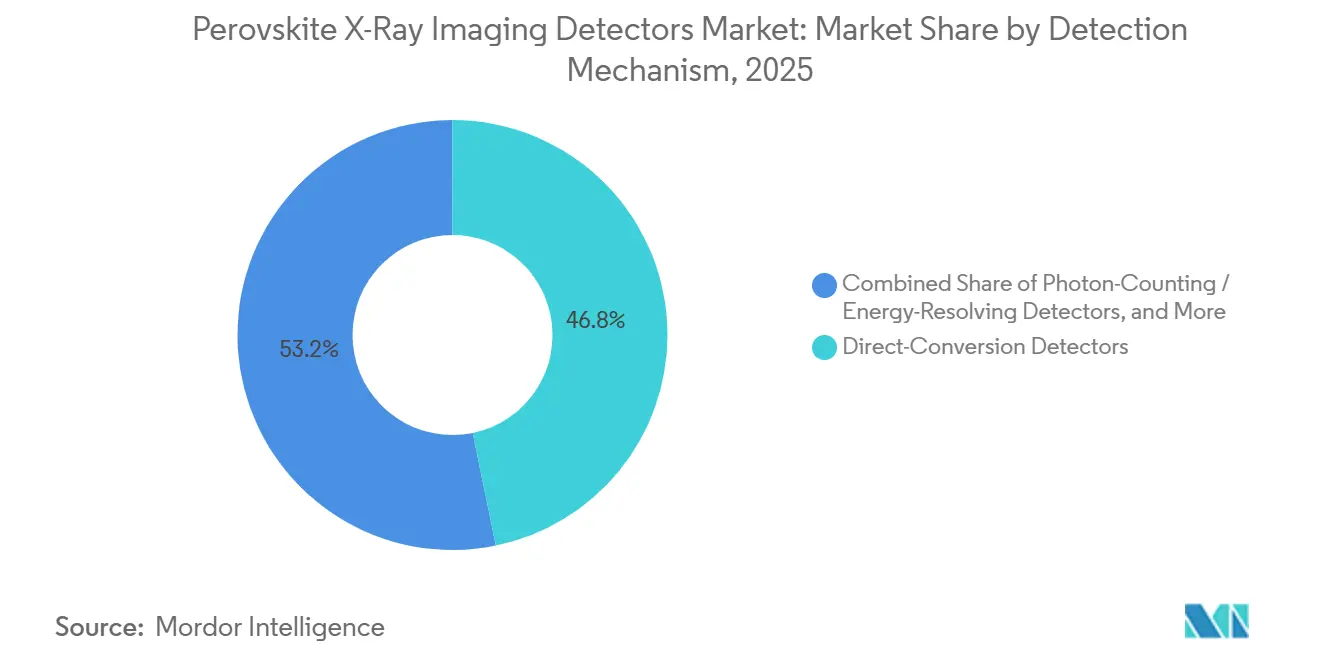
- By detection mechanism, direct-conversion detectors held 46.77% of the Perovskite X-Ray Imaging Detectors market share in 2025, while photon-counting and energy-resolving detectors are projected to expand at a CAGR of 43.89% through 2031.
- By detector architecture, flat-panel detectors accounted for 44.31% of the Perovskite X-Ray Imaging Detectors market size in 2025, while perovskite-on-CMOS detectors are projected to expand at a CAGR of 43.29% through 2031.
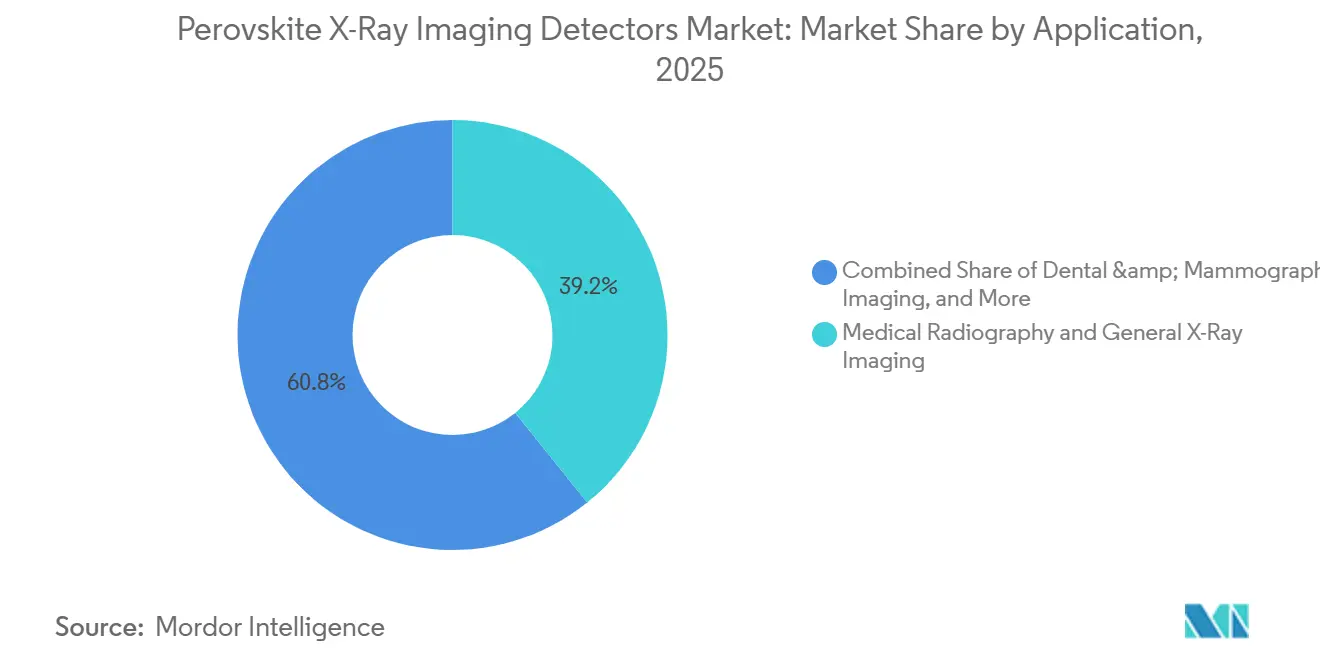
- By application, medical radiography and general X-ray imaging held 39.21% of the Perovskite X-Ray Imaging Detectors market size in 2025 and are projected to expand at a CAGR of 43.83% through 2031.
- By end-user, hospitals and diagnostic imaging centers held 38.92% share in 2025, while research institutes and universities are projected to expand at a CAGR of 43.89% through 2031.
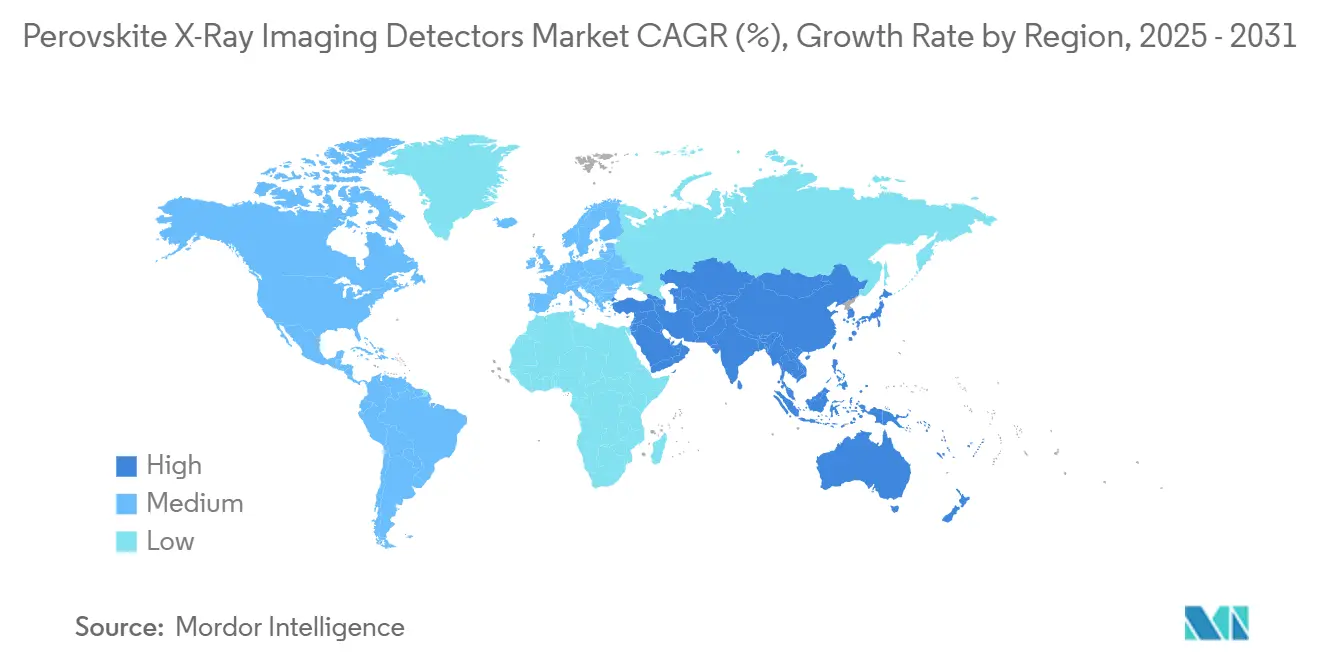
- By geography, Asia-Pacific accounted for 38.43% share in 2025 and is projected to expand at a CAGR of 43.65% through 2031.
Key Report Takeaways
| Segmentation | Segment | Metric | Year | Value |
|---|---|---|---|---|
| By Detection Mechanism | Direct-Conversion Detectors | Market Share | 2025 | 46.77% |
| By Detection Mechanism | Photon-Counting and Energy-Resolving Detectors | CAGR | 2031 | 43.89% |
| By Detector Architecture | Flat-Panel Detectors | Market Share | 2025 | 44.31% |
| By Detector Architecture | Perovskite-on-CMOS Detectors | CAGR | 2031 | 43.29% |
| By Application | Medical Radiography and General X-Ray Imaging | Market Share | 2025 | 39.21% |
| By Application | Medical Radiography and General X-Ray Imaging | CAGR | 2031 | 43.83% |
| By End-User | Hospitals and Diagnostic Imaging Centers | Market Share | 2025 | 38.92% |
| By End-User | Research Institutes and Universities | CAGR | 2031 | 43.89% |
| By Geography | Asia-Pacific | Market Share | 2025 | 38.43% |
| By Geography | Asia-Pacific | CAGR | 2031 | 43.65% |
| Source: Mordor Intelligence | ||||
Note: Market size and forecast figures in this report are generated using Mordor Intelligence’s proprietary estimation framework, updated with the latest available data and insights as of January 2026.
Global Perovskite X-Ray Imaging Detectors Market Trends and Insights
Drivers Impact Analysis*
| Driver | (~) % Impact on CAGR Forecast | Geographic Relevance | Impact Timeline |
|---|---|---|---|
| Transition Toward Low-Dose, High-Resolution X-Ray Imaging | +12.5% | Global, with early demand centers in North America and Europe | Short term (≤ 2 years) |
| Expansion of Photon-Counting and Spectral Imaging Architectures | +9.8% | North America, Europe, and Asia-Pacific, including Japan and South Korea | Medium term (2-4 years) |
| Demand for Low-Temperature, Solution-Processed Detector Manufacturing | +7.5% | Global, with scale-up momentum in China and Europe | Medium term (2-4 years) |
| Growth of Digital Radiography, CT, and Industrial Inspection | +6.4% | Asia-Pacific core, with spillover to the Middle East and Africa | Medium term (2-4 years) |
| Large-Area Array Integration With TFT and CMOS Backplanes | +4.2% | Global, with manufacturing centers in South Korea, Japan, and China | Long term (≥ 4 years) |
| Supply-Chain Localization Through Scalable Perovskite Manufacturing | +2.8% | North America and Europe, with parallel development in China | Long term (≥ 4 years) |
| Source: Mordor Intelligence | |||
Transition Toward Low-Dose, High-Resolution X-Ray Imaging
Clinical radiology is placing greater emphasis on reducing cumulative radiation exposure while maintaining diagnostic image quality. This need supports the Perovskite X-Ray Imaging Detectors market because halide perovskite absorbers have reported sensitivity above 10,000 μC Gy⁻¹air cm⁻². That level is more than 500 times the cited sensitivity of standard amorphous selenium detectors. A 2026 study reported that liquid-phase growth and annealing reduced detector noise by a factor of 10 and enabled low-dose dental and small-animal imaging.[1] European radiation-safety requirements are also raising the value of lower-dose imaging performance. Pediatric radiography, mammography, and repeated CT follow-up are important uses where dose limits can affect equipment selection. The resulting capability could allow providers to extend screening programs without raising aggregate population exposure at the same rate.
Expansion of Photon-Counting and Spectral Imaging Architectures
Photon-counting CT is moving into commercial deployment, which increases demand for detector materials that can resolve individual photon energies under clinical flux. The Perovskite X-Ray Imaging Detectors market benefits from this shift because perovskite devices can combine energy discrimination with fine spatial resolution. Edge-on chloride-alloyed FAPbBr₃ detectors reported a 37-nanosecond response time and a count flux of 2 × 10⁸ photons s⁻¹ mm⁻² at 120 kVp. The same research reported stable spectral response after 120 hours of continuous operation. Clarity Sensors is developing a monolithic perovskite photon-counting detector on a multi-pixel ASIC through its EU-funded PERFORM project. FDA and CE Mark clearances for GE HealthCare Photonova Spectra, together with Canon's Ultimion launch, show that procurement for photon-counting systems is becoming more active.[2]
Demand for Low-Temperature, Solution-Processed Detector Manufacturing
Manufacturing economics are important to the Perovskite X-Ray Imaging Detectors market because perovskite films can be deposited below 150°C. Spin coating, blade coating, and screen printing can be used on prepared TFT and CMOS backplanes. These methods avoid the higher-temperature vapor deposition associated with selenium and the crystal-growth process used for CdTe and CZT. A 2025 study reported 76.9% detective quantum efficiency and 6.2 lp mm⁻¹ spatial resolution at a 0.98 μGy air dose for a thick perovskite film on a TFT substrate.[3] Existing display-panel lines in China and South Korea could support contract manufacturing when film deposition is production-ready. This model could favor detector designers that outsource film deposition rather than building dedicated semiconductor facilities.
Growth of Digital Radiography, CT, and Industrial Inspection
Digital radiography and CT installation bases continue to expand in Southeast Asia, South Asia, and the Middle East and Africa. This expansion gives the Perovskite X-Ray Imaging Detectors market a larger addressable base as the technology advances from preclinical work to OEM integration. Canon Medical launched Ultimion, Japan's first domestically produced photon-counting CT system, in April 2026. Clinical research for the system began at the National Cancer Center Hospital East in March 2026. Industrial inspection also requires low-noise, high-contrast imaging for semiconductor production, aerospace composites, and battery-cell quality control. Perovskite detectors can support this work through fast charge collection and room-temperature operation.
Restraints Impact Analysis*
| Restraint | (~) % Impact on CAGR Forecast | Geographic Relevance | Impact Timeline |
|---|---|---|---|
| Ion Migration and Dark-Current Instability | -4.6% | Global, particularly constraining in high-flux clinical applications | Medium term (2-4 years) |
| Lead Toxicity and Environmental Compliance Requirements | -3.4% | Europe and North America, with compliance influence extending to export markets | Medium term (2-4 years) |
| Large-Area Film Uniformity and Thermal-Expansion Mismatch | -2.1% | Global, particularly affecting large-area detector manufacturing | Long term (≥ 4 years) |
| Limited Clinical Validation and Long-Term Reliability Data | -1.8% | Global, including FDA and CE Mark authorities | Long term (≥ 4 years) |
| Source: Mordor Intelligence | |||
Ion Migration and Dark-Current Instability
Ion migration remains a central barrier for the Perovskite X-Ray Imaging Detectors market. Under sustained electrical bias, mobile halide ions can redistribute within the crystal lattice. This can shift the detector baseline, increase dark current, and cause response drift during image acquisition. A 2025 clinical translation review found that sustained-bias operation in fluoroscopy and CT can exceed the baseline-drift tolerance of clinical readout electronics. Two-dimensional and three-dimensional heterojunctions, together with polymer-enabled homojunctions, have been studied to suppress this behavior. Production panels still need to show reliable operation at clinical temperatures over a commercial product cycle. This makes ion migration a system-integration issue involving bias electronics, thermal control, and readout correction algorithms.
Lead Toxicity and Environmental Compliance Requirements
The dominant MAPbI₃ and FAPbBr₃ absorber compositions contain lead, which complicates market access. The Perovskite X-Ray Imaging Detectors market therefore faces regulatory uncertainty under the EU Restriction of Hazardous Substances Directive and REACH Regulation. The European Commission revised lead-exemption entries through delegated directives published in November 2025, with provisions effective July 1, 2026. A July 2026 consultation also covered further exemption renewals, including X-ray-specific lead uses. Current exemptions address X-ray tubes and image intensifiers, rather than absorber layers in new solid-state detectors. Lead-free bismuth and antimony compositions are under development, but they have not yet matched the combined performance, stability, and scalability of lead-based materials at a viable cost.
*Our forecasts treat driver/restraint impacts as directional, not additive. The impact forecasts reflect baseline growth, mix effects, and variable interactions.
Segment Analysis
By Detection Mechanism: Direct Conversion Holds the Largest Share While Photon Counting Advances
Direct-conversion detectors held 46.77% of the Perovskite X-Ray Imaging Detectors market share in 2025. Their single-stage X-ray-to-electrical-signal conversion removes the spatial blur introduced by an intermediate scintillator layer. This aligns with clinical demand for sharper images at lower dose levels. Polycrystalline CsPbBr₃ direct-conversion prototypes reported 80% detective quantum efficiency and a 45 pGy noise-equivalent dose. The reported fabrication approach supported low-dose, high-contrast CT imaging with single-photon sensitivity.
Photon-counting and energy-resolving detectors are projected to advance at a CAGR of 43.89% from 2026 to 2031. The segment is supported by photon-counting CT deployments from GE HealthCare, Canon, and Siemens Healthineers. Perovskite counting devices could provide a lower-cost alternative to cadmium zinc telluride when manufacturing is qualified. Scintillator-coupled and indirect-conversion detectors remain relevant as a lower-risk route to adoption. They can combine perovskite photodetectors with established CsI or GOS scintillator layers in existing panel geometries.

By Detector Architecture: Flat Panels Lead While CMOS Hybrids Build Momentum
Flat-panel detectors accounted for 44.31% of the Perovskite X-Ray Imaging Detectors market size in 2025. Their position reflects large-format imaging capability and established compatibility with amorphous-silicon and polysilicon TFT backplanes. Display-panel manufacturing capacity in South Korea and China provides a practical manufacturing base. A polymer-enabled homojunction study reported a sensitivity-to-dark-current ratio of 8.84 × 10¹⁰ μC Gy⁻¹air A⁻¹ and successful TFT integration. The work also showed millisecond-scale fidelity for X-ray pulses.
Perovskite-on-CMOS detectors are projected to advance at a CAGR of 43.29% through 2031. CMOS readout offers fast data throughput, smaller pixel pitch, programmable gain, and lower electronic noise than passive TFT arrays. A 2025 IEDM paper described a 640 × 512-pixel perovskite/CMOS sensor with 15 μm pixel pitch, 15.3 lp mm⁻¹ spatial resolution, and 1,900% quantum efficiency under soft X-ray conditions. Pixelated and array detectors also support industrial inspection and radiotherapy portal imaging through per-pixel calibration and dead-pixel correction. iRay's dual-layer detector patent shows continuing work on energy-discriminating imaging architectures.
By Application: Medical Radiography Provides Both Current Scale and Fast Expansion
Medical radiography and general X-ray imaging accounted for 39.21% of the Perovskite X-Ray Imaging Detectors market size in 2025. It is projected to advance at a CAGR of 43.83% through 2031. This application combines a large installed detector base with pressure to improve dose efficiency. A 2026 study demonstrated perovskite dental imaging at doses below commercial dental X-ray clinical standards. This supports the relevance of perovskite panels for high-volume clinical imaging.
Computed tomography is the second-largest application segment. Canon's Ultimion launch and GE HealthCare's Photonova Spectra clearances have expanded the installed base for photon-counting CT systems. Dental and mammography imaging offer smaller-format qualification pathways where strict dose targets are important. Industrial and scientific X-ray imaging includes semiconductor wafer inspection, aerospace testing, and battery electrode examination. In these settings, high spatial resolution and throughput can matter more than dose reduction.
By End-User: Hospitals Lead Early Adoption While Research Institutions Support Validation**
Hospitals and diagnostic imaging centers held 38.92% share of the Perovskite X-Ray Imaging Detectors market in 2025. These providers operate high-throughput radiography and CT systems and can adopt higher-cost detector technology during early product cycles. They also generate the clinical data required for broader purchasing decisions. Research institutes and universities are projected to advance at a CAGR of 43.89% through 2031. Their work is important for validating photon-counting CT and spectral imaging applications.
Northwestern University and Soochow University researchers reported a perovskite-based SPECT gamma-ray camera in 2025. The device achieved 2.5% energy resolution at 141 keV, and commercialization is advancing through Actinia Inc. Dental clinics and specialty imaging centers can provide recurring demand for compact sensor panels. Industrial and manufacturing companies need high-resolution non-destructive testing for circuit boards, battery electrodes, and polymer composites. EU Horizon and ERC programs are also supporting institutional prototype validation across Germany, France, and the United Kingdom.
Geography Analysis
Asia-Pacific held 38.43% of the Perovskite X-Ray Imaging Detectors market share in 2025 and is projected to advance at a CAGR of 43.65% through 2031. China combines perovskite materials research with large-scale TFT and CMOS manufacturing. Research organizations in Wuhan, Nanjing, and Xi'an have reported work on thick-film fabrication, CMOS integration, and ion-migration control. Japan is strengthening its advanced CT position through Canon Medical's April 2026 launch of Ultimion. South Korea remains an important flat-panel manufacturing location through companies including Vieworks, Rayence, and DRTECH. Its semiconductor capacity could support commercial perovskite-on-CMOS production.
North America is the second-largest geographic segment. The region combines institutional research, FDA engagement on photon-counting technology, and high-value OEM partnerships. GE HealthCare received FDA 510(k) clearance for Photonova Spectra after its November 2025 submission. The system uses Deep Silicon rather than perovskite technology, but the clearance indicates an established route for photon-counting CT review. Varex Imaging is targeting a 2027 medical CT ramp for a photon-counting detector product priced at USD 250,000 per detector. Department of Energy and National Institutes of Health programs continue to support research at national laboratories.
Europe has a developed academic-commercial cluster and a demanding regulatory environment. The EIC Transition program funded Clarity Sensors with EUR 2.5 million (USD 2.75 million) for its PERFORM project. The X-PECT project is developing lead-free perovskite alternatives and targets 20- to 50-fold sensitivity and resolution improvement. Medical Device Regulation review adds 12- to 24-month validation timelines for clinical products. Germany, France, and the United Kingdom lead clinical research partnerships, including TRIXELL and Siemens Healthineers. The Middle East and Africa is supported by healthcare expansion in Saudi Arabia and hospital digitization in South Africa and the United Arab Emirates. South America is centered on hospital infrastructure modernization in Brazil.
Competitive Landscape
The Perovskite X-Ray Imaging Detectors market is fragmented, with established imaging suppliers and early-stage perovskite specialists operating at different levels of maturity. Incumbents include Varex Imaging, iRay Technology, Canon, GE HealthCare, FUJIFILM, Konica Minolta, Agfa-Gevaert, Carestream Health, Vieworks, Rayence, DRTECH, Hamamatsu Photonics, and Teledyne Technologies. These companies generate current detector revenue from amorphous-silicon and amorphous-selenium systems while assessing perovskite integration. Clarity Sensors and Actinia Inc. represent the earlier perovskite-focused group. Clarity Sensors is pursuing prototype validation, while Actinia is advancing nuclear-medicine detector commercialization.
Strategic activity in the Perovskite X-Ray Imaging Detectors market centers on integration, intellectual property, and partnerships. iRay Group showed a complete CT component chain at RSNA 2025, including scintillators, CT detectors, CT tubes, collimators, anode targets, and carbon plates. This approach increases system-level integration and can raise switching costs for OEM customers. iRay also filed an international patent for a dual-layer flat-panel detector in February 2025.) Clarity Sensors is developing intellectual property for monolithic perovskite-on-ASIC integration through Cambridge Enterprise licensing.
Large-area film deposition above 10 cm × 10 cm with sub-3% pixel non-uniformity remains an unmet requirement for mammography and chest radiography. Lead-free compositions with sensitivity above 1,000 μC Gy⁻¹air cm⁻² also remain behind lead-based research in commercial development. Varex has described AI-enabled post-processing within detector platforms, which could help correct residual dark-current drift. Its March 2025 presentation cited more than 6,000 patents and OEM relationships averaging more than 25 years. These established relationships make co-development agreements more likely than direct product displacement during the near term.
Perovskite X-Ray Imaging Detectors Industry Leaders
-
Clarity Sensors Limited
-
Samsung Electronics Co., Ltd.
-
TRIXELL
-
Siemens Healthcare GmbH
-
Philips Electronics Nederland B.V.
- *Disclaimer: Major Players sorted in no particular order
Recent Industry Developments
- September 2026: GE HealthCare received CE Mark for Photonova Spectra on August 31, 2026, enabling clinical deployment of its photon-counting CT system using proprietary Deep Silicon detector technology across CE Mark-observing countries. The clearance followed FDA 510(k) clearance and Japanese regulatory approval in March 2026, confirming a multi-regulatory launch strategy that sets a precedent for next-generation detector market entry.
- July 2026: Nature Photonics published research on edge-on chloride-alloyed FAPbBr₃ perovskite photon-counting detectors achieving a 37-nanosecond response time and 2 × 10⁸ photons s⁻¹ mm⁻² count flux at 120 kVp, meeting clinical CT flux thresholds, with stable spectral performance after 120 hours of continuous operation.
- July 2026: Varex Imaging presented TrueSpectrum dual-energy imaging at ECNDT 2026 in Verona, demonstrating CT artifact elimination from a single scan using a photon-counting detector without physical filtration, a performance milestone targeting multi-material industrial and medical inspection.
- April 2026: Canon Medical Systems launched "Ultimion," Japan's first domestically produced Photon-Counting CT system, developed through global clinical research partnerships since 2020, with clinical research operational at the National Cancer Center Hospital East in Chiba Prefecture.
Global Perovskite X-Ray Imaging Detectors Market Report Scope
The Perovskite X-Ray Imaging Detectors Market refers to the worldwide industry focused on the research, development, manufacturing, and commercialization of X-ray detector technologies that utilize perovskite-based semiconductor materials for medical, industrial, security, scientific, and non-destructive testing applications.
The Perovskite X-Ray Imaging Detectors Market Report Is Segmented by Detection Mechanism (Direct-Conversion Detectors, Scintillator-Coupled and Indirect-Conversion Detectors, Photon-Counting and Energy-Resolving Detectors, and Other Detection Mechanisms), Detector Architecture (Flat-Panel Detectors, Pixelated and Array Detectors, Perovskite-on-CMOS Detectors, and Other Detector Architectures), Application (Medical Radiography and General X-Ray Imaging, Computed Tomography, Dental and Mammography Imaging, Industrial and Scientific X-Ray Imaging, and Other Applications), End-User (Hospitals and Diagnostic Imaging Centers, Dental Clinics and Specialty Imaging Centers, Industrial and Manufacturing Companies, Research Institutes and Universities, and Other End-Users), and Geography (North America [United States, Canada, and Mexico], South America [Brazil, Argentina, and Rest of South America], Europe [Germany, United Kingdom, France, Italy, Spain, and Rest of Europe], Asia-Pacific [China, Japan, India, South Korea, ASEAN, and Rest of Asia-Pacific], and Middle East and Africa [Middle East {Saudi Arabia, United Arab Emirates, and Rest of the Middle East} and Africa {South Africa and Rest of Africa}]). The Market Forecasts Are Provided in Terms of Value (USD).
| Direct-Conversion Detectors |
| Scintillator-Coupled / Indirect-Conversion Detectors |
| Photon-Counting / Energy-Resolving Detectors |
| Other Detection Mechanisms |
| Flat-Panel Detectors |
| Pixelated / Array Detectors |
| Perovskite-on-CMOS Detectors |
| Other Detector Architectures |
| Medical Radiography & General X-Ray Imaging |
| Computed Tomography (CT) |
| Dental & Mammography Imaging |
| Industrial & Scientific X-Ray Imaging |
| Other Applications |
| Hospitals & Diagnostic Imaging Centers |
| Dental Clinics & Specialty Imaging Centers |
| Industrial & Manufacturing Companies |
| Research Institutes & Universities |
| Other End-Users |
| North America | United States | |
| Canada | ||
| Mexico | ||
| South America | Brazil | |
| Argentina | ||
| Rest of South America | ||
| Europe | Germany | |
| United Kingdom | ||
| France | ||
| Italy | ||
| Spain | ||
| Rest of Europe | ||
| Asia-Pacific | China | |
| Japan | ||
| India | ||
| South Korea | ||
| ASEAN | ||
| Rest of Asia-Pacific | ||
| Middle East and Africa | Middle East | Saudi Arabia |
| United Arab Emirates | ||
| Rest of the Middle East | ||
| Africa | South Africa | |
| Rest of Africa | ||
| By Detection Mechanism | Direct-Conversion Detectors | ||
| Scintillator-Coupled / Indirect-Conversion Detectors | |||
| Photon-Counting / Energy-Resolving Detectors | |||
| Other Detection Mechanisms | |||
| By Detector Architecture | Flat-Panel Detectors | ||
| Pixelated / Array Detectors | |||
| Perovskite-on-CMOS Detectors | |||
| Other Detector Architectures | |||
| By Application | Medical Radiography & General X-Ray Imaging | ||
| Computed Tomography (CT) | |||
| Dental & Mammography Imaging | |||
| Industrial & Scientific X-Ray Imaging | |||
| Other Applications | |||
| By End-User | Hospitals & Diagnostic Imaging Centers | ||
| Dental Clinics & Specialty Imaging Centers | |||
| Industrial & Manufacturing Companies | |||
| Research Institutes & Universities | |||
| Other End-Users | |||
| By Geography | North America | United States | |
| Canada | |||
| Mexico | |||
| South America | Brazil | ||
| Argentina | |||
| Rest of South America | |||
| Europe | Germany | ||
| United Kingdom | |||
| France | |||
| Italy | |||
| Spain | |||
| Rest of Europe | |||
| Asia-Pacific | China | ||
| Japan | |||
| India | |||
| South Korea | |||
| ASEAN | |||
| Rest of Asia-Pacific | |||
| Middle East and Africa | Middle East | Saudi Arabia | |
| United Arab Emirates | |||
| Rest of the Middle East | |||
| Africa | South Africa | ||
| Rest of Africa | |||
Key Questions Answered in the Report
What is the size of the Perovskite X-Ray Imaging Detectors market?
The Perovskite X-Ray Imaging Detectors market was valued at USD 69.71 million in 2025 and is estimated to reach USD 569.93 million by 2031, at a CAGR of 42.17%. The estimate reflects the transition from laboratory-scale devices toward clinical and industrial qualification.
What is driving adoption of perovskite X-ray detectors?
The Perovskite X-Ray Imaging Detectors market is driven by higher X-ray sensitivity, increasing demand for lower-dose imaging, deployment of photon-counting CT systems, and low-temperature processing capabilities. These factors improve imaging performance while offering alternative manufacturing pathways for detector production.
Which detection mechanism has the largest share?
Direct-conversion detectors held the largest share at 46.77% in 2025 because they eliminate scintillator-related spatial blur and improve image sharpness. Photon-counting and energy-resolving detectors are projected to grow at a CAGR of 43.89% through 2031.
Which application is expected to expand fastest?
Medical radiography and general X-ray imaging is projected to be the fastest-growing application, advancing at a CAGR of 43.83% through 2031. Its large installed base and growing emphasis on dose-efficiency support rapid adoption.
Which region is expected to lead expansion?
Asia-Pacific accounted for 38.43% of the market in 2025 and is projected to expand at a CAGR of 43.65% through 2031. Growth is supported by strong materials research capabilities, expanding manufacturing capacity, and continued investment in imaging infrastructure.
What limits clinical commercialization of perovskite X-ray detectors?
Key limitations include ion migration, dark-current instability, lead-related environmental and regulatory compliance requirements, challenges in achieving large-area film uniformity, and limited long-term reliability validation. Manufacturers must address material stability and readout-system integration challenges before large-scale clinical adoption can occur.