
Europe Industrial Press Machines Market Size and Share
Market Overview
| Study Period | 2020 - 2031 |
|---|---|
| Forecast Data Period | 2026 - 2031 |
| Base Year Market Size (2025) | USD 4.09 Billion |
| Market Size (2026) | USD 4.28 Billion |
| Market Size (2031) | USD 5.28 Billion |
| Growth Rate (2026 - 2031) | 4.29 % |
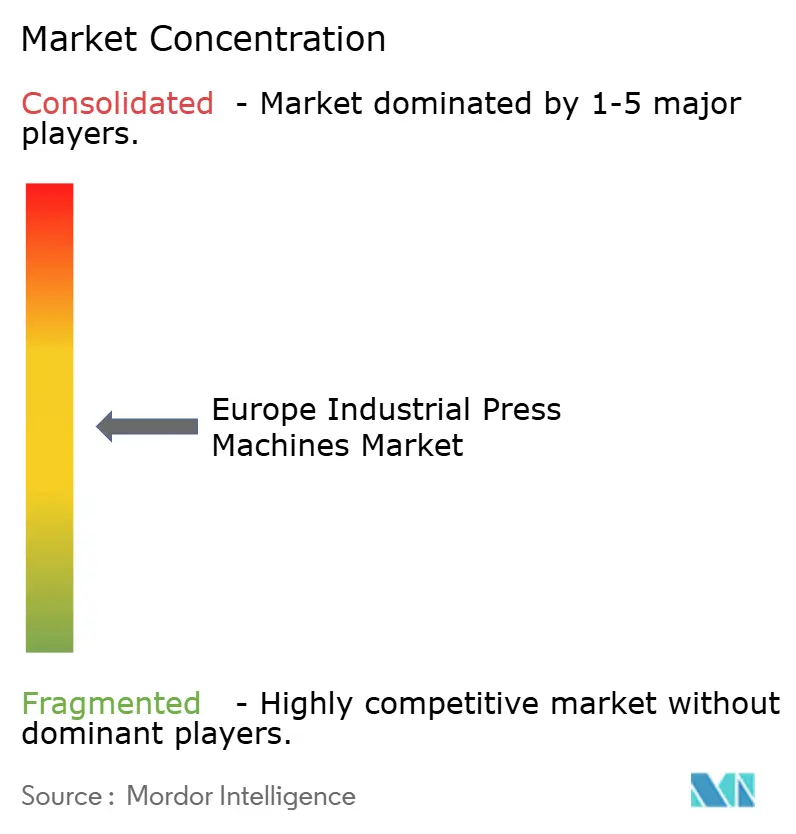
| Market Concentration | Medium |
Major Players *Disclaimer: Major Players sorted in no particular order Image © Mordor Intelligence. Reuse requires attribution under CC BY 4.0. | |
Europe Industrial Press Machines Market Analysis by Mordor Intelligence
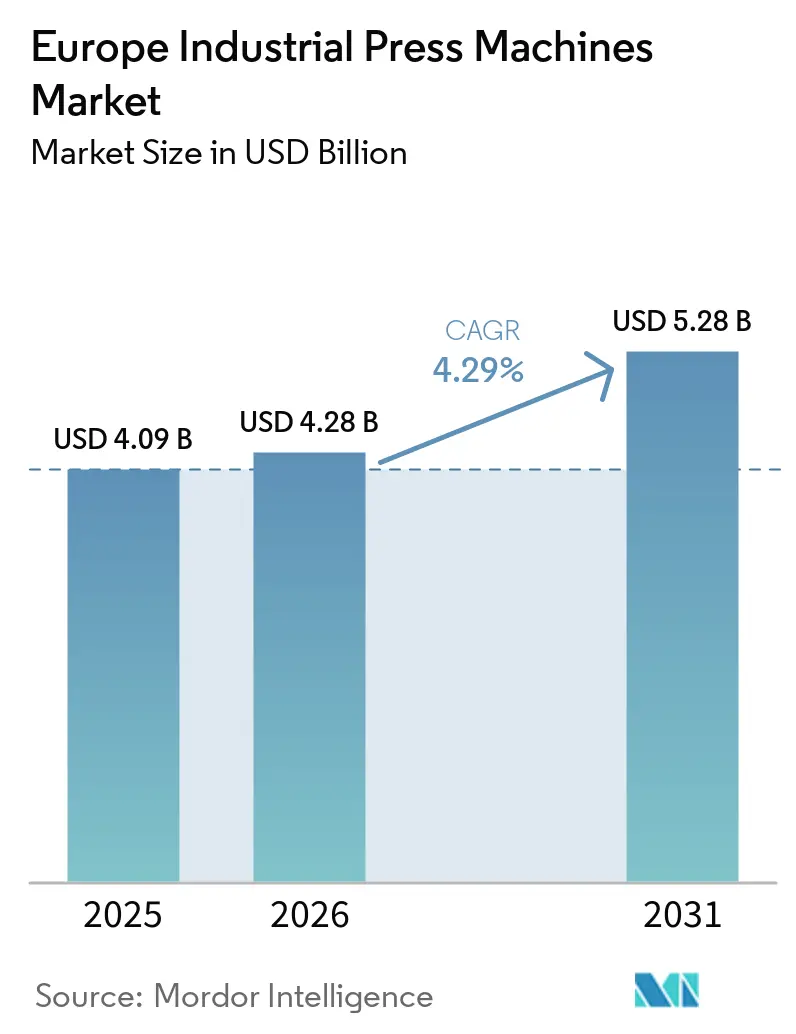
The Europe Industrial Press Machines Market size is projected to be USD 4.09 billion in 2025, USD 4.28 billion in 2026, and reach USD 5.28 billion by 2031, growing at a CAGR of 4.29% from 2026 to 2031.
Demand is moving toward systems that can form advanced high-strength steel, aluminum, and mixed-material parts for electric vehicles. European manufacturing investment in batteries, semiconductors, and power equipment also supports demand for capital equipment with digital monitoring and programmable motion. Integrated press cells that include coil feeding, robotic transfer, vision protection, and maintenance connectivity are raising the value of each installation. This approach favors suppliers that can design, install, and service complete production lines, rather than suppliers focused only on press assembly. Automotive production remains the largest demand base, although uneven utilization at assembly plants continues to delay some new projects.
Key Report Takeaways
- By drive technology, hydraulic presses held 35.4% of Europe industrial press machines market share in 2025, while other and hybrid drive technologies are forecast to grow at a 7% CAGR through 2031.
- By press force and capacity, the 101 to 500 ton band held 31.9% of the Europe industrial press machines market in 2025, while presses above 2,000 tons are forecast to expand at a 7.3% CAGR through 2031.
- By application and process, stamping, blanking, and punching accounted for 30% of the Europe industrial press machines market size in 2025, while assembly, press-fitting, and joining are forecast to grow at a 7.7% CAGR through 2031.
- By end-use industry, automotive and transportation accounted for 40.4% of the Europe industrial press machines market size in 2025, while medical and precision manufacturing are forecast to grow at an 8% CAGR through 2031.
- By geography, Germany led with a 27.5% share in 2025, while the Rest of Europe is forecast to grow at a 5.6% CAGR through 2031.
Note: Market size and forecast figures in this report are generated using Mordor Intelligence’s proprietary estimation framework, updated with the latest available data and insights as of January 2026.
Europe Industrial Press Machines Market Trends and Insights
Drivers Impact Analysis*
| Driver | (~) % Impact on CAGR Forecast | Geographic Relevance | Impact Timeline |
|---|---|---|---|
| EV Battery Enclosure and Crash-Structure Forming Demand | +1.2% | Germany, France, Spain, Italy | Medium term (2-4 years) |
| Automation, Industry 4.0, and Labor Substitution | +1% | Germany, France, Italy, broader Europe | Medium term (2-4 years) |
| Aging European Press Fleet Replacement | +0.8% | Germany, Italy, France, the United Kingdom | Short term (≤ 2 years) |
| Flexible Mixed-Model Press Lines for EV and ICE Production | +0.6% | Germany, France, Spain | Medium term (2-4 years) |
| EU Reindustrialization of Electronics, Batteries, and Power Equipment | +0.5% | Germany, France, Italy, Rest of Europe | Long term (≥ 4 years) |
| Energy-Efficient Servo Retrofits Under High European Power Costs | +0.4% | Germany, the United Kingdom, and Italy | Short term (≤ 2 years) |
| Source: Mordor Intelligence | |||
EV Battery Enclosures, Crash Structures, and Flexible Production
Battery enclosures and crash structures require deeper draw depths, tighter tolerances, and higher press forces than many conventional body panel programs. These parts also require compatible forming processes for advanced high-strength steel and aluminum alloys. In September 2025, Volkswagen said its MEB+ battery frame would move from 123 components to a single aluminum casting, showing how platform design choices can change equipment requirements. The Europe industrial press machines market also benefits when manufacturers choose gigastamping for large structural parts, because these systems require high tonnage and controlled forming conditions. Mixed-model production gives programmable servo lines an additional role, since they can move between EV battery-tray work and conventional body panels without rebuilding a complete line. This flexibility supports hybrid drive technology, where demand for EVs and internal-combustion vehicles remains uneven.
Automation, Labor Availability, and Connected Press Cells
Labor shortages are increasing the value of equipment that automates feeding, transfer, inspection, and force monitoring. European manufacturers are therefore evaluating a press line as a connected cell rather than as a standalone machine. The International Federation of Robotics reported 85,000 industrial robot installations in Europe during 2024, which supports the wider adoption of automated material handling around forming equipment.[1]International Federation of Robotics, “European Robot Installations Remain High,” International Federation of Robotics, ifr.org Vision-based die protection and closed-loop process control can reduce manual intervention in repetitive tasks. These additions can improve quality assurance, but they also lengthen commissioning work and increase the need for trained technicians. The Europe industrial press machine market, therefore, gains from labor substitution while facing a separate constraint from limited integration skills.
Aging European Press Fleet Replacement
The modernization opportunity extends beyond drive replacement to PLC upgrades, digital HMIs, sensors, safety systems, automated feeders, and production monitoring, allowing manufacturers to improve the performance of older presses without replacing the complete machine. Retrofit projects can also improve changeover times, process repeatability, energy monitoring, and preventive maintenance, making them attractive for plants operating under tight capital budgets. The trend is particularly relevant among small and mid-sized fabricators and automotive component suppliers, where existing press frames may remain mechanically serviceable but lack modern automation and connectivity. Equipment suppliers that offer modular retrofit packages, remote diagnostics, spare parts support, and lifecycle service contracts can therefore capture demand between routine maintenance and full machine replacement. As production requirements become more demanding, older presses with limited tonnage, speed, or automation capabilities are eventually likely to move from retrofit to replacement, creating a gradual pipeline of new equipment purchases rather than a single replacement cycle.
Flexible Mixed-Model Press Lines for EV and ICE Production
European OEMs continue to manage uncertainty in vehicle demand, even as the 2035 phaseout framework for new internal-combustion passenger cars remains in place. Programmable servo presses and quick-die-change systems allow plants to shift between battery trays, structural components, and conventional body panels without rebuilding an entire production line. This flexibility reduces downtime, protects capital investment, and enables suppliers to respond to changing production schedules. Adjustable ram-motion profiles also allow one line to process conventional steel, boron steel, aluminum, and mixed-material blanks. As a result, manufacturers are more likely to invest in adaptable press systems while EV production volumes remain uneven across Europe.
Restraints Impact Analysis*
| Restraint | (~) % Impact on CAGR Forecast | Geographic Relevance | Impact Timeline |
|---|---|---|---|
| High Capital Cost, Energy Cost, and Financing Constraints | -0.9% | Europe-wide, acute in Germany, Italy, United Kingdom | Short term (≤ 2 years) |
| Automotive Production Volatility and Capacity Underutilization | -0.7% | Germany, France, Italy, Spain | Short term (≤ 2 years) |
| Cybersecurity, Machine Safety, and Validation Burden for Connected Presses | -0.5% | Europe-wide | Medium term (2-4 years) |
| Skilled Commissioning and Tooling-Integration Shortages | -0.4% | Germany, Italy, France | Short term (≤ 2 years) |
| Source: Mordor Intelligence | |||
High Capital Cost, Energy Cost and Financing Constraints
European industrial energy prices remain above those of several major trading partners, increasing operating costs for press-intensive manufacturers.[2]European Commission, “Cyber Resilience Act,” European Commission, digital-strategy.ec.europa.eu Energy-intensive metalworking operations are therefore under greater pressure to improve machine efficiency, reduce idle time, and adopt energy-monitoring systems. That cost can support a retrofit case, but it also reduces the cash available for new equipment purchases. Smaller fabricators and automotive suppliers face a difficult combination of energy costs, higher borrowing costs, and uncertain order visibility. The European Investment Bank identified financing gaps for energy-intensive manufacturing small and medium-sized enterprises, particularly in Central and Eastern Europe. This can lengthen replacement cycles and encourage customers to extend the operating life of existing presses through controls upgrades, servo retrofits, predictive maintenance, and automation additions.[3]European Investment Bank, “EIB Investment Report 2024/2025, Innovation, Integration and Simplification in Europe,” European Investment Bank, eib.org Connected presses also require more machine safety, cybersecurity, and validation work before commissioning. These requirements can extend project schedules when customers lack experienced engineering or tooling-integration teams, while increasing the total implementation cost beyond the base price of the press itself.
Automotive Underutilization and Investment Delays
Automotive production volatility limits near-term investment in new stamping and forming lines. EU new-car registrations fell 0.7% in the first seven months of 2025 compared with the same period in 2024. When plant utilization is low, OEMs and Tier-1 suppliers are less likely to authorize major greenfield press installations. Uncertainty around vehicle volumes, model launches, and the pace of EV adoption can further encourage manufacturers to prioritize incremental capacity investments over large-scale line replacements. Demand can instead shift toward upgrades that improve output, energy use, or flexibility on existing lines, including automation, controls modernization, servo retrofits, and condition-monitoring systems. Cyber Resilience Act reporting obligations have applied from September 2026, while the Machinery Regulation applies from January 2027, adding design and conformity work for connected equipment. Suppliers may consequently need to allocate additional engineering resources to cybersecurity, functional safety, documentation, and conformity assessment. Clearer implementation requirements after 2027 may support investment decisions, but they do not remove the immediate cost and skills burden.
*Our forecasts treat driver/restraint impacts as directional, not additive. The impact forecasts reflect baseline growth, mix effects, and variable interactions.
Segment Analysis
By Drive/Actuation Technology: Servo Architectures Gain Ground Against Hydraulic Presses
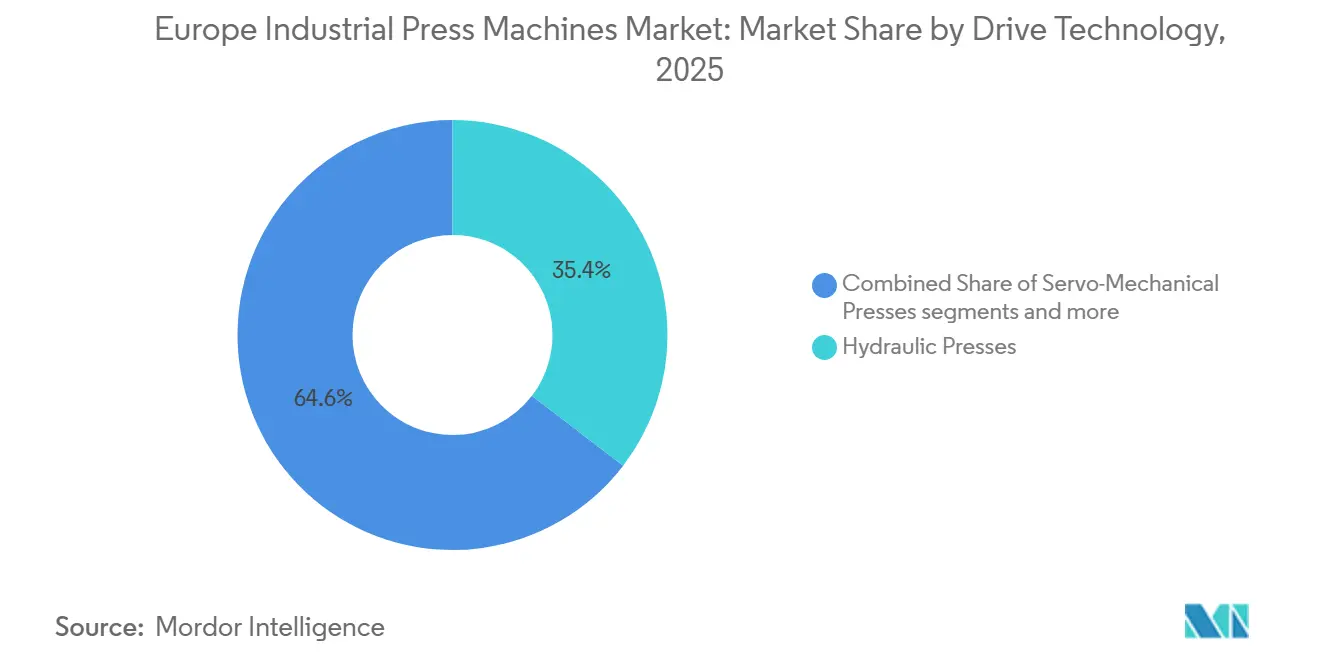
Hydraulic presses held 35.4% of the Europe industrial press machines market in 2025 because they remain suited to deep drawing, forging, and composite compression molding. Other and hybrid drive technology is forecast to grow at a 7% CAGR through 2031. Servo-electric and servo-hydraulic systems support adjustable motion profiles for advanced steel forming and battery enclosure work. ANDRITZ Schuler introduced its HFA plus+ fineblanking series in January 2026 with servo-controlled hydraulic pump drives and higher stroke-rate capability. Mechanical presses continue to serve high-volume stamping where speed remains central to the production case.
Servo-mechanical presses combine mechanical speed with motion control for mixed-model manufacturing. Servo-hydraulic systems can lower connection-power demand and oil-cooling needs because the pump operates on demand. This supports operating-cost payback for users facing high electricity prices. The industrial press machine industry is also moving toward integrated controls that make process data available for quality and maintenance work. The Machinery Regulation makes cybersecurity an essential health and safety requirement for connected control systems from January 2027. Buyers may favor pre-certified drive and control packages because they reduce the conformity work required at the plant level.



By Press Force/Capacity: Ultra-High Tonnage Supports EV Structural Programs
The 101 to 500 ton band held 31.9% of the Europe industrial press machines market size in 2025 because it serves body panels, industrial parts, and general fabrication. Presses above 2,000 tons are forecast to grow at a 7.3% CAGR through 2031. Battery enclosure forming and large EV structural parts are increasing interest in ultra-high-tonnage systems. Volkswagen’s 2025 MEB+ platform announcement shows how component consolidation can alter the production equipment required for a vehicle platform. Presses up to 100 tons retain a role in electronics assembly, medical devices, and precision hardware.
The 501 to 1,000 ton and 1,001 to 2,000 ton bands sit between general fabrication and the largest automotive systems. In these bands, integrated coil feeding and robotic transfer are increasing the value of competitive bids. Buyers are also asking for force-displacement monitoring and digital process logs as standard features. Ecodesign requirements affect drive choices, especially when fixed-speed hydraulic systems create energy-efficiency exposure. This raises the minimum feature set for suppliers competing in the middle of the industrial press machine industry. Lower-specification offerings face a weaker position when customers need energy data and traceability from the same installation.
By Application/Process: Joining Expands with EV Assembly Operations
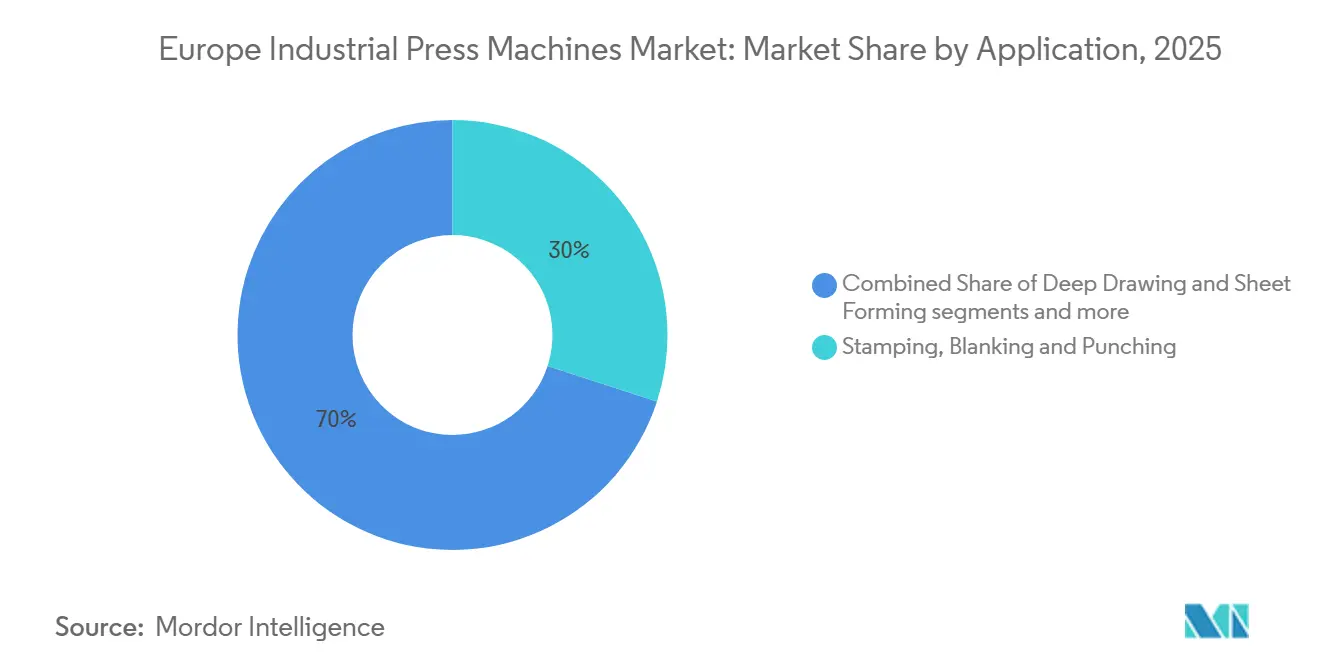
Stamping, blanking, and punching held 30% of the Europe industrial press machines market size in 2025, supported by automotive, appliance, and electrical enclosure production. Assembly, press-fitting, and joining are forecast to grow at a 7.7% CAGR through 2031. Demand is increasingly shifting toward flexible machines that can handle shorter production runs, multiple materials, and frequent tooling changes, particularly among Tier-1 and Tier-2 automotive suppliers. EV production requires busbar pressing, cell-to-module assembly, structural bonding under press load, and precision fastener installation. TRUMPF presented the TruPunch 5000 in September 2026 with camera sorting and direct connectivity to an automated bending cell. Integration of presses with robotic loading, vision inspection, automated tool handling, and production-monitoring software is becoming increasingly relevant as manufacturers seek higher throughput with fewer manual interventions.
Electrical equipment and data-center construction can partly offset weaker automotive demand for stamping capacity. The expansion of power distribution equipment, switchgear, cooling systems, and electrical cabinets is creating additional requirements for sheet-metal forming and punching equipment. Deep drawing and sheet forming remain important for EV work because aluminum and advanced steel blanks require controlled blank-holding force. Forging presses serve heavy vehicles, aerospace fasteners, and powertrain components. Compression molding and powder compaction serve medical and electronics users, where precision requirements can support stronger pricing. Medical device rules require stronger evidence, traceability, and quality controls for high-risk products. These requirements create a demand base for accurate, monitored forming processes, with manufacturers increasingly valuing closed-loop force monitoring, dimensional inspection, process traceability, and automated quality documentation alongside basic press capacity.
By End-Use Industry: Automotive Holds Volume While Medical Grows Faster
Automotive and transportation accounted for 40.4% of the Europe industrial press machines market in 2025. Medical and precision manufacturing are forecast to grow at an 8% CAGR through 2031. Automotive remains central because it uses presses across body panels, structural parts, and vehicle subsystems. The transition toward EVs is also changing equipment requirements, with greater use of aluminum, high-strength steel, copper, and other lightweight materials requiring tighter force and process control. Its purchasing cycles remain exposed to the pace of electric-vehicle adoption and import competition.
Electrical and electronics users need formed components for transformers, switchgear, cable termination hardware, and semiconductor facilities. The European Chips Act supports efforts to expand semiconductor capability, which can increase demand for precision housings and lead-frame processing. Data-center expansion and grid modernization add another source of demand for electrical enclosures, cooling components, busbars, and power-distribution equipment. Industrial machinery, appliances, and construction equipment provide a steadier base of demand. Energy and power equipment also supports press demand through turbine components, heat-exchanger plates, and electrolyzer housings. Medical manufacturing further supports demand for compact, high-precision presses where repeatability, traceability, and automated inspection are important. The European industrial press machine market is less exposed to a single end-use cycle when these applications expand alongside automotive programs. That balance does not remove automotive risk, but it improves the range of available demand sources.
Geography Analysis
Germany led the Europe industrial press machine market with a 27.5% share in 2025. The country has the region’s deepest concentration of automotive press lines and press equipment manufacturers. ANDRITZ Schuler, TRUMPF, SMS group, and Siempelkamp give Germany a large domestic supplier base. High industrial electricity costs strengthen the commercial case for servo retrofits and more efficient controls. Italy and France are the next major national markets, but their demand conditions differ. Italy benefits from precision tooling clusters in Lombardy and Emilia-Romagna. Manufacturers such as Mecolpress, Prima Industrie, and Salvagnini support a domestic equipment base with global customer reach. France has relatively stable power pricing through its nuclear-dominated electricity system, but automotive overcapacity can limit near-term press spending. The United Kingdom operates under a separate certification environment and has aerospace supply chains that support demand for precision forming presses.
Spain benefits from Fagor Arrasate and from renewable capacity that can improve the energy-cost position of press users. Russia remains isolated from Western advanced press technology under export controls, reducing the addressable export opportunity for European suppliers. The rest of Europe is forecast to grow at a 5.6% CAGR through 2031. Poland, the Czech Republic, Romania, and Sweden are expanding manufacturing capacity as supply chains diversify. Central and Eastern European locations can attract tier-one press users through lower operating costs and expanding service coverage.
Competitive Landscape
The Europe industrial press machine market exhibits a medium level of market concentration. Schuler Inc. has a broad range of mechanical, servo, and hydraulic press systems. TRUMPF, AMADA, Bystronic, and Fagor Arrasate compete in overlapping applications and equipment categories. Schuler Inc.'s HFA plus+ development illustrates how suppliers are using servo-controlled hydraulic designs to improve efficiency in fine blanking. TRUMPF’s September 2026 launch shows a similar focus on automation, camera-based sorting, and machine-to-machine connectivity.
Bystronic and Salvagnini differentiate through production management and nesting software in press-brake and bending systems. This software can create switching costs because it connects machine data with production planning and quality processes. Turkish suppliers Durmazlar and Baykal compete on price in cost-sensitive European applications. The 2027 machinery requirements may increase their certification work for connected equipment. Larger suppliers can gain an advantage when they offer pre-integrated controls, documentation, commissioning, and after-sales support.
Mecolpress, LVD Company, and Hare Press Limited compete in sub-500-ton servo and hydraulic equipment with flexible configurations and regional service. This lower-capacity area remains more fragmented than the market for large integrated automotive lines. Aging fleets in Italy and Eastern Europe create opportunities for servo-hydraulic retrofits. Service coverage in Poland and the Czech Republic is increasingly important as tier-one facilities expand in these locations. Software-native planning providers may also increase switching costs by linking press-cell schedules with enterprise and quality systems.
Europe Industrial Press Machines Industry Leaders
Schuler Inc.
AIDA Engineering, Ltd.
SMS group GmbH
Fagor Arrasate S. Coop.
Siempelkamp Maschinen- und Anlagenbau GmbH
- *Disclaimer: Major Players sorted in no particular order

Recent Industry Developments
- September 2026: TRUMPF presented the new-generation TruPunch 5000 at EuroBLECH in Hanover, featuring a 22-metric-ton press force, up to 1,600 strokes per minute, AI-supported camera sorting, and direct integration with the TruBend Center 7030 bending cell via the SheetMaster automation platform. The system targets control-cabinet and data-center-component fabricators in the fast-growing electronics end-use segment.
- July 2026: Schuler Inc. announced the elimination of approximately 500 further jobs at its Schuler division in Germany, attributing the decision to structurally weak automotive sector demand. The move followed a broader restructuring that had already reduced group headcount by more than 2,000 over the preceding 5 years, underscoring automotive overcapacity’s direct impact on Europe’s leading press OEM.
- January 2026: Schuler Inc. launched the HFA plus+ fineblanking press series with Feintool, covering press forces from 3,200 to 15,500 kN at up to 85 strokes per minute. The new servo-controlled hydraulic pump drive delivers a double-digit percentage improvement in energy efficiency over conventional fixed-speed hydraulic systems. Two 8,800-kN pilot systems were built for the U.S. market from the Göppingen, Germany, headquarters.


Europe Industrial Press Machines Market Report Scope
The Europe Industrial Press Machines Market is Segmented by Drive Technology (Hydraulic Presses, Pneumatic Presses, and More), by Press Force (Up To 100 Tons, 101–500 Tons, and More), by Application (Forging, Powder Compaction, and More), by End-Use Industry (Aerospace and Defense, Electrical and Electronics, and More), by Geography (Germany, Italy, France, and More ). The Market Forecasts are Provided in Terms of Value (USD).
| Conventional Mechanical Presses |
| Servo-Mechanical Presses |
| Hydraulic Presses |
| Pneumatic Presses |
| Other and Hybrid Presses |
| Up to 100 Tons |
| 101–500 Tons |
| 501–1,000 Tons |
| 1,001–2,000 Tons |
| Above 2,000 Tons |
| Stamping, Blanking and Punching |
| Deep Drawing and Sheet Forming |
| Forging |
| Straightening and General Forming |
| Compression Molding |
| Powder Compaction |
| Assembly, Press-Fitting and Joining |
| Other Press Applications |
| Automotive and Transportation |
| Aerospace and Defense |
| Industrial Machinery and Equipment |
| Electrical and Electronics |
| Appliances and Consumer Durables |
| Construction and Heavy Equipment |
| Energy and Power Equipment |
| Metal Products and General Manufacturing |
| Medical and Precision Manufacturing |
| Other End-Use Industries |
| Germany |
| Italy |
| France |
| United Kingdom |
| Spain |
| Russia |
| Rest of Europe |
| By Drive / Actuation Technology | Conventional Mechanical Presses |
| Servo-Mechanical Presses | |
| Hydraulic Presses | |
| Pneumatic Presses | |
| Other and Hybrid Presses | |
| By Press Force / Capacity | Up to 100 Tons |
| 101–500 Tons | |
| 501–1,000 Tons | |
| 1,001–2,000 Tons | |
| Above 2,000 Tons | |
| By Application / Process | Stamping, Blanking and Punching |
| Deep Drawing and Sheet Forming | |
| Forging | |
| Straightening and General Forming | |
| Compression Molding | |
| Powder Compaction | |
| Assembly, Press-Fitting and Joining | |
| Other Press Applications | |
| By End-Use Industry | Automotive and Transportation |
| Aerospace and Defense | |
| Industrial Machinery and Equipment | |
| Electrical and Electronics | |
| Appliances and Consumer Durables | |
| Construction and Heavy Equipment | |
| Energy and Power Equipment | |
| Metal Products and General Manufacturing | |
| Medical and Precision Manufacturing | |
| Other End-Use Industries | |
| By Geography | Germany |
| Italy | |
| France | |
| United Kingdom | |
| Spain | |
| Russia | |
| Rest of Europe |


Key Questions Answered in the Report
What is the Europe industrial press machine market forecast through 2031?
The market is forecast to reach USD 5.28 billion by 2031, growing at a 4.3% CAGR from 2026. The forecast reflects demand for programmable, energy-efficient forming systems, integrated production cells, and specialized modern manufacturing equipment.
Which press technology is growing fastest in Europe?
Other and hybrid drive technology is forecast to grow at a 7% CAGR through 2031. Users select these systems for programmable motion, efficiency improvements, and compatibility with mixed-material vehicle parts.
Which end-use application drives the most equipment demand?
Automotive and transportation held 40.4% of demand in 2025. Medical and precision manufacturing have the highest forecast growth at an 8% CAGR, supported by tighter tolerance and traceability needs.
Why are servo presses gaining adoption in Europe?
Servo systems support controlled motion, lower energy demand, and mixed-model manufacturing for EV and conventional vehicle programs. They can also reduce the connection power and cooling requirements associated with older hydraulic equipment.
Which European countries present the strongest opportunities for suppliers?
Germany is the largest national market because of its automotive and equipment-manufacturing base. Poland, the Czech Republic, Romania, and Sweden support growth within the rest of Europe as manufacturing capacity and service networks expand.
How do EU regulations affect press purchasing decisions?
Machinery, cybersecurity, energy efficiency, and traceability requirements increase the value of integrated controls and pre-certified equipment packages. These requirements can also add design, validation, and conformity work before commissioning.
Page last updated on:


 Your data is secure and never sold or shared.


