
Taiwan Industrial Press Machines Market Size and Share
Market Overview
| Study Period | 2020 - 2031 |
|---|---|
| Forecast Data Period | 2026 - 2031 |
| Base Year Market Size (2025) | USD 0.15 Billion |
| Market Size (2026) | USD 0.16 Billion |
| Market Size (2031) | USD 0.22 Billion |
| Growth Rate (2026 - 2031) | 6.58 % |
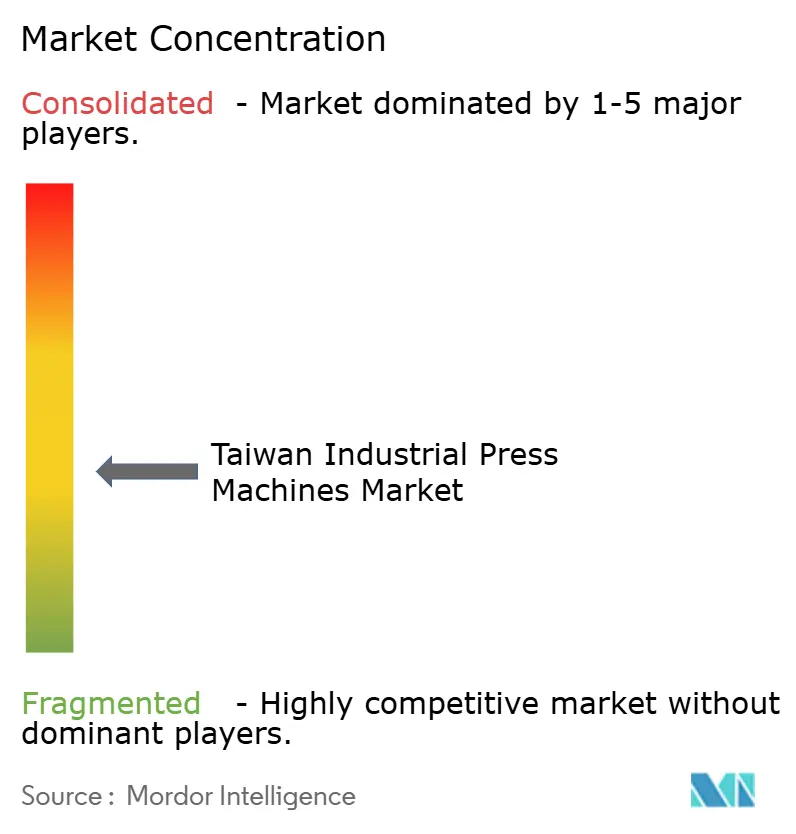
| Market Concentration | Medium |
Major Players *Disclaimer: Major Players sorted in no particular order Image © Mordor Intelligence. Reuse requires attribution under CC BY 4.0. | |
Taiwan Industrial Press Machines Market Analysis by Mordor Intelligence
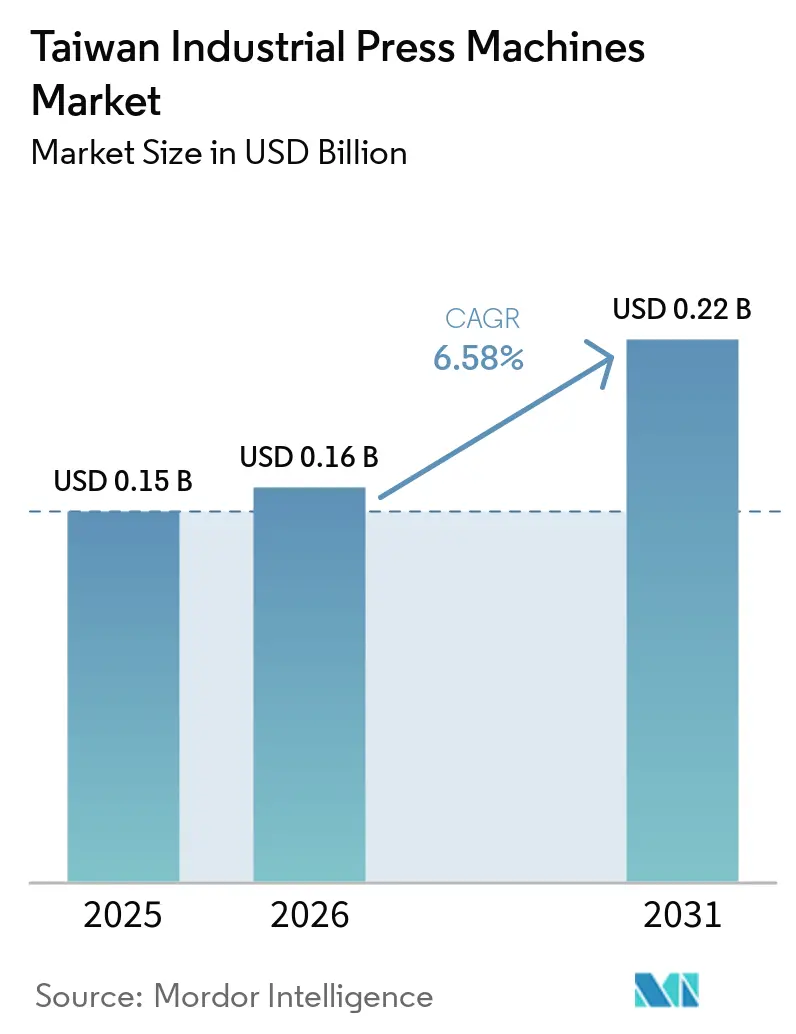
The Taiwan industrial press machines market size was valued at USD 0.15 billion in 2025 and estimated to grow from USD 0.16 billion in 2026 to reach USD 0.22 billion by 2031, at a CAGR of 6.58% during the forecast period (2026-2031).
Semiconductor capacity additions, electric vehicle component production, and more automated manufacturing are widening demand for precision forming equipment in the Taiwan industrial press machines market. The opportunity extends beyond direct fab construction because suppliers need presses for connectors, lead frames, substrate frames, heat sinks, battery cases, and motor laminations. Equipment suppliers are also adapting their offers as buyers seek lower energy use, more process records, and reliable unattended operation. Export conditions remain important because tariff changes, exchange-rate pressure, and lower-priced regional equipment can delay buying decisions. Medical and precision applications have a smaller revenue base, but their tolerance and traceability requirements are shaping the product capabilities that suppliers develop for the Taiwan industrial press machines market.
Key Report Takeaways
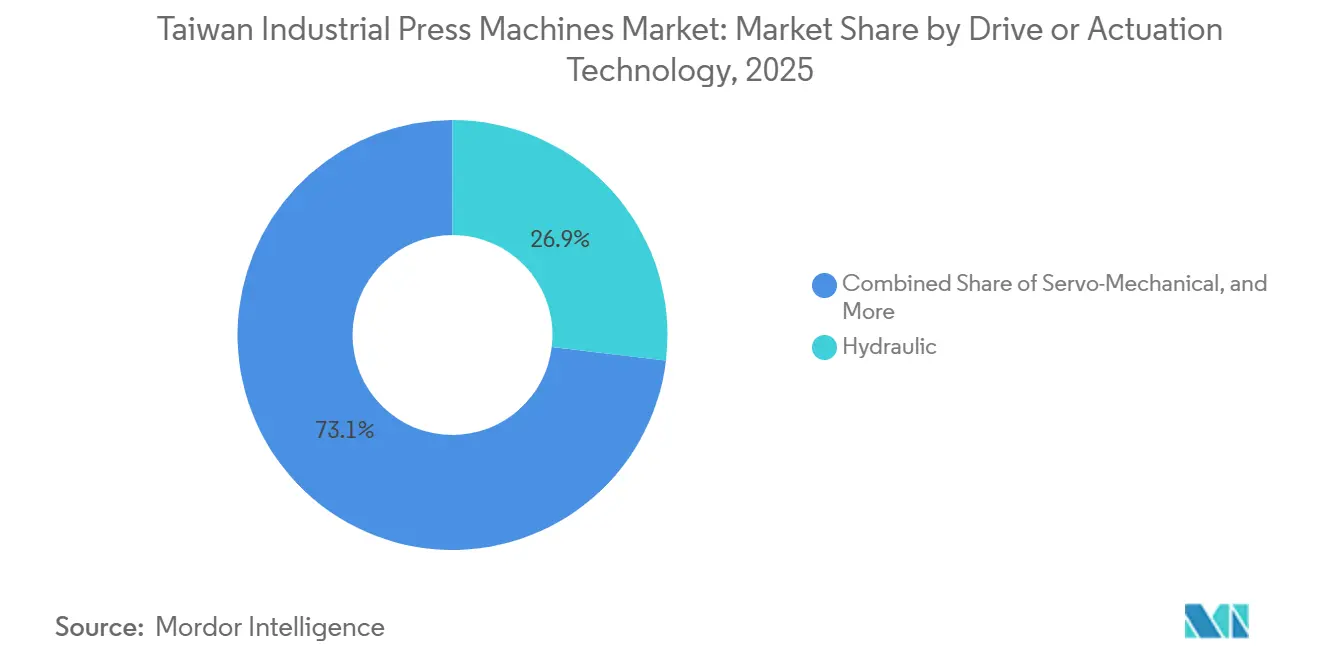
- By drive technology, hydraulic presses held 26.9% of the Taiwan industrial press machines market share in 2025, while servo-mechanical presses are forecast to grow at a 9.1% CAGR through 2031.
- By press force capacity, the 101 to 500 ton range accounted for 40.6% of revenue in 2025, while the above-2,000-ton range is projected to expand at a 7.4% CAGR through 2031.
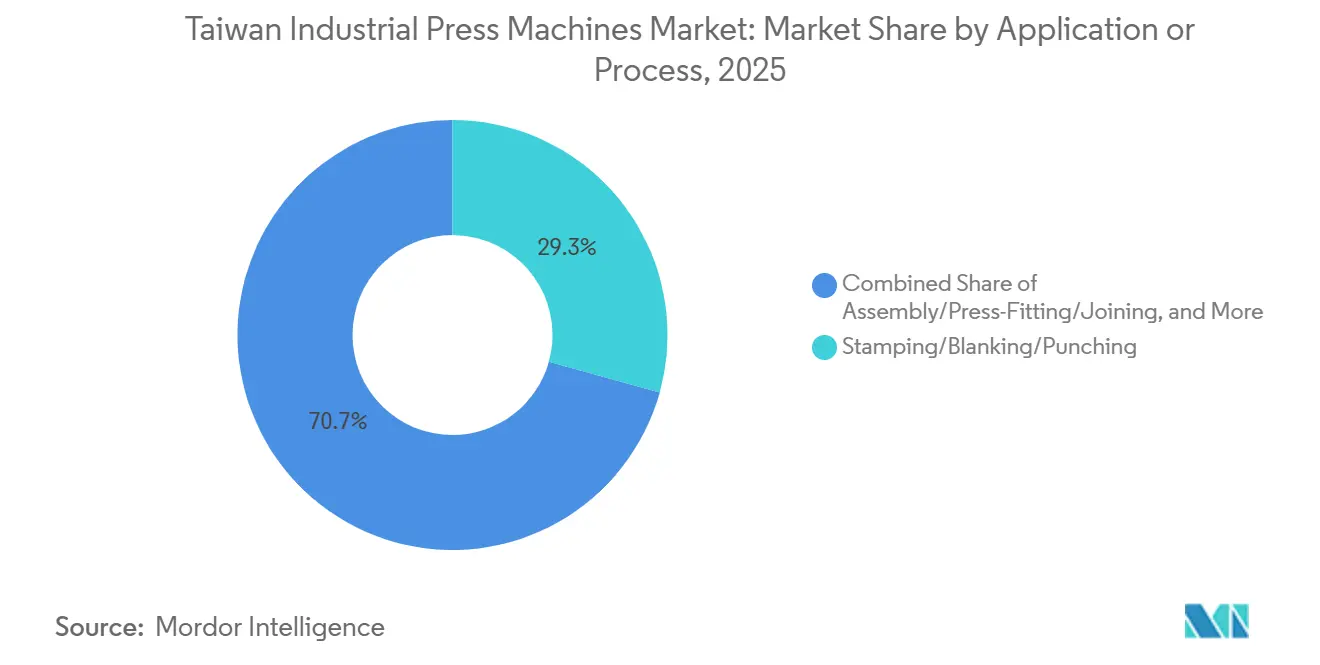
- By application, stamping, blanking, and punching represented 29.3% of the Taiwan industrial press machines market size in 2025, while assembly, press-fitting, and joining are forecast to advance at a 7.2% CAGR through 2031.
- By end-use industry, automotive and transportation accounted for 25.3% of revenue in 2025, while medical and precision manufacturing are projected to grow at an 8.1% CAGR through 2031.
Note: Market size and forecast figures in this report are generated using Mordor Intelligence’s proprietary estimation framework, updated with the latest available data and insights as of January 2026.
Taiwan Industrial Press Machines Market Trends and Insights
Drivers Impact Analysis*
| Driver | (~) % Impact on CAGR Forecast | Geographic Relevance | Impact Timeline |
|---|---|---|---|
| Semiconductor, Connector, and Precision Electronics Expansion | +1.5% | Hsinchu, Longtan, Chiayi, and Kaohsiung science parks and fab clusters | Short term (≤ 2 years) |
| EV Lightweighting and Battery Component Forming | +1.2% | Taoyuan, Changhua, and Kaohsiung | Medium term (2-4 years) |
| Automation Adoption Amid Manufacturing Labor Shortages | +1.0% | Taiwan-wide, especially in Taichung, Changhua, and Yunlin manufacturing corridors | Short term (≤ 2 years) |
| Smart Presses for Predictive Maintenance and Traceability | +0.8% | Taiwan-wide, led by export-oriented original equipment manufacturers and Tier-1 suppliers | Medium term (2-4 years) |
| Energy-Efficient Servo and Electro-Hydraulic Adoption | +0.7% | Taiwan-wide, especially high-volume stamping clusters in Taichung and Changhua | Medium term (2-4 years) |
| Export-Led Aerospace and High-Precision Upgrading | +0.5% | Taichung, Kaohsiung, and Chiayi | Long term (≥ 4 years) |
| Source: Mordor Intelligence | |||
Semiconductor, Connector, and Precision Electronics Capacity Expansion
Taiwan’s semiconductor buildout is creating a durable need for precision presses across the surrounding supplier base. TSMC stated at SEMICON Taiwan 2026 that its equipment procurement estimate reached 1.9 times the level set at the end of 2025, following 2 upward revisions during 2026. TSMC is constructing 13 facilities in Taiwan during 2026, while its wider program includes 25 wafer fabrication and advanced packaging facilities. The Chiayi Science Park Phase II project added 3 advanced packaging facilities, and Taiwan broke ground on a packaging industrial park in Kaohsiung in September 2026. ASE Technology Holding announced 15 new sites in 2026 with a budgeted capital expenditure of USD 8.5 billion. These developments support component suppliers that need presses for lead frames, connectors, substrate frames, and heat sinks, extending demand in the Taiwan industrial press machines market beyond initial fab construction.
EV Lightweighting and Battery Component Forming Requirements
Taiwan’s battery manufacturing base expanded the need for controlled forming equipment during 2025. Formosa Smart Energy began mass production at its Changbin Industrial Park facility, which has 2.1 GWh of installed capacity. The company also announced a second-phase investment of above TWD 40 billion (USD 1.3 billion) for battery-case plants, metal-processing facilities, and module factories. Battery cases, motor laminations, and metallic bipolar plates require consistent dimensional control and surface finish at production volume. SEYI demonstrated a high-rigidity solid-frame servo press at MF-Tokyo 2025 that maintained flow-channel tolerances below 10 microns on an ultra-thin plate. These requirements and new battery-integrator buyers are moving the Taiwan industrial press machines market toward more specialized forming systems.
Automation Adoption Under Manufacturing Labor Shortages
Taiwan’s labor shortage is encouraging manufacturers to adopt automated press systems. The National Development Council projected that the working-age population will decline by 3 million people by 2040. Taiwan had more than 260,000 unfilled vacancies in 2025, and manufacturing represented 32.4% of open positions. The semiconductor sector alone faced a shortage of 34,000 workers in May 2025, while operations and maintenance openings increased 67% in less than 2 years. The National Development Council also projected demand for 19,000 additional manufacturing positions each year through 2030. These constraints support purchases of servo-driven systems with integrated coil feeding and monitoring for multi-shift operation in the Taiwan industrial press machines market.[1]National Development Council, “Official Website”, ndc.gov.tw
Smart Presses for Predictive Maintenance and Process Traceability
Connected press systems are becoming more relevant because automotive, aerospace, and semiconductor buyers ask suppliers for detailed process records. The Department of Industrial Technology and ITRI deployed an Edge AI preventive-maintenance and multi-sensing solution on high-end servo presses at Chin Fong Machine. The system achieved anomaly detection above 95%, held stamping-curve molding errors below 2%, and maintained forming precision within 10 microns. The work supported Chin Fong’s entry into Bombardier’s commercial aerospace supply chain and raised the high-end servo press added value by 20%. The Department of Industrial Technology invested nearly TWD 10 billion (USD 319.1 million) in AI manufacturing research over the 4 years before 2026, producing press-related value above TWD 2.4 billion (USD 76.6 million) in 2025. These results show why connected equipment and per-stroke data are becoming commercial requirements in the Taiwan industrial press machines market.[2]Industrial Technology Research Institute, “Official Website”, itri.org.tw
Restraints Impact Analysis*
| Restraint | (~) % Impact on CAGR Forecast | Geographic Relevance | Impact Timeline |
|---|---|---|---|
| High Capital Cost and Long Payback for Integrated Press Lines | -1.8% | Taiwan-wide, with a larger burden on small and medium-sized enterprises in Taichung and Changhua | Medium term (2-4 years) |
| Export Cyclicality, Tariff Exposure, and Lower-Priced Competition | -1.5% | Export-oriented manufacturers serving the United States, Europe, and Southeast Asia | Short term (≤ 2 years) |
| Shortage of Forming-Process, Controls, and Service Engineers | -1.0% | Taiwan-wide, particularly specialty servo press and controls work | Medium term (2-4 years) |
| Legacy Integration Friction With MES, IoT, and AI Platforms | -0.7% | Established manufacturing corridors with aging press equipment | Long term (≥ 4 years) |
| Source: Mordor Intelligence | |||
High Capital Cost and Long Payback for Integrated Press Lines
Capital cost remains the largest barrier to faster investment among Taiwan’s small and medium-sized manufacturers. A complete servo-mechanical line can include the press body, coil feed, die-change automation, in-line inspection, and manufacturing execution connectivity. This configuration can place the expected payback beyond the 24-36-month threshold used for discretionary manufacturing investment. TAMI reported in August 2025 that tariffs and New Taiwan dollar appreciation had reduced the 20-30% pricing advantage associated with Taiwanese machinery. Smaller buyers often fund robotics and materials-handling systems before a full press-line upgrade, which can defer investment by 12-24 months. New functional safety and EMC testing requirements from January 1, 2027, will add documentation and risk-assessment costs that weigh more heavily on smaller buyers.
Export Cyclicality, Tariff Exposure, and Lower-Priced Regional Competition
Taiwanese press suppliers depend on export markets, which makes order patterns sensitive to policy changes. A 20% United States reciprocal tariff in 2025 created a cost burden 10 percentage points above rates for Japanese and South Korean competitors at peak impact. A bilateral agreement in January 2026 reduced Taiwan’s effective rate to 15%, restoring tariff parity with Japan and South Korea. In July 2026, non-stacked Section 301 tariffs placed Taiwan’s effective machine tool rate at 10%, compared with 12.5% for Japan and South Korea. The final framework remains open, and ECFA changes raised duties on 4 machine tool product categories exported to China to 5% to 9.7%. These conditions, alongside lower-priced Chinese equipment in Southeast Asia, can delay project approvals in the Taiwan industrial press machines market.
*Our forecasts treat driver/restraint impacts as directional, not additive. The impact forecasts reflect baseline growth, mix effects, and variable interactions.
Segment Analysis
By Drive / Actuation Technology: Servo Momentum Gradually Erodes the Hydraulic Lead
Hydraulic presses held 26.9% of revenue in 2025, making them the leading drive category in the Taiwan industrial press machines market. Their installed base is supported by deep drawing, forging, powder compaction, and structural forming. These applications need flexible force control and high tonnage at a competitive equipment cost. Conventional mechanical presses also retain a role in high-speed blanking and progressive-die work. Pneumatic presses serve sub-100-ton assembly tasks in electronics and medical-device production.
Servo-mechanical presses are forecast to expand at a 9.1% CAGR through 2031. The Taiwan industrial press machines market size is supported by reported energy savings of 30% to 50% compared with flywheel-mechanical presses. Programmable stroke profiles also support bipolar plate channels, connectors, and medical components. SEYI has extended its servo portfolio from connector stamping into electric vehicle and hydrogen fuel-cell applications. Other hybrid systems give smaller buyers a lower-commitment path to improved energy performance.


By Press Force / Capacity: Mid-Range Tonnage Anchors the Market While Large-Format Presses Accelerate
The 101 to 500 ton category held 40.6% of revenue in 2025. This range anchors the Taiwan industrial press machines market size because it serves automotive parts, enclosures, connector housings, and appliance components. Taiwan’s large base of small and medium-sized suppliers has production runs and blank sizes that fit this equipment range. Presses up to 100 tons support miniaturized connector stamping, medical components, and precision electronics. The 501–1,000 ton and 1,001–2,000 ton tiers serve automotive and heavy-equipment supply chains.
Presses above 2,000 tons are projected to grow at a 7.4% CAGR through 2031. Aerospace panels, battery-case deep drawing, and thick-gauge automotive frames require high, uniform clamping loads over larger blanks. SEYI launched the SNS2-660-LT in July 2026 for sites with limited overhead clearance. Its hybrid tie-rod and unitized frame design has configurable stroke and die-height specifications. The Taiwan industrial press machines industry is addressing a wider set of factory constraints in mid-to-large tonnage equipment.
By Application / Process: Stamping Holds Its Share While Assembly Processes Record the Fastest Growth
Stamping, blanking, and punching accounted for 29.3% of revenue in 2025. The segment leads because Taiwan has a broad base of connectors, lead frames, heat sinks, and enclosures manufacturing. These products support recurring volume across semiconductor, consumer electronics, and automotive supply chains. Deep drawing and sheet forming serve appliance, automotive, and electric vehicle battery case production. Forging and powder compaction remain specialized uses in aerospace fasteners and powder-metal structural parts.
Assembly, press-fitting, and joining are forecast to grow at a 7.2% CAGR through 2031. Connector insertion, battery-module integration, bearing fitting, bushing fitting, and sensor-housing assembly are supporting this demand. In these processes, equipment performs controlled joining rather than only material deformation. ITRI’s press application held stamping-curve errors below 2% and forming precision within 10 microns. The Taiwan industrial press machines industry can use these functions to support higher-value subassembly work.
By End-Use Industry: Automotive Commands Volume; Medical and Precision Manufacturing Outpaces the Field
Automotive and transportation were the largest end-use segments with 25.3% of revenue in 2025. Demand came from body panels, structural brackets, and electric powertrain components. Electrical and electronics support high-speed lead-frame, connector, and PCB-mounted hardware production. New semiconductor capacity across Taiwan’s science parks is supporting this equipment need in 2026. Industrial machinery, construction, energy and power equipment, and general metal products provide a broad replacement market for standard presses.
Medical and precision manufacturing is projected to grow at an 8.1% CAGR through 2031. Surgical instruments, implant components, device housings, and diagnostic enclosures require tight tolerances and traceable processes. Servo equipment can support sub-10-micron forming requirements at production volume. Taiwan’s drone output reached TWD 12.9 billion (USD 411.6 million) in 2025, and the government has set a TWD 40 billion (USD 1.3 billion) target for 2030. These applications raise the technical requirements served by the Taiwan industrial press machines market.[3]IEEE Spectrum, “Taiwan Drone Supply Chain Powers US Defense Shift”, spectrum.ieee.org
Geography Analysis
Central Taiwan contains the core manufacturing base for the Taiwan industrial press machines market. Greater Taichung has the highest concentration of press builders and metal-fabricating buyers. Its service networks, tooling suppliers, and forming-process specialists support faster equipment installation and maintenance. Changhua and Yunlin extend this central corridor through coastal industrial activity. Formosa Smart Energy’s Changbin facility began mass production in 2025 with 2.1 GWh of installed LFP battery capacity.
Northern Taiwan is an important precision-equipment demand center. Hsinchu Science Park, Longtan Science Park, and the Taipei manufacturing corridor support semiconductor packaging, connector stamping, and precision electronics. The government approved the third-phase Longtan Science Park expansion in September 2026 for TSMC’s 1.4 nm and below processes. The plan includes an initial investment of above TWD 1 trillion (USD 31.9 billion) across 3 wafer plants. The share of sub-100-ton press demand is supported by this northern concentration.
Southern Taiwan is the fastest-changing demand area in 2026. Kaohsiung’s advanced packaging park and the AIDC cluster support demand for precision forming, structural panels, and titanium-alloy forging. Chiayi adds aerospace demand through the Asia UAV AI Innovation Application R&D Center and Minxiong Aerospace Park. These projects broaden the Taiwan industrial press machines market beyond its established central manufacturing base.[4]National Science and Technology Council, “Taiwan Builds the Future: Taiwan Sets the Next Stage of Growth”, cbi.nstc.gov.tw
Competitive Landscape
The Taiwan industrial press machines market is moderately fragmented in mid-range equipment. Established domestic original equipment manufacturers hold different positions by tonnage range and drive technology. AIDA Engineering and Schuler AG compete in large-format and high-precision segments where domestic suppliers have historically had a smaller presence. Concentration is higher in premium servo-mechanical and servo-hydraulic systems. Standard mechanical and hydraulic equipment faces a wider group of domestic and regional suppliers with less differentiation.
Suppliers are adding digital services to hardware platforms across the Taiwan industrial press machines market. Predictive maintenance software, IoT modules, and traceability services can produce recurring revenue and make customer switching more difficult. Chin Fong’s iForming platform connects ERP scheduling, production reporting, automated die switching, and predictive health management. The system was developed with an AI module supported by Feng Chia University. It responds to buyer requirements for production visibility and process records.
A gap remains between entry-level mechanical presses and full-featured servo-electric lines. Smaller Taiwanese buyers may seek servo-hydraulic or smart-press options with lower upfront cost. TMBA’s March 2026 AI Empowerment and Energy-Saving labels give suppliers a basis for product differentiation in export discussions. SEYI’s SNS2-660-LT launch is another example of adapting equipment for constrained factory layouts.
Taiwan Industrial Press Machines Industry Leaders
Chin Fong Machine Industrial Co., Ltd.
Shieh Yih Machinery Industry Co., Ltd.
LIEN CHIEH HYDRAULIC INDUSTRIAL CO., LTD.
Yeh Chiun Industrial Co., Ltd.
SEYI Machinery Co., Ltd.
- *Disclaimer: Major Players sorted in no particular order

Recent Industry Developments
- August 2026: Fair Oaks Precision Machinery Co., Ltd. (Taichung) announced the expanded commercial rollout of its second-generation FST/FSV servo leveler and active-type uncoiler system, engineered for 0.2–0.5 mm ultra-thin silicon steel sheet used in EV traction-motor core lamination and HVAC compressor-motor manufacturing. The system addresses a growing precision requirement as next-generation motor designs push lamination thickness toward thinner gauge to improve efficiency and reduce core loss.
- July 2026: SEYI Machinery launched the SNS2-660-LT, a hybrid tie-rod and unitized frame press engineered for factory environments with constrained overhead clearance, delivering full rated tonnage at one-quarter inch from the bottom with customizable stroke and die-height specifications. The design specifically targets Taiwan's dense central-Taiwan factory districts, where ceiling height limits preclude conventional straight-side press installation.
- June 2026: ASE Technology Holding announced the expansion of 15 new sites in 2026, comprising 6 ASE greenfield fabs and 7 Siliconware Precision Industries greenfield sites, at a budgeted capital expenditure of USD 8.5 billion. The expansion created a sustained ancillary press demand layer for precision connector stamping, substrate-component forming, and heat-sink fabrication across ASE's global packaging network.
- August 2025: Formosa Smart Energy's Changbin Industrial Park battery cell factory commenced mass production as Taiwan's largest LFP battery manufacturer with 2.1 GWh of installed capacity. The company simultaneously announced a follow-on investment of approximately USD 1.25 billion covering second-phase battery-case plants, metal-processing facilities, and module factories—each requiring dedicated deep-drawing and forming equipment.


Taiwan Industrial Press Machines Market Report Scope
| Conventional Mechanical Presses |
| Servo-Mechanical Presses |
| Hydraulic Presses |
| Pneumatic Presses |
| Other and Hybrid Presses |
| Up to 100 Tons |
| 101–500 Tons |
| 501–1,000 Tons |
| 1,001–2,000 Tons |
| Above 2,000 Tons |
| Stamping, Blanking, and Punching |
| Deep Drawing and Sheet Forming |
| Forging |
| Straightening and General Forming |
| Compression Molding |
| Powder Compaction |
| Assembly, Press-Fitting, and Joining |
| Other Press Applications |
| Automotive and Transportation |
| Aerospace and Defense |
| Industrial Machinery and Equipment |
| Electrical and Electronics |
| Appliances and Consumer Durables |
| Construction and Heavy Equipment |
| Energy and Power Equipment |
| Metal Products and General Manufacturing |
| Medical and Precision Manufacturing |
| Other End-Use Industries |
| By Drive / Actuation Technology | Conventional Mechanical Presses |
| Servo-Mechanical Presses | |
| Hydraulic Presses | |
| Pneumatic Presses | |
| Other and Hybrid Presses | |
| By Press Force / Capacity | Up to 100 Tons |
| 101–500 Tons | |
| 501–1,000 Tons | |
| 1,001–2,000 Tons | |
| Above 2,000 Tons | |
| By Application / Process | Stamping, Blanking, and Punching |
| Deep Drawing and Sheet Forming | |
| Forging | |
| Straightening and General Forming | |
| Compression Molding | |
| Powder Compaction | |
| Assembly, Press-Fitting, and Joining | |
| Other Press Applications | |
| By End-Use Industry | Automotive and Transportation |
| Aerospace and Defense | |
| Industrial Machinery and Equipment | |
| Electrical and Electronics | |
| Appliances and Consumer Durables | |
| Construction and Heavy Equipment | |
| Energy and Power Equipment | |
| Metal Products and General Manufacturing | |
| Medical and Precision Manufacturing | |
| Other End-Use Industries |


Key Questions Answered in the Report
What is the projected growth rate for industrial press machines in Taiwan?
The Taiwan industrial press machines market is forecast to grow at a 6.58% CAGR from 2026 to 2031, reaching USD 220 million by 2031.
Which drive technology is growing fastest in Taiwan?
Servo-mechanical presses are forecast to grow at a 9.1% CAGR through 2031, supported by programmable strokes and reported energy savings.
What press capacity is most widely used in Taiwan?
The 101–500 ton range led revenue with 40.6% in 2025 because it suits automotive parts, enclosures, connectors, and appliances.
Why are semiconductor projects important for press equipment suppliers?
Fabs and packaging sites need suppliers for lead frames, connectors, substrate frames, and heat sinks, which require precision stamping and forming equipment.
Which end-use area is growing fastest for press equipment?
Medical and precision manufacturing is forecast to grow at an 8.1% CAGR through 2031 due to traceability and tight forming-tolerance requirements.
What limits equipment investment by smaller manufacturers?
Integrated press lines can have long payback periods, while tariffs, currency pressure, safety requirements, and labor-related investments compete for capital.
Page last updated on:


 Your data is secure and never sold or shared.


