
United States Industrial Press Machines Market Size and Share
Market Overview
| Study Period | 2020 - 2031 |
|---|---|
| Forecast Data Period | 2026 - 2031 |
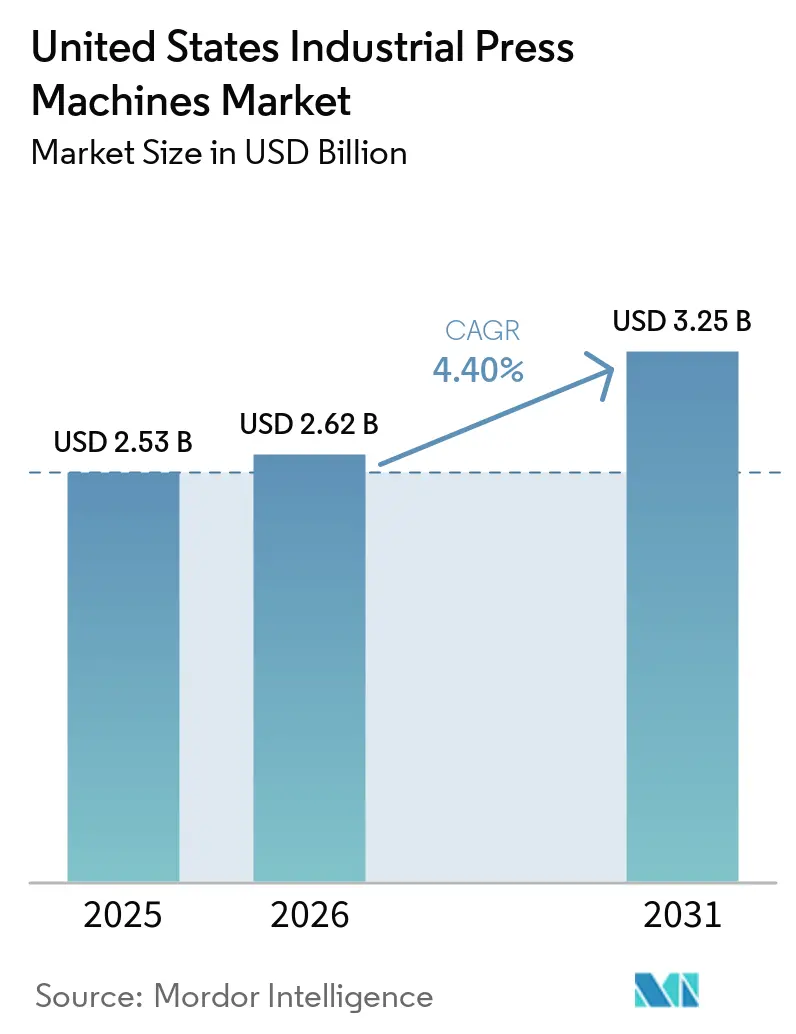
| Base Year Market Size (2025) | USD 2.53 Billion |
| Market Size (2026) | USD 2.62 Billion |
| Market Size (2031) | USD 3.25 Billion |
| Growth Rate (2026 - 2031) | 4.40 % |
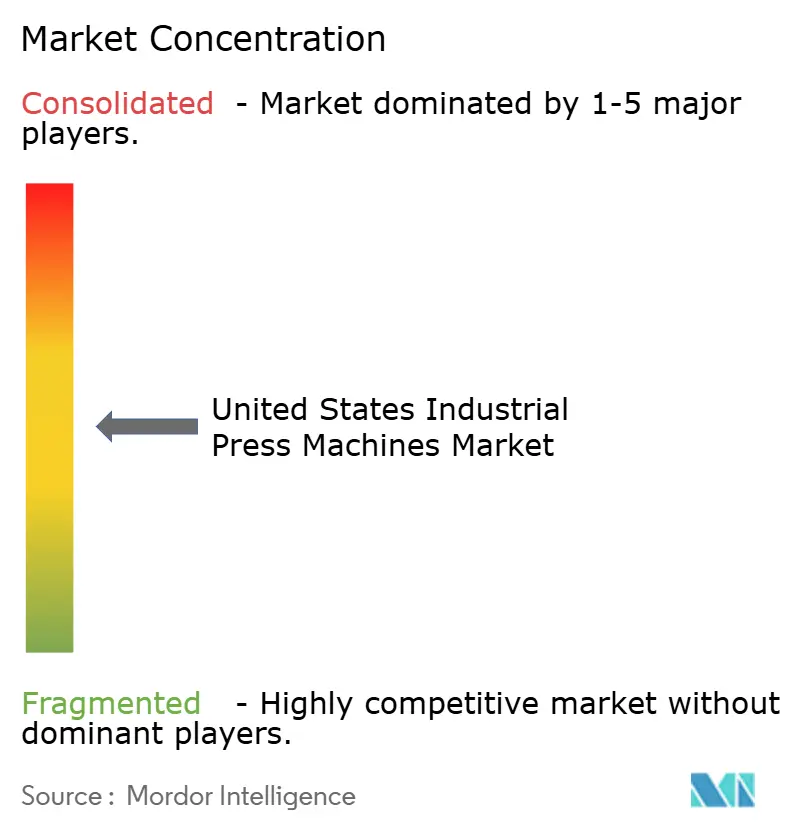
| Market Concentration | Medium |
Major Players *Disclaimer: Major Players sorted in no particular order Image © Mordor Intelligence. Reuse requires attribution under CC BY 4.0. | |
United States Industrial Press Machines Market Analysis by Mordor Intelligence
The United States industrial press machines market size was valued at USD 2.53 billion in 2025 and estimated to grow from USD 2.62 billion in 2026 to reach USD 3.25 billion by 2031, at a CAGR of 4.40% during the forecast period 2026-2031.
Electric vehicle production, new domestic factories, and replacement demand for older mechanical presses support the United States industrial press machines market. Manufacturing technology orders reached USD 5.74 billion in 2025, up 22.5% from 2024, while aerospace orders increased 45.1%, which supports a broader pipeline for press equipment purchases.[1] Incentives for domestic manufacturing are adding factory projects that need press lines, tooling, and material handling equipment when facilities begin operations. The United States industrial press machines market is also shifting toward complete production cells, which favors suppliers that can combine presses with automation, controls, and support services. Trade uncertainty and exposure to imported motors, controls, and electrical drives may delay larger purchases and add cost to custom installations.
Key Report Takeaways
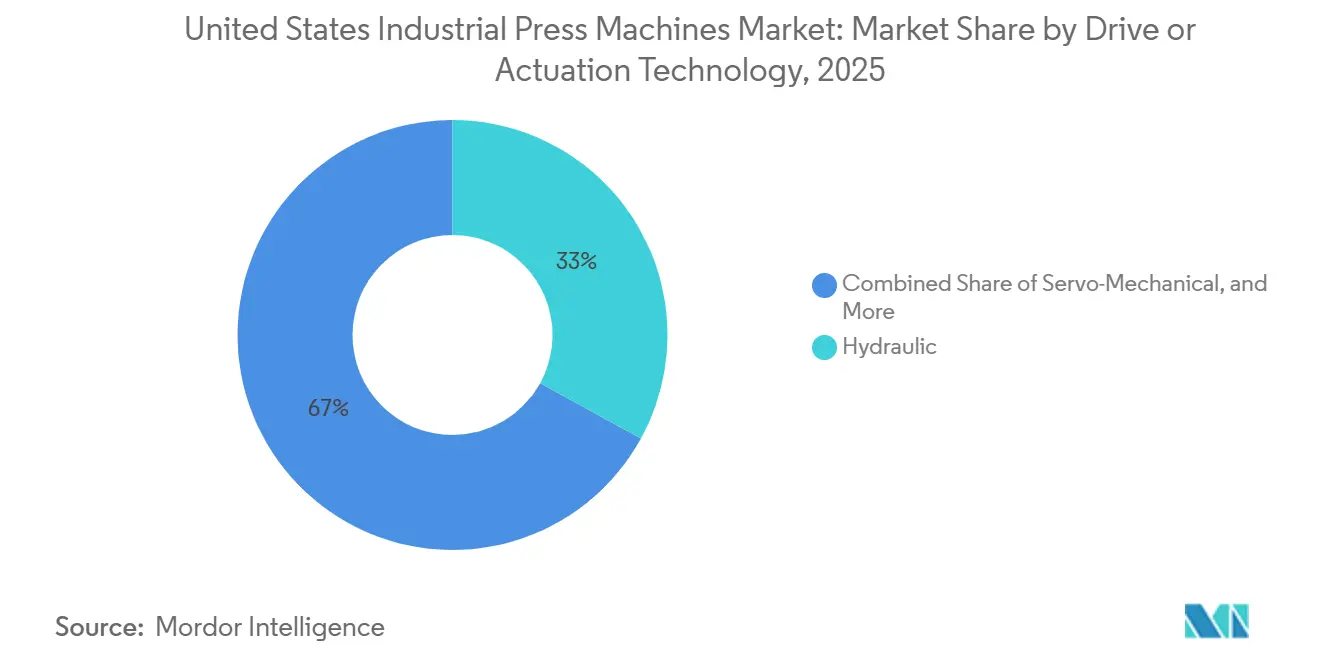
- By drive or actuation technology, hydraulic presses held 33% of the United States industrial press machines market size in 2025, while servo-mechanical presses are forecast to grow at an 8.05% CAGR through 2031.
- By press force, the 101-500 ton category held 33.2% of the United States industrial press machines market share in 2025, while presses above 2,000 tons are projected to grow at a 5.35% CAGR through 2031.
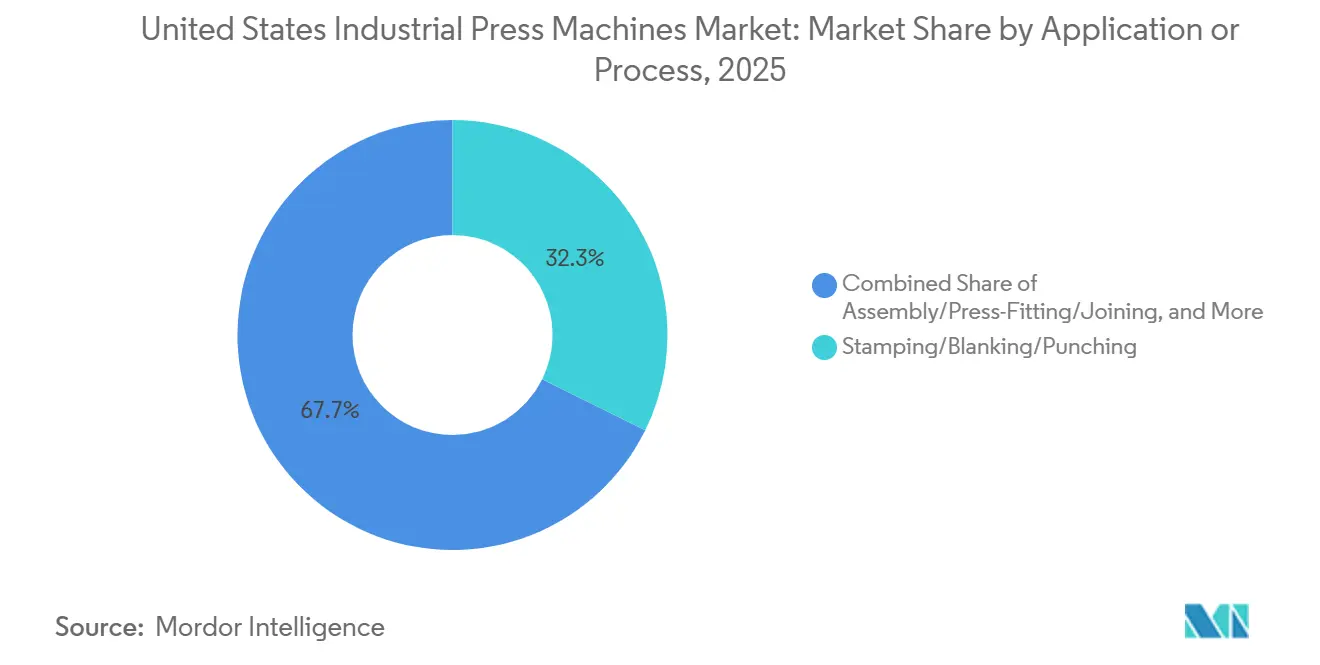
- By application, stamping, blanking, and punching accounted for 32.3% of the United States industrial press machines market size in 2025, while assembly, press-fitting, and joining are forecast to grow at a 5.75% CAGR through 2031.
- By end-use industry, automotive and transportation held 37.8% of the United States industrial press machines market size in 2025, while aerospace and defense are forecast to expand at a 6.05% CAGR through 2031.
Note: Market size and forecast figures in this report are generated using Mordor Intelligence’s proprietary estimation framework, updated with the latest available data and insights as of January 2026.
United States Industrial Press Machines Market Trends and Insights
Drivers Impact Analysis*
| Driver | (~) % Impact on CAGR Forecast | Geographic Relevance | Impact Timeline |
|---|---|---|---|
| Automotive Electrification and Lightweight Component Manufacturing | +1.4% | National, concentrated in the Midwest and Southeast EV clusters | Medium term (2-4 years) |
| Reshoring and Nearshoring of Strategic Manufacturing Capacity | +1% | National, with early gains in the South Central, Southeast, and Midwest regions | Short term (≤ 2 years) |
| Expansion of Automated Stamping and Forming Lines | +0.8% | National, concentrated in automotive press shops and precision component producers | Medium term (2-4 years) |
| Replacement and Modernization of Aging Press Installed Base | +0.6% | National | Short term (≤ 2 years) |
| Electronics, Electrical, and Precision-Component Manufacturing | +0.5% | West Coast, Texas, and Southeast semiconductor and electronics hubs | Long term (≥ 4 years) |
| Demand for Energy-Efficient Servo and Connected Press Technologies | +0.3% | National | Medium term (2-4 years) |
| Source: Mordor Intelligence | |||
Automotive Electrification and Lightweight Component Manufacturing
Electric vehicle programs are changing the equipment requirements of automakers and their tier-1 suppliers in the United States industrial press machines market. Vehicle designs use stamped aluminum closures, advanced high-strength steel members, and battery enclosures that require deep drawing, precision blanking, and powder compaction. Honda committed more than USD 1 billion to its Ohio manufacturing facilities in 2025, including 6 large die-casting machines for electric vehicle battery-case production. General Motors committed USD 4 billion to United States manufacturing plants during 2025-2027 across internal-combustion and electric vehicle programs. Battery cases need rectangular, large-format forms with close wall-thickness control, which increases the need for presses designed around specific applications. This requirement favors suppliers with relevant tooling and process knowledge over suppliers offering only standard machines.
Reshoring and Nearshoring of Strategic Manufacturing Capacity
Factory construction and capital equipment purchasing expanded during 2025, although the pace differed among regions. The United States industrial press machines market benefits when greenfield factories order complete press lines before commissioning, instead of adding equipment in stages. AMT recorded USD 5.74 billion in 2025 manufacturing technology orders, with South Central orders up 49.2% and West region orders up 47.8%. GE Appliances committed USD 3 billion over 5 years to expand domestic production across 11 United States plants, including operations that use appliance-component stamping and forming. Greenfield facilities create concentrated initial demand for press lines, while brownfield projects distribute purchases across several retooling phases. Workforce shortages may make automated equipment more important because manufacturers must expand output with limited skilled labor.
Expansion of Automated Stamping and Forming Lines
Automation is moving from an optional upgrade to a core requirement for many press-line purchases. Integrated production lines combine servo presses, robotic material handling, die-protection systems, and closed-loop tonnage monitoring. ANDRITZ deployed its Metris Visual Die Protection system across 5 servo presses at Alzner Automotive, using dual cameras after every stroke to detect displaced parts and punching residue. This equipment helps protect dies in just-in-time production environments, where interruption can affect output and delivery schedules. Peer-reviewed research reported that optimized servo press systems can improve production rates by 15%-30% compared with conventional mechanical presses, while improving part quality and tool life. The United States industrial press machines market, therefore, favors suppliers that can provide complete press cells rather than stand-alone equipment.
Replacement and Modernization of Aging Press Installed Base
Many mechanical presses installed during the 1980s and 1990s remain in service after delayed replacement decisions. The United States industrial press machines market includes both new equipment demand and retrofit work for these machines. United States private fixed investment in metalworking machinery reached USD 37.4 billion in 2025, although this broad figure covers equipment categories with different replacement needs.[2] Retrofit packages can add servo drives, updated controls, condition-monitoring sensors, and safety systems to older presses. Nidec Minster's USD 30 million facility expansion included a Pama Vertiram 3000 TT Bridge Mill to increase capacity for making and reconditioning large press components. This investment supports both new build projects and rebuild work as replacement cycles advance.
Restraints Impact Analysis*
| Restraint | (~) % Impact on CAGR Forecast | Geographic Relevance | Impact Timeline |
|---|---|---|---|
| High Capital, Installation, and Integration Costs | -0.7% | National | Long term (≥ 4 years) |
| Skilled Tool-and-Die, Controls, and Maintenance Workforce Shortages | -0.5% | National, with the highest exposure in the Midwest manufacturing belt | Medium term (2-4 years) |
| Long Equipment Replacement Cycles | -0.3% | National | Long term (≥ 4 years) |
| Imported Component Exposure and Extended Custom-Press Lead Times | -0.2% | National, with higher exposure for large custom-configured press projects | Short term (≤ 2 years) |
| Source: Mordor Intelligence | |||
High Capital, Installation, and Integration Costs
Large press acquisitions require spending beyond the price of the machine itself. Foundation work, electrical upgrades, installation engineering, safety systems, and automated material handling raise the full project cost. The United States industrial press machines market can therefore face longer approval cycles among smaller fabricators. OSHA requires regular inspections of mechanical power presses, including weekly tests of clutch and brake mechanisms, anti-repeat features, and single-stroke mechanisms.[3] Employers using Presence Sensing Device Initiation must maintain certification and complete annual third-party validation through an OSHA-recognized organization. As of January 15, 2025, the maximum penalty for a serious OSHA violation was USD 16,550 per incident, while willful or repeated violations could reach USD 165,514 per incident.
Skilled Tool-and-Die, Controls, and Maintenance Workforce Shortages
Advanced press equipment needs workers who can operate, maintain, and integrate it. The Bureau of Labor Statistics projected a 2% decline in employment of machinists and tool and die makers between 2024 and 2034, including an 11% decline in tool and die maker employment from 55,200 to 49,300 positions.[4] The same source projected 34,200 annual openings, driven largely by replacements as workers retire. Employment in special die and tool, die set, jig, and fixture manufacturing declined to an index of 77.3 in 2025 from 80.0 in 2024 and 83.6 in 2023. Shortages can slow tool qualification, maintenance, and use of connected press functions. They also strengthen the case for automation, but limited technical staffing can delay the return from that investment.
*Our forecasts treat driver/restraint impacts as directional, not additive. The impact forecasts reflect baseline growth, mix effects, and variable interactions.
Segment Analysis
By Drive/Actuation Technology: Hydraulic Presses Lead While Servo-Mechanical Presses Expand
Hydraulic presses held 33% of the United States industrial press machines market size in 2025. Their position reflects a cost-effective high forming force for deep drawing, compression molding, forging, and straightening, where servo programmability does not always justify a premium. Conventional mechanical presses remain important for high-speed blanking and progressive-die work in automotive body-panel operations. Pneumatic presses serve smaller component assembly and press-fitting work. Other and hybrid systems include servo-hydraulic designs that pair servo control with hydraulic force density.
Servo-mechanical presses are forecast to grow at an 8.05% CAGR from 2026 to 2031, the fastest rate in this category. Their programmable slide motion helps manufacturers adjust press behavior for different part geometries and materials. ANDRITZ developed fineblanking presses for Feintool with servo-controlled hydraulic pump drives that improved energy efficiency by a double-digit percentage while raising stroke output. Energy use, quality requirements, and flexible production needs are supporting servo adoption across the United States industrial press machines market.
By Press Force/Capacity: Mid-Range Presses Support Broad Demand While Ultra-Heavy Systems Serve EV Programs
The 101-500 ton range held 33.2% of the United States industrial press machines market share in 2025. This capacity supports automotive body panels, electrical enclosures, appliance components, and precision-fabricated parts. Presses up to 100 tons serve progressive die, high-speed stamping, and small precision-component operations. The 501-1,000 ton and 1,001-2,000 ton categories support structural automotive stampings, large appliance casings, and industrial machinery components. The range between mid-size and heavy equipment lets plants match press force to part size, tool design, and production volume.
Presses above 2,000 tons are forecast to grow at a 5.35% CAGR from 2026 to 2031. Electric vehicle projects need large tandem and transfer lines, while large-capacity systems also support complex structural parts. AIDA-America shipped 400-1,000 metric ton straight-side mechanical and servo presses for HVAC and electrical component stamping during 2025, showing that large-format demand also extends beyond vehicles. OSHA requires dies to be marked with rated tonnage, stroke, and applicable weight specifications. These requirements add qualification work and can lengthen sales cycles at the upper end of the United States industrial press machines market.
By Application/Process: Stamping Provides the Base While Assembly and Joining Grow Fastest
Stamping, blanking, and punching accounted for 32.3% of the United States industrial press machines market size in 2025. The process supports automotive, appliance, and general fabrication production, making it the core application for many press buyers. Deep drawing and sheet forming provide another major source of revenue in automotive, appliance, and HVAC enclosure manufacturing. Forging supports aerospace structures, powertrain components, and heavy industrial parts, with support from defense procurement and commercial aerospace recovery. Compression molding, straightening, and general forming serve polymer composite and structural correction requirements.
Assembly, press-fitting, and joining are forecast to grow at a 5.75% CAGR from 2026 to 2031. Battery module assembly and precision electrical connector joining support this rate as domestic electric vehicle and electronics production expands. Powder compaction remains a smaller but important application for specialty materials. IperionX commissioned a six-axis SACMI powder metallurgy press in 2025 to expand United States titanium component manufacturing, with capacity for 11 million titanium parts each year for defense and aerospace supply chains. These uses widen the range of applications served by the United States industrial press machines market.
By End-Use Industry: Automotive and Transportation Leads While Aerospace and Defense Expand Fastest
Automotive and transportation held 37.8% of the United States industrial press machines market share in 2025. The sector remains the main source of demand because manufacturers are replacing older internal-combustion stamping lines and qualifying equipment for electric vehicle programs. General Motors committed USD 4 billion to United States plants during 2025-2027. Honda committed more than USD 1 billion to Ohio facilities in 2025, and Rivian began work on a USD 5 billion Georgia electric vehicle plant backed by a USD 6.57 billion Department of Energy loan. These projects provide multi-year procurement opportunities for press equipment, tooling, and supporting systems.
Aerospace and defense are forecast to grow at a 6.05% CAGR from 2026 to 2031. Demand is supported by defense procurement, commercial aircraft production recovery, and new facilities for precision manufacturing. Woodward is building a nearly USD 200 million manufacturing facility in Spartanburg County, South Carolina, for aircraft spoiler actuation systems. Industrial machinery, electrical and electronics, and energy and power equipment form a second group of demand sources. Medical and precision manufacturing needs multi-axis press technology, while appliances, construction, heavy equipment, and general metal products complete the customer base for the United States industrial press machines market.
Geography Analysis
The North Central-East region recorded USD 1,252.8 million in manufacturing technology orders in 2025, an increase of 13.9% from 2024. The United States industrial press machines market has no formal sub-national segments, although Michigan, Ohio, Indiana, and nearby Great Lakes states hold a large concentration of automotive original equipment manufacturers and tier-1 stamping operations. Honda's Ohio program and General Motors' domestic manufacturing commitment support demand for high-tonnage transfer presses, servo cells, and aftermarket services. The region has a mature installed base that requires replacement and retrofit work. Nidec Minster and AIDA-America operate from Ohio, supporting equipment supply, service, and rebuild activity.
The Southeast is a faster-growing press-equipment demand area that combines expanding electric vehicle production with automotive supply chains and an increasing aerospace manufacturing base. Rivian began development of a USD 5 billion electric vehicle plant in Georgia, which provides a multi-year equipment pipeline. Woodward is building a nearly USD 200 million precision manufacturing facility in South Carolina for aircraft spoiler actuation systems. South Central manufacturing technology orders grew 49.2% during 2025, showing the scale of investment in the broader southern production base. Semiconductor, defense electronics, and energy equipment projects support demand beyond automotive production.
The West recorded 47.8% growth in manufacturing technology orders during 2025. Semiconductor and advanced electronics investment in California, Arizona, and Texas supports demand for lead-frame stamping, substrate fabrication, and connector forming equipment. Texas Instruments plans to invest more than USD 60 billion across 7 United States semiconductor fabs, while Amkor Technology broke ground on a USD 7 billion advanced packaging and test campus in Arizona in 2025. The Northeast contributes through defense components, medical device fabrication, and precision machinery production, where hydraulic and servo presses serve specialized aerospace forming, titanium component work, and medical implant compaction.
Competitive Landscape
The United States industrial press machines market is moderately fragmented across global suppliers, but high-tonnage and high-precision equipment is more concentrated. European original equipment manufacturers with North American operations lead in servo systems and large-format transfer presses, while Japanese manufacturers are strong in high-speed precision stamping and progressive-die applications. Domestic suppliers include established builders of custom hydraulic and specialty presses, alongside smaller rebuilders and retrofit providers. The competitive landscape separates suppliers that offer integrated forming and handling solutions from suppliers focused on stand-alone machines. ANDRITZ formally renamed Schuler as ANDRITZ Schuler in March 2025, which reflected its transition from a standalone press maker to an integrated forming and handling technology provider.
Small and mid-sized manufacturers need reconfigurable press solutions that cost less than large-format systems, while the installed base of older mechanical presses needs retrofits, controls, safety upgrades, and rebuild services. Electric vehicle batteries, power electronics, and semiconductor packaging need application-specific press cells rather than standard equipment alone. ANDRITZ's fineblanking collaboration with Feintool produced HFA-Plus systems with servo-controlled hydraulic pump drives, higher stroke output, and double-digit energy-efficiency improvements. Nidec Minster's USD 30 million machining investment strengthens its ability to serve original equipment manufacturing and rebuild work. These moves show why aftermarket capability, digital controls, and application engineering matter when equipment replacement cycles extend beyond 20 years.
Nidec Drive Technology opened a press-machine assembly facility in Ritto, Shiga, in April 2025, doubling annual production capacity from 60 to 120 units and raising its largest available machine size from 150 tons to 330 tons. This expansion strengthens the production base for high-speed precision presses. Competition in the United States industrial press machines market is increasingly based on equipment performance, integration, lifecycle support, and the ability to manage complex line projects.
United States Industrial Press Machines Industry Leaders
-
ANDRITZ Schuler Group
-
AIDA Engineering, Ltd.
-
Komatsu Industries Corp.
-
Nidec Minster Corporation
-
AMADA PRESS SYSTEM CO., LTD.
- *Disclaimer: Major Players sorted in no particular order
Recent Industry Developments
- February 2026: Nidec Minster launched the MMC Titan gap frame press series, with 35-315 ton capacity, Mitsubishi Automation Control, recirculating oil lubrication, programmable limit switch, die protection, and job storage for up to 30 applications, with many units available for immediate shipment.
- September 2025: ANDRITZ Schuler presented a newly developed ring roller at its Erfurt site capable of producing rings up to 2,000 mm in diameter and 400 mm in height. The complete production line integrates a 10,000-ton press, forging robots, laser measuring units, and Metris Track and Trace, with customer commissioning in Kazakhstan scheduled for spring 2026.
- April 2025: ANDRITZ Schuler introduced the Laser Blanking Line 1.18 DFT, capable of processing steel, aluminum, and stainless steel, including AHSS over 1,000 MPa, directly from coil at half the footprint of conventional cut-to-length lines. The line removes the need for floor pit excavation and reduces process steps.
- April 2025: Nidec Drive Technology opened its new press machine assembly factory in Ritto, Shiga, Japan, doubling annual press production capacity from 60 to 120 units and expanding its largest machine offering from 150 tons to 330 tons, with direct supply implications for the United States demand.
United States Industrial Press Machines Market Report Scope
| Conventional Mechanical Presses |
| Servo-Mechanical Presses |
| Hydraulic Presses |
| Pneumatic Presses |
| Other and Hybrid Presses |
| Up to 100 Tons |
| 101–500 Tons |
| 501–1,000 Tons |
| 1,001–2,000 Tons |
| Above 2,000 Tons |
| Stamping, Blanking and Punching |
| Deep Drawing and Sheet Forming |
| Forging |
| Straightening and General Forming |
| Compression Molding |
| Powder Compaction |
| Assembly, Press-Fitting and Joining |
| Other Press Applications |
| Automotive and Transportation |
| Aerospace and Defense |
| Industrial Machinery and Equipment |
| Electrical and Electronics |
| Appliances and Consumer Durables |
| Construction and Heavy Equipment |
| Energy and Power Equipment |
| Metal Products and General Manufacturing |
| Medical and Precision Manufacturing |
| Other End-Use Industries |
| By Drive / Actuation Technology | Conventional Mechanical Presses |
| Servo-Mechanical Presses | |
| Hydraulic Presses | |
| Pneumatic Presses | |
| Other and Hybrid Presses | |
| By Press Force / Capacity | Up to 100 Tons |
| 101–500 Tons | |
| 501–1,000 Tons | |
| 1,001–2,000 Tons | |
| Above 2,000 Tons | |
| By Application / Process | Stamping, Blanking and Punching |
| Deep Drawing and Sheet Forming | |
| Forging | |
| Straightening and General Forming | |
| Compression Molding | |
| Powder Compaction | |
| Assembly, Press-Fitting and Joining | |
| Other Press Applications | |
| By End-Use Industry | Automotive and Transportation |
| Aerospace and Defense | |
| Industrial Machinery and Equipment | |
| Electrical and Electronics | |
| Appliances and Consumer Durables | |
| Construction and Heavy Equipment | |
| Energy and Power Equipment | |
| Metal Products and General Manufacturing | |
| Medical and Precision Manufacturing | |
| Other End-Use Industries |
Key Questions Answered in the Report
How large is demand for industrial press machines in the United States?
The estimated 2026 value is USD 2.62 billion, and the forecast reaches USD 3.25 billion by 2031 at a 4.40% CAGR.
Which press technology leads demand in the United States?
Hydraulic presses led with 33% share in 2025 because they provide high forming force for deep drawing, compression molding, forging, and straightening.
Which press technology is growing fastest?
Servo-mechanical presses are forecast to grow at an 8.05% CAGR through 2031 because they provide programmable slide motion, flexibility, and energy-efficiency benefits.
Which end-use sector purchases the most industrial press machines?
Automotive and transportation held 37.8% share in 2025, supported by electric vehicle programs and the replacement of older stamping lines.
Why are larger press systems gaining demand?
Why are larger press systems gaining demand? Presses above 2,000 tons are forecast to grow at a 5.35% CAGR through 2031 as electric vehicle projects require large tandem and transfer press lines.
What limits press equipment investment?
High installation and integration costs, safety compliance needs, long replacement cycles, and shortages of tool-and-die and maintenance workers can delay investment decisions.