
Industrial Lighting Market Size and Share
Market Overview
| Study Period | 2020 - 2031 |
|---|---|
| Market Size (2026) | USD 8.42 Billion |
| Market Size (2031) | USD 12.09 Billion |
| Growth Rate (2026 - 2031) | 7.50 % |
| Fastest Growing Market | Asia Pacific |
| Largest Market | Asia Pacific |
| Market Concentration | Medium |
Major Players *Disclaimer: Major Players sorted in no particular order Image © Mordor Intelligence. Reuse requires attribution under CC BY 4.0. | |
Industrial Lighting Market Analysis by Mordor Intelligence
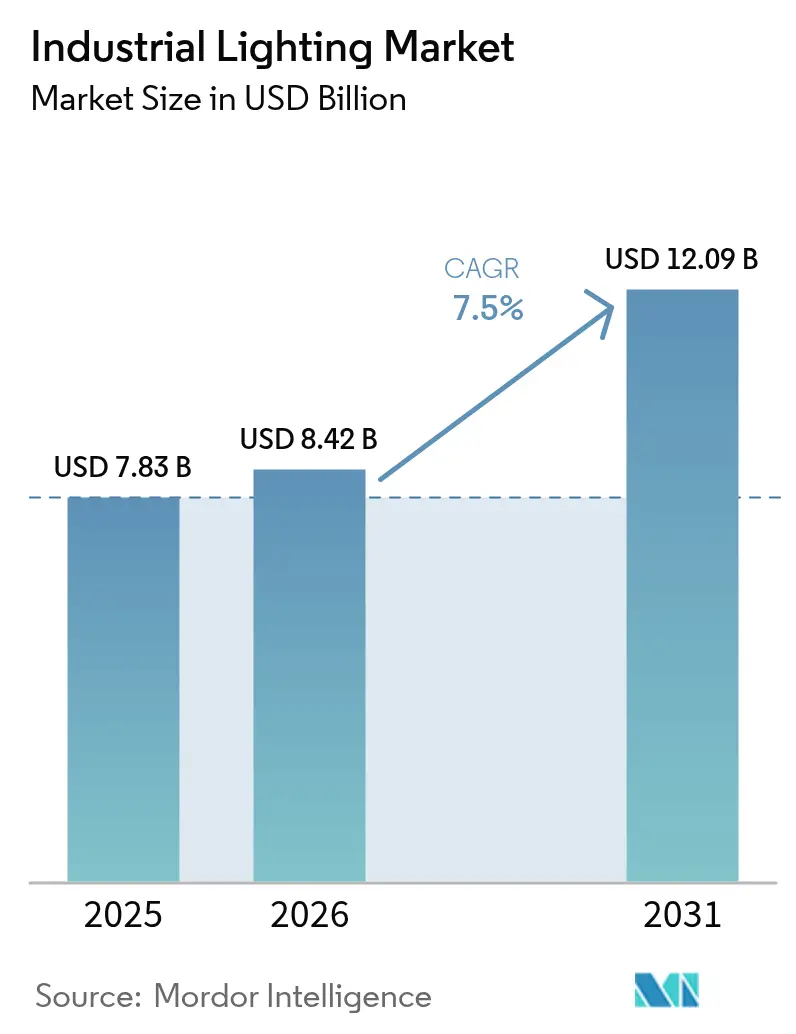
The industrial lighting market size is expected to grow from USD 7.83 billion in 2025 to USD 8.42 billion in 2026 and is forecast to reach USD 12.09 billion by 2031 at 7.5% CAGR over 2026-2031. Growing retrofit projects in aging factories, rising automation in warehousing, and accelerating smart LED uptake underpin this expansion. Digitally connected luminaires that integrate sensors and edge computing cut maintenance downtime, while steep LED price declines widen the replacement gap with fluorescent and HID fixtures. Factory operators also respond to stricter ANSI/IES safety codes, and Lighting-as-a-Service (LaaS) models help bypass capital constraints by turning upgrades into predictable operating expenses.[1] Asia-Pacific leads revenue generation, yet tariff volatility on LED drivers and cybersecurity fears around connected fixtures temper the overall growth trajectory.
Key Report Takeaways
- By light source, LED commanded a 65.20% share of the industrial lighting market in 2025; smart LED variants are expected to expand at a 9.8% CAGR through 2031.
- By installation type, retrofit projects held 44.55% of the industrial lighting market size in 2025 and will progress at a 9.95% CAGR to 2031.
- By product type, high/low-bay luminaires led with 35.85% revenue share of the industrial lighting market in 2025, while explosion-proof fixtures are forecast to climb at a 9.55% CAGR through 2031.
- By end-user application, oil and gas captured 31.20% market share of the industrial lighting market in 2025; warehousing and logistics is projected to register the fastest 8.65% CAGR to 2031.
- By geography, Asia-Pacific accounted for 39.10% of the industrial lighting market's 2025 revenues and is on track for an 8.05% CAGR to 2031.
Note: Market size and forecast figures in this report are generated using Mordor Intelligence’s proprietary estimation framework, updated with the latest available data and insights as of 2026.
Market Trends and Insights
Drivers Impact Analysis of Industrial Lighting Market*
| Driver | (~) % Impact on CAGR Forecast | Geographic Relevance | Impact Timeline |
|---|---|---|---|
| Steepening LED price-performance curve | +1.8% | Global, strongest in Asia-Pacific manufacturing hubs | Medium term (2-4 years) |
| Demand for retrofit-ready luminaires | +1.5% | North America and Europe legacy factories | Short term (≤ 2 years) |
| Stricter workplace-safety illumination codes | +1.2% | North America, expanding globally | Medium term (2-4 years) |
| Digital twin-enabled lighting tools | +0.9% | Germany, Japan, South Korea | Long term (≥ 4 years) |
| Warehouse automation task optics | +1.4% | E-commerce hubs in Asia-Pacific and North America | Short term (≤ 2 years) |
| Lighting-as-a-Service contracts | +0.8% | North America and Europe, emerging in Asia-Pacific | Medium term (2-4 years) |
| Source: Mordor Intelligence | |||
Steepening LED price-performance curve
LED efficacy has surpassed 200 lumens per watt and production costs keep falling by 15-20% every year, shortening payback periods in factory retrofits.[2] Smart luminaires now embed sensors and wireless radios, eliminating separate control infrastructure and enabling predictive maintenance that reduces unplanned downtime.[3] The combined efficiency and intelligence edge positions LEDs as the default choice for both new builds and upgrades.
Demand for retrofit-ready luminaires
Factories built between 1980 and 2010 approach end-of-life for fluorescent and HID fixtures, yet remain structurally sound. Plug-and-play LED retrofit kits slot into existing wiring and minimize production interruptions, slashing installation labor by up to 40%.[4] Energy savings of 50-70% deliver sub-24-month paybacks, persuading financial controllers to green-light projects even amid economic uncertainty.
Stricter workplace-safety illumination codes
ANSI/IES RP-7-21 now mandates 500 lux for precision assembly tasks and 200 lux for general manufacturing. OSHA has stepped up enforcement, citing poor lighting in accident investigations. Facilities unable to meet thresholds risk penalties and production stoppages, making compliance-focused lighting upgrades a board-level priority.
Digital twin-enabled lighting tools
Plant owners increasingly simulate lighting layouts in digital twin platforms from Siemens and NVIDIA Omniverse before installing fixtures.[5] Virtual photometric testing trims design errors and accelerates commissioning. KION Group reported a 40% cut in warehouse lighting deployment time after adopting twin-based workflows.
Restraints Impact Analysis of Industrial Lighting Market*
| Restraint | (~) % Impact on CAGR Forecast | Geographic Relevance | Impact Timeline |
|---|---|---|---|
| Tariff volatility on LED drivers | −1.1% | Global chains, acute on Mexico–U.S. corridor | Short term (≤ 2 years) |
| Cybersecurity concerns on connected fixtures | −0.7% | Advanced manufacturing economies with high IoT penetration | Medium term (2-4 years) |
| Skills gap for controls commissioning | −0.5% | Global, more severe in developed markets | Long term (≥ 4 years) |
| Lengthy hazardous-location certifications | −0.4% | Oil and gas regions: Middle East, North America, North Sea | Medium term (2-4 years) |
| Source: Mordor Intelligence | |||
Tariff volatility on LED drivers
U.S. duties of up to 25% on drivers imported from Mexico and Canada inflate project costs and complicate procurement schedules. Many manufacturers are rerouting orders to Southeast Asia, but longer shipping times and quality-assurance challenges linger.
Cybersecurity concerns over connected fixtures
Operational technology teams fear that IoT luminaires could serve as gateways for ransomware. Surveys show 78% of factories lack in-house expertise to secure lighting networks. Until standardized cybersecurity frameworks mature, some operators postpone large-scale deployments of connected systems.
*Our forecasts treat driver/restraint impacts as directional, not additive. The impact forecasts reflect baseline growth, mix effects, and variable interactions.
Industrial Lighting Market Segment Analysis
By Light Source:
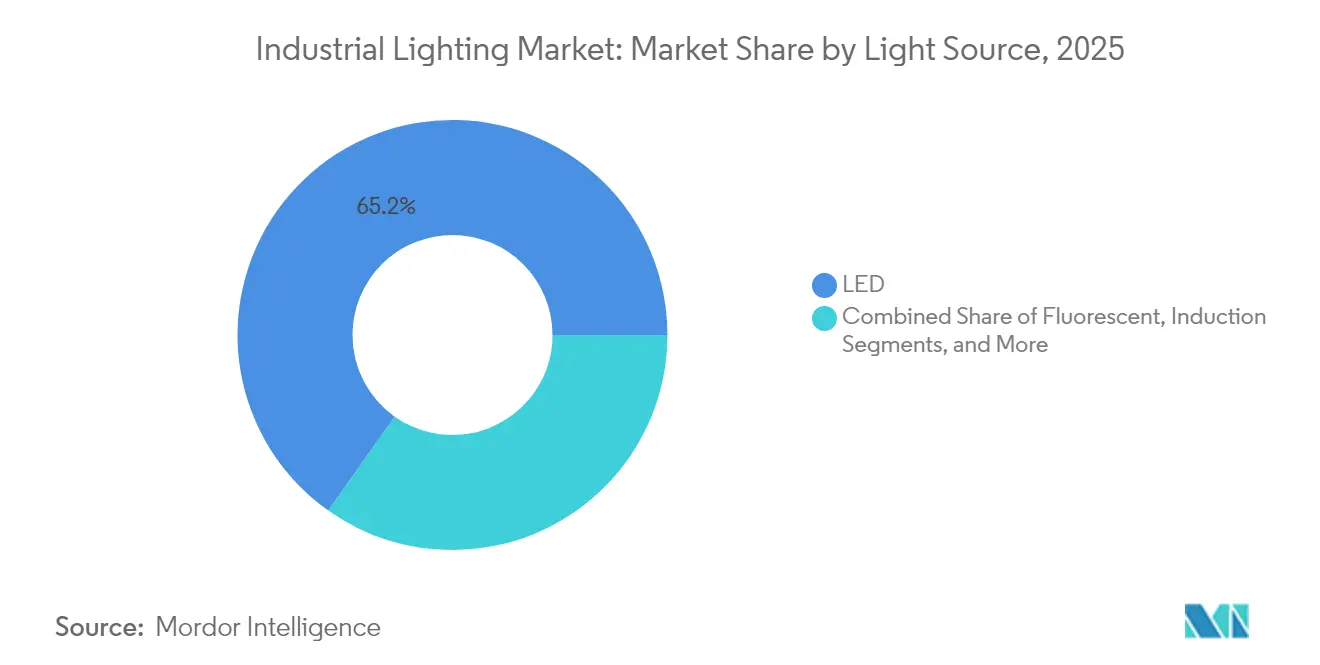
LED Growth Sustains Market LeadershipLED held 65.20% of the industrial lighting market share in 2025, and smart variations are growing at a 9.8% CAGR through 2031. Within the industrial lighting market size, high-intensity discharge fixtures retain 20.05% share for extreme-output tasks, while fluorescent slips to 13.65% as energy codes tighten.
Affordability gains and integrated connectivity consolidate LED dominance. Smart LEDs incorporate occupancy sensing and wireless mesh control that bypasses separate wiring. HID persists in steel mills and shipyards demanding >50,000 lumen outputs, yet OEMs now prototype high-power LEDs to disrupt this niche. Organic LED remains a 1.10% sliver, mainly for curved cleanroom surfaces where uniform light prevents contamination.

By Offering:
Control Systems Capture Premium ValueLamps and luminaires supplied 48.80% of 2025 revenue, but control systems and sensors are forecast to post a 9.6% CAGR to 2031, the fastest within the industrial lighting market. Control modules optimize burn hours, slash energy by 25-35%, and feed predictive algorithms that flag component fatigue.
Services contribute 29.05% share, with LaaS contracts growing 32.8% annually as finance teams prefer OpEx over CapEx. Providers bundle hardware, controls, and maintenance in one monthly fee, de-risking technology obsolescence for plant owners.
By Installation Type:
Retrofit Projects AccelerateRetrofit work accounted for 44.55% of 2025 revenue and will rise at a 9.95% CAGR to 2031, marking the largest slice of the industrial lighting market size at the facility level. New-build activity, at 31.85% share, slows to a 6.65% CAGR as post-pandemic capacity additions normalize.
Regulatory pressure drives retrofits: older sites miss ANSI/IES glare limits and EN12464-1 color-rendering rules. Plug-and-play kits minimize downtime, letting maintenance crews swap fixtures during planned line breaks rather than prolonged shutdowns.
By Product Type:
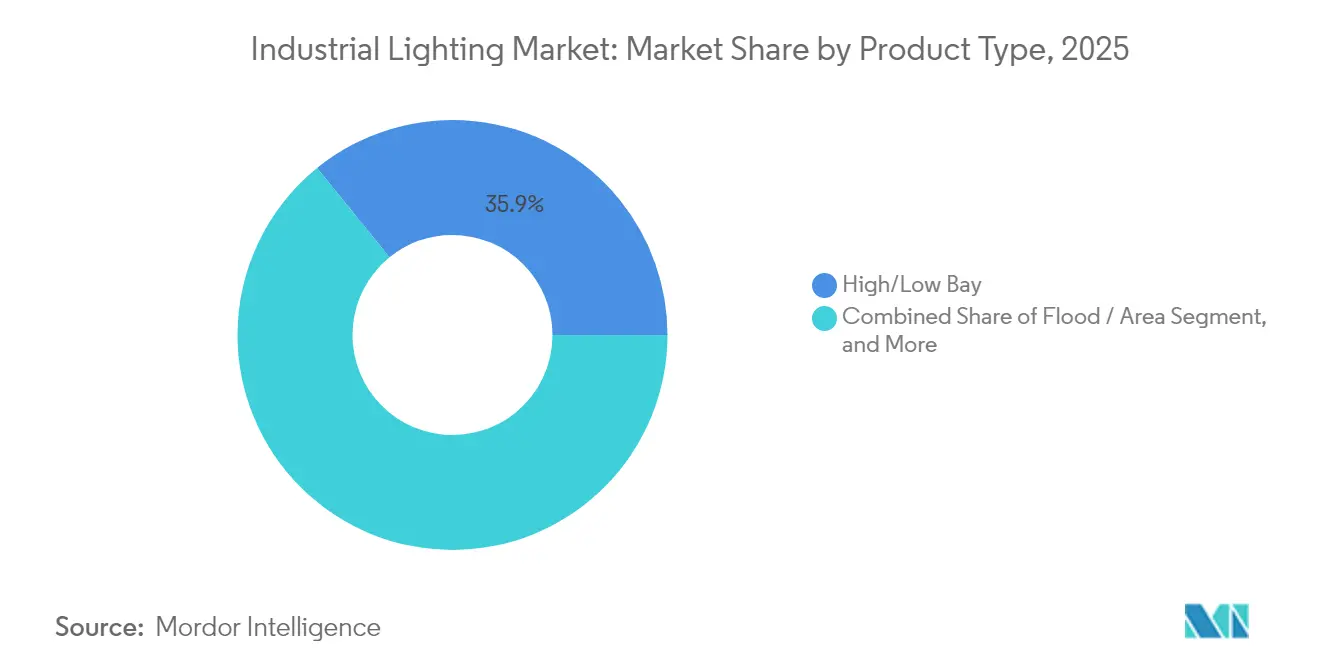
Explosion-Proof Fixtures Earn Premium MarginsHigh/low-bay luminaires dominated with a 35.85% share in 2025, servicing warehouses and machining halls. Yet explosion-proof lighting is the fastest climber at a 9.55% CAGR as petrochemical, mining, and grain-handling plants abide by UL844 and IECEx certification.
Explosion-proof units sell at 3-4 times standard fixture prices, bolstering revenue even though volume lags. Fragmented regional standards, ATEX in Europe, NEC in the U.S., push buyers toward globally certified brands such as R. STAHL and Dialight.
By End-User Application:
Warehousing Surges on E-CommerceOil and gas retained a 31.20% share thanks to explosion-proof demand. Warehousing and logistics is set to expand at an 8.65% CAGR through 2031, the industrial lighting market’s fastest end-use segment. Autonomous mobile robots and machine-vision sorting require uniform, flicker-free light to minimize navigation errors.
Discrete and process manufacturing hold 24.30% share, underpinned by Industry 4.0 retrofits that link lighting to production data streams. Cleanrooms in pharma and semiconductor lines rely on sealed LED housings that repel particles and chemicals, sustaining an 8.05% growth clip.
Geography Analysis
APAC Industrial Lighting Market
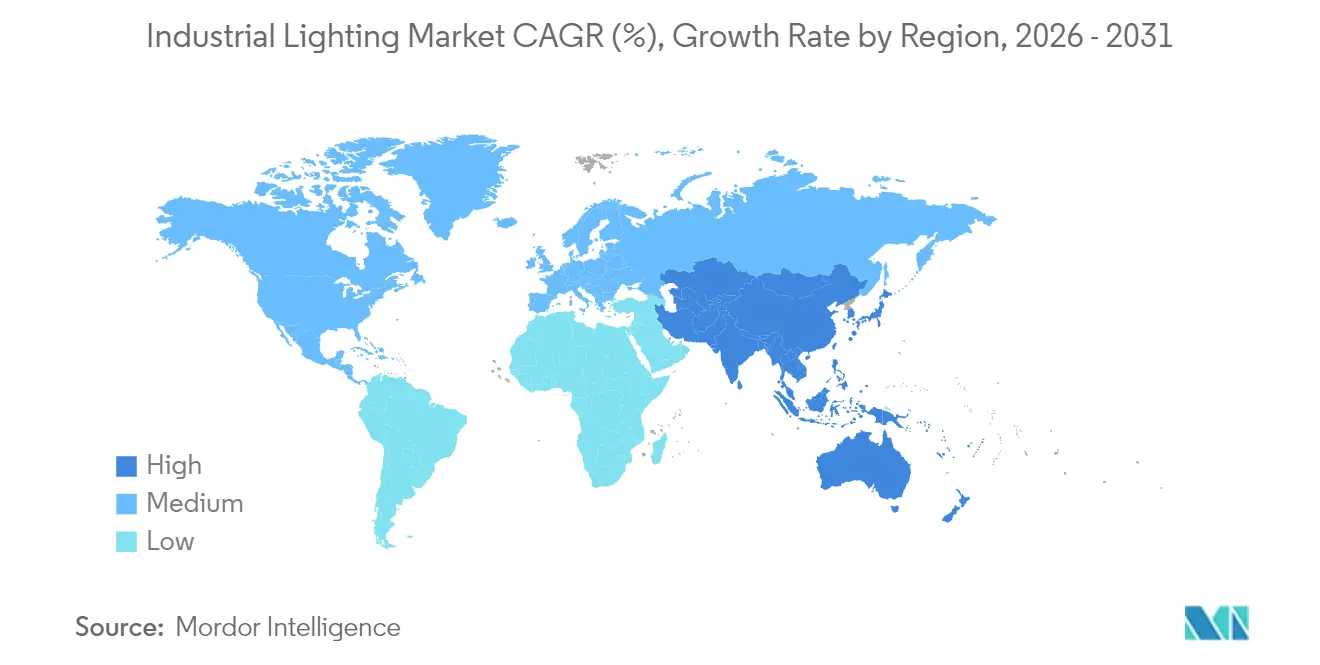
Asia-Pacific contributed 39.10% of 2025 revenue and is forecast for an 8.05% CAGR to 2031. China’s smart-factory subsidies and India’s industrial corridor build-outs keep fixture demand high, while Japan and South Korea specify digital twins in project tenders. Southeast Asia benefits from supply-chain realignment away from China, boosting greenfield lighting installations.
North America and APAC Industrial Lighting Market
North America captured 30.65% of turnover in 2025, advancing at a 6.95% CAGR. The industrial lighting market share for retrofit projects is greatest here because plants average 30 years old. ANSI/IES updates compel upgrades, yet tariffs on Mexican drivers inflate BOM costs and spur sourcing shifts to Vietnam and Thailand. Canadian carbon-reduction incentives further accelerate LED uptake across heavy industry.
Europe Industrial Lighting Market
Europe generated 30.25% of 2025 sales and will post a 6.65% CAGR. Germany leads with Industry 4.0 pilots linking lighting to robotics, while France and the UK target energy savings to meet 2030 climate goals. Eastern Europe, including Poland and Czechia, grows faster at 8.95% on the back of EU structural funds earmarked for manufacturing upgrades.
Regulatory Landscape
Industrial lighting is shaped by a mix of safety and energy-efficiency requirements that increasingly favor high-efficacy LED systems and more prescriptive controls. In the United States, workplace illumination and safety expectations are supported by ANSI/IES task guidance alongside OSHA enforcement practices, while the US Department of Energy (DOE) manages federal energy conservation standards. In March 2026, DOE issued a final determination that standards for metal halide lamp fixtures (MHLFs) will not be amended, and it also published a proposed determination that standards for fluorescent lamp ballasts (FLBs) should not be amended. Together, these actions keep legacy-technology baselines stable while compliance attention shifts toward upgrading installed bases to meet current safety and energy performance norms.
In Europe, ecodesign requirements for light sources and separate control gear are anchored by Regulation (EU) 2019/2020, setting minimum performance and information requirements for products placed on the market. In China, the State Administration for Market Regulation (SAMR) and related standardization bodies advanced multiple LED efficiency and performance standards in 2026, including GB 30255-2026 for indoor LED products, GB/T 24827-2026 for luminaire performance specifications (effective November 1, 2026), and GB 37478-2025 for road and tunnel LED luminaires (implemented on June 1, 2026). This tightening standards environment raises the compliance premium on validated photometrics, documented efficacy, and qualified control gear across global supplier portfolios.
Value Chain Analysis
The industrial lighting value chain starts with upstream materials and components such as LED chips, phosphors, optics, heat sinks, housings, and electronics including drivers and control gear. These inputs flow to luminaire and lamp OEMs that design and assemble high/low-bay fixtures, harsh-environment and explosion-proof products, and sensor-enabled smart luminaires, with certification and test labs acting as key gatekeepers for hazardous-location segments (for example, UL844 and IECEx-aligned product paths referenced in market positioning). Midstream, controls and software layers (sensors, gateways, and building or industrial integration) are increasingly bundled with luminaires, aligning with connected-lighting adoption and LaaS-style service contracts.
Downstream, products move through electrical distributors, project specifiers, and systems integrators that execute retrofit and new-build installations, followed by commissioning and ongoing maintenance services. Recent supply-chain strategy highlights regionalization and partnership-driven manufacturing expansion: Signify formed a manufacturing joint venture in Egypt in July 2024 (Signify Gila Lighting Technologies) to serve Africa, the Middle East, and Europe, and Signify and Dixon Technologies advanced an India manufacturing path through the Lightanium Technologies joint venture (announced March 2025, with operational start reported in July 2025). Across the chain, cost and availability of drivers and electronics remain sensitive to tariff and logistics friction, while connected deployments add a second dependency on controls commissioning skills and OT cybersecurity readiness at the plant level.
Competitive Landscape
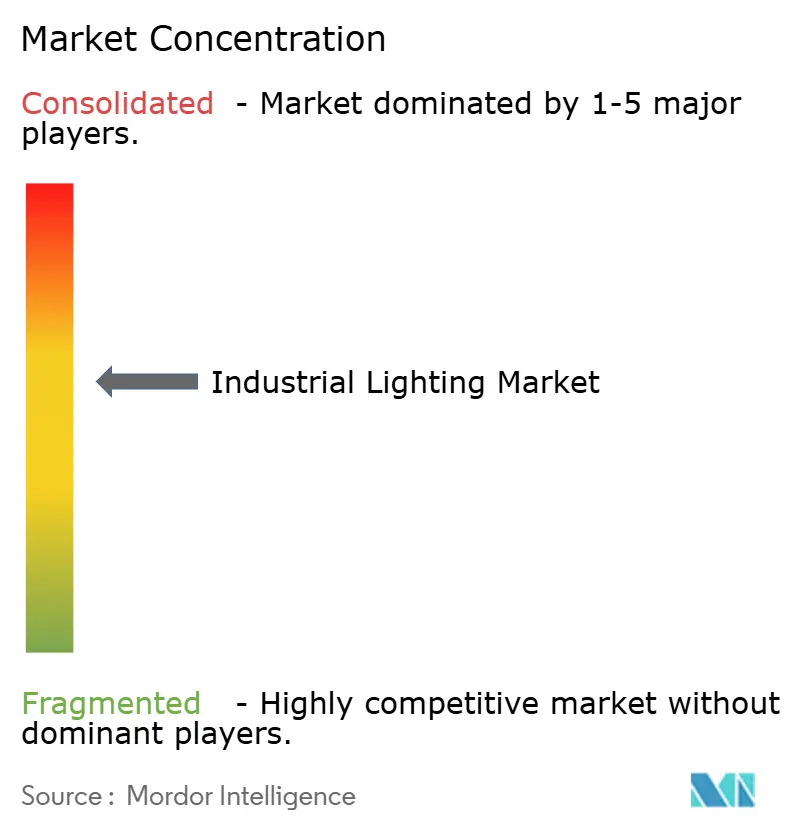
The five largest suppliers command about 42% of global revenue, signaling a moderately concentrated field. Acuity Brands, Signify, and Eaton leverage broad portfolios and proprietary wireless protocols to bundle luminaires, controls, and services. Recent deals, such as LEDVANCE buying loblicht, illustrate value-chain consolidation aimed at turnkey project competence.
Technology rivalry centers on edge-native analytics that predict lamp failure before it halts production. Siemens’ pending buyout of Altair Engineering adds Toggled’s retrofit controls to its industrial automation stack, fusing lighting with PLC-level data. Meanwhile, disruptors selling modular fixtures online bypass traditional distributors, squeezing margins.
Explosion-proof niches remain competitive thanks to certification barriers. Dialight, R. STAHL, and CESP focus on UL844 and IECEx compliance, commanding premium ASPs. Regional specialists defend their share through tailored solutions for harsh climates or high-ambient-temperature processes.
Industrial Lighting Industry Leaders
-
Signify Holding N.V.
-
ams OSRAM AG
-
Acuity Brands, Inc.
-
Eaton Corporation plc
-
Hubbell Incorporated
- *Disclaimer: Major Players sorted in no particular order
Industrial Lighting Market Companies Covered in this Report
- Signify Holding N.V.
- Cree Lighting, a division of IDEAL INDUSTRIES, Inc.
- Eaton Corporation plc
- Emerson Electric Co.
- Dialight plc
- Legrand SA
- Zumtobel Group AG
- Acuity Brands, Inc.
- ams OSRAM AG
- TRILUX GmbH & Co. KG
- Hubbell Incorporated
- Larson Electronics, LLC
- Hilclare Lighting (Group Sylvania)
- Raytec Ltd
- Glamox AS
- Nemalux Inc.
- R. STAHL AG
- ABB Installation Products Inc.
- Schneider Electric SE
- Cooper Lighting Solutions (Signify)
- TOYODA GOSEI Co., Ltd.
- Seoul Semiconductor Co., Ltd.
- Current (dba GE Current, a DAI Company)
- Warom Technology Incorporated Company
Market Opportunities and Future Outlook
A large, addressable opportunity is emerging in accelerating industrial retrofits where LED conversion is paired with networked controls, commissioning, and service models that reduce downtime and shift upgrades from CapEx to OpEx. The market context already points to retrofit projects as the largest installation slice (44.55% revenue share in 2025) and highlights control systems as a fast-expanding value layer within offerings, which aligns with tightening energy-code and control requirements in major jurisdictions. Code-led pull is visible through the publication and use of ANSI/ASHRAE/IES Standard 90.1-2025 as an energy-efficiency reference for commercial and industrial buildings, and the California 2025 Building Energy Efficiency Standards taking effect on January 1, 2026, both of which support demand for higher-efficacy luminaires and more granular lighting control strategies.
Manufacturing and supply-chain whitespace also shows up in regional capacity build-outs and more flexible production methods that shorten lead times for customized industrial luminaires. In May 2026, Signify opened a 3D printing factory in Pila, Poland, positioning additive manufacturing as a lever for rapid prototyping and localized production of lighting components and housings. In parallel, Transrail Lighting Limiteds capacity increase in April 2026 signals continued investment in output scalability for LED fixture categories used in industrial and infrastructure settings. These moves support opportunities for suppliers and integrators that can deliver locally compliant product variants (for example, EU ecodesign requirements and evolving China GB efficiency standards) while addressing connected-lighting deployment barriers, including cybersecurity concerns and controls commissioning skills gaps.
Recent Industry Developments in Industrial Lighting Market
- June 2026: Acuity Brands expanded the Mark Architectural Lighting SLOT family with new recessed and perimeter luminaires. The additions broaden specifier options for linear and perimeter lighting layouts often used in industrial-adjacent facilities such as warehouses, corridors, and support spaces. Portfolio depth supports faster standardization across multi-site rollouts where consistent form factors and trims simplify procurement and installation.
- May 2026: Acuity Brands launched the Lithonia Lighting Beyond LED High Bay, a linear high-bay luminaire featuring a patent-pending thermal design. The release targets core industrial applications where thermal management and reliability drive total cost of ownership and maintenance intervals. It also reinforces product refresh cycles in high/low-bay categories, the largest product segment in the market by 2025 revenue share.
- March 2026: ams OSRAM completed the sale of its Entertainment and Industry Lamps business to Ushio Inc. for EUR 114 million. The divestment reflects a shift away from certain legacy lamp operations toward core photonics and semiconductor priorities. For industrial lighting supply, it signals ongoing restructuring in specialized lamp categories while the broader market mix continues moving toward LED-based systems and integrated controls.
Industrial Lighting Market Report Scope and Research Methodology
Market Definition and Coverage
For this study, the industrial lighting market is defined as the revenue generated from lighting lamps and luminaires used to illuminate industrial spaces such as factories, warehouses, and similar production and storage sites, across new installations and retrofit activity.
Scope exclusions: Decorative residential lighting, consumer smart-home bulbs, and automotive lighting are excluded from this market sizing.
Segments Covered in This Report
- By Light Source
- LED
- High-Intensity Discharge (HID)
- Fluorescent
- Induction
- Organic LED (OLED)
- By Offering
- Lamps and Luminaires
- Control Systems and Sensors
- Services (Design, LaaS, Maintenance)
- By Installation Type
- New Build
- Retrofit
- Replacement
- By Product Type
- High / Low Bay
- Flood / Area
- Task and Spotlight
- Explosion-proof / Harsh-Environment
- By End-user Application
- Oil and Gas
- Mining and Metals
- Pharmaceutical and Clean-room
- Discrete and Process Manufacturing
- Warehousing and Logistics
- Food and Beverage
- Chemical and Petrochemical
- By Geography
- North America
- United States
- Canada
- Mexico
- South America
- Brazil
- Argentina
- Rest of South America
- Europe
- Germany
- United Kingdom
- France
- Italy
- Rest of Europe
- Asia-Pacific
- China
- Japan
- South Korea
- India
- Rest of Asia-Pacific
- Middle East
- Saudi Arabia
- United Arab Emirates
- Rest of Middle East
- Africa
- South Africa
- Rest of Africa
- North America
Data Sources, Market Sizing, and Validation
Desk Research
Desk research was used to set the factual base for the model and to avoid building the market only from assumptions. We referenced public sources such as U.S. Energy Information Administration data for electricity use signals, U.S. Department of Energy materials on lighting efficacy and standards, and U.S. Bureau of Labor Statistics series that indicate industrial activity and employment by sector. For trade and flow checks, we also used datasets such as UN Comtrade and country customs releases where relevant.
Along with these, we reviewed company annual reports, filings, investor decks, and product catalogs to understand how industrial offerings are positioned and priced over time. Patent databases were also used to spot where adoption is moving, especially around LED drivers, controls, and connected lighting features. We also used paid subscriptions for company financials and news intelligence, plus shipment-level import and export tracking for selective cross-checks. The sources named above are illustrative, and many other public references were also used to collect data, validate it, and clarify open questions during the analysis.
Primary Interviews and Surveys
Primary inputs came from interviews and short surveys with stakeholders across the value chain, including manufacturers, distributors, contractors, facility teams, and industrial end users who manage upgrade cycles. We used these discussions to validate retrofit versus new-build splits, average selling price movement, and the pace of LED and control-system adoption across major regions so that the sizing stays realistic.
Distribution of primary research fieldwork respondents
| Company type | Respondent position | Region |
|---|---|---|
| Top tier: 38% | CXOs: 16% | APAC: 42% |
| Mid tier: 45% | Functional/Unit leaders: 41% | EMEA: 31% |
| Smaller Players: 17% | Managers: 43% | Americas: 27% |
Market-Sizing & Forecasting
The core sizing starts with a top-down build where industrial activity and lighting demand are reconstructed using a demand-pool logic by facility type and upgrade cycle, and then translated into value using price benchmarks. In practice, the model is driven by factors such as industrial floor space additions, warehouse and manufacturing expansion, retrofit penetration, LED conversion rates, and replacement frequency for legacy technologies. Where controls and connected features are relevant, we also adjust for attach rates and the observed price premium from interviews.
To ensure the totals are not drifting, results are corroborated with selective bottom-up approximations, such as sampling volumes through distributor and contractor checks, and using indicative ASP times unit volumes for key product families like high-bay and flood lighting. When bottom-up signals are incomplete, the gaps are handled by using conservative proxy ranges agreed in calls, followed by sensitivity checks so no single assumption dominates. For forecasting, we used scenario analysis supported by simple multivariate relationships between industrial output indicators, energy-efficiency policy direction, and expected ASP progression, and then the outlook was reviewed with primary respondents before finalizing the curve.
Data Validation & Update Cycle
Validation is done through repeated cross-checks against independent signals, and then through analyst review before the numbers are signed off. We compare the model output with trade flows, industrial production direction, and pricing reality checks gathered from the channel, which helps flag anomalies early. If a variance looks material, the assumptions are revisited and respondents are re-contacted to confirm whether it is a data issue or a real market change.
Reports are refreshed annually, and interim updates are completed when material events occur, such as policy changes, sharp component price shifts, or major supply disruptions. Before delivery, the latest data releases are rechecked and a final review is completed so the version shared with clients reflects the most recent market conditions.
Mordor Intelligence's Industrial Lighting Market Size Measured Against Other Published Estimates
Published market sizes for industrial lighting can look inconsistent because firms often count different product boundaries and time periods, even when they use similar growth narratives. Differences also show up when some studies mix industrial and commercial applications, or when price assumptions are not refreshed to reflect LED price softening and changing control-system premiums.
Key gap drivers in this market usually come from how retrofit activity is treated versus only new installations, how LED and legacy technologies are blended in the value mix, and whether the estimate includes lamps and luminaires together or focuses on fixtures only. Currency conversion timing and the year used as the starting point can also shift the reported value, especially when regions with different pricing levels are aggregated.
Benchmark comparison
| Source | Market Size | Gaps in Research Methodology |
|---|---|---|
| Mordor Intelligence | USD 7.83 B (2025) | |
| Global Research House A | USD 8.46 B (2024) | Uses an earlier base year and can capture a different price level for LED fixtures and controls, which changes the value even when volumes are similar. |
| Industry Publisher B | USD 8.20 B (2024) | Keeps a broader application lens (including outdoor industrial in some cases) and runs a longer horizon, which can lead to different inclusion choices and smoothing of near-term price declines. |
The table shows a tight spread around the mid single-digit billions, and the remaining difference is largely explained by timing and what is included in the value total. In Mordor Intelligence's model, industrial-use lamps and luminaires are counted across both new build and retrofits, and the 2025 price mix is rechecked using channel feedback on LED conversion and control attach rates. This makes the number easier to trace back to practical demand and pricing variables, and it reduces surprises when users re-run scenarios.
Key Questions Answered in the Report
What is the projected value of the industrial lighting market by 2031?
The market is expected to reach USD 12.09 billion by 2031, growing at a 7.5% CAGR.
Which region accounts for the largest revenue share in industrial lighting?
Asia-Pacific leads with 39.10% of 2025 global revenue and the fastest 8.05% CAGR to 2031.
Why are retrofit projects growing faster than new installations?
Aging factories must meet updated ANSI/IES safety codes, and plug-and-play LED kits cut downtime while delivering sub-24-month paybacks.
How do smart LEDs benefit industrial facilities?
They integrate sensors and wireless communications that enable predictive maintenance and reduce energy consumption by up to 35%.
What factors restrain adoption of connected lighting in industry?
Tariff volatility inflates component costs, and cybersecurity risks deter deployment in highly automated plants.
Which end-user segment will grow the fastest through 2031?
Warehousing and logistics, driven by e-commerce automation, is projected to post an 8.65% CAGR.