
India Taxi Market Size and Share
India Taxi Market Analysis by Mordor Intelligence
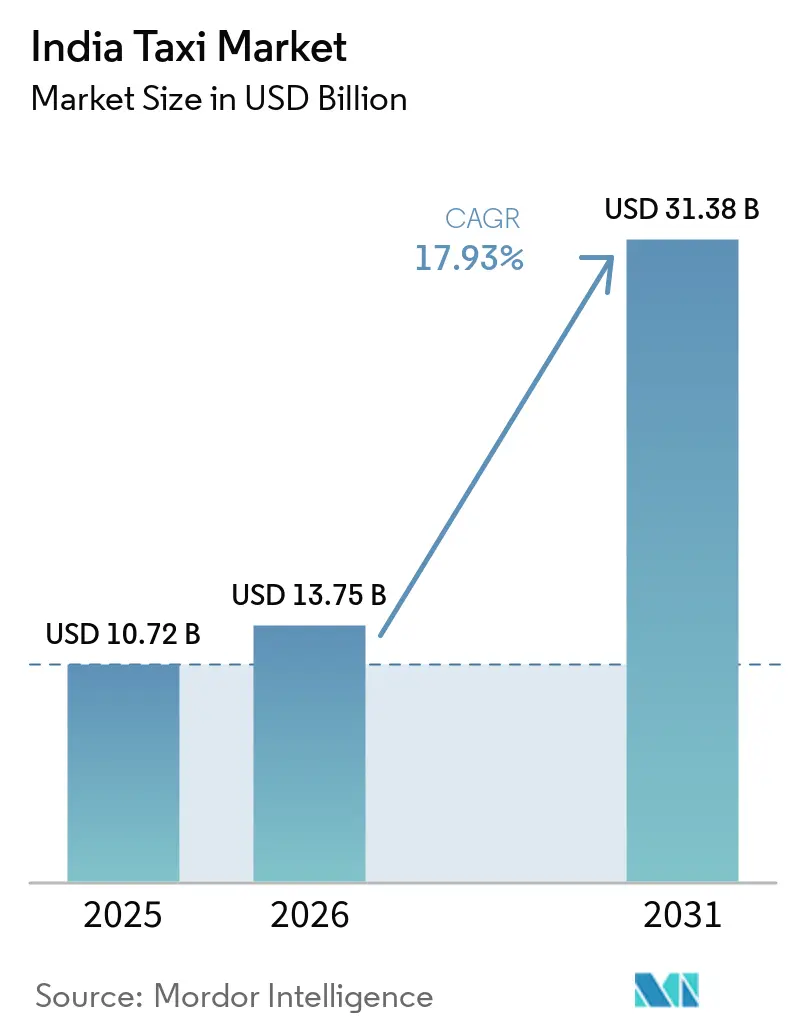
The India taxi market size is expected to increase from USD 13.75 billion in 2026 to USD 16.22 billion in 2027 and reach USD 36.27 billion by 2032, growing at a CAGR of 17.46% over 2027-2032.
Digital payment access broadens the practical reach of taxi booking and payment in India. Congested urban travel and airport journeys tied to departure times create different reasons to book taxi rides. These requirements make vehicle positioning and the organization of a booked journey commercially consequential. Electric taxis add a service choice, while financing conditions and state operating duties influence the economics of new capacity. Where adopted fare-retention rules narrow expansion funds, operators targeting airport and congested-city demand with electric taxis need financing that preserves operating-cost advantages, since costly credit can delay otherwise viable fleet additions.
Key Report Takeaways
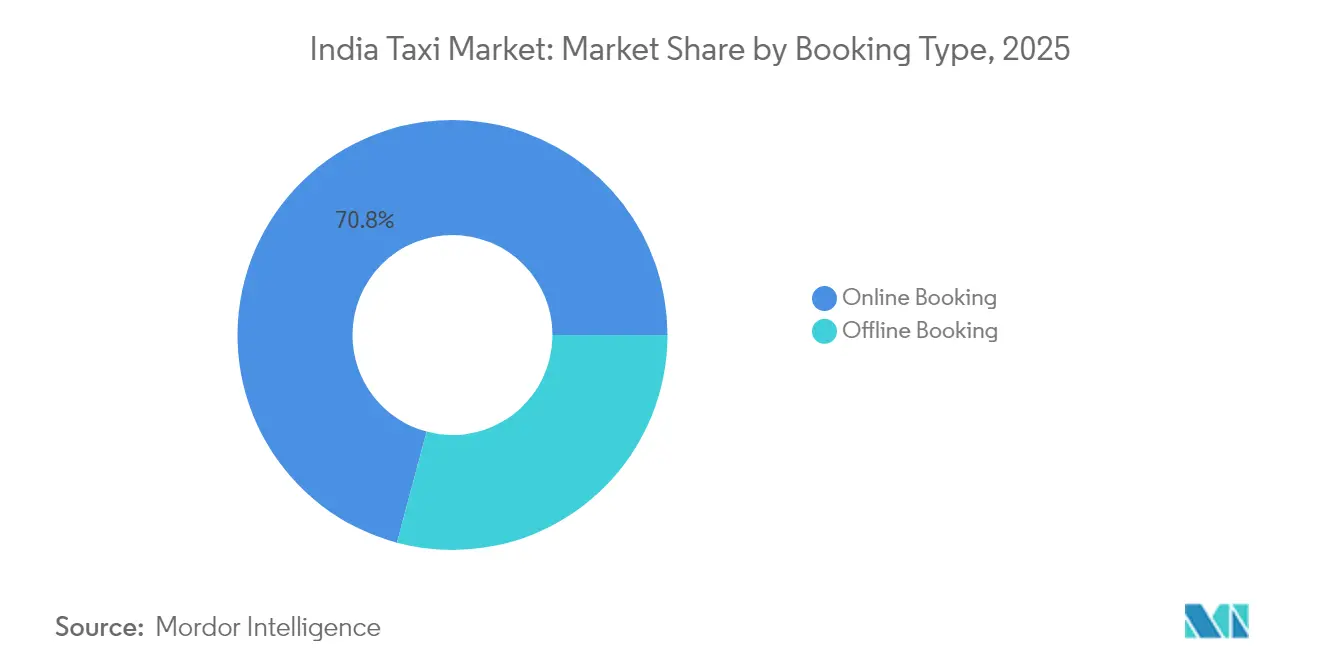
- Booking type favored online booking, which held a 70.92% India taxi market share in 2026 and is forecast to grow fastest at a CAGR of 17.65% during 2027-2032.
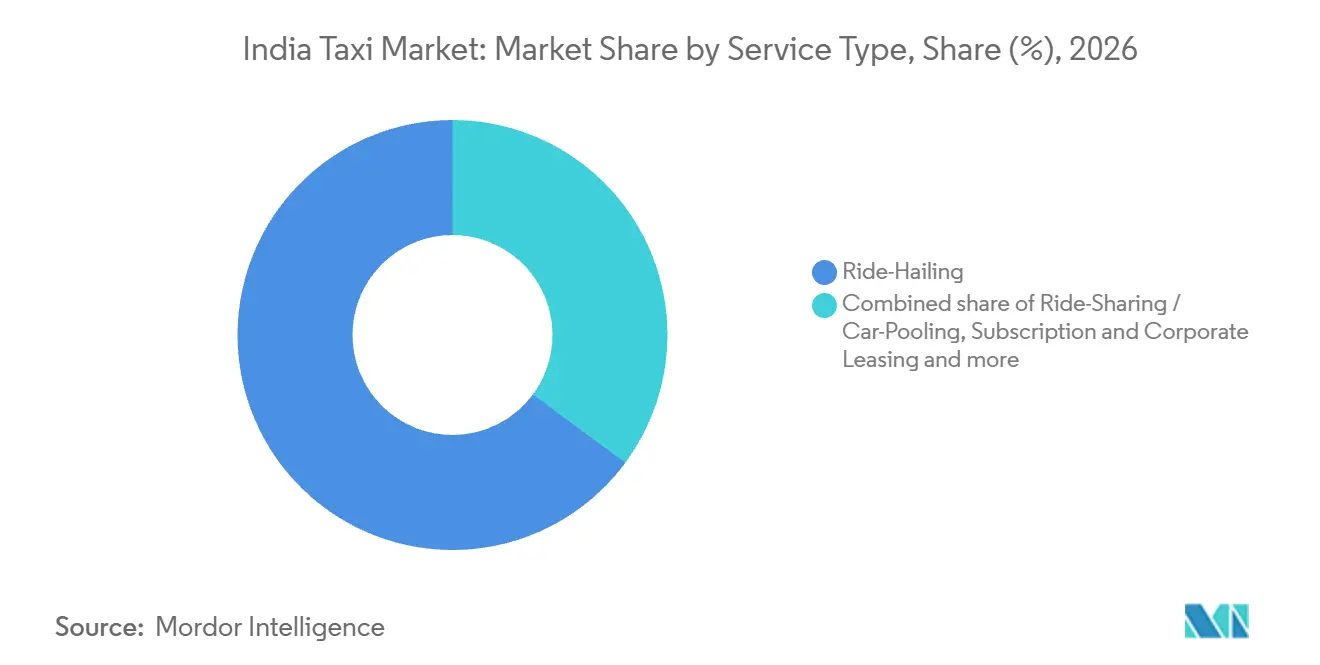
- Within service types, ride-hailing accounted for a 64.86% share of the India taxi market size in 2026, while ride-sharing and car-pooling are forecast to grow fastest at a CAGR of 19.25% over 2027-2032.
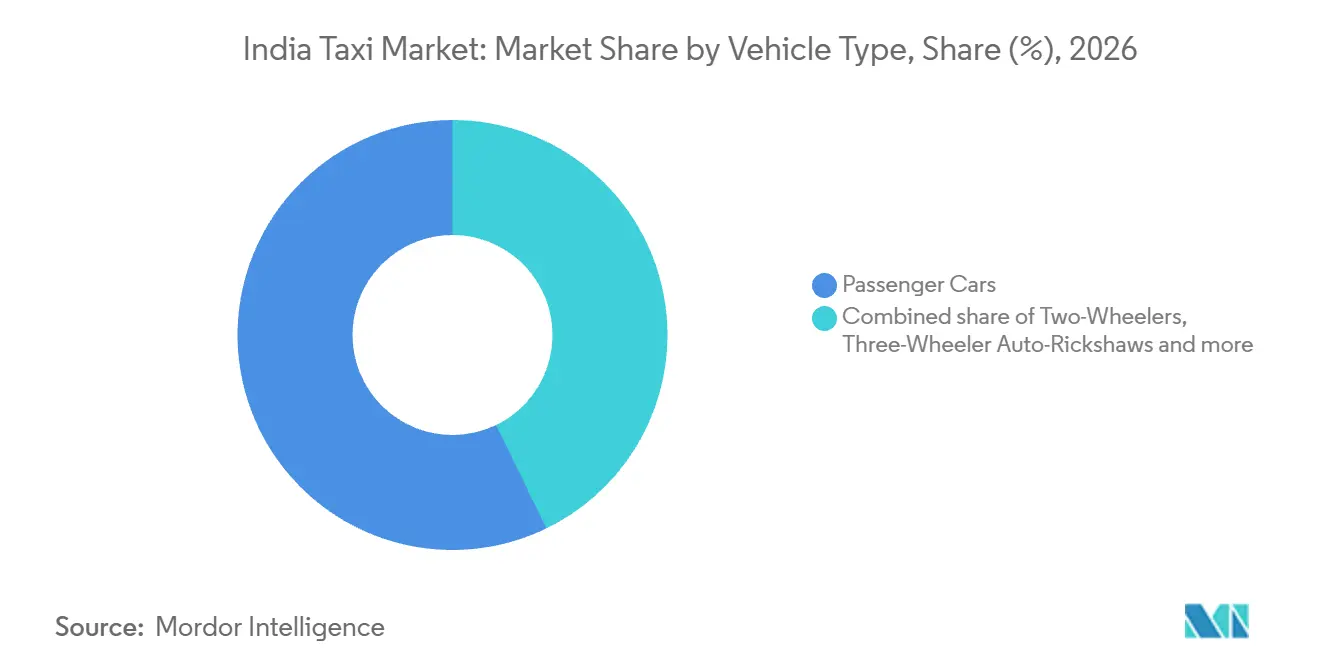
- By vehicle type, passenger cars led with 57.19% of taxi spending in 2026, and two-wheelers are forecast to grow fastest at a CAGR of 18% during 2027-2032.
- Propulsion type was led by ICE (petrol/diesel/CNG), at 83.54% of taxi spending in 2026, while electric taxis are forecast to grow fastest at a CAGR of 19% over 2027-2032.
- Across trip purposes, intra-city point-to-point held 60.65% of taxi spending in 2026, with airport transfers forecast to grow fastest at a CAGR of 18.7% during 2027-2032.
- Customer segmentation was led by individual consumers, with 75.8% of taxi spending in 2026, while corporate and institutional customers are forecast to grow fastest at a CAGR of 18.4% over 2027-2032.
Note: Market numbers in this report are based on Mordor Intelligence's proprietary estimation framework, which combines nine months of actuals with Q4 projections for base year 2026.
India Taxi Market Trends and Insights
Drivers Impact Analysis*
| Driver | (~) % Impact on CAGR Forecast | Geographic Relevance | Impact Timeline |
|---|---|---|---|
| Smartphone Penetration & UPI-Enabled Digital Payments | +6.2% | Nationwide | Short term (≤ 2 years) |
| Urban Congestion & Low Private Car Ownership | +5.4% | Bengaluru metropolitan and central-city areas | Medium term (2-4 years) |
| Government EV Push (PM E-DRIVE, State EV Policies) | +4% | Nationwide | Medium term (2-4 years) |
| Airport Traffic Boom Powering Pre-Scheduled Rides | +3.6% | Nationwide | Short term (≤ 2 years) |
| Cooperative/Tier-III Fleet Model Expansion | +2% | Delhi-NCR, Gujarat, Maharashtra, Rajasthan and Uttar Pradesh | Medium term (2-4 years) |
| AI-Based Mobility-As-A-Service (MaaS) Integrations | +0.9% | Asansol and Durgapur in West Bengal | Long term (≥ 4 years) |
| Source: Mordor Intelligence | |||
Smartphone Penetration & UPI-Enabled Digital Payments
Payment choice can widen the practical reach of app-booked taxis by connecting ride purchases with an established national payment network. Approximately 85.5% of households in India possessed at least one smartphone in January-March 2025, according to a survey covering India except some inaccessible villages in the Andaman and Nicobar Islands. NPCI reported 554.9 million users onboarded on UPI in India as of June 2026.[1] Economy-wide UPI transaction volumes rose 30% year over year in FY2025-26. Uber allows riders in India to add and use UPI as an account payment method. That household device base gives app-based operators a way to offer booking and payment through equipment many potential customers already possess.
Urban Congestion & Low Private Car Ownership
Heavy congestion makes relief from driving through demanding traffic part of the taxi proposition. TomTom measured a 74.4% average congestion level in Bengaluru in 2025, up 1.7 percentage points from 2024, across its metropolitan and central-city road network. For passengers choosing between driving and being driven, paying a fare transfers the driving task to a professional. That choice gives taxi operators a source of demand based on the passenger's use of travel time rather than a promise of a faster journey.
Government EV Push (PM E-DRIVE, State EV Policies)
Government electric vehicle (EV) incentives can expand taxi supply by reducing the entry cost for specifically eligible vehicle categories. PM E-DRIVE demand-incentive support for commercial electric three-wheelers classified as e-rickshaws and e-carts continues through March 2028. Within passenger transportation, the e-rickshaw provision supports the economics of adding qualifying electric vehicles. Telangana’s 2020-2030 EV policy provides a 100% road-tax and registration-fee exemption for the first 5,000 eligible electric 4-wheel commercial passenger vehicles. These include taxis and tourist cabs purchased and registered in the state. Because the exemption stops at the first 5,000 vehicles, earlier qualifying purchases can receive a benefit that later additions beyond the cap cannot.
Airport Traffic Boom Powering Pre-Scheduled Rides
Airport travel creates a taxi opportunity around matching a transport commitment with a passenger’s departure requirements. Indian airports handled 420 million passengers in 2025, up 4.8% from 2024, with December 2025 traffic provisional.[2] In June 2025, Uber reported that nearly a quarter of its airport drop-offs in India used Reserve, which allowed advance booking. Those drop-offs require operators to position a booked vehicle at the passenger's origin, rather than depend on a terminal pickup queue. For operators, the saleable distinction is a time-specific service commitment, with vehicle and driver availability organized around the departure requirement.
Restraints Impact Analysis*
| Restraint | (~) % Impact on CAGR Forecast | Geographic Relevance | Impact Timeline |
|---|---|---|---|
| Commission & Surge-Price Caps (Motor Vehicle Aggregator Guidelines 2025) | -1.6% | Nationwide | Short term (≤ 2 years) |
| High EV Upfront Costs & Financing Gaps | -1.5% | Nationwide | Medium term (2-4 years) |
| Rider-Safety Issues & Driver Attrition | -0.9% | Delhi-NCR passenger taxi service areas | Short term (≤ 2 years) |
| Regulatory Fragmentation Across Indian States | -0.6% | Rajasthan and Maharashtra operating jurisdictions | Medium term (2-4 years) |
| Source: Mordor Intelligence | |||
Commission & Surge-Price Caps (Motor Vehicle Aggregator Guidelines 2025)
Fare-retention limits constrain how much an aggregator can spend supporting each ride while preserving its own earnings. The Ministry of Road Transport and Highways’ July 2025 Motor Vehicle Aggregator Guidelines provide a framework that state governments may follow when issuing aggregator licenses. Under that framework, drivers onboarded with their own vehicles must receive at least 80% of the applicable fare.[3] The guidelines permit dynamic pricing up to 2 times the base fare and a minimum fare 50% below base. Where states adopt these terms, the retained fare must cover platform costs within a bounded pricing framework. That leaves less room to fund driver incentives or service expansion from each transaction.
High EV Upfront Costs & Financing Gaps
Electric taxi investment can be constrained by credit assessment even when the vehicle offers favorable operating economics. The Institute for Energy Economics and Financial Analysis (IEEFA), in its 2026 analysis, identified battery-degradation assessment, thin resale markets, and charging-related vehicle utilization as financing problems for Indian commercial EV borrowers. Its proposed financing-platform scope included taxi and ride-hailing fleets. These uncertainties make it harder to assess the vehicle as collateral and to match repayment obligations with its earning capacity. IEEFA found that expensive commercial borrowing could offset EVs’ total cost-of-ownership advantages. Where borrowing is costly, an electric service that is otherwise workable can still be delayed.
*Our forecasts treat driver/restraint impacts as directional, not additive. The impact forecasts reflect baseline growth, mix effects, and variable interactions.
Segment Analysis
By Booking Type: App Booking Extends Beyond Local Journeys
Online booking accounted for a 70.92% share of the India taxi market size in 2026 and is the fastest-growing segment, with a forecast CAGR of 17.65% over 2027-2032. Uber’s April-June 2026 Intercity index identified Delhi-Dehradun among its fastest-growing corridors. The index traced its fastest growth to regional routes linking Tier-2 cities and popular leisure destinations. That pattern gives online platforms a regional passenger base to address through their booking channel, alongside immediate local trips.
Online service delivery also depends on a physical vehicle presence where the passenger begins the trip. By June 16, 2026, Uber had deployed 30 cabs for airport operations at Noida International Airport. A booking channel at a new terminal is only as useful as the number of cabs stationed there.

By Service Type: Route Breadth Meets Shared-Travel Demand
Ride-hailing represented a 64.86% India taxi market share in 2026, making it the largest segment. In July 2025, Uber announced an expansion of its Intercity product to more than 3,000 city-to-city routes across India. The expansion represented a 50% increase in the product's city-to-city route footprint. The announced route expansion calls for vehicles available for whole journeys rather than short local matches.
Ride-sharing and car-pooling form the fastest-growing segment, with a forecast CAGR of 19.25% during 2027-2032. BlaBlaCar carried 19 million passengers in its India carpooling business in 2025. Its peak daily volumes exceeded 100,000 passengers during major cultural celebrations such as Diwali and Raksha Bandhan that year. Festival-specific ride availability becomes essential to serving those peaks, since broad annual platform reach alone does not supply seats for a concentrated departure window.
By Vehicle Type: Car Supply Anchors a Broader Vehicle Mix
Passenger cars were the largest segment, accounting for 57.19% of taxi spending in 2026. Vahan data recorded about 312,665 passenger-vehicle registrations for taxi services in India during calendar 2025. Hyundai Motor India launched its Prime Taxi sedan and hatchback range in December 2025, adapting existing models for cab service. Those body formats give the supplier more than one vehicle configuration within a taxi-focused range, widening the choices offered to car-service operators. Competition among car suppliers includes taxi-specific packaging as well as the volume of vehicles entering passenger service.
Two-wheelers are the fastest-growing segment, with a forecast CAGR of 18% over 2027-2032. In August 2026, Uber announced expansion into new Indian cities across 18 states and one Union Territory, with Uber Bike leading the rollout. The announced expansion offers a direct geographic route for bringing two-wheeler taxi services to additional potential passengers. For a new service area, the operating challenge is to assemble enough usable local driver coverage for the booking option to become practical.
By Propulsion Type: Established Fueling Supports ICE While Electric Services Enter
ICE (petrol/diesel/CNG) vehicles, powered by internal combustion engines, were the largest segment, with 83.54% of taxi spending in 2026. Wise Travel India’s FY2024-25 annual report attributed ICE taxi dominance to vehicle availability, affordability, established fueling, quick refueling, and mature maintenance and resale systems. Those operating advantages connect vehicle choice with the systems that support a taxi throughout its working life. For a taxi provider, refueling and maintenance arrangements affect how a vehicle can return to passenger service after use or repair. For a small-scale fleet owner, quick refueling and a mature resale and maintenance ecosystem reduce the risk of tying up capital in a taxi.
Electric taxis form the fastest-growing segment, with a forecast CAGR of 19% during 2027-2032. Green SM launched its fully electric Green SM Limo taxi service in New Delhi on June 5, 2026, marking the operator’s entry into India. The launch packaged electric propulsion as a finished ride. Riders could use an electric vehicle while the operator handled fleet deployment and vehicle costs.
By Trip Purpose: Urban Trip Activity Supports Distinct Airport Channels
Intra-city point-to-point was the largest segment, with 60.65% of taxi spending in 2026. By June 2025, Namma Yatri had completed nearly 85 million cumulative trips in Bengaluru. Uber's 2025 annual data report also listed Bengaluru among the five Indian cities with the highest number of Uber rides. For Bengaluru fleet operators, access to these booking channels can connect vehicle supply to established pools of passenger demand.
Airport transfers are the fastest-growing segment, with a forecast CAGR of 18.7% over 2027-2032. On June 18, 2026, IndiGo launched Cabs with IndiGo for journeys to and from airports across Indian cities, with bookings available immediately through its digital channels. IndiGo provided the booking channel for airport cab rides at launch.
By Customer Segment: Individual Reach Meets Institutional Service Commitments
Individual consumers were the largest segment, accounting for 75.8% of taxi spending in 2026. In YouGov’s June 2025 online survey of 1,012 Indian adults aged 18 or older, 61% reported platform cab bookings in the prior 12 months. Within that sample, 82% of baby boomers reported cab use and 14% reported bike use, while 51% of millennials reported bike use over the same period. Those differences make the vehicle mix relevant to how a consumer-facing operator addresses its buyer base. A bike-only proposition would miss the cab use evident among older respondents, even while addressing the reported millennial bike use.
Corporate and institutional customers form the fastest-growing segment, with a forecast CAGR of 18.4% during 2027-2032. In its H2 FY2026 presentation, Wise Travel India described an enterprise mobility platform serving India and separately reported 800+ clients company-wide. Wise Travel India presented its corporate mobility offer as integrated solutions delivered through a technology-enabled, asset-light model. That approach places enterprise-account coordination within the transportation service sold to organizational buyers.
Geography Analysis
Delhi and the Mumbai-Pune route illustrate the role of intercity links in northern and western taxi activity. Uber’s April-June 2026 Intercity data identified Delhi-Agra and Mumbai-Pune among its most popular routes. Uber also ranked both among its five most popular Intercity routes over the 12 months before July 31, 2025, giving their popularity a basis across 2 reported periods. A provider serving Delhi's Agra connection or Maharashtra's Mumbai-Pune route needs coverage at both ends, which differs from purely local dispatch.
Southern intercity services add a regional dimension to taxi operations based around Bengaluru and Chennai. Uber’s April-June 2026 trip data identified Bengaluru-Mysuru and Chennai-Puducherry among its fastest-growing Intercity corridors. In July 2025, Uber said on-demand or reserve-only Uber Pet rides were live in Bengaluru, Delhi, and Mumbai. A Bengaluru operator can pursue regional destinations or accommodate pet-owning riders within the city, which calls for separate route and product decisions.
Kolkata provides an eastern example of linking a recognizable local taxi service with app-based access. In April 2025, 30 new dual-fuel yellow cabs joined the city's streets, bringing the reported new-age yellow cab total to 80, all accessible through the Yatri Sathi app. Heritage Mobility managed the fleet, while Premier Car World led the initiative with Maruti Suzuki. This combination made the additional vehicles reachable through a local booking channel.
Regulatory Framework and Outlook
This comparison of selected jurisdictions assesses policy from the perspective of a taxi aggregator expanding a mixed-propulsion passenger fleet. National guidance and local operating schemes affect different parts of that expansion decision. India’s July 2025 guidelines allow states to adopt the model framework and include additional provisions. The operator must therefore consider both the common policy architecture and the licensing and fleet conditions of the place where service will be supplied.
Regulatory Table
| Decision factor | India | Delhi |
|---|---|---|
| Primary authority | Ministry of Road Transport and Highways | Transport Department, Government of NCT of Delhi |
| Key instruments or direction | Motor Vehicle Aggregator Guidelines 2025, with state adoption and additional state provisions | Delhi Motor Vehicle Aggregator and Delivery Service Provider Scheme, 2023, covering entities with at least 25 associated vehicles |
| Commercial effect | State-led adoption leaves local operating conditions commercially relevant | Covered new aggregators need a license before operations; phased EV additions lead to an all-electric fleet by April 1, 2030 |
| Current policy attractiveness | Medium | Low |
| Future direction of policy attractiveness | No change | Hardening |
| Source: Mordor Intelligence | ||
National policy is Medium because common model principles coexist with the ability of states to add operating conditions. The No change direction reflects continuity in that state-led adoption structure, leaving market access dependent on local implementation. Delhi’s Low rating reflects licensing before entry for covered new aggregators and the phased electric-fleet obligations facing an operator expanding with mixed propulsion. The scheduled April 1, 2030 all-electric deadline supports Hardening, and Delhi's June 2026 EV policy kept that obligation in force under the 2023 aggregator scheme.
Value Chain Stages
The value chain compares vehicle supply, booking access, and passenger-service execution through their earnings mechanisms and operating dependencies. Uber’s India platform connects driver-owners and drivers working for non-driving fleet partners who own vehicles and manage drivers. Vehicle ownership and the platform relationship can therefore sit with different participants in the same passenger-service arrangement. This division makes the allocation of capital, booking responsibility, and transport delivery relevant to who earns at each stage.
Value Chain Analysis Table
| Primary activity | Key participants | Value capture | Bottleneck | Resilience response |
|---|---|---|---|---|
| Taxi vehicle supply | Vehicle manufacturers such as Maruti Suzuki India Limited | Vehicle sales | Vehicle capital committed before passenger fares are earned | Phase vehicle additions against service-readiness milestones |
| Booking and driver matching | Platform providers such as Uber India Systems Private Limited | Fixed or variable periodic fees that Uber may charge at its discretion if Drive Pass is unavailable | Dependence on local pickup-area driver availability | Build driver coverage around required pickup areas |
| Passenger transport and account delivery | Corporate passenger-transport providers such as Carzonrent India Pvt Ltd | Passenger transportation charges through corporate billing | Coordinating overlapping service commitments | Centralize dispatch and retain backup transport capacity |
| Source: Mordor Intelligence | ||||
Carzonrent’s corporate pricing and centralized billing connect passenger transportation with an organizational account. Under Uber's India terms, drivers or fleet partners purchase Drive Pass, a paid platform-access subscription subject to pass terms and app-specified duration and validity. If the pass is unavailable to the driver or in the driver's territory, Uber may charge fixed or variable periodic service fees at its discretion. Separating access charges from transport billing allows fleet providers and booking platforms to develop distinct commercial models, with the allocation of vehicle and driver responsibilities determining which participant must keep the passenger journey deliverable.
Competitive Landscape
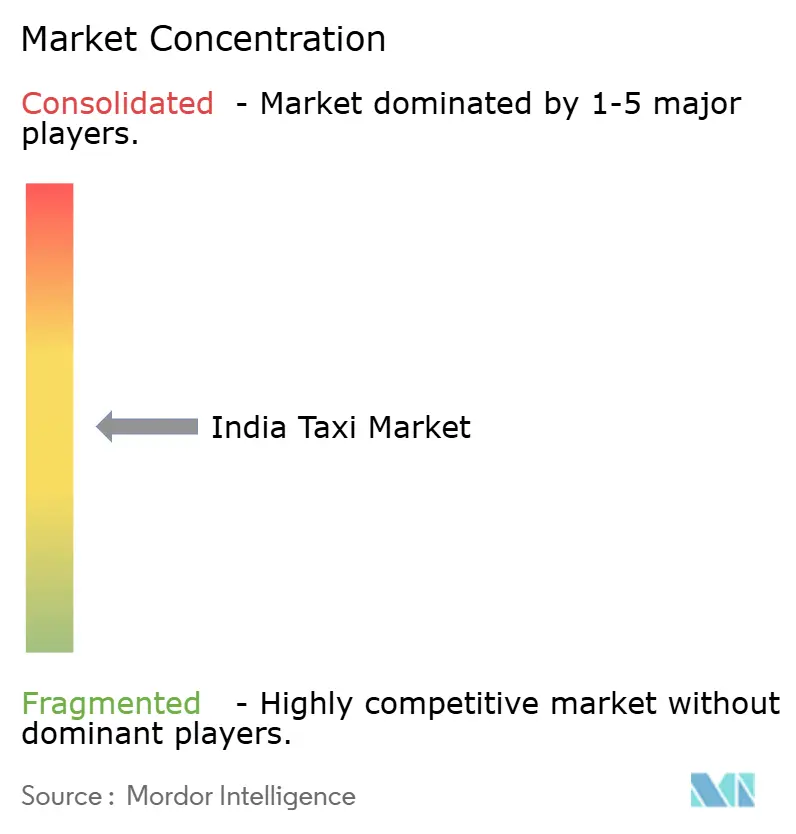
Competition combines app-based distribution with specialized corporate, airport, and outstation operators, producing an overlapping supplier structure. Uber Technologies Inc. competes through ride-hailing and agreed with Noida International Airport in May 2025 to operate dedicated pickup zones, with exclusive parking spaces for Uber driver-partners. ANI Technologies Pvt Ltd (Ola Cabs) operates the Ola Consumer ride-hailing business and offers city, hourly, and outstation rides. MLL Mobility Pvt Ltd (formerly Meru Mobility Tech Private Limited), a Mahindra Logistics subsidiary, supplies consumer and corporate transportation, while Carzonrent India Pvt Ltd supplies corporate, airport, and chauffeur-driven services. Savaari Car Rentals adds chauffeur-driven local, airport, and outstation coverage, giving buyers alternatives organized around different service requirements.
Driver charging models provide a separate dimension of competition because they determine how a platform earns from the suppliers participating in its network. According to people familiar with the matter, Ola Consumer rolled out a pan-India zero-commission framework in FY26, replacing per-ride commissions with fixed daily or monthly driver subscriptions. The change separates the platform charge from an individual fare, allowing driver participation to be priced through continued access rather than a deduction on each trip. Corporate and outstation specialists can differentiate through the passenger service and its contract terms, while platform rivals reshape the charges associated with driver access.
State licensing creates a competitive distinction between established platforms and challengers seeking authorization in the same operating area. By August 6, 2026, Maharashtra had granted aggregator licenses to Bharat Taxi and Deodatta Taxi. On September 3, 2026, the state's transport minister said Ola, Uber, and Rapido had not secured licenses. At that point, the department had not decided whether those platforms could continue operating after a planned September 4 meeting. The reported gap placed state authorization alongside platform reach as a condition of competitive access for the named incumbents and their licensed challengers.
India Taxi Industry Leaders
-
Uber Technologies Inc.
-
ANI Technologies Pvt Ltd (Ola Cabs)
-
MLL Mobility Pvt Ltd
-
Carzonrent India Pvt Ltd
-
Savaari Car Rentals
- *Disclaimer: Major Players sorted in no particular order
Key Opportunities for Market Participants
The opportunities below compare passenger services that could be developed as cooperative taxi coverage extends to additional locations. In August 2026, the Ministry of Cooperation described Bharat Taxi’s phased expansion as dependent on operational readiness, driver availability, statutory requirements, approvals, and state coordination. As of August 4, 2026, Bharat Taxi had registered 848,000 driver-partners across India. Converting that registration base into local, cross-city, or scheduled services depends on usable pickup-area staffing and the required approvals.
Market Opportunities Table
| Opportunity | Why now | Buyer / lead segment | Recommended play | Main barrier | Likely beneficiaries |
|---|---|---|---|---|---|
| Local taxi service in additional rollout cities | Phased expansion creates a route to additional local service areas | Individual consumers needing intra-city trips | Open a manageable pickup area after securing approvals and usable driver coverage | Driver availability and operational preparedness | Sahakar Taxi Cooperative Ltd. and participating drivers |
| Cooperative cross-city passenger connections | State coordination forms part of expansion planning | Outstation and intercity passengers | Connect neighboring authorized service areas with bookable passenger trips | Statutory requirements and coordination across service areas | Sahakar Taxi Cooperative Ltd. and participating vehicle operators |
| Scheduled taxi service for organizational buyers | Location-specific rollout allows service design around available operating capacity | Corporate and institutional customers buying passenger transportation | Offer scheduled chauffeur-driven trips after allocating capacity to honor pickup commitments | Operational capacity to deliver committed service times | Sahakar Taxi Cooperative Ltd. and participating drivers |
| Source: Mordor Intelligence | |||||
The cooperative model’s next source of passenger revenue depends on matching permitted service areas with drivers ready to accept trips. A new location creates little fare income until vehicles can be dispatched there, making an operable pickup area the practical commercial unit. Connecting neighboring usable service areas can extend passenger choice without requiring a simultaneous nationwide rollout.
Recent Industry Developments
- Sep 2026: Maharashtra's transport minister said on September 3 that Ola, Uber, and Rapido had not secured state aggregator licenses.
- Aug 2026: Uber announced an expansion into new Indian cities across 18 states and one Union Territory, with Uber Bike leading the rollout.
- Jun 2026: IndiGo launched Cabs with IndiGo on June 18, a booking service for pre-scheduled airport cab rides across India, powered by Mojoboxx.
Research Methodology Framework and Report Scope
Market Definition and Coverage
The India taxi market measures annual customer spending on passenger taxi transportation in India, including point-to-point rides and passenger mobility supplied through taxi subscriptions or corporate contracts. These services are classified by booking mode, service arrangement, vehicle type and propulsion, trip purpose, and whether the customer is an individual or an organization.
Scope exclusions: Vehicle-only rental or leasing, passenger vehicle sales and vehicle financing, bus, metro, and rail passenger fares, and goods delivery and courier services are excluded.
Segmentation Overview
- By Booking Type
- Online Booking
- Offline Booking
- By Service Type
- Ride-Hailing
- Ride-Sharing / Car-Pooling
- Subscription & Corporate Leasing
- By Vehicle Type
- Passenger Cars
- Two-Wheelers
- Three-Wheeler Auto-Rickshaws
- Vans & MPVs
- By Propulsion Type
- ICE (Petrol/Diesel/CNG)
- Electric
- Hybrid
- By Trip Purpose
- Intra-City Point-to-Point
- Airport Transfers
- Outstation / Inter-city
- Corporate Mobility
- By Customer Segment
- Individual Consumers
- Corporate / Institutional
Data Sources, Market Sizing, and Validation
Desk Research
Public research can draw on such sources as the World Bank's urban population series and the Ministry of Finance's Economic Survey for India's urbanization and mobility context. The Vahan Public Dashboard provides registration and permit views, while the Ministry of Civil Aviation's Annual Report provides airport passenger traffic for assessing transfer demand.
Public company filings, investor presentations, government notices, and reputable Indian business press can supplement operating evidence on fleet availability, fares, service launches, and corporate mobility. These named sources are not exhaustive, and further sources inform collection, validation and clarification.
Primary Interviews and Surveys
Suitable India-based respondents include ride-platform and taxi-fleet executives, dispatch and fleet-operations leaders, driver-supply managers, corporate travel buyers, and transport-policy specialists. Interviews and structured surveys can test secondary estimates of trip frequency, realized fares, booking mix, vehicle utilization, and service boundaries, with conflicting responses reconciled to source records. Where evidence remains sparse, analysts document the gap and triangulate activity and fare indicators before revising an input.
Distribution of primary research fieldwork respondents
| Company type | Respondent position | Region |
|---|---|---|
| Top tier: 35% | CXOs: 20% | |
| Mid tier: 45% | Functional/Unit leaders: 35% | |
| Smaller Players: 20% | Managers: 45% |
Market-Sizing & Forecasting
A top-down demand model estimates annual customer fares and contracted taxi-service charges across India, then allocates the total across booking, service, vehicle, propulsion, trip-purpose, and customer dimensions using observed service activity and mix. Urban population growth indicates the potential passenger base, airport passenger counts inform transfer demand, Vahan commercial registrations and permits provide a supply signal, and published paid-trip activity, average fares, and digital-channel use through online booking and digital payments help estimate annual spending and its movement between channels. Segment shares are built from these activity and spending indicators, with operator, fleet, and corporate-buyer evidence used to test whether the categories describe distinct taxi services.
Scenario analysis carries forward passenger activity, average fare, and service mix under different paths for app adoption, airport demand, operating rules, and electric fleet availability. Analysts can test trip, fare, booking, and fleet assumptions with India-based platform, fleet, driver-supply, and corporate travel respondents, then reconcile disagreement against source series before changing an assumption. Selective bottom-up checks multiply sampled paid trips by an observed fare or roll up available operator and channel activity against the national total. Where trip or fare records are incomplete, analysts bound the partial series with independent activity signals before using it as a national cross-check.
Data Validation & Update Cycle
Analysts triangulate market totals and segment shares against independent signals such as airport traffic, vehicle registrations, urban growth, company disclosures, and fare or trip evidence. They investigate outliers and material variance between source series, check units and time periods, and review assumptions through source verification, analyst reconciliation, and senior review before sign-off. Only after that review confirms a source's period, unit, and service definition does a changed observation enter the forecast. A changed fare rule, material service launch, fleet disruption, or regulatory change triggers targeted re-contact of relevant India-based respondents and a focused model refresh. The full series is refreshed annually, updated between cycles for material events, and checked again in a fresh pre-delivery review.
Mordor Intelligence's India Taxi Market Size Measured Against Other Published Estimates
Published estimates can differ in the transactions and products they count and the inputs used to model demand. These services are classified by booking mode, service arrangement, vehicle type and propulsion, trip purpose, and whether the customer is an individual or an organization.
Key Gap Drivers include the study's defined coverage and market-specific modeling choices. Segment shares are built from these activity and spending indicators, with operator, fleet, and corporate-buyer evidence used to test whether the categories describe distinct taxi services.
Benchmark comparison
| Source | Market Size | Gaps in Research Methodology |
|---|---|---|
| Mordor Intelligence | USD 16.22 B (2027) | |
| Industry Research Publisher A | USD 21.4 B (2025) | At its 2025 base, this estimate is 31.9% above this report's 2027 value of USD 16.22 B, 2 years later. Its published paid-trip volume and average realized fare provide an operational cross-check on the passenger-spending estimate. |
| Industry Research Publisher B | USD 14.8 B (2026) | At its 2026 base, this estimate is 8.8% below this report's 2027 value of USD 16.22 B, 1 year later. The estimate is for an earlier year, and its forecast describes a rising market trajectory. |
Mordor Intelligence's analysts triangulate market totals and segment shares against independent signals such as airport traffic, vehicle registrations, urban growth, company disclosures, and fare or trip evidence.
Key Questions Answered in the Report
What is the India taxi market size and growth outlook?
The size is forecast at USD 16.22 billion in 2027 and USD 36.27 billion by 2032, with a CAGR of 17.46% during 2027-2032.
What supports demand for taxi rides in India?
Smartphone access and UPI payments support app-based taxi booking, alongside airport travel. UPI had 554.9 million onboarded users in India as of June 2026.
Which booking channel leads taxi spending in India?
Online booking held 70.92% of taxi spending in 2026 and is forecast to grow at a CAGR of 17.65% over 2027-2032.
Which companies compete in Indian taxi transportation?
Major participants include Uber Technologies Inc., ANI Technologies Pvt Ltd (Ola Cabs), MLL Mobility Pvt Ltd, Carzonrent India Pvt Ltd, and Savaari Car Rentals.
What financing risks face electric taxi fleets in India?
IEEFA’s 2026 analysis identified battery assessment, thin resale markets, and vehicle utilization as commercial EV financing challenges. Costly credit can offset operating advantages.
Which intercity corridors stand out for taxi services in India?
In Uber's April-June 2026 data, Mumbai-Pune and Delhi-Agra were among its most popular Intercity routes. Bengaluru-Mysuru and Chennai-Puducherry were among its fastest-growing corridors in that period.