
India Precipitated Silica Market Size and Share
Market Overview
| Study Period | 2020 - 2031 |
|---|---|
| Forecast Data Period | 2026 - 2031 |
| Base Year Market Size (2025) | 162.35 kilotons |
| Market Volume (2026) | 168.89 kilotons |
| Market Volume (2031) | 205.69 kilotons |
| Growth Rate (2026 - 2031) | 4.03 % |
| Market Concentration | High |
Major Players *Disclaimer: Major Players sorted in no particular order Image © Mordor Intelligence. Reuse requires attribution under CC BY 4.0. | |
India Precipitated Silica Market Analysis by Mordor Intelligence
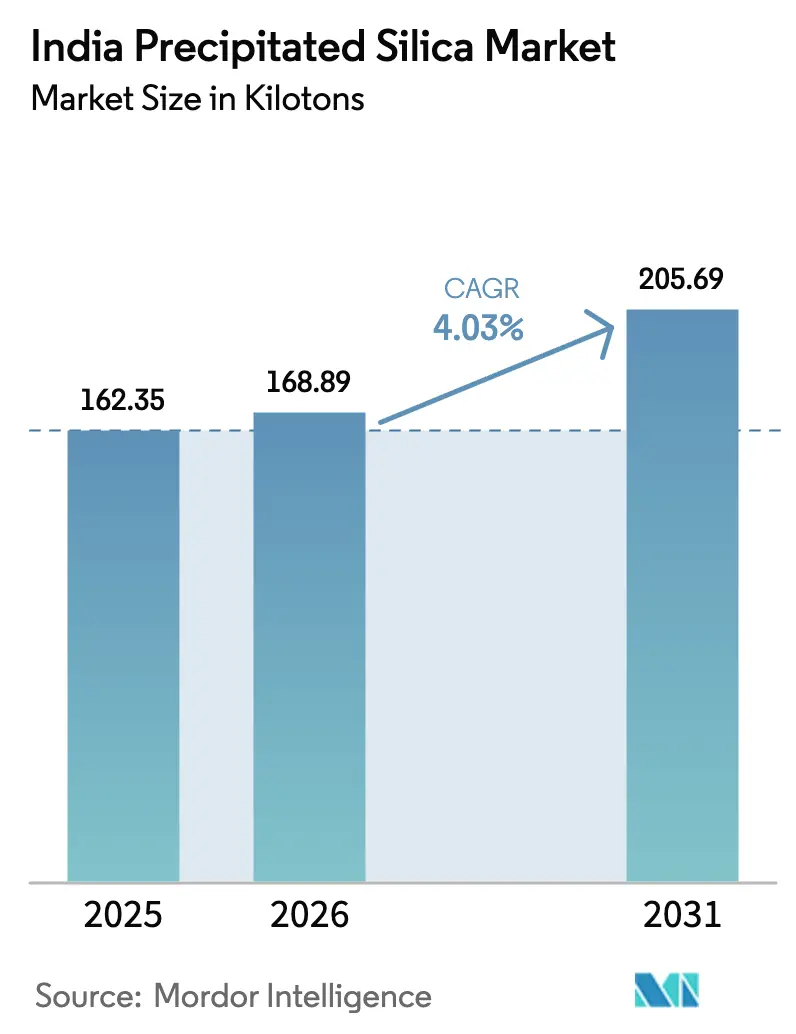
The India Precipitated Silica Market size was valued at 162.35 kilotons in 2025 and estimated to grow from 168.89 kilotons in 2026 to reach 205.69 kilotons by 2031, at a CAGR of 4.03% during the forecast period (2026-2031). Momentum stems from the automotive sector’s shift toward fuel-efficient tires, the premiumization of fast-moving consumer goods, and policy support for localized solar-glass and agrochemical manufacturing. Tire makers continue to optimize rolling resistance and durability, lifting silica loading per unit and underpinning steady offtake. Consumer trends toward low-VOC toothpastes and cosmetics accelerate demand for specialty grades that command higher margins. On the supply side, capacity additions by domestic chemical majors and soda-ash expansions in Gujarat improve raw-material availability, although environmental compliance costs and Chinese imports weigh on margins. These forces collectively propel the India precipitated silica market toward higher-value, application-specific products rather than pure tonnage growth, signaling a transition phase in industry maturity.
Key Report Takeaways
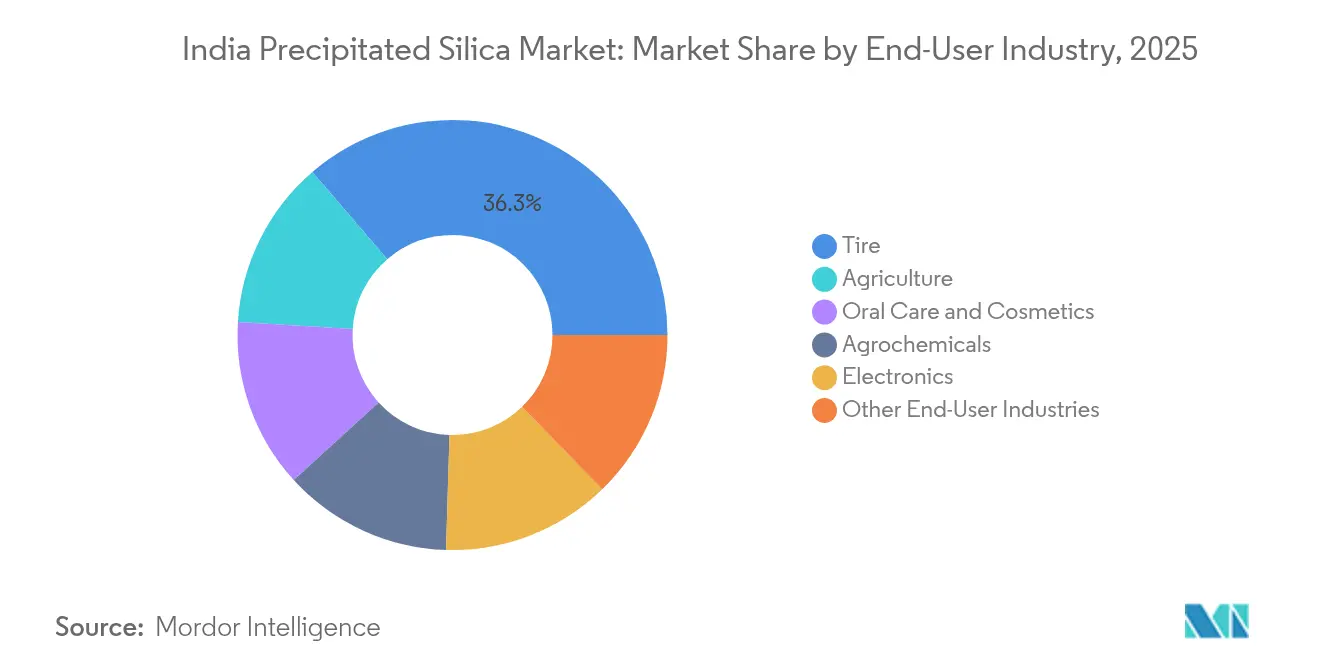
- By end-user industry, tires held 36.30% of the India precipitated silica market share in 2025, while oral care and cosmetics are projected to expand at a 5.12% CAGR through 2031.
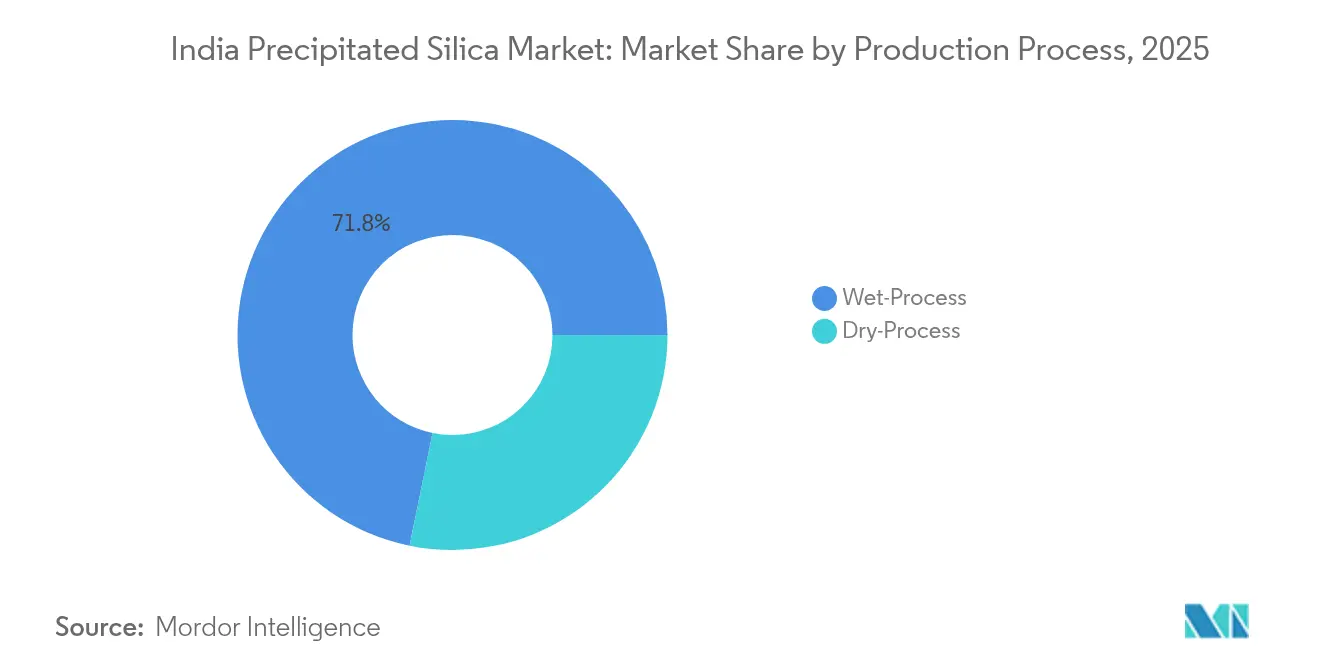
- By production process, the wet method held a 71.80% share in 2025; the dry method is expected to advance at a 4.19% CAGR between 2026 and 2031.
- By product form, powder accounted for 48.60% revenue share in 2025, whereas micro-pearls are forecast to grow at a 4.87% CAGR through 2031.
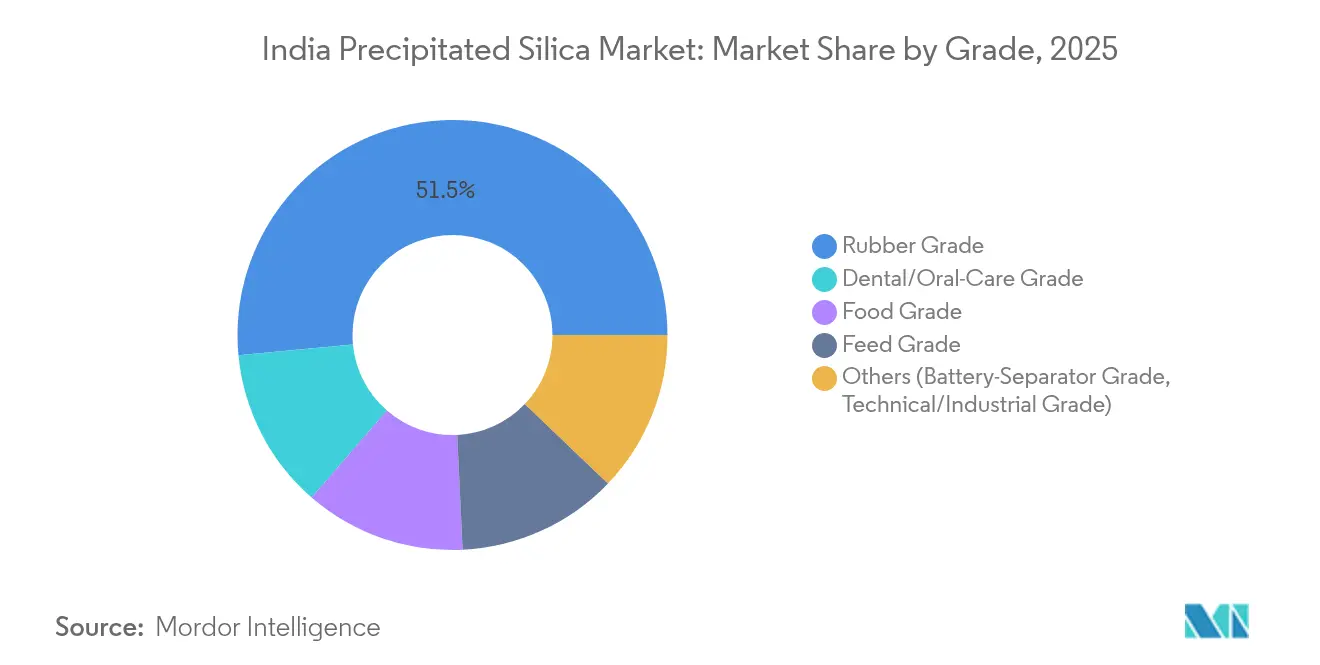
- By grade, rubber grade commanded 51.50% of the India precipitated silica market size in 2025; food grade is expected to register the fastest growth at 5.07% CAGR to 2031.
Note: Market size and forecast figures in this report are generated using Mordor Intelligence’s proprietary estimation framework, updated with the latest available data and insights as of 2026.
Worldwide, activity is shaped by contributions from multiple countries and regions, with India representing one among them. The global report on precipitated silica market by Mordor Intelligence reflects how these countries and regional layers combine into a single system.
India Precipitated Silica Market Trends and Insights
Drivers Impact Analysis*
| Driver | (~) % Impact on CAGR Forecast | Geographic Relevance | Impact Timeline |
|---|---|---|---|
| Tire-grade silica demand from domestic OEM-focused rubber industry | +1.20% | West & South India with spillover to North India | Medium term (2-4 years) |
| Rapid shift toward low-VOC toothpastes by FMCG majors | +0.80% | National, early gains in urban markets | Short term (≤2 years) |
| Government push for solar PV glass fabs | +0.60% | Gujarat, Tamil Nadu expanding nationwide | Long term (≥4 years) |
| Mandatory BIS compliance for agrochemical wettable powders | +0.40% | National, agrochemical hubs | Medium term (2-4 years) |
| Start-up-led silica-based battery anode R&D | +0.20% | Karnataka, Telangana, potential national spread | Long term (≥4 years) |
| Source: Mordor Intelligence | |||
Tyre-Grade Silica Demand from Domestic OEM-Focused Rubber Industry
Domestic tire manufacturers now integrate higher silica loadings to meet stringent fuel-efficiency and emission norms, positioning precipitated silica as a performance-critical additive rather than a commodity input. CEAT’s ramp-up from 105 tons per day to 160 tons per day in its off-highway tire unit, along with its 25% export revenue target, illustrates how scale and global diversification underpin demand resilience. Import restrictions that reclassified several tire categories from “Free” to “Restricted” in 2020 cut foreign inflows by more than 80%, effectively channeling silica demand to domestic supply chains. Growing SUV sales and the radialization wave translate into larger tire dimensions and greater silica dosage, further anchoring consumption. The India precipitated silica market benefits directly as high-performance mixes offer pricing latitude that preserves manufacturer margins amid feedstock volatility. These interlinked automotive trends provide a multi-year volume corridor sustaining a progressive upswing in specialty rubber grades.
Rapid Shift Toward Low-VOC Toothpastes by FMCG Majors
FMCG players are reformulating oral-care lines to eliminate volatile organic solvents, incentivizing the use of precipitated silica as both an abrasive and rheology modifier. Colgate Palmolive India aims to triple premium-segment revenues, where margins are 5-8 percentage points higher, and mandates silica grades that deliver enhanced whitening and mouth-feel properties. Rural hygiene penetration remains low, with only 20% of urban consumers brushing their teeth twice daily, indicating untapped volume upside as awareness increases. BIS standard IS 6356:2001 formally lists precipitated silica among accepted polishing agents, providing regulatory certainty for formulators. Combining premiumization and compliance unlocks a new value pool for the India precipitated silica market, even before considering spillovers into cosmetics and personal-care categories.
Government Push for Solar PV Glass Fabs (Greenfield)
The Production Linked Incentive scheme, earmarking INR 4,500 crore for solar module manufacturing, enforces domestic value-addition thresholds that cascade upstream to specialty silica used in solar glass[1]. Planned additions of 10 GW integrated capacity call for local sourcing of high-purity silica to optimize melt coefficients and transmission rates. GHCL’s clearance for a 500,000-ton soda-ash expansion in Kutch underscores the strategic coupling of alkali chemicals and renewable infrastructure. A 10% import duty on solar glass and content requirements across subsidy programs shield emerging fabs from price erosion, bolstering predictable silica uptake. Although this driver manifests over a longer horizon, its scale could reshape regional demand clusters, cementing India's precipitated silica market as a pivotal materials contributor to the energy transition.
Mandatory BIS Compliance for Agrochemical Wettable Powders
BIS mandates on pesticide formulations are accelerating reformulation activity among agrochemical makers, who rely on precipitated silica for flow control, dispersion stability, and anti-caking performance. India Chemicals Management and Safety Rules require registration for substances above 1 tonne annually, formalizing demand for consistent-quality silica grades. Water-dispersible granules developed by IPFT emphasize solvent-free systems, aligning with silica’s functional advantages in particle-size optimization. Anti-dumping duties on sodium cyanide imports further localize chemical supply chains, indirectly fortifying domestic silica demand. Compliance drivers thus create a defensible, regulation-anchored growth pocket that buffers the India precipitated silica market from automotive cyclicality.
Restraints Impact Analysis*
| Restraint | (~) % Impact on CAGR Forecast | Geographic Relevance | Impact Timeline |
|---|---|---|---|
| Tightening effluent norms on sodium silicate effluents | -0.70% | Nationwide, stricter in industrial clusters | Short term (≤2 years) |
| Volatility in soda-ash prices | -0.50% | National footprint | Short term (≤2 years) |
| Import penetration of low-cost Chinese grades | -0.30% | National, acute in price-sensitive applications | Medium term (2-4 years) |
| Source: Mordor Intelligence | |||
Tightening Effluent Norms on Sodium Silicate Effluents
Regulatory scrutiny over liquid discharges is escalating capital requirements for wet-process units, which account for more than 70% of domestic capacity. Draft CPCB guidelines mandate zero-liquid-discharge systems, dust suppression, and water recycling across the silica value chain, inflating compliance costs. The May 2024 fire at Aksharchem’s Gujarat plant illustrates operational vulnerabilities faced during modernization. Smaller players lacking financial muscle may exit or delay upgrades, consolidating volume among large, compliant manufacturers. The India precipitated silica market, therefore, navigates a near-term supply tightening that offsets part of the demand gains while reinforcing competitive barriers.
Import Penetration of Low-Cost Chinese Grades
Despite elevated freight costs, Chinese suppliers still undercut domestic prices in powder and standard rubber grades. Local buyers in price-sensitive agrochemical or footwear sectors occasionally favor imports, pressuring domestic realizations. While import curb measures on tires absorbed some silica inflow, similar protections do not uniformly apply to filler chemicals, keeping a structural cost arbitrage open. Sustained R&D and customer partnerships are necessary for domestic players to defend shares in the India precipitated silica market until broad-based cost parity or additional trade measures materialize.
*Our forecasts treat driver/restraint impacts as directional, not additive. The impact forecasts reflect baseline growth, mix effects, and variable interactions.
Segment Analysis
By End-user Industry: Tire Dominance Drives Market Evolution
The tire segment captured 36.30% of the India precipitated silica market share in 2025, reflecting the automotive sector’s entrenched role in filler demand. Volume visibility remains high as OEMs integrate silica-reinforced compounds to hit rolling-resistance targets and emission standards. Concurrently, oral care and cosmetics, while having a smaller base, are forecast to post a 5.12% CAGR through 2031, evidencing diversification and premiumization in fast-moving consumer goods.
Tire-makers are regionalizing production; CEAT’s export-oriented capacity expansion and Apollo’s plans for greenfield off-the-road units highlight the global positioning of domestic brands. Meanwhile, agrochemical formulators adopt precipitated silica for wettable powder compliance, creating ancillary demand insulated from automotive swings. Electronics applications, though nascent, align with national semiconductor and battery programs, hinting at future pull for high-purity grades. This mosaic of use-cases nudges the India precipitated silica market toward specialized product lines, mitigating risk concentration in a single end-use.

By Production Process: Wet-Process Leadership Faces Technological Transition
Wet-process technology retained 71.80% dominance in 2025 as installed units leverage sunk costs and broad formulation acceptance. Yet environmental mandates and water-usage restrictions accelerate the dry-process CAGR to 4.19%, signaling gradual realignment toward lower-effluent routes.
Wet-process producers are retrofitting effluent-treatment plants to comply with tightened norms, which lifts capex per ton and may erode cost advantages. Dry-process adopters pitch energy savings and tighter morphology control, finding traction in oral-care and micro-pearl niches. Over the forecast horizon, the India precipitated silica market expects coexistence: wet processes serving large-volume, price-sensitive rubber applications, and dry processes capturing specialty and export-oriented segments.
By Product Form: Powder Prevalence Meets Specialty Morphology Growth
Powder grades held a 48.60% share in 2025, underscoring logistic familiarity and blending ease across industries. However, micro-pearls are set to grow at a 4.87% CAGR through 2031, driven by automated compounding lines that favor dust-free, free-flowing inputs.
Micro-pearls command premium pricing rooted in precise spray-drying techniques that fashion spherical particles with narrow size distribution. Downstream converters in the tire and personal care industries value these traits for reduced housekeeping and faster dispersion. Granules and beads occupy smaller niches where specific flow rate profiles are mandatory. The ascendancy of specialized morphologies confirms the India precipitated silica market’s maturation toward differentiated value propositions.
By Grade: Rubber Grade Strength Supports Food Grade Opportunities
Rubber grade silica dominated at 51.50% share in 2025, directly mirroring tire sector volumes. Food grade ranks as the fastest-growing at 5.07% CAGR to 2031, as fortified beverages, nutraceuticals, and food-additive formulations proliferate.
Rubber grade demand remains tightly correlated with vehicle production and replacement cycles, but its cyclicality is tempered by export footprints of domestic tire makers. Food, dental, and feed grades, governed by stringent purity standards, fetch higher margins and offer counter-cyclical buffers. Growing regulatory oversight and health awareness expand addressable volume, while feed and technical grades exploit inroads into battery separators and insulation composites. These grade dynamics diversify revenue streams, reducing the India precipitated silica market’s exposure to a single industrial macrocycle.
Geography Analysis
West India commanded 34.00% of the India precipitated silica market in 2025, buoyed by Maharashtra’s automotive corridor and Gujarat’s chemical ecosystem that anchors integrated supply chains. The proximity of tire OEMs, soda-ash producers, and port infrastructure around Mumbai and Kandla compresses freight costs and supports export logistics. Expansionary moves like GHCL’s soda-ash project and Wacker’s Kolkata-Panagarh network underscore continuous investment in the region’s materials backbone.
South India is the fastest-growing region, with a 4.41% CAGR through 2031, as the Tamil Nadu’s Sriperumbudur-Oragadam belt and Karnataka’s Bengaluru cluster attract automotive, FMCG, and electronics manufacturers. Tata Chemicals’ acquisition of Allied Silica’s Cuddalore unit and semiconductor fab announcements illustrate a pivot toward higher-value chemicals downstream of silica. The technology-startup ecosystem in Bengaluru also incubates battery-materials ventures, sowing early-stage demand for ultra-high-purity grades.
North India and East & North-East India hold smaller shares but contribute stable baseline volumes. North India leverages proximity to the agricultural heartland, driving steady purchase of silica for pesticide formulations. East India’s industrial base around Jharkhand and Odisha feeds rubber and refractories demand. Infrastructure upgrades and ongoing capacity expansions promise incremental growth, ensuring the India precipitated silica market maintains balanced geographic exposure.
Regulatory Landscape
India’s precipitated silica market operates within a standards-led quality and compliance framework anchored by the Bureau of Indian Standards (BIS). For rubber applications, precipitated silica is covered under Indian Standard IS 12076:1986, which underwent a formal BIS review in 2022, reinforcing specification alignment for tire-compound formulators and domestic producers.
Beyond product standards, compliance obligations increasingly affect both local manufacturers and importers through BIS quality regimes such as the ISI Mark Scheme for domestic production and the Foreign Manufacturer Certification Scheme (FMCS) for overseas suppliers. In parallel, Quality Control Orders (QCOs) used across chemical categories in India raise the importance of auditable conformance and can increase the cost of entry for non-compliant grades, shaping sourcing decisions in price-sensitive segments.
Value Chain Analysis
The India precipitated silica value chain begins with alkali and silicate inputs, notably soda ash and sodium silicate, and runs through wet- and dry-process conversion, finishing (powder, micro-pearls, granules), quality testing, and application support. Upstream scale and integration influence economics, with large domestic capacity anchoring supply, for example, Madhu Silica’s installed capacity of 270,000 MTPA (as of September 30, 2025) at Bhavnagar, Gujarat. Specialty-grade development also relies on capability-led assets such as Tata Chemicals’ silica operations in Cuddalore, Tamil Nadu, which use proprietary technology developed at its Pune Innovation Centre.
Downstream demand is concentrated in tire and rubber compounding, dental/oral care formulations, and paints, where customers increasingly specify dispersion, particle-size control, and morphology. As a result, R&D and technical service are embedded across the chain, including DSIR-recognized R&D infrastructure at Madhu Silica and differentiated feedstock work such as Tata Chemicals’ green silica derived from Rice Husk Ash, which links agricultural residues to higher-value specialty outputs.
Competitive Landscape
The India precipitated silica market is highly consolidated, with domestic incumbents like Tata Chemicals, Madhu Silica, and Aksharchem competing against global majors such as Evonik, Wacker, and Solvay. Tata Chemicals’ strategy to quintuple capacity through brownfield debottlenecking and the Allied Silica acquisition typifies aggressive scaling to protect share[2]. Evonik’s creation of “Smart Effects” integrates its silica and silane portfolios to deliver composite solutions for tires, construction, and healthcare, reinforcing technological differentiation.
International players retain leadership in specialty grades by leveraging cross-regional R&D and application labs. Wacker’s Kolkata plant supports local oral-care converters, while its Panagarh site supplies electronics-grade silicas to emerging semiconductor value chains. Solvay focuses on high-dispersibility silica variants for next-generation tires, aligning with emission standards. Domestic challengers stake claims through cost competitiveness and responsive customer service, although rising compliance capital expenditures may recalibrate the playing field in favor of scale players.
White-space opportunities in battery separators, high-purity electronics, and nano-silica open doors for start-ups and joint ventures. Partnerships between chemical producers and academic institutions in Bengaluru and Hyderabad are exploring the pilot-scale production of silica-coated battery anodes, signaling potential future disruption. Overall, competitive dynamics hinge on a blend of capacity scale, environmental compliance, and technical support that collectively shape positioning in the India precipitated silica market.
India Precipitated Silica Industry Leaders
-
Evonik Industries AG
-
Madhu Silica Pvt. Ltd.
-
PPG Industries Inc.
-
Ralington Pharma
-
Tata Chemicals Ltd.
- *Disclaimer: Major Players sorted in no particular order

Market Opportunities and Future Outlook
A key opportunity area is the shift from commodity fillers to higher-dispersibility and specialty morphologies in tire and consumer applications, supported by named capacity and product moves within India. Tata Chemicals has disclosed a strategy targeting a 5x expansion of its silica capacity within five years (2025-2028), backed by a INR 775 crore investment for capacity expansion at Cuddalore, Tamil Nadu, and it commissioned 3,000 MTPA of Pearl Silica capacity at Cuddalore in November 2025. These steps expand local availability of differentiated forms that suit dust-free handling and faster dispersion needs in automated compounding and premium FMCG formulations.
Another opportunity is application-led substitution and sustainability positioning through materials innovation, particularly in radial tires and renewable-linked value chains. Tata Chemicals has articulated focus areas including Highly Dispersible Silica (HDS) for radial tyres and green silica derived from Rice Husk Ash (RHA), creating whitespace for suppliers that can qualify consistent performance grades while meeting tightening environmental expectations for wet-process operations. Alongside this, the scale of domestic capacity, for example Madhu Silica at 270,000 MTPA, provides a platform to supply localized standard grades and to redirect incremental investment toward higher-margin, compliance-ready specialty segments.
Recent Industry Developments
- May 2026: Evonik reaffirmed the strategic priority of its precipitated silica expansion at the Charleston site through its 2026 company factbook, with start-up indicated for Q2 2026. The additional capacity strengthens global supply for high-performance silica used in green-tire formulations, influencing availability and competitive benchmarking for Indian tire and rubber customers that source specialty grades globally.
- September 2025: CARE Ratings documentation highlighted that Madhu Silica operated 270,000 MTPA of installed capacity at its Bhavnagar, Gujarat facility as of September 30, 2025. This scale reinforces domestic supply depth for rubber and oral-care grades and supports customer preference for large, reliable suppliers amid tighter environmental compliance requirements for wet-process operations.
- October 2024: Evonik broke ground on a major precipitated silica capacity expansion at its Charleston, South Carolina site, designed to increase capacity by 50% to serve the green tire market. The project underscored global producers’ commitment to performance-silica growth, which can reshape supply dynamics and technology expectations for India’s high-dispersibility and specialty silica demand.
Research Methodology Framework and Report Scope
Market Definition and Coverage
For this methodology, the market covers precipitated silica produced and consumed in India across industrial and consumer uses, counted in volume terms as the annual demand and supply balance for the country.
Scope exclusions: This excludes other silica types such as fumed silica, silica gel, colloidal silica, and mined natural silica used without chemical precipitation.
Segmentation Overview
- By End-user Industry
- Agriculture
- Oral Care and Cosmetics
- Agrochemicals
- Tire
- Electronics
- Other End-User Industries
- By Production Process
- Wet-Process
- Dry-Process
- By Product Form
- Powder
- Beads
- Micro-pearls
- Granules
- By Grade
- Rubber Grade
- Food Grade
- Dental/Oral-Care Grade
- Feed Grade
- Others (Battery-Separator Grade, Technical/Industrial Grade)
Data Sources, Market Sizing, and Validation
Desk Research
Desk work starts with a clean view of India-side demand drivers and input economics, then checks what producers and end users are publicly indicating. We rely on public sources such as the Ministry of Commerce and Industry trade statistics (DGFT), UN Comtrade, and Central Pollution Control Board disclosures for regulatory and compliance direction, since these can affect plant utilization and operating costs.
To anchor end-use intensity, we also refer to sources such as Society of Indian Automobile Manufacturers releases, Rubber Board of India publications, and peer-reviewed papers on rubber compounding and silica reinforcement behavior. Annual reports, investor presentations, and reputed press coverage are used to confirm capacity additions, expansion timing, and end-market commentary. Where needed, paid subscriptions for company financials and intelligence, patent databases, and shipment-level import and export records help fill gaps on supplier mix and cross-border flows. The desk research sources listed here are illustrative only, and other public documents were also used for data collection, validation, and clarification.
Primary Interviews and Surveys
Primary work is used to verify what the desk data cannot fully show, mainly current demand intensity by application, grade mix shifts, and realistic pricing movement by customer type. We speak with producers, distributors, compounders, tire and rubber buyers, oral care formulators, and agrochemical industry participants, and we re-check inputs across the main manufacturing and consuming belts in India so the model does not lean on one region's view.
Distribution of primary research fieldwork respondents
| Company type | Respondent position |
|---|---|
| Top tier: 29% | CXOs: 12% |
| Mid tier: 54% | Functional/Unit leaders: 42% |
| Smaller Players: 17% | Managers: 46% |
Market-Sizing & Forecasting
Sizing is built using a top-down and bottom-up structure, where the top-down side starts from India application demand pools and converts them into precipitated silica needs using usage intensity and grade-level adoption. In practice, this uses indicators such as tire and rubber output trends, replacement tire demand, silica loading per tire compound, oral care production and formulation trends, and agrochemical carrier consumption patterns.
To keep the totals realistic, we corroborate results with selective bottom-up approximations, including supplier capacity and utilization checks, import and export flow validation, and sampled price ranges by grade and buyer group. When a data point is missing for a smaller application, we handle the gap using confirmed proxy ratios from similar buyers, then stress-test the impact with primary feedback before finalizing.
For forecasting, scenario analysis is used so the model can reflect different end-market paths for automotive output, fuel-efficiency tire adoption, and agrochemical demand cycles. Inputs are adjusted based on what interviewees expect for near-term capacity additions, environmental compliance costs, and substitution between silica routes, and then the final trajectory is reviewed so no single variable overdrives the outcome.
Data Validation & Update Cycle
Validation is done by cross-checking the computed market totals against independent signals such as capacity movement, trade balances, and plausible demand intensity ranges per application. Large variances are investigated, and if a number appears inconsistent with plant utilization or known end-use output, it is sent back for rework and additional checks.
Before sign-off, the model goes through a multi-step analyst review so assumptions, units, and conversions remain consistent across the workbook. When new capacity starts up, a policy change affects operations, or trade flows swing materially, we re-contact relevant experts to confirm what changed and how fast it is moving. Reports are refreshed annually, with interim updates for material events, and a final fresh pass is completed before delivery so clients receive the latest updated view.
Mordor Intelligence's India Precipitated Silica Market Size Compared Against Other Published Estimates
Published market sizes for India precipitated silica often differ because the scope and unit of measurement are not always aligned, and some studies blend India with broader Asia numbers before back-splitting. Differences also come from how each publisher treats imports, capacity utilization, and grade mix, which can change totals even when the end-use story sounds similar.
The table shows a clear spread that is mainly explained by how the market is expressed and what is included. In Mordor Intelligence's model, the market is presented in kilotons for India-only consumption and production balance, rather than being converted into USD using a single assumed price across grades and applications.
Benchmark comparison
| Source | Market Size | Gaps in Research Methodology |
|---|---|---|
| Mordor Intelligence | USD 162.35 M (2025) | |
| Industry Blog A | USD 169.00 M (2026) | Uses a demand-only view that is heavily tied to tire and rubber commentary, and it does not clearly state adjustments for imports, exports, or non-tire applications when projecting forward. |
| Global Market Commentary B | USD 700.00 M (2024) | Appears to rely on a high-level global narrative and a broad India callout, and the scope likely mixes wider specialty silica value pools or uses aggressive price assumptions that do not separate grade and application mix. |
Reading the table together, the practical takeaway is that different unit choices and scope boundaries can make the same market look smaller or larger on paper. By keeping the India scope tight and validating volume through end-use intensity, trade checks, and capacity signals, the estimate remains traceable to repeatable inputs that can be re-tested as conditions change.
Key Questions Answered in the Report
What is the projected volume for the India precipitated silica market by 2031?
The market is expected to reach 205.69 kilo tons by 2031, expanding at a 4.03% CAGR from the 2025 base of 162.35 kilo tons.
Which end-use sector drives the highest demand for precipitated silica in India?
The tire segment leads, holding 36.30% share in 2025 due to the automotive industry’s shift toward fuel-efficient, silica-reinforced compounds.
Which production process is gaining popularity for environmental reasons?
The dry process is advancing at a 4.19% CAGR as manufacturers seek lower effluent generation and tighter morphology control.
What regulatory driver is influencing agrochemical demand for precipitated silica?
Mandatory BIS compliance for wettable powder formulations is pushing agrochemical firms to increase silica loading for flow control and anti-caking performance.
How are environmental regulations impacting silica producers?
Tightening effluent norms require investments in zero-liquid-discharge systems, elevating operating costs and favoring larger, well-capitalized companies.