
India Cross-Border E-commerce Logistics Market Size and Share
Market Overview
| Study Period | 2020 - 2031 |
|---|---|
| Forecast Data Period | 2026 - 2031 |
| Base Year Market Size (2025) | USD 0.64 Billion |
| Market Size (2026) | USD 0.74 Billion |
| Market Size (2031) | USD 1.29 Billion |
| Growth Rate (2026 - 2031) | 11.79 % |
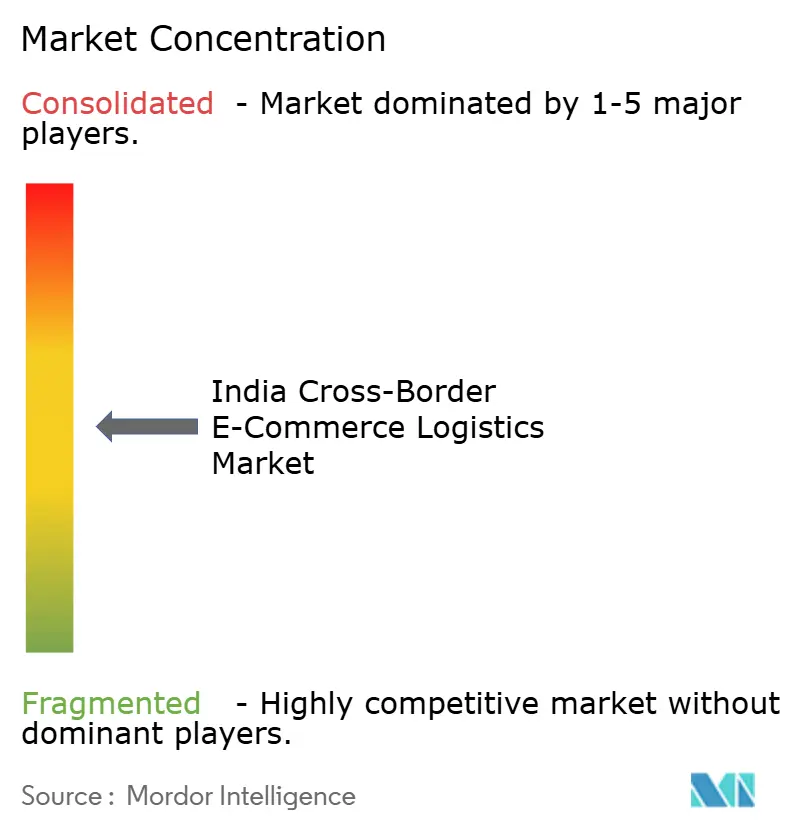
| Market Concentration | Medium |
Major Players *Disclaimer: Major Players sorted in no particular order Image © Mordor Intelligence. Reuse requires attribution under CC BY 4.0. | |
India Cross-Border E-commerce Logistics Market Analysis by Mordor Intelligence
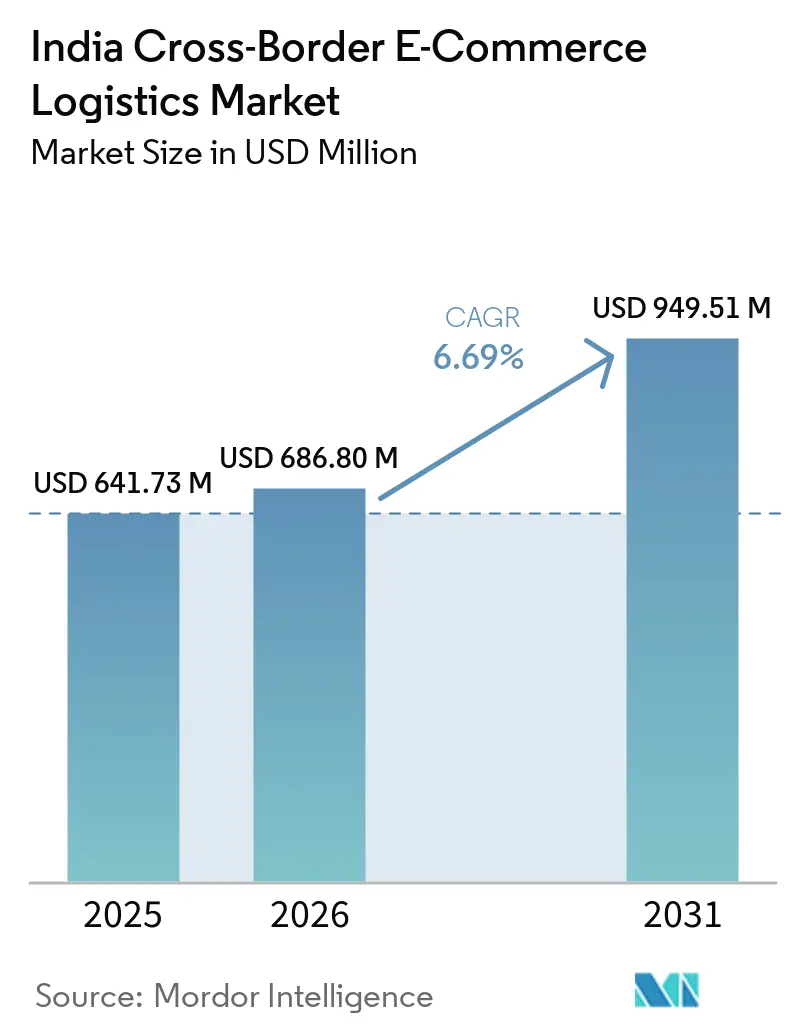
The India Cross-Border E-commerce Logistics Market size was valued at USD 0.64 billion in 2025 and is estimated to grow from USD 0.74 billion in 2026 to reach USD 1.29 billion by 2031, at a CAGR of 11.79% during the forecast period (2026-2031).
The India Cross-Border E-commerce Logistics Market is supported by a broader export enablement push that now combines e-commerce export hubs, Dak Ghar Niryat Kendras, courier facilitation, and direct marketplace onboarding for MSMEs, steadily broadening the seller base beyond the largest metros. The market is also becoming more dependent on payment compliance, customs readiness, booking visibility, and delivery predictability than on transport capacity alone, as cross-border payment intermediaries now operate under the RBI’s PA-CB framework and logistics providers increasingly embed automation into network operations. The next phase of the India Cross-Border E-commerce Logistics Market is likely to favor operators that can combine export onboarding, landed-cost transparency, and service reliability across multiple corridors rather than operators competing only on freight pricing. Large global and domestic players are already responding through multi-year investment plans, new cargo infrastructure, automation programs, and cross-border parcel products that indicate long-cycle confidence in India rather than short-term opportunism. That leaves the strongest opportunity in the India Cross-Border E-commerce Logistics Market with service providers that can turn regulatory simplification and digital tools into faster clearance, better seller retention, and more predictable cross-border delivery performance.
Key Report Takeaways
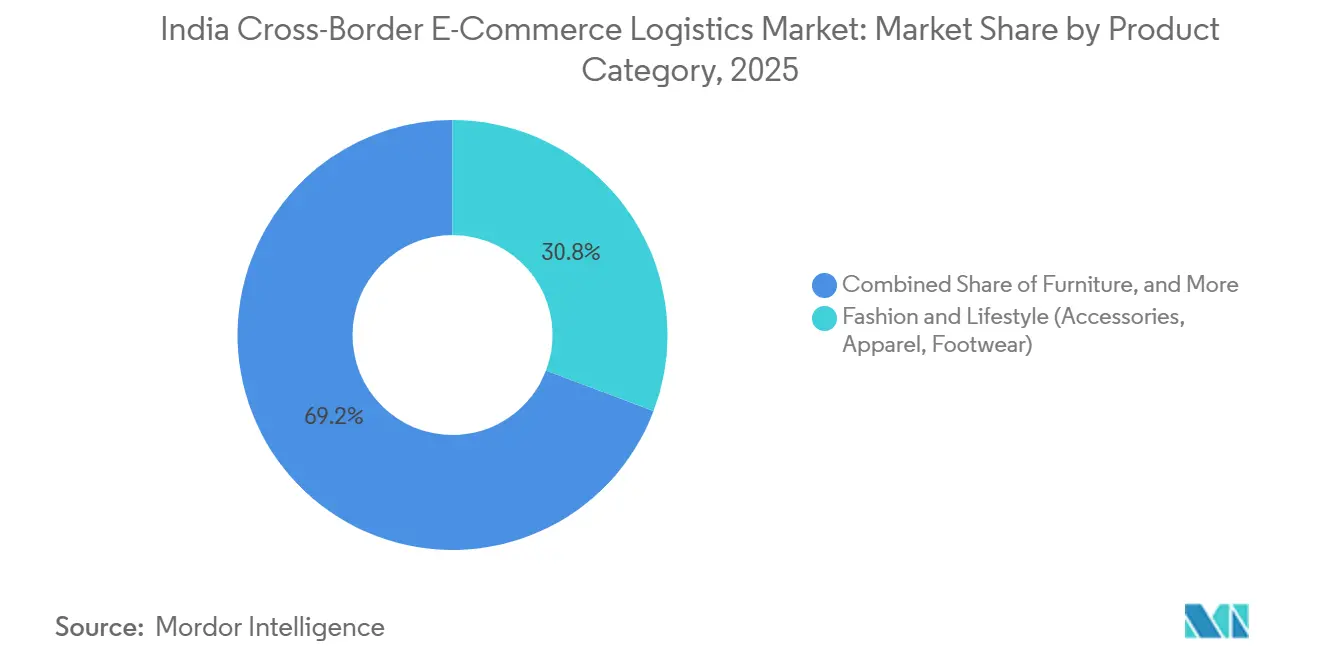
- By product category, fashion and lifestyle held 30.76% of the India Cross-Border E-commerce Logistics Market share in 2025, while health and beauty / personal care is projected to expand at a 12.97% CAGR through 2031.
- By logistics function, transportation accounted for 71.42% of the India Cross-Border E-commerce Logistics Market size in 2025, while value-added services and others are projected to grow at a 14.9% CAGR through 2031.
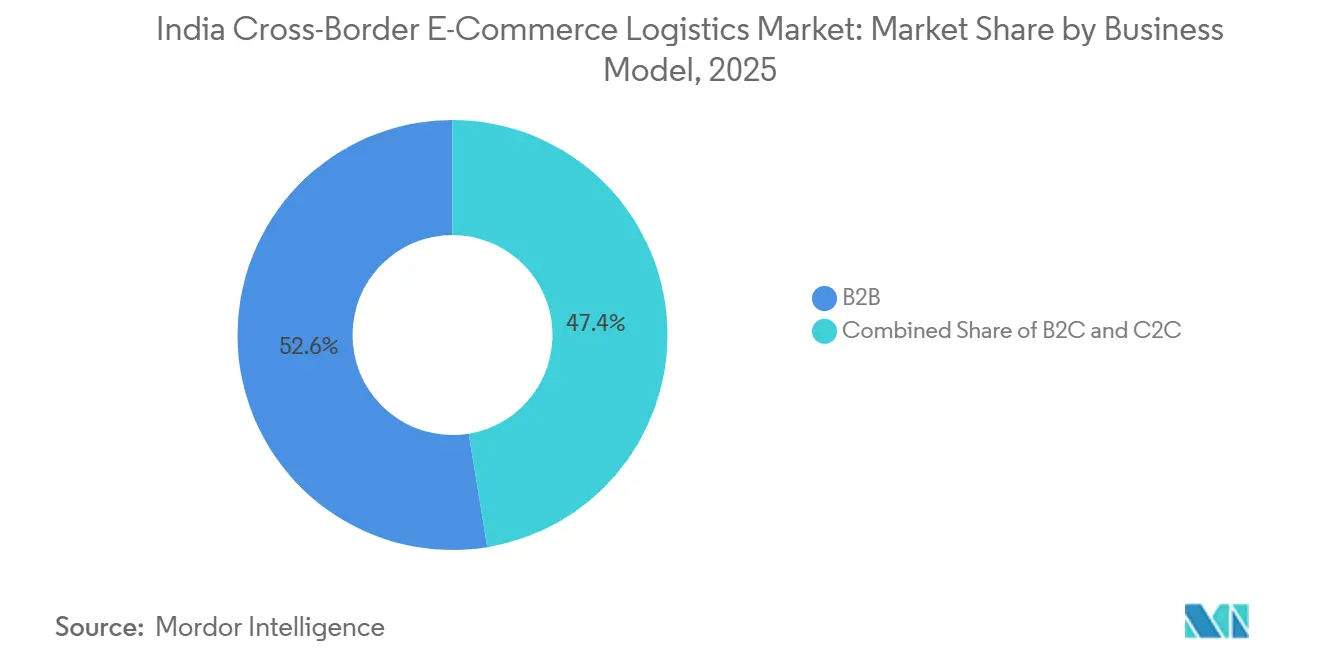
- By business model, B2B held 56.22% of the India Cross-Border E-commerce Logistics Market share in 2025, while B2C recorded the highest projected CAGR at 20.41% through 2031.
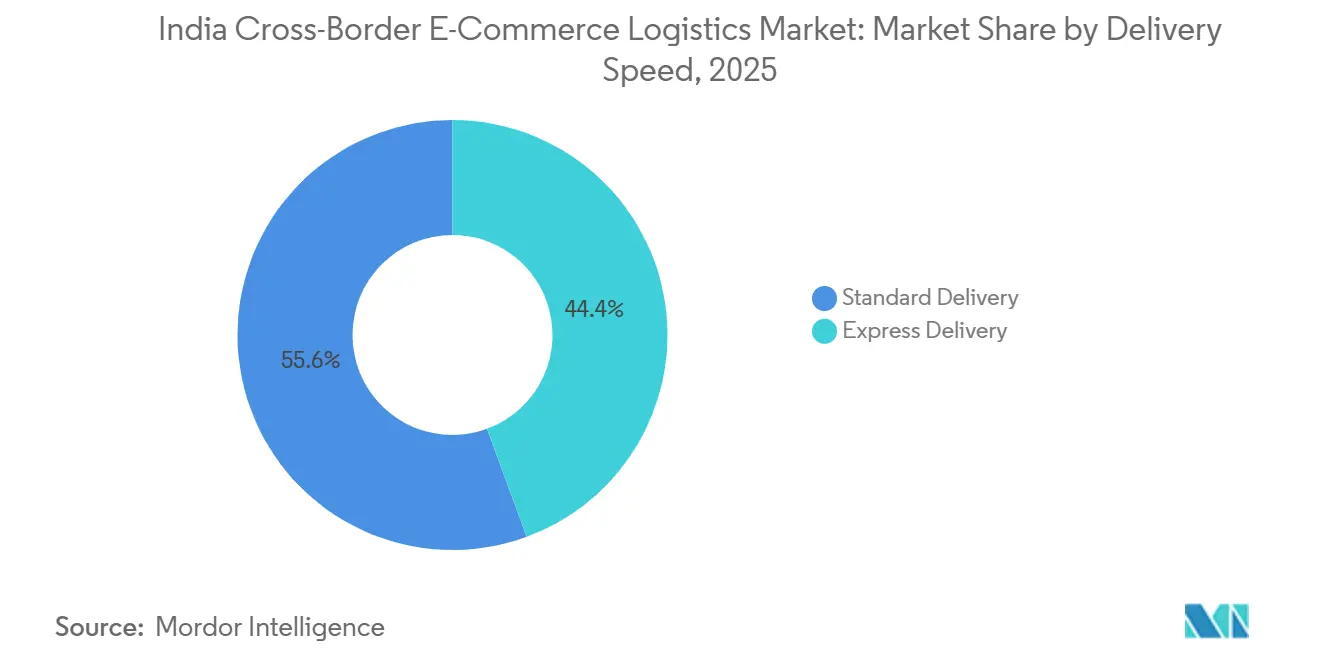
- By delivery speed, standard delivery accounted for 55.62% of the India Cross-Border E-commerce Logistics Market share in 2025, while express delivery is forecast to advance at a 12.76% CAGR through 2031.
- By flow direction, inbound (imports) held 64.11% of the India Cross-Border E-commerce Logistics Market share in 2025, while outbound (exports) is projected to expand at a 11.72% CAGR through 2031.
Note: Market size and forecast figures in this report are generated using Mordor Intelligence’s proprietary estimation framework, updated with the latest available data and insights as of January 2026.
India Cross-Border E-commerce Logistics Market Trends and Insights
Drivers Impact Analysis*
| Driver | (~) % Impact on CAGR Forecast | Geographic Relevance | Impact Timeline |
|---|---|---|---|
| E-Commerce Export Hubs, DNKs, and Export-Incentive Support | +1.2% | Global outbound, with early gains across all India corridors | Short term (≤ 2 years) |
| Global Demand for Indian Fashion, Decor, Beauty, and Heritage Products | +1.5% | North America, Europe, MENA, with spillover to APAC | Medium term (2-4 years) |
| Marketplace and Aggregator-Led MSME Export Onboarding | +1.0% | Global, concentrated in US, UK, GCC, Australia corridors | Medium term (2-4 years) |
| Faster Cross-Border Fulfillment Through Courier Digitization and Visibility Tools | +0.8% | Global, high impact across express lane operators | Short term (≤ 2 years) |
| Postal-Route Incentive Parity Improving Low-AOV Parcel Economics | +0.6% | India-wide, strongest gains in Tier 2–3 export clusters | Short term (≤ 2 years) |
| RBI-Regulated Cross-Border Payment Rails and UPI-Linked Settlement Innovation | +0.7% | MENA, APAC, with spillover to Europe | Medium term (2-4 years) |
| Source: Mordor Intelligence | |||
E-Commerce Export Hubs, DNKs, and Export-Incentive Support
India’s export enablement architecture is becoming more practical for small sellers because it now combines physical access points with digital processing support. The government had established 1,013 Dak Ghar Niryat Kendras across the country, which give exporters in remote and secondary clusters a formal export access node rather than an informal workaround. The same official framework also states that e-commerce export hubs are being built to reduce logistics costs and time, streamline regulation, and simplify re-imports, with integrated support around customs clearance, packaging, quality certification, and warehousing. In practice, this matters for the India Cross-Border E-commerce Logistics Market because parcel exports depend on repeatable process quality, not only on seller demand. It also means the India Cross-Border E-commerce Logistics Market can pull new volume from places that previously had product supply but lacked a viable export channel[1].
Global Demand for Indian Fashion, Decor, Beauty, and Heritage Products
Demand conditions remain favorable for categories where India already has a visible online export identity. Amazon Global Selling stated in October 2025 that Indian sellers had crossed USD 20 billion in cumulative e-commerce exports, with the United States, United Kingdom, Germany, Canada, UAE, France, Italy, Spain, and Saudi Arabia among key export markets in 2024. The same release showed that health and personal care and beauty were among the fastest-growing categories over the last 10 years, and non-electronics categories are becoming more important in export parcel flows. For the India Cross-Border E-commerce Logistics Market, that matters because categories with stronger brand pull and higher perceived value can absorb premium freight, DDP handling, and returns processing more easily than low-value commodity parcels. That is one reason the India Cross-Border E-commerce Logistics Market is seeing stronger long-run support from fashion, décor, beauty, and culturally differentiated products than from categories that compete mainly on price.
Marketplace and Aggregator-Led MSME Export Onboarding
Marketplace-led onboarding is reducing the time it takes for small Indian sellers to start exporting at scale. Amazon Global Selling said its exporter base rose 33% in one year to 200,000 entrepreneurs and small businesses, with sellers registered across 28 states, 7 union territories, and more than 200 cities, and with access to over 18 international marketplaces. Delhivery also entered this space with Delhivery International, launched in December 2025 and live in the United States, United Kingdom, Canada, and Australia by Q4 FY26, which shows that domestic logistics companies are moving beyond a purely India-focused role. This broadens the addressable volume in the India Cross-Border E-commerce Logistics Market, as onboarding support is no longer limited to a few global integrators. It also shifts competition in the India Cross-Border E-commerce Logistics Market toward seller retention, data visibility, and platform compatibility, since the exporter that is easy to acquire is not always easy to keep[2].
Faster Cross-Border Fulfillment Through Courier Digitization and Visibility Tools
Technology is becoming a direct operating lever in cross-border fulfillment. Delhivery’s FY26 disclosures show expanding use of AI-based prediction systems, automation, and an integrated technology layer across operations, while its cross-border product is being built alongside these network tools rather than separately from them. Kuehne+Nagel’s India expansion also includes automation such as telescopic conveyors and high-performance sorting systems, which raised peak order handling capacity by 75% across the new facilities. FedEx expanded International Connect Plus in India to offer day-definite delivery in 3 to 4 business days across destinations in Asia, the Americas, and Europe, reinforcing the shift toward service commitments built on visibility and predictability. As these tools become standard, the India Cross-Border E-commerce Logistics Market is likely to reward operators that reduce documentation errors and booking uncertainty upstream. This also raises the competitive threshold in the India Cross-Border E-commerce Logistics Market because technology is now shaping both service quality and commercial differentiation.
Restraints Impact Analysis*
| Restraint | (~) % Impact on CAGR Forecast | Geographic Relevance | Impact Timeline |
|---|---|---|---|
| Customs, Documentation, and Payment Reconciliation Complexity | -0.8% | Global, highest friction for MSME exporters in Tier 2–3 clusters | Long term (≥ 4 years) |
| High Landed Cost, DDP Burden, and Reverse-Logistics Losses | -0.7% | North America, Europe, DDP compliance-intensive markets | Medium term (2-4 years) |
| US De Minimis Withdrawal Disrupting Low-Ticket Parcel Economics | -1.2% | North America, immediate impact on US-bound MSME parcel corridors | Short term (≤ 2 years) |
| EU ICS2 and VAT Data-Compliance Tightening for SME Exporters | -0.5% | Europe, early impact in Germany, France, Netherlands corridors | Short term (≤ 2 years) |
| Source: Mordor Intelligence | |||
Customs, Documentation, and Payment Reconciliation Complexity
The customs and payment layer is still difficult for small exporters to handle consistently. RBI’s PA-CB framework brought entities facilitating cross-border online payment transactions for import and export under direct regulation, with clear rules around merchant onboarding, transaction handling, settlement accounts, due diligence, and reporting. That is a positive step for long-term system quality, but it also confirms that cross-border commerce is no longer a light-compliance activity for intermediaries or sellers. The India Cross-Border E-commerce Logistics Market still faces operating friction when exporters must align platform workflows, payment timelines, customs declarations, and delivery commitments across several parties. For smaller sellers, the real challenge is not just access to demand. It is the ability to complete every documentation and settlement step without delays, exceptions, or reconciliation gaps.
US De Minimis Withdrawal Disrupting Low-Ticket Parcel Economics
The India Cross-Border E-commerce Logistics Market also faces pressure from the shift in the United States low-value parcel treatment. This change has underscored the importance of duty-paid shipping, upfront landed-cost calculation, and improved pre-clearance preparation for United States-bound parcels. The operational result is that micro-exporters with thin margins are under more strain than sellers with stronger pricing power or better compliance support. That pushes the India Cross-Border E-commerce Logistics Market toward providers that can reliably manage DDP execution. It also makes corridor profitability more selective, since not every seller or carrier can absorb added compliance and collection costs without losing conversion.
*Our forecasts treat driver/restraint impacts as directional, not additive. The impact forecasts reflect baseline growth, mix effects, and variable interactions.
Segment Analysis
By Product Category: Fashion Anchors Revenue as Beauty Leads Future Growth
Fashion and lifestyle held 30.76% of the India Cross-Border E-commerce Logistics Market share in 2025, making it the largest category in the market. Its position reflects steady demand for accessories, apparel, and footwear, where India combines manufacturing depth with a recognizable export identity. These products also align well with parcel-led trade because they ship in manageable sizes and fit marketplace-led selling models. That keeps fashion and lifestyle central to volume formation across the India Cross-Border E-commerce Logistics Market.
Health and beauty / personal care is projected to expand at a 12.97% CAGR over 2026-2031, making it the fastest-growing product segment. Amazon’s October 2025 update showed that health and personal care and beauty were among the fastest-growing categories for Indian sellers over the last decade, supporting the momentum already visible in the India Cross-Border E-commerce Logistics Market. Beauty is also structurally favorable because average order values tend to be stronger than in many low-ticket apparel lines, which improves the economics of premium shipping and DDP handling. Consumer electronics, household appliances, and furniture remain smaller contributors, but they create more complex packaging, customs valuation, and damage-control requirements. Foods and beverages is still smaller in absolute terms, yet it adds corridor depth in ethnic and specialty categories where repeat diaspora demand supports steady parcel traffic. Handicrafts remained an important growth lever inside Fashion and Lifestyle, which shows that culturally differentiated products continue to matter for export mix quality[3].

By Logistics Function: Transport Dominates but Value Addition Reshapes Margins
Transportation accounted for 71.42% of the India Cross-Border E-commerce Logistics Market size in 2025, which confirms that line-haul movement still absorbs most value in the operating stack. Air freight remains especially important in this segment because cross-border parcel trade depends on time-definite delivery, particularly for fashion, health-linked categories, and premium consumer orders. The dominance of transportation also reflects the long-standing need to move shipments across multiple borders and service zones before the last-mile handoff occurs. As a result, transport still anchors revenue generation in the India Cross-Border E-commerce Logistics Market.
The value-added services and others segment is forecast to grow at a 14.9% CAGR over 2026-2031, making it the fastest-growing segment. This reflects stronger demand for customs-as-a-service, DDP management, returns support, relabeling, and destination-specific compliance processing. Kuehne+Nagel’s 100,000 m² capacity addition across five Indian cities shows that fulfillment infrastructure is being expanded through automation rather than just square footage, which supports these higher service layers. Sea transport and inland waterway activity are becoming more relevant for organized B2B flows, especially after Maersk launched its FI2 Far East Asia to India service as a second direct lane alongside FI3. Rail remains smaller, but Maersk’s weekly reefer rail link from Hyderabad to Nhava Sheva shows that specialized multimodal options are expanding for specific export sectors. The India cross-border e-commerce logistics industry is therefore shifting toward a margin structure where service layering matters more than basic freight movement alone. Over time, the India Cross-Border E-commerce Logistics Market should see more value captured by operators that convert warehousing, compliance, and returns processing into a bundled offering.
By Business Model: B2B Volume Leads but B2C Sets the Pace of Change
B2B held 56.22% of the India Cross-Border E-commerce Logistics Market share in 2025, which kept it ahead of all other business models. This large base reflects heavier inbound flows and larger shipment values moving through structured importer and distributor channels. B2B also benefits from more established customs routines, consolidated bookings, and clearer landed-cost planning than small-ticket direct selling. These conditions explain why B2B still leads absolute value in the India Cross-Border E-commerce Logistics Market.
B2C, however, is projected to expand at a 20.41% CAGR through 2031, well above the overall market pace. Amazon’s exporter network reached 200,000 sellers across more than 200 Indian cities, and that wider seller base is one of the clearest reasons why direct-to-consumer parcel trade is gaining speed. Delhivery International’s launch and rapid expansion to 4 destination countries by FY 2026 also show that logistics networks are being redesigned around export-parcel demand from smaller merchants, not just enterprise freight. C2C remains a small part of total activity, mainly because it lacks the scale, discipline, and process consistency that organized export channels now require. B2C’s rapid growth is a base effect, since it started from a lower absolute level. Even so, the India Cross-Border E-commerce Logistics Market is being reshaped by B2C because it changes the mix of shipment size, service expectations, and technology needs faster than B2B does. The India cross-border e-commerce logistics industry is therefore moving toward a dual structure where B2B preserves volume weight and B2C drives strategic innovation.
By Delivery Speed: Standard Delivery Prevails as Express Premiumization Takes Hold
Standard delivery accounted for 55.62% of the India Cross-Border E-commerce Logistics Market share in 2025, indicating that price sensitivity remains strong among both exporters and importers. Many sellers still accept longer transit times when the trade-off is lower shipping cost and wider pricing room on international marketplaces. Standard service also fits consolidated freight and less urgent replenishment flows better than time-definite lanes do. This keeps Standard delivery as the larger base within the India Cross-Border E-commerce Logistics Market.
Express delivery is forecast to expand at a 12.76% CAGR over 2026-2031, making it the fastest-growing segment. FedEx widened its International Connect Plus offer in India in January 2025, with delivery in 3 to 4 business days to destinations across Asia, the Americas, and Europe, underscoring how carriers are targeting sellers who need predictable international transit. Express lanes gain most when buyers expect cross-border delivery windows that feel close to domestic service standards. That is why premiumization is rising first in categories such as beauty, apparel, wellness, and higher-value D2C shipments, where delivery speed directly affects conversion. The constraint is that express economics are more sensitive to handling duties, address accuracy, failed deliveries, and return costs. In this setting, the India Cross-Border E-commerce Logistics Market will reward operators that connect speed promises with strong landed-cost control rather than with faster transport alone. Express growth therefore says as much about service design as it does about aircraft or line-haul capacity.
By Flow Direction: Imports Lead but the Export Corridor Narrows the Gap
Inbound (imports) held 64.11% of the India Cross-Border E-commerce Logistics Market size in 2025, leaving them well ahead of outbound exports in the India Cross-Border E-commerce Logistics Market. This reflects India’s established position as a destination for electronics, consumer goods, and other merchandise moving through organized import channels. Import-oriented infrastructure has been easier to scale because shipment values are larger, processes are more standardized, and buyer networks are more formalized. That is why inbound remains the larger side of the India Cross-Border E-commerce Logistics Market today.
Outbound (exports), however, are projected to expand at a 11.72% CAGR over 2026-2031. Government support around e-commerce export hubs and the 1,013 Dak Ghar Niryat Kendras is widening the export base, while marketplace participation is making it easier for Indian sellers to reach foreign buyers. On the import side, Maersk’s FI2 launch strengthens the Far East-to-India connection and adds flexibility to inbound freight planning. On the export side, Delhivery, FedEx, DHL, and Kuehne+Nagel are all adding capacity or service capabilities to India-linked international flows. This means the gap between import-led scale and export-led momentum is narrowing, even though inbound still leads current value. In practical terms, the India Cross-Border E-commerce Logistics Market is moving from an import-calibrated structure toward a more balanced model that takes outbound parcel readiness far more seriously.
Geography Analysis
North America remained the largest destination zone for Indian outbound cross-border e-commerce, which keeps it central to revenue formation in the Indian cross-border e-commerce logistics market. The region absorbs a large share of fashion, jewelry, handicrafts, and other high-intent categories where Indian sellers already have marketplace traction. Amazon identified the United States and Canada as key export markets for Indian sellers, underscoring the depth of this corridor. FedEx also broke ground in February 2026 on a 300,000 sq. ft. automated air cargo hub at Navi Mumbai International Airport with long-term investment exceeding INR 2,500 crores (USD 2.78 billion), reinforcing India’s western corridor for connections to Southeast Asia, the Middle East, Europe, and the United States. North America, therefore, remains important not only because of demand, but also because network investment is being aligned to serve time-sensitive westbound trade.
Europe is the fastest-growing high-value outbound destination, and that makes it increasingly important for the India Cross-Border E-commerce Logistics Market size across premium categories. Buyers in Europe are supporting demand for fashion, wellness, and design-led Indian products where service quality matters as much as price. The European Commission confirmed that the transition to ICS2 Release 3 was complete on August 29, 2025, which means EU-bound cargo now operates under a tighter advance data environment. That adds compliance work for exporters, but it also favors logistics providers with stronger filing discipline and pre-arrival data readiness. Europe is therefore becoming a corridor where service reliability and documentation quality can decide share gains more clearly than simple freight price can[4].
Asia-Pacific continues to dominate inbound flows into India, with China and other manufacturing economies supplying a large part of the merchandise moving into the country. Maersk’s FI2 service adds a second direct Far East to India ocean lane, which improves network coverage and routing options into Nhava Sheva and Pipavav. The Middle East and Africa corridor is strategically important because it offers proximity, business connectivity, and growing relevance for outward parcel trade. South America remains the smallest geography in current mix terms, but it still presents selective opportunity in categories where Indian exporters can sustain corridor economics with niche demand. Together, these patterns show that the India Cross-Border E-commerce Logistics Market is no longer centered on one export region alone, even if North America and Europe remain the strongest value corridors.
Competitive Landscape
The India Cross-Border E-commerce Logistics Market has a layered competitive structure rather than a winner-takes-all pattern. Global integrators such as DHL, FedEx, and UPS remain strongest in premium express lanes and enterprise-grade international freight because they combine owned or controlled air networks, broad customs capability, and long-standing multinational customer relationships. DHL reinforced that position by announcing an investment of around EUR 1 billion (USD 1.10 billion) in India by 2030 across e-commerce, life sciences and healthcare, and new energy-linked logistics infrastructure. FedEx added another clear signal in February 2026 with its Navi Mumbai cargo hub project, intended to connect India more deeply with major overseas trade regions through a high-capacity, automated node. This keeps the top tier of the India Cross-Border E-commerce Logistics Market focused on high-service, high-control international flows.
Below that layer, domestic and tech-led operators are becoming more influential in MSME export flows. Delhivery’s December 2025 launch of Delhivery International and its live presence in 4 countries by FY 2026 show that India-origin operators are no longer staying on the edge of the cross-border segment. Amazon also continues to shape channel access because its marketplace network helps determine where small sellers discover demand and how quickly they can scale cross-border volume. Kuehne+Nagel is strengthening the organized fulfillment tier through 100,000 m² of added India capacity and more automation in handling flows tied to consumer goods and healthcare. Maersk is also deepening corridor capability through both its FI2 ocean service and its dedicated reefer rail solution for pharmaceutical exporters, which broadens its relevance beyond conventional forwarding. The India Cross-Border E-commerce Logistics Market is therefore seeing competition move across service tiers rather than remain concentrated inside one operating model.
The most under-served capability areas remain returns management, landed-cost transparency, and compliance-heavy DDP execution. Those gaps matter because cross-border sellers lose margin quickly when duty collection, classification, failed delivery, or returns handling is inconsistent. Delhivery’s FY 2026 disclosures show that its AI and automation stack is being monetized as a structural operating asset, not just as a back-end efficiency tool. FedEx also highlighted innovation-led customs and trade facilitation in its 2025 economic impact material, which points to the same competitive direction. That means the India Cross-Border E-commerce Logistics Market is likely to remain competitive, but the strongest players will be the ones that connect technology, compliance, and corridor execution into a single export-facing proposition.
India Cross-Border E-commerce Logistics Industry Leaders
-
DHL Group
-
FedEx
-
United Parcel Service of America, Inc. (UPS)
-
Aramex
-
India Post
- *Disclaimer: Major Players sorted in no particular order
Recent Industry Developments
- May 2026: Maersk launched a dedicated weekly reefer rail service from Hyderabad to Nhava Sheva in partnership with CONCOR, serving pharmaceutical exporters with temperature-controlled, lower-emission multimodal connectivity to North America's East Coast and Latin America.
- April 2026: DTDC Express and India Post signed an MoU to jointly extend logistics coverage to 9,000+ new pin codes across 21 states, combining DTDC's express network with India Post's rural postal infrastructure to deepen cross-border parcel origination from underserved geographies.
- December 2025: Delhivery launched Delhivery International, a low-cost economy air parcel service targeting Indian MSME exporters, initially covering the United States. The service expanded to the United States, Canada, and Australia in Q1 2026, with 10 additional destinations planned by Q2 FY 2027, as Delhivery scales its cross-border infrastructure by leveraging domestic network consolidation for cost advantage.
- October 2025: Kuehne+Nagel announced a 100,000 m² fulfillment center expansion across five new facilities in Gurgaon, Kolkata, Nagpur, Mumbai, and Rajpura, increasing its India fulfillment footprint to nearly 500,000 m² total and creating more than 1,500 new jobs to serve e-commerce and cross-border logistics clients.
India Cross-Border E-commerce Logistics Market Report Scope
| Foods and Beverages |
| Personal and Household Care |
| Fashion and Lifestyle (Accessories, Apparel, Footwear) |
| Furniture |
| Consumer Electronics and Household Appliances |
| Other Products |
| Transportation | Road |
| Air | |
| Sea and Inland Waterways | |
| Rail | |
| Warehousing, Distribution and Inventory Management | |
| Value-added Services and Others |
| B2C |
| B2B |
| C2C |
| Express |
| Standard |
| Outbound (Exports) | North America |
| Europe | |
| Asia-Pacific | |
| Middle East and Africa | |
| South America | |
| Inbound (Imports) | North America |
| Europe | |
| Asia-Pacific | |
| Middle East and Africa | |
| South America |
| By Product Category | Foods and Beverages | |
| Personal and Household Care | ||
| Fashion and Lifestyle (Accessories, Apparel, Footwear) | ||
| Furniture | ||
| Consumer Electronics and Household Appliances | ||
| Other Products | ||
| By Logistics Function | Transportation | Road |
| Air | ||
| Sea and Inland Waterways | ||
| Rail | ||
| Warehousing, Distribution and Inventory Management | ||
| Value-added Services and Others | ||
| By Business Model | B2C | |
| B2B | ||
| C2C | ||
| By Delivery Speed | Express | |
| Standard | ||
| By Flow Direction | Outbound (Exports) | North America |
| Europe | ||
| Asia-Pacific | ||
| Middle East and Africa | ||
| South America | ||
| Inbound (Imports) | North America | |
| Europe | ||
| Asia-Pacific | ||
| Middle East and Africa | ||
| South America | ||
Key Questions Answered in the Report
What is the current size of India cross-border e-commerce logistics?
The India Cross-Border E-commerce Logistics Market stands at USD 0.74 billion in 2026 and is projected to reach USD 1.29 billion by 2031 at a 11.79% CAGR.
Which business model is growing the fastest in this space?
B2C is the fastest-growing business model, with a projected 20.41% CAGR through 2031, even though B2B remained larger in 2025 with a 56.22% share.
Which logistics function holds the largest share?
Transportation led with 71.42% of market value in 2025, reflecting the heavy weight of air, ocean, and line-haul movement in cross-border operations.
Which product category leads revenue, and which one grows the fastest?
Fashion and lifestyle held the largest share at 30.76% in 2025, while health and beauty / personal care is forecast to grow the fastest at a 12.97% CAGR through 2031.
Why is express delivery gaining traction in India’s overseas parcel trade?
Express delivery is projected to grow at a 12.76% CAGR because overseas buyers increasingly expect faster and more predictable international delivery, especially for D2C and premium categories.
What is driving export-side momentum from India?
Export momentum is being supported by wider MSME onboarding, 1,013 Dak Ghar Niryat Kendras, e-commerce export hubs, and expanding cross-border services from players such as Amazon, Delhivery, DHL, FedEx, Kuehne+Nagel, and Maersk.