
Market Overview
| Study Period | 2021 - 2031 |
|---|---|
| Forecast Data Period | 2026 - 2031 |
| Base Year Market Size (2025) | 15.97 gigawatt |
| Market Volume (2026) | 17.61 gigawatt |
| Market Volume (2031) | 28.68 gigawatt |
| Growth Rate (2026 - 2031) | 10.25 % |
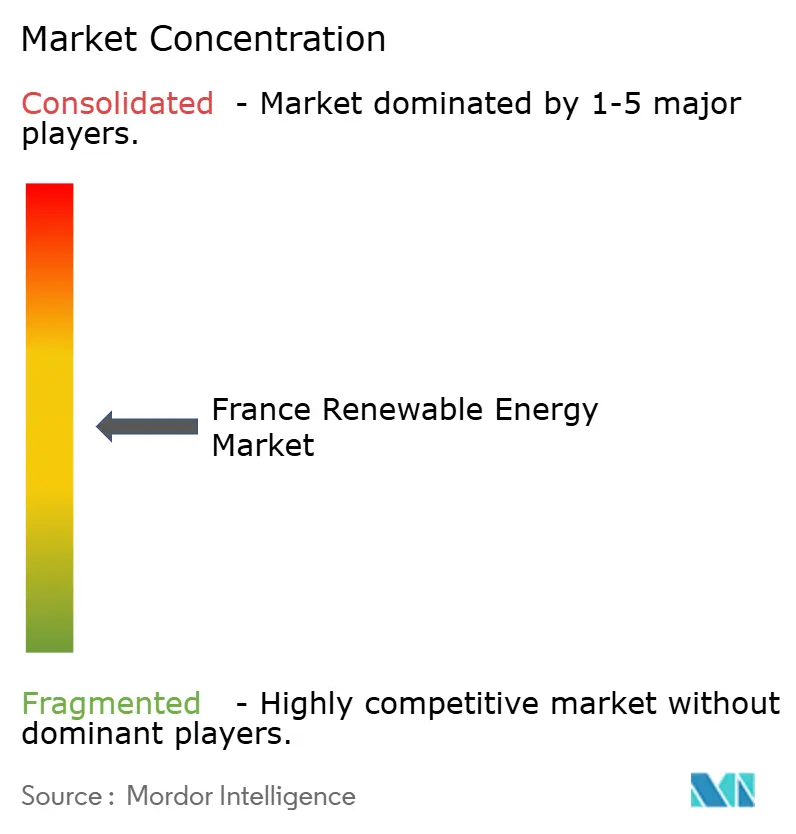
| Market Concentration | Medium |
Major Players *Disclaimer: Major Players sorted in no particular order Image © Mordor Intelligence. Reuse requires attribution under CC BY 4.0. | |
France Renewable Energy Market Analysis by Mordor Intelligence
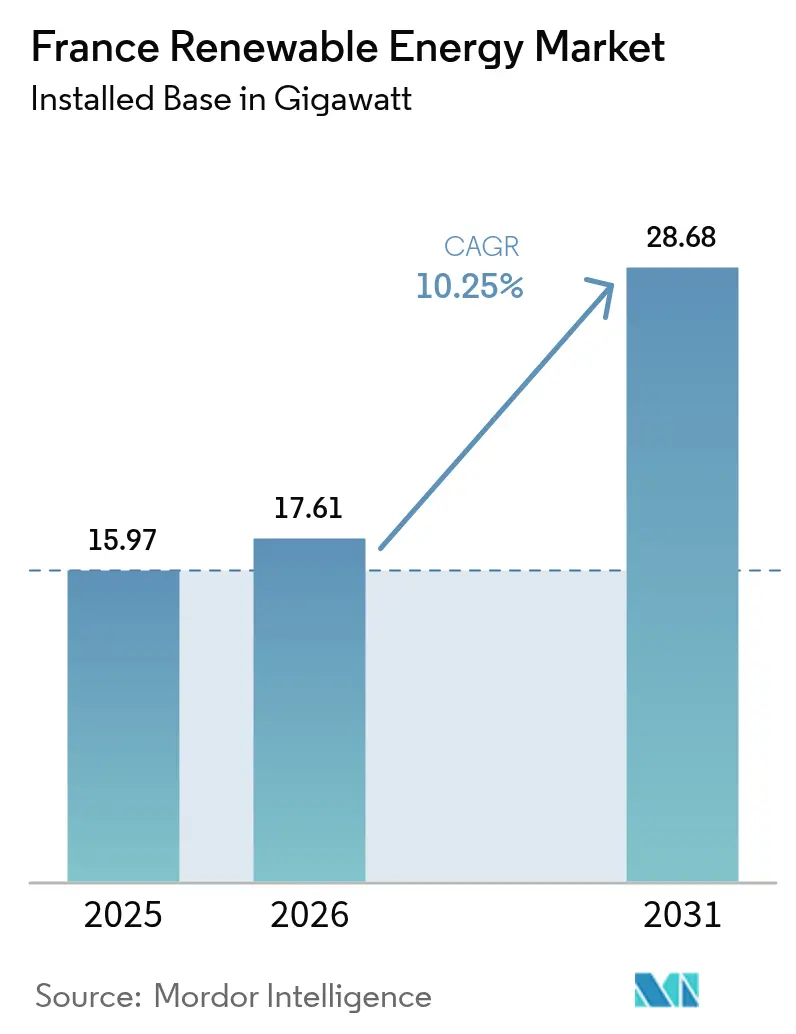
The France Renewable Energy Market size is expected to grow from 15.97 gigawatt in 2025 to 17.61 gigawatt in 2026 and is forecast to reach 28.68 gigawatt by 2031 at 10.25% CAGR over 2026-2031.
Steady momentum reflects binding REPowerEU mandates, a 20% fall in solar-PV installed costs reported by IRENA in 2024, and a corporate PPA pipeline that surpassed 1,842 GWh during 2024. Falling levelized costs have lifted project returns above the 8% hurdle preferred by French pension funds, helping utilities and independent power producers accelerate the conversion of their pipelines. Offshore wind auctions under the revised Multi-year Energy Programme (PPE2) are broadening the diversity of technology and crowding in long-term project finance from domestic banks. At the same time, agrivoltaics legislation enacted in 2024 is unlocking dual land use across 500,000 hectares of viticulture and cereal zones, laying the groundwork for the next growth leg of commercial-scale solar. Competitive intensity is rising as integrated utilities, such as EDF Renewables, TotalEnergies, and Engie Green, vie with Neoen, Voltalia, and Akuo Energy for feed-in tariff contracts and corporate off-take agreements. Meanwhile, grid bottlenecks in Brittany and Provence-Alpes-Côte d’Azur are expected to require EUR 100 billion of transmission upgrades through 2040.
Key Report Takeaways
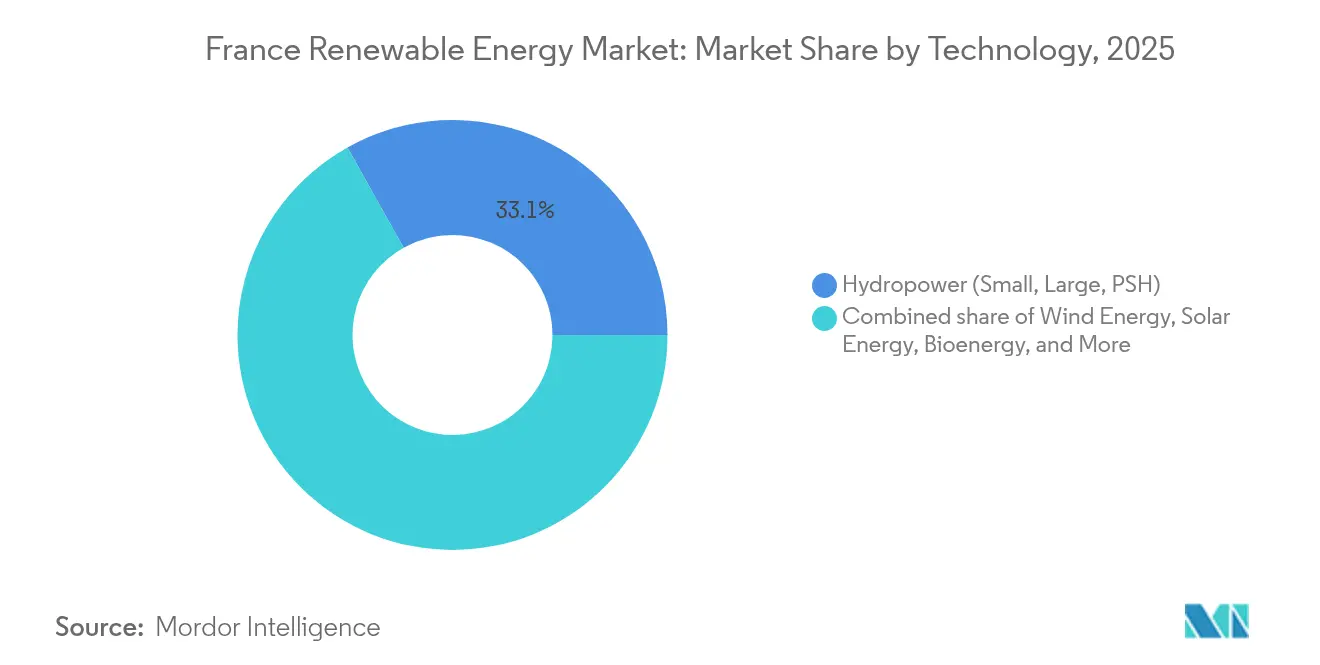
- By technology, hydropower held 33.12% of France's renewable energy market share in 2025; solar energy is forecast to climb at a 18.55% CAGR through 2031.
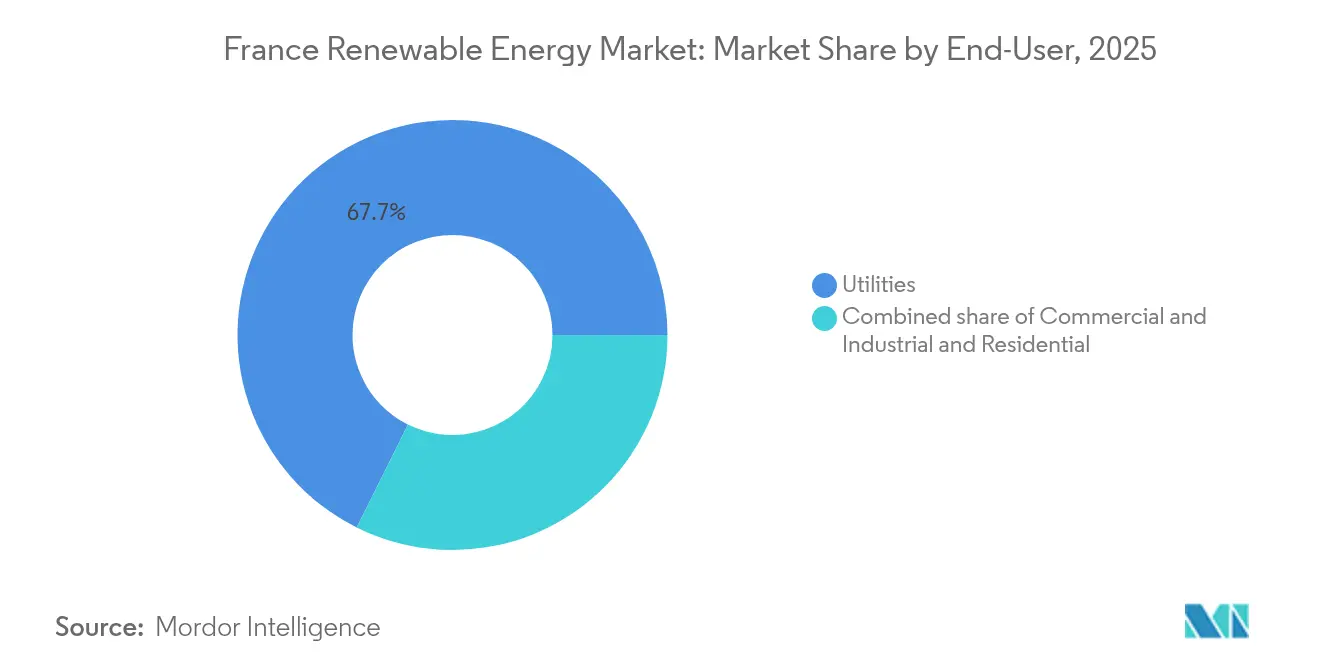
- By end-user, utilities accounted for 67.65% of the France renewable energy market size in 2025, whereas the commercial and industrial segment is advancing at a 15.25% CAGR between 2026 and 2031.
- EDF Renewables, TotalEnergies, Engie Green, Neoen, and Voltalia collectively controlled approximately 55% of the installed capacity in 2024.
Note: Market size and forecast figures in this report are generated using Mordor Intelligence’s proprietary estimation framework, updated with the latest available data and insights as of 2026.
Market Trends and Insights
Drivers Impact Analysis of France Renewable Energy Market*
| Driver | (~) % Impact on CAGR Forecast | Geographic Relevance | Impact Timeline |
|---|---|---|---|
| EU Fit-for-55 & REPowerEU targets accelerate French RES uptake | 2.5% | National, with spillover to cross-border interconnectors | Long term (≥ 4 years) |
| Multi-year Energy Programme (PPE2) raises offshore wind auction pipeline | 1.8% | Atlantic coast (Brittany, Normandy), Mediterranean (Gulf of Lion) | Medium term (2-4 years) |
| Falling LCOE of solar-PV & onshore wind improves project IRR | 1.5% | National, concentrated in southern solar belt and northern wind corridor | Short term (≤ 2 years) |
| Corporate PPAs surge as CAC-40 firms decarbonize scopes 1-2 | 1.2% | National, with early gains in industrial clusters (Lyon, Lille, Marseille) | Short term (≤ 2 years) |
| Repowering ageing wind farms doubles yield without extra land | 0.8% | Northern and eastern regions with legacy turbine stock | Medium term (2-4 years) |
| Agrivoltaics law unlocks dual-land use in agri-regions | 0.6% | Southern viticulture zones, cereal plains in Centre-Val de Loire | Medium term (2-4 years) |
| Source: Mordor Intelligence | |||
EU Fit-for-55 And REPowerEU Targets Accelerate French RES Uptake
Brussels requires France to lift the renewable share of final energy consumption to 42.5% by 2030, up from 20.7% in 2024.[1] Recovery and Resilience Facility grants of EUR 5.4 billion support grid reinforcement, permitting digitalization, and storage pilots that ease integration. France’s updated National Energy and Climate Plan commits to 54-60 GW of solar and 33-35 GW of onshore wind by 2030, requiring a threefold increase in annual installation rates. Allowance prices above EUR 80 per ton under the EU ETS shift marginal economics decisively in favor of wind and solar, while renewable heat and transport mandates accelerate the injection of biomethane. Compliance checkpoints every two years create a hard back-stop that keeps policy pressure high and maintains investor confidence in the France renewable energy market.
Multi-year Energy Programme (PPE2) Raises Offshore Wind Auction Pipeline
The revised PPE2 schedules 17.2 GW of offshore wind capacity across four auction rounds, with strike prices in the 2024 AO7 round clearing at EUR 69 /MWh, 30% below earlier ceilings.[2] Atlantic fixed-bottom projects boast capacity factors exceeding 50%, while Mediterranean floating auctions are driving the development of local manufacturing hubs in Saint-Nazaire and Cherbourg. Local-content rules that require 40% nacelle value and 60% foundation fabrication within the EU are fostering supply-chain localization and job creation. Capital intensity of EUR 3 million per MW concentrates financing in syndicates led by BNP Paribas and Société Générale; however, the low merchant exposure after COD makes the assets attractive to pension funds seeking duration.
Falling LCOE of Solar-PV & Onshore Wind Improves Project IRR
Utility-scale solar LCOE slipped to EUR 40 /MWh in 2024 as bifacial efficiencies hit 22% and single-axis trackers lifted yields by 15%.[3] Onshore wind costs declined to EUR 50/MWh as hub heights increased to 120 m. Inflation-indexed tariff clauses adopted in 2024 shield developers from cost spikes and enable 15-year debt at sub-4% interest rates, pushing project IRRs above 8%. The cost advantage over combined-cycle gas units, which face EUR 90/MWh marginal costs, has accelerated fuel switching, with EDF retiring the 600 MW Cordemais coal plant for a 1 GW solar-plus-storage replacement.
Corporate PPAs Surge As CAC-40 Firms Decarbonize Scopes 1-2
Corporate PPAs hit 1,842 GWh in 2024, a 50% YoY rise, as industrials hedge power prices and meet SBTi targets. TotalEnergies’ 1.5 TWh deal with STMicroelectronics was the largest on record, and Saint-Gobain secured 875 GWh from Engie wind farms. The Carbon Border Adjustment Mechanism will levy a phase-in from 2026, making renewable electricity a defensive cost play for exporters of steel, cement, and aluminum. Sleeved PPA structures enable corporates with distributed sites to purchase renewable attributes without direct connections, thereby broadening the addressable demand.
Restraints Impact Analysis of France Renewable Energy Market*
| Restraint | (~) % Impact on CAGR Forecast | Geographic Relevance | Impact Timeline |
|---|---|---|---|
| Lengthy permitting & court appeals delay grid-connected RES | -1.5% | National, acute in rural communes with organized opposition | Long term (≥ 4 years) |
| Grid congestion in Brittany & PACA limits additional capacity | -1.2% | Brittany peninsula, Provence-Alpes-Côte d'Azur, isolated from backbone | Medium term (2-4 years) |
| Nuclear life-extension works squeeze skilled labour pool | -0.8% | National, concentrated near EDF nuclear sites (Flamanville, Gravelines) | Medium term (2-4 years) |
| Li-ion cell shortages constrain co-located storage roll-outs | -0.5% | National, affecting utility-scale solar and wind projects | Short term (≤ 2 years) |
| Source: Mordor Intelligence | |||
Lengthy Permitting & Court Appeals Delay Grid-Connected RES
Onshore wind projects average 7-9 years from feasibility to COD, with administrative steps consuming four years and court appeals adding up to three more. Setback distances of 500 m from residences curtail 60% of otherwise viable parcels, while radar rules near military airbases eliminate an additional 10%. Appeals overturned 15% of prefectural approvals in 2024, forcing developers to restart studies and eroding net present value. The burden falls hardest on small developers lacking in-house legal teams, tilting market power toward large utilities.
Grid Congestion In Brittany & PACA Limits Additional Capacity
RTE curtailed 8% of Brittany’s wind output in 2024 to prevent voltage instability as 225 kV lines hit 95% utilization.[4] PACA’s 4 GW solar fleet also suffers from negative pricing as export capacity to Lyon and Marseille reaches its maximum. A EUR 100 billion plan through 2040 involves adding 2,000 km of 400 kV lines and 15 GW of HVDC interconnectors to Spain and Italy. However, permitting delays stretch each new corridor to a decade, pushing developers toward lower-resource areas that still have grid headroom.
*Our forecasts treat driver/restraint impacts as directional, not additive. The impact forecasts reflect baseline growth, mix effects, and variable interactions.
France Renewable Energy Market Segment Analysis
By Technology:
Solar Surges While Hydro Anchors BaseSolar added 2.8 GW in 2024 and is forecast to expand at a 18.55% CAGR through 2031, the strongest uplift in the France renewable energy market. Two drivers dominate: agrivoltaics, which open up dual land use on 500,000 hectares, and rooftop mandates on new commercial buildings exceeding 1,000 m². Hydropower retained 33.12% of installed capacity in 2025, providing indispensable pumped-storage flexibility even as environmental constraints cap greenfield development. Wind energy follows, buoyed by 3 GW of repowering and 17.2 GW of offshore auctions, while bioenergy pursues France’s 44 TWh biomethane target for 2030. Ocean and geothermal energy remain at the demonstration stage, adding, accounting for less than 1% combined capacity.
Solar’s momentum accelerates the France renewable energy market as bifacial modules reach 22% efficiency and tracker penetration deepens across Occitanie and Nouvelle-Aquitaine. Offshore wind contributes scale and diversity, with fixed-bottom Atlantic projects and floating Mediterranean farms capturing deep-water potential. Hydropower’s aging fleet receives targeted upgrades that add 2 GW of pumped storage by 2030 to integrate solar oversupply. Bioenergy growth hinges on digestate disposal regulations, and geothermal pilots in Alsace aim to achieve cost breakthroughs before scaling up.

By End-User:
Utilities Dominate, Yet C&I AcceleratesUtilities controlled 67.65% of installed capacity in 2025, reflecting multi-gigawatt auction awards and their balance-sheet financing capability for high-capex offshore wind projects. The commercial and industrial segment registers the fastest growth, rising at a 15.25% CAGR as CAC-40 firms lock in PPAs to secure renewable supply and pre-empt carbon border levies. Residential rooftop PV grows steadily under net-metering, which pays EUR 100/MWh for surplus exports, although split-incentive issues in multi-family housing temper penetration.
Corporate PPAs, which surged 50% YoY in 2024, illustrate how industrial off-takers are reshaping power contracting. Utilities continue to dominate grid-connected assets, but independent producers such as Voltalia and Akuo Energy are carving out a share by aggregating sub-50 MW solar projects tailored to corporate tenants. Residential uptake benefits from collective self-consumption schemes introduced in 2024, yet remains constrained by upfront capital expenditures and roof size limitations.
Geography Analysis
Southern France, specifically Occitanie, PACA, and Nouvelle-Aquitaine, houses 64.45% of the country's solar capacity, thanks to its 1,800 sunshine hours annually and the 2024 agrivoltaics framework. Brittany and Normandy dominate fixed-bottom offshore wind, while the Gulf of Lion advances floating variants. Hauts-de-France and Grand Est lead onshore wind repowering, leveraging 120 m hub heights to tap 7 m/s winds. Île-de-France trails due to density and radar restrictions.
Grid congestion is acute along the Brittany peninsula, where 225 kV lines now curtail 8% of wind output. RTE's EUR 100 billion plan includes 2,000 km of 400 kV backbone and 15 GW of HVDC links to Spain and Italy, yet each corridor faces a decade-long permitting process. Offshore wind will depend on subsea cables routed to Normandy landing points before power heads go inland.
Local-content policies concentrate manufacturing in coastal hubs. Saint-Nazaire and Cherbourg are emerging turbine clusters employing 3,500 workers by 2027. However, these yards compete with EDF nuclear refits for welders and quality inspectors, prolonging installation schedules on Atlantic and Mediterranean projects.
Regulatory Landscape
France’s renewable power build-out is shaped by EU Fit-for-55 and REPowerEU commitments, which are transposed through national planning and tendering frameworks led by the Ministry for Ecological Transition and the Commission de regulation de l’energie (CRE). The 2023 Renewable Energy Acceleration Law (Loi no 2023-175) is the main mechanism for streamlined permitting and territorial planning, while CRE continues to administer technology-specific competitive tenders and refine support designs (feed-in tariffs, premiums, and CfD-style mechanisms) to manage system costs and integration impacts.
In February 2026, Decret no 2026-76 set the third Multi-Annual Energy Programme (PPE 3) for 2026-2035, outlining updated capacity pathways, including solar PV targets (48 GW by 2030, 55-80 GW by 2035), and reinforcing a siting hierarchy that favors already-artificialized land (buildings, brownfields) alongside agrivoltaics and self-consumption. In March 2026, CRE published proposals for large-scale PV (over 100 kWc), explicitly encouraging PV and storage coupling and redirecting support away from inefficient negative-price compensation, with future auction design linked more closely to flexibility and grid-friendly dispatch behavior.
Competitive Landscape
Market concentration is moderate. EDF Renewables, TotalEnergies, Engie Green, Neoen, and Voltalia together command 55% of capacity, while another 200 players share the remainder. Integrated utilities finance multi-gigawatt offshore projects with ten-year build cycles. Pure-play developers focus on 50-200 MW assets and often flip portfolios to infrastructure funds once operational.
Strategic differentiation appears in technology bets. EDF filed 12 patents in 2024 for floating wind substructures, while Sun'Agri advances agrivoltaic IP that elevates grape yields by 15%. Chinese inverter makers are winning the rooftop share by undercutting European rivals by 20% in price. Acquisition appetite is rising: RWE bought a 60 MW solar portfolio in 2024 to fast-track entry, and more cross-border deals are likely for assets with grid queues in place.
Equipment suppliers localize to meet EU content thresholds. Siemens Gamesa opened a Saint-Nazaire nacelle plant capable of 100 turbines per year, and GE Vernova is building a blade facility in Cherbourg. Such moves anchor supply chains and enhance bid competitiveness under PPE2 auctions.
France Renewable Energy Industry Leaders
-
EDF Renewables
-
TotalEnergies Renewables
-
Engie Green
-
Neoen SA
-
Voltalia SA
- *Disclaimer: Major Players sorted in no particular order
France Renewable Energy Market Companies Covered in this Report
- EDF Renewables
- TotalEnergies Renewables
- Engie Green
- Neoen SA
- Voltalia SA
- Akuo Energy
- Albioma SA
- Boralex Inc
- WPD Offshore France
- RWE Renewables France
- Iberdrola (?Ailes Marines)
- Enel Green Power France
- Ørsted France
- Vestas France
- Siemens Gamesa RE France
- GE Vernova France
- Nordex France
- BayWa r.e. France
- Envision France
Market Opportunities and Future Outlook
PPE 3 (2026-2035) clarifies opportunity for developers, EPCs, and asset owners able to deliver grid-compatible renewables. It raises solar build-out targets (48 GW by 2030 and 55-80 GW by 2035) while focusing deployment on artificialized surfaces and supporting agrivoltaics and self-consumption. That emphasis shifts opportunity toward commercial rooftops, brownfields, and dual-use agricultural projects, and it also strengthens the case for hybridization with storage where it helps reduce price cannibalization and congestion. CRE’s March 2026 work on incentivizing PV plus storage coupling for large-scale systems reinforces this direction.
Offshore wind is also emerging as a multi-project investment channel backed by long-dated public frameworks rather than single-asset economics. In July 2026, the European Commission approved a EUR 63 billion French aid scheme covering 11 offshore wind farms (11.1 GW combined) across the North Sea, Atlantic, and Mediterranean, which supports bankability for developers and supply-chain participants meeting tender and local-content conditions. The pipeline is progressing through execution and authorization gates as well, including Ocean Winds reaching key construction and operating milestones in 2026 and TotalEnergies filing for authorization for its 1.5 GW Centre Manche Energies offshore wind project off Normandy in May 2026, sustaining demand for permitting, marine works, grid connection, and long-term O&M.
Recent Industry Developments in France Renewable Energy Market
- July 2026: TotalEnergies finalized the sale of its distributed solar generation activities, including around 170 MW of assets across seven European countries, to Amarenco and AMPYR Distributed Energy. The divestment narrows TotalEnergies’ renewables capital allocation toward larger-scale projects and can accelerate consolidation in France’s distributed solar asset base under specialist operators.
- May 2026: TotalEnergies filed for authorization for the 1.5 GW Centre Manche Energies offshore wind project located off the Normandy coast. Advancing the project into the single-authorization process strengthens the near-term offshore wind pipeline and reflects continued commitment by integrated utilities to gigawatt-scale developments under France’s tender-led framework.
- June 2024: ENGIE reported 2.3 GW of renewable capacity additions in the first nine months of 2024 and reiterated its full-year target of 4 GW. The pace of additions supported ENGIE’s ability to serve both tender-backed projects and corporate offtake demand, intensifying competitive pressure among leading developers in France.
France Renewable Energy Market Report Scope and Research Methodology
Market Definition and Coverage
For this methodology, the France renewable energy market is defined as the installed electricity generation capacity connected in France that comes from renewable sources, tracked in gigawatts and aligned to grid and project commissioning reality.
Scope exclusions: This sizing excludes conventional thermal and nuclear capacity, and it also excludes pure transmission and distribution upgrades unless they are bundled inside a renewable power project.
Segments Covered in This Report
- By Technology
- Solar Energy (PV and CSP)
- Wind Energy (Onshore and Offshore)
- Hydropower (Small, Large, PSH)
- Bioenergy
- Geothermal
- Ocean Energy (Tidal and Wave)
- By End-User
- Utilities
- Commercial and Industrial
- Residential
Data Sources, Market Sizing, and Validation
Desk Research
Desk research set the factual backbone for the model, especially around capacity additions, retirements, and the policy calendar that influences new builds. We used public sources such as the French Ministry for the Ecological Transition, RTE system publications, IEA and IRENA renewable statistics, Eurostat energy datasets, and grid and auction documentation that is publicly released.
Along with that, we screened company annual reports, investor decks, and project announcements to understand commissioning timing and typical project sizes, which helps keep year-by-year totals consistent with what is being connected. When needed, a paid subscription focused on company financials and patent intelligence was referenced to cross-check supplier exposure and technology direction, not to replace public datasets. The desk sources mentioned here are illustrative only and not exhaustive, and other public and paid sources were also used for data collection, validation, and clarification.
Primary Interviews and Surveys
Primary work was used to pressure test the build rates and to confirm how quickly projects move from awards and permitting to real grid connection. We covered developers, utilities, EPC and O&M participants, and also spoke with domain experts who track auctions, interconnection queues, and technology-specific constraints across France.
Insights from these discussions were used to refine assumptions on commissioning slippage, repowering patterns, and technology mix changes. After that, our model outputs were rechecked until the resulting year-by-year ramp matched what participants described in the current project pipeline.
Distribution of primary research fieldwork respondents
| Company type | Respondent position |
|---|---|
| Top tier: 29% | CXOs: 15% |
| Mid tier: 56% | Functional/Unit leaders: 33% |
| Smaller Players: 15% | Managers: 52% |
Market-Sizing & Forecasting
Sizing was built using the top-down capacity accounting method, where national renewable capacity is reconstructed from reported installed base levels and then adjusted using known additions, retirements, and the timing of grid connection. To keep the totals grounded, selective bottom-up checks were run, such as rolling up a sampled set of announced and awarded projects by technology and applying typical project size and completion timing seen in France.
Key inputs used in the model include annual renewable capacity additions by technology, auction award volumes and commissioning schedules, interconnection and grid readiness signals, repowering activity for mature wind assets, and policy targets and revisions that change the achievable build-out pace. Where project data was incomplete, gaps were handled with conservative lag assumptions that were validated through interviews, and then corrected if the implied annual ramp looked inconsistent with recent construction and permitting reality.
For forecasting, scenario analysis was used because policy timelines and grid constraints can shift the pace materially from one year to the next. The scenarios were tied to interview-led expectations on award-to-commissioning lags and technology mix, and then narrowed to a base case that best matches the current pipeline and the likely build rhythm.
Data Validation & Update Cycle
Outputs were checked against independent signals so major breaks in logic are caught early, including year-over-year capacity change patterns and the implied technology mix versus observed deployment trends. Any large variance triggers a second pass on assumptions, followed by a peer review where calculations, unit consistency, and conversion steps are verified before sign-off.
The model is refreshed annually, and interim adjustments are made when a material policy shift, auction change, or grid constraint meaningfully changes the forward build outlook. Before delivery, a final review is completed so clients receive the most current view, with updates to key assumptions and a repeat check on outliers.
Mordor Intelligence's France Renewable Energy Market Size Versus Other Published Estimates
Published market sizes for France renewables do not always line up because the unit of measurement, the scope boundary, and even the year used as the starting point can differ across studies. Some publishers focus on capacity in gigawatts, others translate generation into monetary values, and the forecast windows are often not aligned, which makes simple comparisons misleading.
Grid-connection commissioning records and technology-level installed-capacity series are the evidence checks that keep Mordor Intelligence's estimate tied to what is actually operating in France, rather than mixing in broader clean-tech spending or wholesale priced energy output. Differences also come from whether pumped storage is included under hydropower, how repowering is counted, and how delays between auction award and commissioning are treated, since those timing rules can shift the year-by-year totals.
Benchmark comparison
| Source | Market Size | Gaps in Research Methodology |
|---|---|---|
| Mordor Intelligence | USD 15.97 B (2025) | |
| Global Research Firm A | USD 140.52 B (2023) | Uses a value and volume framing that mixes USD with electricity output units, and it anchors the market to energy produced rather than installed capacity, so the result is not comparable to a GW-based capacity count for a single base year. |
| Global Research Firm B | USD 29.07 B (2024) | Looks at the wider clean-technology spend pool, where renewables sit alongside storage, efficiency, and environmental solutions, which inflates totals versus a renewables-only capacity scope for France. |
The spread across the table mostly comes from what is being counted and how it is translated into a single number, not just from different growth views. By keeping the scope anchored to operating renewable capacity and then validating timing and mix with project pipeline checks, our estimate stays easier to trace back to clear, repeatable inputs.
Key Questions Answered in the Report
How large is the France renewable energy market in 2026?
The market totals 17.61 GW in 2026 and is forecast to reach 28.68 GW by 2031, reflecting a 10.25% CAGR.
Which technology is growing the fastest in France’s renewables mix?
Solar energy leads with a projected 18.55% CAGR between 2026 and 2031, supported by agrivoltaics and falling LCOE.
Why are corporate PPAs expanding rapidly in France?
Industrial buyers use PPAs to secure fixed power prices and meet decarbonization obligations ahead of the Carbon Border Adjustment Mechanism.
What is the main bottleneck to new onshore wind projects?
Lengthy permitting and legal appeals extend development cycles to 7-9 years, slowing capacity additions.
Which regions dominate offshore wind development?
Brittany and Normandy host most fixed-bottom projects, while the Gulf of Lion focuses on floating turbines.
How concentrated is the competitive landscape?
The top five players control about 55% of installed capacity, indicating a moderately concentrated market.