
Market Overview
| Study Period | 2020 - 2031 |
|---|---|
| Forecast Data Period | 2026 - 2031 |
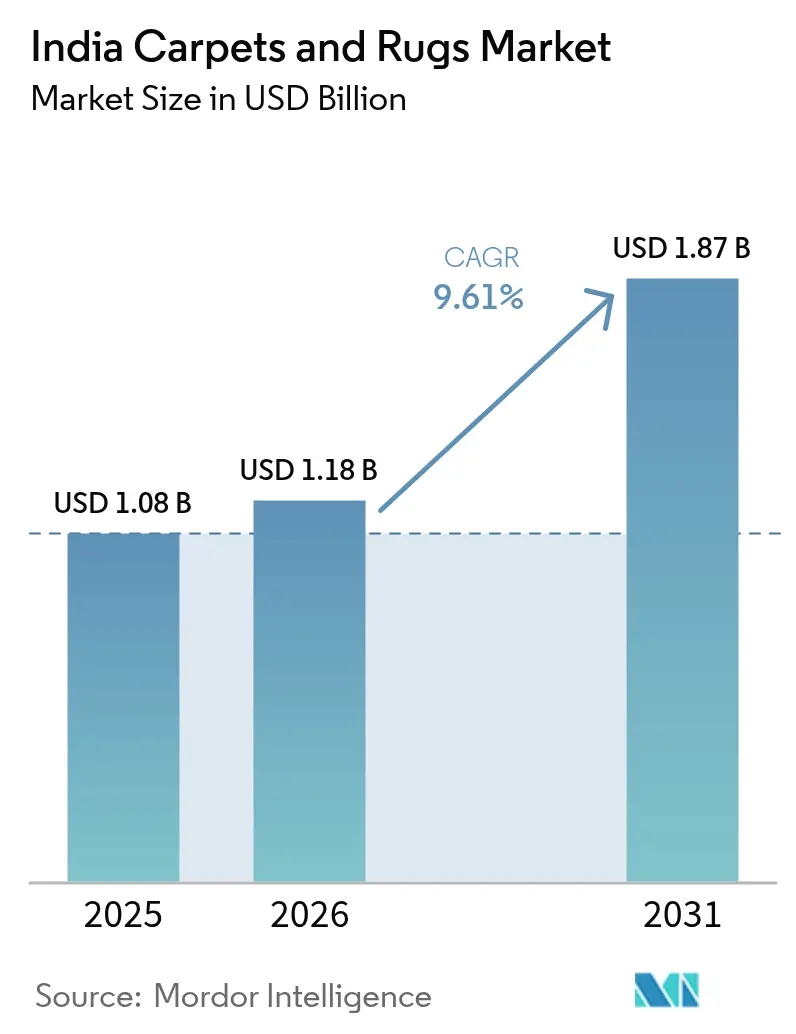
| Base Year Market Size (2025) | USD 1.08 Billion |
| Market Size (2026) | USD 1.18 Billion |
| Market Size (2031) | USD 1.87 Billion |
| Growth Rate (2026 - 2031) | 9.61 % |
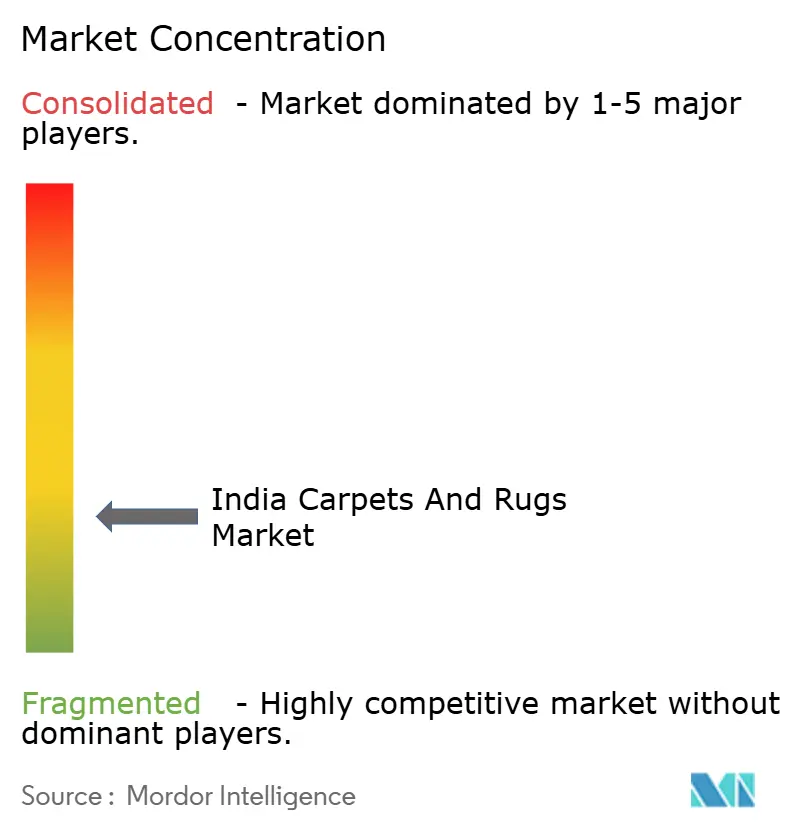
| Market Concentration | Low |
Major Players *Disclaimer: Major Players sorted in no particular order Image © Mordor Intelligence. Reuse requires attribution under CC BY 4.0. | |
India Carpets And Rugs Market Analysis by Mordor Intelligence
India carpets and rugs market size in 2026 is estimated at USD 1.18 billion, growing from 2025 value of USD 1.08 billion with 2031 projections showing USD 1.87 billion, growing at 9.61% CAGR over 2026-2031. This robust trajectory mirrors strong domestic demand, the country’s 40% share of global handmade-carpet exports, and sustained government incentives that strengthen artisanal clusters[1]. Technology-driven machine-tufting, widening e-commerce reach, and luxury-oriented sustainability preferences further accelerate uptake across residential and commercial renovations. At the same time, policy tools such as PM MITRA parks and Production Linked Incentives lower entry barriers, enlarge formal employment, and draw global buyers toward traceable, premium offerings. Strategic investments in renewable energy, digital authentication, and modular tile formats position manufacturers to capture margin upside while meeting ESG expectations.
Key Report Takeaways
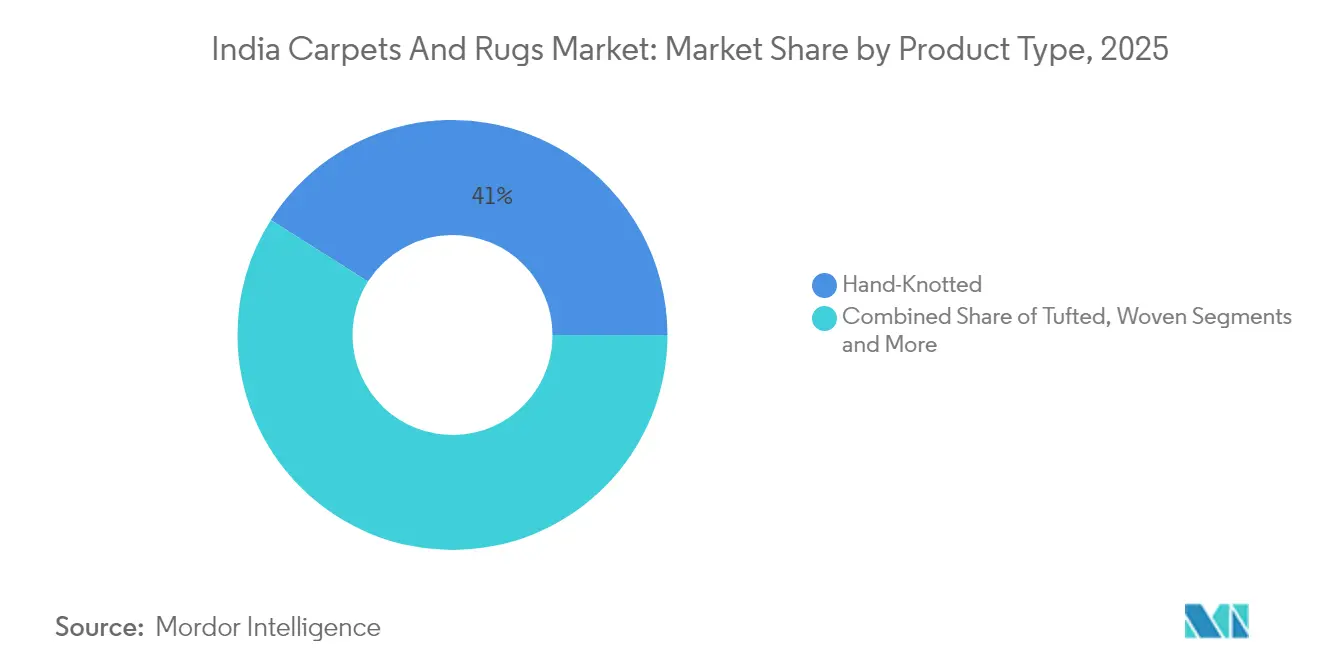
- By product type, hand-knotted carpets held 41.02% of the India carpets and rugs market share in 2025, while machine-tufted products are forecast to expand at a 10.98% CAGR through 2031.
- By material, wool commanded a 46.55% share of the India carpets and rugs market size in 2025, whereas polypropylene is projected to grow at a 10.08% CAGR to 2031.
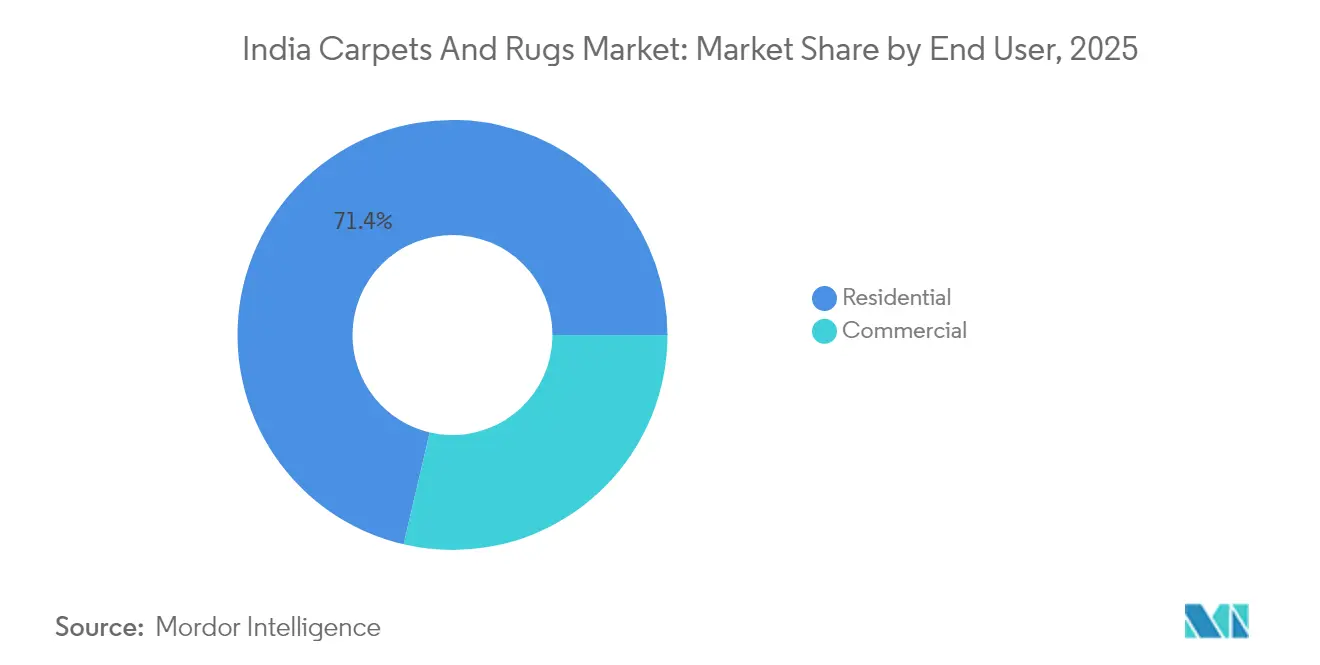
- By end user, residential applications accounted for a 71.35% share in 2025, and commercial demand is advancing at a 11.76% CAGR through 2031.
- By distribution channel, B2C retail maintained 83.92% revenue share in 2025; B2B direct sales are rising at a 9.41% CAGR between 2026-2031.
- By region, North India led with a 33.72% share in 2025, whereas West India is on track for an 11.36% CAGR to 2031.
- The India carpets and rugs market exhibits moderate fragmentation, top players such as Jaipur Rugs Company, Welspun India Ltd, Obeetee Pvt Ltd, Shaw Industries Group Inc, Surya Carpets Pvt Ltd holds major market share.
Note: Market size and forecast figures in this report are generated using Mordor Intelligence’s proprietary estimation framework, updated with the latest available data and insights as of 2026.
India Carpets And Rugs Market Trends and Insights
Drivers Impact Analysis*
| Driver | (~) (%) Impact on CAGR Forecast | Geographic Relevance | Impact Timeline |
|---|---|---|---|
| Rapid growth of organised décor retail & e-commerce | +1.8% | North & West India, global reach | Short term (≤ 2 years) |
| Government incentives and textile-cluster expansion | +1.5% | UP, Gujarat, Rajasthan | Medium term (2-4 years) |
| Premiumization & demand for sustainable natural-fiber carpets | +1.2% | Urban India, US & EU export markets | Medium term (2-4 years) |
| Export-oriented hand-knotted gains from US/EU tariff preferences | +1.0% | Northern hubs, global buyers | Long term (≥ 4 years) |
| Adoption of carpet tiles in hybrid-office refurbishments | +0.7% | Metro commercial districts | Short term (≤ 2 years) |
| Hospitality boom ahead of major sporting & G20 projects | +0.6% | Tourism corridors, metro infrastructure zones | Medium term (2-4 years) |
| Source: Mordor Intelligence | |||
Rapid Growth of Organized Décor Retail & E-Commerce
Amazon’s Global Selling program alone enabled 150,000 Indian exporters to ship USD 13 billion worth of goods by 2024, with home textiles among the top categories. Mobile apps now aggregate micro-orders, streamline raw-yarn procurement, and ensure timely digital payments, thereby empowering over 2 million weavers who historically relied on multi-tier intermediaries. Government-run AIICE underscores the creative economy’s 8% workforce share and spotlights digital intelligence as essential for sustaining cottage industries. These converging forces expand the India carpets and rugs market’s effective addressable audience, compress fulfillment lead times, and reinforce price transparency that rewards genuine craftsmanship.
Government Incentives and Textile-Cluster Expansion
Union Budget 2025-26 raised textile outlays 19% to INR 5,272 crore, earmarking modern parks, R&D centers, and skill missions that directly support carpet production[2]. Seven PM MITRA parks are slated to generate 300,000 jobs each, while the PLI scheme reserves more than INR 10,000 crore for export-ready value addition. Uttar Pradesh is fast-tracking private parks, with Lonex Textile Park in Shamli set for December 2025 commissioning and 5,000 new positions. The RoSCTL rebate extension keeps zero-rated export status intact, buffering SMEs against logistics-driven cost spikes. Collectively, these incentives sharpen India’s comparative edge over Bangladesh and Vietnam and channel fresh capital into the India carpets and rugs market’s core manufacturing belts.
Premiumization & Demand for Sustainable Natural-Fiber Carpets
Urban consumers and foreign buyers increasingly reward low-carbon, traceable carpets. Welspun Living pledges carbon neutrality by 2030, leveraging biomass-based energy and recyclable backing layers. Reliance Industries’ ECOTHERM fiber debuted at Bharat Tex 2024, offering lightweight insulation without compromising dyeability. Mohawk Industries reports a 36% greenhouse-gas-intensity cut since 2010, pointing to sector-wide environmental gains[3]. Wool carpet exports touched USD 1.34 billion in FY 2024, aided by the Integrated Wool Development Programme’s INR 126 crore quality push. Such initiatives allow producers to command premium tags, diversify revenue toward ESG-compliant niches, and future-proof the India carpets and rugs market against stricter Western procurement codes.
Export-Oriented Hand-Knotted Segment Gains from US/EU Tariff Preferences
Hand-knotted exports delivered USD 1.39 billion in FY 2024 and still enjoy favorable duties in the EU, preserving India’s 40% global share. Recent US tariff hikes, however, threaten 70% of outbound volumes, compelling the Carpet Export Promotion Council to lobby for separate HSN codes that shield artisanal SKUs. The RoDTEP rebate now clears within 15 days, easing liquidity for SME exporters. Large B2B trade fairs continue to secure multibillion-rupee orders and uphold artisanal livelihoods across Bhadohi and Mirzapur. Authenticity certificates and QR-based tracking reinforce buyer confidence, sustaining export premiums and supporting the India carpets and rugs market’s foreign-exchange inflow.
Restraints Impact Analysis*
| Restraint | (~) (%) Impact on CAGR Forecast | Geographic Relevance | Impact Timeline |
|---|---|---|---|
| Raw-material price volatility squeezing SME margins | -1.3% | National, small manufacturers | Short term (≤ 2 years) |
| Shift to hard-flooring alternatives | -1.0% | Urban residential markets | Medium term (2-4 years) |
| Informal labor practices limit ESG sourcing | -0.7% | Traditional clusters, export buyers | Long term (≥ 4 years) |
| Water-scarcity regulation curbs dyeing capacity | -0.5% | UP & Rajasthan clusters | Medium term (2-4 years) |
| Source: Mordor Intelligence | |||
Raw-Material Price Volatility Squeezing SME Margins
Polyester staple fiber was quoted at INR 93,000-95,000 per ton for November 2024, stubbornly high versus falling PTA feedstock, eroding pass-through ability for exporters. Cotton imports more than doubled in FY 2025, while oil-linked synthetic fibers remain volatile, bloating yarn costs. The new Textile Production Subsidy offers 15% relief, but adoption lags among cash-constrained clusters. Gujarat mills cite seasonal worker attrition and wage inflation as compounding stressors. Unless raw-material hedges mature and scale purchasing cooperatives grow, volatile inputs will continue to drag margins in the India carpets and rugs market.
Shift to Hard-Flooring Alternatives (Laminate, Vinyl, Tiles)
Ceramic tile, vinyl plank, and laminate suppliers tout easy maintenance, modern aesthetics, and antimicrobial surfaces, tempting urban homeowners away from fiber-based coverings. Mohawk Industries diversified beyond carpets to log USD 11.1 billion in broader flooring sales during 2024. Tarkett posted EUR 3.36 billion revenue from flexible flooring, illustrating the scale of substitution pressure. Yet carpet tiles partially offset the threat by delivering acoustics and warmth hard floors cannot replicate. Balanced product-mix strategies help manufacturers defend share, but the substitution trend trims India carpets and rugs market growth potential.
*Our forecasts treat driver/restraint impacts as directional, not additive. The impact forecasts reflect baseline growth, mix effects, and variable interactions.
Segment Analysis
By Product Type: Machine-Tufted Scale Meets Hand-Knotted Heritage
Hand-knotted carpets accounted for 41.02% of the India carpets and rugs market share in 2025, reflecting deep artisanal roots across Bhadohi, Mirzapur, and Kashmir clusters. International collectors prize their complex knot counts, allowing exporters to secure premium margins despite longer lead times. Machine-tufted ranges, by contrast, are forecast to register an 10.98% CAGR through 2031 as automated looms lift daily output and lower per-square-foot costs. The India carpets and rugs market size attributed to machine-tufted lines is therefore expanding faster than its handmade counterpart, especially for mid-priced domestic renovations.
Technology now bridges tradition with efficiency. AI-augmented talim code software assists Kashmir weavers in color mapping, cutting rework, and protecting ancestral motifs. QR-based provenance labels reassure buyers about authenticity, reinforcing hand-knotted value even as tufted formats compete on affordability. As a result, blended retail portfolios, premium wool knots alongside entry-level synthetic tufts, help brands hedge demand cycles while broadening the India carpets and rugs market footprint across income cohorts.

By Material: Polypropylene Momentum Tests Wool Dominance
Wool retained 46.55% of material demand in 2025, sustained by India’s strong clip supply and USD 1.34 billion wool-carpet export tally. The Integrated Wool Development Programme funds improved shearing, grading, and scouring that lift yield quality. Simultaneously, polypropylene products are set for a 10.08% CAGR to 2031, favored in offices, hospitality corridors, and outdoor patios for stain resistance and lighter weight. This blend positions synthetics as the quickest-growing slice of the India carpets and rugs market.
Nylon and PET fibers occupy niche commercial sites where traffic intensity or moisture demands exceed wool capabilities. Innovations like ECOTHERM fiber showcase synthetic upgrades that reduce gram-weight without sacrificing thermal comfort. On the natural side, jute and sisal flat-weaves cater to eco-minded décor shoppers seeking tactile, biodegradable surfaces. Recycled yarn adoption remains nascent but gains policy backing under circularity drives at Bharat Tex 2025. Material diversification therefore future-proofs the India carpets and rugs market against raw-wool scarcity and synthetic price swings.
By End User: Commercial Demand Surges on Infrastructure Roll-Out
Residential households generated 71.35% of the 2025 volume, cementing floor-covering relevance for comfort and visual warmth in India’s urban homes. Rising disposable incomes, coupled with flexible financing for home improvement, sustain this core. The commercial segment, however, is forecast to race ahead at a 11.76% CAGR, energised by hotel pipelines, mall retrofits, and airport expansions tied to tourism-driven GDP agendas. These trends widen the India carpets and rugs market share gap between legacy residential uptake and emergent institutional orders.
Hospitality brands specify high-twist nylon or wool-blend carpets that survive luggage wheels and floor-polishing chemicals. Hybrid work formats push corporate fit-outs toward acoustic carpet tiles, leveraging modularity for desk-ratio changes. Education and healthcare settings follow suit, adopting low-VOC, antimicrobial coatings that comply with indoor air standards. OEM automotive and aviation niches add incremental volume through needle-punched mats and aisle runners. Together, these use cases diversify revenue streams and insulate the India carpets and rugs market against cyclical homebuilding downturns.
By Distribution Channel: Direct-to-Project Routes Gain Traction
Traditional B2C retail, multi-brand showrooms, furnishing outlets, and high-street boutiques, still captured 83.92% of 2025 sales. Carpets remain tactile goods; consumers like to touch pile height and test color shift in ambient light. Growing smartphone penetration, however, propels a vibrant digital path: B2B direct sales are expanding at a 9.41% CAGR as manufacturers court architects, facility managers, and hospitality procurement teams online. E-catalogs with augmented-reality room visualizers truncate design cycles, shrinking project overheads across the India carpets and rugs industry.
Home-improvement chains cater to do-it-yourself renovators seeking in-stock SKUs, while specialty flooring franchises provide stitching, hemming, and site-measurement services for upscale clientele. Rural pop-up exhibitions engage tier-3 consumers unfamiliar with online checkout. Manufacturers, in response, adopt omnichannel stacks that unify inventory views between factory, warehouse, and front-end platforms. Such integration reduces markdowns, accelerates cash turns, and anchors loyalty within the India carpets and rugs market.
Geography Analysis
North India accounted for 33.72% of 2025 shipments, anchored by Bhadohi’s “City of Carpet” status and Mirzapur’s dense loom network. Export agents crowd Varanasi’s logistics hubs, linking finished lots to Delhi’s ICD for outbound sailings. Government-sponsored craft clusters and road upgrades further cement northern dominance within the India carpets and rugs market size.
West India is the fastest climber, registering an 11.36% CAGR through 2031 on the back of Gujarat’s petro-chem feedstock, integrated weaving units, and proactive subsidy regimes. Surat daily extrudes 30 million meters of grey fabric, feeding tufting plants in adjoining districts. Policy clarity on power tariffs and land acquisition accelerates expansion plans, bringing new capacity online that plugs supply gaps for domestic and export buyers.
Southern mills in Tamil Nadu and Telangana support blended-fiber carpets and command shorter shipping lanes to Chennai and Krishnapatnam ports. Eastern jute belts furnish backing cloth and natural-fiber flat-weaves aimed at eco décor boutiques. Kashmir’s artisanal revival—evidenced by the record 72 x 40-foot carpet completed in 2024—adds cultural cachet yet remains capacity constrained. Diverse regional strengths thus ensure resilient sourcing for the India carpets and rugs market, even as water-stress or labor shortages challenge individual hubs.
Regulatory Landscape
The India carpets and rugs market operates within the Ministry of Textiles ecosystem, with sector coordination and export facilitation led by the Carpet Export Promotion Council (CEPC) and statutory oversight supported by the Textiles Committee. On product quality and safety, BIS standards for textile floor coverings are largely voluntary, but institutional buyers and exporters frequently reference them for specification alignment. Ongoing coverage includes IS 14566:2023 for hand-knotted silk carpets and IS 5884:2020 for hand-tufted carpets, reviewed in 2025.
For trade compliance, the Textiles Committee is authorized by the DGFT to issue Certificates of Origin, supporting export documentation for carpet consignments. Export competitiveness is also shaped by RoSCTL and faster RoDTEP processing, which influence working capital cycles for SME exporters. Social compliance obligations, including adherence to the Child Labour (Prohibition and Regulation) Act, 1986, continue to serve as a baseline expectation for export-facing supply chains as buyer audits and traceability requirements intensify for handmade and artisanal clusters. Origin signaling remains important for handmade categories, supported by Kaleen mark-like schemes used in trade to assure provenance and quality attributes.
Value Chain Analysis
The value chain runs from raw material sourcing (wool, silk, cotton, jute, and petrochemical-derived synthetics such as polypropylene and polyester) through yarn processing and dyeing, weaving or tufting (hand-knotted and hand-tufted clusters alongside mechanized tufting units), finishing (washing, shearing, backing, and latexing), quality inspection, and packing for domestic and export channels. Production remains highly clustered and fragmented, with major handmade hubs in Bhadohi and Mirzapur (Uttar Pradesh) and additional activity across Rajasthan and Kashmir. A large artisan base underpins the handmade segment, while organized manufacturers scale machine-tufted and broadloom output.
Standards and authenticity practices (BIS specifications for floor coverings and cluster-level provenance mechanisms such as QR-based labeling referenced in the report context) are increasingly embedded at manufacturing and finishing stages to meet export buyer requirements. Downstream, distribution splits into B2C retail (multi-brand showrooms, specialty flooring stores, and online marketplaces) and project-led B2B or direct sales to hospitality, offices, and institutional buyers. Export support is driven by CEPC-led promotion and government tools such as RoDTEP and Duty Drawback, with market access reinforced through trade promotion programs and international fair participation highlighted in the report context, including Bharat Tex. Key bottlenecks persist around input price volatility (oil-linked synthetics and cotton), compliance and traceability costs for smaller units, and capacity constraints in wet processing under water-stress regulation in northern clusters, which can elongate lead times and push brands toward more integrated, compliant suppliers.
Competitive Landscape
The India carpets and rugs market features a moderate concentration of scale players coexisting with thousands of cottage units. Welspun Living is steering toward USD 1.8 billion (Rs 15,000 crore) turnover by FY 2027, with its Telangana flooring plant adding 40 million m² annual capacity. Jaipur Rugs differentiates via a social-enterprise model that integrates 40,000 artisans across five states and delivers to 60-plus export destinations[4]. Obeetee, founded in 1920, leverages SA 8000 accreditation and industry-first effluent treatment to win ESG-sensitive tenders.
QR-code authentication combats knock-offs and enhances storytelling on global marketplaces. AI-driven demand planning cuts stockouts and guides small-batch dyeing that preserves cash. Sustainability parity is the second battleground: biomass boilers, solar rooftops, and recycled PET yarns are entering mainstream collections to meet EU green-deal norms. Players that synchronize digital, ESG, and artisan narratives thus command a higher wallet share in the India carpets and rugs market.
Horizontal diversification also intensifies. Mohawk leverages Indian subcontractors post-Karastan’s U.S. line exit to shift best-sellers like Spice Market, illustrating how global alliances reshape domestic value chains. Start-ups focusing on direct-to-consumer wool dhurries invest in Instagram-first launches, eroding legacy retail markup. Mid-tier exporters hedge against tariff swings by onboarding composite product families, carpet tiles, entry mats, and luxury throws, to buffer customer budgets. Adaptive positioning keeps competition fluid and ensures continuous innovation for the India carpets and rugs industry.
India Carpets And Rugs Industry Leaders
-
Jaipur Rugs Company
-
Welspun India Ltd
-
Obeetee Pvt Ltd
-
Shaw Industries Group Inc
-
Surya Carpets Pvt Ltd
- *Disclaimer: Major Players sorted in no particular order
Market Opportunities and Future Outlook
Digitization and provenance tools create a narrower path for export-oriented handmade carpets to defend pricing and reduce rework during design translation. A specific example is the Indian Institute of Carpet Technology (IICT) initiative in March 2025 to digitize 560 traditional carpet designs in Kashmir, which supports faster adaptation of heritage motifs to contemporary demand. This aligns with the report context on AI-assisted talim code software and QR-based tracking for authenticity.
As buyers place more weight on traceability and documentation, manufacturers that combine digital design libraries, QR provenance, and standardized quality testing, including references to BIS standards such as IS 14566:2023 and IS 5884:2020, can scale premiumization across wool and silk segments. On commercialization, government export enablement is a tangible lever for MSME exporters and first-time shippers, anchored by the Export Promotion Mission (EPM) approved for FY 2025-26 to FY 2030-31 with an outlay of INR 25,060 crore, supported by sub-schemes such as NIRYAT PROTSAHAN and NIRYAT DISHA. National Handicrafts Development Programme provisions on marketing support, skill development, infrastructure, technology support, and R&D also back cluster upgrades that feed into carpet production. When combined with the report context on organized decor retail and e-commerce growth, including Amazon Global Selling scale, and the shift toward modular formats such as carpet tiles in hybrid-office refurbishments, the most actionable opportunity is for brands to pair faster design-to-sample cycles with compliant, export-ready production and omnichannel selling models.
Recent Industry Developments
- May 2026: Welspun Living disclosed board approval for a USD 13 million capital expenditure to set up a new pillow and textiles facility in Nevada, United States. The move expands its North America supply footprint and supports faster servicing of large retail and institutional customers. It also diversifies execution risk for export-facing home textile portfolios that include floor coverings and adjacent categories.
- October 2025: Obeetee announced a INR 100 crore investment to expand into home decor and furnishings. This broadens the company from a carpet-led offering to a wider lifestyle assortment, increasing cross-category selling through retail and digital channels. The investment also reflects rising competitive intensity as established rug makers pursue higher share of wallet in home interiors.
- January 2024: Reliance Industries expanded its ECOTHERM fiber initiative to support large-scale manufacturing planning, with broader demonstrations at Bharat Tex 2024 illustrating dyeable, lightweight synthetics for rug applications. This tracks the market shift toward engineered fibers and strengthens integration with polypropylene and other synthetic backings across premium rug segments.
Research Methodology Framework and Report Scope
Market Definition and Coverage
This market covers the value of carpets and rugs sold for use in India across home and commercial spaces, counting products made locally as well as items brought in through imports.
Scope exclusions: We exclude adjacent floor covering categories such as hard flooring and non-textile coverings, and we also exclude installation labor and underlay accessories.
Segmentation Overview
- By Product Type
- Tufted
- Woven
- Needle-Punched
- Knotted / Hand-Knotted
- Others (Flat-weave, Hooked, Braided)
- By Material
- Nylon
- Polyester (PET & PTT)
- Polypropylene
- Wool
- Other Natural Fibres (Jute, Sisal, Cotton, Silk)
- Recycled & Bio-based Fibres
- By End User
- Residential
- Commercial
- Hospitality & Leisure
- Corporate Offices
- Retail
- Healthcare & Educational Institutions
- Other Commercial Facilities
- By Distribution Channel
- B2B/Direct from the Manufacturers
- B2C/Retail
- Home-Improvement & DIY Stores
- Specialty Flooring Stores (includes exclusive brand outlets)
- Furniture & Furnishing Stores
- Online
- Other Distribution Channels
- By Geography
- North India
- West India
- South India
- East India
Data Sources, Market Sizing, and Validation
Desk Research
Desk research was used to map the industry boundaries and to build a clean fact base for the sizing model. We referenced public sources such as the Ministry of Commerce and Industry trade statistics, Directorate General of Commercial Intelligence and Statistics summaries where available, the Reserve Bank of India macro series, and the Ministry of Textiles releases (including handloom and handicraft related updates). We also reviewed Customs and HS code level trade disclosures where they are publicly summarized, along with peer reviewed textile and polymer research to understand fiber shifts and durability trends.
To ground the market mechanics, we also used company annual reports, investor presentations, and reputed business press to capture capacity additions, product mix moves, and channel expansion signals. In parallel, a paid company financials and intelligence subscription and an import and export shipment-level database were used selectively to cross-check producer footprints and trade direction, which then informed realistic penetration assumptions. The sources listed here are illustrative, and many other public documents were also referred to for data collection, validation, and research clarification.
Primary Interviews and Surveys
Primary work focused on validating what is actually selling in the market and what is just being produced for exports, which is a common gap in this category. We spoke with manufacturers, distributors, organized retailers, and large project buyers, and then used follow-up surveys to sanity-check price bands, channel shares, and demand momentum across major consumption centers in India.
Distribution of primary research fieldwork respondents
| Company type | Respondent position |
|---|---|
| Top tier: 37% | CXOs: 17% |
| Mid tier: 43% | Functional/Unit leaders: 23% |
| Smaller Players: 20% | Managers: 60% |
Market-Sizing & Forecasting
Sizing was first constructed using a top-down approach where India demand is rebuilt from household and commercial flooring activity, plus category spend intensity, and then filtered through carpets and rugs penetration and replacement cycles. Since price points swing widely between handmade and machine-made products, average selling prices were built using a tiered mix and then applied to estimated unit movement, with checkpoints taken from trade flows for imported rugs and raw material cost direction.
Before finalizing totals, we corroborated results using selective bottom-up approximations such as a roll-up of key supplier revenues attributable to domestic sales, channel checks on sell-through, and sampled price lists across offline and online selling formats. Key inputs that were tracked include residential completions and renovation signals, commercial project starts in offices and hospitality, export diversion tendencies versus domestic allocation, fiber mix shifts (wool, cotton, synthetics), and the share movement from unorganized to organized retail. Forecasting relied mainly on scenario analysis supported by simple regression checks, where demand drivers like housing activity and commercial build-outs were varied and then aligned to what industry respondents considered a realistic base case.
Data Validation & Update Cycle
Validation was done by comparing modeled demand with independent signals such as import and export movements, raw material price direction, and visible capacity utilization commentary from public disclosures. Any large variance against these checks was investigated, and assumptions were revised only after the underlying driver was re-verified through fresh calls or additional desk references.
A multi-step internal review is followed so that calculation logic, unit conversions, and inflation and currency handling are consistent. The report is refreshed annually, and interim updates are triggered when material events occur such as tariff shifts, sharp fiber cost changes, or sudden demand swings in housing and commercial projects. Before delivery, an analyst runs a final update pass so the numbers reflect the latest available public data and confirmed primary inputs.
Mordor Intelligence's India Carpets and Rugs Market Size Measured Against Other Published Estimates
Published market values for carpets and rugs in India can vary a lot because firms choose different product boundaries, conversion timing, and how they treat export-heavy production. Some sources also mix carpets and rugs into a wider floor covering bucket, which changes the denominator and can make the final number look larger.
The table also shows a wide spread for 2025, and in Mordor Intelligence's model the value reflects carpets and rugs sold for use inside India, with adjacent hard flooring categories and installation services left out and with trade and domestic allocation cross-checked in interviews.
Benchmark comparison
| Source | Market Size | Gaps in Research Methodology |
|---|---|---|
| Mordor Intelligence | USD 1.08 B (2025) | |
| Syndicated Publisher A | USD 2.70 B (2025) | This figure appears to apply a broader product and format scope and may treat a larger share of export-oriented production as part of domestic market value, which can lift the total when compared to a use-in-India definition. |
| Industry Research Portal B | USD 3.17 B (2025) | This estimate is for the wider floor covering market, where carpets and rugs are only one product group. Using the full floor covering total naturally results in a larger number than a carpets-and-rugs-only scope. |
From the comparison, the main takeaway is that scope choices drive most of the gap, followed by how domestic demand is separated from export-led output and how pricing mix is handled. By keeping the assumptions traceable to housing and commercial activity, trade signals, and interview-based channel checks, we arrive at a balanced value that can be re-created and audited as conditions change.
Key Questions Answered in the Report
How big is the India carpets and rugs market in 2026?
The market is valued at USD 1.18 billion in 2026 and is set to grow at a 9.61% CAGR to USD 1.87 billion by 2031.
Which segment is growing fastest within Indian carpets?
Machine-tufted carpets are the fastest, projected at an 10.98% CAGR through 2031 due to automated looms and cost efficiency.
Why are polypropylene carpets gaining popularity?
Polypropylene offers lower price, stain resistance, and suitability for high-traffic commercial spaces, driving a 10.08% CAGR outlook.
What government policies support carpet exporters?
PM MITRA parks, Production Linked Incentives, and extensions of RoSCTL and RoDTEP rebates collectively lower production costs and preserve export competitiveness.
How are companies addressing sustainability demands?
Firms like Welspun and Obeetee invest in renewable energy, recycled fibers, and effluent treatment, enabling ESG-compliant products that fetch premium pricing.