Market Overview
| Study Period | 2018 - 2031 |
|---|---|
| Forecast Data Period | 2026 - 2031 |
| Base Year Market Size (2025) | USD 242.16 Million |
| Market Size (2026) | USD 264.43 Million |
| Market Size (2031) | USD 410.58 Million |
| Growth Rate (2026 - 2031) | 9.20 % |
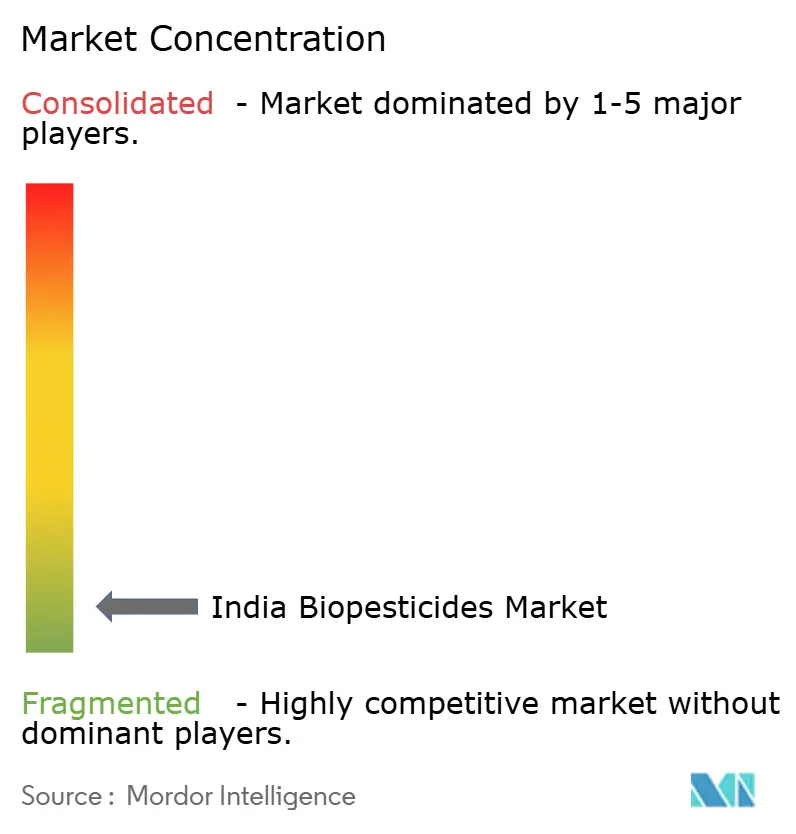
| Market Concentration | Low |
Major Players *Disclaimer: Major Players sorted in no particular order Image © Mordor Intelligence. Reuse requires attribution under CC BY 4.0. | |
India Biopesticides Market Analysis by Mordor Intelligence
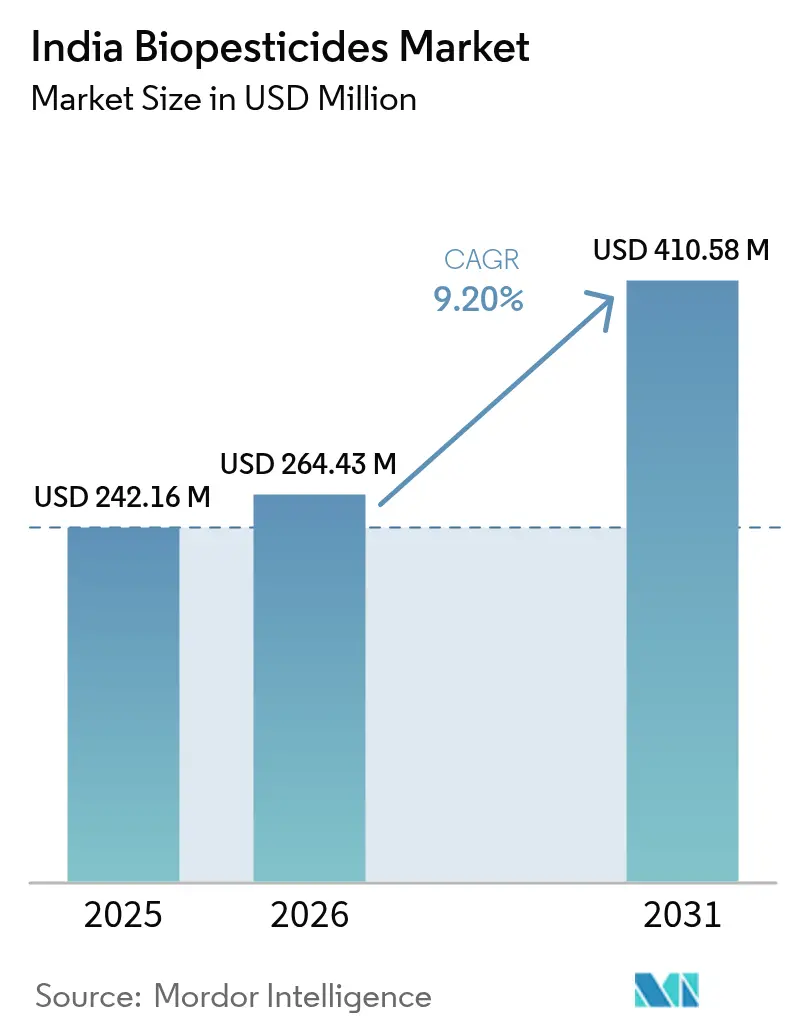
The India biopesticides market size in 2026 is estimated at USD 264.43 million, growing from 2025 value of USD 242.16 million with 2031 projections showing USD 410.58 million, growing at 9.2% CAGR over 2026-2031. Continuing regulatory support, export-driven residue compliance, and scaling public-sector biocontrol capacity create a solid demand pipeline for biological crop protection. Faster BioRRAP registrations shorten time-to-market, which encourages smaller manufacturers to launch proven microbial strains. Rising organic acreage, particularly in Punjab, Haryana, and Maharashtra, adds incremental volumes, while drone-enabled precision application improves field efficacy and user confidence. Venture capital inflows, largely from Chinese investors, help domestic start-ups expand fermentation capacity and lower production costs, further accelerating adoption in the India biopesticides market.
Key Report Takeaways
- By form, bioherbicides led the India biopesticides market with a 30.12% share in 2025, whereas bioinsecticides are projected to post the fastest growth of 10.1% CAGR up to 2031.
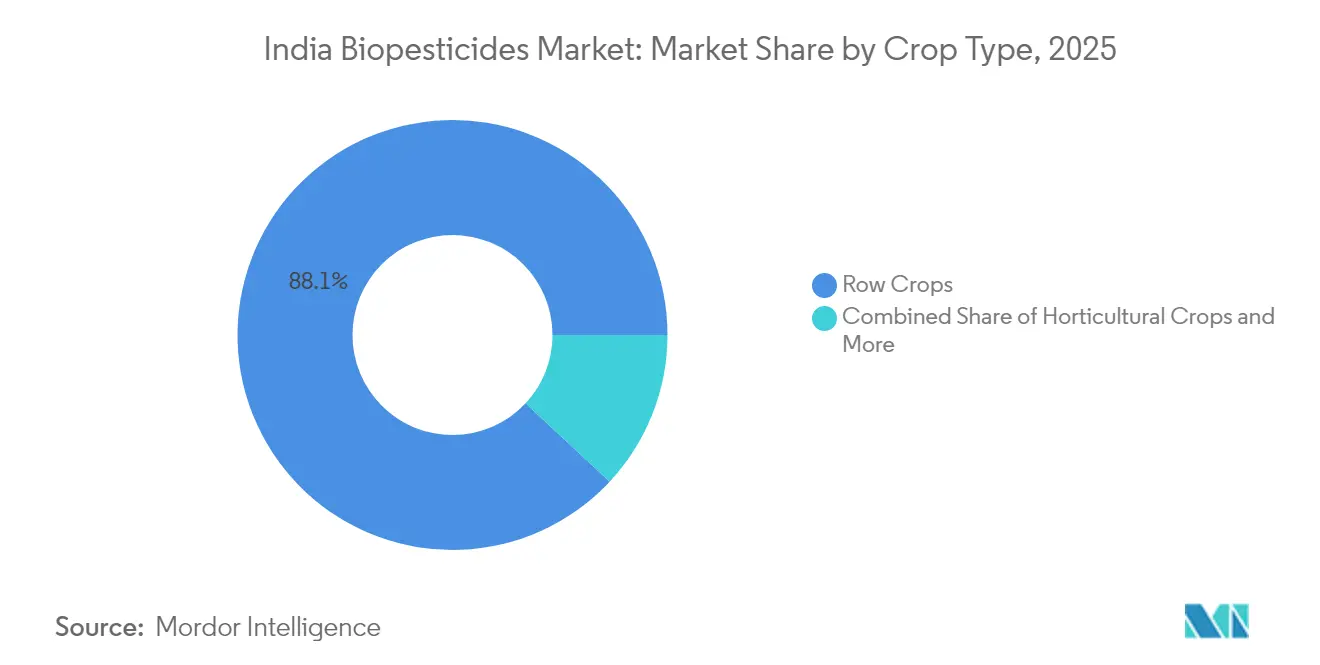
- Row crops, such as rice, wheat, and maize, accounted for 88.05% of the Indian biopesticides market size in 2025 and are anticipated to grow at a 9.2% CAGR through 2031.
Note: Market size and forecast figures in this report are generated using Mordor Intelligence’s proprietary estimation framework, updated with the latest available data and insights as of 2026.
India Biopesticides Market Trends and Insights
Drivers Impact Analysis*
| Driver | (~) % Impact on CAGR Forecast | Geographic Relevance | Impact Timeline |
|---|---|---|---|
| Growing organic farming acreage | +1.8% | National, concentrated in Punjab, Haryana, and Maharashtra | Medium term (2-4 years) |
| Stricter MRL (Maximum Residue Limit) compliance pressure from export markets | +2.1% | Export-oriented states: Maharashtra, Gujarat, Karnataka, and Tamil Nadu | Short term (≤ 2 years) |
| Roll-out of BioE3 policy and single-window BioRRAP approvals | +1.5% | National, with faster adoption in progressive states | Medium term (2-4 years) |
| Public-sector biocontrol labs scaling low-cost strains | +0.9% | National, led by ICAR institutes and state agricultural universities | Long term (≥ 4 years) |
| Drone-enabled precision delivery unlocks new use-cases | +1.2% | Technology-forward regions: Punjab, Haryana, and Western Maharashtra | Medium term (2-4 years) |
| RMB-denominated VC inflow into Indian bio-ag startups | +0.8% | Urban innovation hubs: Bangalore, Hyderabad, and Delhi NCR | Long term (≥ 4 years) |
| Source: Mordor Intelligence | |||
Growing Organic Farming Acreage
Certified organic land has seen significant growth in recent years, with government programs aiming to substantially increase the area under organic cultivation in the coming years. [1]Source: Ministry of Agriculture and Farmers Welfare, “BioE3 Policy Framework for Biotechnology Development,” Government of India, agricoop.nic.in. Organic standards prohibit synthetic pesticides, which directly boosts demand in the India biopesticides market. Export-oriented crops, such as basmati rice, spices, and tea, secure significant price premiums that offset higher biopesticide costs. Nonetheless, a conversion period creates temporary revenue gaps because farmers must adopt biological inputs before they can earn organic premiums. State initiatives in Sikkim and Andhra Pradesh show that farmer training and subsidized bio-inputs accelerate adoption.
Stricter MRL Compliance Pressure from Export Markets
Indian exporters faced significant losses due to consignments rejected for MRL breaches, and the European Union introduced several new limits that directly impact crops such as grapes, pomegranates, and basmati rice. The United States is tightening pre-harvest intervals under the Produce Safety Rule, making fast-degrading biological actives more favorable. Compliance frameworks such as GlobalGAP now award quicker certification to farms demonstrating integrated biological pest management systems, reinforcing the demand for the India biopesticides market.
Roll-out of BioE3 Policy and Single-Window BioRRAP Approvals
The BioE3 ecosystem has allocated significant funding through the coming years, with the single-window BioRRAP mechanism significantly reducing registration timelines. Small and medium enterprises benefit from considerable cost savings on compliance, creating a more level playing field against established players. Risk-based assessments streamline the use of proven microbial strains and minimize redundant testing, though uneven state implementation continues to delay some regional launches.
Public-Sector Biocontrol Laboratories Scaling Low-Cost Strains
The Indian Council of Agricultural Research (ICAR) operates numerous biocontrol labs that collectively produce significant quantities of bio-agents annually, at considerably lower costs compared to the private sector.[2]Source: Indian Council of Agricultural Research, “Biocontrol Laboratory Network Annual Report 2024,” ICAR, icar.org.in Indigenous strains exhibit better field performance in diverse agroclimates than imported formulations. Technology-transfer arrangements license strains to local producers for nominal fees, improving regional supply chains. Krishi Vigyan Kendras train numerous farmers each year in the correct application, raising confidence in the India biopesticides market.
Restraints Impact Analysis*
| Restraint | (~) % Impact on CAGR Forecast | Geographic Relevance | Impact Timeline |
|---|---|---|---|
| Short shelf-life in hot-humid supply chains | -1.4% | Pan-India, severe in coastal and tropical regions | Short term (≤ 2 years) |
| Farmer skepticism on speed-of-kill vs. synthetics | -1.1% | Traditional farming regions: UP, Bihar, West Bengal | Medium term (2-4 years) |
| Fragmented landholdings inflate last-mile distribution costs | -0.8% | National, acute in eastern and southern states | Long term (≥ 4 years) |
| Counterfeit and sub-standard products erode trust | -0.6% | Rural markets with limited quality control infrastructure | Medium term (2-4 years) |
| Source: Mordor Intelligence | |||
Short Shelf-Life in Hot-Humid Supply Chains
Biological formulations degrade significantly within a short period when ambient temperatures are extremely high and humidity levels are elevated during the monsoon. [3]Central Insecticides Board and Registration Committee, “Biopesticide Registration Guidelines,” cibrc.nic.in Only a small percentage of agricultural inputs are transported through cold chains, and most rural mandis still lack climate-controlled storage facilities. New packaging with desiccants and oxygen scavengers extends shelf life but raises unit costs significantly. Solar-powered mini cold storages, devised by the Central Institute of Post-Harvest Engineering and Technology, offer a possible solution, yet adoption is still limited due to high capital outlays.
Farmer Skepticism about Speed of Kill versus Synthetics
Many growers expect immediate pest knock-down and find biological agents slow because full mortality typically appears several days post-application compared to the quicker results of chemical alternatives. Field trials indicate similar season-long control, but a significant portion of first-time users discontinue biopesticides after one cycle, citing poor visible results. Demonstration plots and village field schools run by Krishi Vigyan Kendras help realign expectations, although they currently reach only a small fraction of agricultural villages.
*Our forecasts treat driver/restraint impacts as directional, not additive. The impact forecasts reflect baseline growth, mix effects, and variable interactions.
Segment Analysis
By Form: Bioinsecticides Accelerate Adoption
Bioherbicides held a 30.12% share of the Indian biopesticides market in 2025, reflecting the escalating labor costs associated with manual weeding. Meanwhile, bioinsecticides are projected to grow at a 10.1% CAGR, representing the leading innovation engine. Multi-strain Bacillus thuringiensis formulations, recently cleared for cotton bollworm, broaden the spectrum control and answer farmer concerns about narrow activity ranges. Coromandel International has invested significantly in fermentation capacity to meet the rising demand, and the Central Insecticides Board has approved numerous new bioinsecticide registrations, far outpacing the introduction of synthetic alternatives.
Market education programs highlight selectivity benefits that preserve pollinators and natural enemies, a key factor for integrated pest management systems. Enhanced shelf-stable, wettable powders extend storage duration, gradually alleviating viability concerns. Biofungicides are gaining popularity in high-value fruit crops, such as grapes, where fungal diseases can significantly reduce yields. Meanwhile, bionematicides and plant growth regulators occupy a niche segment with strong future potential as formulation technology advances.




By Crop Type: Row Crops Anchor Demand
Row crops, such as rice, wheat, and maize, accounted for 88.05% of the Indian biopesticides market size in 2025 and are anticipated to grow in line with the overall 9.2% sector growth. Government minimum support prices provide growers with the confidence to invest in premium inputs, thereby enhancing their competitiveness and profitability. Biological seed-treatment packages combine anti-fungal and growth-promoting strains that improve emergence in these staple cereals.
Horticultural acreage is increasing at a faster rate, driven by residue-driven export opportunities. Grapes and pomegranates, in particular, benefit from biological fungicides that leave no detectable residues. Cash crops, including cotton, incorporate bioinsecticides against bollworm and whitefly to delay the buildup of resistance. Knowledge dissemination through ICAR’s 200 crop-pest protocols assists farmers in choosing strain combinations best suited to local pests, reinforcing adoption in the India biopesticides market.
Geography Analysis
Maharashtra contributed significantly to India's biopesticides market in 2025, due to its diversified portfolio of grapes, onions, and pomegranates that must clear demanding import tests. Dedicated state subsidies for organic inputs, combined with an active horticulture export sector, foster rapid uptake. Gujarat follows, where cotton farmers are increasingly relying on bioinsecticides to combat resistant bollworms.
Punjab and Haryana exhibit moderate conversion despite intensive agriculture, and entrenched chemical use is beginning to give way to biocontrol in basmati rice as concerns about residues grow. Karnataka stands out for horticulture adoption, underpinned by research hubs in Bangalore that streamline product trials. Tamil Nadu and Andhra Pradesh advance as state-run field schools promote biological pest management; the proximity of biotech clusters supports supply reliability.
Eastern states remain underpenetrated due to fragmented holdings and weaker extension coverage, yet the National Mission on Sustainable Agriculture is piloting collective procurement models. Drone services are starting trial runs in hilly Northeast terrain, potentially leapfrogging infrastructure shortcomings. These geographic dynamics illustrate that localized extension, cold-chain reach, and export linkages shape uptake patterns in the India biopesticides market.
Competitive Landscape
The top manufacturers controlled a small share of the revenue, confirming a fragmented field with potential for consolidation. Coromandel International, UPL Limited, and T. Stanes leverage nationwide dealer networks, whereas regional specialists thrive on localized strain portfolios. Leading firms invest in vertical integration; Coromandel International’s new Visakhapatnam plant is anticipated to enhance annual capacity in the near future.
UPL Limited bundles biologicals with digital scouting and weather-based spray alerts to lock in grower loyalty. Regional players deploy indigenous strains suited to local microclimates, often winning repeat orders in a single state. Precision application technologies create new partnerships between drone service providers and bio-formulators.
Post-harvest protection and seed-treatment niches offer white-space opportunities where biological actives outperform chemicals in residue-sensitive contexts. Regulatory expertise becomes a competitive moat as firms with clean quality records navigate faster BioRRAP channels and secure global certifications valued by exporters.
India Biopesticides Industry Leaders
Coromandel International Ltd
GrowTech Agri Science Private Limited
IPL Biologicals Limited
T.Stanes and Company Limited
Gujarat State Fertilizers and Chemicals Ltd.
- *Disclaimer: Major Players sorted in no particular order

Recent Industry Developments
- October 2025: IPL Biologicals won the Bronze at the 10th Bernard Blum Awards 2025 for its biocontrol product Bellator, which is used in sustainable agriculture. This international recognition highlights India’s growing role in biological crop protection and affirms IPL Biologicals’ leadership in the biopesticide sector.
- June 2025: Arqivo, supported by Tagros Chemicals, entered the Indian agrochemical market with its launch in Uttarakhand. Its product portfolio comprises biopesticides and organic solutions, focusing on promoting sustainable farming practices nationwide.
- November 2024: The Indian Institute of Spices Research (IISR) has developed a granular lime-based Trichoderma biopesticide-fertilizer designed to enhance soil health and control diseases. This product is designed to promote sustainable farming and facilitate easy application within Indian agricultural practices.


India Biopesticides Market Report Scope
Biofungicides, Bioherbicides, Bioinsecticides are covered as segments by Form. Cash Crops, Horticultural Crops, Row Crops are covered as segments by Crop Type.Form
| Biofungicides |
| Bioherbicides |
| Bioinsecticides |
| Other Biopesticides |
Crop Type
| Cash Crops |
| Horticultural Crops |
| Row Crops |
| Form | Biofungicides |
| Bioherbicides | |
| Bioinsecticides | |
| Other Biopesticides | |
| Crop Type | Cash Crops |
| Horticultural Crops | |
| Row Crops |


Market Definition
- AVERAGE DOSAGE RATE - The average application rate is the average volume of biopesticides applied per hectare of farmland in the respective region/country.
- CROP TYPE - Crop type includes Row crops (Cereals, Pulses, Oilseeds), Horticultural Crops (Fruits and vegetables) and Cash Crops (Plantation Crops, Fibre Crops and Other Industrial Crops)
- FUNCTION - The Crop Protection function of agirucultural biological include products that prevent or control various biotic and abiotic stress.
- TYPE - Biopesticides prevent or control various pests, including insects, diseases, and weeds, from causing crop damage and yield loss.
| Keyword | Definition |
|---|---|
| Cash Crops | Cash crops are non-consumable crops sold as a whole or part of the crop to manufacture end-products to make a profit. |
| Integrated Pest Management (IPM) | IPM is an environment-friendly and sustainable approach to control pests in various crops. It involves a combination of methods, including biological controls, cultural practices, and selective use of pesticides. |
| Bacterial biocontrol agents | Bacteria used to control pests and diseases in crops. They work by producing toxins harmful to the target pests or competing with them for nutrients and space in the growing environment. Some examples of commonly used bacterial biocontrol agents include Bacillus thuringiensis (Bt), Pseudomonas fluorescens, and Streptomyces spp. |
| Plant Protection Product (PPP) | A plant protection product is a formulation applied to crops to protect from pests, such as weeds, diseases, or insects. They contain one or more active substances with other co-formulants such as solvents, carriers, inert material, wetting agents or adjuvants formulated to give optimum product efficacy. |
| Pathogen | A pathogen is an organism causing disease to its host, with the severity of the disease symptoms. |
| Parasitoids | Parasitoids are insects that lay their eggs on or within the host insect, with their larvae feeding on the host insect. In agriculture, parasitoids can be used as a form of biological pest control, as they help to control pest damage to crops and decrease the need for chemical pesticides. |
| Entomopathogenic Nematodes (EPN) | Entomopathogenic nematodes are parasitic roundworms that infect and kill pests by releasing bacteria from their gut. Entomopathogenic nematodes are a form of biocontrol agents used in agriculture. |
| Vesicular-arbuscular mycorrhiza (VAM) | VAM fungi are mycorrhizal species of fungus. They live in the roots of different higher-order plants. They develop a symbiotic relationship with the plants in the roots of these plants. |
| Fungal biocontrol agents | Fungal biocontrol agents are the beneficial fungi that control plant pests and diseases. They are an alternative to chemical pesticides. They infect and kill the pests or compete with pathogenic fungi for nutrients and space. |
| Biofertilizers | Biofertilizers contain beneficial microorganisms that enhance soil fertility and promote plant growth. |
| Biopesticides | Biopesticides are natural/bio-based compounds used to manage agricultural pests using specific biological effects. |
| Predators | Predators in agriculture are the organisms that feed on pests and help control pest damage to the crops. Some common predator species used in agriculture include ladybugs, lacewings, and predatory mites. |
| Biocontrol agents | Biocontrol agents are living organisms used to control pests and diseases in agriculture. They are alternatives to chemical pesticides and are known for their lesser impact on the environment and human health. |
| Organic Fertilizers | Organic fertilizer is composed of animal or vegetable matter used alone or in combination with one or more non-synthetically derived elements or compounds used for soil fertility and plant growth. |
| Protein hydrolysates (PHs) | Protein hydrolysate-based biostimulants contain free amino acids, oligopeptides, and polypeptides produced by enzymatic or chemical hydrolysis of proteins, primarily from vegetal or animal sources. |
| Biostimulants/Plant Growth Regulators (PGR) | Biostimulants/Plant Growth Regulators (PGR) are substances derived from natural resources to enhance plant growth and health by stimulating plant processes (metabolism). |
| Soil Amendments | Soil Amendments are substances applied to soil that improve soil health, such as soil fertility and soil structure. |
| Seaweed Extract | Seaweed extracts are rich in micro and macronutrients, proteins, polysaccharides, polyphenols, phytohormones, and osmolytes. These substances boost seed germination and crop establishment, total plant growth and productivity. |
| Compounds related to biocontrol and/or promoting growth (CRBPG) | Compounds related to biocontrol or promoting growth (CRBPG) are the ability of a bacteria to produce compounds for phytopathogen biocontrol and plant growth promotion. |
| Symbiotic Nitrogen-Fixing Bacteria | Symbiotic nitrogen-fixing bacteria such as Rhizobium obtain food and shelter from the host, and in return, they help by providing fixed nitrogen to the plants. |
| Nitrogen Fixation | Nitrogen fixation is a chemical process in soil which converts molecular nitrogen into ammonia or related nitrogenous compounds. |
| ARS (Agricultural Research Service) | ARS is the U.S. Department of Agriculture's chief scientific in-house research agency. It aims to find solutions to agricultural problems faced by the farmers in the country. |
| Phytosanitary Regulations | Phytosanitary regulations imposed by the respective government bodies check or prohibit the importation and marketing of certain insects, plant species, or products of these plants to prevent the introduction or spread of new plant pests or pathogens. |
| Ectomycorrhizae (ECM) | Ectomycorrhiza (ECM) is a symbiotic interaction of fungi with the feeder roots of higher plants in which both the plant and the fungi benefit through the association for survival. |


Research Methodology
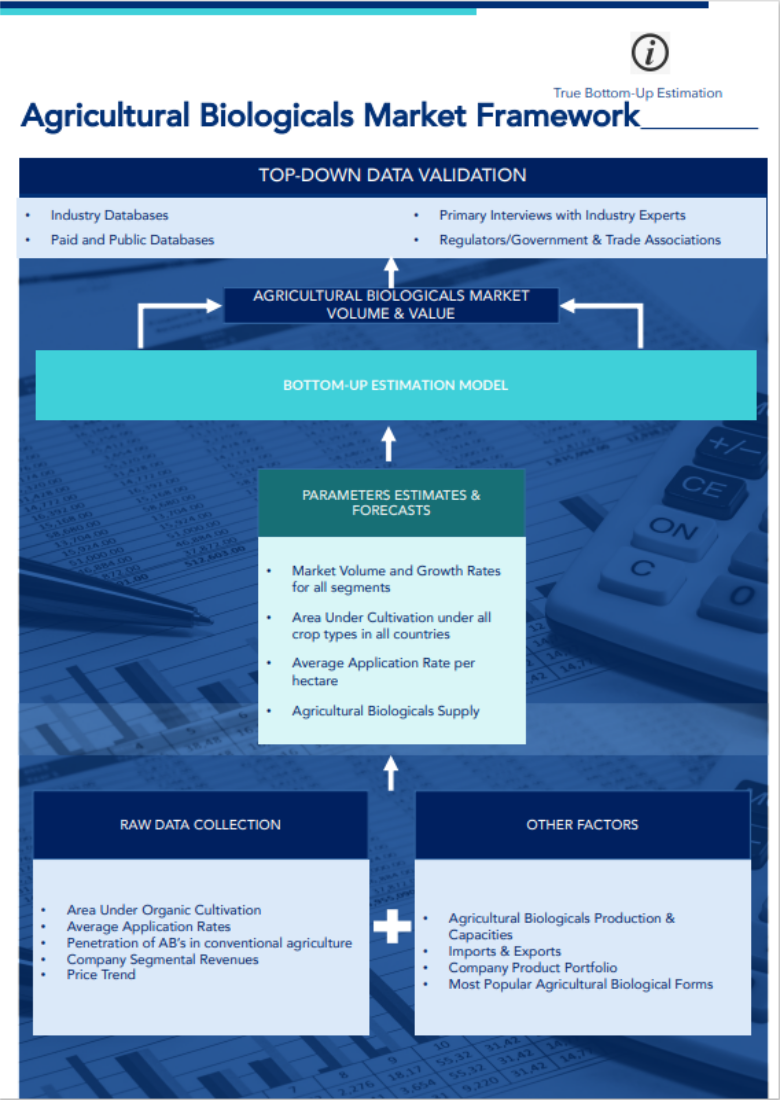
Mordor Intelligence follows a four-step methodology in all our reports.
- Step-1: Identify Key Variables: In order to build a robust forecasting methodology, the variables and factors identified in Step-1 are tested against available historical market numbers. Through an iterative process, the variables required for market forecast are set and the model is built on the basis of these variables.
- Step-2: Build a Market Model: Market-size estimations for the forecast years are in nominal terms. Inflation is not a part of the pricing, and the average selling price (ASP) is kept constant throughout the forecast period.
- Step-3: Validate and Finalize: In this important step, all market numbers, variables and analyst calls are validated through an extensive network of primary research experts from the market studied. The respondents are selected across levels and functions to generate a holistic picture of the market studied.
- Step-4: Research Outputs: Syndicated Reports, Custom Consulting Assignments, Databases & Subscription Platforms.