
In-Vitro Diagnostics Quality Control Market Size and Share
Market Overview
| Study Period | 2020 - 2031 |
|---|---|
| Market Size (2026) | USD 1.51 Billion |
| Market Size (2031) | USD 1.85 Billion |
| Growth Rate (2026 - 2031) | 4.15 % |
| Fastest Growing Market | Asia-Pacific |
| Largest Market | North America |
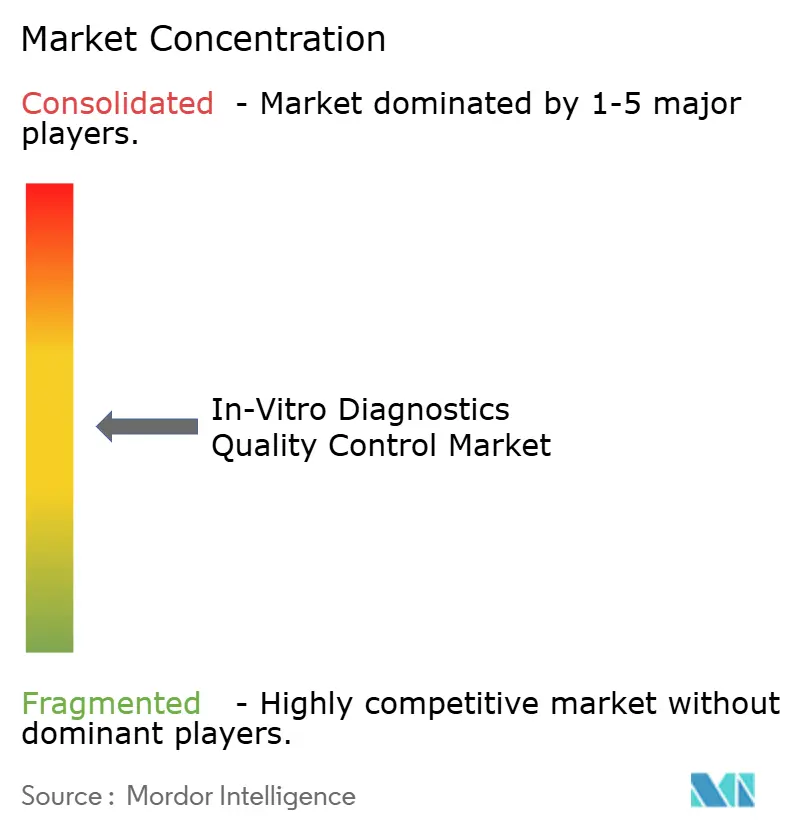
| Market Concentration | Medium |
Major Players *Disclaimer: Major Players sorted in no particular order Image © Mordor Intelligence. Reuse requires attribution under CC BY 4.0. | |
In-Vitro Diagnostics Quality Control Market Analysis by Mordor Intelligence
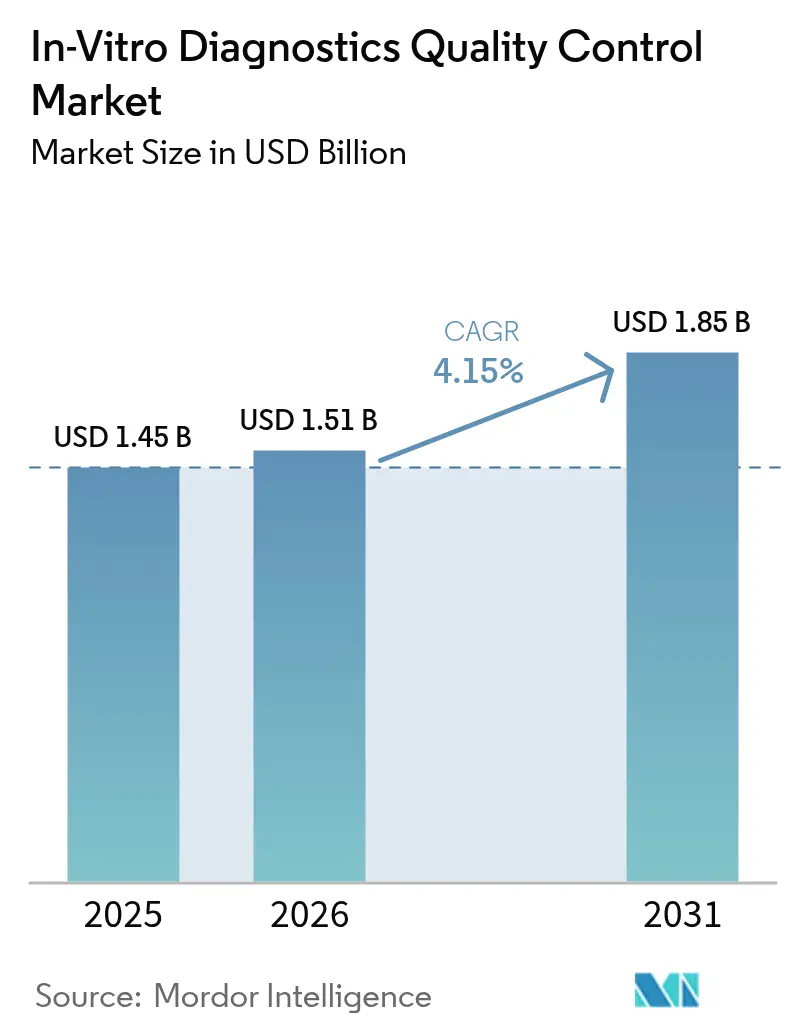
The In-Vitro Diagnostics Quality Control Market size was valued at USD 1.45 billion in 2025 and is estimated to grow from USD 1.51 billion in 2026 to reach USD 1.85 billion by 2031, at a CAGR of 4.15% during the forecast period (2026-2031).
The industry is transitioning from a focus on reagent volume to data-driven quality ecosystems that integrate hardware, software, and services. Molecular diagnostics is leading this growth, fueled by the increasing adoption of liquid biopsies and NGS panels, which require advanced multi-analyte reference materials that traditional controls cannot support. Stricter regulatory frameworks under the EU IVDR and U.S. CLIA are tying reimbursement to measurable quality performance, pushing laboratories to implement ISO-traceable controls. Additionally, middleware solutions that integrate control data into electronic health records have proven effective, reducing reportable errors by 22% in hospital pilot programs conducted in 2025.
Key Report Takeaways
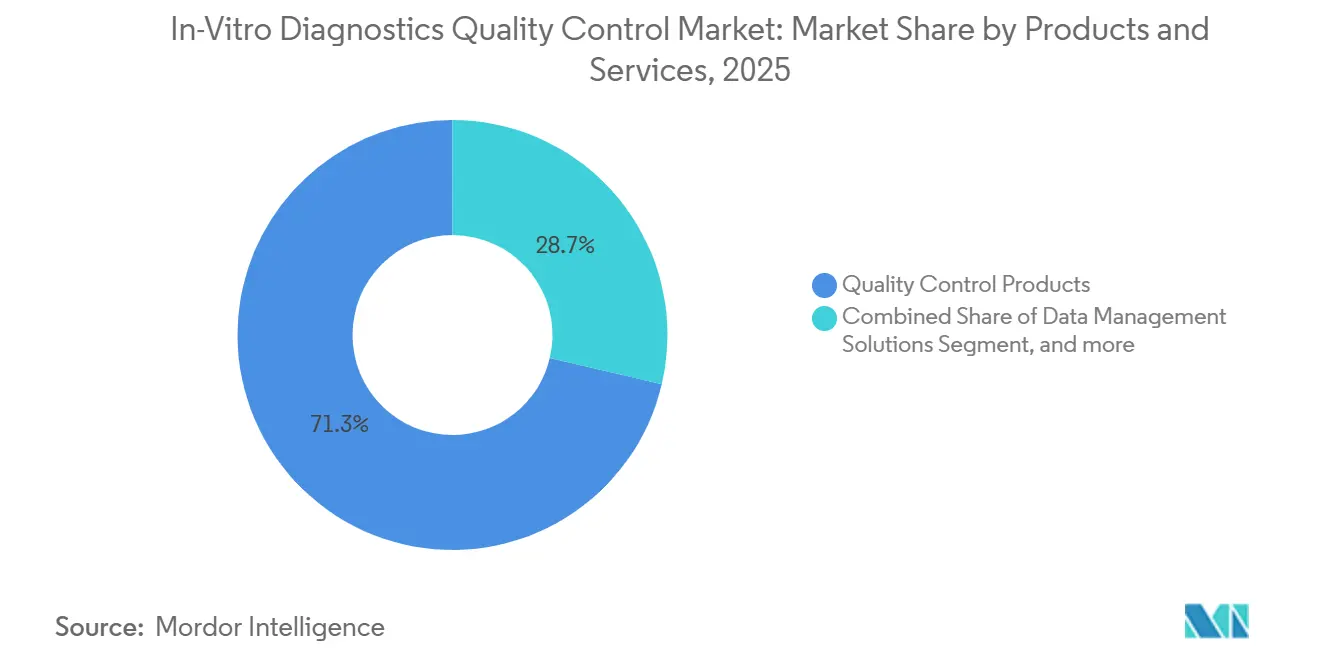
- By products and services, quality control products led with 71.32% revenue share in 2025; data management solutions are projected to expand at a 6.75% CAGR through 2031.
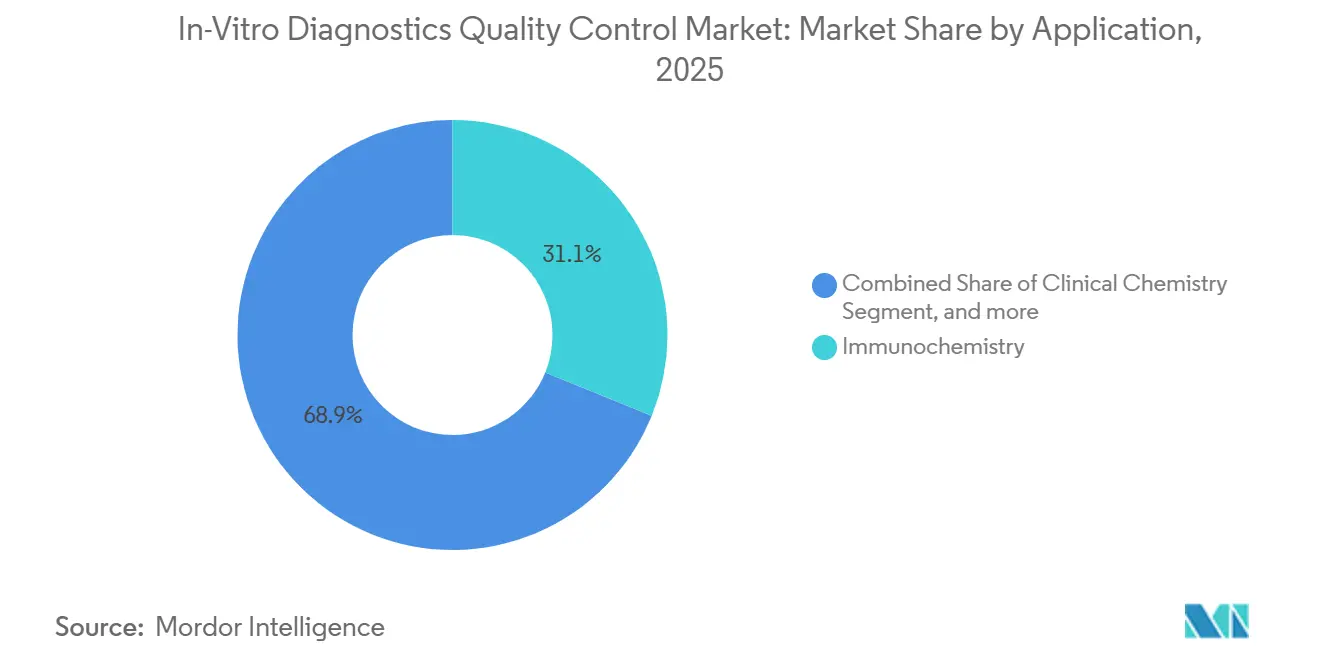
- By application, immunochemistry accounted for 31.12% of the in-vitro diagnostics quality control market share in 2025, while molecular diagnostics is expected to advance at a 6.87% CAGR to 2031.
- By end user, independent clinical laboratories accounted for 44.55% of 2025 revenue, and IVD manufacturers and contract research organizations are growing at a 7.86% CAGR.
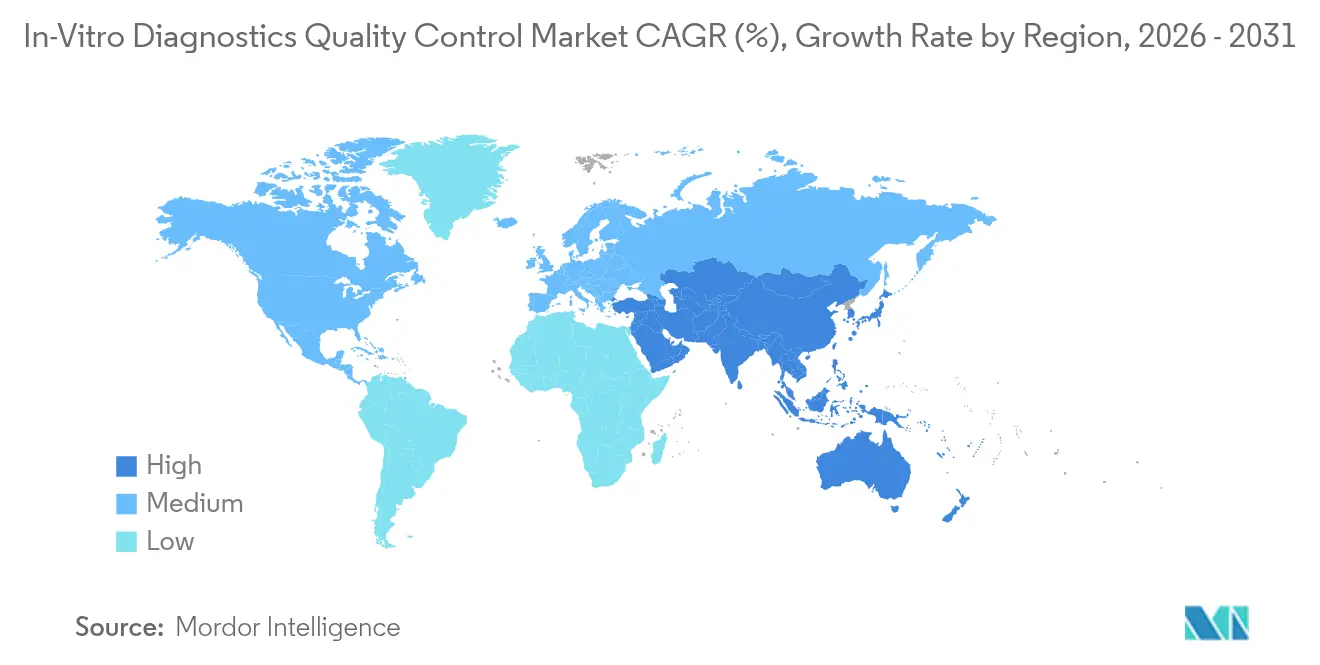
- By geography, North America accounted for 44.12% of revenue in 2025, whereas Asia-Pacific is expected to grow at a 5.65% CAGR through 2031.
Note: Market size and forecast figures in this report are generated using Mordor Intelligence’s proprietary estimation framework, updated with the latest available data and insights as of 2026.
Market Trends and Insights
Drivers Impact Analysis of In-Vitro Diagnostics Quality Control Market*
| Driver | (~) % Impact on CAGR Forecast | Geographic Relevance | Impact Timeline |
|---|---|---|---|
| Growing Global Disease Burden | +0.9% | Global with acute pressure in APAC and MEA | Long term (≥ 4 years) |
| Expansion of Accredited Clinical Laboratories | +0.8% | North America and EU core, spill-over to APAC | Medium term (2-4 years) |
| Technological Advancements in IVD Platforms | +0.7% | Global led by North America and Western Europe | Medium term (2-4 years) |
| Shift Toward Decentralized and Point-of-Care Testing | +0.6% | North America, EU, and urban APAC | Short term (≤ 2 years) |
| Increasing Regulatory Focus on Diagnostic Accuracy | +0.5% | North America, EU, and Australia | Short term (≤ 2 years) |
| Digital Transformation and Data Integration in Laboratories | +0.6% | North America, EU, and select APAC markets | Medium term (2-4 years) |
| Source: Mordor Intelligence | |||
Growing Global Disease Burden
Chronic and infectious diseases are expanding test volumes that need daily quality oversight, driving direct growth in the in-vitro diagnostics quality control market. Non-communicable ailments accounted for 74% of global deaths in 2024, and rising diabetes prevalence boosts demand for glycated hemoglobin controls that laboratories must run at multiple levels each day. Oncology laboratories increased liquid biopsy volumes by 28% in 2025, yet fewer than 40% stock circulating tumor DNA materials with defined allele frequencies, leaving a compliance gap regulators have begun to question[1]U.S. National Cancer Institute, “Liquid Biopsy Market Trends 2025,” National Cancer Institute, cancer.gov. Public health facilities in Brazil and Thailand tripled molecular control inventories during 2024-2025 outbreaks, underscoring how epidemiological swings escalate per-test quality costs. Quality spending now aligns more with disease volatility than routine growth, favoring vendors that can scale multi-analyte reference kits quickly. This trend will keep upward pressure on consumable demand even as laboratories adopt data platforms.
Expansion of Accredited Clinical Laboratories
Accreditation has shifted quality control from optional to mandatory spending, enlarging the in-vitro diagnostics quality control market across mature regions. The College of American Pathologists counted 8,200 accredited U.S. labs by December 2025, a 6% rise since 2023, after Medicare tied reimbursement eligibility to deemed-status recognition. ISO 15189 became a prerequisite for public procurement in Germany and France, prompting 1,400 private labs to launch compliance programs that require documented controls on every platform. China ordered all tertiary hospitals to secure ISO 15189 status by 2027, influencing roughly 3,000 facilities and fueling short-term spikes in bulk control purchases. Accreditation also pushes buyers toward suppliers that can provide certificates traceable to international reference methods, consolidating share among multinational vendors. Laboratories now treat control documentation as a credential for payer negotiations and public tenders.
Technological Advancements in IVD Platforms
High-throughput systems such as Roche cobas pro process up to 300 samples per hour and require controls with proven commutability with fresh human serum, a feature that only a few third-party suppliers offer today. Abbott Alinity flagged 12% of generic controls as out of linearity during 2025 validations, pressuring labs to adopt proprietary materials or finance costly bridging studies. In molecular diagnostics, next-generation sequencing panels require synthetic DNA references with single-nucleotide precision, yet fewer than eight suppliers hold FDA clearance for BRCA1 or EGFR materials. Specialty firms now develop modular kits that laboratories can tailor for custom gene lists, opening new revenue lanes. Platform vendors have begun bundling exclusive controls within reagent-rental contracts to lock in service revenue. This technical escalator elevates entry barriers and steers demand toward integrated ecosystems.
Shift Toward Decentralized and Point-of-Care Testing
Point-of-care expansion fragments oversight and exposes quality gaps, affecting near-term growth of the in-vitro diagnostics quality control market. The FDA cleared 47 new POCT devices in 2025, but only 18% included stability data for tropical field conditions, leaving clinics uncertain about control frequency. A 2024 CLIA audit found that 34% of physician office labs skipped external control runs due to cost and workflow concerns. Suppliers responded with single-use ambient-stable formats that remove refrigeration needs and cut waste in low-volume sites. Device makers are also embedding electronic algorithms that validate performance using patient result patterns, a shift that could erode up to 20% of traditional control demand by 2030 if regulators approve the method. The tension between convenience and traceability will determine adoption curves.
Restraints Impact Analysis of In-Vitro Diagnostics Quality Control Market*
| Restraint | (~) % Impact on CAGR Forecast | Geographic Relevance | Impact Timeline |
|---|---|---|---|
| Unfavorable Reimbursement Landscape | -0.5% | North America, secondary effects in EU | Short term (≤ 2 years) |
| Limited Laboratory Infrastructure in Emerging Regions | -0.4% | Sub-Saharan Africa, Southeast Asia, rural Latin America | Long term (≥ 4 years) |
| High Compliance and Validation Costs | -0.3% | North America and EU | Medium term (2-4 years) |
| Supply Chain Vulnerabilities and Material Shortages | -0.2% | Global, most acute in emerging markets | Short term (≤ 2 years) |
| Source: Mordor Intelligence | |||
Unfavorable Reimbursement Landscape
Payment cuts force laboratories to ration control use, weighing on near-term growth of the in-vitro diagnostics quality control market. Medicare’s schedule has reduced test fees by a cumulative 8.5% since 2021 and more reductions are scheduled through 2027, prompting 42% of U.S. hospital labs to move from twice-daily to once-daily runs for stable analytes in 2025 surveys. Commercial insurers introduced prior authorization on molecular tests, shrinking volumes by 18% and delaying purchases of high-cost next-generation sequencing controls. German statutory payers negotiated a 3.2% tariff cut in 2025 that hit small independent labs hardest, as they lack the volume discounts enjoyed by national chains[2]GKV-Spitzenverband, “Laboratory Tariff Agreement 2025,” GKV-Spitzenverband, gkv-spitzenverband.de. Consolidation accelerated, with 127 U.S. independents acquired in 2025 because shrinking margins made standalone quality programs unsustainable. Suppliers face pressure to lower per-test costs or risk being replaced by in-house electronic quality schemes.
Limited Laboratory Infrastructure in Emerging Regions
Power outages and weak cold-chain capacity limit product viability and sales potential in many low-income markets, restraining the long-term trajectory of the in-vitro diagnostics quality control market. Only 29% of sub-Saharan African labs reported uninterrupted electricity in a 2024 WHO audit, and fewer than 15% possessed functional refrigeration for temperature-sensitive controls. A 2025 survey in India found that 61% of district labs lacked staff trained to interpret Westgard rules, leading to undetected systematic errors. Import tariffs ranging from 12% in Vietnam to 28% in Nigeria inflate control costs by up to 50%, pushing buyers toward uncertified local products with erratic lot performance[3]World Bank, “Customs Tariffs on Medical Reagents Database 2025,” World Bank, worldbank.org. Regulatory bodies in fewer than 20 African and Southeast Asian countries mandate external quality assessment, removing incentives to invest in premium controls. Until multilateral funding improves infrastructure, growth in these regions will lag the global average.
*Our forecasts treat driver/restraint impacts as directional, not additive. The impact forecasts reflect baseline growth, mix effects, and variable interactions.
In-Vitro Diagnostics Quality Control Market Segment Analysis
By Products & Services:
Data Platforms Reshape Value CaptureQuality control products accounted for 71.32% of 2025 revenue, equal to about two-thirds of the in-vitro diagnostics quality control market, reflecting laboratories’ continuing need for multi-level liquid and lyophilized reagents for daily instrument checks. Data management solutions, although still a smaller slice, are expanding at a 6.75% CAGR as laboratories adopt cloud platforms that automate Westgard rule application and flag instrument drift in real time. Roche’s navify Quality Control Management demonstrated a 19% cut in unplanned downtime across 34 hospitals by triaging service calls before errors reached patients. Bio-Rad broadened its Liquichek line to 42 analytes per vial, lowering inventory complexity and sustaining reagent demand. At the same time, subscription analytics generate recurring revenue that offsets slowing vial growth.
Laboratories now evaluate suppliers on the combined value of reagents, middleware, and proficiency testing programs, a shift that re-orders procurement criteria toward end-to-end ecosystems. As a result, data platforms win share even when offered at premium prices because they quantify cost avoidance from prevented errors. The in-vitro diagnostics quality control market share for pure-play software is poised to rise as younger lab directors prioritize workflow efficiency over per-vial cost. Suppliers that cannot complement reagents with predictive analytics risk being relegated to second-tier status. Demand therefore tilts toward companies owning ISO-17025 plants plus software development teams, giving multinationals a scale edge.



By Application:
Molecular Diagnostics Outpaces Legacy SegmentsImmunochemistry retained 31.12% of 2025 demand, benefiting from thyroid, cardiac, and tumor marker panels that require daily multi-level controls. Yet molecular diagnostics is growing at 6.87% as oncology companion tests and infectious-disease panels migrate to multi-gene workflows that need synthetic DNA references traceable to WHO standards. Coagulation is another bright spot because direct oral anticoagulants force laboratories to validate anti-Xa assays with chromogenic substrates, raising control spend per test by about 12% since 2024. Clinical chemistry and hematology remain mature but stable, underpinned by high-volume metabolic panels.
The in-vitro diagnostics quality control market for molecular assays will grow as next-generation sequencing panels expand from single-gene panels to 500-plus-gene oncology portfolios. Fewer than eight vendors now hold FDA clearance for BRCA or EGFR reference materials, creating scarcity pricing and high gross margins. Point-of-care testing controls are also rising because the U.S. FDA draft guidance now expects stability data under worst-case tropical environments, spurring adoption of ambient-stable lyophilized kits. Suppliers that tailor modular kits enabling laboratories to customize mutation mixes stand to capture incremental share. Those lacking nucleic-acid manufacturing capacity face a steep entry barrier, reinforcing consolidation trends in advanced applications.
By End User:
IVD Manufacturers Internalize Quality FunctionsIndependent clinical laboratories generated 44.55% of 2025 revenue, reflecting routine chemistry, immunoassay, and hematology workloads that depend on twice-daily control runs. Hospitals follow, but their growth is tempered as group purchasing organizations negotiate multi-year contracts that cap price increases at 2-3% annually. IVD manufacturers and contract research organizations, though smaller, are expanding at a 7.86% CAGR by conducting in-house validation to shorten regulatory timelines and secure design-history files before product launch. Academic centers buy specialized controls for translational research, driven by the U.S. NIH rigor guidelines that require assay validation evidence in every omics grant.
The in-vitro diagnostics quality control market share for manufacturer-run labs will climb as platform vendors vertically integrate lot-release testing and proficiency programs. Ambulatory and physician-office laboratories lag because 34% failed to meet recommended control frequencies during the 2025 CLIA reviews, citing workflow disruptions. Suppliers responded with single-use vials that cut handling time by 60%, narrowing the compliance gap. Over the forecast period, purchasing power will continue to shift toward multinational IVD companies and consolidated hospital networks, nudging smaller independent labs either to merge or to outsource quality functions.
Geography Analysis
North America In-Vitro Diagnostics Quality Control Market
North America captured 44.12% of 2025 revenue, underpinned by stringent CAP accreditation and CMS payment rules that reward documented quality, but growth now moderates as reimbursement cuts pressure laboratories to reduce daily control frequency. The United States alone accounts for more than three-quarters of regional spending, yet its cost-containment climate is pushing suppliers to offer value-based contracts that tie price to instrument uptime. Canada shows steadier momentum because provincial health plans have ring-fenced laboratory budgets through 2028.
Europe In-Vitro Diagnostics Quality Control Market
Europe is the second-largest region, driven by Germany, France, and the United Kingdom, which together contributed roughly 62% of 2025 sales after the EU IVDR mandated lot-to-lot surveillance for every control shipment. Laboratories fast-tracked ISO 15189 certification to qualify for public tenders, adding about 1,400 new accredited sites in 2024-2025. Southern Europe lags due to fragmented payer systems, but convergence toward Northern standards is expected by 2028. The in-vitro diagnostics quality control market size tied to European public hospitals will likely edge higher as digital quality records become compulsory.
APAC, MEA and South America In-Vitro Diagnostics Quality Control Market
Asia-Pacific advances at a 5.65% CAGR through 2031, led by China’s mandate that all tertiary hospitals secure ISO 15189 status by 2027, a move that touches about 3,000 institutions. India’s private chains continue rolling out tier-2 city labs, broadening reach where facility density is under one lab per 100,000 people. Japan and South Korea remain mature but demand premium multi-level controls as ministries enforce daily QC logs. Emerging ASEAN markets wrestle with refrigeration gaps, so ambient-stable kits dominate orders. The Middle East and Africa still represent a small share, yet Gulf Cooperation Council spending on reference labs positions the region for mid-single-digit growth. South America’s outlook hinges on Brazil and Argentina, where currency swings hinder capital equipment buys but keep consumable purchases resilient, anchoring a baseline for the in-vitro diagnostics quality control market share in the region.

Regulatory Landscape
Regulation is tightening around documented, traceable quality systems for IVD manufacturing and laboratory operations, which is increasing the importance of third-party and instrument-integrated QC materials. In the United States, the FDA Quality Management System Regulation (QMSR) became effective in February 2026 and incorporates ISO 13485:2016 by reference, reinforcing end-to-end controls, documentation, and supplier quality management practices that flow through to QC design, labeling, and lot release.
In Europe, the IVDR framework continues to formalize conformity assessment processes and reduce uncertainty around Notified Body operations. In May 2026, Commission Implementing Regulation (EU) 2026/977 set uniform operational rules and defined maximum timelines for certain notified body activities (including a 90-day QMS review timeline), while the IVDR harmonised standards list was updated in June 2026 via Commission Implementing Decision (EU) 2026/1313 (including EN ISO 15223-1:2021/A1:2025). Separately, the FDA LDT final rule published in May 2024 phases out broad enforcement discretion for laboratory developed tests over four years, increasing the compliance burden on clinical laboratories and intensifying demand for validated QC and traceable documentation.
Value Chain Analysis
The value chain spans (1) upstream inputs such as human-source matrices (including plasma collection networks), synthetic polymer feedstocks, preservatives, and packaging; (2) specialized reference material and control manufacturers producing liquid and lyophilized multi-analyte controls and synthetic nucleic-acid materials; (3) IVD system providers and diagnostics specialists that bundle proprietary controls, software, and service; and (4) distribution through direct contracting with hospital networks and consolidated independent laboratories, plus established diagnostic distributors supporting hospital and point-of-care sites. Data-layer participants (middleware and cloud QC management) increasingly sit between controls and end users by converting QC runs into audit-ready documentation and performance dashboards.
Bottlenecks and value capture are shaped by certified reference material lead times, scarcity of high-titre or rare biological materials that constrain disease-state matrices, and regulatory throughput limits such as EU Notified Body capacity. Policy shifts also affect sourcing and localization decisions: the EU amendment 2024/1860 revised IVDR transitional provisions for legacy devices, and the US FDA May 2024 final rule on LDTs increases QMS requirements that pull documentation upstream to suppliers. Tariff pressure on outside-the-US manufactured medical device components and reagents adds another cost variable, which is accelerating interest in localized manufacturing, synthetic materials where feasible, and tighter supplier qualification to maintain lot-to-lot consistency.
Competitive Landscape
Roche, Bio-Rad Laboratories, Siemens Healthineers, Abbott, and Danaher’s Beckman Coulter collectively controlled 58% of 2025 global revenue, giving the in-vitro diagnostics quality control market a moderately concentrated profile. Leading firms anchor strategy on platform integration; Roche bundles cobas controls and navify software within reagent‐rental agreements that lock customers into multiyear consumable streams. Siemens Healthineers deploys Atellica Quality Control Management on Microsoft Azure, offering laboratories peer-benchmarking dashboards that justify premium pricing. Abbott strengthens defensibility by restricting third-party controls on Alinity instruments after 2025 validation mismatches and now promotes an FDA-cleared respiratory pathogen kit to keep consumables in-house.
Mid-tier players carve niches through formulation innovation. Randox Laboratories and Technopath Clinical Diagnostics supply lyophilized vials with 24-month ambient stability, reducing cold-chain logistics costs by about 30% in regions lacking reliable refrigeration. ZeptoMetrix and SeraCare target molecular assays with customizable synthetic DNA references that laboratories can tailor to any multi-gene oncology panel, winning orders from independent oncology labs. Streck focuses on point-of-care by launching room-temperature platelet and hematology controls that cut handling time in busy clinics.
Competitive dynamics now reward suppliers that couple ISO-17025 manufacturing, deep regulatory affairs, and cloud analytics. Patent filings underscore the shift: Bio-Rad lodged seven patents on lyophilized immunoassay matrices during 2024-2025, while Roche secured intellectual property for multi-site quality dashboards at the U.S. Patent and Trademark Office. Mergers and acquisitions accelerate capability stacking: Bio-Rad purchased Quantum Analytics for USD 340 million to embed predictive algorithms into Liquichek programs, and Thermo Fisher acquired CorEvitas to broaden real-world evidence and external assessment services. As electronic algorithms for “virtual” controls gain regulatory traction, incumbents race to demonstrate software superiority before quality schemes that eschew hardware erode the reagent base. The net effect is a tilt toward vendors able to sell integrated ecosystems rather than stand-alone vials, reinforcing the current share hierarchy while leaving white-space for agile specialists in molecular diagnostics.
In-Vitro Diagnostics Quality Control Industry Leaders
Abbott Laboratories
Thermo Fisher Scientific Inc.
F. Hoffmann-La Roche AG
Siemens Healthineers AG
Bio-Rad Laboratories Inc.
- *Disclaimer: Major Players sorted in no particular order
In-Vitro Diagnostics Quality Control Market Companies Covered in this Report
- Abbott Laboratories
- Alpha Laboratories Ltd.
- Bio-Rad Laboratories
- Bio-Techne
- bioMérieux
- Danaher
- DiaSorin
- Roche
- Fortress Diagnostics Ltd.
- Grifols Diagnostic Solutions
- Instand e.V.
- LGC Clinical Diagnostics (SeraCare & Maine Standards)
- Maine Molecular Quality Controls
- Microbiologics
- Qnostics Ltd.
- QuidelOrtho
- Randox Laboratories
- Seegene
- Seronorm AS
- Siemens Healthineers
- Streck Inc.
- Sun Diagnostics LLC
- Sysmex
- Technopath Clinical Diagnostics
- Thermo Fisher Scientific
- ZeptoMetrix
Read Analysis of In-Vitro Diagnostics Quality Control Companies

Market Opportunities and Future Outlook
A major opportunity area sits at the intersection of regulation and laboratory workflow digitization, where laboratories and IVD vendors are standardizing QC documentation to satisfy audits, reimbursement-linked quality requirements, and cross-site comparability. ISO 15189:2022 is used as a benchmark for medical laboratory quality management in many accreditation programs and is referenced in IVDR-related discussions for laboratories running tests under Article 5(5), creating whitespace for vendors that can package ISO-traceable controls together with automated rule application, corrective action documentation, and connectivity into LIS and broader quality systems. The market also shows room for multi-analyte and molecular reference materials that traditional controls cannot support, particularly for NGS and liquid-biopsy workflows where defined allele frequency materials and commutability expectations raise the technical bar.
Connected QC and remote monitoring platforms also represent a nearer-term opportunity as laboratories shift from manual, episodic checks to continuous performance oversight across instrument fleets and decentralized sites. Within the current market context, middleware integration has demonstrated measurable reductions in reportable errors in hospital pilots during 2025, which supports broader adoption of QC data management as a procurement criterion rather than an add-on. Point-of-care expansion and environmental stability requirements further highlight demand for ambient-stable, single-use controls and for systems that embed QC into instrument software to reduce operator burden while preserving traceability under evolving US and EU compliance expectations.
Recent Industry Developments in In-Vitro Diagnostics Quality Control Market
- June 2026: Roche, through its subsidiary TIB MOLBIOL, developed and deployed a molecular PCR test for the Ebola Bundibugyo virus that runs on LightCycler and cobas z 480 platforms. The rapid assay development and compatibility with installed PCR systems reinforces the strategic role of standardized controls and validation materials in outbreak-scale molecular testing.
- January 2026: bioMérieux acquired Accellix, a US company specializing in rapid, automated flow cytometry solutions for cell and gene therapy quality control. The acquisition expands bioMérieux's capabilities in automated QC workflows and strengthens its footprint in advanced-therapy quality control, a segment that increasingly overlaps with regulated diagnostic-grade performance and documentation needs.
- May 2025: Roche highlighted the cobas ultra system at its Diagnostics Day briefing, positioning it as a next-generation laboratory system with integrated workflow elements that include quality control features. The emphasis on embedded QC supports the broader market shift from standalone vials toward platform-linked QC and data management that simplifies compliance and operational oversight.


In-Vitro Diagnostics Quality Control Market Report Scope and Research Methodology
Market Definition and Coverage
This market covers the revenues earned from in vitro diagnostics (IVD) quality control used to check whether lab tests are performing as intended, including control products, related data management solutions, and quality assurance services used across routine diagnostic workflows.
Scope exclusions: It excludes IVD instruments and standard diagnostic reagents that are sold mainly for patient testing rather than quality monitoring.
Segments Covered in This Report
- By Products & Services
- Quality Control Products
- Data Management Solutions
- Quality Assurance Services
- By Application
- Immunochemistry
- Clinical Chemistry
- Hematology
- Molecular Diagnostics
- Coagulation / Hemostasis
- Microbiology & Infectious Disease
- Point-Of-Care Testing
- By End User
- Hospitals
- Independent Clinical Laboratories
- IVD Manufacturers & CROs
- Academic & Research Institutes
- Ambulatory & Physician Office Labs
- Geography
- North America
- United States
- Canada
- Mexico
- Europe
- Germany
- United Kingdom
- France
- Italy
- Spain
- Rest of Europe
- Asia-Pacific
- China
- Japan
- India
- Australia
- South Korea
- Rest of Asia-Pacific
- Middle East & Africa
- GCC
- South Africa
- Rest of Middle East & Africa
- South America
- Brazil
- Argentina
- Rest of South America
- North America
Data Sources, Market Sizing, and Validation
Desk Research
Desk work starts by mapping the real testing environment in which quality control is consumed, and then aligning it with what can be tracked in public statistics. We refer to sources such as the US FDA (regulatory and safety communications), the US CDC (public health testing priorities), the WHO (disease surveillance context), and the OECD health statistics (health system capacity indicators), since these help frame demand signals that ultimately drive IVD testing volumes.
To anchor the commercial side, we also review company filings and investor presentations, association websites, and reputed press coverage to understand portfolio mix and pricing direction for controls, software, and services. When helpful, paid subscriptions are used for company financials and intelligence, patent databases (to see method and panel activity), and shipment-level import and export data for cross-checking trade movement of relevant materials. The source list stated here is not exhaustive, and additional references were used to collect data, validate assumptions, and clarify open points.
Primary Interviews and Surveys
Primary interviews and surveys are used to validate the sizing logic with people who see ordering, usage patterns, and QC policy requirements in daily practice. We typically speak with QC material suppliers, lab managers, hospital and reference lab stakeholders, and quality leads, and then we cross-check differences in adoption across APAC, EMEA, and the Americas so the regional assumptions remain aligned to day-to-day purchasing behavior.
Distribution of primary research fieldwork respondents
| Company type | Respondent position | Region |
|---|---|---|
| Top tier: 33% | CXOs: 12% | APAC: 46% |
| Mid tier: 49% | Functional/Unit leaders: 30% | EMEA: 35% |
| Smaller Players: 18% | Managers: 58% | Americas: 19% |
Market-Sizing & Forecasting
Market size is built using a top-down model where the demand pool is reconstructed from IVD testing activity and the QC burden that laboratories must run to keep assays under control (which varies by test type and lab accreditation practice). Those totals are then corroborated with selective bottom-up approximations, such as sampled average selling price ranges for common control formats multiplied by implied run rates, followed by channel checks to confirm the totals feel realistic.
Key inputs used in the model include the split of testing by major application areas (for example, clinical chemistry, immunoassay, molecular, and microbiology), typical control frequency and lot change behavior, the installed base and throughput of routine analyzers as a proxy for run volume, and adoption of data management tools for QC documentation. When gaps appear in bottom-up checks, the model uses bounded ranges and applies conservative mid-points that are confirmed again during follow-up calls, so one large estimate does not over-pull the total.
For forecasting, scenario analysis is used because demand is shaped by a few practical drivers that can shift with funding and testing priorities. Growth is projected by combining expected test volume trends, pricing movement for control materials, and the mix shift toward higher complexity panels, with assumptions adjusted using expert consensus collected during fieldwork.
Data Validation & Update Cycle
Validation is done through several passes where outputs are compared against independent signals, and then the biggest variances are investigated before sign-off. We run checks such as regional share sanity tests, growth rate consistency versus IVD testing growth, and price-volume logic to spot anomalies that may come from unit errors or overstated adoption.
If a metric breaks expected bounds or if expert feedback contradicts the modeled direction, the team re-contacts sources and revises the assumption trail so changes are traceable. The report is refreshed annually, and interim updates are completed when material events occur, after which a final pre-delivery review is run so clients receive the most current view available at release time.
Mordor Intelligence's In Vitro Diagnostics Quality Control Market Size Compared Against Other Published Estimates
Published market values for IVD quality control do not always match, even when the topic name looks the same, because the scope boundary can shift in small but meaningful ways. Differences often come from what gets counted as quality control versus general lab consumables, how software and services are treated, and which year is used as the sizing anchor.
By tracking QC consumption across control products, data management solutions, and quality assurance services, Mordor Intelligence keeps the count tied to repeatable QC activity signals rather than folding in broader IVD spending, which is a common reason totals spread apart.
Benchmark comparison
| Source | Market Size | Gaps in Research Methodology |
|---|---|---|
| Mordor Intelligence | USD 1.45 B (2025) | |
| Global Consultancy A | USD 1.55 B (2025) | Uses a broader definition that can treat lab software and supporting services as a wider quality management spend, and it may apply higher average pricing assumptions across regions, which lifts the 2025 total. |
| Industry Research Group B | USD 1.28 B (2023) | Uses an earlier base year and a narrower counted set focused on control materials, which can understate services and newer QC data management adoption that became more visible in later years. |
The benchmark range largely comes down to the counted boundary and the chosen base year. When scope is kept tight to QC-specific products, software, and services, and when year alignment is handled carefully, the final number becomes easier to audit and repeat with the same input signals over time.


Key Questions Answered in the Report
What is the projected value of the in-vitro diagnostics quality control market in 2031?
The market is forecast to reach USD 1.85 billion by 2031.
Which application category is growing fastest within quality control?
Molecular diagnostics leads with a projected 6.87% CAGR through 2031.
Why are data management platforms gaining traction among laboratories?
Cloud middleware predicts control failures, cuts reportable errors by 22%, and reduces analyzer downtime, delivering measurable cost savings.
How concentrated is supplier power in this space?
The five largest vendors control 58% of 2025 revenue, reflecting moderate concentration.
What geographic region shows the highest growth rate?
Asia-Pacific advances at a 5.65% CAGR, propelled by China's ISO 15189 mandate and expanding private diagnostic networks.
How are reimbursement cuts affecting laboratory quality programs?
U.S. Medicare fee reductions prompt many labs to lower control run frequency, pressuring suppliers to offer
Page last updated on:


 Your data is secure and never sold or shared.


