
IIoT Device Identity Security Market Size and Share
Market Overview
| Study Period | 2021 - 2032 |
|---|---|
| Market Size (2027) | USD 4.30 Billion |
| Market Size (2032) | USD 10.71 Billion |
| Growth Rate (2027 - 2032) | 20.05 % |
| Fastest Growing Market | Asia-Pacific |
| Largest Market | North America |
| Market Concentration | Medium |
Major Players *Disclaimer: Major Players sorted in no particular order Image © Mordor Intelligence. Reuse requires attribution under CC BY 4.0. | |
IIoT Device Identity Security Market Analysis by Mordor Intelligence
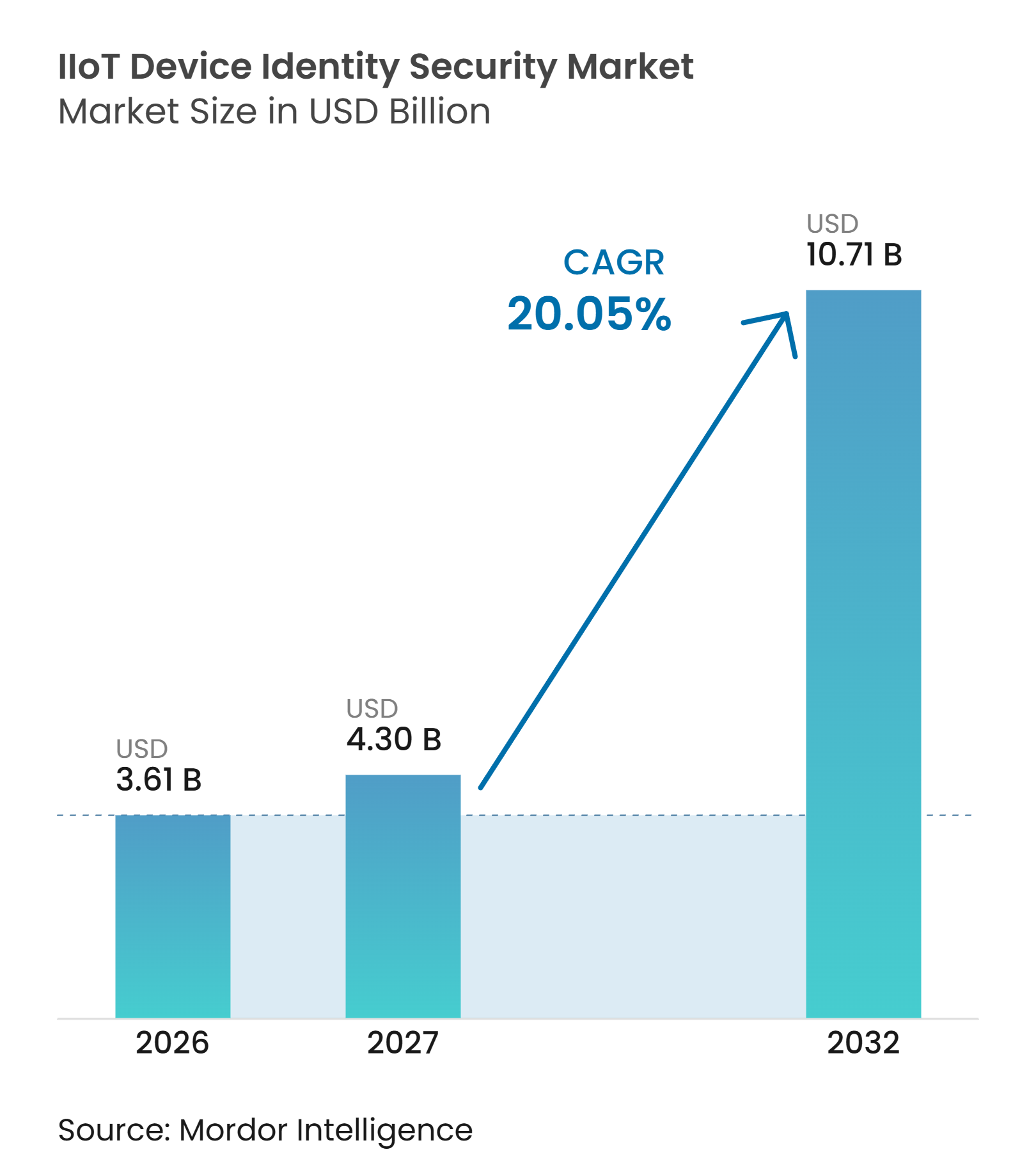
The IIoT device identity security market size is projected to expand from USD 3.61 billion in 2026 to USD 4.33 billion in 2027, and to USD 10.71 billion by 2032, registering a CAGR of 20.05% between 2027 and 2032. Growth reflects the need to give connected operational technology assets a verifiable cryptographic identity as industrial networks expand. Device makers and plant operators are facing lifecycle security obligations that increase demand for secure provisioning, certificate management, and software attestation. Zero-trust programs are moving closer to sensors, controllers, and gateways, where network boundaries alone cannot determine whether a device should be trusted. Suppliers are responding by combining hardware roots of trust with software that can issue, monitor, renew, and revoke credentials. This leaves a large legacy estate difficult to protect because older equipment often cannot support modern identity controls.
Key Report Takeaways
- By component, software led with 67.10% of the IIoT device identity security market share in 2026, while services are projected to expand at a 22.05% CAGR through 2032.
- By identity function, certificate and key lifecycle management accounted for 51.29% of the IIoT device identity security market revenue in 2026, while firmware integrity and remote attestation are projected to grow at a 21.45% CAGR through 2032.
- By deployment mode, on-premises accounted for 66.21% of the IIoT device identity security market revenue in 2026, while cloud is projected to grow at a 21.79% CAGR through 2032.
- By organization size, large enterprises held 70.14% of the IIoT device identity security market revenue in 2026, while small and medium enterprises are projected to grow at a 22.36% CAGR through 2032.
- By industry vertical, industrial manufacturing held 30.11% of the IIoT device identity security market revenue in 2026, while automotive and mobility are projected to expand at a 20.71% CAGR through 2032.
- By geography, North America held 37.12% of revenue in 2026, while Asia-Pacific is projected to grow at a 21.10% CAGR through 2032.
Note: Market numbers in this report are based on Mordor Intelligence's proprietary estimation framework, which combines nine months of actuals with Q4 projections for base year 2026.
Global IIoT Device Identity Security Market Trends and Insights
Drivers Impact Analysis*
| Driver | (~) % Impact on CAGR Forecast | Geographic Relevance | Impact Timeline |
|---|---|---|---|
| Brownfield OT Asset Connectivity and Identity Blind Spots | +4.5% | Global, concentrated in North America, Germany, Japan, and China | Short term (≤ 2 years) |
| EU Cyber Resilience Act Product Lifecycle Obligations | +4.0% | Europe core, with supply chain effects in North America and Asia-Pacific | Medium term (2-4 years) |
| Growth of Edge-Native Zero-Trust Architectures | +3.5% | Global, with early adoption in North America and Northern Europe | Medium term (2-4 years) |
| Cyber-Insurance Requirements for Auditable Device Identity | +3.0% | North America and Europe, with emerging influence in Asia-Pacific industrial corridors | Short term (≤ 2 years) |
| Expansion of Factory-Level Zero-Touch Provisioning | +2.0% | Global, strongest in automotive and electronics hubs in Germany, China, Japan, and South Korea | Medium term (2-4 years) |
| Post-Quantum Cryptography Readiness for Long-Lived Industrial Devices | +1.5% | European Union and North America first, followed by Asia-Pacific | Long term (≥ 4 years) |
| Source: Mordor Intelligence | |||
Brownfield OT Asset Connectivity and Identity Blind Spots
The IIoT device identity security market is driven by a fundamental weakness in existing industrial estates, where many production assets lack a usable cryptographic identity. CISA guidance published in 2025 outlined a continuous process for identifying operational technology assets and recognized the need for an accurate inventory across ownership, classification, monitoring, and maintenance activities. Network sensors and edge gateways connect older plant equipment to enterprise systems, but they also introduce additional non-person entities that require credentials. Identity platforms can address this gap through discovery, enrollment, and lifecycle controls that fit existing operating environments. The commercial opportunity for the IIoT device identity security market is strongest where plants need to improve visibility without waiting for a full hardware replacement cycle.
EU Cyber Resilience Act Product Lifecycle Obligations
The Cyber Resilience Act shifts device security from a design-stage activity to a set of responsibilities that continue throughout the product lifecycle. Its main requirements apply as of December 11, 2027, establishing a defined planning period for manufacturers that sell connected products in the European Union. The related 2025 implementing regulation identifies identity management systems, authentication readers, public key infrastructure software, and privileged access management tools as important or critical. The Act permits penalties of up to 2.5% of worldwide annual turnover, depending on the nature of the infringement. These rules make credential issuance, secure provisioning, update capability, and auditable governance more material in supplier selection. They also raise the value of the IIoT device identity security market platforms that can sustain identity controls after equipment is deployed.
Growth of Edge-Native Zero-Trust Architectures
Operators are applying zero-trust methods at the edge, where sensors, programmable logic controllers, and gateways exchange operational data. CISA states that operational technology zero trust relies on explicit verification and includes practical identity standards such as IEEE 802.1AR DevID, OPC UA security profiles, and DNP3 Secure Authentication. Long-lived equipment creates a gap because certificate tooling must continue to work over asset lives that can extend for decades. The IIoT device identity security market benefits when policy enforcement can operate within air-gapped and mixed-vendor environments, rather than only through centralized information technology systems, in safety-conscious industrial settings. NERC CIP-003-9 took effect on April 1, 2026, widening electronic access-control obligations for low-impact assets in the bulk electric system. In Europe, NIS2 requires appropriate access-control policies and security in network and information systems, which reinforces the case for identity-bound remote maintenance controls.
Cyber-Insurance Requirements for Auditable Device Identity
Cyber-insurance reviews are placing more weight on evidence that operators can provide than on attestations. Device inventory records, multifactor authentication coverage, remote session logs, and network segmentation documentation provide insurers with information about operational exposure. The IIoT device identity security market, therefore, reaches smaller operators through a commercial requirement that can operate alongside formal regulation. These operators can use managed services from the IIoT device identity security market without building a complete internal public key infrastructure team. The effect is relevant to cloud-based deployment because subscription services reduce the initial specialist effort for smaller plants. It also gives security teams a reason to maintain identity evidence continuously rather than prepare records only during renewal discussions.
Restraints Impact Analysis*
| Restraint | (~) % Impact on CAGR Forecast | Geographic Relevance | Impact Timeline |
|---|---|---|---|
| Legacy PLCs With Hard-Coded Credentials | -0.5% | Global, most acute in brownfield facilities in South America, Southeast Asia, and Eastern Europe | Long term (≥ 4 years) |
| Interoperability Gaps Across Certificate Formats and OT Protocols | -0.4% | Global, concentrated in multi-vendor manufacturing environments | Medium term (2-4 years) |
| Certificate Lifecycle Management Operating Expense at Industrial Scale | -0.3% | North America and Europe, where large deployments face high renewal overhead | Medium term (2-4 years) |
| OT Cybersecurity Skills Shortages in Emerging Markets | -0.2% | Asia-Pacific, South America, Middle East, and Africa, particularly brownfield sectors | Long term (≥ 4 years) |
| Source: Mordor Intelligence | |||
Legacy PLCs With Hard-Coded Credentials
Existing controllers remain a persistent constraint because many cannot support credential rotation or certificate-based authentication. A 2025 Siemens advisory for SIMATIC CN 4100 documented a critical vulnerability involving hard-coded credentials, a pattern that can require equipment replacement or tightly controlled maintenance work to remediate. CISA industrial control system advisories have continued to document vulnerabilities affecting major operational technology vendors.[1] Identity-enforcing proxies, media access control binding, and compensating network controls can reduce exposure, but they do not make the field device itself public-key infrastructure-capable. IEC 62443-4-2 defines component authentication requirements, while legacy field devices may need a hardware refresh to fully meet them. This creates a replacement cycle that limits the short-term reach of IIoT device identity security market controls across brownfield plants.
Interoperability Gaps Across Certificate Formats and OT Protocols
Industrial environments commonly combine Modbus/TCP, PROFINET, EtherNet/IP, DNP3, and OPC UA, which were not built around a common certificate model. Each protocol can use distinct trust anchors, certificate formats, and revocation practices, increasing work in multi-vendor facilities. A 2026 IACR paper found that certificate transparency methods developed for web public key infrastructure require substantial redesign for the private public key infrastructure of industrial automation and control systems. Separate enrollment flows and certificate hierarchies may remain necessary at different protocol layers and for different device classes. The charging ecosystem also highlights the issue, because ISO 15118-20 deployments use separate public-key infrastructure trust roots from those in ISO 15118-2. Suppliers in the IIoT device identity security market that provide credible integration plans across protocols can reduce this operational burden for industrial customers.
*Our forecasts treat driver/restraint impacts as directional, not additive. The impact forecasts reflect baseline growth, mix effects, and variable interactions.
Segment Analysis
By Component: Software Leads Revenue While Services Change Operating Models
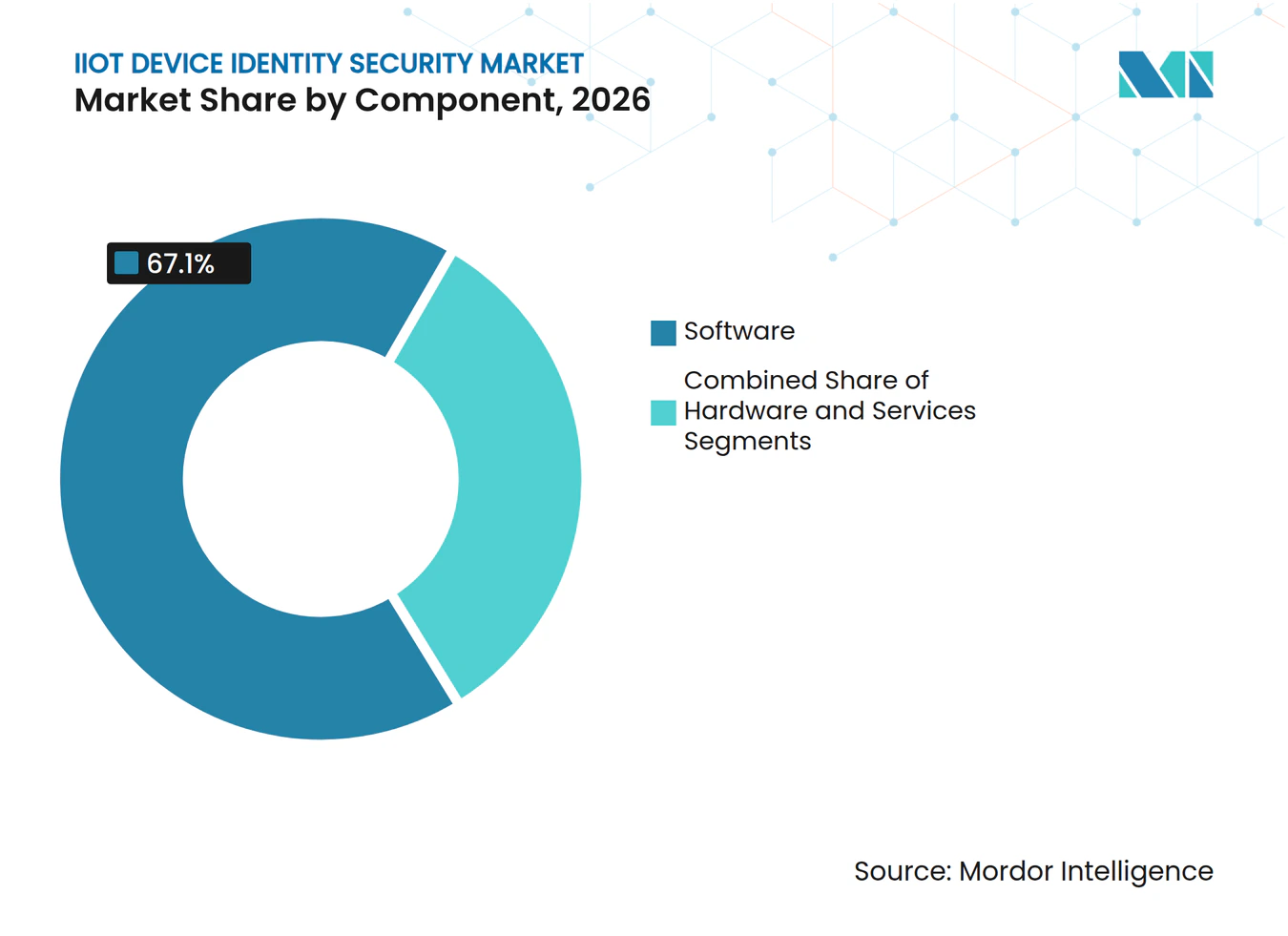
Software held 67.10% of the IIoT device identity security market in 2026. Its position reflects the need for policy orchestration, cryptographic inventory management, and automated certificate lifecycle work across large device fleets. The software layer manages issuance, renewal, revocation, and reporting, even when a device stores its key in a hardware element. IEC 62443-4-2 addresses this need because its security requirements include controls for component authentication and for protecting data in transit. Hardware remains smaller in revenue terms, but it provides the root of trust that protects private keys. Research on resource-constrained microcontrollers has shown implementation paths for post-quantum cryptography, which supports the long-term role of silicon-based protection.
Services are projected to record a 22.05% CAGR through 2032, the fastest rate in this segmentation. Managed services can operate public key infrastructure, certificate renewal, and policy administration for customers that do not have large specialist teams. This operating model turns ongoing certificate administration in the IIoT device identity security market into a service relationship rather than a project that requires full in-house capability. It is especially relevant to plants where personnel must manage both cyber risk and availability constraints. The IIoT device identity security industry also gains when providers help customers integrate identity controls with existing security operations. The combination of software and services makes continuous credential governance practical across mixed operational technology estates.



By Identity Function: Certificate Management Leads While Attestation Expands
Certificate and key lifecycle management held 51.29% of the IIoT device identity security market share in 2026. Every identity function uses certificates or keys through issuance, enrollment, renewal, rotation, revocation, or validation. The CA/Browser Forum policy sets a path to reduce the maximum lifetime of publicly trusted TLS certificates to 47 days by 2029, increasing renewal frequency for organizations that operate large certificate inventories. Industrial deployments need their own lifecycle practices because devices can operate for many years and may have intermittent connectivity. Lifecycle management platforms address this work with automated workflows, discovery, expiry monitoring, and audit records. These capabilities make certificate operations in the IIoT device identity security market a core control rather than an administrative task.
Firmware integrity and remote attestation are projected to expand at a 21.45% CAGR through 2032. This function verifies whether device software and boot processes remain approved after equipment is installed. NIST operational technology guidance describes the importance of monitoring and managing assets throughout their lifecycle, including controls suited to operational environments.[2] IEC 62443-4-2 also includes requirements related to software and information integrity, which support interest in attestation. Secure provisioning and enrollment, plus authentication and authorization, are established functions that support device onboarding and access decisions. Other identity functions include emerging approaches to decentralized identity and device reputation scoring.
By Deployment Mode: On-Premise Architecture Retains a Leading Role
On-premises deployment accounted for 66.21% of revenue in 2026. Air-gapped systems, safety systems, and data residency requirements mean that many industrial operators cannot rely on a cloud connection for credential provisioning or authentication. The IIoT device identity security market size for on-premise environments is therefore supported by architectural requirements rather than a simple preference for local systems. On-premise public key infrastructure can keep sensitive credential operations close to production networks while allowing local teams to set maintenance windows. It also fits plants that use several equipment vendors and older protocols. These conditions make local infrastructure central to identity programs in manufacturing, energy, and other critical operations.
Cloud deployment is projected to grow at a 21.79% CAGR through 2032. Small and medium enterprises can obtain managed public key infrastructure services without maintaining all the supporting systems themselves. Larger enterprises can also use cloud services for satellite facilities or connected operations while retaining on-premise controls at core plants. ASRock Industrial introduced AiFDO in May 2025 as a zero-touch onboarding platform based on the FIDO Device Onboard standard for smart factories, industrial artificial intelligence, and edge computing. The example shows how automated onboarding can reduce manual setup work at scale. Hybrid operating models can therefore coexist with continued demand for IIoT device identity security market infrastructure that keeps critical credential operations local.
By Organization Size: Large Enterprises Lead While SMEs Grow Faster
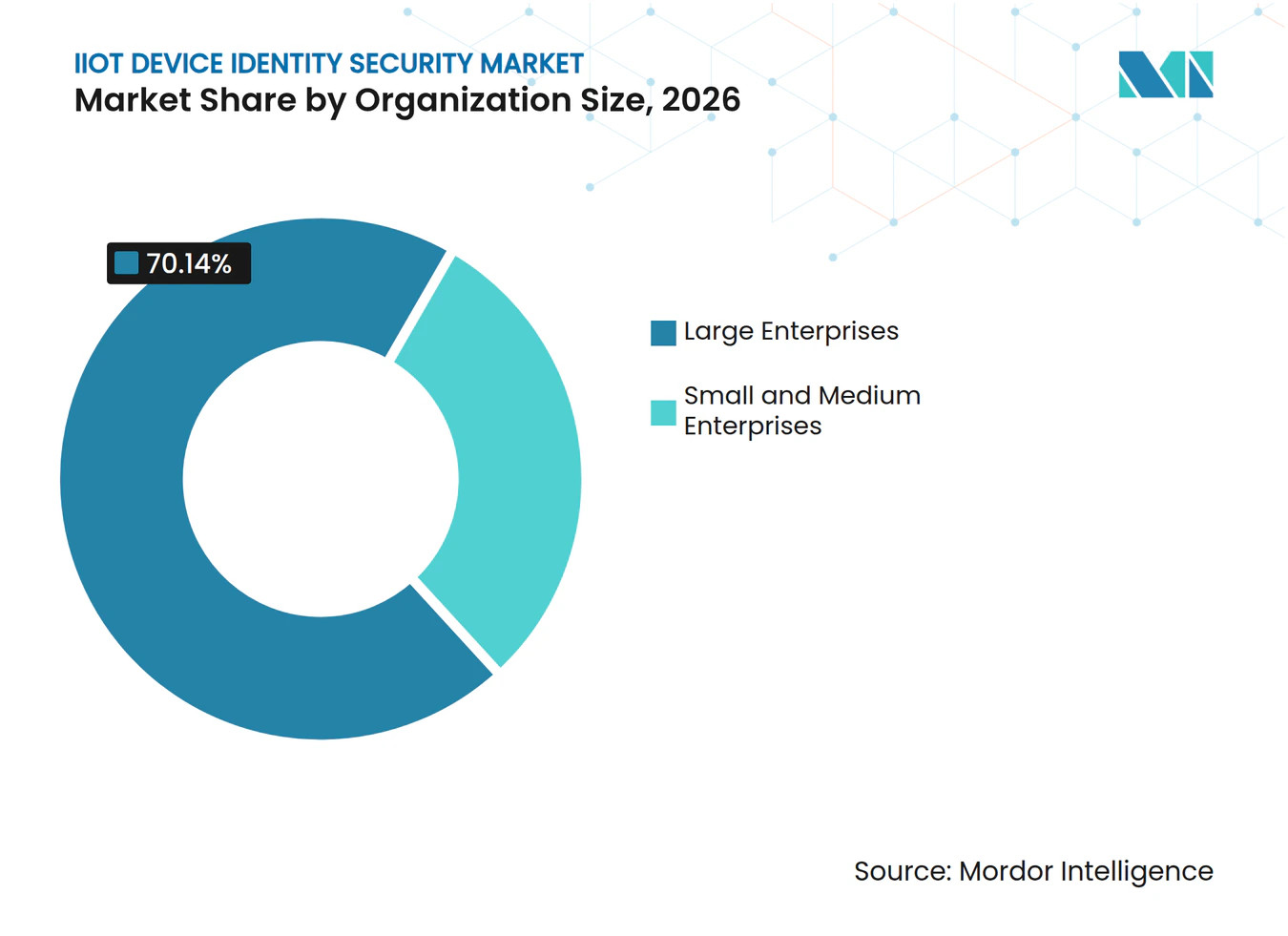
Large enterprises held 70.14% of revenue in 2026. They operate larger device fleets, multiple sites, and more complex public key infrastructure environments than smaller organizations. Many are subject to sector rules that require asset inventory, segmented network architecture, access control, and device authentication. The leading position of large enterprises also reflects their capacity to fund and operate continuous certificate programs. Energy, manufacturing, and critical infrastructure operators have significant exposure to downtime and regulatory scrutiny. Their procurement processes increasingly consider hardware protection, lifecycle automation, integration capability, and audit support together.
Small and medium enterprises are projected to grow at a 22.36% CAGR through 2032. Cyber-insurance reviews and customer supply-chain expectations can encourage these companies to document assets, segregate operational and information technology, and protect remote access. Research on small and medium-sized enterprise security highlights the value of risk-based controls that reduce the effort required to implement stronger practices. Managing public key infrastructure, guiding onboarding, and subscription delivery can make those controls more accessible. These businesses may not have the institutional capacity to operate an enterprise-scale identity program without external support. Providers in the IIoT device identity security market that simplify deployment and ongoing compliance can address that gap.

By Industry Vertical: Manufacturing Leads While Automotive Builds Momentum
Industrial manufacturing held 30.11% of revenue in 2026. Production lines contain dense populations of controllers, sensors, gateways, and connected machines that need authenticated communication. Manufacturers also face ransomware and remote-access exposure, where weak identity controls can create a path into operational networks. The IIoT device identity security market is consequently supported by manufacturing programs that adopt ISA/IEC 62443 practices. These programs require stronger visibility into assets and deliberate security zones and conduits. Manufacturing demand also favors platforms that can operate across established proprietary systems and newer connected equipment.
Automotive and mobility are projected to grow at a 20.71% CAGR through 2032. Vehicle connectivity, digital keys, and vehicle-to-everything infrastructure increase the number of components that need protected credentials. ISO 21434 defines a cybersecurity engineering framework for road vehicles that supports systematic attention to threats throughout the vehicle lifecycle. NXP has described automotive secure elements designed for use with the Car Connectivity Consortium Digital Key, underscoring the role of hardware-backed credentials in car access systems. Energy and utilities, oil and gas, and transportation and logistics also need identity controls for grid assets, pipeline control systems, and logistics networks. Each vertical has different uptime and protocol needs, which makes tailored IIoT device identity security market integration important.
Geography Analysis
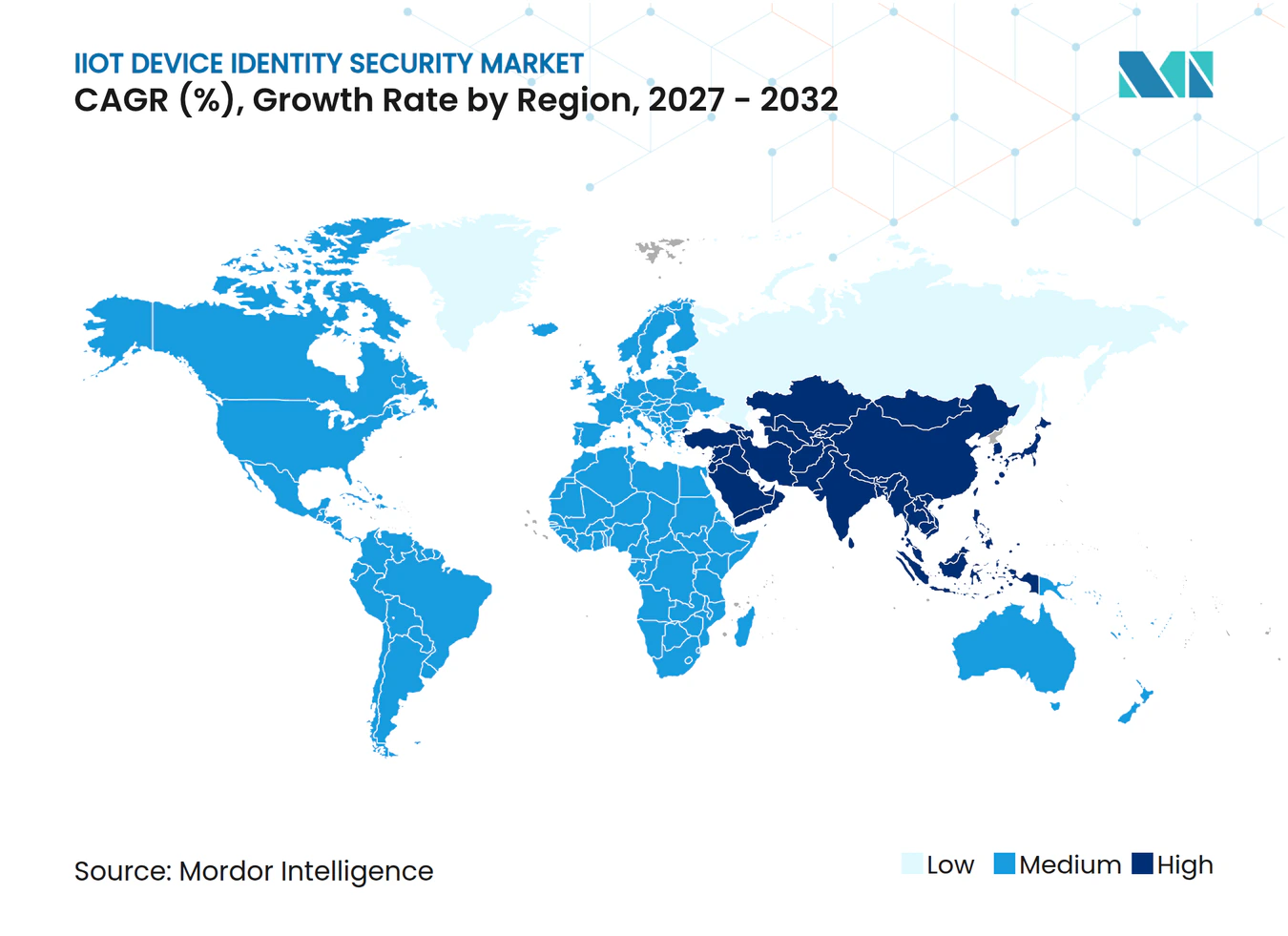
North America held 37.12% of the IIoT device identity security market share in 2026. A federal zero-trust policy, critical infrastructure requirements, and a large base of regulated industries support spending on public key infrastructure and device authentication. Executive Order 14028 directed federal agencies to adopt modern cybersecurity practices, while NERC CIP-003-9 broadened electronic access-control obligations for low-impact assets, effective April 2026. Insurers and enterprise customers seek documented network segmentation, multifactor authentication, and session-log retention. These needs support IIoT device identity security market platforms across energy, defense, and manufacturing.
Asia-Pacific is projected to grow at a 21.10% CAGR through 2032. Smart-factory investment in China, India, Japan, and South Korea is occurring alongside more explicit cybersecurity requirements for connected industrial systems. Japan's Ministry of Economy, Trade, and Industry published 2025 guidance for semiconductor device factories that aligns security practices with IEC 62443 principles. SEALSQ joined Japan's ECHONET Consortium in 2025 as a public key infrastructure services provider for the ECHONET Lite smart-home and energy management standard. The regional opportunity extends from large electronics and automotive producers to connected energy systems and facilities that need scalable IIoT device identity security market provisioning as new device fleets are brought online.
Europe held the second-largest regional revenue position in 2026, with Germany leading procurement volume. The Cyber Resilience Act requirements that apply in December 2027 are compressing product-security planning, while its implementing regulation identifies public key infrastructure software and authentication hardware among important and critical product categories.[3] The coordinated European Union post-quantum cryptography roadmap calls for member states to begin migration by the end of 2026 and to complete the migration of high-risk systems by the end of 2030. This timetable makes cryptographic inventory and upgrade planning more important, while South America, the Middle East, and Africa remain relevant for managed and phased deployment models.
Competitive Landscape
Market Concentration
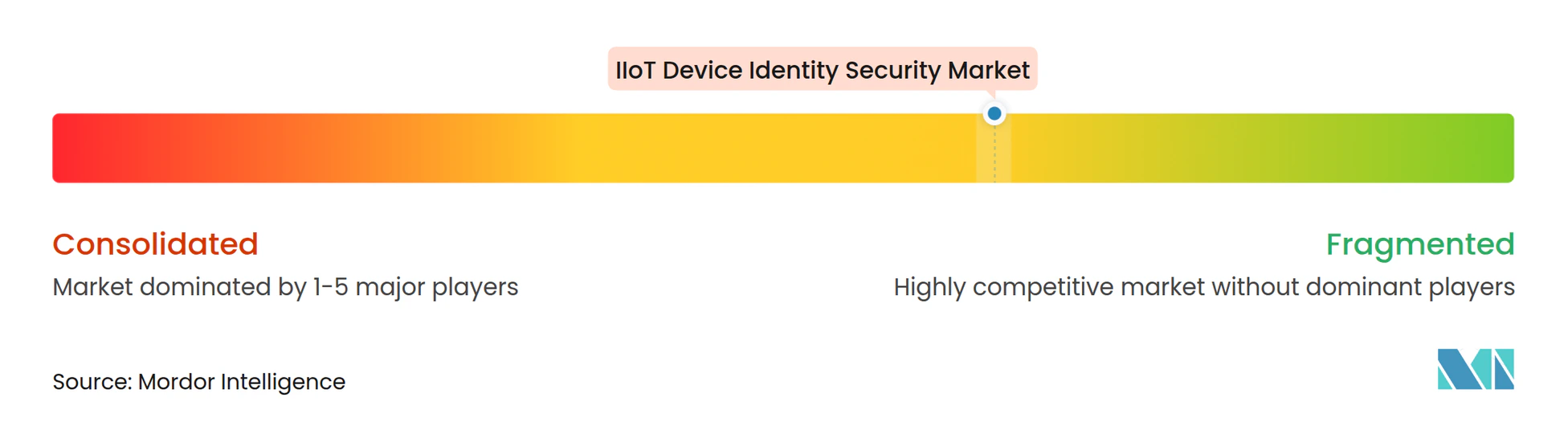
The IIoT device identity security market is moderately fragmented among certificate lifecycle and identity software providers, as well as semiconductor suppliers that provide hardware roots of trust. Keyfactor, Entrust, and DigiCert compete in public key infrastructure, certificate lifecycle management, and related identity workflows. Infineon Technologies, NXP Semiconductors, and SEALSQ compete in secure elements, security controllers, and other silicon-based protection. Device Authority, Intrinsic ID, and Kudelski IoT focus on constrained-device enrollment and physical unclonable function-based authentication. Competition depends on combining secure hardware with enrollment, renewal, policy, discovery, and audit functions, as well as protocol support, across mixed-vendor plants.
Post-quantum cryptography readiness is becoming a procurement consideration for long-lived industrial deployments. Infineon launched the TEGRION SLI22 automotive security controller in March 2026 with integrated post-quantum cryptography and Common Criteria certification from Germany's Federal Office for Information Security.[4] SEALSQ announced FIPS 140-3 Level 3 validation for its VaultIC408 secure element in August 2026, while Keyfactor launched its Trust Control Plane in June 2026 for public key infrastructure management, lifecycle automation, cryptographic discovery, and post-quantum migration. These moves extend offerings from standalone credentials toward broader machine-identity governance. FIDO Device Onboard also provides a vendor-neutral path for automated onboarding at factory scale.
Certification and assurance evidence increasingly influence selection decisions. FIPS 140-3 and ISA/IEC 62443 validation can provide buyers with a defined basis for assessing cryptographic modules and industrial security controls. Suppliers in the IIoT device identity security market must fit customer protocols, maintenance windows, and legacy hardware. Software-only providers can face limits where buyers require hardware-bound keys, while hardware suppliers need lifecycle tools after deployment. The IIoT device identity security market rewards partners that connect silicon-level trust to usable operational workflows.
IIoT Device Identity Security Industry Leaders
-
Keyfactor, Inc.
-
Device Authority Ltd.
-
Sectigo Limited
-
AppViewX, Inc.
-
Ascertia Limited
- *Disclaimer: Major Players sorted in no particular order
Recent Industry Developments
- October 2026: DigiCert reported accelerated growth in its Trust Lifecycle Manager platform, citing enterprise adoption of automated certificate operations and the expansion of integrations with BeyondTrust, F5, Fortinet, HPE, and Imperva. The company also introduced Apple Device Attestation, which verifies hardware-backed device identity before certificate issuance, extending automation to managed device ecosystems.
- August 2026: SEALSQ Corp announced that its VaultIC408 secure element platform received NIST Certificate No. 5463 under FIPS 140-3 Level 3, validated August 5, 2026. The certification targets government, defense, critical infrastructure, and industrial IoT applications, providing OEMs with a validated hardware-security building block for IIoT identity programs.
- July 2026: Infineon Technologies AG launched the SECORA ID Key S USB, a Java Card-based solution with USB and NFC connectivity, certified FIDO Level 3+ and compliant with CTAP 2.1, enabling phishing-resistant passwordless authentication with PKI functions for industrial access and physical security use cases.
- July 2026: SEALSQ updated its quantum-resistant hardware certification roadmap, confirming that QVault TPM 185, with full PQC support, including ML-KEM-1024 and ML-DSA-87, targets FIPS 140-3 and Common Criteria EAL5+ certifications, with French ANSSI Protection Profile approval expected in December 2026.
Global IIoT Device Identity Security Market Report Scope
The IIoT Device Identity Security Market comprises revenues generated from hardware, software, and services used to establish, authenticate, manage, and protect the identities of Industrial Internet of Things (IIoT) devices throughout their operational lifecycle. These solutions enable secure provisioning, device authentication, certificate and key management, firmware integrity verification, and remote attestation across industrial environments. The market addresses identity-based security requirements for connected sensors, gateways, controllers, industrial equipment, and edge devices. It supports secure communications, access control, compliance, and zero-trust architectures within industrial ecosystems. Adoption is driven by increasing industrial connectivity and the growing need to secure cyber-physical systems.
The IIoT Device Identity Security Market Report is Segmented by Component (Hardware, Software, and Services), Identity Function (Secure Provisioning and Enrollment, Authentication and Authorization, Certificate and Key Lifecycle Management, Firmware Integrity and Remote Attestation, and Other Identity Functions), Deployment Mode (Cloud, On-Premise, and Hybrid), Organization Size (Large Enterprises, and Small and Medium Enterprises), Industry Vertical (Industrial Manufacturing, Energy and Utilities, Oil and Gas, Transportation and Logistics, Automotive and Mobility, Retail and E-Commerce, and Other Industry Verticals), and Geography (North America, South America, Europe, Asia-Pacific, Middle East, and Africa). The Market Forecasts are Provided in Terms of Value (USD).
| Hardware |
| Software |
| Services |
| Secure Provisioning and Enrollment |
| Authentication and Authorization |
| Certificate and Key Lifecycle Management |
| Firmware Integrity and Remote Attestation |
| Other Identity Functions |
| Cloud |
| On-Premise |
| Hybrid |
| Large Enterprises |
| Small and Medium Enterprises |
| Industrial Manufacturing |
| Energy and Utilities |
| Oil and Gas |
| Transportation and Logistics |
| Automotive and Mobility |
| Retail and E-Commerce |
| Other Industry Verticals |
| North America | United States |
| Canada | |
| Mexico | |
| South America | Brazil |
| Argentina | |
| Rest of South America | |
| Europe | Germany |
| United Kingdom | |
| France | |
| Italy | |
| Russia | |
| Rest of Europe | |
| Asia-Pacific | China |
| Japan | |
| India | |
| South Korea | |
| Rest of Asia-Pacific | |
| Middle East | Saudi Arabia |
| United Arab Emirates | |
| Rest of Middle East | |
| Africa | South Africa |
| Nigeria | |
| Rest of Africa |
| By Component | Hardware | |
| Software | ||
| Services | ||
| By Identity Function | Secure Provisioning and Enrollment | |
| Authentication and Authorization | ||
| Certificate and Key Lifecycle Management | ||
| Firmware Integrity and Remote Attestation | ||
| Other Identity Functions | ||
| By Deployment Mode | Cloud | |
| On-Premise | ||
| Hybrid | ||
| By Organization Size | Large Enterprises | |
| Small and Medium Enterprises | ||
| By Industry Vertical | Industrial Manufacturing | |
| Energy and Utilities | ||
| Oil and Gas | ||
| Transportation and Logistics | ||
| Automotive and Mobility | ||
| Retail and E-Commerce | ||
| Other Industry Verticals | ||
| By Geography | North America | United States |
| Canada | ||
| Mexico | ||
| South America | Brazil | |
| Argentina | ||
| Rest of South America | ||
| Europe | Germany | |
| United Kingdom | ||
| France | ||
| Italy | ||
| Russia | ||
| Rest of Europe | ||
| Asia-Pacific | China | |
| Japan | ||
| India | ||
| South Korea | ||
| Rest of Asia-Pacific | ||
| Middle East | Saudi Arabia | |
| United Arab Emirates | ||
| Rest of Middle East | ||
| Africa | South Africa | |
| Nigeria | ||
| Rest of Africa | ||
Key Questions Answered in the Report
What is the IIoT device identity security market size?
The IIoT device identity security market is projected to increase from USD 3.61 billion in 2026 and USD 4.33 billion in 2027 to USD 10.71 billion by 2032, at a 20.05% CAGR.
Which component leads demand for IIoT device identity security?
Software leads with a 67.10% revenue share in 2026 because it manages policy, cryptographic inventory, and certificate lifecycles across device fleets.
Why is certificate lifecycle management important for industrial devices?
It held 51.29% of revenue in 2026 and supports the issuance, renewal, rotation, revocation, and validation of credentials used across industrial operations.
Which deployment approach is most widely used?
On-premise deployment held 66.21% of revenue in 2026 because air-gapped plants, safety systems, and local data requirements often limit cloud dependence.
Which end-use sector is growing fastest?
Automotive and mobility is projected to expand at a 20.71% CAGR through 2032, supported by connected vehicles, digital keys, and vehicle-to-everything infrastructure.
Which region is growing fastest?
Asia-Pacific is projected to grow at a 21.10% CAGR through 2032 as smart-factory investment and cybersecurity requirements expand across the region.