
Machine Identity Management Platform Market Size and Share
Market Overview
| Study Period | 2020 - 2031 |
|---|---|
| Market Size (2026) | USD 4.85 Billion |
| Market Size (2031) | USD 14.28 Billion |
| Growth Rate (2026 - 2031) | 24.11 % |
| Fastest Growing Market | Asia-Pacific |
| Largest Market | North America |
| Market Concentration | Medium |
Major Players *Disclaimer: Major Players sorted in no particular order Image © Mordor Intelligence. Reuse requires attribution under CC BY 4.0. | |
Machine Identity Management Platform Market Analysis by Mordor Intelligence
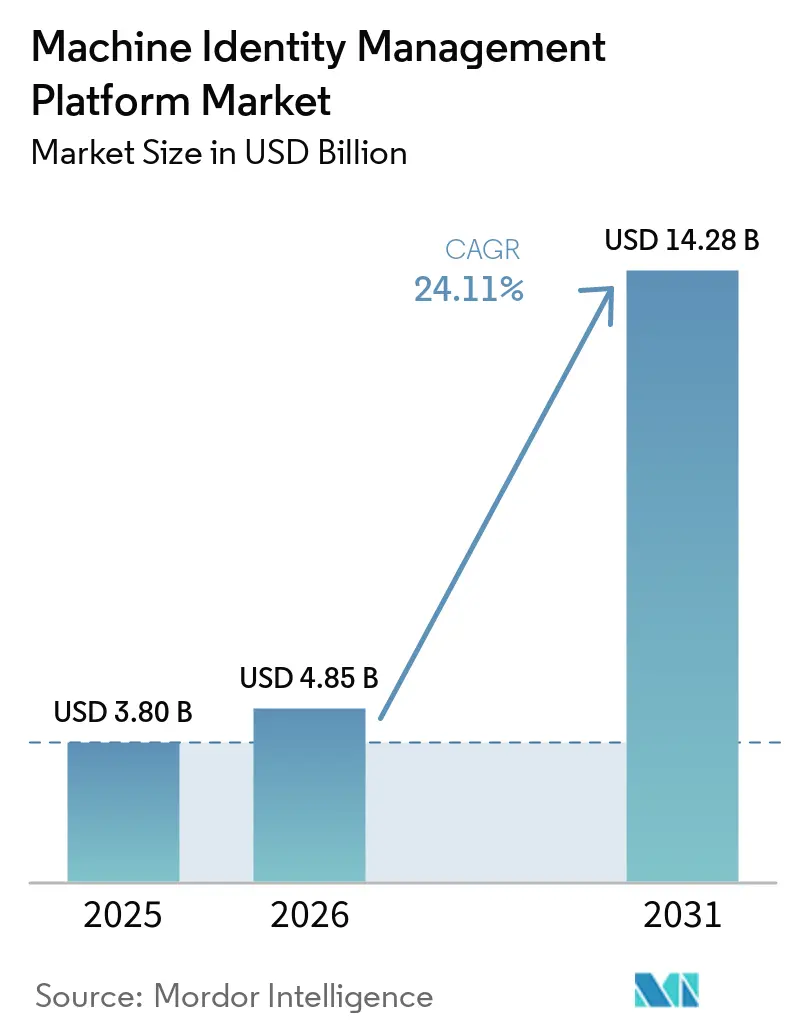
The Machine Identity Management Platform Market size is projected to expand from USD 3.80 billion in 2025 and USD 4.85 billion in 2026 to USD 14.28 billion by 2031, registering a CAGR of 24.11% between 2026 and 2031. The machine identity management market is being shaped by the rapid increase in non-human identities across cloud applications, APIs, containers, and automated workflows. Shorter TLS certificate validity periods are making automated discovery, renewal, and revocation more important for organizations that manage certificates at scale. Zero trust programs are also moving machine authentication from a narrow PKI task into a broader security requirement. Vendors are responding by bringing certificate lifecycle management, secrets management, workload identity, and AI agent controls into more unified platforms. Implementation capacity remains important because fragmented ownership and limited PKI expertise can delay the realization of a platform purchase's benefits.
Key Report Takeaways
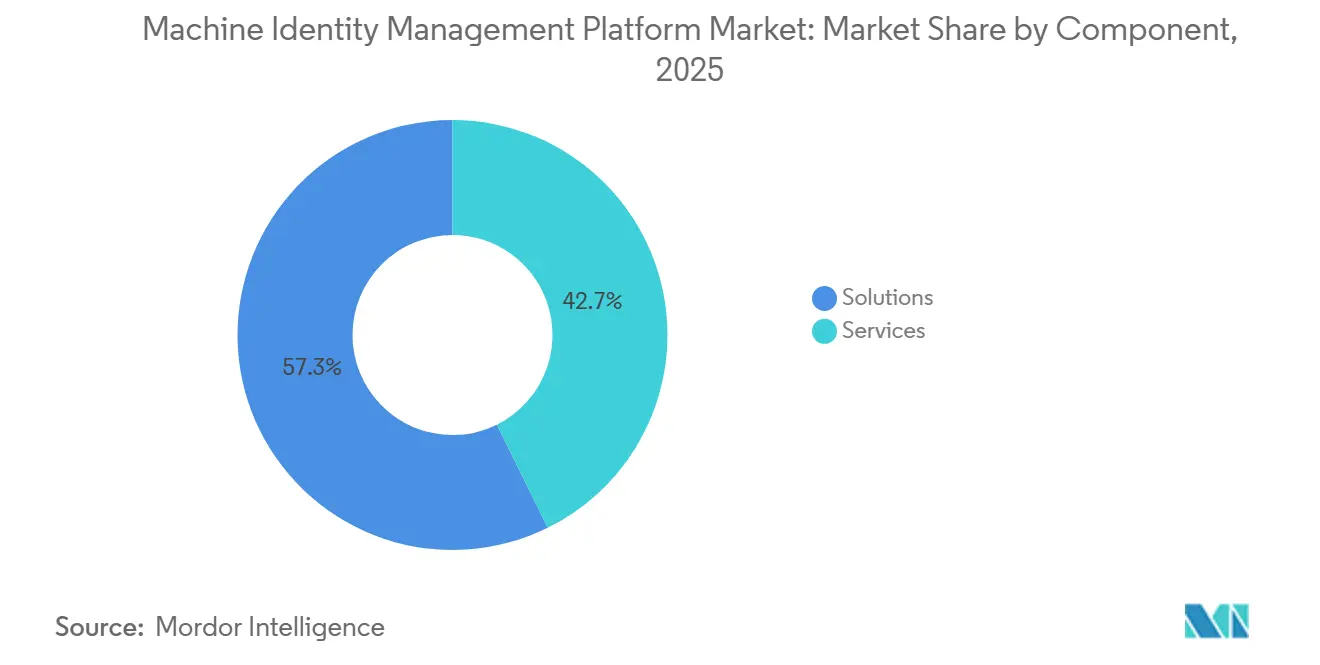
- By component, solutions held 57.31% share in the machine identity management market in 2025, while services are projected to expand at a 24.51% CAGR through 2031
- By identity type, application and service identities accounted for 28.53% share in the machine identity management market in 2025, while AI agent identities are projected to expand at a 25.51% CAGR through 2031.
- By deployment mode, cloud-based deployment held 48.18% share in 2025, while hybrid deployment is projected to expand at a 24.71% CAGR through 2031.
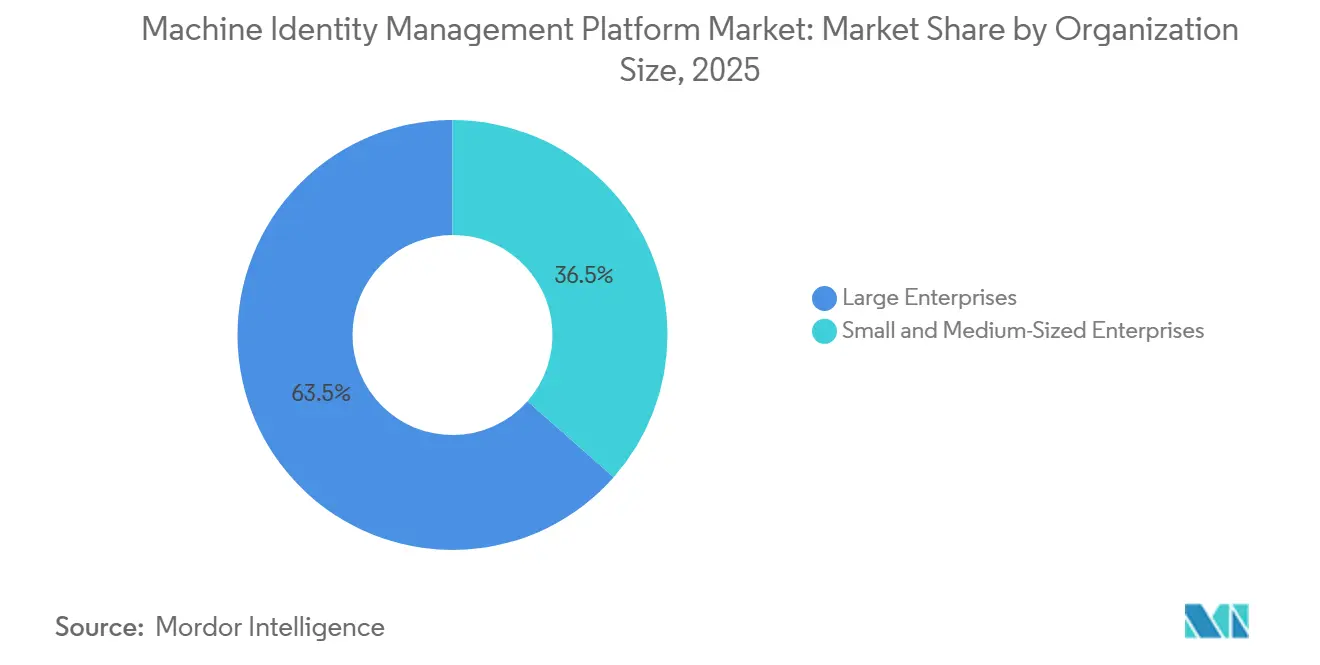
- By organization size, large enterprises commanded 63.49% share in 2025, while small and medium-sized enterprises are projected to expand at a 24.47% CAGR through 2031.
- By end-user industry, BFSI accounted for 23.64% of the machine identity management market size in 2025, while IT and telecommunications are projected to expand at a 25.69% CAGR through 2031.
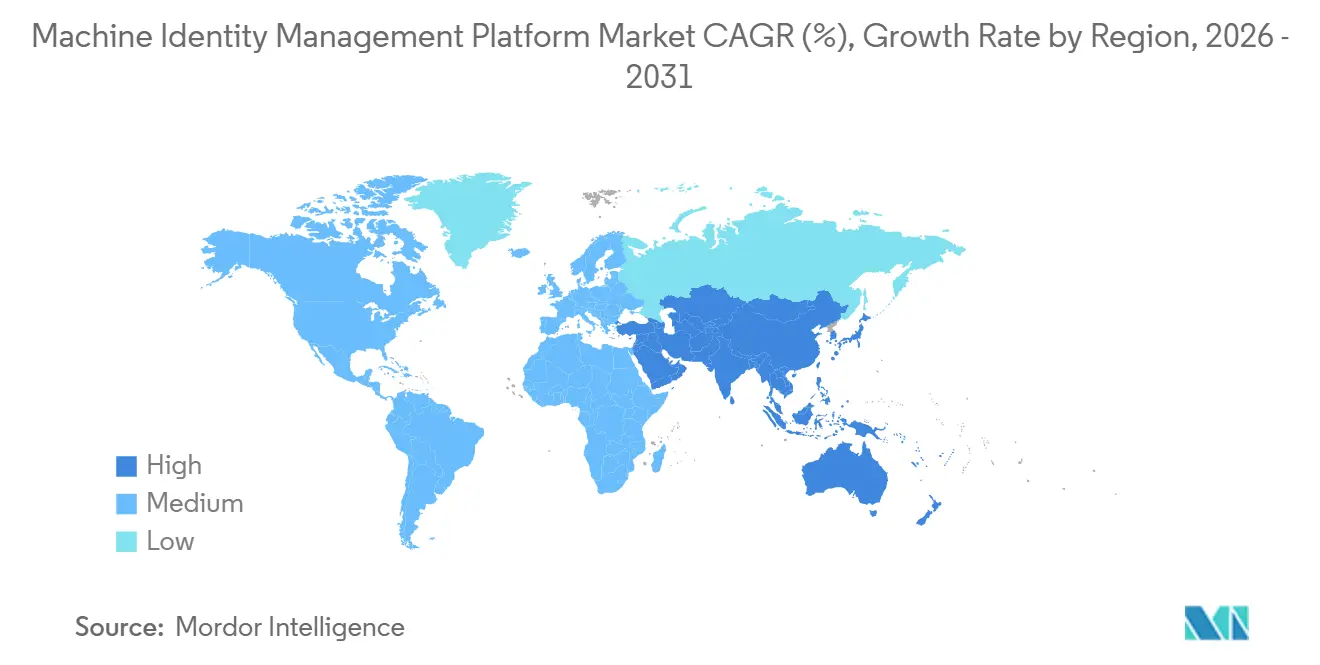
- By geography, North America accounted for 43.77% of the machine identity management market size in 2025, while Asia-Pacific is projected to expand at a 25.09% CAGR through 2031.
Note: Market size and forecast figures in this report are generated using Mordor Intelligence’s proprietary estimation framework, updated with the latest available data and insights as of January 2026.
Global Machine Identity Management Platform Market Trends and Insights
Drivers Impact Analysis*
| Driver | (~) % Impact on CAGR Forecast | Geographic Relevance | Impact Timeline |
|---|---|---|---|
| Expansion of Cloud-Native Workloads and APIs | +4.8% | Global, concentrated in North America and Asia-Pacific | Short term (≤ 2 years) |
| Zero-Trust Adoption for Machine-to-Machine Access | +4.2% | North America and Europe, expanding to Asia-Pacific | Short term (≤ 2 years) |
| Shortening Certificate Lifespans and Automated Renewal Requirements | +3.6% | Global, with early compliance gains in North America and Europe | Medium term (2-4 years) |
| AI Agent and Autonomous Workflow Proliferation | +3.2% | Global, with early adoption in North America and fast Asia-Pacific uptake | Short term (≤ 2 years) |
| Machine Identity Governance for Software Supply Chains | +2.1% | North America and Europe, with Asia-Pacific expanding | Medium term (2-4 years) |
| Post-Quantum Cryptography Readiness and Crypto-Agility Programs | +1.8% | Global, with early gains in North America, Germany, and Japan | Long term (≥ 4 years) |
| Source: Mordor Intelligence | |||
Expansion of Cloud-Native Workloads and APIs Fuels Credential Demand
Cloud-native designs create machine identities at a much faster rate than traditional data center systems. Each microservice, container, serverless function, and API endpoint needs a distinct cryptographic identity for authenticated communication. Multi-cloud environments increase this requirement because each environment may use different tools and policies. IBM introduced machine identity management as a dedicated discipline within its identity and access management portfolio in 2026, with a focus on automated discovery, issuance, renewal, and revocation.[1]IBM, “Introducing Machine Identity Management to Strengthen IAM for Non-Human Identities,” IBM, ibm.com. API sprawl can also leave API keys and OAuth tokens outside the security team's visibility when development teams create them independently. The machine identity management market, therefore, benefits both from a higher credential volume and from the need to close the resulting visibility gap.
Zero-Trust Adoption Redefines Machine-to-Machine Authentication
Zero trust requires verification for every connection, regardless of where that connection begins. This principle applies directly to machine-to-machine traffic, which supports much of the activity in enterprise networks. The SPIFFE and SPIRE standard maintained by the Cloud Native Computing Foundation, support workload identities through short-lived cryptographic SVIDs and continuous attestation for containers and virtual machines. Corsha received a USD 50 million sole-source IDIQ contract from the US Defense Logistics Agency in 2025 for zero-trust connectivity across critical operational systems. This activity shows that machine authentication is becoming relevant in defense, utilities, and manufacturing settings that historically relied more heavily on network segmentation, extending the machine identity management market beyond traditional enterprise PKI projects.
Certificate Lifespan Compression Creates an Automation Imperative
The CA/Browser Forum ballot phases TLS certificate validity from 398 days to 200 days, then 100 days, and eventually 47 days by 2029. Manual renewal processes become difficult to sustain when certificate inventories are large and renewal cycles are short, supporting the machine identity management market where automation replaces scattered renewal practices. A 2026 Ponemon-Sullivan study reported an average of 114,591 internal certificates under management, which highlights the operational burden of manual workflows. NIST guidance on TLS server certificate management identifies automated certificate management as a foundational control. Organizations operating with multiple certificate authorities also need to manage discovery, renewal, and deployment across multiple APIs. This requirement supports the adoption of machine identity management across both large organizations and small and medium-sized enterprises.
AI Agent and Autonomous Workflow Proliferation Opens an Ungoverned Identity Surface
AI agents that work across enterprise systems need verifiable identities and short-lived credentials tied to specific tasks. Many existing identity and access management programs were not designed for this type of autonomous activity. The Cloud Security Alliance reported in 2026 that more than 16% of organizations do not track the creation of AI-related identities. OWASP identified identity and authorization failures in 8 of the 10 highest-rated risks in its December 2025 Top 10 for Agentic Applications. The Coalition for Secure AI stated that each AI agent needs a distinct and verifiable identity linked to its code and model version. The machine identity management market is consequently expanding toward controls that can govern agent identities alongside certificates, API keys, and secrets.
Restraints Impact Analysis*
| Restraint | (~) % Impact on CAGR Forecast | Geographic Relevance | Impact Timeline |
|---|---|---|---|
| Fragmented Legacy PKI and Secrets Tooling | -2.8% | Global, most acute in North America and Europe among large enterprises | Medium term (2-4 years) |
| Shortage of PKI and Machine Identity Specialists | -2.1% | Global, most severe in Asia-Pacific and emerging markets | Long term (≥ 4 years) |
| Ownership Ambiguity Across Platform Engineering and Security Teams | -1.6% | Global | Medium term (2-4 years) |
| False Positives from Ephemeral and Shadow Machine Identities | -1.0% | Global, concentrated in cloud-native environments | Short term (≤ 2 years) |
| Source: Mordor Intelligence | |||
Fragmented Legacy PKI and Secrets Tooling Delays Platform Adoption
More than one-third of organizations identified legacy PKI cost and risk as a primary barrier to securing machine credentials in a 2026 Ponemon study cited by Palo Alto Networks. Large organizations often operate Microsoft Active Directory Certificate Services, HashiCorp Vault, cloud secret stores, and hardware security modules from different vendors. These tools must be connected to a common governance layer before automated policy enforcement can work consistently. The Ponemon-Sullivan study found that 53% of organizations still used manual or ad hoc methods to assess PKI health. NIST finalized FIPS 203, FIPS 204, and FIPS 205 in August 2024, adding post-quantum migration to the work already required to modernize PKI operations.[2]National Institute of Standards and Technology, “Post-Quantum Cryptography Standards,” National Institute of Standards and Technology, nist.gov. The machine identity management market is experiencing slower adoption, as organizations must redesign legacy infrastructure while maintaining stable daily certificate operations.
Shortage of Machine Identity Specialists Limits Program Scale
Organizations typically assigned only 4 staff members to PKI management in the 2026 Ponemon-Sullivan study. Only 42% of respondents reported having sufficient in-house expertise, while 63% outsourced basic certificate operations to managed service providers. The skills gap is particularly challenging for mid-market organizations and buyers in Asia-Pacific and South America that have fewer local PKI specialists. AI agents add further requirements because teams must understand workload identity, SPIFFE and SPIRE, OAuth 2.1, and secrets rotation. Vendors are introducing guided automation and AI-assisted policy management, but these tools do not replace practitioner judgment in complex deployments. The shortage may delay program scale, while also supporting demand for managed services in the machine identity management industry.
*Our forecasts treat driver/restraint impacts as directional, not additive. The impact forecasts reflect baseline growth, mix effects, and variable interactions.
Segment Analysis
By Component: Services Delivery Models Offset Structural Capability Gaps
Solutions held 57.31% of the machine identity management market share in 2025. This category includes certificate lifecycle management platforms, secrets management vaults, PKI-as-a-service offerings, and workload identity tools that provide the core technology layer for machine identity governance programs. Services are projected to expand at a 24.51% CAGR from 2026 to 2031. Platform deployments often require implementation, integration, and managed operations support before organizations can achieve consistent outcomes. The component pattern reflects the shortage of PKI talent across many enterprise security teams.
Professional services demand also reflects the work required to migrate to post-quantum cryptography. A 2025 study in Computers estimated migration timelines of 8 to 12 years for medium-sized enterprises and 12 to 15+ years for large enterprises. This duration supports ongoing consulting and advisory opportunities for vendors with cryptographic expertise. Managed services are serving organizations that lack internal PKI staffing, and the same 2026 Ponemon-Sullivan study found that 63% of organizations outsourced basic PKI operations. Vendors that combine managed certificate lifecycle management with post-quantum readiness assessments can address both operational and planning needs.


By Identity Type: AI Agent Identities Lead the Growth Frontier
Application and service identities held 28.53% of the machine identity management market share in 2025. Their position reflects the established base of applications and microservices that use service accounts, client certificates, and OAuth tokens for authenticated API communication. AI agent identities are projected to expand at a 25.51% CAGR from 2026 to 2031. This growth reflects the need for continuous identity attestation rather than static service account credentials. The IETF Agent Identity Framework draft outlines layers for identity, authorization, attestation, evidence, and trust.[3]Internet Engineering Task Force, “Agent Identity Framework: Trust and Identity for Autonomous AI Agents,” IETF Datatracker, ietf.org.
Workload and container identities, together with SSH keys and cryptographic keys, remain essential to DevSecOps pipelines. Their automation potential increases as the validity periods of certificates shorten. Secrets, passwords, access tokens, API keys, and OAuth token identities also represent large installed bases where shadow credentials create governance needs. A single agentic workflow may use API keys, invoke services via mutual TLS, and access secrets in a single transaction, creating dependencies across identity categories. The machine identity management industry, therefore, needs platforms that manage lifecycles across identity types rather than tools that operate in isolation.
By Deployment Mode: Hybrid Architectures Bridge Sovereignty and Cloud Efficiency
Cloud-based deployment accounted for 48.18% of the machine identity management market in 2025. This position reflects demand from organizations that use SaaS certificate lifecycle and secrets management for public cloud workloads. Hybrid deployment is projected to expand at a 24.71% CAGR from 2026 to 2031. Data sovereignty rules in the European Union, India, and Southeast Asia can require cryptographic key material to remain within national or organizational boundaries, allowing cloud workflows while retaining local control over sensitive keys. On-premises deployment continues to matter in financial services, defense, and healthcare, where isolated PKI roots of trust are required by architecture.
Post-quantum migration also supports hybrid deployment models. Microsoft made ML-DSA post-quantum certificate issuance generally available in Windows Server 2025 Active Directory Certificate Services through update KB5087539 in May 2026. This capability lets internal PKI environments issue quantum-resistant certificates, while cloud tools automate certificate lifecycles. Red Hat released Zero Trust Workload Identity Manager version 1.1 in 2026 with runtime-attested identities in a cloud-native operator model and support for bring-your-own PKI. These releases show how local key custody and cloud-native automation can operate together. Hybrid architecture offers buyers who need both control and operational flexibility.
By Organization Size: SMEs Emerge as the Fastest-Growing Buyer Segment
Large enterprises commanded 63.49% share in the machine identity management market in 2025. Large organizations have historically adopted security tools earlier because their certificate inventories and application environments are more complex, while small and medium-sized enterprises are projected to expand at a 24.47% CAGR from 2026 to 2031. The 47-day TLS certificate validity requirement applies to organizations of every size. Cloud-native development also creates credential volumes that can exceed the capacity of manual management much earlier than in traditional IT environments. These conditions reduce the advantage that large enterprises have historically held in formal machine identity programs, while SaaS delivery and managed support increase access.
Managed services and SaaS delivery models are especially relevant for smaller buyers without dedicated PKI personnel. The Ponemon-Sullivan study found that 63% of organizations already outsourced basic PKI operations. Small technology companies are also using autonomous workflows earlier in their security maturity cycle and may need AI agent identity controls before they have established formal governance programs. Vendors targeting this group are emphasizing guided onboarding and policy templates instead of deep configurability. This product approach can weaken the traditional advantage of legacy certificate lifecycle management providers focused on large enterprises.
By End-User Industry: BFSI Leads as IT and Telecommunications Accelerates
BFSI accounted for 23.64% of the machine identity management market size in 2025. Financial institutions face requirements for certificate lifecycle visibility, cryptographic key management, and automated renewal under DORA and PCI DSS v4.0, while IT and telecommunications are projected to expand at a 25.69% CAGR from 2026 to 2031. Cloud-native software development organizations and telecom operators manage high volumes of device and network element credentials. This operating environment supports continued demand for automated machine identity controls. The machine identity management market also benefits from the sector's need to secure API-rich development pipelines.
Healthcare and life sciences organizations need machine identity controls for connected medical devices, electronic health record integrations, and pharmaceutical research environments. US Food and Drug Administration guidance on medical device cybersecurity has increased attention to software supply chain security for device manufacturers. Federal zero trust requirements support government and public-sector demand, while manufacturing and industrial organizations are extending governance to operational technology as automation increases the volumes of APIs and certificates. Retail, energy and utilities, and transportation and logistics remain earlier-stage adopters. Ransomware risks affecting operational and logistics systems are increasing the relevance of these controls in those sectors.
Geography Analysis
North America accounted for 43.77% of the machine identity management market size in 2025. The region benefits from the concentration of cloud-scale technology buyers, established zero-trust programs, and leading vendors such as CyberArk, Keyfactor, AppViewX, and DigiCert. US federal zero-trust direction under the Office of Management and Budget memorandum M-22-09 continues to extend requirements across civilian agencies and federal contractors. This creates demand beyond the largest private enterprises and helps the machine identity management market reach government suppliers and agencies. Canada and Mexico add volume through financial services and cross-border technology operations, while Microsoft expanded its Zero Trust for AI strategy in August 2026 with a DevSecOps pillar in its Zero Trust Workshop that includes 15 control groups and 91 tasks.
Europe held the second-largest regional share in 2025. Germany, the United Kingdom, and France form the principal demand base, and DORA entered into force in January 2025 for financial entities and their ICT service providers. Germany's BSI and France's ANSSI have issued post-quantum cryptography transition guidance, while 70% of German security professionals expected at least 1 PQC algorithm to be in production by 2026, according to a November 2025 Trusted Computing Group survey. The United Kingdom promotes certificate lifecycle automation in its cyber resilience guidance, while South America remains an emerging region, with Brazil supported by financial services digitalization and the requirements of the Banco Central do Brasil.
Asia-Pacific is projected to expand at a 25.09% CAGR from 2026 to 2031, and the machine identity management market is gaining relevance as regional identity systems are modernized. In 2026, Palo Alto Networks reported that machine identities outnumbered human workers by 111 to 1 across enterprise environments in the region. India is seeing demand driven by fintech expansion, digital payment infrastructure, and a large developer base, where API-dense work creates large credential inventories. Japan and South Korea are advancing cybersecurity programs that emphasize zero-trust principles for machine authentication, while an Okta survey in 2026 across Australia, Singapore, and Japan found that fewer than 10% of respondents considered their identity systems fully equipped to manage non-human identities. China generates machine identity volumes through cloud infrastructure and state-led AI development, with data localization shaping vendor access, while the Middle East and Africa remain at earlier stages of adoption, supported by financial-sector rules and government digital programs.

Competitive Landscape
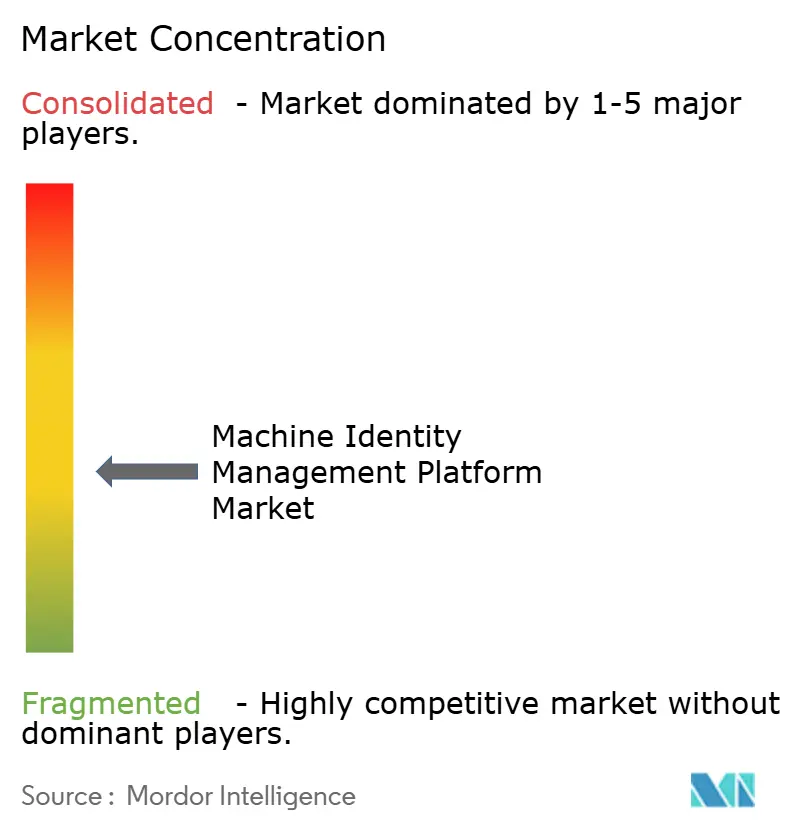
The machine identity management market is moderately fragmented. Broad-platform vendors compete with providers focused on workload identity, secrets management, and AI agent governance. Palo Alto Networks completed its acquisition of CyberArk for USD 25 billion in February 2026.[4]Palo Alto Networks, “Palo Alto Networks Completes Acquisition of CyberArk to Secure the AI Era,” Palo Alto Networks, paloaltonetworks.com. CyberArk had previously acquired Venafi for USD 1.54 billion, adding certificate lifecycle management capabilities and placing human, machine, and agentic identity capabilities within a larger security platform. The transaction increased competitive pressure on standalone providers of certificate lifecycle management and privileged access management.
Keyfactor secured more than USD 1 billion in strategic growth investment from Summit Partners in July 2026. It also announced its intent to acquire Cofide for AI agent and cloud workload identity capabilities. AppViewX acquired Eos in March 2026 to add an AI-native identity control plane. DigiCert introduced an AI Trust architecture in April 2026 for agent governance, model integrity, and content provenance. These moves reflect the shift in the machine identity management market from separate point products toward platforms that can govern certificates, secrets, workloads, and AI agents together.
Sectigo completed the acquisition of Entrust's public certificate business in January 2025 and transitioned more than 500,000 certificates to Sectigo Certificate Manager. Oasis Security integrated with Zscaler in June 2026 to extend non-human identity lifecycle governance across the Zscaler Zero Trust Exchange. Specialists such as Oasis Security, Akeyless, Aembit, and SPIRL differentiate through non-human identity lifecycle, secrets management, and SPIFFE-based workload identity. Cross-cloud cryptographic inventory, hybrid post-quantum certificate migration, and AI agent governance have no clearly dominant provider.
Machine Identity Management Platform Industry Leaders
Keyfactor, Inc.
DigiCert, Inc.
Sectigo Limited
AppViewX, Inc.
Palo Alto Networks
- *Disclaimer: Major Players sorted in no particular order

Recent Industry Developments
- August 2026: Sectigo released Sectigo Orchestration Gateway as generally available, an automation layer within the Sectigo Certificate Manager platform that enables end-to-end certificate lifecycle management, including discovery, issuance, renewal, and deployment, across hybrid and multi-cloud environments, directly addressing the operational pressure created by the CA/Browser Forum's forthcoming 47-day TLS certificate validity mandate.
- July 2026: Keyfactor secured over USD 1 billion in strategic growth investment from Summit Partners, with existing investors Insight Partners and Sixth Street Growth retaining significant ownership, to accelerate global expansion, product innovation, team building, and strategic acquisitions in AI agent and post-quantum machine identity infrastructure.
- July 2026: Keyfactor announced its intent to acquire Cofide, a UK-based identity platform for AI agents and cloud workloads, extending Keyfactor's Trust Control Plane to non-human identities using short-lived cryptographic identities replacing static credentials across hybrid and multi-cloud environments.
- July 2026: AppViewX released its Summer 2026 platform update, introducing support for hybrid composite post-quantum cryptography certificates and an AppViewX Model Context Protocol server enabling AI agents to autonomously discover, issue, renew, and manage certificates, converging PQC readiness and agentic identity governance on a single platform.


Global Machine Identity Management Platform Market Report Scope
The Machine Identity Management Platform market comprises software solutions and associated services designed to discover, identify, authenticate, secure, govern, monitor, and manage non-human identities and their credentials throughout their lifecycle. These platforms enable organizations to establish and enforce policies for machine-to-machine access, automate identity provisioning and credential rotation, control privileges, monitor identity activity, and reduce security risks associated with unmanaged, compromised, expired, or excessive machine identities.
The Machine Identity Management Platform Market Report is Segmented by Component (Solutions, and Services), Identity Type (Application and Service Identities, API Keys and OAuth Token Identities, Workload and Container Identities, Machine Certificates, Secrets, Passwords, and Access Tokens, SSH Keys and Cryptographic Keys, AI Agent Identities, and Other Identity Types), Deployment Mode (Cloud-Based, On-Premises, and Hybrid), Organization Size (Large Enterprises, and Small and Medium-Sized Enterprises), End-User Industry (BFSI, Information Technology and Telecommunications, Healthcare and Life Sciences, Government and Public Sector, Manufacturing and Industrial, Retail and E-Commerce, Energy and Utilities, and Transportation and Logistics), and Geography (North America, South America, Europe, Asia-Pacific, Middle East, and Africa). The Market Forecasts are Provided in Terms of Value (USD).
| Solutions |
| Services |
| Application and Service Identities |
| API Keys and OAuth Token Identities |
| Workload and Container Identities |
| Machine Certificates |
| Secrets, Passwords, and Access Tokens |
| SSH Keys and Cryptographic Keys |
| AI Agent Identities |
| Other Identity Types |
| Cloud-Based |
| On-Premises |
| Hybrid |
| Large Enterprises |
| Small and Medium-Sized Enterprises |
| BFSI |
| Information Technology and Telecommunications |
| Healthcare and Life Sciences |
| Government and Public Sector |
| Manufacturing and Industrial |
| Retail and E-Commerce |
| Energy and Utilities |
| Transportation and Logistics |
| North America | United States |
| Canada | |
| Mexico | |
| South America | Brazil |
| Argentina | |
| Rest of South America | |
| Europe | Germany |
| United Kingdom | |
| France | |
| Italy | |
| Spain | |
| Russia | |
| Rest of Europe | |
| Asia-Pacific | China |
| India | |
| Japan | |
| South Korea | |
| Australia | |
| Rest of Asia-Pacific | |
| Middle East | Saudi Arabia |
| United Arab Emirates | |
| Turkey | |
| Rest of Middle East | |
| Africa | South Africa |
| Nigeria | |
| Rest of Africa |
| By Component | Solutions | |
| Services | ||
| By Identity Type | Application and Service Identities | |
| API Keys and OAuth Token Identities | ||
| Workload and Container Identities | ||
| Machine Certificates | ||
| Secrets, Passwords, and Access Tokens | ||
| SSH Keys and Cryptographic Keys | ||
| AI Agent Identities | ||
| Other Identity Types | ||
| By Deployment Mode | Cloud-Based | |
| On-Premises | ||
| Hybrid | ||
| By Organization Size | Large Enterprises | |
| Small and Medium-Sized Enterprises | ||
| By End-User Industry | BFSI | |
| Information Technology and Telecommunications | ||
| Healthcare and Life Sciences | ||
| Government and Public Sector | ||
| Manufacturing and Industrial | ||
| Retail and E-Commerce | ||
| Energy and Utilities | ||
| Transportation and Logistics | ||
| By Geography | North America | United States |
| Canada | ||
| Mexico | ||
| South America | Brazil | |
| Argentina | ||
| Rest of South America | ||
| Europe | Germany | |
| United Kingdom | ||
| France | ||
| Italy | ||
| Spain | ||
| Russia | ||
| Rest of Europe | ||
| Asia-Pacific | China | |
| India | ||
| Japan | ||
| South Korea | ||
| Australia | ||
| Rest of Asia-Pacific | ||
| Middle East | Saudi Arabia | |
| United Arab Emirates | ||
| Turkey | ||
| Rest of Middle East | ||
| Africa | South Africa | |
| Nigeria | ||
| Rest of Africa | ||


Key Questions Answered in the Report
What is the size of the machine identity management platform market?
The market was valued at USD 3.80 billion in 2025 and stands at USD 4.85 billion in 2026. It is projected to reach USD 14.28 billion by 2031 at a 24.11% CAGR.
What is driving demand for machine identity management platforms?
Cloud-native workloads, zero trust adoption, shorter TLS certificate lifespans, and AI agents are increasing the need for automated credential governance.
Which component leads machine identity management platform spending?
Solutions led with 57.31% share in 2025, while services are projected to record the fastest component CAGR at 24.51% through 2031.
Which identity type is expanding fastest?
AI agent identities are projected to expand at a 25.51% CAGR from 2026 to 2031 as organizations introduce autonomous workflows.
Which deployment model is expected to expand fastest?
Hybrid deployment is projected to expand at a 24.71% CAGR through 2031 because organizations need cloud automation while retaining control over cryptographic key material.
Which region is projected to advance fastest?
Asia-Pacific is projected to expand at a 25.09% CAGR through 2031, supported by digitalization, cloud adoption, and rising non-human identity needs.
Page last updated on:





