
Identity Provisioning Market Size and Share
Market Overview
| Study Period | 2021 - 2032 |
|---|---|
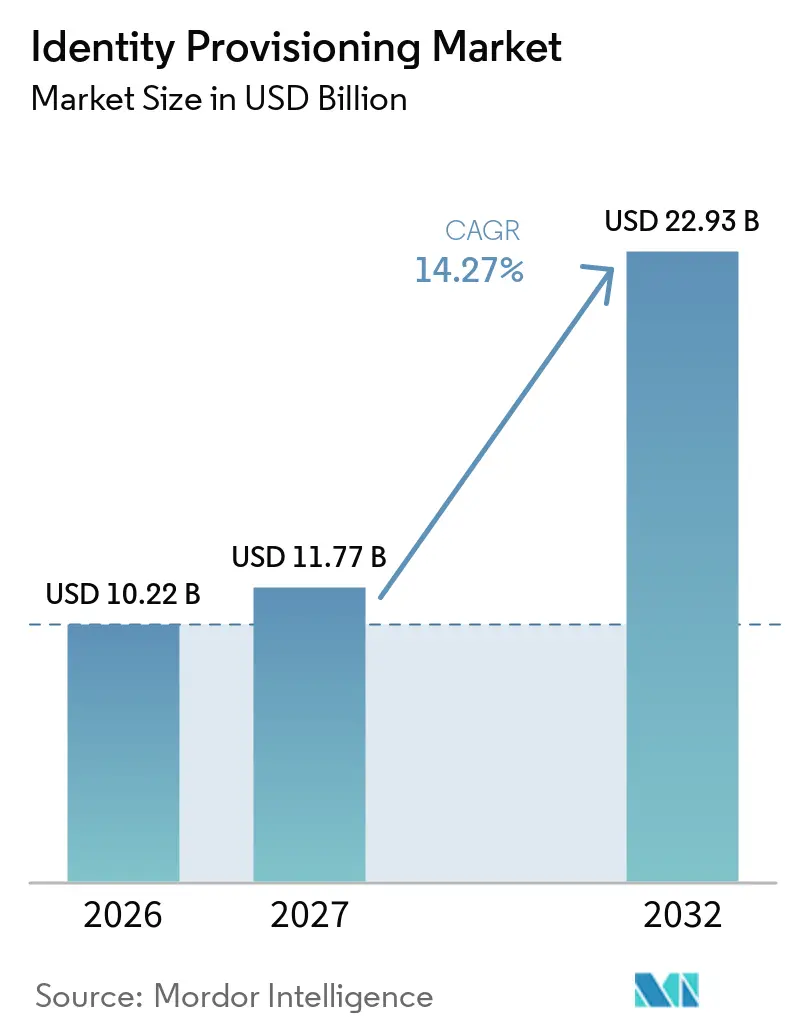
| Market Size (2027) | USD 11.77 Billion |
| Market Size (2032) | USD 22.93 Billion |
| Growth Rate (2027 - 2032) | 14.27 % |
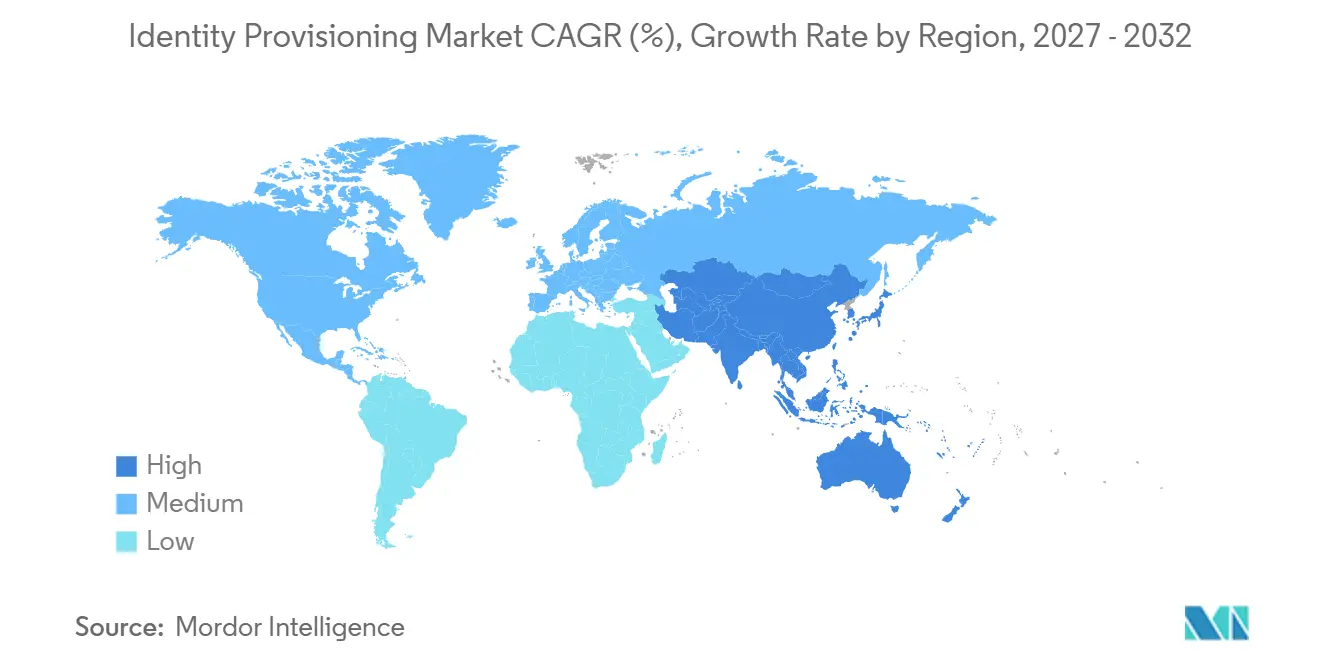
| Fastest Growing Market | Asia-Pacific |
| Largest Market | North America |
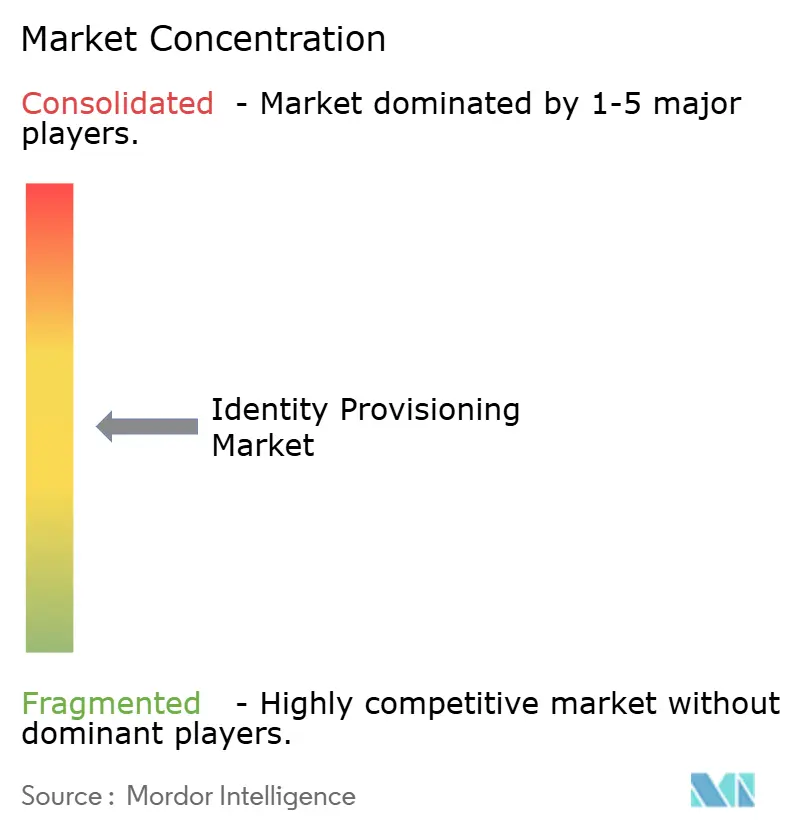
| Market Concentration | Medium |
Major Players *Disclaimer: Major Players sorted in no particular order Image © Mordor Intelligence. Reuse requires attribution under CC BY 4.0. | |
Identity Provisioning Market Analysis by Mordor Intelligence
The identity provisioning market size is valued at USD 10.22 billion in 2026 and is projected to reach USD 22.93 billion by 2032, registering a CAGR of 14.27% from 2027 to 2032. Identity provisioning now governs access to systems, conditions of access, and the duration of access across enterprise environments. Rising non-human identity volumes, zero trust programs, and digital-operational regulations are moving this work beyond periodic administration. Enterprises need continuous, automated controls as application estates, cloud environments, and autonomous agents expand. Providers are responding with integrated platforms that combine identity governance, privileged access, and non-human identity security. Integration depth, service capacity, and AI-based access analysis are likely to shape purchasing decisions in the identity provisioning market.
Key Report Takeaways
- By component, solutions held 71.46% of the identity provisioning market share in 2026, while services are projected to expand at a 14.74% CAGR through 2032.
- By deployment model, cloud accounted for 68.48% of revenue in 2026 and is projected to expand at a 14.36% CAGR through 2032.
- By identity type, workforce identities held 44.98% of revenue in the identity provisioning market in 2026, while AI-agent identities are projected to expand at a 14.59% CAGR through 2032.
- By organization size, large enterprises held 77.68% of revenue in 2026, while SMEs are projected to expand at a 14.84% CAGR through 2032.
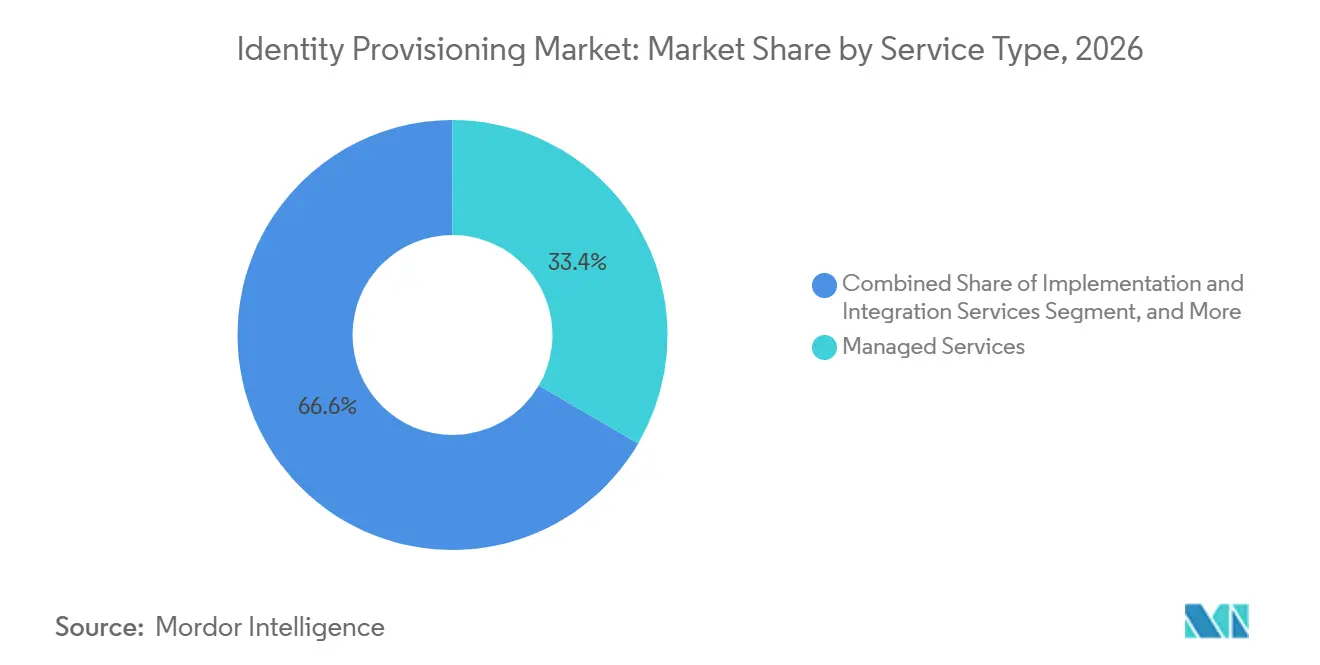
- By service type, managed services accounted for 33.41% of service revenue in the identity provisioning market in 2026 and are projected to grow at a 14.74% CAGR through 2032.
- By end user, BFSI held 21.59% of revenue in 2026, while IT and telecommunications are projected to expand at a 14.82% CAGR through 2032.
- By geography, North America held 41.88% of revenue in 2026, while Asia-Pacific is projected to expand at a 14.53% CAGR through 2032.
Note: Market numbers in this report are based on Mordor Intelligence's proprietary estimation framework, which combines nine months of actuals with Q4 projections for base year 2026.
Global Identity Provisioning Market Trends and Insights
Drivers Impact Analysis*
| Driver | (~) % Impact on CAGR Forecast | Geographic Relevance | Impact Timeline |
|---|---|---|---|
| Regulatory Compliance and Audit Automation | +3.8% | Global, with highest concentration in North America and Europe | Short term (≤ 2 years) |
| Zero Trust and Least-Privilege Programs | +3.2% | North America and Europe, with growing adoption in Asia-Pacific | Short term (≤ 2 years) |
| Hybrid and Multi-Cloud Identity Sprawl | +2.5% | Global | Medium term (2-4 years) |
| Workforce Onboarding, Offboarding, and Scalability | +1.8% | Global, strongest in North America and Asia-Pacific | Medium term (2-4 years) |
| AI-Assisted Role Mining and Continuous Access Intelligence | +1.5% | North America, Europe, and Asia-Pacific | Medium term (2-4 years) |
| Non-Human Identity and AI-Agent Expansion | +1.7% | Global | Long term (≥ 4 years) |
| Source: Mordor Intelligence | |||
Regulatory Compliance and Audit Automation
Regulatory obligations are a major short-term demand trigger for the identity provisioning market. DORA has applied to EU financial entities since January 17, 2025, requiring access controls and auditable records for critical systems. Germany's NIS2 transposition law took effect in December 2025 and extended access-control obligations across essential and important sectors. DORA, NIS2, HIPAA, SOC 2, CMMC 2.0, and PCI-DSS v4.0.1 require stronger evidence of access governance. Ticket-based processes cannot provide the continuous evidence expected under these requirements. Mid-market organizations with 500 to 2,000 employees are therefore adopting full-cycle provisioning capabilities that were once mainly used by larger enterprises.
Zero Trust and Least-Privilege Programs
Zero-trust programs are affecting provisioning architecture as well as wider security policy. Omada reported that 95% of surveyed U.S. enterprises had adopted zero trust at some level, while 47% described their programs as fully integrated.[1] Many programs still focus on authentication and network segmentation instead of the access lifecycle. Periodic certification can leave standing privileges in place between reviews. Organizations are using governance platforms for just-in-time access and zero standing privilege. This shift raises demand for entitlement analysis and modernized access certification within the identity provisioning market.
Hybrid and Multi-Cloud Identity Sprawl
Hybrid infrastructure creates access-management challenges across separate cloud and on-premises environments. Each environment can use distinct identity policies, audit records, and administrative controls. Inconsistent access policies can leave gaps between cloud services and established enterprise applications. The number of non-human identities adds material scale to this management problem. The Cloud Security Alliance reported that non-human identities outnumber human users by 45 to 1 on average and by 144 to 1 in cloud-native environments.[2] Manual governance cannot adequately manage this volume, supporting demand for centralized provisioning and lifecycle automation.
Workforce Onboarding, Offboarding, and Scalability
Access request volumes are increasing as enterprises add SaaS tools, contractors, and new roles. Okta reported that the average number of access requests per customer more than doubled in 1 year and increased 1,140% over 2 years.[3] This increase reflects application expansion and workforce movement rather than headcount alone. Offboarding presents a significant control issue when unused access persists after a worker leaves. The Cloud Security Alliance found that 47% of non-human identities had not changed for more than 1 year, while 8% had no HR ownership link after their creator departed. Automated joiner-mover-leaver workflows are becoming necessary for both human and machine identities.
Restraints Impact Analysis*
| Restraint | (~) % Impact on CAGR Forecast | Geographic Relevance | Impact Timeline |
|---|---|---|---|
| Legacy Application and Directory Integration Complexity | -2.8% | Global, most acute in Europe and Asia-Pacific | Long term (≥ 4 years) |
| Identity Engineering Skill Shortages | -2.2% | Global | Medium term (2-4 years) |
| Fragmented Data Residency and Sovereignty Requirements | -1.0% | Global, strongest in Europe and Asia-Pacific | Long term (≥ 4 years) |
| Inconsistent API, Event, and Connector Standards | -0.6% | Global | Medium term (2-4 years) |
| Source: Mordor Intelligence | |||
Legacy Application and Directory Integration Complexity
Legacy applications and directories remain the main source of deployment delays in the identity provisioning market. ERP systems, mainframe directories, and older custom applications often require specialized connectors. Proprietary interfaces and batch-file user-management processes can become fragile as applications change. SAP Identity Management will reach end of maintenance in 2027, creating migration work for enterprises with complex identity workflows. Access drift can occur when the governance platform record differs from the access state within the target system. This creates lingering entitlements and an expanding compliance risk where organizations must demonstrate that deployed access matches approved access.
Identity Engineering Skill Shortages
Identity deployment complexity is increasing faster than the available specialist workforce. SANS found that skills gaps were the leading workforce challenge for 60% of surveyed organizations in 2026, and 27% reported breaches connected to capability gaps.[4] The shortage complicates connector design, access-model development, migration, and ongoing governance. Enterprises without experienced identity engineers can face longer deployment schedules and weaker program oversight. Managed services provide an operational alternative for organizations unable to build a dedicated identity team. This supports provider demand, but it can limit adoption where managed delivery is unavailable or lacks local capacity.
*Our forecasts treat driver/restraint impacts as directional, not additive. The impact forecasts reflect baseline growth, mix effects, and variable interactions.
Segment Analysis
By Component: Solutions Anchor Revenue While Services Accelerate
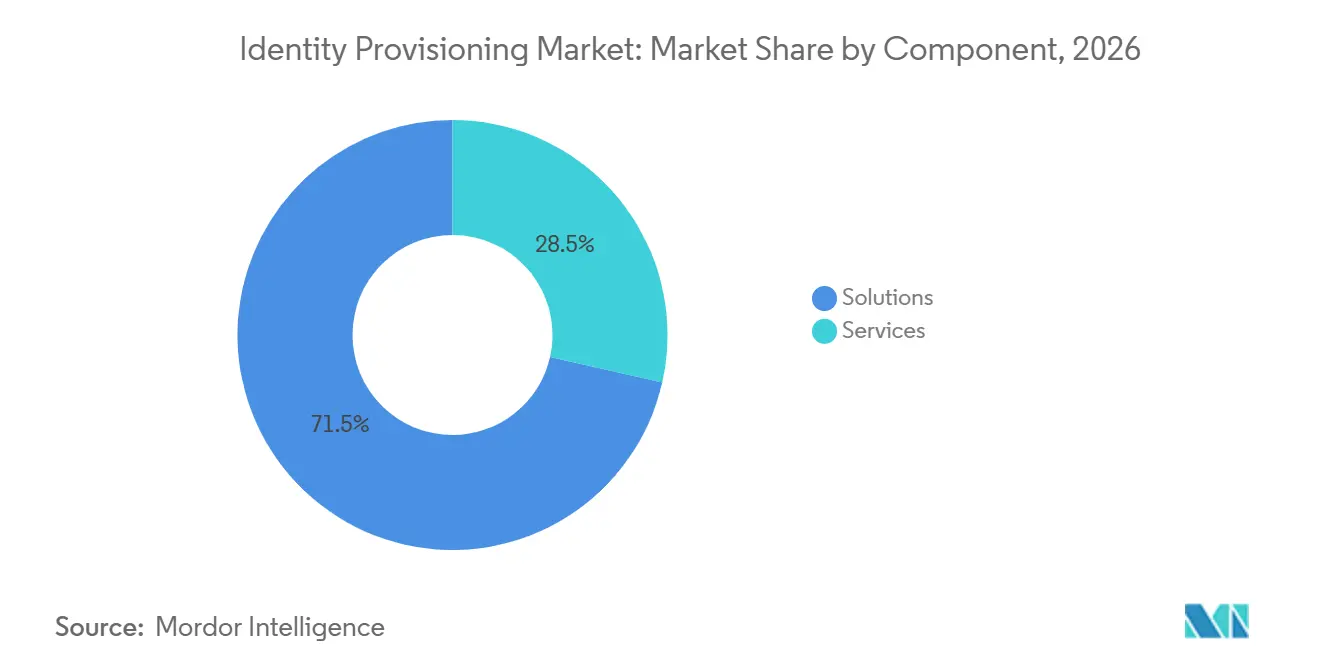
Solutions held 71.46% of the identity provisioning market share in 2026. They include user provisioning and de-provisioning, access certification and review, privileged governance, and password management. These functions form the operating layer that enterprises need before adding outside support services. Regulated organizations rely on this layer to control access, document decisions, and handle worker changes across connected business systems. The software also creates the records used in certification cycles and audit preparation. Access certification is receiving particular attention as vendors add usage data to review processes. AI-enabled certification can reduce the labor needed for repeated manual reviews, especially where reviewers must assess many applications and entitlements. SailPoint announced a next-generation Access Certification engine and a Separation of Duties rebuild in March 2026. The release indicates that certification modernization is an active product priority among established providers.
Services are projected to expand at a 14.74% CAGR from 2027 to 2032, making them the fastest-growing component of the identity provisioning market size. Managed services are gaining demand as enterprises transfer lifecycle management to specialist providers. Providers can operate platforms, maintain connectors, schedule certifications, and handle escalations within a defined service arrangement. This lets internal teams focus on policy decisions and higher-priority security work. Professional services continue to support greenfield projects and platform migrations. This work is important when clients need tailored integrations or revised access models across older and newer systems. However, project work is more variable than contracted managed operations. Mid-market organizations may favor managed delivery because maintaining an internal governance team can cost more than a specialized engagement. This shift supports recurring service revenue alongside the platform software base, while allowing customers to retain responsibility for access policy, approval models, and the business decisions that determine appropriate system access.
By Deployment Model: Cloud Leads as Hybrid Environments Continue
Cloud accounted for 68.48% of the identity provisioning market share in 2026. It is also projected to expand at a 14.36% CAGR through 2032. Identity-as-a-Service platforms have addressed earlier security concerns through in-region data residency, private tenancy, and compliance certifications. These features matter to regulated buyers in BFSI and healthcare, where control requirements influence deployment choices. Cloud deployment can also reduce the infrastructure burden for organizations starting a governance program. It provides a route to more frequent platform updates and service integration. The identity provisioning market continues to favor cloud delivery as organizations need faster access to automation and analytics. Cloud adoption does not remove the need to govern older directories and applications that remain inside hybrid estates, so buyers need deployment plans that can connect new cloud controls to records and entitlement models held within their established systems.
On-premises deployments remain important where sovereignty requirements are strict or entitlement models are heavily customized. RSA found that 75% of surveyed organizations operated hybrid environments, an increase of 5 percentage points from 2025 RSA. This shows that cloud expansion is taking place alongside persistent local infrastructure. SailPoint released IdentityIQ 9.0 in October 2026 with time-based role access and enhanced hybrid governance. Hybrid architectures connect cloud governance platforms with on-premises directories and applications that enterprises cannot quickly replace. They are widely used by large enterprises that must preserve established systems. This keeps on-premises and hybrid capabilities relevant to vendor product roadmaps, particularly when a migration must keep business-critical access flows operating without interruption and must address legacy interfaces that lack modern application programming interfaces.
By Identity Type: Workforce Identities Lead While AI Agents Expand
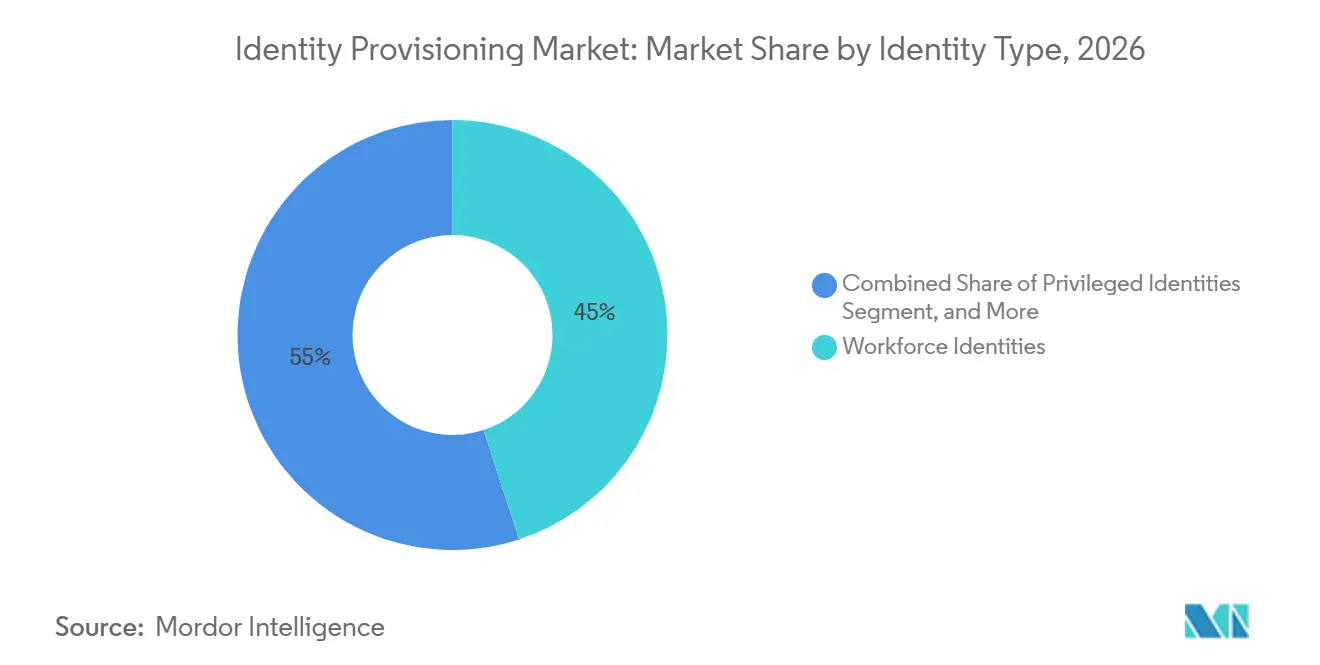
Workforce identities accounted for 44.98% of the identity provisioning market share in 2026. Employee joiner-mover-leaver processes remain the basic use case for most identity programs. Organizations use these controls to grant initial access, revise entitlements after role changes, and remove access at departure. These activities must be coordinated across many applications, directories, and administrative systems. Privileged identities are the next major area because administrator and system-owner accounts present elevated risk. Third-party and nonemployee accounts are also becoming more important across supply chains. The Cloud Security Alliance reported that third-party breaches represented 48% of breaches and cited a 60% year-over-year increase in the Verizon Data Breach Investigations Report. These demands keep workforce governance at the center of deployment decisions. They also expand the identity types that a single platform must manage.
AI-agent identities are projected to expand at a 14.59% CAGR from 2027 to 2032. Machine, workload, and application accounts increase as organizations use DevOps processes and API-driven architectures. These accounts may be created and changed more frequently than traditional employee identities. Many organizations lack comprehensive automated lifecycle management for machine identities and rely on manual processes for at least part of the identity lifecycle. U.S. enterprises are increasingly using or piloting agentic AI. However, many organizations lack a documented policy for creating or removing AI identities. Human-account governance processes do not fully address short-lived autonomous identities, creating a distinct product requirement that brings lifecycle decisions, access approval, monitoring, and removal practices into the same control discussion.

By Organization Size: Large Enterprises Lead While SMEs Adopt Cloud Platforms
Large enterprises held 77.68% of the identity provisioning market share in 2026. Their scale creates extensive application portfolios, multiple cloud services, and layered contractor access. These organizations often operate across jurisdictions with separate regulatory requirements. Automated provisioning becomes an operational need when thousands of users and systems require coordinated access changes. Large organizations also face more complex segregation-of-duties requirements and audit expectations. Their programs must align policies across business units while retaining records that support control reviews. ManageEngine found that more than half of large enterprises managed 3 or more IAM vendors. It also reported that 76% of North American firms were consolidating vendors or assessing a unified vendor approach. This consolidation cycle can raise spending on the selected governance platform.
SMEs are projected to expand at a 14.84% CAGR from 2027 to 2032. Cloud-native platforms reduce infrastructure requirements and can shorten deployment cycles from months to weeks. This makes formal access governance more accessible to organizations without large internal security teams. It also lets buyers use standard capabilities before committing resources to highly customized implementations. Vertical SaaS providers can offer configurations suited to healthcare, BFSI, or manufacturing requirements. Compliance-ready configurations can reduce the amount of initial design work for mid-market buyers. SMEs still need access reviews, onboarding controls, and documented approval paths. Managed offerings can address the shortage of dedicated identity engineering staff. These conditions position cloud vendors with industry-specific configurations to serve a growing SME customer base, especially where buyers need structured governance capabilities but cannot build the connector libraries and specialist operating teams usually associated with a large-enterprise program.
By Service Type: Managed Services Become the Preferred Delivery Model
Managed services held 33.41% of service revenue in 2026 and are projected to expand at a 14.74% CAGR through 2032. This dual position reflects a preference to outsource ongoing identity operations to specialists. Under managed models, providers handle platform operations, certification schedules, connector maintenance, and escalations. These activities require technical skills that many enterprises cannot sustain internally. The service model can also provide a predictable operating structure after a platform goes live. It is particularly relevant to organizations with small security teams and complex access requirements. Providers can apply the same operating discipline to routine requests, periodic reviews, and system changes. The identity provisioning market benefits when service providers can combine platform expertise with ongoing lifecycle management. This model can help customers maintain governance continuity despite workforce constraints, while making recurring reviews and maintenance part of an agreed operating service rather than an intermittent internal project.
Professional services continue to support migrations, new connector deployments, and modernization programs. Implementation and integration are often the first engagements in a new identity program. Training, consulting, and support help organizations build internal familiarity with governance processes. These services are useful when a client must connect legacy systems or revise access roles. They also support periodic reconfiguration as the application estate changes and new systems enter the access environment. Professional services revenue is project-based and may be less predictable than managed contracts. Managed services create recurring contractual revenue for providers. This difference makes the managed delivery model a significant strategic focus for vendors and integrators, even as implementation specialists remain necessary when organizations move from older identity tools or add complex applications that require tailored connector and workflow design.
By End User: BFSI Anchors Demand While IT and Telecommunications Set the Pace
BFSI accounted for 21.59% of the identity provisioning market share in 2026. The sector faces access-control requirements under SOX, PCI-DSS, DORA, and GDPR. These frameworks require visibility into access, segregation-of-duties controls, and auditable provisioning records. Financial institutions operate mature identity programs because they manage sensitive data and critical transactional systems. DORA enforcement is increasing the demand for real-time and event-driven access controls that retain evidence of changes. Such controls can demonstrate continuous compliance rather than only point-in-time access reviews. Healthcare and life sciences also have defined requirements under HIPAA and FDA 21 CFR Part 11. Government, defense, and manufacturing represent further demand pools with their own compliance and operational needs, where access governance must account for specialized systems, sensitive records, and operational roles that differ from those used in financial institutions.
IT and telecommunications are projected to expand at a 14.82% CAGR from 2027 to 2032. Telecom operators manage hybrid networks and many privileged accounts across network-management systems. They need provisioning tools that cover both IT and operational technology systems. Retail and e-commerce demand is increasing as customer-facing application estates broaden. Manufacturing remains at an earlier stage of adoption but is adding connected operational environments. Industry 4.0 deployments add industrial devices and cloud manufacturing platforms that require non-human identity governance. The result is a wider set of access relationships that provisioning platforms must identify, approve, and review. The identity provisioning industry serves these verticals with different compliance needs and operating environments, which makes adaptable workflows and broad coverage across employee, privileged, third-party, machine, and application identities important to each deployment.
Geography Analysis
North America held 41.88% of the identity provisioning market share in 2026. The region has a large base of enterprise governance deployments and identity-specialized integrators. The United States contains many major platform vendors and regulated enterprises with established identity programs. This creates a mature buying environment in which customers compare broad platform coverage, connector availability, and ongoing service capability. Large companies frequently need to coordinate access across established on-premises applications and cloud services, making unified governance platforms relevant. Canada contributes to demand through financial services and federal procurement. Mexico is earlier in its adoption cycle, but is adding cloud-delivered provisioning as nearshore manufacturing and fintech activity increase. These conditions give the identity provisioning market a substantial installed base in North America, where modernization work can be as important as entirely new governance deployments. North American organizations still face identity engineering shortages despite their mature ecosystem. The region's installed base gives vendors an important environment for enterprise consolidation and platform modernization.
Europe is the second-largest geography for the identity provisioning market. The United Kingdom, Germany, and France are the principal demand centers. DORA has applied to EU financial entities since January 2025, while Germany's NIS2 transposition took effect in December 2025. Organizations subject to both frameworks are consolidating governance on unified platforms instead of maintaining separate compliance tools. A common governance layer can support evidence needs across multiple regulations and reduce the work associated with parallel audit trails. Regional data-residency needs also influence where platforms process identity information and how service providers structure delivery. These considerations make the identity provisioning market dependent on both functional coverage and deployment choices that meet jurisdiction-specific requirements. South America remains an emerging region, led by Brazil and Argentina. Brazil's LGPD framework is raising access-governance investment in regulated BFSI and healthcare organizations.
Asia-Pacific is projected to expand at a 14.53% CAGR from 2027 to 2032. Digital transformation, cloud expansion, and varying regulatory requirements are supporting regional demand. The wide range of national requirements makes localized data handling and regional delivery capacity important considerations for suppliers. Cloud-based platforms can give enterprises a practical route to standardize governance while continuing to operate different local application environments. This mix of cloud adoption and local requirements is supporting the identity provisioning market across economies with very different stages of digital maturity. India has a large enterprise base moving identity infrastructure toward cloud-native platforms. Japan has demand from manufacturing and financial services. Australia's Privacy Act amendments and Cyber Security Strategy are supporting adoption in government and critical infrastructure. Saudi Arabia and the United Arab Emirates are adding demand through digital transformation and cybersecurity mandates. Africa remains at an early stage, with South Africa and Nigeria as the main enterprise demand centers.
Competitive Landscape
The identity provisioning market is moderately concentrated among platform providers and fragmented across service delivery. Integrated vendors compete for enterprise consolidation programs, while specialists address application governance, cloud privileged access, and SME provisioning. The field combines large security platforms, established identity governance providers, and focused vendors with narrower technical capabilities. Buyers must assess whether an integrated platform can support their existing applications without creating new migration burdens. Palo Alto Networks completed its CyberArk acquisition in February 2026 and launched the Idira platform. The combination placed privileged access, secrets management, and machine identity capabilities under one identity security brand. This indicates that identity is becoming a central part of broader security platform strategies. In the identity provisioning market, this raises the importance of platforms that can serve connected governance and privileged-access requirements through fewer integrated products. Providers that cover governance, privileged access, non-human identities, and AI-agent identities can reduce the need for point-product integration. This capability is likely to matter in competitive evaluations by large enterprises.
AI-agent governance remains an open area where no provider has established clear ownership. SailPoint made Agentic Fabric generally available in August 2026, while Okta made Agent SSO generally available on August 24, 2026. SailPoint completed its acquisition of Entro Security in June 2026, adding secrets detection and non-human identity detection and response capabilities. Okta signed an agreement to acquire Permiso Security in July 2026 to add multi-cloud identity threat detection and behavioral analytics. These moves show that identity providers are extending their platforms around behavioral signals, credentials, and autonomous agents. Vendors are trying to bring lifecycle, policy, detection, and response functions into a common control structure instead of treating each function separately. This approach is relevant where AI agents can act across several applications and may use permissions that require close review. The identity provisioning market therefore has an active area of competition around controls for machine and autonomous identities. Emerging non-human identity specialists continue to offer purpose-built controls for short-lived and autonomous identities. This keeps the competitive field active despite greater platform consolidation.
Technology differentiation increasingly centers on continuously updated identity graphs. These systems map identities, entitlements, and access paths across enterprise environments. Graph-based approaches can support context-aware access decisions in near real time. They offer a contrast to older batch-processing platforms that update less frequently. The value of these architectures depends on the quality and coverage of the underlying identity, application, and entitlement data. Platforms also need to maintain those records as users change roles, workloads scale, and cloud environments are added. Integration libraries and partner ecosystems remain important because legacy systems still slow deployments. Vendors with strong connector coverage can reduce the work needed to include older applications. Managed service capability is also becoming a differentiator where customers lack identity engineers. These technical and delivery factors help determine whether an identity platform can be adopted across an enterprise rather than used only for a limited access-governance use case.
Identity Provisioning Industry Leaders
-
Microsoft Corporation
-
SailPoint Technologies Holdings Inc.
-
IBM Corporation
-
Oracle Corporation
-
SAP SE
- *Disclaimer: Major Players sorted in no particular order
Recent Industry Developments
- October 2026: SailPoint announced at its Navigate 2026 conference the release of IdentityIQ 9.0 for on-premises and hybrid customers, featuring granular time-based access for roles, a rebuilt technical foundation on modern application servers, and enhanced governance controls, providing a parallel modernization path for large enterprises with complex on-premises estates.
- October 2026: SailPoint released updated Okta SaaS connectors supporting Non-Human Identity discovery, enabling the connector to discover OpenID Connect applications as non-human identities and correlate admin API tokens to creating users.
- September 2026: Okta announced new capabilities across Okta Identity Governance and Okta Privileged Access following its Permiso Security acquisition, introducing identity threat detection and response that extends behavioral analytics and risk signals across multiple identity providers and cloud environments.
- August 2026: SailPoint unveiled its unified Identity Security solution combining SailPoint Agentic Fabric and SailPoint Human Fabric, with inline prompt security that redacts personally identifiable information (PII) before it reaches large language models (LLMs) and a centralized control to disable rogue agents.
Global Identity Provisioning Market Report Scope
The Identity Provisioning Market comprises software solutions that automate the creation, update, and deletion of user accounts, roles, and entitlements across cloud, on-premises, and SaaS applications throughout the identity lifecycle.
The Identity Provisioning Market Report is Segmented by Component (Solutions, and Services), Deployment Model (Cloud, On-Premises, and Hybrid), Identity Type (Workforce, Privileged, Third-Party, Machine, and AI-Agent), Organization Size (Large Enterprises, and SMEs), Service Type (Professional, Managed, Implementation, and Training/Consulting), End User (BFSI, IT and Telecom, Healthcare, Government, Retail, and Manufacturing), and Geography (North America, South America, Europe, Asia-Pacific, and Middle East, Africa). The Market Forecasts are Provided in Terms of Value (USD).
| Solutions | User Provisioning and De-Provisioning |
| Access Certification and Review | |
| Privileged Governance | |
| Password Management | |
| Services | Professional Services |
| Managed Services |
| Cloud |
| On-Premises |
| Hybrid |
| Workforce Identities |
| Privileged Identities |
| Third-Party and Non-Employee Identities |
| Machine, Workload, and Application Identities |
| AI-Agent Identities |
| Large Enterprises |
| Small and Medium-Sized Enterprises |
| Professional Services |
| Managed Services |
| Implementation and Integration Services |
| Training, Consulting, and Support Services |
| Banking, Financial Services, and Insurance |
| Information Technology and Telecommunications |
| Healthcare and Life Sciences |
| Government and Defense |
| Retail and E-Commerce |
| Manufacturing |
| Other End-User Industries |
| North America | United States |
| Canada | |
| Mexico | |
| South America | Brazil |
| Argentina | |
| Rest of South America | |
| Europe | United Kingdom |
| Germany | |
| France | |
| Italy | |
| Russia | |
| Rest of Europe | |
| Asia-Pacific | China |
| India | |
| Japan | |
| South Korea | |
| Australia | |
| Rest of Asia-Pacific | |
| Middle East | Saudi Arabia |
| Turkey | |
| United Arab Emirates | |
| Rest of Middle East | |
| Africa | South Africa |
| Nigeria | |
| Rest of Africa |
| By Component | Solutions | User Provisioning and De-Provisioning |
| Access Certification and Review | ||
| Privileged Governance | ||
| Password Management | ||
| Services | Professional Services | |
| Managed Services | ||
| By Deployment Model | Cloud | |
| On-Premises | ||
| Hybrid | ||
| By Identity Type | Workforce Identities | |
| Privileged Identities | ||
| Third-Party and Non-Employee Identities | ||
| Machine, Workload, and Application Identities | ||
| AI-Agent Identities | ||
| By Organization Size | Large Enterprises | |
| Small and Medium-Sized Enterprises | ||
| By Service Type | Professional Services | |
| Managed Services | ||
| Implementation and Integration Services | ||
| Training, Consulting, and Support Services | ||
| By End User | Banking, Financial Services, and Insurance | |
| Information Technology and Telecommunications | ||
| Healthcare and Life Sciences | ||
| Government and Defense | ||
| Retail and E-Commerce | ||
| Manufacturing | ||
| Other End-User Industries | ||
| By Geography | North America | United States |
| Canada | ||
| Mexico | ||
| South America | Brazil | |
| Argentina | ||
| Rest of South America | ||
| Europe | United Kingdom | |
| Germany | ||
| France | ||
| Italy | ||
| Russia | ||
| Rest of Europe | ||
| Asia-Pacific | China | |
| India | ||
| Japan | ||
| South Korea | ||
| Australia | ||
| Rest of Asia-Pacific | ||
| Middle East | Saudi Arabia | |
| Turkey | ||
| United Arab Emirates | ||
| Rest of Middle East | ||
| Africa | South Africa | |
| Nigeria | ||
| Rest of Africa | ||
Key Questions Answered in the Report
What is the identity provisioning market size?
The identity provisioning market is valued at USD 10.22 billion in 2026 and is projected to reach USD 22.93 billion by 2032 at a 14.27% CAGR.
Which component has the largest share of identity provisioning revenue?
Solutions lead with 71.46% of revenue in 2026 because they provide the core provisioning, certification, privileged governance, and password-management functions.
Why are AI-agent identities important for enterprise access control?
AI-agent identities are projected to expand at a 14.59% CAGR through 2032, while 78% of organizations lacked a documented AI identity lifecycle policy in mid-2026.
Which deployment model leads identity provisioning adoption?
Cloud leads with 68.48% of revenue in 2026 and is projected to expand at a 14.36% CAGR through 2032.
Which end-user sector has the largest identity provisioning demand?
BFSI leads with 21.59% of revenue in 2026 because financial organizations require access visibility, segregation-of-duties controls, and auditable records.
Which region is expanding fastest for identity provisioning?
Asia-Pacific is projected to expand at a 14.53% CAGR through 2032, supported by digital transformation, cloud use, and evolving access-governance requirements.