
Machine Identity Management Market Size and Share
Market Overview
| Study Period | 2027 - 2032 |
|---|---|
| Market Size (2027) | USD 3.16 Billion |
| Market Size (2032) | USD 7.43 Billion |
| Growth Rate (2027 - 2032) | 18.65 % |
| Fastest Growing Market | Asia-Pacific |
| Largest Market | North America |
| Market Concentration | Medium |
Major Players *Disclaimer: Major Players sorted in no particular order Image © Mordor Intelligence. Reuse requires attribution under CC BY 4.0. | |
Machine Identity Management Market Analysis by Mordor Intelligence
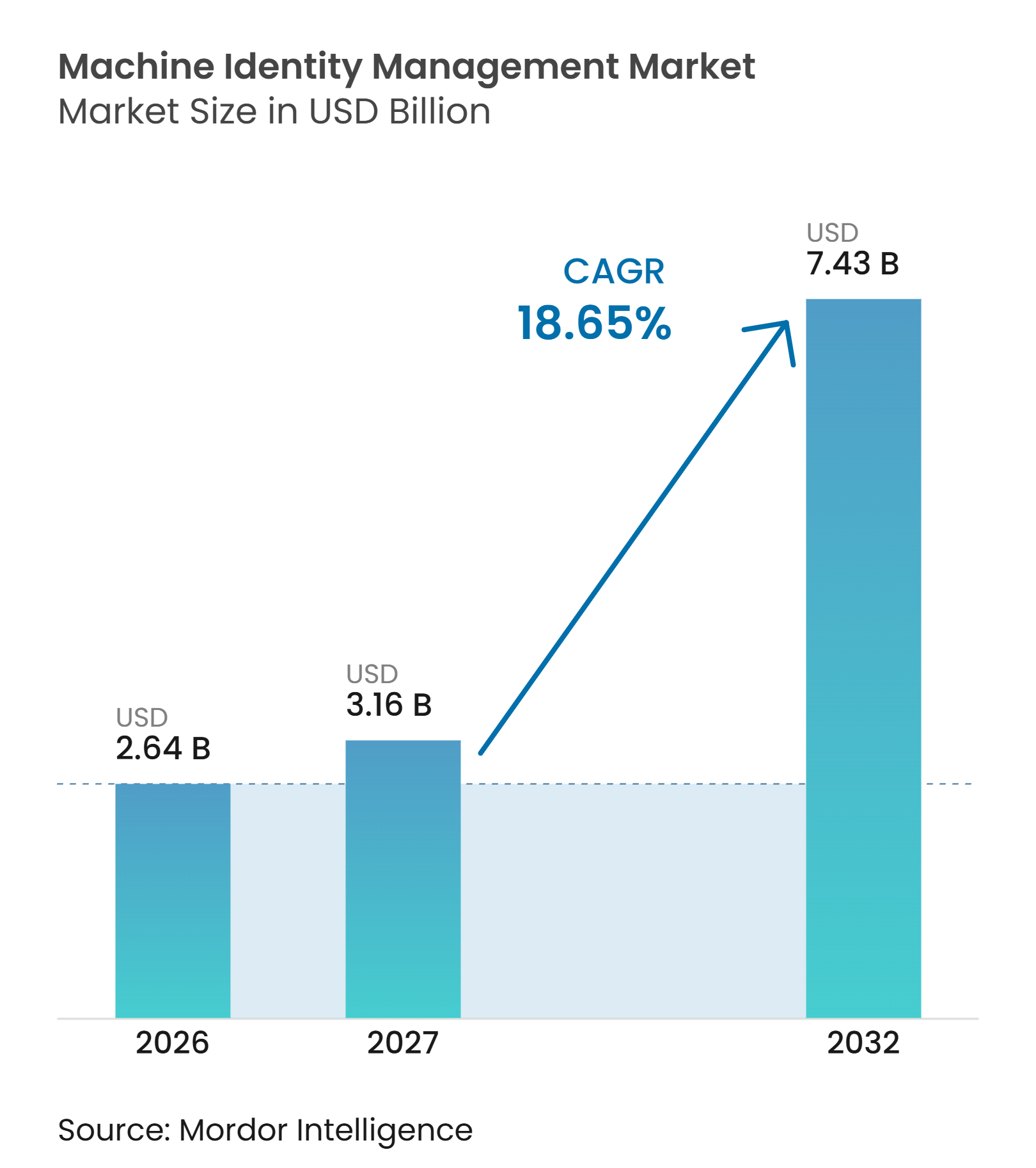
The Machine Identity Management Market size is projected to expand from USD 2.64 billion in 2026 and USD 3.16 billion in 2027 to USD 7.43 billion by 2032, registering a CAGR of 18.65% between 2027 to 2032. The machine identity management market is supported by the rising number of non-human identities across cloud-native applications, APIs, AI agent workflows, and containerized environments. Manual processes for certificate renewal, secrets handling, and SSH key governance are increasingly difficult to use when workloads are created and retired quickly. Zero-trust requirements, shorter TLS certificate lifespans, and post-quantum cryptography programs are making automated identity controls a recurring compliance priority for regulated organizations. The machine identity management market also benefits from North American demand in regulated sectors and from faster adoption in Asia-Pacific, where digital finance, AI infrastructure, and zero-trust plans are increasing the volume of credentials that must be governed.
Key Report Takeaways
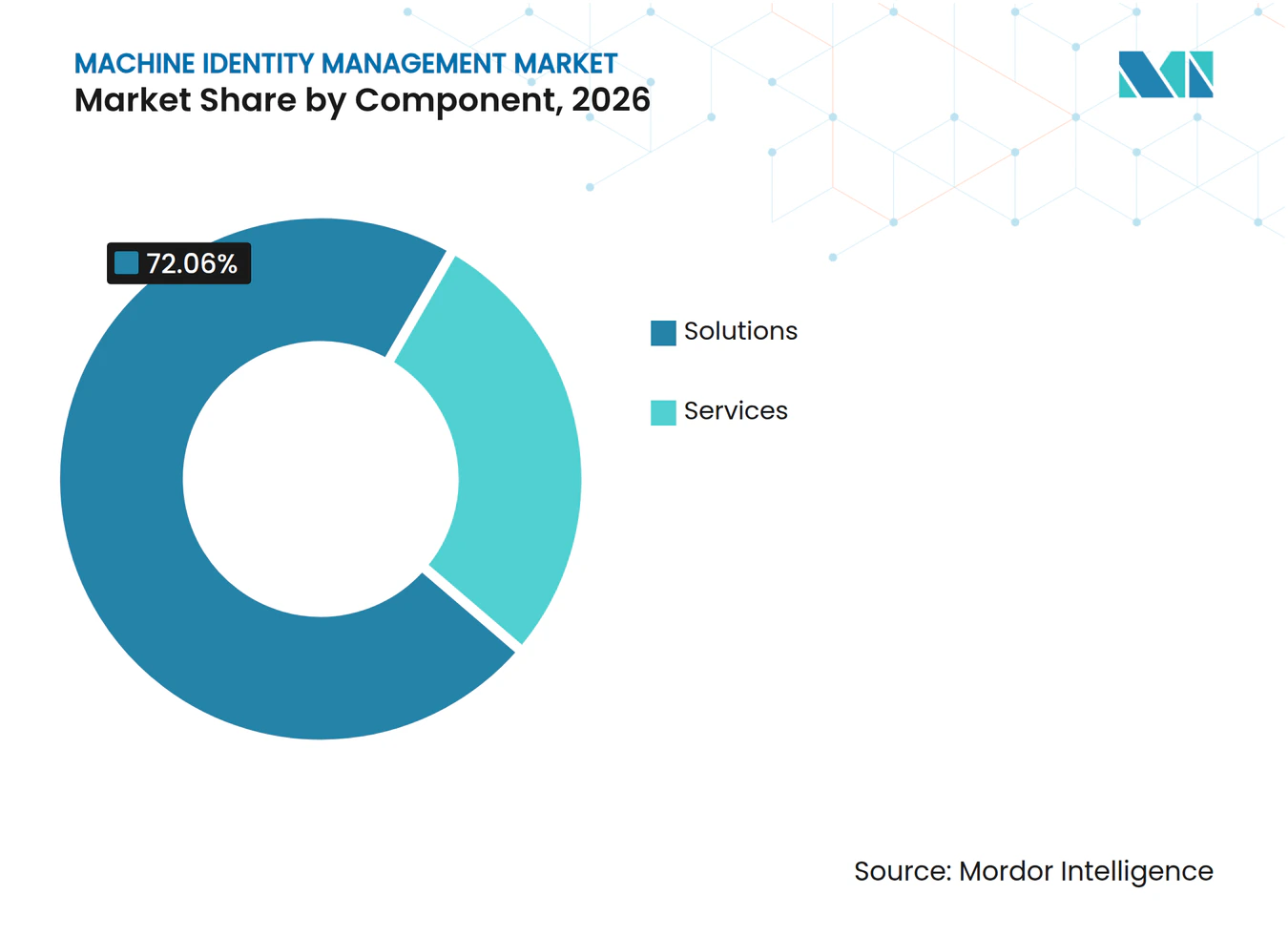
- By component, Solutions held 72.06% of the machine identity management market share in 2026, while the Solutions segment is projected to expand at a 19.71% CAGR through 2032.
- By identity type, Machine Certificates held 26.54% of the machine identity management market share in 2026, while AI Agent Identities are projected to expand at a 19.63% CAGR through 2032.
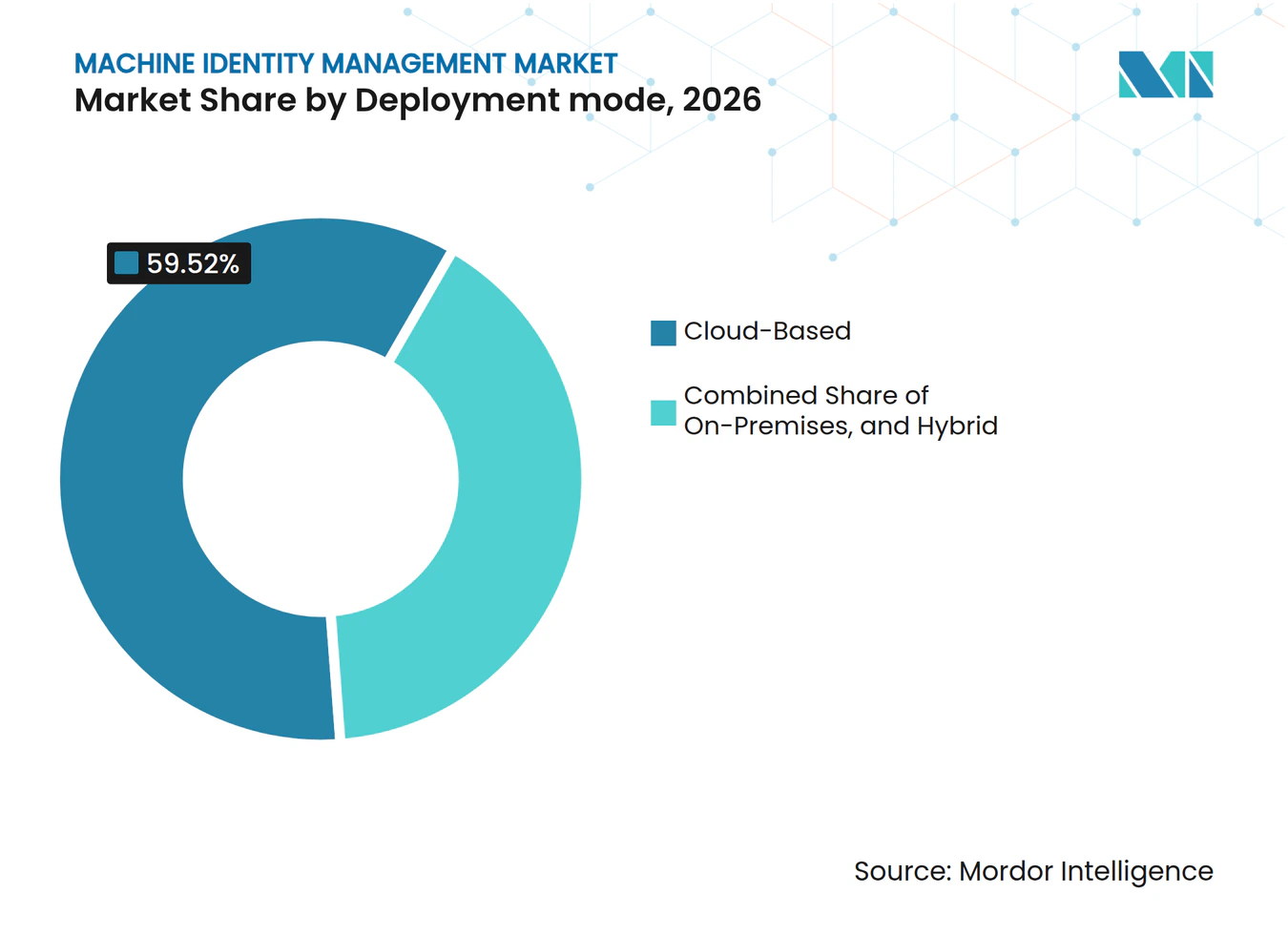
- By deployment mode, Cloud-Based deployment accounted for 59.52% of the machine identity management market share in 2026, while Hybrid deployment is projected to expand at a 19.39% CAGR through 2032.
- By organization size, Large Enterprises held 70.92% of the machine identity management market share in 2026, while SMEs are projected to expand at a 19.71% CAGR through 2032.
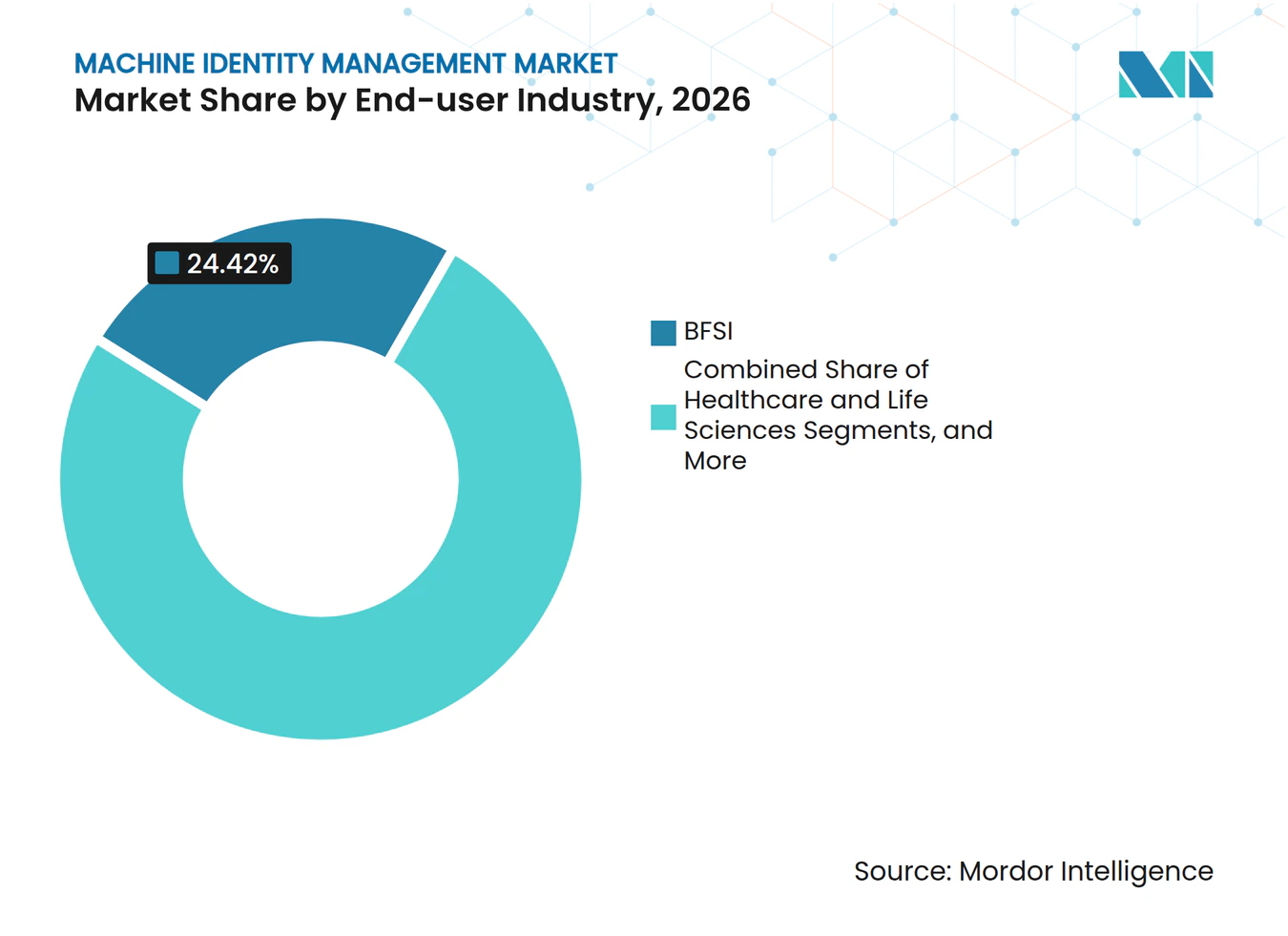
- By end-user industry, BFSI held 24.42% of the machine identity management market share in 2026, while Healthcare and Life Sciences are projected to expand at a 19.01% CAGR through 2032.
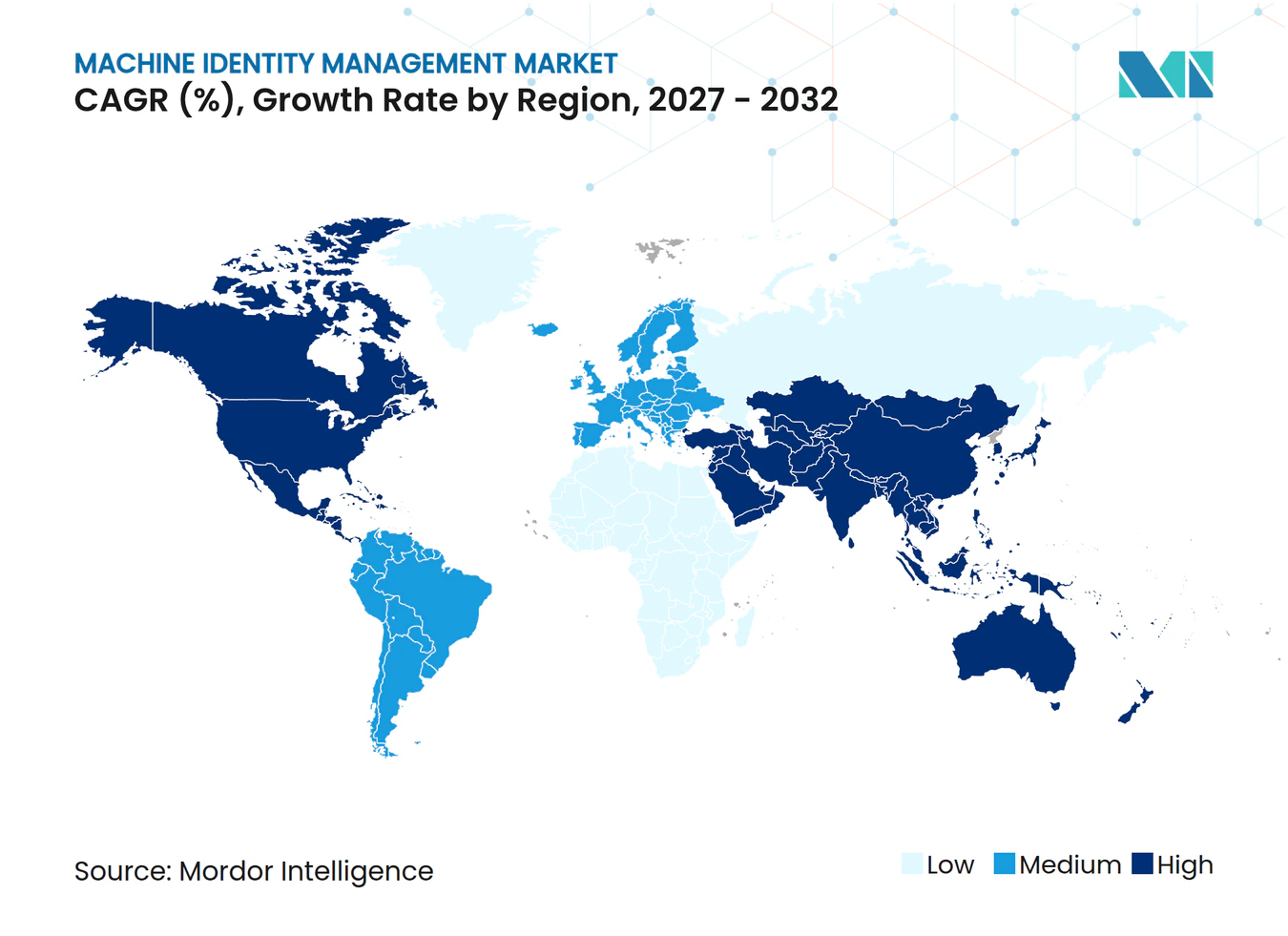
- By geography, North America held 45.51% of the machine identity management market share in 2026, while Asia-Pacific is projected to expand at a 19.58% CAGR through 2032.
Note: Market numbers in this report are based on Mordor Intelligence's proprietary estimation framework, which combines nine months of actuals with Q4 projections for base year 2026.
Market Trends and Insights
Drivers Impact Analysis of Machine Identity Management Market*
| Driver | (~) % Impact on CAGR Forecast | Geographic Relevance | Impact Timeline |
|---|---|---|---|
| Expansion of Cloud-Native Workloads and APIs | +4.0% | Global | Short term (≤ 2 years) |
| AI Agent and Autonomous Workflow Proliferation | +3.5% | North America, Europe, Asia-Pacific core | Medium term (2-4 years) |
| Zero-Trust Adoption for Machine-to-Machine Access | +3.2% | North America and Europe | Short term (≤ 2 years) |
| Shortening Certificate Lifespans and Automated Renewal Requirements | +2.8% | Global | Short term (≤ 2 years) |
| Software Supply-Chain Governance for Non-Human Identities | +2.1% | North America and Europe | Medium term (2-4 years) |
| Post-Quantum Cryptography Readiness and Crypto-Agility Programs | +1.8% | North America and Europe, spillover to Asia-Pacific | Long term (≥ 4 years) |
| Source: Mordor Intelligence | |||
Expansion of Cloud-Native Workloads and APIs
The move to microservices, API gateways, and containerized applications has changed how enterprises create and retire machine identities. The Cloud Native Computing Foundation reported in 2025 that 50% of backend developers used API gateways and 46% operated microservices, while 77% used at least 1 technology associated with cloud-native development.[1] Each service boundary can require a separate credential, which raises the administrative load on security teams. The machine identity management market is responding to this demand with platforms that can discover and govern identities across Kubernetes clusters, serverless functions, and multi-cloud identity systems. Manual inventory reviews cannot keep pace when services are temporary and credentials are issued at production speed. Suppliers that provide continuous discovery and API-based controls are better placed to replace disconnected tools with a single operating view.
AI Agent and Autonomous Workflow Proliferation
AI agents create a new demand source because their credentials can change with the task, system context, and access scope. Palo Alto Networks stated in 2025 that AI agents introduce privileged machine identities at unprecedented scale and require controls over the credentials used by those agents.[2] Each agent can use API tokens, OAuth grants, and service certificates that need the same lifecycle discipline as other privileged identities. The machine identity management market therefore has an opportunity to support agent credentials that require dynamic issuance, monitoring, rotation, and revocation. This need differs from the management of static service accounts because agent actions can be autonomous and can span multiple systems. Vendors are adapting their platforms to cover AI agent identity governance alongside certificates, secrets, and workload identities.
Zero-Trust Adoption for Machine-to-Machine Access
Zero-trust programs are moving machine authentication from a periodic compliance task to a continuing security requirement. The National Security Agency issued guidance for zero-trust protection of operational technology systems in October 2026, extending these controls to industrial environments that historically relied on perimeter security.[3]The Cybersecurity and Infrastructure Security Agency identified poorly managed API tokens and access assertions as key routes for lateral movement in hybrid multi-cloud environments in September 2026. The machine identity management market benefits when organizations need verified identities at each workload boundary. Certificate lifecycle management and secrets management are often considered together because both are necessary to control machine access. This requirement is particularly relevant for critical infrastructure operators and contractors that must update controls across industrial and enterprise systems.
Shortening Certificate Lifespans and Automated Renewal Requirements
Shorter TLS certificate lifespans are increasing the operational need for automated renewal. The CA/Browser Forum set the maximum public TLS certificate validity at 200 days from March 15, 2026, with further reductions to 100 days in March 2027 and 47 days in March 2029. Sectigo reported that the rule change establishes a 47-day maximum term as the end point of the phased schedule. CyberArk reported in 2025 that 72% of security leaders had experienced certificate-related outages. The machine identity management market gains urgency as renewal intervals become too short for human-led workflows. Organizations also need clear ownership, reliable inventories, and automated approval paths if they are to avoid interruptions caused by expired certificates.
Restraints Impact Analysis of Machine Identity Management Market*
| Restraint | (~) % Impact on CAGR Forecast | Geographic Relevance | Impact Timeline |
|---|---|---|---|
| Fragmented Legacy PKI and Secrets Tooling | -3.5% | Global | Short term (≤ 2 years) |
| Shortage of PKI and Machine Identity Specialists | -2.8% | Global | Medium term (2-4 years) |
| Ownership Ambiguity Across Platform Engineering and Security Teams | -2.0% | Global | Medium term (2-4 years) |
| False Positives from Ephemeral and Shadow Machine Identities | -1.5% | North America and Europe | Short term (≤ 2 years) |
| Source: Mordor Intelligence | |||
Fragmented Legacy PKI and Secrets Tooling
Disconnected certificate stores, vault instances, and secrets tools can delay benefits after a platform purchase. Many organizations maintain several PKI hierarchies, each with different automation interfaces, audit records, and renewal processes. The machine identity management market faces slower deployments where teams must connect certificate authority tools, SSH key managers, cloud secrets engines, and existing vaults before a central policy can operate. This work can delay the realization of value by 12 to 24 months after procurement. Incomplete inventories also weaken automated renewal and revocation because certificates issued through nonstandard channels can remain undiscovered. Providers that offer broad discovery and simpler integration can reduce this barrier, but customers still need to reconcile ownership and technical dependencies.
Shortage of PKI and Machine Identity Specialists
A shortage of PKI and cryptographic operations specialists can limit the value organizations realize from machine identity platforms. Organizations need practitioners who can design multi-CA architectures, deploy SPIFFE-compliant workload identity systems, and prepare cryptographic libraries for post-quantum migration. Keyfactor reported in January 2026 that 86% of cybersecurity professionals considered AI agents and autonomous systems untrustworthy without unique, dynamic digital identities. The machine identity management market must address this capability gap through managed services, implementation support, and easier operational workflows. Organizations without internal PKI knowledge can postpone renewal programs or use overly permissive certificate policies. These choices can increase service-disruption risk and enable unauthorized movement through compromised credentials.
*Our forecasts treat driver/restraint impacts as directional, not additive. The impact forecasts reflect baseline growth, mix effects, and variable interactions.
Machine Identity Management Market Segment Analysis
By Component:
Platform Solutions Consolidate Ahead of ServicesSolutions accounted for 72.06% of the machine identity management market size in 2026. This position reflects the consolidation of certificate lifecycle management, secrets management, workload identity, and cryptographic discovery within broader platforms. Customers increasingly prefer a smaller number of systems that can provide a consistent policy framework across these functions. Vendors are also adding AI agent identity governance, SSH key management, and cryptographic inventory to their existing product sets. These additions can increase contract value and make a platform more central to customer security operations.
The Solutions segment is projected to expand at a 19.71% CAGR from 2027 to 2032. The machine identity management market is seeing software delivery models reduce implementation barriers for enterprise and mid-market buyers. Services remain important for professional support, managed PKI, and advisory work. They are particularly relevant to SMEs that do not have dedicated cryptographic staff. Keyfactor reported in September 2026 that its Command platform supports automated certificates at scale, showing the operational value of software-delivered automation.


By Identity Type:
Machine Certificates Anchor, AI Agent Identities SurgeMachine Certificates held 26.54% of the machine identity management market share in 2026. Their position is supported by their role in TLS-based authentication across sectors and operating environments. The CA/Browser Forum validity schedule increases the number of certificate operations organizations must manage each year. This gives automated renewal tools continuing relevance even as certificate management practices mature. Machine certificates remain a basic control for service-to-service authentication, public-facing applications, and internal systems.
AI Agent Identities are projected to expand at a 19.63% CAGR from 2027 to 2032. The Cloud Security Alliance stated in 2025 that organizations may need to govern tens of thousands of agent identities where they previously managed hundreds of human users. The machine identity management market includes other identity classes such as application and service identities, API keys and OAuth token identities, workload and container identities, secrets and access tokens, and SSH keys. Each addresses a different area of the non-human identity estate. Their common requirement is for discovery, policy enforcement, credential rotation, and access control that work across dynamic infrastructure.
By Deployment Mode:
Cloud-Based Scales, Hybrid Gains the Fastest GroundCloud-Based deployment accounted for 59.52% of the machine identity management market size in 2026. SaaS-delivered PKI platforms can take responsibility for infrastructure management and certificate authority connector maintenance. This model becomes more useful as certificate inventories expand and as customers need to apply consistent renewal practices. Cloud delivery can also simplify access to new features for identity discovery, cryptographic inventory, and automation. The model does not remove the need to integrate with customer environments, but it reduces the operational burden of running the platform.
Hybrid deployment is projected to expand at a 19.39% CAGR from 2027 to 2032. The Cloud Native Computing Foundation reported in 2025 that 30% of backend developers used hybrid deployments and 23% used multi-cloud deployments. The machine identity management market must support controls that extend from on-premises systems into cloud environments. On-premises deployment remains relevant to government agencies and defense contractors that face data-residency limits. Keyfactor reported in 2026 that it achieved FedRAMP certification and CMMC Level 2 certification, showing the compliance posture suppliers need to address those environments.


By Organization Size:
Large Enterprises Anchor, SMEs AccelerateLarge Enterprises held 70.92% of the machine identity management market share in 2026. Their large certificate inventories, regulatory responsibilities, and established security teams create a strong case for comprehensive governance. Banks, insurers, and technology companies can manage hundreds of thousands of certificates across multi-cloud systems. For these organizations, automated governance is an operational requirement rather than a discretionary security enhancement. Their scale also makes it more practical to consolidate several identity functions into one platform.
SMEs are projected to expand at a 19.71% CAGR from 2027 to 2032. Managed PKI-as-a-service and SaaS automation can reduce entry barriers that previously required dedicated cryptographic expertise. The machine identity management market can reach these organizations through implementation models that require less in-house administration. Keyfactor made its Command MCP Server available through AWS Marketplace in December 2025, providing multi-user scalability and wider AI client support for organizations using that procurement channel. Smaller buyers still need clear ownership and operating processes, but managed delivery can reduce the resource burden.
By End-User Industry:
BFSI Leads While Healthcare and Life Sciences AcceleratesBFSI held 24.42% of the machine identity management market share in 2026. The sector faces certificate governance obligations under PCI DSS and SOX, while its high-value workloads make service availability and access control especially important. Thales reported in 2025 that 89% of BFSI respondents expressed an urgent or moderate desire to consolidate identity vendor stacks. This reflects the operating cost and control gaps that can result from fragmented identity tools. The machine identity management market has a clear role in helping these organizations bring credentials, lifecycle controls, and audit records into a more coherent operating model.
Healthcare and Life Sciences are projected to expand at a 19.01% CAGR from 2027 to 2032. Digitization of clinical operations, telehealth API traffic, and AI-assisted diagnostics are introducing new types of identities into sensitive environments. Information Technology and Telecommunications and Government and Public Sector also represent substantial demand pools because of cloud-native deployment and zero-trust requirements. Manufacturing and Industrial, Retail and E-Commerce, Energy and Utilities, and Transportation and Logistics add demand through IoT use, operational technology convergence, and logistics automation. The machine identity management market must serve each of these sectors without forcing a single deployment model or credential type.
Geography Analysis
North America Machine Identity Management Market
North America held 45.51% of the machine identity management market share in 2026. The region combines regulated industries, mature cybersecurity purchasing, and recurring federal security direction. The National Institute of Standards and Technology published its post-quantum cryptography transition guidance in 2025, setting out the need to replace quantum-vulnerable algorithms by 2035. Canada contributes demand through financial services digitization and government cloud modernization, while Mexico offers an emerging opportunity as nearshoring-related manufacturing investment increases the need for structured identity automation.
Europe Machine Identity Management Market
Europe held the second-largest regional revenue position in 2026. The United Kingdom and Germany are the region's largest contributors, supported by NIS2 compliance requirements for critical-infrastructure operators and suppliers. France, Italy, and Spain are also progressing procurement that aligns with NIS2 timelines and strengthens identity governance across connected infrastructure and cloud environments. Russia operates under a distinct regulatory setting shaped by domestic sourcing requirements that can limit access for international platform suppliers.
APAC, MEA and South America Machine Identity Management Market
Asia-Pacific is projected to expand at a 19.58% CAGR from 2027 to 2032, giving it the fastest regional rate in the machine identity management market. The region has a large governance gap because identity estates can expand more quickly than existing control programs. India is the fastest-growing country in the region, supported by fintech expansion, API-intensive development, and outsourced software work. China is generating identity volumes through cloud infrastructure expansion and state-led AI programs, while data-localization rules shape vendor access. Japan, South Korea, Australia, and Singapore are advancing zero-trust and identity programs that require broader machine credential governance. The Middle East is supported by financial-sector digitization in Saudi Arabia and the United Arab Emirates, while South America is led by Brazil's fintech and cloud-native activity, and Africa remains at an earlier adoption stage linked to mobile financial services.
Competitive Landscape
Market Concentration
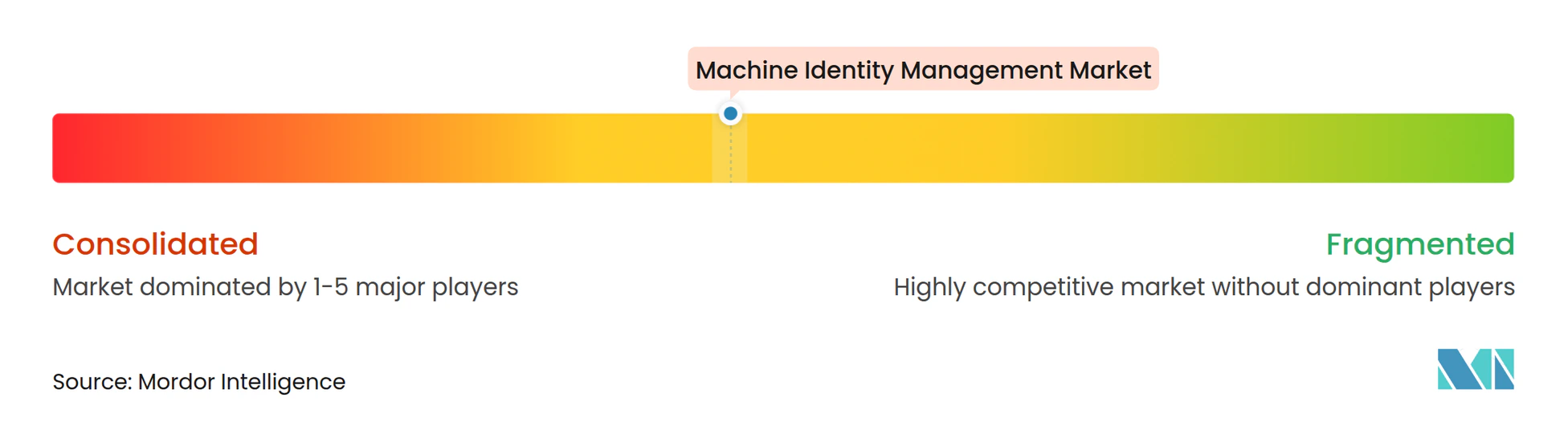
The machine identity management market is moderately fragmented and includes 3 distinct competitive tiers. Large security platforms, cloud hyperscalers, and enterprise security vendors compete on ecosystem breadth and on their ability to include machine identity controls within broader contracts. Focused specialists compete through cryptographic depth, standards compliance, and integration with Kubernetes environments and CI/CD toolchains. Palo Alto Networks announced a definitive agreement to acquire CyberArk for USD 25 billion in July 2025, a transaction that positioned identity security as a core part of broad cybersecurity platforms.
Competitive positioning depends on the breadth of cryptographic asset discovery across hybrid environments. Suppliers also need credible post-quantum migration plans that align with NIST transition guidance and practical integration with developer workflows. Keyfactor launched its Trust Control Plane in June 2026 to combine PKI, certificate lifecycle management, cryptographic discovery, secrets management, and AI agent identity governance in 1 system. Keyfactor also announced a USD 1 billion strategic growth investment in July 2026 to support product development, geographic expansion, and its planned acquisition of Cofide. These moves show that platform scope and the ability to support AI and post-quantum requirements are becoming important points of competition.
Managed service providers have room to package PKI-as-a-service and AI agent identity governance in consumption-based offers for SMEs without dedicated PKI teams. Teleport, Smallstep Labs, and Akeyless Security compete in workload identity through open standards such as SPIFFE, OAuth, and OIDC rather than proprietary certificate formats. This approach can lower switching barriers for DevSecOps teams that value interoperability. CyberArk expanded its Machine Identity Security portfolio in October 2025 with discovery and context capabilities, including a dashboard for the CA/Browser Forum 47-day certificate timeline. The machine identity management market will continue to reward providers that can combine standards support, deployment flexibility, and simpler operating processes.
Machine Identity Management Industry Leaders
-
Keyfactor, Inc.
-
DigiCert, Inc.
-
Palo Alto Networks, Inc.
-
Sectigo Limited
-
Entrust Corporation
- *Disclaimer: Major Players sorted in no particular order
Machine Identity Management Market Companies Covered in this Report
- Keyfactor, Inc.
- DigiCert, Inc.
- Palo Alto Networks, Inc.
- Sectigo Limited
- Entrust Corporation
- Microsoft Corporation
- Amazon Web Services, Inc.
- Google LLC
- IBM Corporation
- Thales Group
- GlobalSign Ltd.
- AppViewX, Inc.
- Akeyless Security Ltd.
- GitGuardian SAS
- BeyondTrust Corporation
- Delinea Inc.
- Fortanix, Inc.
- Teleport, Inc.
- Smallstep Labs, Inc.
- Aembit, Inc.
Recent Industry Developments in Machine Identity Management Market
- September 2026: Keyfactor exceeded USD 200 million in ARR at the start of Q3 2026, with certificates issued via EJBCA SaaS growing 168% since early 2025, reflecting sustained enterprise and government demand for unified machine identity governance.
- July 2026: Keyfactor announced a USD 1 billion+ strategic growth investment led by Summit Partners, allocating capital toward product innovation, geographic expansion, and the planned acquisition of Cofide to extend verified workload and AI agent identity capabilities into the Keyfactor Trust Control Plane platform.
- June 2026: Keyfactor launched the Trust Control Plane, consolidating PKI, certificate lifecycle management, cryptographic discovery, secrets management, and AI agent identity governance into a single unified system, and achieved FedRAMP certification status to serve US federal agencies with cloud-based certificate automation.
- March 2026: The CA/Browser Forum's SC-081v3 ballot took operational effect, reducing maximum TLS certificate validity to 200 days, the first operational phase of the phased reduction to 47 days by March 2029, immediately expanding automated renewal requirements for all organizations managing public-trust certificates.
Global Machine Identity Management Market Report Scope
The Machine Identity Management Market encompasses solutions and services for securing, authenticating, governing, and managing non-human identities, credentials, certificates, and cryptographic keys across cloud, on-premises, and hybrid enterprise environments worldwide. The Market is Segmented by Component (Solutions, and Services), Identity Type (Application and Service Identities, API Keys and OAuth Token Identities, Workload and Container Identities, Machine Certificates, Secrets, Passwords, and Access Tokens, SSH Keys and Cryptographic Keys, AI Agent Identities, Other Identity Types), Deployment Mode (Cloud-Based, On-Premises, and Hybrid), Organization Size (Large Enterprises, and Small and Medium-Sized Enterprises), End-User Industry (BFSI, Information Technology and Telecommunications, Healthcare and Life Sciences, Government and Public Sector, Manufacturing and Industrial, Retail and E-Commerce, Energy and Utilities, Transportation and Logistics), and Geography (North America, Europe, Asia-Pacific, South America, Middle East, Africa). The Market Forecasts are Provided in Terms of Value (USD).
Segmentation Overview
| Solutions |
| Services |
| Application and Service Identities |
| API Keys and OAuth Token Identities |
| Workload and Container Identities |
| Machine Certificates |
| Secrets, Passwords, and Access Tokens |
| SSH Keys and Cryptographic Keys |
| AI Agent Identities |
| Other Identity Types |
| Cloud-Based |
| On-Premises |
| Hybrid |
| Large Enterprises |
| Small and Medium-Sized Enterprises |
| BFSI |
| Information Technology and Telecommunications |
| Healthcare and Life Sciences |
| Government and Public Sector |
| Manufacturing and Industrial |
| Retail and E-Commerce |
| Other End-User Industries |
| North America | United States |
| Canada | |
| Mexico | |
| South America | Brazil |
| Argentina | |
| Rest of South America | |
| Europe | Germany |
| United Kingdom | |
| France | |
| Italy | |
| Spain | |
| Russia | |
| Rest of Europe | |
| Asia-Pacific | China |
| India | |
| Japan | |
| South Korea | |
| Australia | |
| Rest of Asia-Pacific | |
| Middle East | Saudi Arabia |
| United Arab Emirates | |
| Turkey | |
| Rest of Middle East | |
| Africa | South Africa |
| Egypt | |
| Nigeria | |
| Rest of Africa |
| By Component | Solutions | |
| Services | ||
| By Identity Type | Application and Service Identities | |
| API Keys and OAuth Token Identities | ||
| Workload and Container Identities | ||
| Machine Certificates | ||
| Secrets, Passwords, and Access Tokens | ||
| SSH Keys and Cryptographic Keys | ||
| AI Agent Identities | ||
| Other Identity Types | ||
| By Deployment Mode | Cloud-Based | |
| On-Premises | ||
| Hybrid | ||
| By Organization Size | Large Enterprises | |
| Small and Medium-Sized Enterprises | ||
| By End-User Industry | BFSI | |
| Information Technology and Telecommunications | ||
| Healthcare and Life Sciences | ||
| Government and Public Sector | ||
| Manufacturing and Industrial | ||
| Retail and E-Commerce | ||
| Other End-User Industries | ||
| By Geography | North America | United States |
| Canada | ||
| Mexico | ||
| South America | Brazil | |
| Argentina | ||
| Rest of South America | ||
| Europe | Germany | |
| United Kingdom | ||
| France | ||
| Italy | ||
| Spain | ||
| Russia | ||
| Rest of Europe | ||
| Asia-Pacific | China | |
| India | ||
| Japan | ||
| South Korea | ||
| Australia | ||
| Rest of Asia-Pacific | ||
| Middle East | Saudi Arabia | |
| United Arab Emirates | ||
| Turkey | ||
| Rest of Middle East | ||
| Africa | South Africa | |
| Egypt | ||
| Nigeria | ||
| Rest of Africa | ||
Key Questions Answered in the Report
What is the machine identity management market size?
The Machine Identity Management Market is projected to rise from USD 2.64 billion in 2026 and USD 3.16 billion in 2027 to USD 7.43 billion by 2032, at an 18.65% CAGR from 2027 to 2032.
What is driving demand for machine identity management?
Cloud-native workloads, AI agents, zero-trust controls, and shorter TLS certificate validity periods are increasing the need for automated credential governance.
Which component leads demand for machine identity management?
Solutions led with a 72.06% share in 2026 because organizations are consolidating certificate lifecycle management, secrets, workload identity, and cryptographic discovery.
Which identity type is expanding fastest?
AI Agent Identities are projected to expand at a 19.63% CAGR through 2032 as autonomous workflows require dynamically managed credentials.
Which region is expected to expand fastest?
Asia-Pacific is projected to expand at a 19.58% CAGR through 2032, supported by fintech, AI infrastructure, and zero-trust adoption.
Which end-user sector is expanding fastest?
Healthcare and Life Sciences are projected to expand at a 19.01% CAGR through 2032 as digital clinical operations, telehealth, and AI-assisted diagnostics increase identity requirements.