
Hydraulic Dosing Pump Market Size and Share
Market Overview
| Study Period | 2021 - 2031 |
|---|---|
| Market Size (2026) | USD 1.12 Billion |
| Market Size (2031) | USD 1.52 Billion |
| Growth Rate (2026 - 2031) | 6.37 % CAGR |
| Fastest Growing Market | Asia Pacific |
| Largest Market | Asia Pacific |
| Market Concentration | Medium |
Major Players *Disclaimer: Major Players sorted in no particular order. Image © Mordor Intelligence. Reuse requires attribution under CC BY 4.0. |
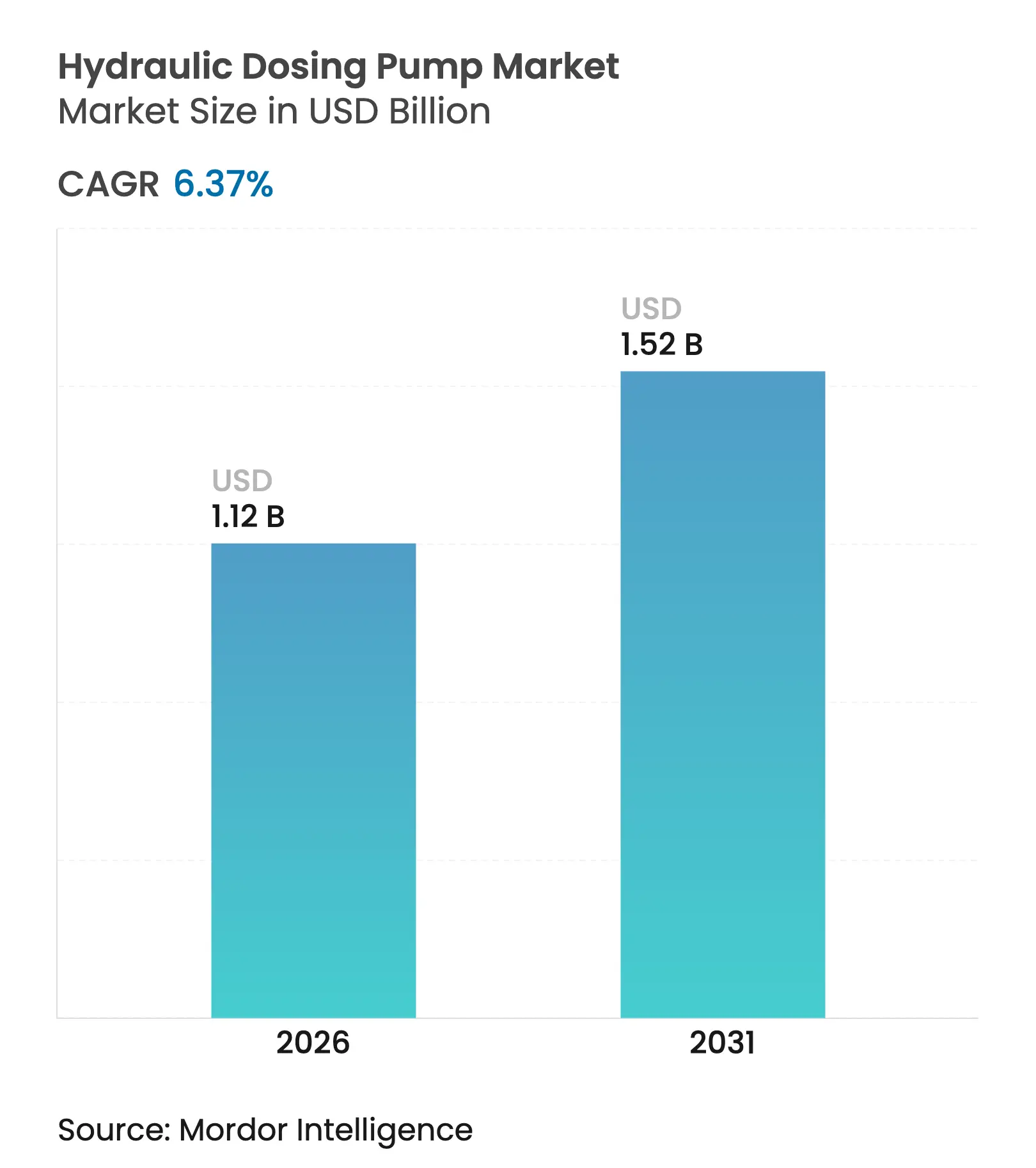

Hydraulic Dosing Pump Market Analysis by Mordor Intelligence
Growth reflects the indispensability of hydraulically actuated metering equipment for chemical injection in water treatment, oil & gas production, and the nascent hydrogen economy. Demand is buoyed by regulatory insistence on dosing accuracy, the inability of electric or solenoid designs to meet ultra-high-pressure requirements above 500 bar, and the industry’s shift toward Industry 4.0-enabled remote monitoring, which lowers the total cost of ownership. The Asia-Pacific region holds the largest market position, with customers in the oil & gas sector being the fastest adopters of next-generation smart pumps. Diaphragm technology retains technical dominance due to its leak-free operation across hazardous chemistries.
Key Report Takeaways
- By pump type, diaphragm technology captured 46.60% of the hydraulic dosing pump market share in 2025.
- By end-use, oil & gas chemical injection is projected to register the fastest 7.12% CAGR through 2031, contributing to the growth of the hydraulic dosing pump market size.
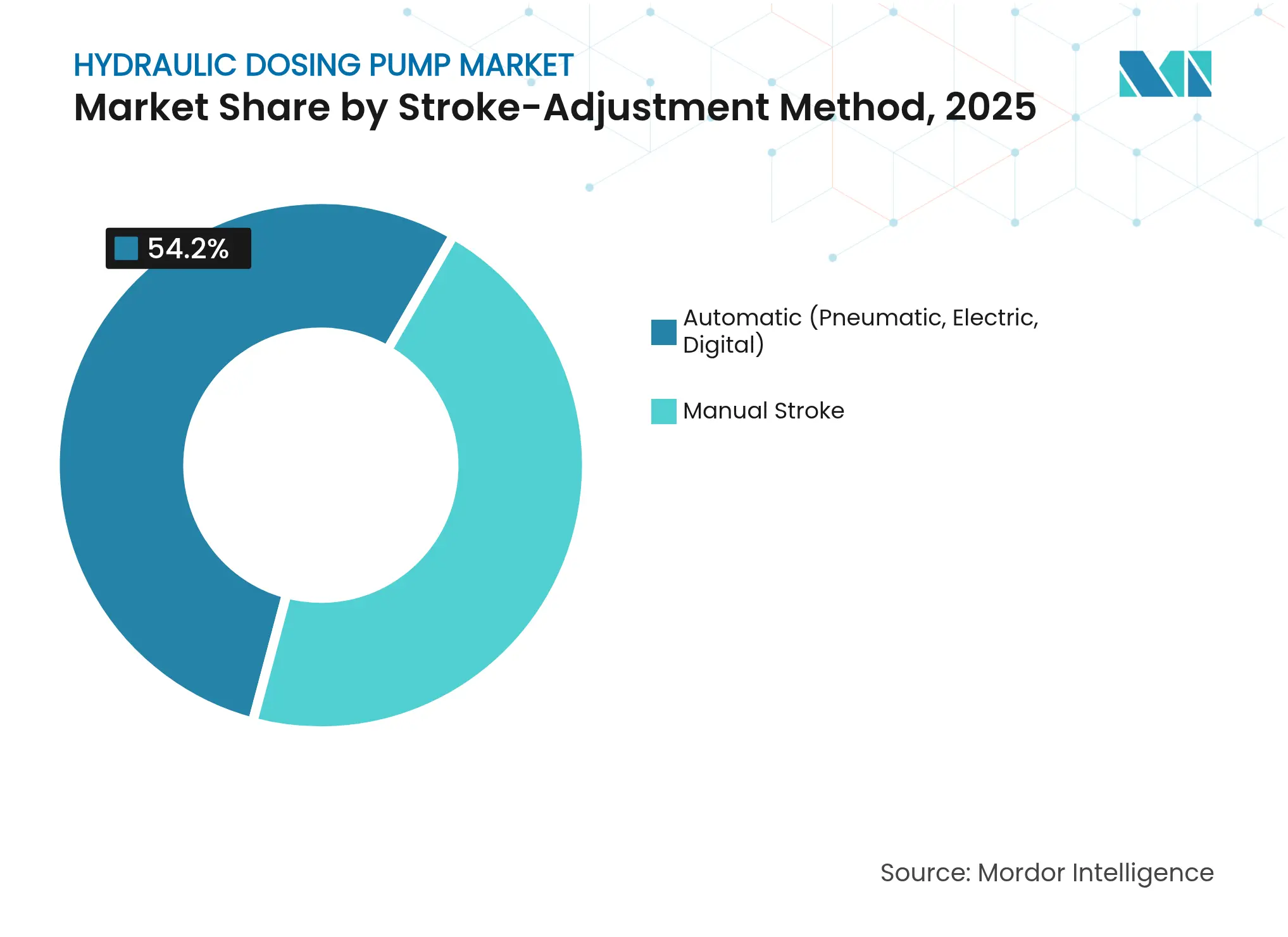
- By the stroke-adjustment method, automatic systems commanded 54.20% of the hydraulic dosing pump market size in 2025 and are expected to expand at a 6.62% CAGR through 2031.
- By discharge pressure, the 100–500 bar segment is expected to outpace others at a 7.32% CAGR between 2026 and 2031 within the hydraulic dosing pump market.
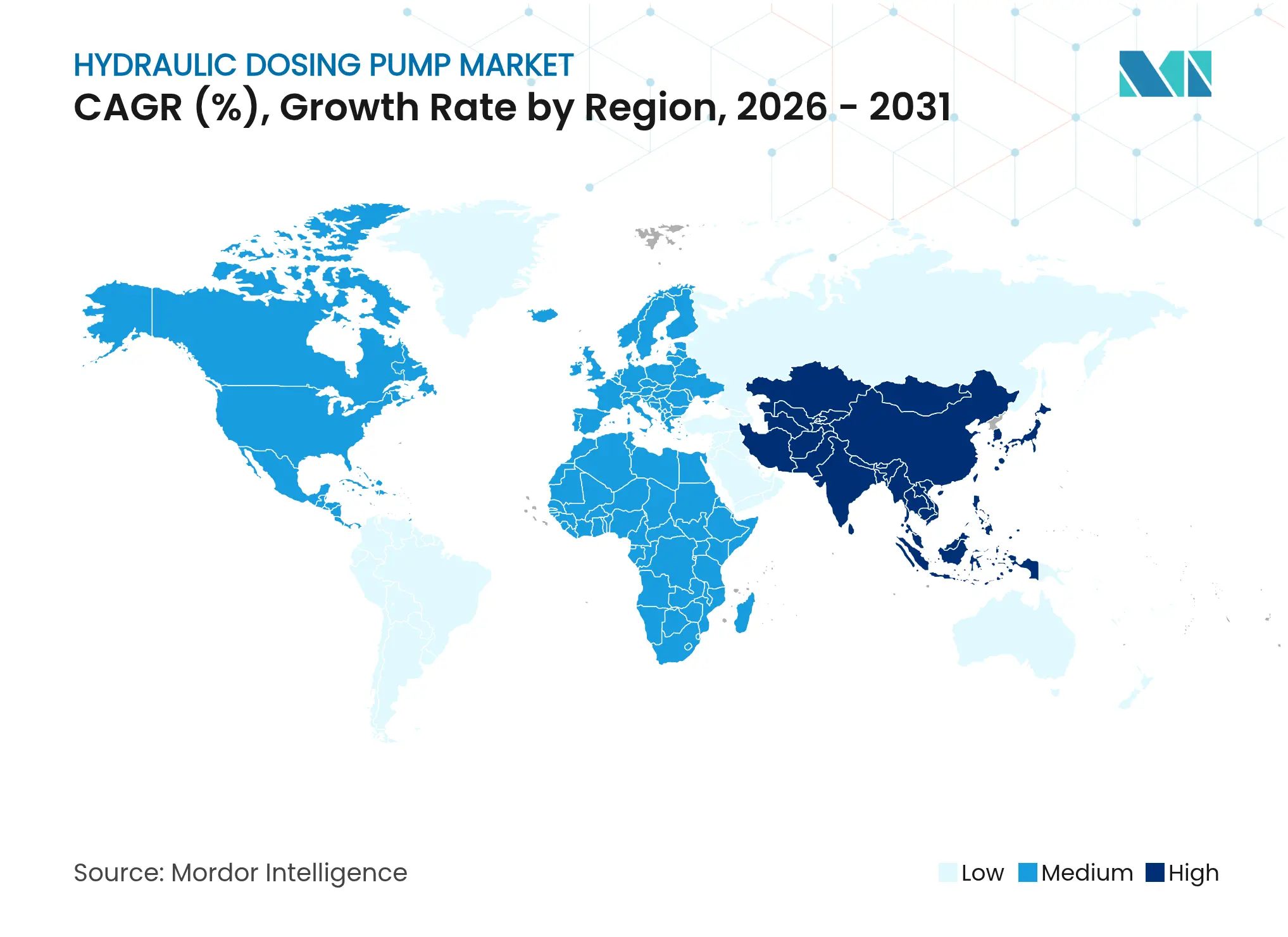
- By geography, Asia-Pacific led with 38.20% revenue and is accelerating at 6.68% CAGR through 2031 across the hydraulic dosing pump market
Note: Market size and forecast figures in this report are generated using Mordor Intelligence's proprietary estimation framework, updated with the latest available data and insights as of 2026.
Global Hydraulic Dosing Pump Market Trends and Insights
Drivers Impact Analysis
| Driver | (~) % Impact on CAGR Forecast | Geographic Relevance | Impact Timeline |
|---|---|---|---|
Rising water & wastewater treatment investments | 1.80% | Global; strongest in APAC & North America | Long term (≥ 4 years) |
Expanding chemical processing capacity in Asia-Pacific | 1.20% | APAC core; spill-over to MEA | Medium term (2-4 years) |
Increasing offshore & shale oil chemical injection needs | 0.90% | North America, Middle East, North Sea | Medium term (2-4 years) |
Regulatory demand for dosing accuracy & operator safety | 0.70% | Global; led by North America & EU | Long term (≥ 4 years) |
Industry 4.0-enabled smart dosing systems adoption | 0.60% | North America, EU, developed APAC | Short term (≤ 2 years) |
Hydrogen electrolyzer dosing for clean-fuel value chain | 0.40% | EU, North America, select APAC | Long term (≥ 4 years) |
| Source: Mordor Intelligence | |||
Rising Water & Wastewater Treatment Investments
Municipalities continue to retrofit aging plants with precision dosing pumps to meet stricter PFAS and nutrient-discharge rules set by the U.S. EPA and the EU, creating recurring replacement demand for the hydraulic dosing pump market.[1] IoT-connected metering equipment now tracks pH, turbidity, and residual disinfectant in real-time, automatically modulating stroke length to minimize chemical overfeed. A Watson-Marlow Qdos installation reduced phosphorus load by 97.5% in a German facility, while also reducing operator exposure to ferric chloride, thanks to a sealed pumphead.[2] Growing interest in decentralized water treatment in rural Africa and Southeast Asia favours compact, solar-ready hydraulic units that can run autonomously for weeks, reinforcing market penetration.
Expanding Chemical Processing Capacity in Asia-Pacific
China’s migration up the value chain into lithium battery materials and advanced polymers requires ultraprecise flow control of corrosive catalysts, fortifying regional demand in the hydraulic dosing pump market. India’s USD 142 billion petrochemical build-out necessitates large-scale installations for pH neutralization and additive dosing, underpinning equipment orders through 2030. Local producers seek automated skids pre-equipped with smart sensors to reduce the need for operators amid labour constraints. European suppliers gain ground by licensing safety-diaphragm designs to Chinese and Indian OEM partners, widening technology dissemination.
Increasing Offshore & Shale Oil Chemical Injection Needs
Deep-water developments in the Gulf of Mexico and Brazil now require chemical injection at pressures exceeding 900 bar to prevent hydrates, making hydraulic pumps the sole viable option for methanol and corrosion inhibitor dosing. Shale producers, meanwhile, cycle pumps intermittently during fracturing stages, pushing suppliers to offer modular, quick-change liquid ends that cut standby energy draw. LEWA’s micro-flow systems maintain 50 l/h at ultra-high purity to prevent valve fouling, proving the technology’s reliability for sour-gas fields
Regulatory Demand for Dosing Accuracy & Operator Safety
OSHA’s Process Safety Management rules in the United States require producers to document dosing skid integrity, prompting the purchase of hydraulically actuated units with built-in pressure relief and diaphragm rupture detection. The EU’s harmonised GHS Revision 7 likewise calls for enclosed chemical handling architectures, and users now specify triple-layer diaphragms and PTFE backings by default. Pharmaceutical plants insist on <±1% dosing precision over 10,000-hour validation intervals, assuring sticky demand in the hydraulic dosing pump market.[3]
Restraints Impact Analysis
| Restraint | (~) % Impact on CAGR Forecast | Geographic Relevance | Impact Timeline |
|---|---|---|---|
Availability of low-cost electric & solenoid metering pumps | -1.10% | Global; price-sensitive markets | Short term (≤ 2 years) |
High maintenance costs in abrasive/viscous media | -0.80% | Heavy industry worldwide | Medium term (2-4 years) |
Volatility in specialty hydraulic-fluid raw-material prices | -0.60% | Global supply chains | Short term (≤ 2 years) |
Shortage of skilled calibration & service technicians | -0.40% | Developed economies | Long term (≥ 4 years) |
| Source: Mordor Intelligence | |||
Availability of Low-Cost Electric & Solenoid Metering Pumps
ProMinent’s gamma/XL electric solenoid model achieves ±1% accuracy at a significantly lower upfront cost, making it an attractive option for buyers in chlorination and boiler feed tasks operating at pressures below 100 bar.[4] Mass production and simplified spare parts pools erode price premiums for hydraulic units, squeezing margins in the hydraulic dosing pump market. Yet hydraulic designs retain primacy wherever fail-safe hydraulic oil cushions and pressure relief valves are mandated.
High Maintenance Costs in Abrasive / Viscous Media
Ceramic slurries shred diaphragms and check-ball seats, lifting total maintenance spend by 15%-20% over pump life. NETZSCH solved this by deploying hardened steel lobes in its TORNADO T.Proc, achieving six-times longer service life. Despite such advances, end users still perceive manual intervention frequency as a barrier, particularly in 24/7 plants with thin maintenance crews.
Segment Analysis
By Pump Type: Diaphragm Dominance Drives Innovation
Diaphragm pumps held 46.60% of the hydraulic dosing pump market share in 2025 and are projected to post a 6.95% CAGR through 2031, driven by multi-layer PTFE diaphragms that eliminate fugitive emissions. This leadership endures because chemical compatibility and leak-free performance outweigh initial capital outlay in most regulated industries. Smart diagnostics now alert operators before diaphragm rupture, further cementing preference for this architecture in the hydraulic dosing pump market.
Plunger and piston variants remain indispensable for super-high-pressure methanol injection above 500 bar, particularly offshore. In contrast, peristaltic and hydraulically backed hybrids are suitable for handling shear-sensitive or abrasive fluids. Watson-Marlow’s Conveying Wave Technology achieved a 97.5% phosphorus removal record, illustrating how niche designs can wrestle share by tackling application pain points.
By Stroke-Adjustment Method: Automation Accelerates Adoption
Automatic stroke-control designs captured 54.20% of the hydraulic dosing pump market size in 2025 and are expected to expand at a 6.62% CAGR as plants pursue unmanned operations. Variable-frequency drives, pneumatic positioners, and digital stepper motors enable stroke length and speed to adapt in real-time, thereby trimming chemical overfeed.
Manual systems maintain a presence in remote mines and small breweries where electricity is unreliable, yet even these sites are increasingly retrofitting low-power PLC modules for data logging. Suppliers bundle cloud dashboards, allowing maintenance staff to check stroke count and diaphragm health from smartphones, thereby widening the installed base for smart units across the hydraulic dosing pump market.
Note: Segment shares of all individual segments available upon report purchase
By Discharge-Pressure Range: Mid-Pressure Growth Outpaces Extremes
The ≤100 bar class dominated with 56.90% of the revenue in 2025, as municipal water and general chemicals seldom require higher pressures. Still, the 100-500 bar mid-pressure tier is expected to lead to expansion at a 7.32% CAGR, driven by hydrocarbon processing and specialty-chemical reactors that benefit from mild pressure intensification. Pump makers now use duplex stainless steel heads to contain 400 bar while resisting chlorides, cutting the life-cycle cost of desalination plants.
High-pressure units above 500 bar serve confined niches such as subsea hydrate inhibition but command premium margins, helping vendors offset commoditization in the low-pressure layers of the hydraulic dosing pump market.
By End-Use Industry: Water Treatment Scale Meets Oil & Gas Acceleration
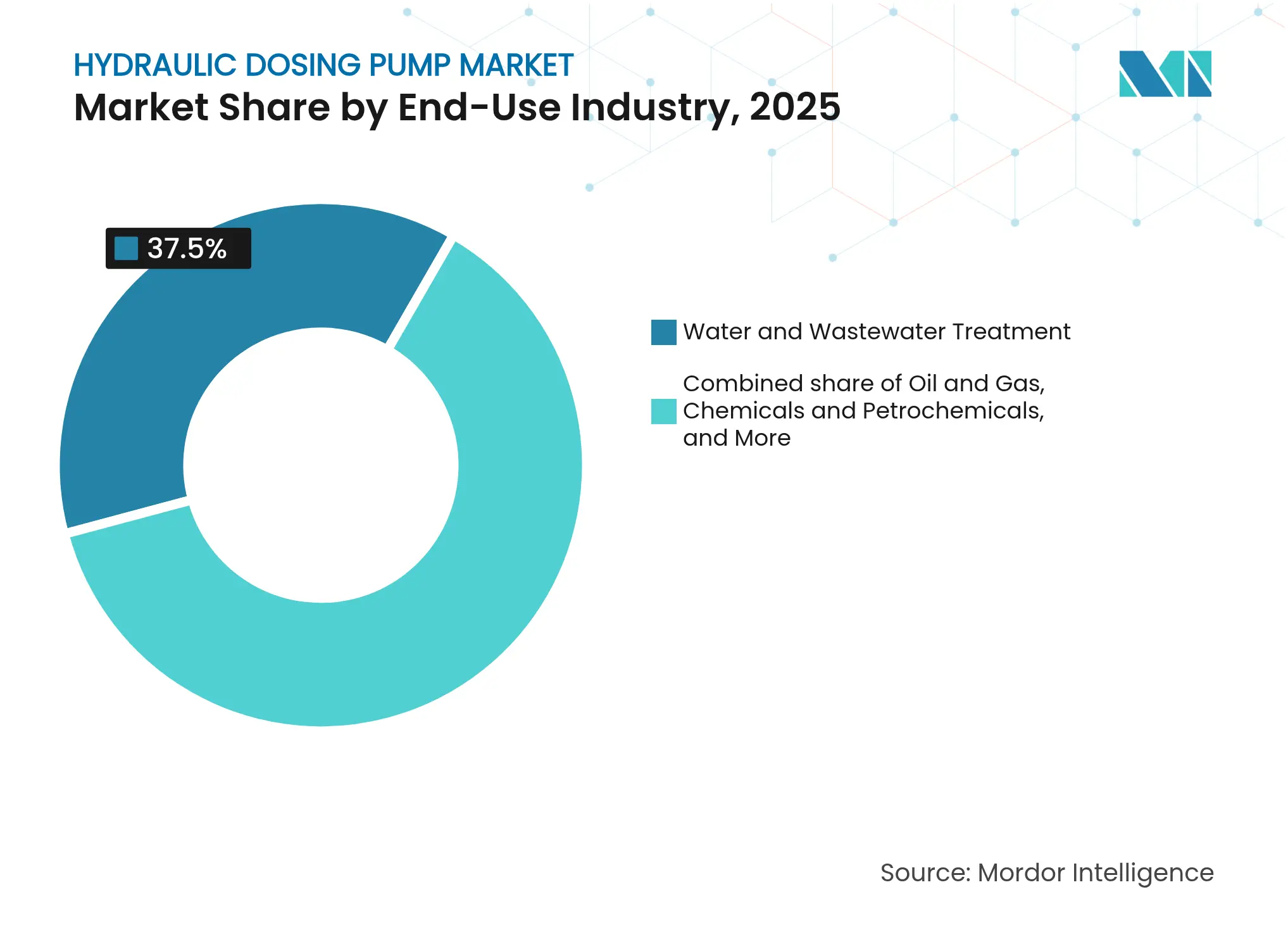
Water and wastewater treatment retained 37.50% of the hydraulic dosing pump market size in 2025, underpinned by mandated phosphate removal, PFAS remediation, and residual chlorine control. Oil & gas will outstrip all other verticals at 7.12% CAGR because deep-water projects and shale plays need precision chemical injection for flow assurance and corrosion management. Chemical processing, power generation, and the food and beverage industry remain sizable, steady buyers where dosing errors directly impact product quality or regulatory compliance.
Pharmaceutical plants adopt hygienic, fully drainable pump heads that withstand autoclaving, while pulp & paper mills pick abrasion-tolerant diaphragms for bleaching chemicals. Such diversity shields the hydraulic dosing pump market from downturns in a single industry.
Note: Segment shares of all individual segments available upon report purchase
Geography Analysis
The Asia-Pacific region commanded 38.20% of 2025 revenue and is expected to accelerate at a 6.68% CAGR through 2031, as China scales up production of lithium-battery precursors and India invests USD 142 billion in petrochemical capacity. Producers in the Yangtze River Delta and Gujarat’s Jamnagar cluster favour turnkey skid packages that integrate dosing pumps, PLC panels, and tank farms, enlarging average order sizes within the hydrogen dosing pump market.
North America follows, driven by U.S. shale and Gulf of Mexico deep-water activity, which demands a≥900 bar injection capability, plus a USD 55 billion federal commitment to water-infrastructure upgrades that specify smart metering equipment. Canada’s oil-sands operators invest in high-viscosity polymer dosing skids, while Mexico’s chemical parks in Veracruz adopt automated pH-control loops.
Europe emphasises Industry 4.0 and decarbonisation. Germany’s 100 MW green hydrogen plant in Rostock exemplifies the need for micro-flow hydraulic pumps in electrolyzer build-outs for lye recirculation. The United Kingdom’s technician shortage presents service outsourcing opportunities, and Scandinavia’s pulp sector is retrofitting smart pumps to reduce bleach-chemical overuse.
The Middle East and Africa lean on desalination and enhanced oil recovery, where 350-bar polymer injections are common. South America’s mining and agribusiness expansions spur uptake of acid-dosing systems in Chile and Brazil. Across all regions, local regulations influence material selection; however, the fundamental need for reliable and accurate dosing continues to drive the hydraulic dosing pump market on a solid upward trajectory.

Competitive Landscape
Market Concentration
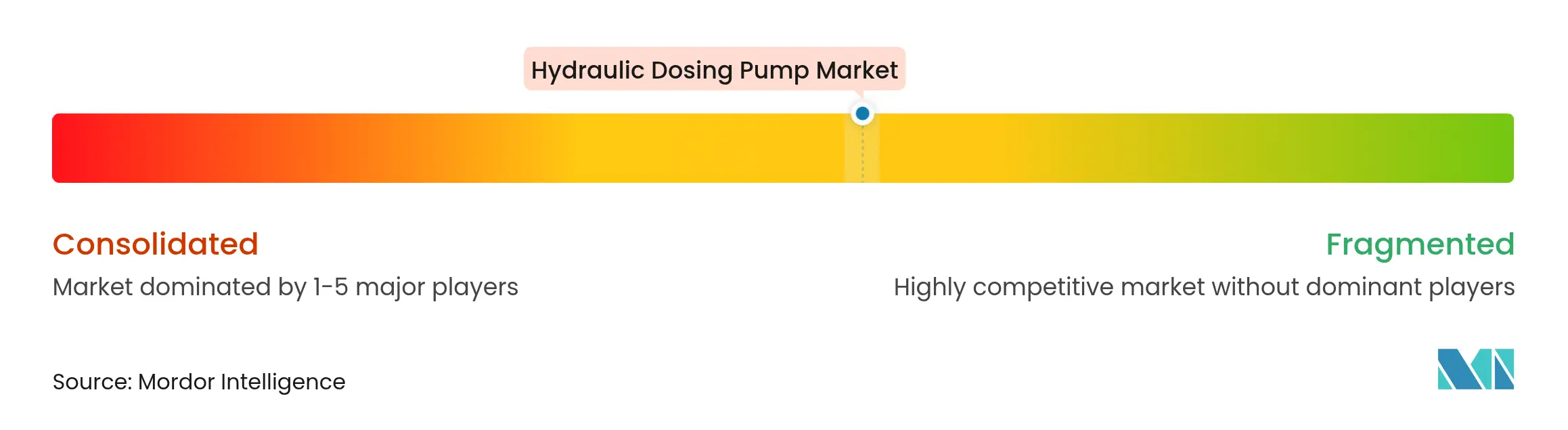
The competitive arena is moderately fragmented, with no single firm exceeding a 15% share. However, the top five players jointly control roughly 46%, resulting in a healthy rivalry that does not erode price discipline. European specialists, such as Grundfos, ProMinent, and LEWA, dominate the smart-pump niche, while U.S. multinationals like Dover, ITT, and Ingersoll Rand leverage broad distribution to win multi-site rollouts.
Recent M&A signals strategic positioning. Dover’s January 2025 purchase of Cryogenic Machinery Corp injects cryogenic expertise for liquid-gas applications. Atlas Copco’s Kracht acquisition plugs gaps in chemical-transfer lobe pumps, and ITT’s Svanehøj deal deepens LNG cargo pump coverage, potentially cross-selling dosing equipment to shipyards. Meanwhile, ABB’s Real Tech buy adds inline spectroscopy that pairs naturally with dosing-control logic, foreshadowing tighter sensor-pump integration.
Start-ups exploit white space in hydrogen electrolyzers and AI-driven maintenance. Several newcomers offer “subscription dosing,” where chemical-injection hardware, software, and maintenance are bundled into a monthly fee, shifting buyer focus from capital expenditures to guaranteed process stability. As Industry 4.0 matures, the hydraulic dosing pump market is increasingly rewarding predictive analytics prowess over mechanical pedigree.
Hydraulic Dosing Pump Industry Leaders

*Disclaimer: Major Players sorted in no particular order
Recent Industry Developments
- March 2025: ANDRITZ landed a contract to engineer a 100 MW green hydrogen plant in Rostock, Germany, using pressurized alkaline electrolyzer stacks.
- February 2025: ProMinent unveiled TriPower hydraulic metering pumps and DULCOMETER diaLog X controller at ACHEMA 2024, targeting process-industry customers.
- January 2025: Dover Corporation acquired Cryogenic Machinery Corp, adding centrifugal and seal technology for liquefied-gas markets.
- January 2025: Fluid Metering Inc. introduced the FENYX variable-dispense pump for sub-microliter life-science applications.
Table of Contents for Hydraulic Dosing Pump Industry Report
1. Introduction
- 1.1 Study Assumptions & Market Definition
- 1.2 Scope of the Study
2. Research Methodology
3. Executive Summary
4. Market Landscape
- 4.1 Market Overview
- 4.2 Market Drivers
- 4.2.1 Rising water & wastewater treatment investments
- 4.2.2 Expanding chemical processing capacity in Asia-Pacific
- 4.2.3 Increasing offshore & shale oil chemical?injection needs
- 4.2.4 Regulatory demand for dosing-accuracy & operator safety
- 4.2.5 Industry 4.0-enabled smart dosing systems adoption
- 4.2.6 Hydrogen-electrolyzer dosing for clean-fuel value chain
- 4.3 Market Restraints
- 4.3.1 Availability of low-cost electric & solenoid metering pumps
- 4.3.2 High maintenance costs in abrasive/viscous media
- 4.3.3 Volatility in specialty hydraulic-fluid raw-material prices
- 4.3.4 Shortage of skilled calibration & service technicians
- 4.4 Supply-Chain Analysis
- 4.5 Regulatory Landscape
- 4.6 Technological Outlook
- 4.7 Porter's Five Forces
- 4.7.1 Bargaining Power of Suppliers
- 4.7.2 Bargaining Power of Consumers
- 4.7.3 Threat of New Entrants
- 4.7.4 Threat of Substitute Products & Services
- 4.7.5 Intensity of Competitive Rivalry
5. Market Size & Growth Forecasts
- 5.1 By Pump Type
- 5.1.1 Plunger/Piston
- 5.1.2 Diaphragm
- 5.1.3 Others (Hydraulically-backed, Peristaltic)
- 5.2 By Stroke-Adjustment Method
- 5.2.1 Manual Stroke
- 5.2.2 Automatic (Pneumatic, Electric, Digital)
- 5.3 By Discharge-Pressure Range
- 5.3.1 Up to 100 bar
- 5.3.2 100 to 500 bar
- 5.3.3 Above 500 bar
- 5.4 By End-Use Industry
- 5.4.1 Water and Wastewater Treatment
- 5.4.2 Oil and Gas
- 5.4.3 Chemicals and Petrochemicals
- 5.4.4 Power Generation
- 5.4.5 Food and Beverage
- 5.4.6 Others (Pulp and Paper, Pharmaceuticals, Mining)
- 5.5 By Geography
- 5.5.1 North America
- 5.5.1.1 United States
- 5.5.1.2 Canada
- 5.5.1.3 Mexico
- 5.5.2 Europe
- 5.5.2.1 Germany
- 5.5.2.2 United Kingdom
- 5.5.2.3 France
- 5.5.2.4 Italy
- 5.5.2.5 NORDIC Countries
- 5.5.2.6 Russia
- 5.5.2.7 Rest of Europe
- 5.5.3 Asia-Pacific
- 5.5.3.1 China
- 5.5.3.2 India
- 5.5.3.3 Japan
- 5.5.3.4 South Korea
- 5.5.3.5 ASEAN Countries
- 5.5.3.6 Australia and New Zealand
- 5.5.3.7 Rest of Asia-Pacific
- 5.5.4 South America
- 5.5.4.1 Brazil
- 5.5.4.2 Argentina
- 5.5.4.3 Chile
- 5.5.4.4 Rest of South America
- 5.5.5 Middle East and Africa
- 5.5.5.1 Saudi Arabia
- 5.5.5.2 United Arab Emirates
- 5.5.5.3 South Africa
- 5.5.5.4 Egypt
- 5.5.5.5 Rest of Middle East and Africa
6. Competitive Landscape
- 6.1 Market Concentration
- 6.2 Strategic Moves (M&A, Partnerships, PPAs)
- 6.3 Market Share Analysis (Market Rank/Share for key companies)
- 6.4 Company Profiles (includes Global level Overview, Market level overview, Core Segments, Financials as available, Strategic Information, Products & Services, and Recent Developments)
- 6.4.1 Dover Corporation
- 6.4.2 ProMinent GmbH
- 6.4.3 Grundfos Holding A/S
- 6.4.4 Nikkiso Co., Ltd.
- 6.4.5 Iwaki Co., Ltd.
- 6.4.6 IDEX Corporation
- 6.4.7 Milton Roy LLC
- 6.4.8 Lewa GmbH
- 6.4.9 SEKO S.p.A.
- 6.4.10 SPX FLOW Inc.
- 6.4.11 Watson-Marlow Fluid Technology Group
- 6.4.12 Xylem Inc.
- 6.4.13 Blue-White Industries
- 6.4.14 Verder Liquids (Verder Group)
- 6.4.15 Lutz-Jesco GmbH
- 6.4.16 Sera Group
- 6.4.17 Seepex GmbH
- 6.4.18 SEIM S.r.l.
- 6.4.19 Tapflo Group
- 6.4.20 Ingersoll Rand Inc.
7. Market Opportunities & Future Outlook
- 7.1 White-space & Unmet-Need Assessment
Global Hydraulic Dosing Pump Market Report Scope
The hydraulic dosing pump market report includes:
| By Pump Type | Plunger/Piston | |
| Diaphragm | ||
| Others (Hydraulically-backed, Peristaltic) | ||
| By Stroke-Adjustment Method | Manual Stroke | |
| Automatic (Pneumatic, Electric, Digital) | ||
| By Discharge-Pressure Range | Up to 100 bar | |
| 100 to 500 bar | ||
| Above 500 bar | ||
| By End-Use Industry | Water and Wastewater Treatment | |
| Oil and Gas | ||
| Chemicals and Petrochemicals | ||
| Power Generation | ||
| Food and Beverage | ||
| Others (Pulp and Paper, Pharmaceuticals, Mining) | ||
| By Geography | North America | United States |
| Canada | ||
| Mexico | ||
| Europe | Germany | |
| United Kingdom | ||
| France | ||
| Italy | ||
| NORDIC Countries | ||
| Russia | ||
| Rest of Europe | ||
| Asia-Pacific | China | |
| India | ||
| Japan | ||
| South Korea | ||
| ASEAN Countries | ||
| Australia and New Zealand | ||
| Rest of Asia-Pacific | ||
| South America | Brazil | |
| Argentina | ||
| Chile | ||
| Rest of South America | ||
| Middle East and Africa | Saudi Arabia | |
| United Arab Emirates | ||
| South Africa | ||
| Egypt | ||
| Rest of Middle East and Africa | ||
