
Market Overview
| Study Period | 2021 - 2031 |
|---|---|
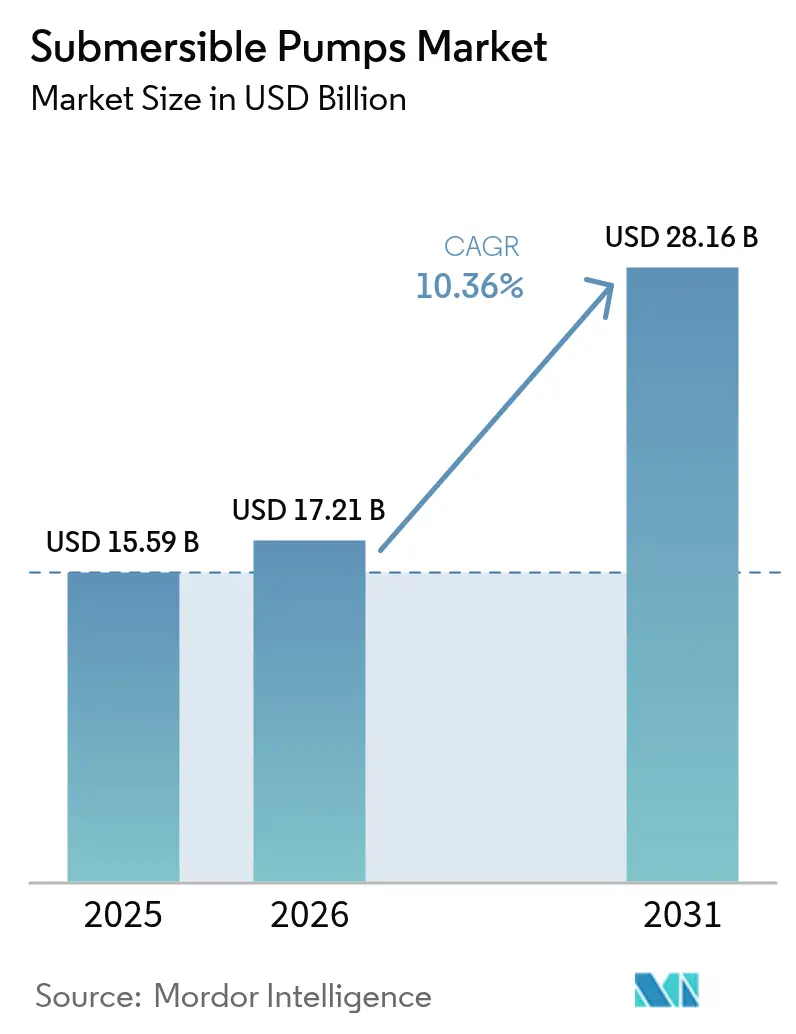
| Market Size (2026) | USD 17.21 Billion |
| Market Size (2031) | USD 28.16 Billion |
| Growth Rate (2026 - 2031) | 10.36 % |
| Fastest Growing Market | Asia Pacific |
| Largest Market | Asia Pacific |
| Market Concentration | Low |
Major Players *Disclaimer: Major Players sorted in no particular order Image © Mordor Intelligence. Reuse requires attribution under CC BY 4.0. | |
Submersible Pumps Market Analysis by Mordor Intelligence
The Submersible Pumps Market size was valued at USD 15.59 billion in 2025 and estimated to grow from USD 17.21 billion in 2026 to reach USD 28.16 billion by 2031, at a CAGR of 10.36% during the forecast period (2026-2031).
Demand is scaling as utilities, energy companies, and construction firms prioritize energy-efficient equipment that performs reliably in harsh or flooded settings. Deeper well exploitation, large-scale flood-control programs, and rapid electrification of agricultural irrigation are reshaping procurement strategies, while smart monitoring tools are lowering lifetime operating costs and reinforcing the value proposition of premium systems. Competitive intensity remains moderate because globally diversified manufacturers and regional specialists now race to pair hydraulics expertise with digital diagnostics and renewable-ready powertrains. Supply-chain pressure on permanent-magnet motors and a shortage of advanced down-hole technicians raise execution risks, but they also open opportunities for modular motor platforms, automation, and local assembly partnerships.
Key Report Takeaways
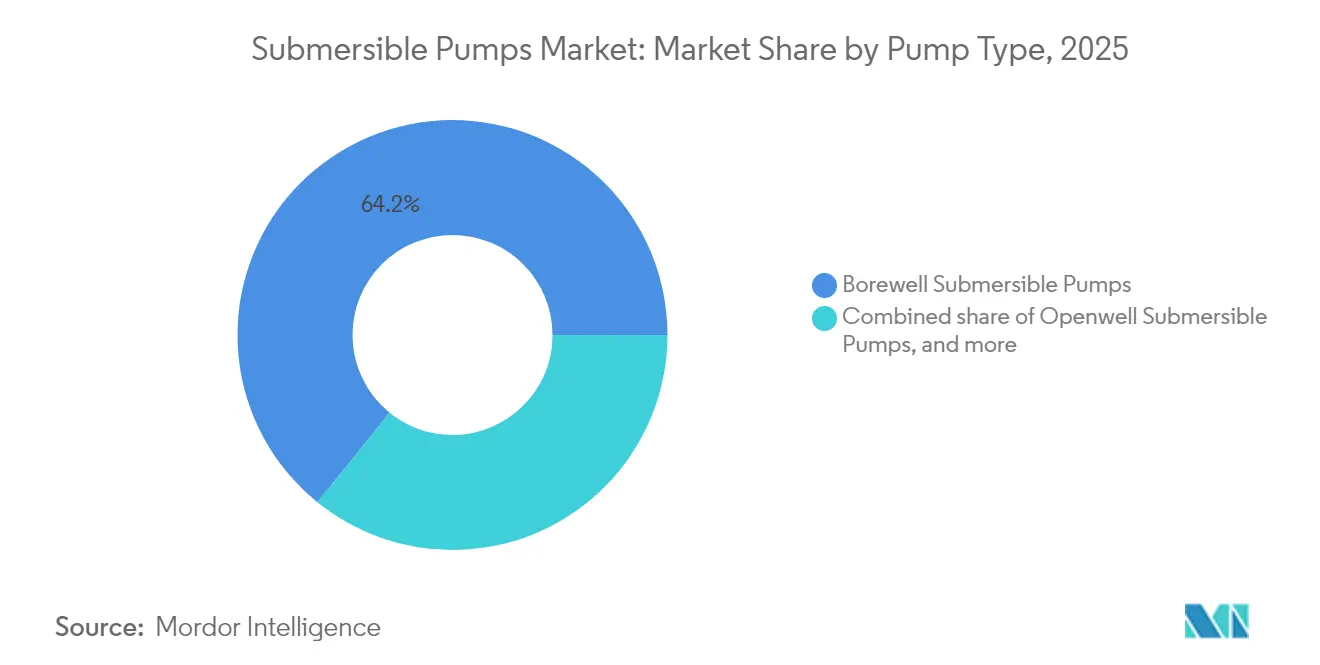
- By pump type, borewell units led with 64.18% revenue share in 2025; non-clog sewage pumps are forecast to expand at a 10.62% CAGR to 2031.
- By drive type, electric systems captured 77.65% of the submersible pump market share in 2025, while the same segment is expected to grow at a 10.89% CAGR through 2031.
- By head rating, above 100 m products accounted for 69.25% of the submersible pump market size in 2025 and are advancing at a 10.5% CAGR through 2031.
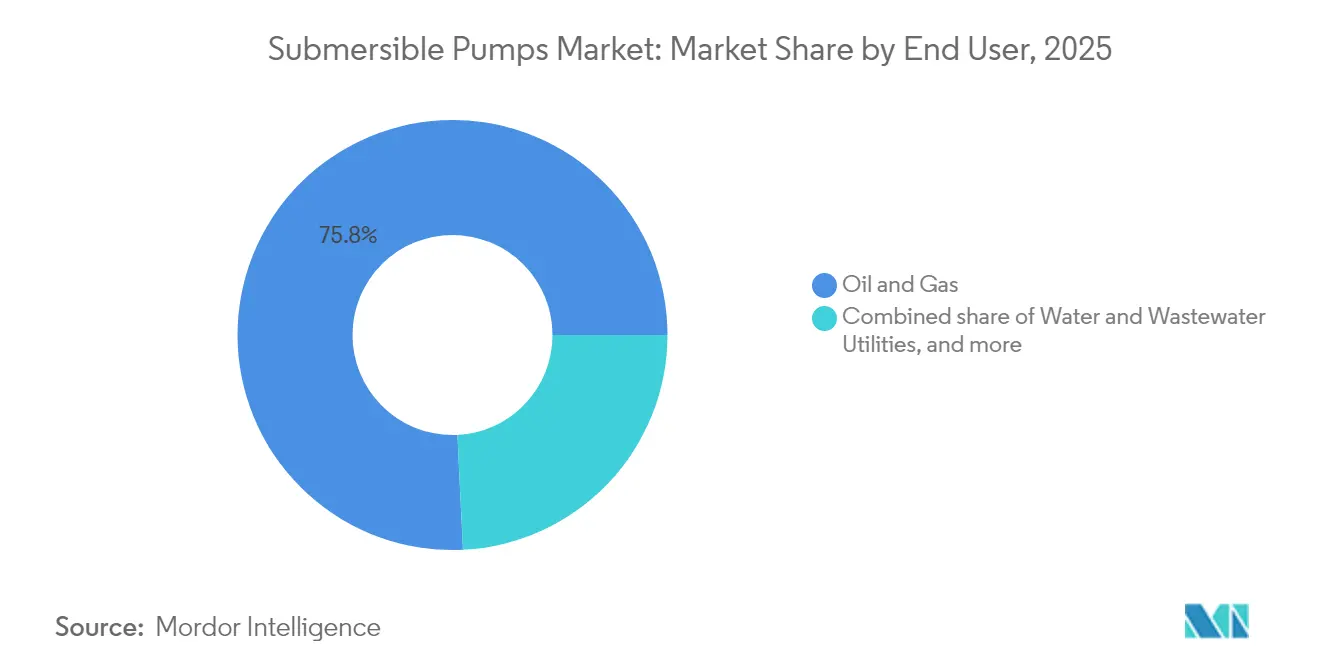
- By end user, oil and gas applications commanded 75.78% of demand in 2025, whereas water and wastewater utilities are recording the fastest projected CAGR at 11.05% through 2031.
- By geography, Asia-Pacific dominates with 39.62% submersible pump market share in 2025 and is projected to expand at an 11.44% CAGR through 2031.
Note: Market size and forecast figures in this report are generated using Mordor Intelligence’s proprietary estimation framework, updated with the latest available data and insights as of 2026.
Market Trends and Insights
Drivers Impact Analysis of Submersible Pumps Market*
| Driver | (~) % Impact on CAGR Forecast | Geographic Relevance | Impact Timeline |
|---|---|---|---|
| Recovery in oil & gas brown-field projects | +2.1% | Global, concentrated in North America, Middle East | Medium term (2-4 years) |
| Global construction boom & dewatering needs | +1.8% | APAC core, spill-over to North America & Europe | Short term (≤ 2 years) |
| Climate-driven flood-control investments | +1.5% | Global, with early gains in UK, Netherlands, NYC | Medium term (2-4 years) |
| Rising municipal water-&-wastewater CAPEX | +1.9% | North America & EU, expanding to APAC | Long term (≥ 4 years) |
| Electrification of African irrigation via solar pumps | +1.2% | Sub-Saharan Africa, expanding to South Asia | Long term (≥ 4 years) |
| AI-enabled predictive maintenance lowering OPEX | +0.8% | Global, led by developed markets | Medium term (2-4 years) |
| Source: Mordor Intelligence | |||
Recovery in oil & gas brown-field projects
Brownfield optimization reshapes artificial-lift economics as operators redeploy capital toward mature wells requiring high-lift electric submersible pump (ESP) systems [1]Baker Hughes, “SOCAR Awards ESP Contract,” bakerhughes.com. A multi-year agreement to supply more than 150 ESP strings to Azerbaijan’s SOCAR illustrates how legacy reservoirs now depend on modern ESP technology to offset declining pressures and rising water cuts. SLB’s compact wide-range ESP series pursues similar goals, enabling deeper production zones while minimizing completion footprints. Subsea boosting contracts for projects such as BP’s Kaskida field further confirm that ESPs remain essential even when industry drilling budgets flatten, because maximizing recovery from existing assets protects cash flow and reduces exploration risk.
Global Construction Boom & Dewatering Needs
Accelerated infrastructure, tunneling, and underground transit programs boost demand for reliable site-dewatering pumps running continuously in abrasive conditions. The USD 1.1 billion Kensico-Eastview Connection Tunnel in New York requires high-capacity drainage systems to keep excavation dry. Manufacturers like Sulzer have expanded ranges, including portable site-drainage units and heavy-duty tunnel pumps, pairing rugged impeller materials with smart sensors to prevent unexpected downtime. Asia-Pacific civil works, pipelines, and mining exploration add additional momentum.
Climate-driven Flood-control Investments
More frequent extreme-rainfall events force municipalities to build large pump stations and mobile fleets that manage peak inflows. The UK budgeted GBP 2.65 billion for over 1,000 flood schemes requiring multiple high-throughput submersible pumps. New York City’s Bushwick sewer upgrade plans to lift capacity almost ninefold to 1.9 billion gallons per day, underscoring the scale of equipment required. Flowserve’s concrete-volute and vertical wet-pit pumps exceed 200,000 m³/h, setting new benchmarks for urban flood resilience.
Rising Municipal Water & Wastewater CAPEX
Regulatory mandates and aging assets drive North American and European utilities to spend hundreds of billions of dollars on pump replacement and treatment capacity expansion. The US Environmental Protection Agency projects more than USD 1 trillion in needed water infrastructure spending over two decades. San Francisco’s USD 4.8 billion Water System Improvement Program includes deep-well retrofits and variable-frequency drives that cut power draw and enable predictive maintenance. Nearly every surveyed operator plans to maintain or increase capital budgets in 2025, accelerating demand for connected and energy-efficient submersible systems.
Restraints Impact Analysis of Submersible Pumps Market*
| Restraint | (~) % Impact on CAGR Forecast | Geographic Relevance | Impact Timeline |
|---|---|---|---|
| High life-cycle energy costs vs. surface pumps | -1.4% | Global, particularly in energy-intensive applications | Long term (≥ 4 years) |
| Shortage of skilled down-hole service labor | -0.9% | North America, Middle East, offshore regions | Medium term (2-4 years) |
| Volatile rare-earth prices hitting PM motor BOM | -1.1% | Global, concentrated in high-performance applications | Short term (≤ 2 years) |
| Remote-area grid power-quality issues causing failures | -0.7% | Rural areas in developing markets, mining regions | Medium term (2-4 years) |
| Source: Mordor Intelligence | |||
High life-cycle energy costs vs. surface pumps
Energy-intensive users often favor surface alternatives when shallow lift depths allow similar hydraulic performance at lower kilowatt-hours. Comparative ownership studies show submersible pump efficiency improves markedly only when paired with premium motors and variable-frequency drives such as Franklin Electric’s SubDrive series [2]Franklin Electric, “SubDrive Constant Pressure Systems,” franklin-electric.com. Manufacturers continue to refine impellers and insulation classes, yet inherent cooling losses impose an energy penalty in certain shallow settings.
Shortage of skilled down-hole service labor
Advanced ESP installations require technicians capable of handling high-voltage cables, fiber-optic sensors, and pressure-balanced seals. Talent pipelines have thinned as experienced workers retire faster than replacements are certified. Baker Hughes is responding with retrievable systems that minimize rig time and remote diagnostics that cut on-site visits. Automation alleviates some strain but does not fully substitute for field experience, making service capacity a gating factor in regions with accelerating artificial-lift projects.
*Our forecasts treat driver/restraint impacts as directional, not additive. The impact forecasts reflect baseline growth, mix effects, and variable interactions.
Submersible Pumps Market Segment Analysis
By Pump Type:
Borewell leadership underpins irrigation expansionBorewell units delivered 64.18% of 2025 revenue and are projected to log a 10.58% CAGR as acreage under electric or solar-assisted irrigation rises in India, China, and parts of Africa. The submersible pump market size for borewell applications is forecast to widen sharply because governments are issuing subsidies that defray initial hardware costs and incentivize farmers to swap diesel sets for efficient electric drives. Deep-well ESP systems occupy the premium tier, serving production rates above 150,000 barrels per day in oilfields with temperatures up to 250 °C. Urban growth supports non-clog sewage models, while open-well pumps remain viable where shallow aquifers enable simplified installations.
Growth momentum hinges on solar integration, with national schemes such as India’s PM-KUSUM awarding bulk orders for photovoltaic pump kits that cut electricity bills and reduce grid peak loads. Suppliers that combine corrosion-resistant metallurgy with maximum power-point tracking controllers stand to reinforce recurring revenue through replacement impellers and electronics upgrades. Conversely, inexpensive imports into price-sensitive farm markets heighten margin pressure for domestic fabricators.



By Drive Type:
Electric dominance benefits from grid qualityElectric drives secured 77.65% market share in 2025 and are expanding at 10.89% CAGR as transmission upgrades improve voltage stability across emerging economies. Solar-ready inverters increasingly ship as standard, allowing the same motor to run on daytime photovoltaic arrays and night-time utility supply. Hydraulic drives persist in offshore and remote mineral projects where central power generation is impractical, but their lifecycle costs remain higher due to auxiliary equipment.
Innovations in permanent-magnet motors, active cooling jackets, and silicon-carbide power modules lift overall efficiency, mitigating one of the key restraints facing the submersible pump market. Short-term risks arise from rare-earth price swings that disrupt magnet supply; this is directing R&D toward ferrite or synchronous reluctance alternatives. Suppliers certifying products for low harmonic distortion also capture share in mining camps reliant on generator sets that exhibit uneven waveforms.
By Head Rating:
Deep-lift systems command premium pricingPumps rated for heads above 100 m accounted for 69.25% of 2025 revenue and will post a 10.5% CAGR because oilfields, skyscrapers, and deep municipal wells all demand high differential pressures. The submersible pump market size at this head range grows faster than lower ranges because unit prices climb sharply with horsepower, metallurgy, and sensor options.
Engineering advances like multi-stage diffuser stacks and down-thrust compliant bearings extend run hours between pull-outs. Compact permanent-magnet motors reduce outside diameter so operators can fit larger flow stages within the same casing. Mid-range 50-100 m products target booster stations and small industrial parks, while sub-50 m centrifugal wet ends dominate private residential boreholes where a low purchase cost outweighs longevity.
By End User:
Utilities begin to close gap with petroleum sectorOil and gas held 75.78% of demand in 2025, yet water and wastewater utilities exhibit an 11.05% CAGR as federal grants flow into pipe renewal and flood-mitigation projects. Municipalities increasingly deploy online vibration and insulation monitoring that alerts crews before seal failures release effluent. Mining and construction represent steady niche revenues where dewatering remains mission-critical during excavation.
Thanks to solar pump kits that now approach grid parity in many sun-rich geographies, agricultural irrigation is the second-fastest rising use case. Farmers gravitate toward deeper borewell configurations as water tables decline, sustaining aftermarket demand for bowls, shafts, and thrust washers. Meanwhile, flood-control stations purchase very large axial-flow submersible propeller pumps, a specialized product family that only a handful of global OEMs currently build
Geography Analysis
APAC Submersible Pumps Market
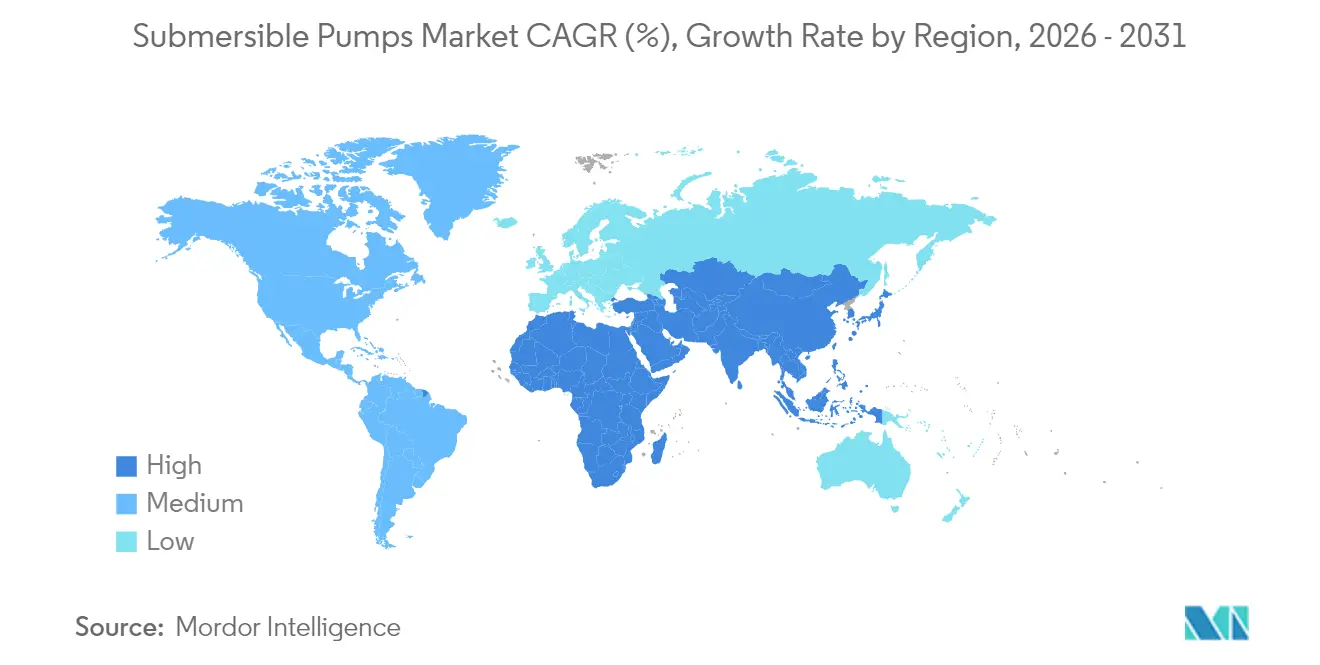
Asia-Pacific contributed 39.62% of 2025 revenue and is tracking an 11.44% CAGR through 2031. China’s push to modernize rural water supply and India’s subsidy-backed irrigation electrification combine with Indonesia’s metro-rail expansion to keep tender volumes high. Regional suppliers such as Shakti Pumps and Kirloskar Brothers leverage cost-competitive casting capacity and local warranty networks, while multinationals source control electronics from regional contract manufacturers to reduce lead times.
North America Submersible Pumps Market
North America remains a volume hub for high-horsepower ESP strings used in tight-oil basins, though a labor shortage of certified cable-splice and pull-crew technicians tempers installation pace. Substantial water infrastructure appropriations under the Infrastructure Investment and Jobs Act steer municipal bid specifications toward premium efficiency ratings and predictive-maintenance gateways. Canada’s remote mining districts adopt hybrid solar-diesel microgrids where variable-speed submersible pumps smooth station load profiles.
Europe Submersible Pumps Market
Europe prioritizes climate resilience and puts strict energy-efficiency labels on public procurement. The United Kingdom’s GBP 2.65 billion flood program adds a sizable project pipeline for high‐capacity stormwater stations. Germany, France, and the Benelux region deploy variable-speed borehole pumps in district heating and groundwater source-heat-pump loops, a market niche that values corrosion-resistant stainless alloys. Scandinavia’s focus on circularity drives refurbishment contracts over full replacements, favoring modular pump designs.
MEA and South America Submersible Pumps Market
The Middle East invests in seawater desalination, where submersible turbine pumps withstand brine abrasion; a EUR 508 million plant in Taiwan secured SUEZ equipment orders that include corrosion-proof wet ends . African governments scale solar irrigation to curb diesel imports, while South America’s pre-salt fields award subsea boost systems that rely on long-step-out ESP modules rated for chemical exposure to CO₂-rich fluids.

Regulatory Landscape
Energy-efficiency compliance is a key procurement gate for submersible pumps in major markets. In the European Union, Commission Regulation (EU) 547/2012 applies Ecodesign requirements to water pumps using the Minimum Efficiency Index (MEI), and submersible multistage pump configurations are covered through defined pump categories and test conditions. In the United States, the Department of Energy regulates energy conservation standards for commercial and industrial equipment under 10 CFR Part 431, including pump-related provisions under 10 CFR 431.465, with separate circulator pump standards scheduled to take effect starting May 22, 2028. This timing requires OEMs and distributors to align product testing and documentation ahead of the deadline.
Application-specific standards also shape product design, testing, and qualification across end users. For oil and gas ESPs, ISO 15551:2023 defines requirements for tubing-deployed electric submersible pump systems, supporting more standardized design verification and manufacturing practices for petroleum applications. In India, IS 8034:2018 (reaffirmed 2022) sets technical requirements for submersible pumpsets used in boreholes for water supply and agriculture, while industry test conformity is commonly anchored by Hydraulic Institute standards such as ANSI/HI 11.6 for rotodynamic submersible pump acceptance testing.
Competitive Landscape
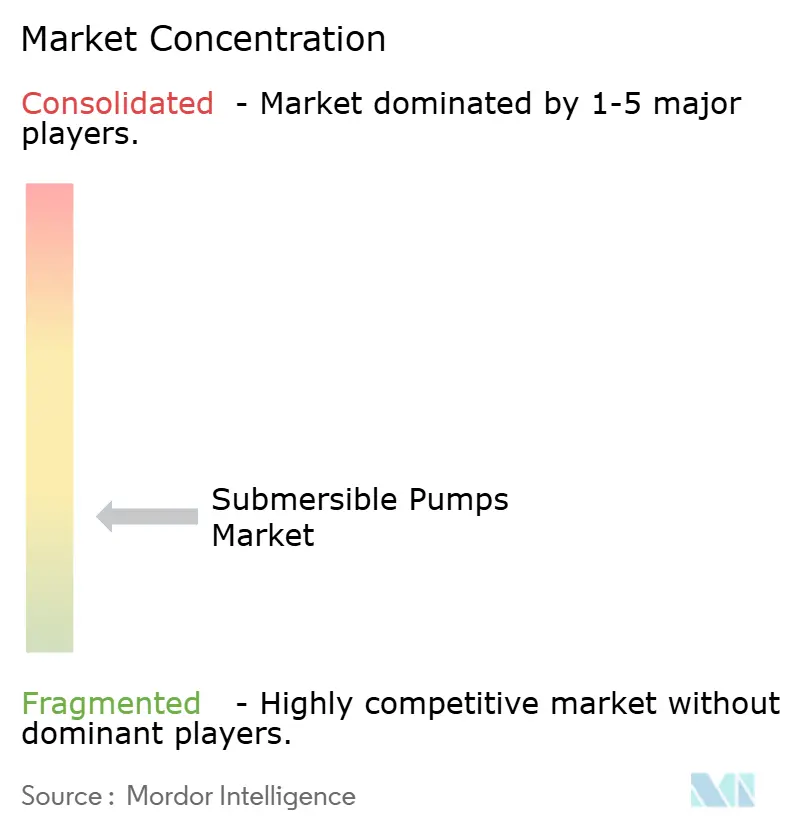
Competition is moderate because the five largest suppliers combine broad technology portfolios with installed-base service revenues, yet regional manufacturers successfully defend share in lower-price agricultural and building-services segments. Baker Hughes, SLB, and Grundfos lead R&D intensity, funneling capital toward digital twins, fiber-optic telemetry, and composite material research. Grundfos’ acquisition of Culligan’s European commercial unit tightens vertical integration into water treatment skids that ship with factory-programmed submersible pumps [4]Grundfos, “Acquisition of Culligan C&I Business,” grundfos.com.
Regional champions like Kirloskar Brothers and CRI Pumps secure government tenders by offering energy audits and on-site field service fleets. Shakti Pumps’ expansion into solar-ready controllers exemplifies how agile firms fill product gaps that global giants address more slowly. White-space entrants develop analytics platforms that layer machine learning onto vibration and insulation data, selling subscription services that boost mean-time-between-failure.
Strategic alliances revolve around electrification and lower emissions. Baker Hughes’ launch of all-electric cementing units and interval control valves illustrates the move toward integrated surface-and-subsurface electrification ecosystems. SLB’s planned acquisition of ChampionX adds specialty chemicals that extend ESP run life by mitigating scale and corrosion. Capital allocation patterns indicate sustained investment in automating diagnostics and precertifying components for hydrogen and ammonia compatibility.
Submersible Pumps Industry Leaders
Grundfos Holding A/S
Xylem Inc.
Sulzer AG
Flowserve Corporation
Baker Hughes Co.
- *Disclaimer: Major Players sorted in no particular order
Submersible Pumps Market Companies Covered in this Report
- Baker Hughes Co.
- Schlumberger Ltd.
- Halliburton Co.
- Weir Group PLC
- Sulzer AG
- Grundfos Holding A/S
- Flowserve Corporation
- Xylem Inc.
- Atlas Copco AB
- Ebara Corporation
- Franklin Electric Co. Inc.
- KSB SE & Co. KGaA
- Wilo SE
- Kirloskar Brothers Ltd.
- CRI Pumps Pvt. Ltd.
- Shakti Pumps India Ltd.
- Pentair PLC
- Gorman-Rupp Company
- Borets International Ltd.
- ITT Goulds Pumps

Market Opportunities and Future Outlook
Compliance-driven upgrades and system-efficiency retrofits create whitespace beyond new pump sales, especially where tenders and operator specifications emphasize reduced lifecycle energy use. Under the EU Ecodesign requirements in Regulation (EU) 547/2012 (MEI framework) and the US DOE efficiency rulemaking for pump-related equipment under 10 CFR Part 431, buyers place more value on high-efficiency hydraulics paired with variable frequency drives and controls. This shift supports opportunities in VFD retrofits, connected monitoring, and packaged solutions that document performance at the system level rather than only at the pump.
Regional manufacturing and service footprint expansion is also becoming a practical lever for capturing demand from municipal, industrial, and wastewater projects while reducing lead times and easing local-content constraints. In 2026, Kirloskar Brothers inaugurated a new factory building at its Kaniyur manufacturing facility in Tamil Nadu, and NETZSCH opened a new pump production facility in Goa, reinforcing India as a build-and-serve hub for industrial pumps and related assemblies. On the service side, the shortage of skilled down-hole labor for high-horsepower ESP deployments increases the attractiveness of offerings that shorten installation time, simplify retrieval, and use remote diagnostics, which benefits suppliers that bundle pumps with power skids, controls, and field-service capacity.
Recent Industry Developments in Submersible Pumps Market
- June 2026: Grundfos held a groundbreaking for a 143,000-square-foot production facility and opened its Academy Americas training center in Brookshire, Texas. The added footprint and training capacity strengthens localized supply and service readiness for water and wastewater applications, where uptime and rapid field support influence award decisions.
- May 2026: Grundfos acquired Yeomans Chicago Corporation to broaden its North American wastewater and sewage pump offering. The deal expands product depth in solids-handling and wastewater niches, improving the ability to bid turnkey packages alongside controls and service.
- October 2024: Frontier-Kemper Constructors secured a USD 1.1 billion contract for New Yorks Kensico-Eastview Connection Tunnel, which specifies high-capacity dewatering pumps for continuous excavation support. Large civil tunneling programs of this scale raise demand for rugged submersible dewatering fleets and drive OEM focus on abrasion resistance, reliability, and simplified maintenance.


Submersible Pumps Market Report Scope and Research Methodology
Market Definition and Coverage
This market covers revenue generated from submersible pumps sold for moving water or other fluids while the pump operates below the liquid level, across industrial, municipal, agricultural, and energy-related uses, and across all major regions.
Scope exclusions: We exclude downstream services that are not part of the pump sale (such as routine maintenance labor) unless they are bundled and billed as part of the pump system purchase.
Segments Covered in This Report
- By Pump Type
- Borewell Submersible Pumps
- Openwell Submersible Pumps
- Non-clog/Sewage Submersible Pumps
- Deep-well Electric Submersible Pumps (ESPs)
- Submersible Turbine Pumps
- By Drive Type
- Electric
- Hydraulic
- Solar-powered
- By Head Rating
- Below 50 m
- 50 to 100 m
- Above 100 m
- By End User
- Water and Wastewater Utilities
- Oil and Gas (Artificial-Lift)
- Mining and Construction Dewatering
- Agriculture and Irrigation
- Municipal Flood Control
- Geography
- North America
- United States
- Canada
- Mexico
- Europe
- United Kingdom
- Germany
- France
- Spain
- Nordic Countries
- Russia
- Rest of Europe
- Asia-Pacific
- China
- India
- Japan
- South Korea
- ASEAN Countries
- Rest of Asia-Pacific
- South America
- Brazil
- Argentina
- Colombia
- Rest of South America
- Middle East and Africa
- United Arab Emirates
- Saudi Arabia
- South Africa
- Egypt
- Rest of Middle East and Africa
- North America
Data Sources, Market Sizing, and Validation
Desk Research
Desk research was used to set the market boundaries, build the first demand picture, and create starting assumptions for price and adoption by end use. For the early demand view, we leaned on public infrastructure and industrial indicators, such as water and wastewater investment releases, groundwater and irrigation statistics, and mining and construction activity signals.
To keep inputs auditable, we referenced non-paywalled sources such as World Bank water and sanitation indicators, UN industrial statistics, International Energy Agency energy outlook tables, USGS water data releases, and FAO irrigation and agriculture datasets, followed by company annual reports, investor presentations, and credible trade-press coverage. In a few cases, paid database subscriptions were used only as cross-checks for company financials, news timelines, and patenting activity tied to pump design changes and efficiency claims. This list is illustrative, and we also used other public sources during data collection, validation, and clarification.
Primary Interviews and Surveys
Primary work focused on validating how demand is actually formed across key use cases like water and wastewater, oil and gas lifting, mining dewatering, and agriculture, since reported sales can shift with project timing. We spoke with pump manufacturers, distributors, EPC and project stakeholders, and large end users, covering APAC, EMEA, and the Americas so regional pricing and specification differences were not averaged out too early.
Distribution of primary research fieldwork respondents
| Company type | Respondent position | Region |
|---|---|---|
| Top tier: 27% | CXOs: 12% | APAC: 47% |
| Mid tier: 58% | Functional/Unit leaders: 37% | EMEA: 30% |
| Smaller Players: 15% | Managers: 51% | Americas: 23% |
Market-Sizing & Forecasting
Our sizing starts with a top-down build where regional demand pools are reconstructed from end-use activity, then translated into pump spend using penetration and replacement logic. For example, water and wastewater capex, new housing and commercial construction starts, irrigated area growth, and mining project intensity were treated as leading signals that drive unit demand, then adjusted for replacement cycles in installed-base-heavy applications.
Once this structure was in place, we ran selective bottom-up checks to confirm the totals look realistic, using sampled supplier revenues, channel feedback on unit volumes, and a simple ASP times volume approximation by head range and drive type. The variables that mattered most in the model included the typical head-band mix (below 50 m, 50-100 m, and above 100 m), the split between electric and hydraulic drives, order sizes by end user (utilities versus industrial), and regional price differences driven by duty requirements and compliance. Forecasting was done mainly through scenario analysis supported by short-series trend smoothing, because project-driven ordering can create spikes that a single straight-line curve misses, and the final scenario weights were adjusted using expert consensus from interviews. Where a bottom-up check had gaps, we used conservative extrapolation based on adjacent regions or similar end-use patterns, and then re-validated those assumptions in follow-up calls.
Data Validation & Update Cycle
Validation is handled through triangulation across three layers, demand indicators, supply-side reality checks, and pricing sanity checks, so one noisy data stream does not steer the outcome. When outputs diverge from independent signals like construction activity, municipal spending trends, or energy field development patterns, we review the assumptions and re-contact respondents if the variance is material.
Before sign-off, the model and key drivers go through multi-step analyst reviews, where anomalies are challenged and then corrected with documented reasoning. Reports are refreshed annually, and interim updates are made when major events shift demand or pricing, such as policy changes, large infrastructure programs, or sharp currency moves. Right before delivery, we complete a final review pass so clients receive the latest updated view available at that time.
Mordor Intelligence's Global Submersible Pump Market Market Estimate Compared With Other Published Estimates
Published market sizes for submersible pumps can differ even when they appear to measure the same thing, because scope and year selection are not always aligned. The gap usually comes from what is counted as a submersible pump sale, how end uses are grouped, and whether the size is anchored on a demand model or a supplier roll-up.
By tracking head-range splits, checking end-use demand signals (like water and wastewater spending and mining activity), and refreshing currency timing assumptions, Mordor Intelligence keeps the 2026 market value tied to a clear demand pool and avoids mixing earlier-year bases into the same headline number. Some sources also publish a 2024 base and then project forward with smoother growth, which can raise or lower the comparison depending on how replacement demand and ASP changes are treated in the middle years.
Benchmark comparison
| Source | Market Size | Gaps in Research Methodology |
|---|---|---|
| Mordor Intelligence | USD 17.21 B (2026) | |
| Trade Publisher A | USD 18.83 B (2024) | Uses a 2024 base-year framing and a different forecast window, which can embed earlier-cycle pricing and demand conditions, and may not reconcile mid-period replacement demand with the same end-use activity checks. |
| Industry Research Portal B | USD 18.95 B (2024) | Focuses on a 2024 point estimate and mixes base-year references across sections, which can shift the headline if ASP progression and the timing of infrastructure and mining orders are not normalized to a single anchor year. |
Overall, the spread is explained mainly by base-year selection and how demand is reconstructed across applications before pricing is applied. When scope stays consistent and the year anchor is fixed, the sizing becomes easier to reproduce and easier to reconcile with real-world activity indicators.


Key Questions Answered in the Report
What is the current size of the submersible pump market?
The market stands at USD 17.21 billion in 2026 and is projected to reach USD 28.16 billion by 2031.
Which segment is growing fastest within the submersible pump market?
Water and wastewater utilities are expanding at an 11.05% CAGR, outpacing other end-user groups.
Why are electric drive systems so dominant?
Electric drives hold a 77.65% share because grid reliability, renewable power integration and variable-speed electronics lower operating costs relative to hydraulic or diesel alternatives.
How will flood-control spending influence demand?
Climate-driven investments such as the UK’s GBP 2.65 billion program require high-capacity pumps, boosting orders for large axial-flow models over the forecast horizon.
Which region offers the highest growth potential?
Asia-Pacific leads with a 39.62% share and an 11.44% CAGR due to accelerating urban infrastructure and irrigation electrification projects.
What restraints could slow market expansion?
Elevated life-cycle energy costs for shallow lifts and shortages of skilled down-hole technicians may curb uptake unless efficiency improvements and automation close the gap.
Page last updated on:


 Your data is secure and never sold or shared.


