
Higher Education Testing and Assessment Market Size and Share
Market Overview
| Study Period | 2021 - 2031 |
|---|---|
| Market Size (2026) | USD 20.85 Billion |
| Market Size (2031) | USD 27.42 Billion |
| Growth Rate (2026 - 2031) | 5.63 % |
| Fastest Growing Market | Asia-Pacific |
| Largest Market | North America |
| Market Concentration | Medium |
Major Players *Disclaimer: Major Players sorted in no particular order Image © Mordor Intelligence. Reuse requires attribution under CC BY 4.0. | |
Higher Education Testing and Assessment Market Analysis by Mordor Intelligence
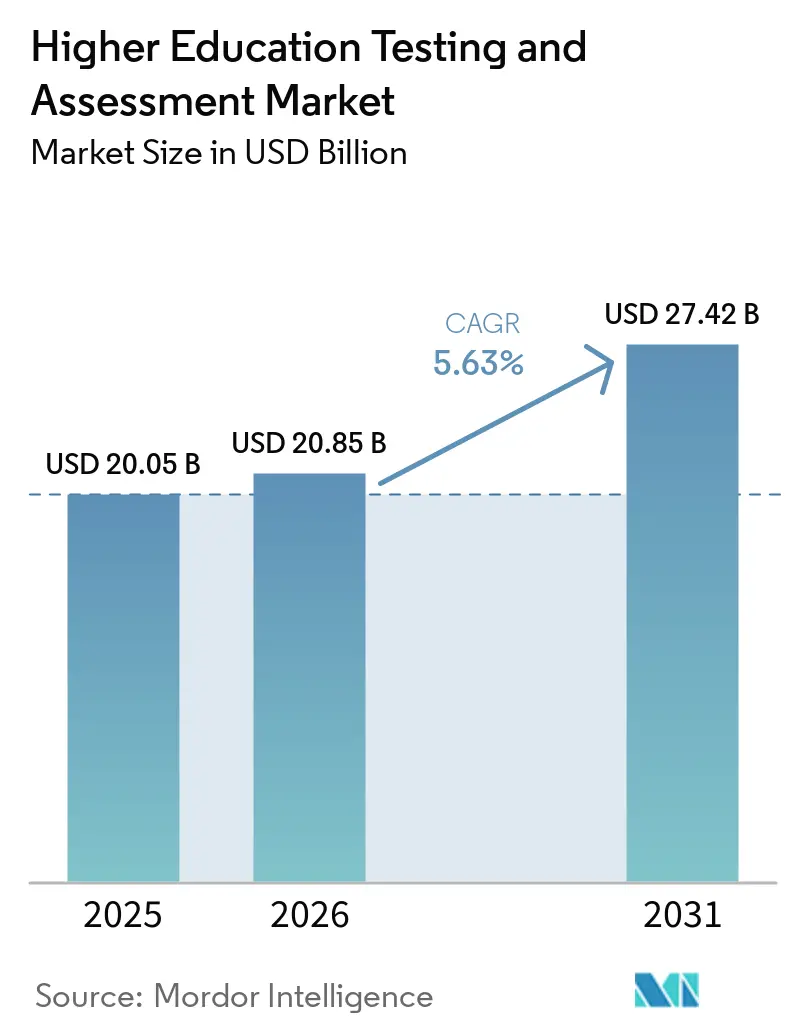
The higher education testing and assessment market was valued at USD 20.05 billion in 2025 and is estimated to grow from USD 20.85 billion in 2026 to reach USD 27.42 billion by 2031, at a CAGR of 5.63% during the forecast period (2026–2031). This market is being influenced by the ongoing transition to digital and hybrid delivery models across universities, certification programs, and workforce-oriented learning pathways. There is increasing demand for assessment systems that can verify skills and competencies in ways that are more transparent to employers, prompting institutions to reassess procurement priorities and the value of platforms. Artificial intelligence plays a significant role in test design, scoring, content generation, and exam security, creating a strategic divide between providers with advanced psychometric technology and those reliant on manual processes. Additionally, the market is experiencing competitive shifts driven by acquisitions, partnerships, and platform integrations, as key vendors aim to unify learning, testing, credentialing, and analytics within a single operational framework. A notable challenge is the impact of generative AI, compelling institutions to rapidly redesign traditional written and multiple-choice assessment formats at a pace that smaller providers and universities may struggle to maintain[1].
Key Report Takeaways
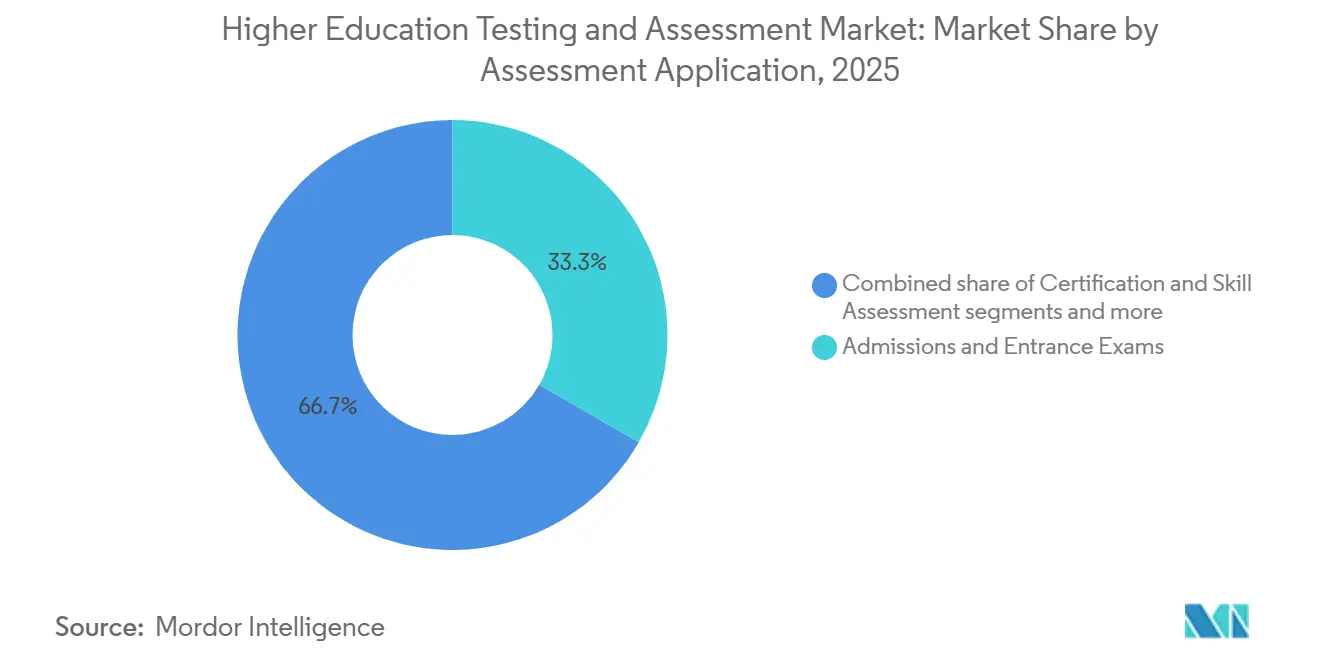
- By assessment application, Admissions and Entrance Exams accounted for 33.31% of the Higher Education Testing and Assessment Market in 2025, while Continuous Learning Assessment is projected to expand at the highest CAGR of 6.124% by 2031.
- By delivery mode, Computer-Based Testing held a 59.7% share of the Higher Education Testing and Assessment Market in 2025, while Remote Proctored Assessments are projected to expand at the highest CAGR of 6.85% by 2031.
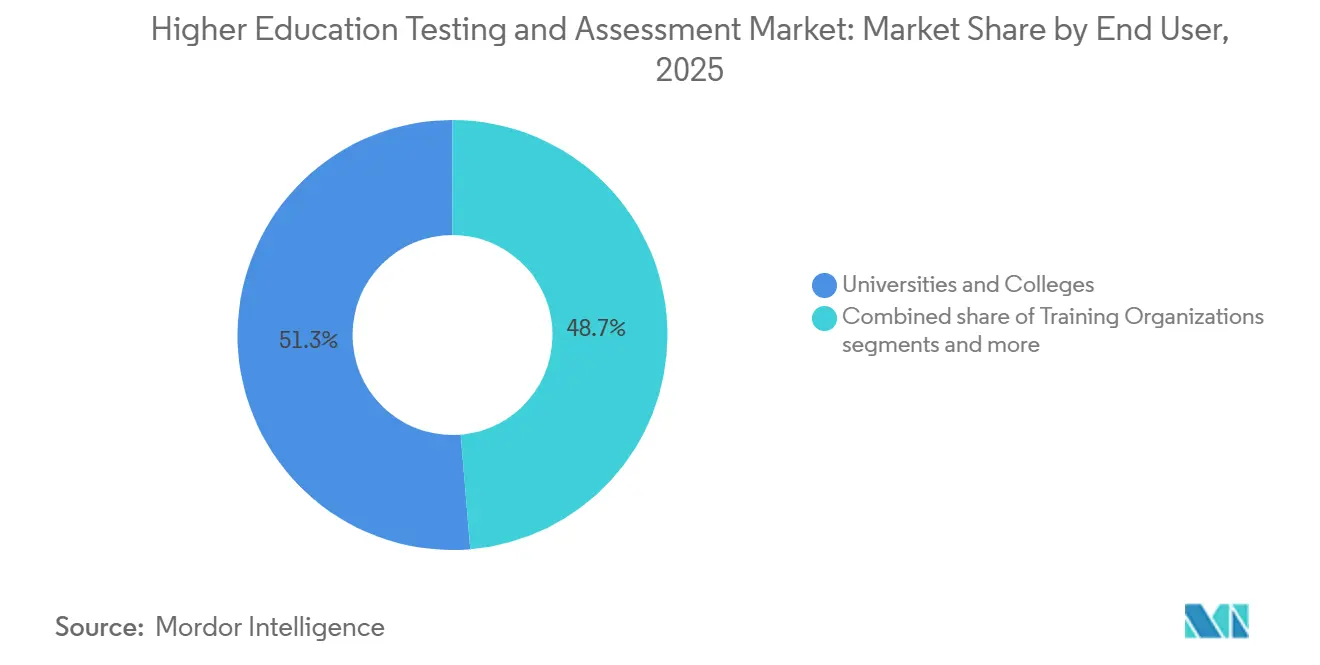
- By end user, Universities and Colleges accounted for a 51.32% share of the Higher Education Testing and Assessment Market in 2025, while Certification and Accreditation Bodies recorded the highest CAGR of 7.35% by 2031.
- By geography, North America held a 35.78% share of the Higher Education Testing and Assessment Market in 2025, while Asia-Pacific is projected to expand at the highest CAGR of 7.12% by 2031.
Note: Market size and forecast figures in this report are generated using Mordor Intelligence’s proprietary estimation framework, updated with the latest available data and insights as of January 2026.
Global Higher Education Testing and Assessment Market Trends and Insights
Drivers Impact Analysis*
| Driver | (~) % Impact on CAGR Forecast | Geographic Relevance | Impact Timeline |
|---|---|---|---|
| Proliferation of Remote and Hybrid Learning | +0.8% | Global, concentrated in North America and the Asia-Pacific | Short term (≤ 2 years) |
| Integration of AI and ML in Assessment Workflows | +1.2% | Global, with early leadership in North America and Western Europe | Medium term (2-4 years) |
| Rising Demand for Skills-Based Certification and Competency Testing | +0.9% | Global, with the strongest momentum in North America and Asia | Medium term (2-4 years) |
| Shift Toward Adaptive and Personalized Assessment Design | +0.7% | Global, with faster adoption in digitally mature markets | Medium term (2-4 years) |
| Expansion of Micro-Credentials and Stackable Learning Pathways | +0.6% | Global, with strong institutional uptake in North America and Oceania | Long term (≥ 4 years) |
| Rising Institutional Need for Learning Outcomes Analytics | +0.5% | Global, especially among universities and accreditation bodies | Long term (≥ 4 years) |
| Source: Mordor Intelligence | |||
Proliferation of Remote and Hybrid Learning
Remote and hybrid learning have broadened the scope of the higher education testing and assessment market beyond traditional campus settings. Research highlighted a shift in student attitudes toward remote proctoring, with greater acceptance due to convenience, though privacy and trust concerns remain. PSI enhanced this market segment by integrating deepfake detection and advanced identity verification through a partnership with Entrust, emphasizing that remote testing growth is driven by security investments rather than just digital access. Remote delivery also enables institutions to reach geographically dispersed learners, working professionals, and continuing education candidates without expanding physical test centers. This is particularly significant in regions like India, where challenges such as scale, distance, and exam logistics are prevalent. Secure remote and hybrid testing formats offer a commercially viable solution in such contexts when reliability is ensured.
Integration of AI and ML in Assessment Workflows
Artificial intelligence is reshaping the higher education testing and assessment market, influencing both content creation and delivery processes. Prometric secured a United States patent for AI-powered assessment item generation with its Finetune Generate platform, significantly reducing exam content development timelines for certification-focused programs. The company also introduced Finetune Score, which uses AI and optical character recognition to automate the grading of complex, open-ended responses, demonstrating the expansion of scoring automation beyond multiple-choice formats. A global review by the Digital Education Council and Pearson highlighted various methods for AI-integrated assessment design and emphasized AI-resistant design as essential for institutions seeking to maintain validity in the era of generative AI[2]. The market is increasingly divided between vendors with proprietary psychometric AI capabilities and those relying on slower, manual item-bank workflows, which is expected to impact product speed, pricing, and competitive positioning.
Rising Demand for Skills-Based Certification and Competency Testing
The higher education testing and assessment market is influenced by employer demand for credentials that demonstrate skills rather than just academic qualifications. A report by Lumina Foundation highlighted that most global employers were adopting or exploring skills-based hiring practices, with many recognizing the value of micro-credentials in strengthening candidate applications. ETS underscored this trend by announcing the Khan TED Institute in partnership with Khan Academy and TED. This program emphasizes competency-based learning, prioritizing progression and affordability over traditional seat time. The shift in purchasing decisions for assessment tools is moving away from prioritizing admissions volume and toward aligning with labor-market relevance, particularly for programs aiming to improve employability outcomes. In large education systems like India, this transition supports digital assessment formats that efficiently evaluate applied skills across large candidate pools while minimizing administrative challenges[3].
Shift Toward Adaptive and Personalized Assessment Design
Adaptive assessment is transforming the higher education testing and assessment market by better aligning question difficulty, learner progression, and score interpretation. ACT introduced an enhanced format to provide greater flexibility in science and writing sections, addressing institutional demand for more targeted evaluation structures. A review by the Digital Education Council and Pearson highlighted that institutions are redesigning assessments to align with AI-era validity, focusing on personalized, design-responsive approaches rather than traditional, uniform formats. Official Data demonstrated that adaptive multi-level learning models improved prediction accuracy compared to global baselines, reinforcing the educational benefits of responsive assessment frameworks. The market is shifting away from standardized evaluation models toward systems that personalize pacing, feedback, and performance visibility while maintaining comparability.
Restraints Impact Analysis*
| Restraint | (~) % Impact on CAGR Forecast | Geographic Relevance | Impact Timeline |
|---|---|---|---|
| Cybersecurity And Student Data Privacy Risks | -0.5% | Global, acute in North America and Europe | Short term (≤ 2 years) |
| Generative AI-Enabled Academic Misconduct | -0.6% | Global, with higher exposure in remote and hybrid delivery settings | Short term (≤ 2 years) |
| High Cost Of Secure Digital Assessment Infrastructure | -0.4% | Emerging markets and smaller institutions globally | Medium term (2-4 years) |
| Resistance To Change In Traditional Academic Assessment Models | -0.3% | Global, strongest in established university systems | Long term (≥ 4 years) |
| Source: Mordor Intelligence | |||
Generative AI-Enabled Academic Misconduct
Generative AI presents a significant challenge to the higher education testing and assessment market by undermining the credibility of traditional written evaluations. Researchers from Cornell emphasized the urgent need for reform, linking the misuse of generative AI in course assessments to concerns over the credibility of university credentials. A study published in the International Journal for Educational Integrity found that major AI detection tools are unreliable at identifying hybrid human-AI authorship, a common cheating pattern in real-world scenarios. This finding underscores the limitations of relying solely on detection tools. Institutions are increasingly compelled to adopt alternative evaluation methods, such as oral defenses, live performances, simulations, or portfolio-based assessments. These formats are better suited to address the challenges posed by generative AI. Consequently, the market is expected to favor vendors offering solutions that support AI-resistant evaluation methods over those focused on traditional multiple-choice or unsupervised essay models.
Cybersecurity and Student Data Privacy Risks
Cybersecurity risks are constraining the growth of the higher education testing and assessment market because assessment workflows rely on identity data, video streams, score records, and integrated learning platforms. Official Data indicate that deepfake identity fraud attempts occur frequently during remote testing sessions, with a notable rise in digital document forgery in recent years. To address these challenges, PSI partnered with Entrust to enhance security measures and later introduced Test Security as a Service, emphasizing the growing importance of anti-fraud controls as a core component of exam delivery. For both global and India-linked deployments, stricter data governance and identity assurance requirements are increasing procurement complexity, favoring providers with audited security capabilities. This trend is expected to continue, as institutions face challenges in scaling digital testing without strong trust in privacy, authentication, and breach response mechanisms[4].
*Our forecasts treat driver/restraint impacts as directional, not additive. The impact forecasts reflect baseline growth, mix effects, and variable interactions.
Segment Analysis
By Assessment Application: Admissions Testing Anchors Volume, but Continuous Learning Defines Future Revenue
Admissions and Entrance Exams held 33.31% of the higher education testing and assessment market in 2025, making it the largest application area by spending and institutional significance. This segment is driven by established tests like the SAT and ACT in North America, the GRE for graduate admissions, and national frameworks in India, China, Japan, and South Korea, reflecting long-standing buyer relationships and operating histories. ACT introduced an enhanced format in 2025 with optional science and writing sections, adapting to institutional demands for flexibility and targeted evaluation. Certification and Skill Assessment, along with Placement and Diagnostic Testing, continue to expand the segment’s scope as assessments increasingly focus on employability and readiness rather than solely access decisions. Admissions remains central to industry volume, but its future relevance depends on aligning academic selection with evolving skill and outcome expectations.
Continuous Learning Assessment is projected to grow at a 6.12% CAGR from 2026 to 2031, reflecting the market’s shift toward assessments integrated throughout the learner journey. A 2026 study showed adaptive multi-level learning models improved prediction performance by 18.6%, highlighting the benefits of ongoing, data-driven performance measurement over terminal testing. This segment shifts vendor revenue from one-time exams to recurring, curriculum-linked applications scalable across courses and programs. It aligns workforce-oriented and micro-credential pathways that require repeated evidence of progress. Continuous assessment drives platform retention, recurring software demand, and the value of instructional analytics in the industry.

By Delivery Mode: CBT Leads on Scale, Remote Proctored Disrupts on Growth
Computer-Based Testing (CBT) accounted for 59.74% of the higher education testing and assessment market in 2025, reflecting its dominance in secure digital delivery. This position stems from investments in test center infrastructure, established psychometric practices, and the need for monitored environments in medical licensure, legal testing, and professional certifications. Paper-based testing continues to decline but remains relevant in areas with limited digital infrastructure or where regulations favor traditional methods. CBT remains essential due to its scalability, control, and legal defensibility, which remote delivery has not fully matched in high-stakes applications. In markets like India, paper-to-digital transitions often begin with CBT before moving to large-scale remote assessments.
Remote Proctored Assessments are the fastest-growing delivery mode, with a 6.85% compound annual growth rate (CAGR) from 2026 to 2031, driving expansion of the delivery architecture. PSI enhanced this segment in 2024 through its Entrust partnership, focusing on deepfake detection and advanced ID verification, emphasizing the importance of trust controls. The 2025 launch of Test Security as a Service introduced modular security features like behavioral analytics and AI-generated answer detection, evolving remote proctoring into a comprehensive exam integrity model. This segment gains market share by addressing physical capacity constraints and supporting dispersed learners, though it faces challenges in privacy, identity verification, and validity. Providers combining scalability with robust fraud prevention, human oversight, and reliable candidate experiences are likely to succeed in the higher education testing and assessment market.
By End User: Universities Drive Volume, Certification Bodies Accelerate Growth
Universities and colleges represented 51.32% of end-user demand in 2025, making them the largest buyers in the higher education testing and assessment market. Their spending includes academic assessment software, course-linked evaluation tools, admissions testing interfaces, and high-volume examination platforms integrated into institutional workflows. This segment remains critical as universities manage the largest base of learners, assessments, and credential-awarding structures. However, procurement in this channel progresses slowly due to faculty governance, complex technology integration, and accreditation-related review cycles. While universities generate the largest revenue base, their product adoption cycle is slower.
Certification and accreditation bodies are the fastest-growing end-user category, with a projected CAGR of 7.35% from 2026 to 2031. This growth reflects their strong connection to labor-market outcomes and job-relevant validation. ETS acquired PSI in January 2024, forming a network that delivers nearly 50 million tests annually across 200+ countries and territories. These buyers adopt products faster than universities, as competency testing is tied to employability, compliance, and candidate throughput rather than academic governance. Training organizations serve industries like healthcare, technology, and financial services, where competency evidence is critical. In the higher education testing and assessment market, vendors diversifying beyond university procurement are better positioned to achieve faster growth and secure more responsive product funding.
Geography Analysis
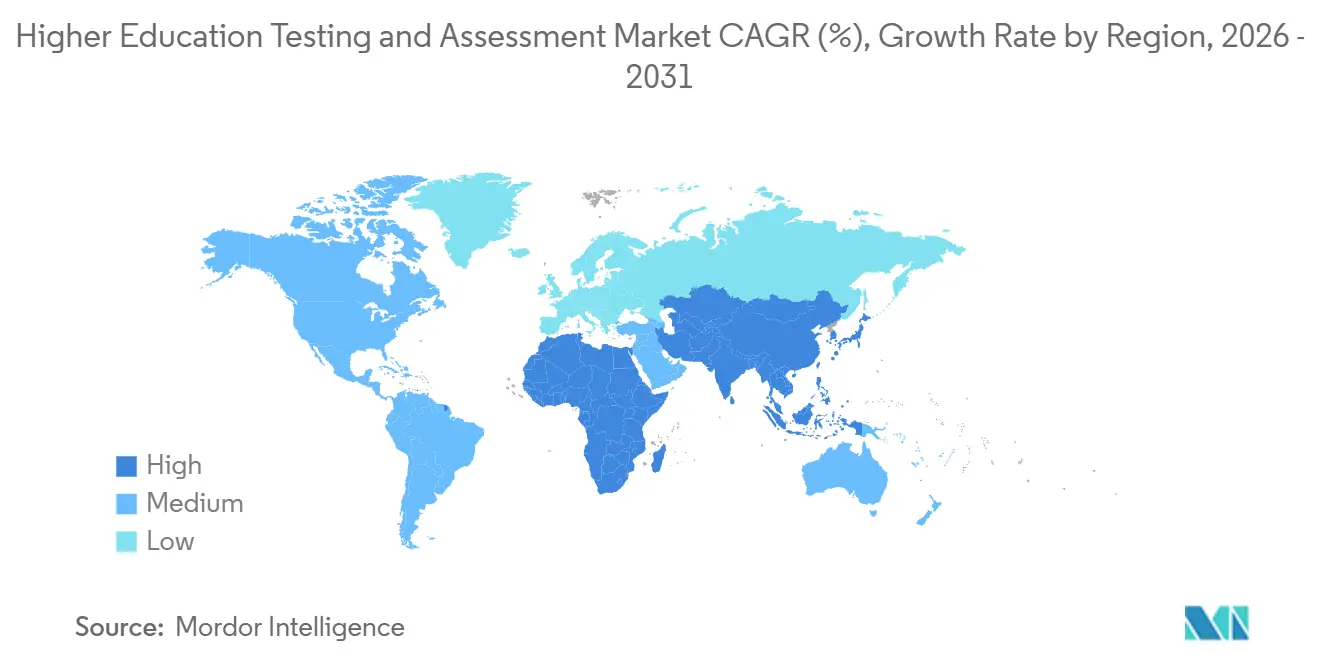
North America held 35.78% of the market size in 2025 and is expected to grow at a CAGR of 5.8% through 2031, maintaining its top position by revenue. The region benefits from established infrastructure, significant digital spending, and strong ecosystems for certification, accreditation, and admissions testing. The College Board expanded its role by acquiring Campus Sonar in 2026, emphasizing the importance of recruitment intelligence and data services. ACT underwent restructuring after its 2024 acquisition by Nexus Capital, introducing strategic changes. Canada and Mexico contribute to demand in bilingual and multicultural assessments, complementing the region's mature market.
Asia-Pacific is projected to grow at a CAGR of 7.12% from 2026 to 2031, driven by India and China, which combine large learner populations with rising demand for scalable and secure assessments. South Asia faces infrastructure and digital-skills gaps, creating opportunities for providers offering tiered delivery models. In India, operational reliability and exam integrity are prioritized over feature breadth.
Europe is expected to grow at a CAGR of 5.4% from 2026 to 2031, with the United Kingdom and Germany advancing in AI-assisted assessments, while BENELUX and Nordic countries explore AI-resistant exam designs. Regulatory discipline and institutional innovation make Europe a key market. The Middle East and Africa show varying growth rates. Gulf markets like the UAE and Saudi Arabia drive demand for digital assessments aligned with international standards, while Sub-Saharan Africa grows through online certification adoption. Vendors offering secure and flexible solutions are better positioned in these regions.
Competitive Landscape
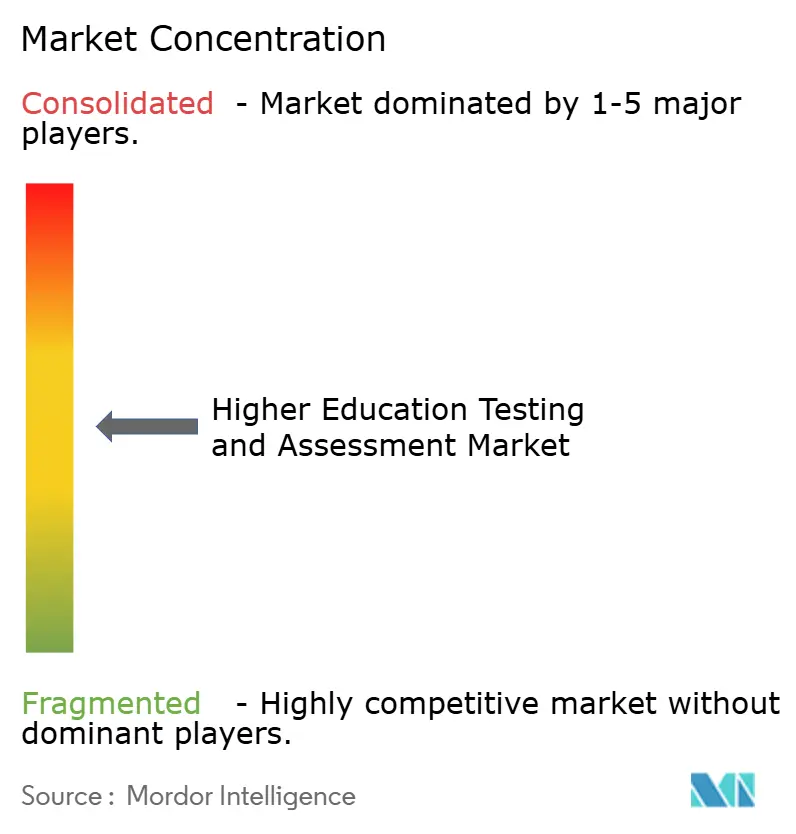
The higher education testing and assessment market is moderately fragmented, with companies focusing on ecosystem development rather than standalone product launches. Key players such as Pearson, ETS, McGraw-Hill, College Board, and ACT are prominent, but no single company dominates global spending. Pearson has formed partnerships with major technology firms, integrating assessment tools with AI, cloud, and workforce-learning ecosystems. This shift reflects a trend toward connecting assessment assets with broader platforms, fostering integration across learning, credentialing, analytics, and enterprise upskilling.
ETS has expanded its market presence through acquisitions and investments. The acquisition of PSI created a comprehensive testing network focused on workforce skills testing and credentialing. Investments in Memorang and Impacter Pathway indicate interest in skills analytics and AI-supported preparation. Prometric has developed intellectual property in AI-based content generation and scoring, appealing to certification bodies requiring faster item development cycles. These strategies highlight the importance of scale and technological control over validity, security, and workflow efficiency.
Opportunities in AI-native item generation, blockchain-based credential verification, and simulation-based assessment address challenges related to speed, trust, and validity. A prototype for blockchain-supported degree verification demonstrated practical solutions to credential fraud. Smaller specialists like Questionmark and TestReach maintain strong positions in niche segments, prioritizing focus and service quality. Larger providers are raising entry barriers through investments in AI, security, and integrated service models. The market is expected to remain fragmented, with technologically advanced vendors capturing a growing share of value.
Higher Education Testing and Assessment Industry Leaders
-
Pearson plc
-
Educational Testing Service
-
McGraw Hill LLC
-
College Board
-
ACT, Inc.
- *Disclaimer: Major Players sorted in no particular order
Recent Industry Developments
- June 2026: ETS Capital invested in Impacter Pathway, a K–12 human skills analytics company, supporting behavioral and durable-skill measurement as a category in high-stakes educational assessment and expanding the ETS portfolio beyond traditional cognitive testing.
- May 2026: Cognia merged with EL Education, combining accreditation services and an English language arts curriculum. The organization now serves 40,000 schools in over 100 countries, transitioning from a traditional accreditor to a comprehensive learning outcomes provider.
- May 2026: Pearson launched AI learning modules for college and university students in over 20 disciplines. These modules address the AI readiness gap between higher education and the workplace and are available internationally through MyLab and Mastering.
- April 2026: College Board acquired Campus Sonar, a higher education advisory firm specializing in near-real-time enrollment intelligence, to strengthen recruitment analytics for institutional partners.
Global Higher Education Testing and Assessment Market Report Scope
| Admissions & Entrance Exams |
| Course Evaluation & Academic Grading |
| Certification & Skill Assessment |
| Placement & Diagnostic Testing |
| Continuous Learning Assessment |
| Computer-Based Testing (CBT) |
| Paper-Based Testing |
| Remote Proctored Assessments |
| Universities & Colleges |
| Training Organizations |
| Certification and Accreditation Bodies |
| Other End Users |
| North America | United States |
| Canada | |
| Mexico | |
| South America | Brazil |
| Peru | |
| Chile | |
| Argentina | |
| Rest of South America | |
| Europe | United Kingdom |
| Germany | |
| France | |
| Spain | |
| Italy | |
| BENELUX (Belgium, Netherlands, and Luxembourg) | |
| NORDICS (Denmark, Finland, Iceland, Norway, and Sweden) | |
| Rest of Europe | |
| Asia-Pacific | India |
| China | |
| Japan | |
| Australia | |
| South Korea | |
| South East Asia (Singapore, Malaysia, Thailand, Indonesia, Vietnam, and the Philippines) | |
| Rest of Asia-Pacific | |
| Middle East and Africa | United Arab Emirates |
| Saudi Arabia | |
| South Africa | |
| Nigeria | |
| Rest of Middle East and Africa |
| By Assessment Application | Admissions & Entrance Exams | |
| Course Evaluation & Academic Grading | ||
| Certification & Skill Assessment | ||
| Placement & Diagnostic Testing | ||
| Continuous Learning Assessment | ||
| By Delivery Mode | Computer-Based Testing (CBT) | |
| Paper-Based Testing | ||
| Remote Proctored Assessments | ||
| By End User | Universities & Colleges | |
| Training Organizations | ||
| Certification and Accreditation Bodies | ||
| Other End Users | ||
| By Geography | North America | United States |
| Canada | ||
| Mexico | ||
| South America | Brazil | |
| Peru | ||
| Chile | ||
| Argentina | ||
| Rest of South America | ||
| Europe | United Kingdom | |
| Germany | ||
| France | ||
| Spain | ||
| Italy | ||
| BENELUX (Belgium, Netherlands, and Luxembourg) | ||
| NORDICS (Denmark, Finland, Iceland, Norway, and Sweden) | ||
| Rest of Europe | ||
| Asia-Pacific | India | |
| China | ||
| Japan | ||
| Australia | ||
| South Korea | ||
| South East Asia (Singapore, Malaysia, Thailand, Indonesia, Vietnam, and the Philippines) | ||
| Rest of Asia-Pacific | ||
| Middle East and Africa | United Arab Emirates | |
| Saudi Arabia | ||
| South Africa | ||
| Nigeria | ||
| Rest of Middle East and Africa | ||
Key Questions Answered in the Report
What is the 2031 value forecast for higher education testing and assessment?
The sector is forecast to reach USD 27.42 billion by 2031, up from USD 20.85 billion in 2026, with a 5.63% CAGR over 2026-2031.
Which application segment is currently the largest?
Admissions and Entrance Exams led in 2025, with a 33.31% share, showing that institutional gatekeeping still accounts for a large share of spending.
Which delivery model is growing the fastest?
Remote Proctored Assessments is the fastest-growing delivery mode with a projected 6.85% CAGR through 2031, supported by wider hybrid learning adoption and stronger security tools.
Why are certification bodies growing faster than universities?
Certification and Accreditation Bodies are expected to grow at a 7.35% CAGR, as their assessments are increasingly tied to labor-market outcomes and skills validation.
Which region offers the strongest growth outlook?
Asia-Pacific has the fastest growth outlook at 7.12% CAGR through 2031, supported by large student volumes and continuing digital exam modernization, including in India and China.
What is the biggest near-term challenge for assessment providers?
Generative AI misuse is the clearest short-term challenge because it weakens the validity of traditional written assessments and forces providers to redesign formats and controls.