
Higher Education Market Size and Share
Market Overview
| Study Period | 2022 - 2031 |
|---|---|
| Market Size (2026) | USD 2.26 Trillion |
| Market Size (2031) | USD 2.93 Trillion |
| Growth Rate (2026 - 2031) | 5.37 % |
| Fastest Growing Market | Asia-Pacific |
| Largest Market | North America |
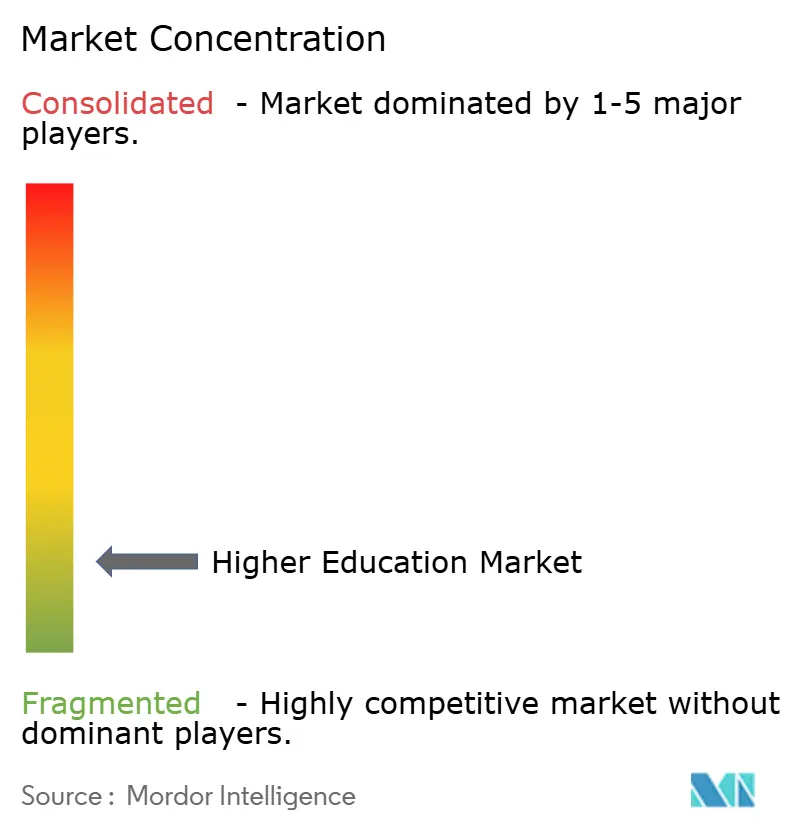
| Market Concentration | Low |
Major Players *Disclaimer: Major Players sorted in no particular order Image © Mordor Intelligence. Reuse requires attribution under CC BY 4.0. | |
Higher Education Market Analysis by Mordor Intelligence
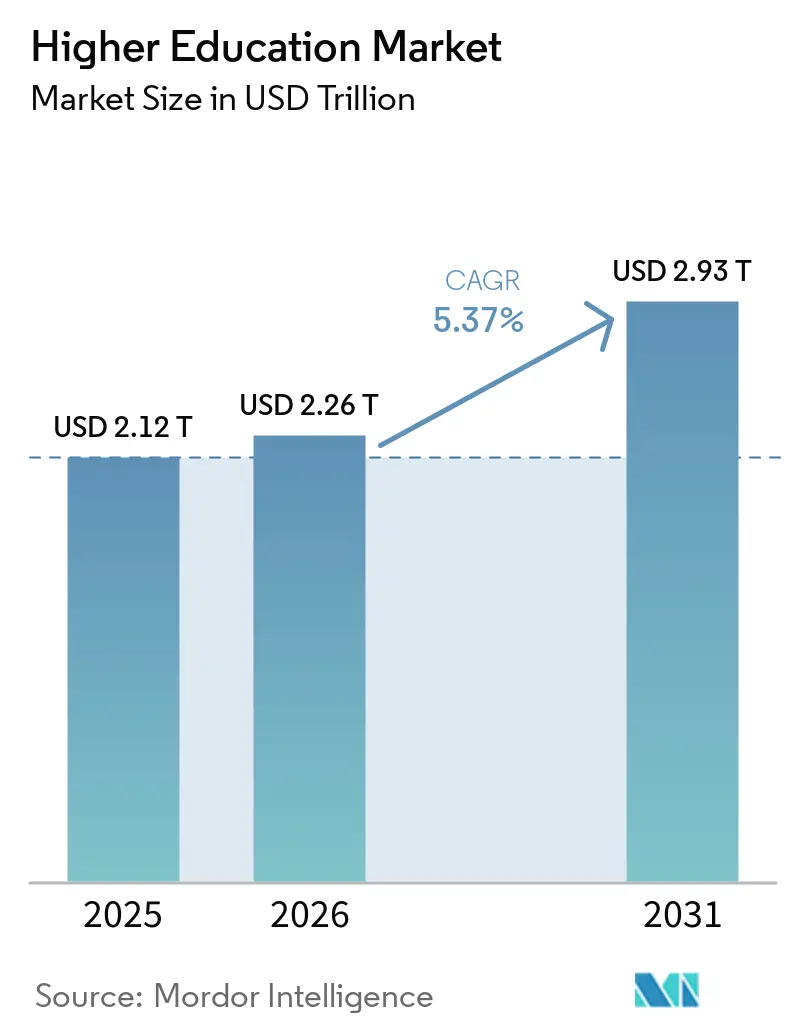
The Higher Education Market size is projected to expand from USD 2.12 trillion in 2025 and USD 2.26 trillion in 2026 to USD 2.93 trillion by 2031, registering a CAGR of 5.37% between 2026 to 2031.
Global enrollment reached 269 million students by 2024, indicating that access continued to widen across income groups, geographies, and age bands in the global higher education market. Workforce shifts, population expansion in emerging economies, and a faster move toward digital and hybrid delivery are supporting the global higher education market in 2026. The traditional full-time undergraduate model still accounts for the largest revenue base. Still, short-cycle credentials are capturing a larger share of institutional investment and learner demand in the global higher education market. AI adoption is also changing how institutions manage advising, student services, and operating costs, with institutional adoption rising from 49% in 2024 to 66% in 2025. International student mobility remains a major demand channel for the global higher education market. Still, student flows are moving toward destinations with more open policy settings, which is changing where institutions recruit and expand.[1]
Key Report Takeaways
- By education level, undergraduate programs held 60.12% of the global higher education market share in 2025, while Professional and Executive Education is projected to record the fastest growth at a 6.43% CAGR through 2031.
- By ownership, public institutions accounted for 62.62% of the global higher education market in 2025, while private for-profit institutions are forecast to expand at the highest CAGR of 6.23% through 2031.
- By delivery mode, on-campus delivery accounted for 72.71% of the global higher education market in 2025, while hybrid delivery is expected to grow the fastest at a 6.97% CAGR through 2031.
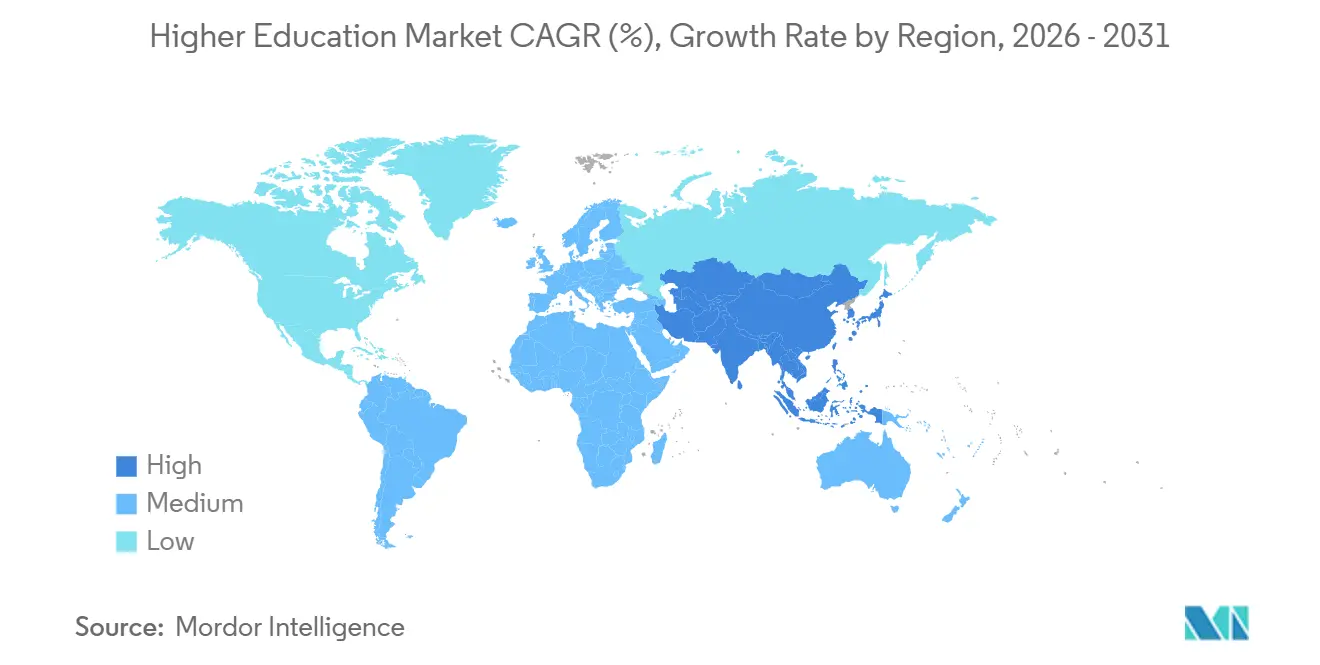
- By geography, North America led the global higher education market with 34.32% in 2025, while Asia-Pacific is projected to grow at the fastest CAGR of 6.12% through 2031.
Note: Market size and forecast figures in this report are generated using Mordor Intelligence’s proprietary estimation framework, updated with the latest available data and insights as of January 2026.
Global Higher Education Market Trends and Insights
Drivers Impact Analysis*
| Drivers | (~) % Impact on CAGR Forecast | Geographic Relevance | Impact Timeline |
|---|---|---|---|
| Rising Demand for Career-Aligned Micro-Credentials and Short-Cycle Programs | +0.8% | Global, with the highest intensity in North America and Western Europe, and spillover into urban Asia-Pacific and Middle East, and Africa hubs | Medium term (2-4 years) |
| Expansion of Inbound Cross-Border Student Recruitment to Main Campuses | +0.7% | Asia-Pacific source markets, including India, China, and Southeast Asia, with redirected demand toward Germany, France, and the UAE | Short term (≤ 2 years) |
| Widespread Proliferation of Hybrid Campus Infrastructure and Digital Experience Software | +0.9% | Global, with the strongest adoption in North America and Northern Europe, and faster buildout across Latin America and South and East Asia | Medium term (2-4 years) |
| Policy Push and Public Funding for Adult Learner Re-Entry and Workforce Reskilling | +0.6% | North America, Europe, Japan, and South Korea, with relevance rising in Latin America | Medium term (2-4 years) |
| Establishment of Physical International Branch Campuses in Emerging Hubs | +0.5% | India, Saudi Arabia, the UAE, Malaysia, and Singapore as host markets, with the UK, the US, and Australia as exporting systems | Long term (≥ 4 years) |
| Institutional Integration of Industry-Embedded and Co-Designed Curricula | +0.6% | North America and Northern Europe first, with visible expansion into India, Singapore, and Australia | Medium term (2-4 years) |
| Source: Mordor Intelligence | |||
Rising Demand for Career-Aligned Micro-Credentials and Short-Cycle Programs
Demand for short-cycle learning has become one of the clearest growth levers for the global higher education market. Coursera reported that 94% of employers are willing to offer higher starting salaries to candidates with micro-credentials, and 92% said entry-level workers with micro-credentials outperform peers without them in the first year. The same shift is visible at the institutional level, where 88% of online and professional continuing education units in the United States now offer micro-credentials, and 85% design them specifically for workforce development, up from 55% in 2021. This is changing the revenue mix of the global higher education market because these programs move faster from design to launch than full degree programs. It also favors institutions that can update curricula quickly and align content to employer demand without long approval cycles. Coursera’s Entry-Level Professional Certificate portfolio grew 32% year over year, and total enrollments exceeded 20 million, which shows that short-cycle learning is now a durable volume and revenue channel rather than a trial format.
Expansion of Inbound Cross-Border Student Recruitment to Main Campuses
Cross-border recruitment remains a high-value engine for the global higher education market because international students still support both tuition and campus utilization. UNESCO data showed that nearly 7.3 million students studied abroad globally in 2023, which confirmed that mobility remains structurally important even as policy settings become less predictable. The current shift is less about total demand falling and more about demand being redirected toward receptive destinations in continental Europe and newer Asian hubs. Germany recorded a 6% rise in international student enrollment in the 2024/25 winter semester to nearly 402,000 students, with India and China remaining the main non-EU source markets. For institutions in the global higher education market, that shift rewards flexible language delivery, local partnerships, and more balanced recruitment networks. It also gives India a stronger position in outbound student influence because Indian mobility patterns are helping shape which host systems gain share in the next phase of international recruitment.
Widespread Proliferation of Hybrid Campus Infrastructure and Digital Experience Software
Hybrid delivery is no longer a temporary accommodation in the global higher education market. It is now being treated as a planned infrastructure model that supports both traditional students and working adults. Grand Canyon Education reported that hybrid campus enrollment at partner institutions rose 18.7% in 2025, led by accelerated nursing and healthcare programs. That pattern matters because it shows hybrid growth is moving into regulated and employment-linked fields, not only into general education. The technology layer behind this model is also scaling quickly, with Ellucian serving nearly 3,000 institutions across 50 countries and reaching more than 21 million students through its platform. Even so, 56% of institutions in Ellucian’s 2025 survey identified data security and privacy as the top barrier to AI adoption, indicating that digital expansion in the global higher education market is increasingly tied to governance quality and software spending.
Policy Push and Public Funding for Adult Learner Re-Entry and Workforce Reskilling
Adult learner re-entry is widening the addressable base of the global higher education market. Governments and employers are treating higher education institutions as delivery partners for reskilling, especially in persistent labor shortages. In Ibero-America, regional enrollment exceeded 34 million students, and institutions are under pressure to modernize their delivery to reach first-generation learners and adults in rural and peri-urban areas. The same logic is visible in aging economies, where public funding for reskilling supports more stable enrollments than the traditional undergraduate cycle. This is creating a stronger role for continuing education divisions, executive learning units, and employer-sponsored certificates inside the global higher education market. It is also pushing institutions in India and other emerging systems to connect academic offerings more directly to employability and mid-career advancement.
Restraints Impact Analysis*
| Restraints | (~) % Impact on CAGR Forecast | Geographic Relevance | Impact Timeline |
|---|---|---|---|
| Tuition Affordability Crises and Extreme Student Debt Sensitivity | -0.8% | North America first, with spillover into the UK, Australia, and higher-fee Asia-Pacific systems | Short term (≤ 2 years) |
| Demographic Softness and Shrinking Domestic Youth Populations | -0.6% | Western Europe, Japan, South Korea, rural China, and parts of Eastern Europe | Long term (≥ 4 years) |
| Visa, Immigration Policy Fluctuation, and Cross-Border Geopolitical Friction | -0.9% | Canada, the UK, Australia, and the US, with Germany and France acting as partial counterweights | Short term (≤ 2 years) |
| Persistent Faculty Capacity Shortages and Quality-Consistency Constraints | -0.4% | Global, with the sharpest pressure in STEM, nursing, and applied sciences across Asia-Pacific and Sub-Saharan Africa | Medium term (2-4 years) |
| Source: Mordor Intelligence | |||
Tuition Affordability Crises and Extreme Student Debt Sensitivity
Affordability pressure is reshaping demand in the global higher education market, especially for postgraduate and premium-priced offerings. Students are increasingly judging programs by their visible career payoff rather than by institutional brand alone. This is putting pressure on institutions to demonstrate employment outcomes through internships, employer partnerships, and wage transparency. In the global higher education market, discounting alone is not solving the problem, as students are increasingly cautious about programs with unclear returns. The result is a stronger tilt toward credentials that are shorter, cheaper, and more easily linked to labor market outcomes. That is one reason the global higher education market is seeing stronger momentum in professional certificates, hybrid learning, and employer-backed formats than in purely academic expansion.
Demographic Softness and Shrinking Domestic Youth Populations
Demographic softness is a slower but important restraint on the global higher education market. Mature systems with shrinking youth cohorts cannot rely on traditional undergraduate demand to support the same volume growth as before. This is especially relevant where institutions have high fixed costs and limited flexibility across delivery modes. It also explains why many providers in the global higher education market are putting more emphasis on adult learners, international students, and flexible credentials. The pressure is not uniform because emerging systems continue to add learners while older education systems face weaker domestic intake. That uneven demographic picture is likely to widen the gap between high-growth and low-growth regions in the global higher education market over the forecast period.
*Our forecasts treat driver/restraint impacts as directional, not additive. The impact forecasts reflect baseline growth, mix effects, and variable interactions.
Segment Analysis
By Education Level: Professional Education Drives Premium Revenue Amid Undergraduate Market Pressure
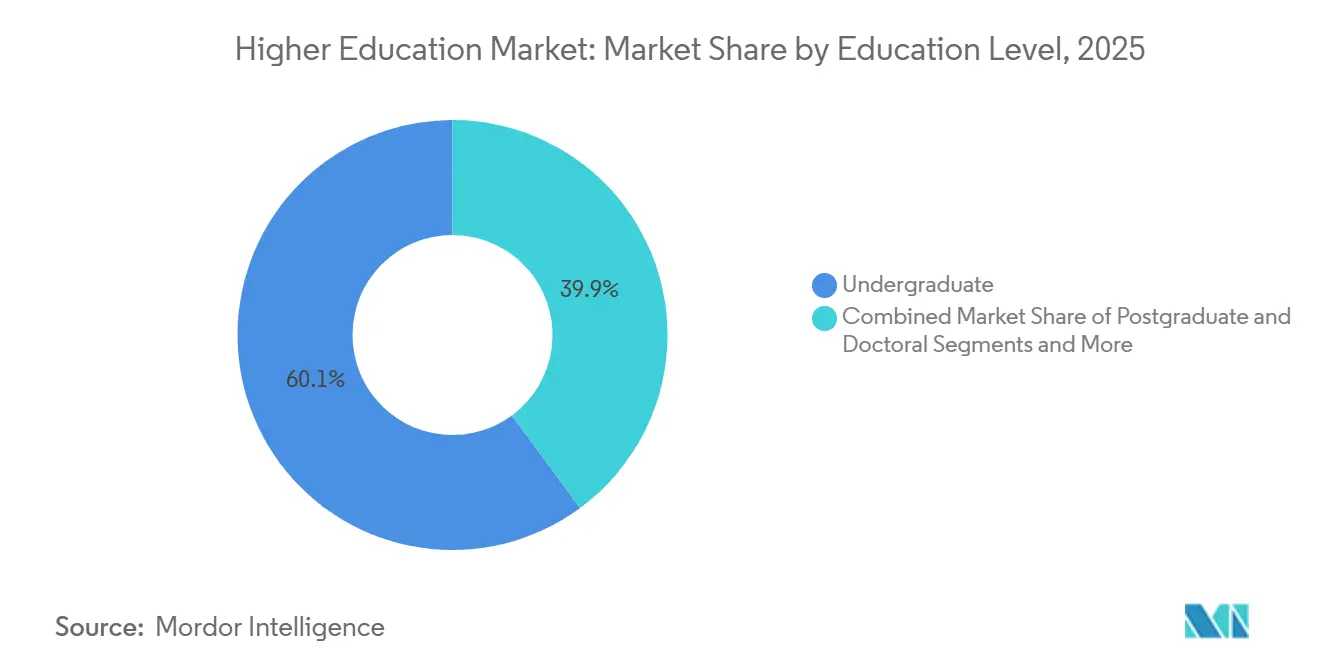
Undergraduate programs held 60.12% of the global higher education market share in 2025, making them the largest revenue base by education level. That position still reflects the scale of full-time degree infrastructure, public funding channels, and the central role of bachelor's education in most national systems. UNESCO's 2026 global trends data showed that bachelor's programs accounted for 85% of global enrollment at ISCED levels 6 to 8, while master's programs accounted for 13% and doctoral programs accounted for 2%. The large undergraduate base means that even modest changes in entry rates, retention, or pricing still have a large effect on the global higher education market. It also means that pressure in mature youth cohorts is most likely to be felt first in undergraduate-heavy systems, even when total global demand remains positive.
Professional and Executive Education is projected to grow at a 6.43% CAGR from 2026 to 2031, making it the fastest-growing education segment in the global higher education market. Growth is being supported by employer demand for AI skills, leadership development, and continuous workforce transformation. Shorter program cycles and clearer outcome framing are giving this segment a stronger commercial profile than longer academic tracks. The global higher education industry is also seeing more budget allocated to nondegree learning because employers can deploy it more quickly across teams and job functions. Postgraduate and doctoral demand still matter for research-led institutions. Still, they do not offer the same volume base as undergraduate education or the same speed of response as professional learning. In practical terms, this leaves the global higher education market more dependent on undergraduate scale for stability and on professional education for incremental growth.

By Ownership: For-Profit Operators Outpace the Market Amid Public Sector Portfolio Rationalization
Public institutions accounted for 62.6% of the global higher education market in 2025, underscoring the continued influence of scale and subsidy on the sector. Public universities remain central because they have the largest enrollments, the broadest program portfolios, and the strongest national legitimacy in many countries. Their position is especially important in the global higher education market, where access expansion, research mandates, and regional development goals are tied closely to public provision. At the same time, public institutions often face slower program approval processes and more complex administrative structures. That makes it harder for them to respond quickly when demand shifts toward new skills, shorter credentials, or hybrid delivery.
Private for-profit institutions are forecast to grow at a 6.2% CAGR through 2031, making them the fastest-growing ownership segment in the global higher education market. In the United States, for-profit enrollment grew at a 3.5% CAGR from 2021 to 2025, compared with 0.5% for the sector overall, reflecting faster launch speeds for healthcare, cybersecurity, and technology programs. Laureate Education reported total enrollment of 498,000 students in 2025 and revenue of USD 1.7 billion, up 9% year over year, supported by fully online scaling in Peru and enrollment growth in Mexico. Private non-profit institutions remain under the most visible structural pressure because they lack public subsidy support and often lack the speed advantages of for-profit operators. In the global higher education market, this leaves ownership strategy closely tied to cost discipline, portfolio clarity, and the ability to connect programs to employability.
By Delivery Mode: Hybrid Expansion Rewrites Campus Investment Logic
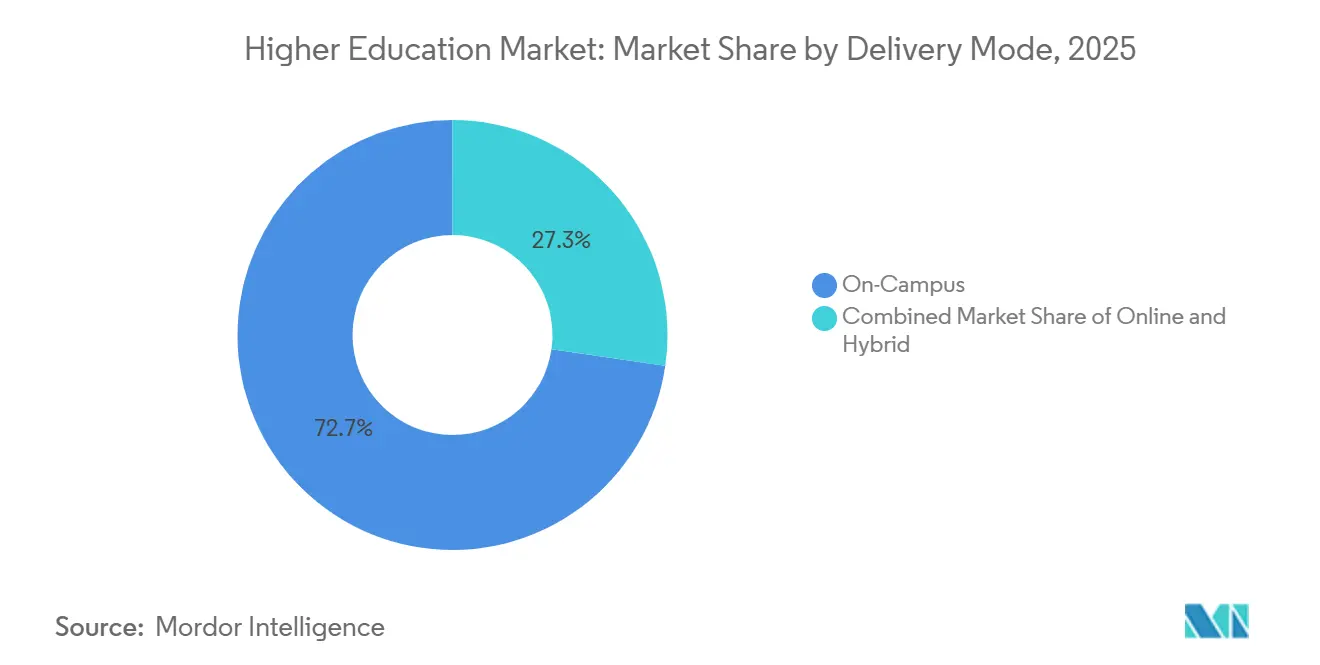
On-campus delivery accounted for 72.7% of the global higher education market in 2025, confirming that physical campuses remain the core delivery setting for degree education. Residential study still matters because it combines instruction, student life, identity formation, and institutional signaling into a single model. Even so, hybrid delivery is expected to expand at a 7% CAGR through 2031, which makes it the fastest-growing mode in the global higher education market. Grand Canyon Education’s partner universities reported 18.7% growth in hybrid campus enrollment in 2025, led by accelerated nursing and healthcare programs. This shows that hybrid growth is not limited to low-contact disciplines and is now being used in fields that require structured practical training.
Online delivery has become a permanent part of the global higher education market, especially for working professionals and adult learners. NCES data showed that 58% of students at private for-profit institutions were enrolled in distance education in fall 2024, compared with 28% at public institutions and 21% at private non-profit institutions. Institutions with multiple delivery modes retain students more effectively because they can shift learners across formats rather than losing them entirely. The global higher education industry is therefore moving toward a model in which physical campuses, digital systems, and learner services work together rather than compete for priority. That also explains why software, advising tools, and student experience platforms are becoming more critical to execution quality in the global higher education market.[2]
Geography Analysis
North America held 34.32% of the global higher education market share in 2025, making it the largest regional contributor by revenue. The region still benefits from research university density, mature funding structures, and strong institutional brands that attract both domestic and international students. At the same time, the global higher education market in North America is under greater, more visible operating pressure than before, as international recruitment has become less predictable and institutions are reviewing academic portfolios more closely. Cost controls, restructuring, and merger discussions are becoming part of the operating backdrop in ways that were less common when international flows and graduate demand were stronger. This means North America remains large and influential in the global higher education market, but it is no longer insulated from slower enrollment growth and greater scrutiny of financial sustainability.
Asia-Pacific is projected to grow at a 6.12% CAGR from 2026 to 2031, making it the fastest-growing regional segment of the global higher education market. India is a major reason for that outlook because the country is targeting a 50% gross enrollment ratio by 2035 and is also opening its system to foreign branch campuses. By October 2025, 9 UK university campuses had received approval in India, and the University of Southampton launched its New Delhi campus in September 2025, targeting 5,000 students. This gives the global higher education market a strong, India-centered growth path, as domestic demand, policy reform, and foreign institutional entry are all moving in the same direction.
Europe, the Middle East, and Africa are benefiting from the redirection of international student demand in the global higher education market. Germany recorded nearly 402,000 international students in the 2024/25 winter semester, up 6%, while India represented 37.6% of Germany’s non-EU graduate cohort. Germany also posted the highest STEM graduate share in the EU at 35.5%, further strengthening its position as a destination for skilled international students. In parallel, Gulf host markets are using branch campuses and large-scale educational investments to raise their profile in the global higher education market, while Europe is benefiting from a relatively open recruitment environment.[3]
Competitive Landscape
The global higher education market remains fragmented, with revenue and enrollment spread across public universities, private institutions, online operators, and technology enablers. Public institutions still anchor the largest share of the system, but the fastest growth is coming from formats and ownership models that move more quickly. Competitive behavior in 2025 and 2026 has followed 2 tracks: financially pressured institutions exploring consolidation, while growth-oriented players expand digital, cross-border, and employer-linked capabilities. This is why the global higher education market is showing both defensive moves, such as mergers and restructuring, and offensive moves, such as branch campuses and platform-based expansion. Competition is no longer defined only by campus prestige, because flexibility, employability, and delivery scale now matter more across several learner groups.
A clear example is Laureate Education, which increased enrollment to 498,000 students in 2025 and revenue to USD 1.7 billion through online scaling in Peru and growth in Mexico. Another example is Grand Canyon Education, where hybrid campus enrollment rose 18.7% and online enrollment grew 8.7%, with nearly 1-third of new online students sourced directly from employer relationships. Ellucian has also deepened its infrastructure role in the global higher education market through an AI-powered platform that now serves nearly 3,000 institutions and more than 21 million students across 50 countries. These examples show that competitive strength is increasingly tied to operating systems, multi-format delivery, and the ability to partner with employers as much as to institutional legacy.
Cross-border expansion is also becoming a stronger source of competitive differentiation in the global higher education market. The University of Southampton’s entry into New Delhi gave it a physical foothold in one of the most important long-term student demand markets. King’s College London and Cranfield University also moved toward a merger in May 2026, which showed that scale, capability complementarity, and resilience are rising priorities among established institutions. In the global higher education market, accreditation and compliance are also becoming increasingly important, as regulatory standing now affects international recruitment credibility and the viability of cross-border growth. This keeps the market competitive, without being concentrated around a handful of operators, because most regions still have a wide provider base and different models compete on different terms.
Higher Education Industry Leaders
-
Laureate Education, Inc.
-
Strategic Education, Inc.
-
Grand Canyon Education, Inc.
-
Adtalem Global Education Inc.
-
Perdoceo Education Corporation
- *Disclaimer: Major Players sorted in no particular order
Recent Industry Developments
- May 2026: King's College London and Cranfield University signed a formal agreement as the first step toward a merger, targeting full integration from August 2027. The combination is designed to create a dual-site research university spanning London and the Oxford-Cambridge Growth Corridor, combining King's clinical and humanities breadth with Cranfield's defense, engineering, and industry-linked capabilities.
- February 2026: Grand Canyon Education reported Q4 2025 results showing hybrid campus enrollment, excluding closed or teach-out sites, rising 18.7%, and online enrollment growing 8.7%, with approximately 1-third of new online students sourced directly from employer relationships.
- July 2025: The University of Southampton launched its New Delhi branch campus with an initial cohort, becoming the first foreign institution to obtain full approval under India's University Grants Commission framework for foreign branch campuses. The university targets 5,000 students at the Delhi campus.
- March 2025: The EQT-led consortium completed the acquisition of Nord Anglia Education for USD 14.5 billion, with co-investors including Neuberger Berman Private Markets, CPP Investments, CF Alba, and Dubai Holding. The transaction reflected sustained investor conviction in premium international education's revenue resilience.
Global Higher Education Market Report Scope
| Undergraduate |
| Postgraduate |
| Doctoral |
| Professional and Executive Education |
| Public Institutions |
| Private Non-Profit Institutions |
| Private For-Profit Institutions |
| On-Campus |
| Online |
| Hybrid |
| North America | United States |
| Canada | |
| Mexico | |
| South America | Brazil |
| Peru | |
| Chile | |
| Argentina | |
| Rest of South America | |
| Europe | United Kingdom |
| Germany | |
| France | |
| Spain | |
| Italy | |
| BENELUX (Belgium, Netherlands, and Luxembourg) | |
| NORDICS (Denmark, Finland, Iceland, Norway, and Sweden) | |
| Russia | |
| Rest of Europe | |
| Asia-Pacific | India |
| China | |
| Japan | |
| Australia | |
| South Korea | |
| South East Asia (Singapore, Malaysia, Thailand, Indonesia, Vietnam, and Philippines) | |
| Rest of Asia-Pacific | |
| Middle East and Africa | United Arab Emirates |
| Saudi Arabia | |
| South Africa | |
| Nigeria | |
| Rest of Middle East and Africa |
| By Education Level | Undergraduate | |
| Postgraduate | ||
| Doctoral | ||
| Professional and Executive Education | ||
| By Ownership | Public Institutions | |
| Private Non-Profit Institutions | ||
| Private For-Profit Institutions | ||
| By Delivery Mode | On-Campus | |
| Online | ||
| Hybrid | ||
| By Geography | North America | United States |
| Canada | ||
| Mexico | ||
| South America | Brazil | |
| Peru | ||
| Chile | ||
| Argentina | ||
| Rest of South America | ||
| Europe | United Kingdom | |
| Germany | ||
| France | ||
| Spain | ||
| Italy | ||
| BENELUX (Belgium, Netherlands, and Luxembourg) | ||
| NORDICS (Denmark, Finland, Iceland, Norway, and Sweden) | ||
| Russia | ||
| Rest of Europe | ||
| Asia-Pacific | India | |
| China | ||
| Japan | ||
| Australia | ||
| South Korea | ||
| South East Asia (Singapore, Malaysia, Thailand, Indonesia, Vietnam, and Philippines) | ||
| Rest of Asia-Pacific | ||
| Middle East and Africa | United Arab Emirates | |
| Saudi Arabia | ||
| South Africa | ||
| Nigeria | ||
| Rest of Middle East and Africa | ||
Key Questions Answered in the Report
What is the projected value of the global higher education sector by 2031?
The global higher education market is projected to reach USD 2.93 trillion by 2031, rising from USD 2.26 trillion in 2026 at a 5.4% CAGR over 2026-2031.
Which region is growing the fastest in higher education through 2031?
Asia-Pacific is the fastest-growing region, with a forecast CAGR of 6.1%, supported strongly by India’s enrollment expansion and foreign campus policy opening.
Which education level is expanding the fastest?
Professional and Executive Education is the fastest-growing education level segment, with a projected 6.4% CAGR through 2031.
Why is hybrid delivery gaining traction across universities?
Hybrid delivery is growing because it gives students more flexibility and helps institutions serve both campus-based and working adult learners. It is forecast to grow at 7% through 2031.
Why does India matter so much to future growth?
India is a key demand center because it is targeting a 50% gross enrollment ratio by 2035 and is also allowing foreign branch campuses, which expands both domestic and cross-border opportunities.
What is changing competition among universities and education providers?
Competition is shifting toward employability, digital delivery, employer partnerships, and cross-border presence, rather than relying only on legacy reputation or campus scale.