
High Performance Plastics Market Size and Share
Market Overview
| Study Period | 2021 - 2031 |
|---|---|
| Market Size (2026) | USD 40.52 Billion |
| Market Size (2031) | USD 63.36 Billion |
| Growth Rate (2026 - 2031) | 9.35 % |
| Fastest Growing Market | Asia-Pacific |
| Largest Market | Asia-Pacific |
| Market Concentration | Medium |
Major Players *Disclaimer: Major Players sorted in no particular order Image © Mordor Intelligence. Reuse requires attribution under CC BY 4.0. | |
High Performance Plastics Market Analysis by Mordor Intelligence
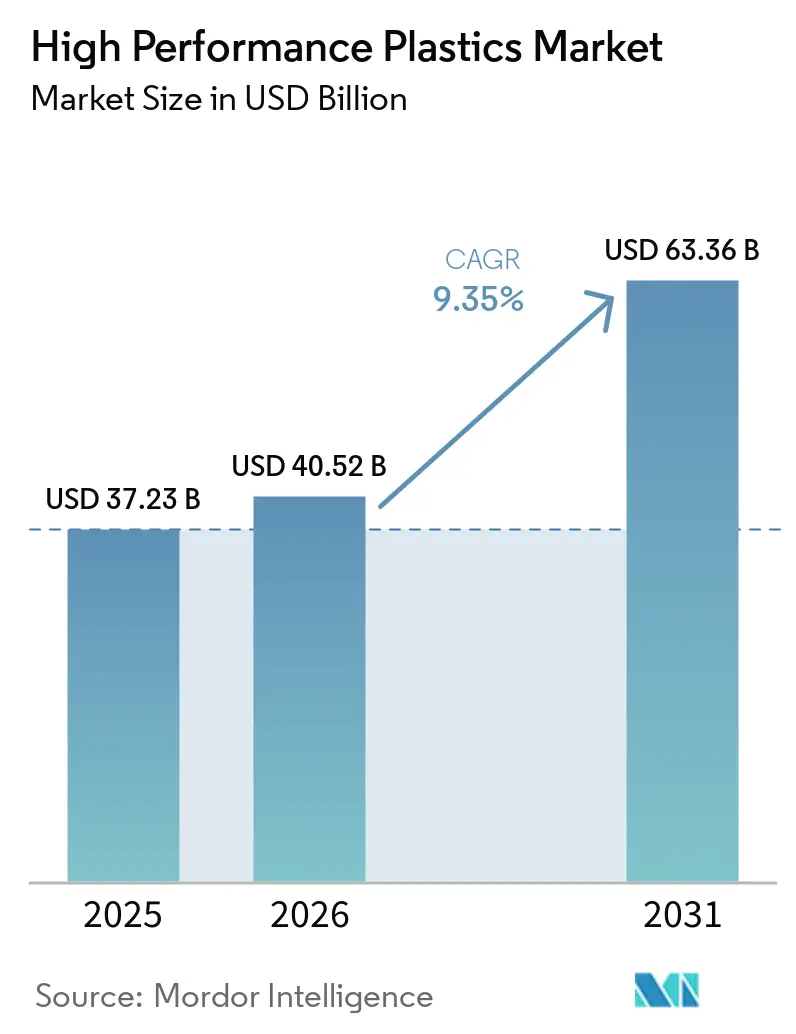
The high performance plastics market size is projected to expand from USD 37.23 billion in 2025 and USD 40.52 billion in 2026 to USD 63.36 billion by 2031, at a CAGR of 9.35% between 2026 and 2031. Vehicle electrification, artificial intelligence data centers, and advanced semiconductor production are increasing demand for materials that tolerate heat, chemicals, and electrical loads. These requirements support use in applications where standard engineering resins cannot meet operating conditions. Producers are expanding compounding capacity closer to automotive, electronics, and semiconductor customers in Asia-Pacific. The regulatory outlook for PFAS remains an important consideration for fluoropolymer suppliers and their customers. Competition depends on material qualification, application support, regional certification, and reliable supply rather than resin chemistry alone.
Key Report Takeaways
- By type, fluoropolymers held 36.15% of the high performance plastics market share in 2025, while high performance polyamides (HPPA) are forecast to grow at a 9.84% CAGR through 2031.
- By processing technology, injection molding held 44.32% revenue share in 2025 and recorded the highest projected CAGR at 10.15% through 2031.
- By end-use industry, transportation accounted for 42.81% of end-use revenue in 2026, while electrical and electronics is projected to expand at a 10.43% CAGR through 2031.
- By geography, Asia Pacific held 43.06% revenue share in 2025 and is forecast to grow at a 10.33% CAGR through 2031.
Note: Market size and forecast figures in this report are generated using Mordor Intelligence’s proprietary estimation framework, updated with the latest available data and insights as of January 2026.
Global High Performance Plastics Market Trends and Insights
Drivers Impact Analysis*
| Driver | (~) % Impact on CAGR Forecast | Geographic Relevance | Impact Timeline |
|---|---|---|---|
| Vehicle Lightweighting and Metal Replacement | +2.3% | Global, led by Europe, North America, and China | Long term (≥ 4 years) |
| EV Battery, Inverter, and Thermal Management Demand | +2.1% | Global, concentrated in China, South Korea, and Germany | Medium term (2-4 years) |
| Semiconductor Miniaturization and High Purity Processing | +1.6% | Asia-Pacific core, Taiwan, South Korea, and Japan, with spillover to North America | Long term (≥ 4 years) |
| High Frequency Connectivity and AI Data Center Hardware | +1.4% | Global, with dense demand in North America and Asia-Pacific data center corridors | Short term (≤ 2 years) |
| Qualification of Local Specialty Polymer Supply in Asia-Pacific | +1.0% | Asia-Pacific, China, India, and South Korea | Medium term (2-4 years) |
| Source: Mordor Intelligence | |||
Vehicle Lightweighting and Metal Replacement
The need to reduce vehicle weight is moving beyond body panels into powertrain, structural, and thermal-management components. The high performance plastics market benefits as manufacturers replace metal parts with PPS, aromatic ketone polymers, and HPPA grades. These materials retain mechanical strength and thermal stability where standard engineering resins can deflect or creep. SABIC reported that its Noryl GTX thermoplastic system can reduce weight by up to 25% against filled engineering plastics in EV battery protection components.[1]SABIC, “SABIC Advances Thermoplastic Solutions for Critical EV Battery Technologies,” SABIC, sabic.com EV growth is increasing the number of polymer contacts, housings, and structural brackets within each vehicle platform. The change also reduces use of metallic fasteners and aluminum brackets in selected assemblies.
Electric Vehicle Battery, Inverter, and Thermal Management Demand
The move from 400V to 800V EV architectures increases thermal, electrical, and chemical demands on component materials. This shift supports the high performance plastics market because earlier polymer systems may not withstand the higher operating loads. Envalior launched Xytron PPS M5080ET in June 2026 for EV busbar overmolding applications. The company stated that the compound improves thermal shock resistance by more than 70% against earlier PPS formulations. BASF also noted that 800V battery systems require new material solutions for demanding battery components.[2]BASF, “BASF on the Next Generation of Battery Materials,” BASF, basf.com PVDF electrode binders and PTFE sealing parts face both stronger EV demand and scrutiny under PFAS regulation, which can encourage the use of HPPA and PPS in non-electrode applications.
Semiconductor Miniaturization and High Purity Processing
Semiconductor fabrication below the 3nm node raises demand for polymer systems with high purity and chemical resistance. The high performance plastics market serves wet-process equipment that must handle ultrapure water and aggressive etchants. PFA, PTFE, and PVDF are used because of their chemical inertness and low extractables. SEMI material standards discussions noted that high-purity fluoropolymer grades can command prices 2 to 3 times higher than standard industrial grades. Supply is concentrated around leading-edge fabrication customers with demanding material specifications. Semiconductor uses may receive PFAS derogations in the European framework, which could direct limited high-purity capacity toward chip production instead of broader industrial applications.
High Frequency Connectivity and AI Data Center Hardware
AI data center construction is increasing demand for high-frequency PCB materials and related polymer substrates. The high performance plastics market is supported by server designs with more board layers than conventional systems. Würth Elektronik reported that conventional server motherboards use 18 layers, while advanced AI servers use 32 to more than 90 layers. The same source stated that an advanced server can consume 10 to 15 times more physical board material than a standard unit. PTFE composites and liquid crystal polymer films support high-speed links where conventional FR-4 does not provide the needed electrical performance. This demand can divert specialty laminate capacity from automotive and industrial PCB production, supporting polymer prices when supply is tight.
Restraints Impact Analysis*
| Restraint | (~) % Impact on CAGR Forecast | Geographic Relevance | Impact Timeline |
|---|---|---|---|
| High Resin, Processing, and Qualification Costs | -1.8% | Global | Long term (≥ 4 years) |
| Fluorochemical Regulation and End of Life Compliance | -1.3% | Europe, with secondary relevance in North America | Medium term (2-4 years) |
| Long Validation Cycles and Limited Standardized Testing | -0.9% | Global, concentrated in aerospace, medical, and automotive applications | Long term (≥ 4 years) |
| Source: Mordor Intelligence | |||
High Resin, Processing, and Qualification Costs
High resin prices and demanding production conditions can limit adoption across the high performance plastics market. PEEK prices range from USD 80 to USD 120 per kilogram, while processing often requires temperatures from 350°C to 400°C. These conditions require specialized molding or extrusion equipment and can increase tooling wear. The FDA issued draft Q3E guidance on extractables and leachables in August 2025, reinforcing the testing burden for regulated polymer changes. Adoption is strongest where the performance benefit is clear, and the component value can absorb development costs. Small and medium-sized suppliers also face pressure to recover tooling costs before recurring production orders begin.
Fluorochemical Regulation and End of Life Compliance
The proposed European Union REACH universal PFAS restriction creates a material regulatory issue for fluoropolymer producers. The European Chemicals Agency stated that its Risk Assessment Committee adopted its final opinion on 2 March 2026. The Committee for Socio-Economic Analysis agreed its draft opinion on 10 March 2026 and is expected to complete its opinion during 2026. The proposal covers close to 14,000 synthetic chemicals and keeps use-specific derogations under discussion. The United Kingdom published its first comprehensive PFAS Plan on 3 February 2026 and signaled an intention to reform United Kingdom REACH by December 2028. The high performance plastics market faces added uncertainty because high-purity PTFE, PFA, and PVDF grades can cost up to 25% more than standard grades.
*Our forecasts treat driver/restraint impacts as directional, not additive. The impact forecasts reflect baseline growth, mix effects, and variable interactions.
Segment Analysis
By Type: Fluoropolymers Lead Demand While HPPA Drives Growth
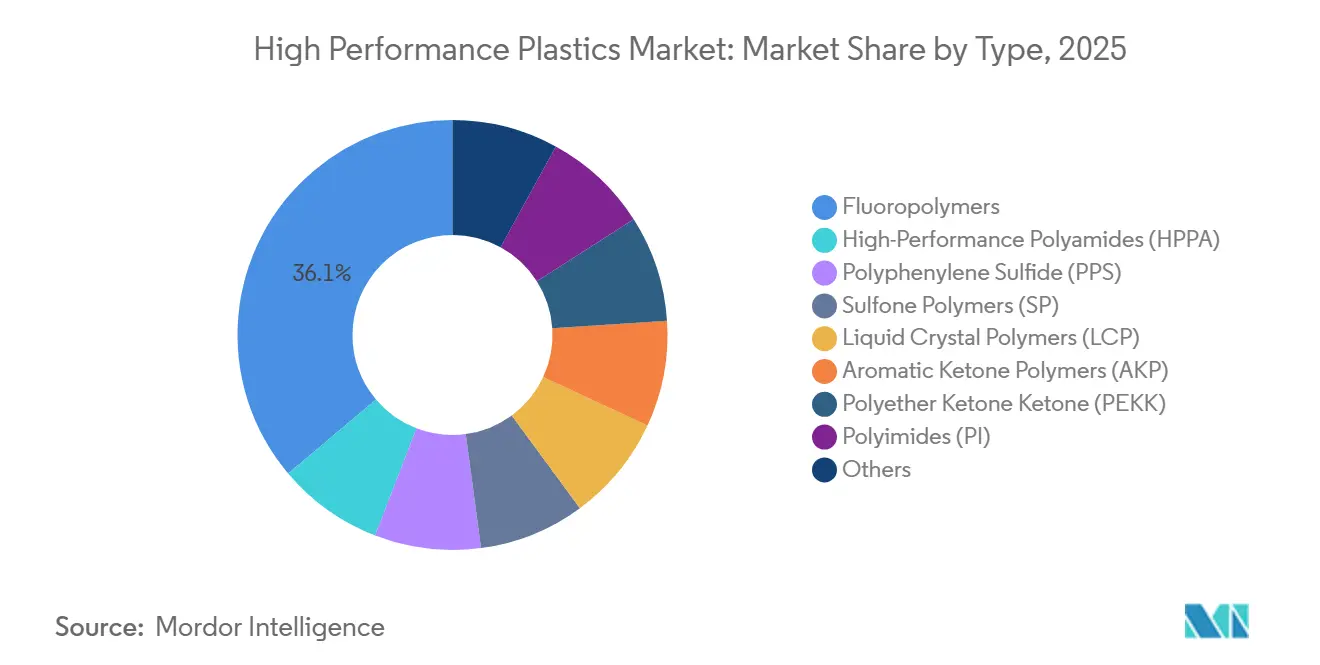
Fluoropolymers held 36.15% of the high performance plastics market size in 2025, supported by semiconductor wet processing, chemical fluid systems, EV components, and high-frequency cable insulation. Their chemical resistance and low-extractable properties remain important where substitution is technically difficult. High-performance polyamides are the fastest-growing type at a 9.84% CAGR through 2031. The high performance plastics industry uses HPPA for EV battery housings, inverter enclosures, thermal-management circuits, and connectors. These parts must tolerate continuous temperatures from 150°C to 175°C in selected 800V architectures. Standard PA6 and PA66 grades are less suitable for these operating conditions.
Syensqo expanded its Changshu site in May 2025 with capacity for Kalix HPPA, Omnix HPPA, and Amodel PPA grades. In the high performance plastics market, PPS has a material position in connectors and housings because it combines thermal performance with a cost advantage against PEEK. LCP demand is tied to high-frequency PCB substrates used in data center systems. PEEK, PEKK, and LMPAEK remain high-specification aromatic ketone polymers with strong margins in demanding applications. Victrex stated that its LMPAEK technology provides a processing window up to 40°C wider and consumes up to 25% less processing energy than conventional PEEK. Polyimides and sulfone polymers continue to serve smaller, high-value microelectronics and water-treatment membrane uses.



By Processing Technology: Injection Molding Retains the Volume Position
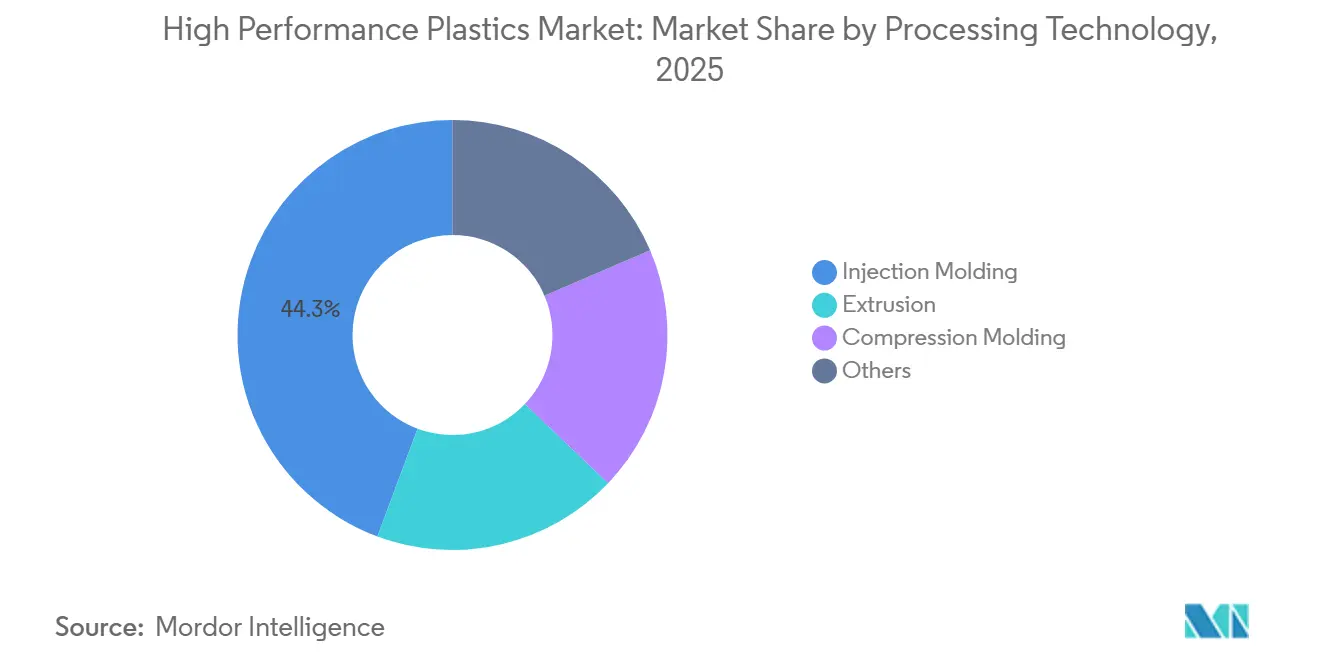
Injection molding held 44.32% revenue share in 2025 because it supports efficient, repeatable production of complex parts. Automotive connectors, electronics housings, and medical-device components require tight dimensional tolerances at high volumes. Injection molding is also the fastest-growing route, with a projected 10.15% CAGR through 2031. A molded HPPA bracket can replace 3 to 5 stamped metal and rubber subassemblies in suitable designs. This can improve part performance and reduce system cost. The value proposition reflects total assembly cost rather than resin price alone.
Extrusion produces pipes, films, tubing, and sheet profiles for chemical processing, semiconductor ultrapure-water systems, and medical fluid handling. These applications need consistent geometry, high purity, and dependable processing quality. Compression molding is used for thick-section aerospace and industrial components made from PEEK and polyimide. Its slower cycles are acceptable in low-volume applications requiring dimensional precision. The other processing category includes additive manufacturing, which is gaining relevance in aerospace fabrication. Victrex stated that LMPAEK filament systems can enable out-of-autoclave parts at cycle rates up to 4 times faster than traditional thermoplastic composite methods.
By End-Use Industry: Transportation Holds Scale While Electronics Accelerates
Transportation accounted for 42.81% of the high performance plastics market size in 2026, making it the largest end-use segment. Automotive programs use PPS connectors, HPPA under-hood components, LCP antenna substrates, and PEEK structural bearings. EV platforms raise polymer content per vehicle because they introduce components that were not present in internal combustion designs. The electrical and electronics segment is projected to record the highest 10.43% CAGR through 2031. AI data centers and advanced semiconductor packaging are the main demand sources. These applications require materials that preserve electrical performance at high frequencies and during sustained thermal exposure.
AI servers represented more than 25% of PCB demand in 2026 after accounting for 15% in 2025. The increase can tighten supply for PTFE composite and LCP laminates, which may support elevated prices through 2027. Medical demand is supported by cleared PEEK implant systems. The FDA cleared Curiteva’s Porous PEEK cervical interbody fusion system in January 2026. Industrial demand is supported by chemical processing and oil and gas fluid handling, where fluoropolymer linings and PTFE seals remain common specifications. The high performance plastics market serves both high-volume vehicle programs and specialized regulated applications.
Geography Analysis
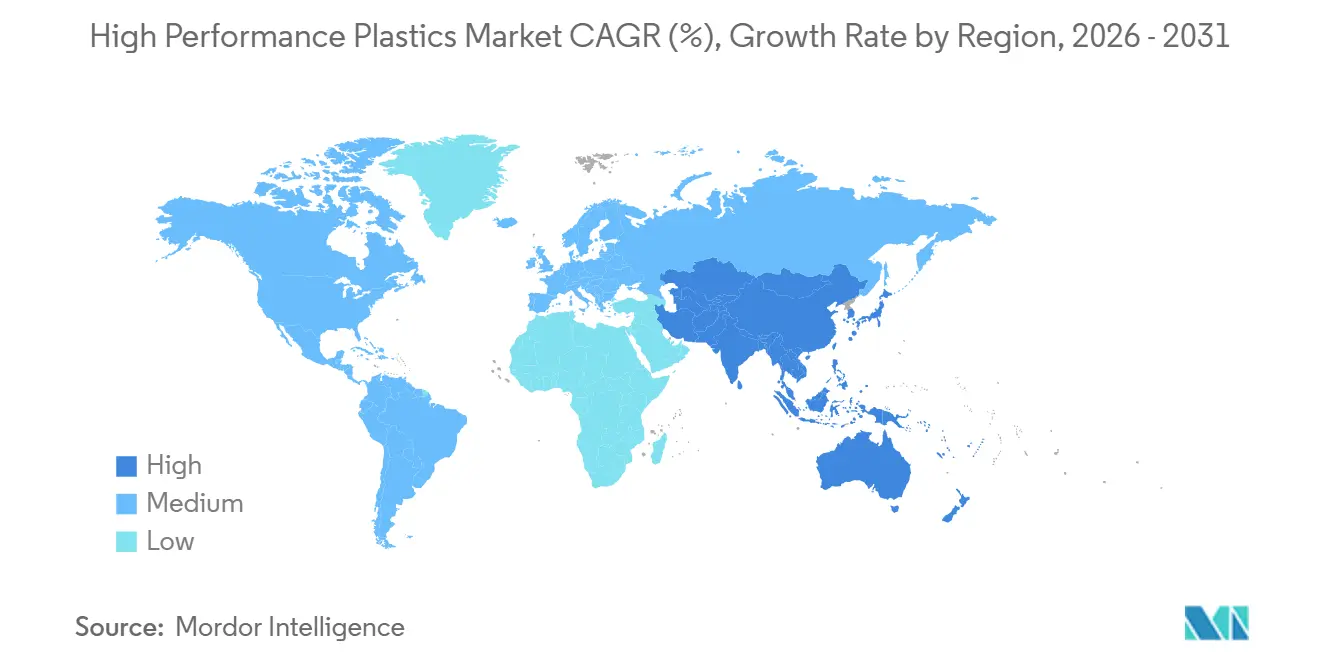
Asia Pacific held 43.06% of the high performance plastics market share in 2025 and is projected to grow at a 10.33% CAGR through 2031. China’s EV production, South Korea’s semiconductor production base, Japan’s precision-parts manufacturing, and automotive supply chains in India and ASEAN support regional demand. Higher polymer content in premium and EV vehicle platforms also raises material use across the region. Syensqo completed its Changshu compounding expansion in May 2025 to support e-mobility, semiconductors, smart devices, and healthcare uses. The company announced a Panoli, India, compounding investment in September 2026 that will support automotive customers.
North America holds a strong position in the high performance plastics market through aerospace composites, medical-device manufacturing, and semiconductor capacity expansion. PEEK and PEKK composites are important in aerospace applications, while medical manufacturers require established material qualification records. Arkema started a 15% PVDF capacity expansion at Calvert City, Kentucky, in June 2026. The USD 20 million investment supports EV battery, data center cable, and semiconductor demand. U.S. domestic-content requirements for EV battery supply chains are accelerating local qualification of PVDF and fluoropolymer grades. This creates demand that is separate from the broader automotive production cycle.
Europe’s high performance plastics market is supported by thermoplastic composite programs, German automotive production, and established chemical manufacturing centers. EU REACH PFAS work is directly affecting the region’s fluoropolymer supply chain and customer qualification plans. Suppliers are investing in compliance documentation, emission tracking, and high-purity product reformulation for European applications. South America, the Middle East and Africa remain smaller regional areas with steady energy-sector demand. Fluoropolymer pipe linings support oil and gas processing in Brazil and Saudi Arabia. Mexico’s location near the United States vehicle assembly plants is also attracting injection-molding compounders that serve the USMCA supply chain.

Competitive Landscape
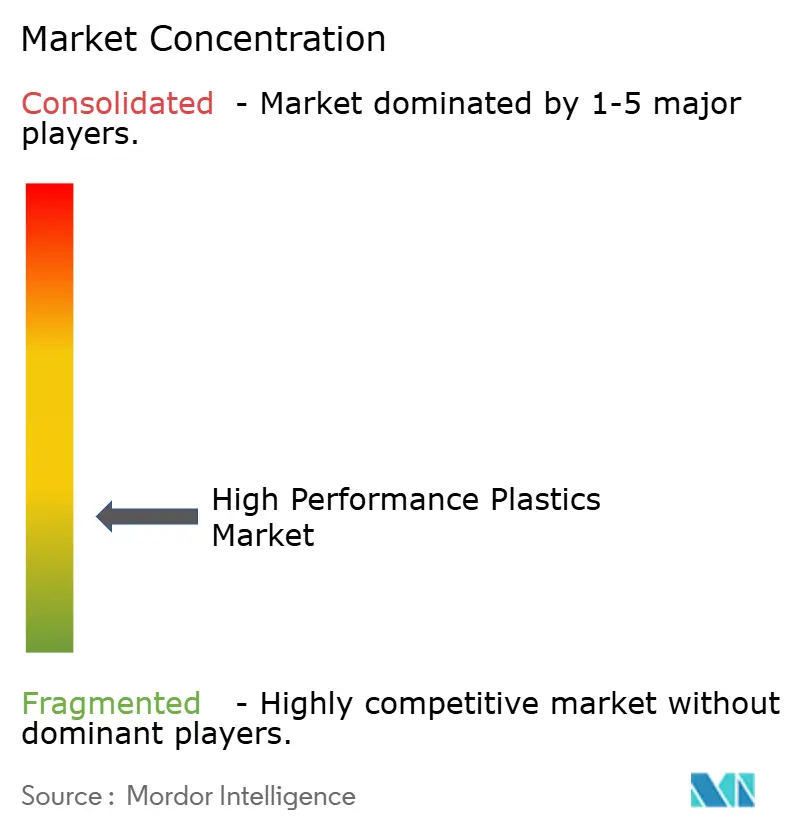
The high performance plastics market is moderately concentrated around Syensqo, Arkema, DuPont, Victrex, and The Chemours Company. These producers supply widely specified resin families, including PEEK, PEKK, PVDF, PTFE, and HPPA grades. Their strategies combine monomer production, compounding, application engineering, and intellectual property around processing and composite systems. Arkema received U.S. Patent 12460078 in November 2025 for PAEK-related additive manufacturing technology. The company also holds technology related to fiber-impregnation methods using PEKK. Smaller specialists such as Ensinger and KURARAY PLASTICS compete through custom semi-finished profiles, proximity to precision-machining customers, and short lead times for low-volume work.
Syensqo expanded specialty polymer compounding at Changshu in May 2025 and added grades for e-mobility, semiconductor, smart-device, and healthcare applications. In September 2026, it announced a new aromatic polymer compounding line at Panoli that will double the current site capacity and is planned to begin operating in Q1 2028. Arkema started its Calvert City PVDF expansion in June 2026 after a USD 20 million investment. Arkema also announced a 20% PVDF capacity expansion at Changshu in March 2026, with start-up planned for 2028. These investments show that proximity to battery, semiconductor, and vehicle customers is becoming central to high performance plastics market supplier positioning.
Opportunities are focused on bio-sourced aromatic precursors, recycled-content PEEK for industrial applications, and thermally conductive grades for EV battery thermal management. Syensqo reported that specialty polymer volumes and sales returned to year-on-year growth in the second quarter of 2026, led by semiconductor-related demand. Chinese PEEK producers have expanded capacity since 2020 and are seeking qualification for industrial automotive specifications. Their presence could place pressure on standard PEEK grades in mid-tier automotive uses. Incumbent suppliers are likely to retain an advantage in aerospace and medical grades that require extensive documentation and long qualification periods. The high performance plastics market, therefore, remains shaped by technology ownership, approved grades, and local application support.
High Performance Plastics Industry Leaders
DuPont
BASF
Solvay
Celanese Corporation
Arkema
- *Disclaimer: Major Players sorted in no particular order

Recent Industry Developments
- September 2026: Syensqo announced investment in a new high-performance aromatic polymer compounding line at its Panoli, India, facility, doubling current Panoli capacity. The modular hub will process PPS, PEEK, PPA, and polyarylamide, targeting automotive OEMs and supporting India's Make in India localization drive, with a planned start-up in Q1 2028.
- June 2026: Arkema successfully started up its 15% PVDF capacity expansion at its Calvert City, Kentucky, plant. The USD ~20 million investment, announced in February 2025, was completed on time and on budget, supporting EV battery, data-center cable, and semiconductor market growth in North America.


Global High Performance Plastics Market Report Scope
High performance plastics are advanced polymers that withstand extreme heat, harsh chemicals, and heavy mechanical stress far beyond the limits of standard or engineering plastics.
The high performance plastics market is segmented by type, processing technology, end-use industry, and geography. By type, the market is segmented into fluoropolymers, High-Performance Polyamides (HPPA), Polyphenylene Sulfide (PPS), Sulfone Polymers (SP), Liquid Crystal Polymers (LCP), Aromatic Ketone Polymers (AKP), Polyether Ketone Ketone (PEKK), Polyimides (PI), and Others. By processing technology, the market is segmented into injection molding, extrusion, compression molding, and others. By end-use industry, the market is segmented into transportation, electrical and electronics, medical, industrial, and other end-use industries. By geography, the market is segmented into Asia Pacific, North America, Europe, South America, Middle East and Africa. The report also covers the high performance plastics market size and forecasts for the high performance plastics market in 16 countries across major regions. For each segment, the market sizing and forecasts have been done on the basis of value (USD).
| Fluoropolymers |
| High-Performance Polyamides (HPPA) |
| Polyphenylene Sulfide (PPS) |
| Sulfone Polymers (SP) |
| Liquid Crystal Polymers (LCP) |
| Aromatic Ketone Polymers (AKP) |
| Polyether Ketone Ketone (PEKK) |
| Polyimides (PI) |
| Others |
| Injection Molding |
| Extrusion |
| Compression Molding |
| Others |
| Transportation |
| Electrical and Electronics |
| Medical |
| Industrial |
| Other End-Use Industries |
| Asia-Pacific | China |
| India | |
| Japan | |
| South Korea | |
| ASEAN Countries | |
| Rest of Asia-Pacific | |
| North America | United States |
| Canada | |
| Mexico | |
| Europe | Germany |
| United Kingdom | |
| France | |
| Italy | |
| NORDIC Countries | |
| Russia | |
| Rest of Europe | |
| South America | Brazil |
| Argentina | |
| Rest of South America | |
| Middle East and Africa | Saudi Arabia |
| South Africa | |
| Rest of Middle East and Africa |
| By Type | Fluoropolymers | |
| High-Performance Polyamides (HPPA) | ||
| Polyphenylene Sulfide (PPS) | ||
| Sulfone Polymers (SP) | ||
| Liquid Crystal Polymers (LCP) | ||
| Aromatic Ketone Polymers (AKP) | ||
| Polyether Ketone Ketone (PEKK) | ||
| Polyimides (PI) | ||
| Others | ||
| By Processing Technology | Injection Molding | |
| Extrusion | ||
| Compression Molding | ||
| Others | ||
| By End-Use Industry | Transportation | |
| Electrical and Electronics | ||
| Medical | ||
| Industrial | ||
| Other End-Use Industries | ||
| By Geography | Asia-Pacific | China |
| India | ||
| Japan | ||
| South Korea | ||
| ASEAN Countries | ||
| Rest of Asia-Pacific | ||
| North America | United States | |
| Canada | ||
| Mexico | ||
| Europe | Germany | |
| United Kingdom | ||
| France | ||
| Italy | ||
| NORDIC Countries | ||
| Russia | ||
| Rest of Europe | ||
| South America | Brazil | |
| Argentina | ||
| Rest of South America | ||
| Middle East and Africa | Saudi Arabia | |
| South Africa | ||
| Rest of Middle East and Africa | ||


Key Questions Answered in the Report
What is the present and forecasted market size of the high performance plastics market?
The high performance plastics market size is projected to rise from USD 40.52 billion in 2026 to USD 63.36 billion by 2031, at a 9.35% CAGR.
Which polymer type has the largest share?
Fluoropolymers held 36.15% revenue share in 2025 because they are used in semiconductor fluid handling, chemical systems, EV components, and high-frequency insulation.
Which processing technology is growing fastest?
Injection molding is forecast to grow at a 10.15% CAGR through 2031 and held 44.32% revenue share in 2025.
Which region leads global demand?
Asia Pacific held 43.06% revenue share in 2025 and is projected to grow at a 10.33% CAGR through 2031.
Page last updated on:


 Your data is secure and never sold or shared.


