
High-Performance Plastic Compounds Market Size and Share
Market Overview
| Study Period | 2022 - 2032 |
|---|---|
| Market Size (2027) | USD 11.01 Billion |
| Market Size (2032) | USD 17.07 Billion |
| Growth Rate (2027 - 2032) | 9.17 % |
| Fastest Growing Market | Asia-Pacific |
| Largest Market | Asia-Pacific |
| Market Concentration | Medium |
Major Players *Disclaimer: Major Players sorted in no particular order Image © Mordor Intelligence. Reuse requires attribution under CC BY 4.0. | |
High-Performance Plastic Compounds Market Analysis by Mordor Intelligence
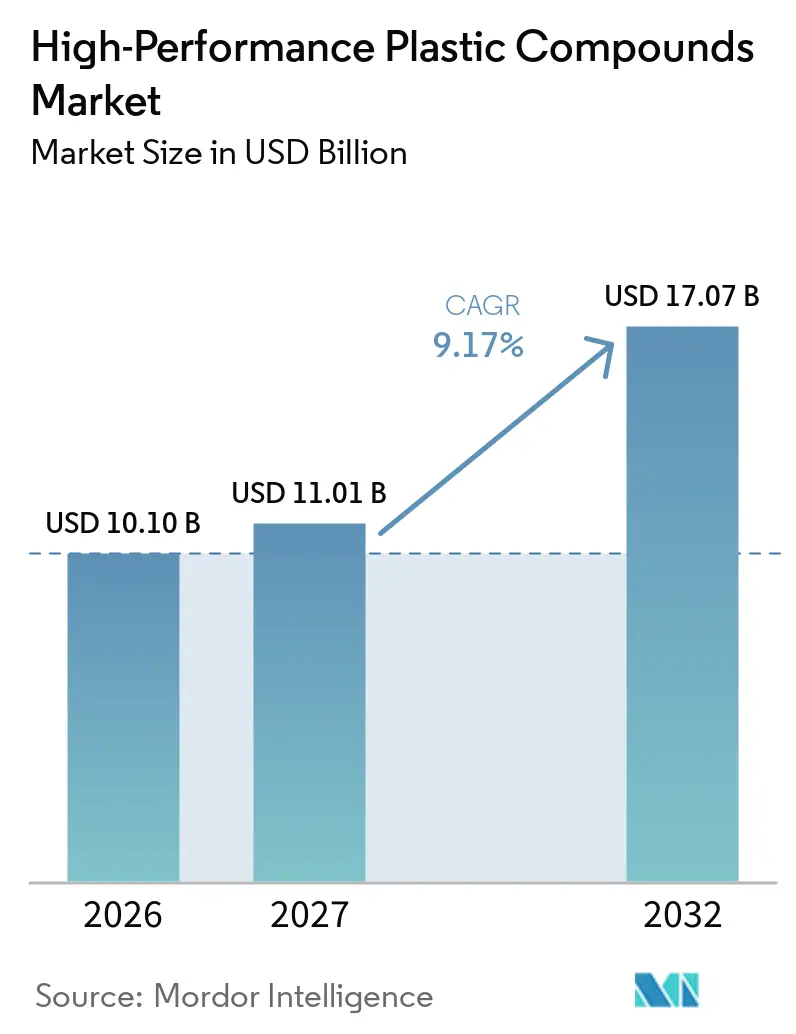
The High-Performance Plastic Compounds Market size was valued at USD 10.10 billion in 2026 and is estimated to grow from USD 11.01 billion in 2027 to reach USD 17.07 billion by 2032, at a CAGR of 9.17% during the forecast period (2027-2032). The high-performance plastic compounds market is supported by material substitution in automotive, electronics, aerospace, and medical applications that require higher thermal, mechanical, chemical, and electrical performance. Electric vehicle programs, data center construction, semiconductor packaging, and new aircraft platforms are increasing the need for specialty thermoplastics. Qualification requirements also support recurring demand because approved materials can remain in an original equipment manufacturer platform for several years. Suppliers are responding through specialized formulations, local capacity additions, technical support, and qualification assistance. Feedstock cost volatility, high processing requirements, and limited recycled content for critical grades remain constraints for the high-performance plastic compounds market.
Key Report Takeaways
- By plastic type, polyphenylene sulfide (PPS) held 32.46% of the high-performance plastic compounds market share in 2026, while polyether ether ketone (PEEK) is forecast to advance at a 10.45% CAGR through 2032.
- By additive type, glass fiber held 46.13% of the high-performance plastic compounds market share in 2026, while carbon fiber is forecast to advance at a 10.66% CAGR through 2032.
- By end-use industry, automotive held 35.91% of the high-performance plastic compounds market share in 2026, while aerospace is forecast to advance at an 11.13% CAGR through 2032.
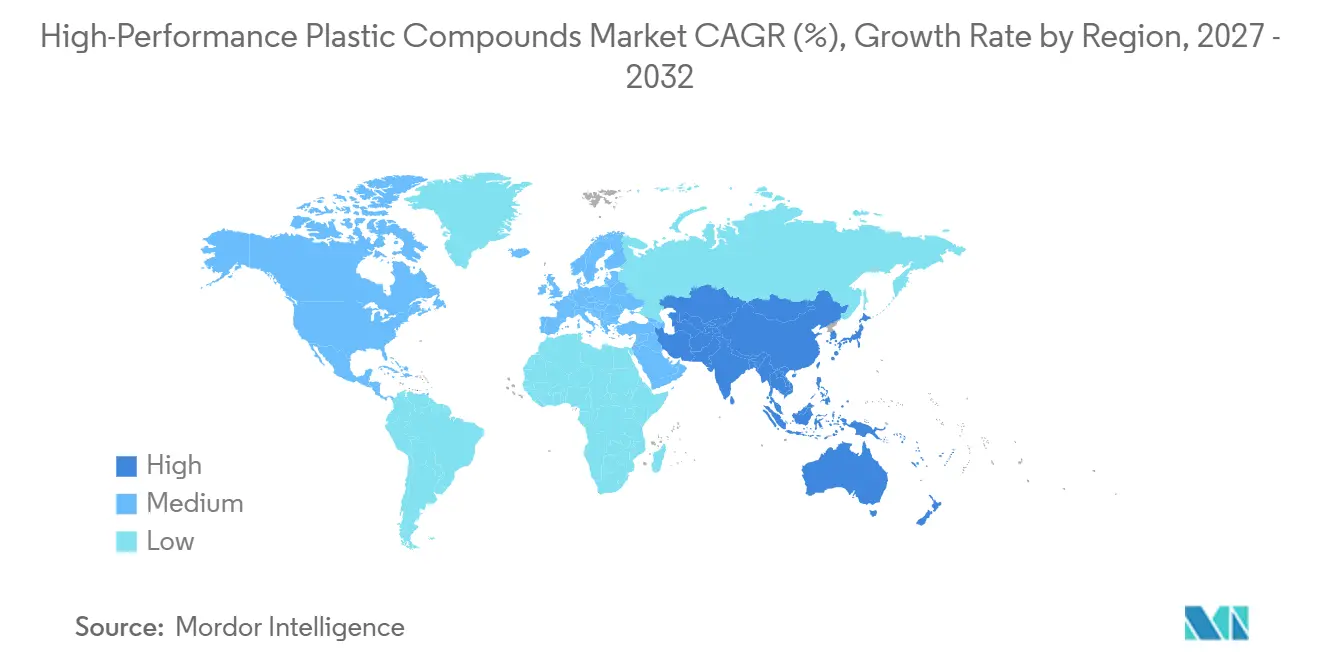
- By geography, Asia-Pacific held 50.57% of the high-performance plastic compounds market share in 2026 and is forecast to advance at a 10.84% CAGR through 2032.
Note: Market numbers in this report are based on Mordor Intelligence's proprietary estimation framework, which combines nine months of actuals with Q4 projections for base year 2026.
Market Trends and Insights
Drivers Impact Analysis of High-Performance Plastic Compounds Market*
| Driver | (~) % Impact on CAGR Forecast | Geographic Relevance | Impact Timeline |
|---|---|---|---|
| Electrification and Lightweighting in Automotive Platforms | +2.8% | Global, concentrated impact in China, Germany, and South Korea | Medium term (2–4 years) |
| Semiconductor, Data Center, and High-Frequency Electronics Expansion | +2.1% | Asia-Pacific core, spillover to North America and Europe | Short term (≤ 2 years) |
| Aerospace Weight Reduction and Fleet Modernization | +1.7% | North America & Europe, emerging demand in Asia-Pacific | Long term (≥ 4 years) |
| Medical Devices Requiring Sterilization Resistance and Biocompatibility | +1.3% | Global, early gains in North America, Europe, and East Asia | Long term (≥ 4 years) |
| Qualification-Grade Materials for Additive Manufacturing | +0.8% | North America & Europe | Medium term (2–4 years) |
| Source: Mordor Intelligence | |||
Electrification and Lightweighting in Automotive Platforms
The high-performance plastic compounds market benefits from electric vehicle designs that place demanding thermal and electrical requirements on battery, connector, and inverter components. Systems operating at 800 V require flame resistance, electro-corrosion resistance, and dimensional stability through thermal cycling from -40 °C to 150 °C. Polyphthalamide and polyphenylene sulfide compounds are used where these requirements exceed the capability of conventional engineering plastics. BASF introduced Ultramid Advanced N3U42G6 in June 2025 for high-voltage connectors in inverters and direct current to direct current converters, with UL 94 V-0 performance at a 0.25 mm wall thickness and a heat distortion temperature of 265 °C[1]. The high-performance plastic compounds market also gains from the weight savings available from fiber-reinforced polymer composites, which a 2025 peer-reviewed study found can reach 50% against equivalent metal structures. Halide-free qualification is becoming a baseline condition for some high-voltage applications, which places more importance on processing support and approved material performance.
Semiconductor, Data Center, and High-Frequency Electronics Expansion
The high-performance plastic compounds market is expanding beyond conventional electronics housings as artificial intelligence data centers and fifth-generation network equipment require more capable polymer materials. Low-loss laminates and semiconductor packaging substrates need controlled moisture absorption, dielectric behavior, and dimensional stability. The National Institute of Standards and Technology reported in 2025 that polymer materials for advanced packaging must meet new requirements associated with three-dimensional heterogeneous chip integration[2]. The same research noted that a new packaging material can take 10 to 25 years to reach production scale, which makes early approval especially valuable. This long approval process can strengthen the position of suppliers that gain specification status early in a product cycle. International Electrotechnical Commission (IEC) and International Organization for Standardization (ISO) requirements for dielectric performance and flame resistance also separate qualified material suppliers from suppliers of standard grades.
Aerospace Weight Reduction and Fleet Modernization
The high-performance plastic compounds market receives long-term support from commercial aviation recovery and defense programs that require light and durable structural materials. Aerospace manufacturers use polyether ether ketone and related polyaryletherketone materials in brackets, clamps, inserts, and electrical insulation components that can replace aluminum parts. TORAY INDUSTRIES, INC. completed the National Center for Advanced Materials Performance qualification for Cetex TC1225 low-melt polyaryletherketone fabric-based thermoplastic composite in December 2025. The publicly available Federal Aviation Administratio-accepted design allowables can reduce the time and expense that aerospace manufacturers face in certifying composite structures. Federal Aviation Administration (FAA) and European Union Aviation Safety Agency (EASA) requirements reinforce long relationships between approved material suppliers and aircraft programs. The high-performance plastic compounds market therefore depends less on short purchasing cycles in these applications than on access to qualified platforms.
Medical Devices Requiring Sterilization Resistance and Biocompatibility
The high-performance plastic compounds market is supported by medical devices that need repeated sterilization resistance, biocompatibility, and traceable material supply. Polyether ether ketone and polyetherimide can retain mechanical performance through steam autoclaving, gamma radiation, and ethylene oxide exposure. These materials are relevant to the requirements associated with International Organization for Standardization 17665, International Organization for Standardization 11137, and International Organization for Standardization 11135 sterilization methods. Syensqo used KetaSpire Polyether Ether Ketone in an orthopedic surgical guide commercialized by Hanisch Medical and TechImport in Brazil, where the material reduced instrument weight and supported imaging precision. Polyether ether ketone also enables radiolucent implant designs, which can support imaging after surgery. International Organization for Standardization 10993 biocompatibility requirements and American Society for Testing and Materials (ASTM) F2026 requirements for Polyether Ether Ketone spinal implants raise the effort needed to change an approved material.
Restraints Impact Analysis of High-Performance Plastic Compounds Market*
| Restraint | (~) % Impact on CAGR Forecast | Geographic Relevance | Impact Timeline |
|---|---|---|---|
| High Specialty-Resin and Feedstock Costs | -1.8% | Global, most acute in Europe and North America | Medium term (2–4 years) |
| Complex Processing and Capital-Intensive Manufacturing | -1.2% | Global | Long term (≥ 4 years) |
| Limited Recyclate Availability for Qualification-Critical Grades | -0.7% | North America & Europe | Long term (≥ 4 years) |
| Source: Mordor Intelligence | |||
High Specialty-Resin and Feedstock Costs
The high-performance plastic compounds market faces cost pressure because specialty resins require tightly controlled feedstocks and energy-intensive conversion. Fluoropolymer compounds depend on fluorspar availability, while Polyether Ether Ketone grades used in demanding applications have higher material costs than standard engineering plastics. Cost exposure is most difficult for smaller contract compounders when customer agreements limit the pass-through of resin and energy increases. Large integrated suppliers can manage more of the value chain and may have stronger purchasing and production flexibility. This can widen the operating gap between integrated producers and smaller competitors. The resulting cost structure can limit adoption in cost-sensitive subsystems even when the material provides a performance benefit.
Complex Processing and Capital-Intensive Manufacturing
The high-performance plastic compounds market requires processing conditions that are more demanding than those used for standard engineering plastics. Some materials need temperatures above 350 °C, specialized tooling, thermal control, and longer production cycles. Aerospace and medical programs also require process validation, traceability systems, and third-party certifications before production begins. These requirements can extend over several years and require investment before revenue is realized. Incumbent suppliers can spread qualification costs across established production programs, which makes new entry more difficult. This structure supports consolidation among companies that can fund equipment, testing, and long qualification cycles.
*Our forecasts treat driver/restraint impacts as directional, not additive. The impact forecasts reflect baseline growth, mix effects, and variable interactions.
High-Performance Plastic Compounds Market Segment Analysis
By Plastic Type:
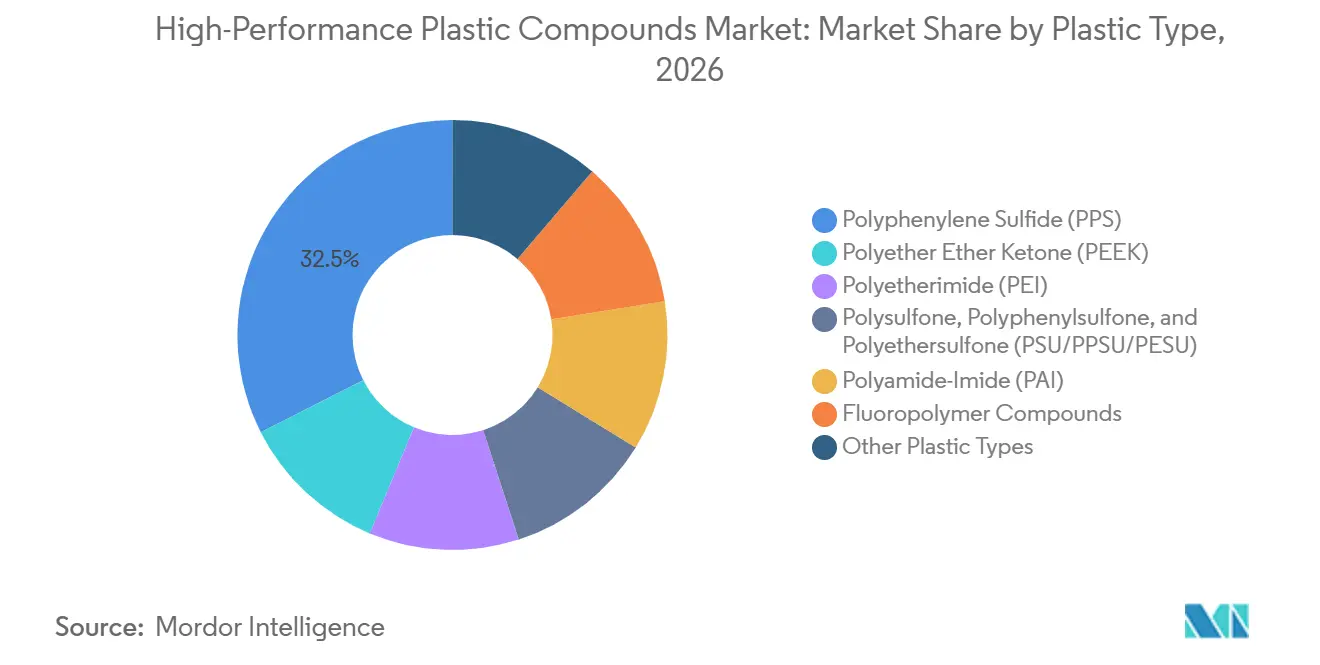
Polyphenylene Sulfide (PPS) Leads, While Polyether Ether Ketone (PEEK) ExpandsPolyphenylene sulfide (PPS) held 32.46% of the high-performance plastic compounds market share in 2026, supported by established use in fuel-system components, electrical connectors, and industrial pump housings. The material combines heat resistance above 200 °C, chemical resistance, and injection-molding capability for demanding parts. It remains relevant to electric vehicle assemblies and high-frequency electronics housings where dimensional control matters. Polyetherimide serves another part of the plastic type range because its transparency, biocompatibility, and autoclave durability support reusable surgical instruments and avionics housings. Polysulfone, polyphenylsulfone, and polyethersulfone serve filtration, food-contact, and sterilization equipment applications that require hydrolytic stability. Fluoropolymer compounds and polyamide-imide remain specialized materials for chemical processing, semiconductor wet processing, compressors, and industrial equipment.
Polyether ether ketone (PEEK) is projected to advance at a 10.45% CAGR through 2032. Aerospace structural components and implant-grade medical devices are broadening the list of applications that specify this material. The plastic type mix is moving toward higher-performing materials as some applications that used polyphenylene sulfide evaluate polyether ether ketone. Other users are evaluating polyaryletherketone hybrids that offer lower melt temperatures and wider processing windows. Evonik Industries AG launched VESTAKEEP Easy Slide 2 in April 2026 for high-temperature, high-pressure slide bearings. The material was formulated without intentionally added fluoropolymers, which responds to scrutiny of perfluoroalkyl and polyfluoroalkyl substances in relevant applications. The high-performance plastic compounds industry uses this kind of formulation development to address both application requirements and changing regulatory attention. Suppliers must still balance material performance with processing requirements and the cost of qualification. Material selection also depends on the ability to validate consistent performance through a customer’s manufacturing process.

By Additive Type:
Carbon Fiber Builds Demand in High-Value UsesGlass fiber held 46.13% of the additive type segment in 2026, reflecting its cost-performance balance in automotive and industrial applications. Its tensile strength of 2,400 MPa and material economics of USD 2.50 per kilogram support its use in high-volume injection-molded parts. The additive improves structural performance where cost-per-part considerations affect material selection. Mineral-filled grades provide dimensional stability and isotropic thermal conductivity for electronics housings and connectors. The high-performance plastic compounds market uses these grades where directional fiber reinforcement could affect part geometry. RTP Company and Ensinger are among specialty compounders that combine glass fiber and mineral fillers in hybrid formulations for customer-specific requirements. Such combinations address coefficient of thermal expansion management while retaining structural performance. The broad use of glass fiber also provides a base for the high-performance plastic compounds market across mass-volume applications.
Carbon fiber is projected to advance at a 10.66% CAGR through 2032, supported by aerospace production, structural battery enclosures, and robotics applications. The reinforcement offers high specific stiffness for parts where weight reduction has a larger value than the cost premium. This makes it more suitable for applications that require high mechanical performance and lower mass. The high-performance plastic compounds market benefits when aerospace and defense programs specify fiber-reinforced specialty compounds rather than metal components. Carbon fiber also supports premium electric vehicle designs that use structural battery enclosures. The choice between glass fiber and carbon fiber remains dependent on part cost, target performance, and manufacturing conditions. Additive selection can therefore change the economics of the finished compound even when the base resin remains the same. Suppliers that control formulation, processing, and customer testing can support these application-specific decisions. Application testing remains important before a reinforcement system is established in a customer design.
By End-Use Industry:
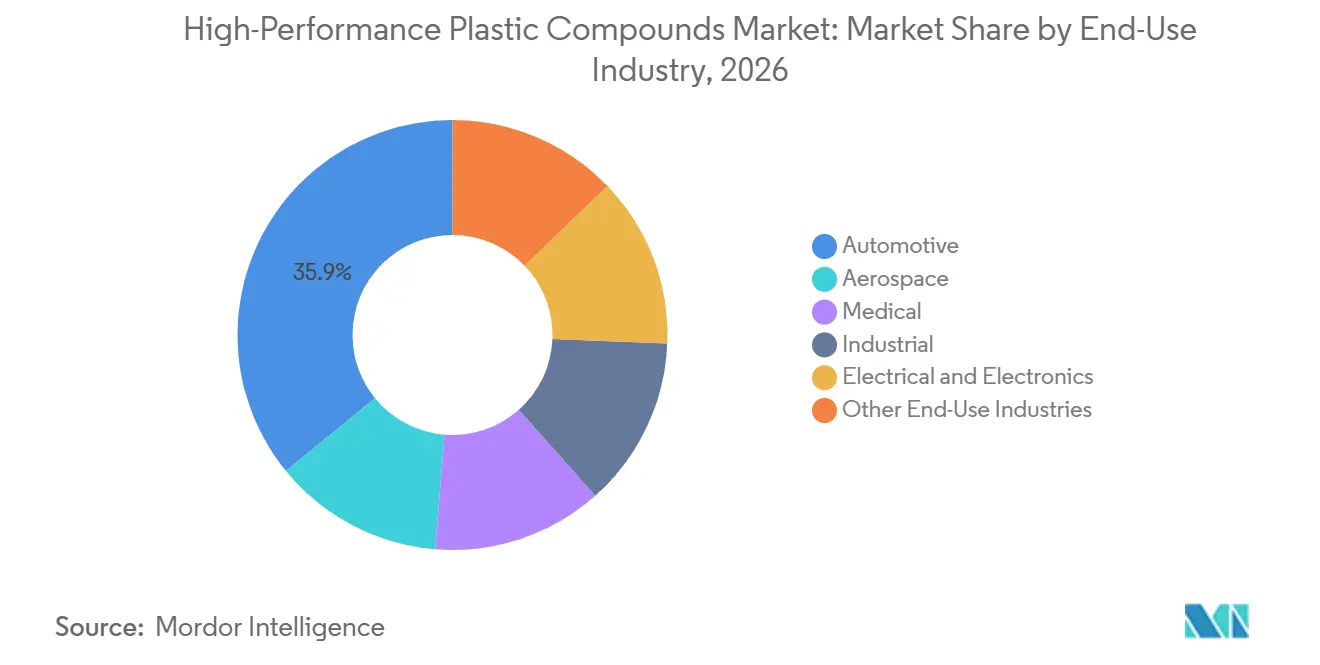
Aerospace Outpaces Automotive GrowthAutomotive held 35.91% of the end-use industry segment in 2026. Electric vehicle systems require thermally stable and electrically robust materials for battery management systems, motor housings, and 800 V connectors. These uses offset part of the decline in conventional internal combustion engine applications. Automotive customers also need materials that can meet flame resistance, dimensional stability, and manufacturing requirements at scale. The high-performance plastic compounds market size in automotive benefits from the need to replace metal and lower-performance polymers in selected electric vehicle components. BASF developed Ultramid Advanced N3U42G6 for high-voltage connectors used in inverters and direct current to direct current converters. The grade provides UL 94 V-0 performance at a 0.25 mm wall thickness and has a heat distortion temperature of 265 °C. Automotive demand remains linked to vehicle electrification plans and the materials approved by Tier 1 suppliers.
Aerospace is projected to advance at an 11.13% CAGR through 2032. Aircraft production backlogs, defense programs, and satellite platforms require qualified thermoplastic composites for brackets, thermal protection, and electrical insulation. Syensqo announced in July 2026 that it would supply advanced composites, adhesives, and specialty polymers for structural components in the U.S. Army MV-75 Cheyenne rotorcraft program. TORAY INDUSTRIES, INC. completed the National Center for Advanced Materials Performance qualification for Cetex TC1225 in December 2025, which can reduce aerospace certification time and cost. Medical applications command high per-kilogram prices because of biocompatibility, traceability, and implant qualification requirements. Industrial, electrical, and electronics users create a demand base through pump housings, valve bodies, relays, connectors, and circuit board components. Specialty compounds also support consumer electronics where compact structural components need precise performance.
Geography Analysis
APAC High-Performance Plastic Compounds Market
Asia-Pacific held 50.57% of the high-performance plastic compounds market size in 2026 and is projected to advance at a 10.84% CAGR through 2032. China anchors regional demand through its integrated polymer, electronics, electric vehicle, fifth-generation network, and semiconductor manufacturing base. Automotive production, electronic components, and battery systems support demand for polyphenylene sulfide, polyetherimide, and fluoropolymer compounds. India is increasing its role through manufacturing programs and localized demand from automotive and appliance producers. ASEAN countries offer a diversification option as manufacturers seek to reduce single-country concentration in supply chains.
North America High-Performance Plastic Compounds Market
North America is a key region for aerospace-grade and medical-grade materials, where Federal Aviation Administration certification and Food and Drug Administration frameworks create barriers to entry. U.S. defense procurement for rotorcraft, hypersonic platforms, and satellite systems provides demand that is less linked to commodity pricing cycles. Arkema completed a USD 20 million, 15% polyvinylidene fluoride capacity expansion at Calvert City, Kentucky, in June 2026. The capacity is intended to serve lithium-ion batteries, data center cable, and semiconductor markets in North America. Mexico also supports demand through its position in North American automotive supply chains and its production links with regional original equipment manufacturers.
EMEA and South America High-Performance Plastic Compounds Market
Europe has demand from premium automotive original equipment manufacturers, aerospace production in France and Germany, and medical device companies operating under European Union Medical Device Regulation 2017/745. BASF inaugurated its world-scale Verbund site in Zhanjiang, China, in March 2026 with total investment of EUR 8.7 billion (approximately USD 9.4 billion) supporting a local-for-local supply model for specialty materials. The high-performance plastic compounds market in Europe remains connected to regional research, application engineering, and premium material qualification despite production investments in Asia. South America, led by Brazil and Argentina, and Middle East and Africa have selective demand in automotive, industrial, and oil and gas applications that need chemical-resistant components.
Competitive Landscape
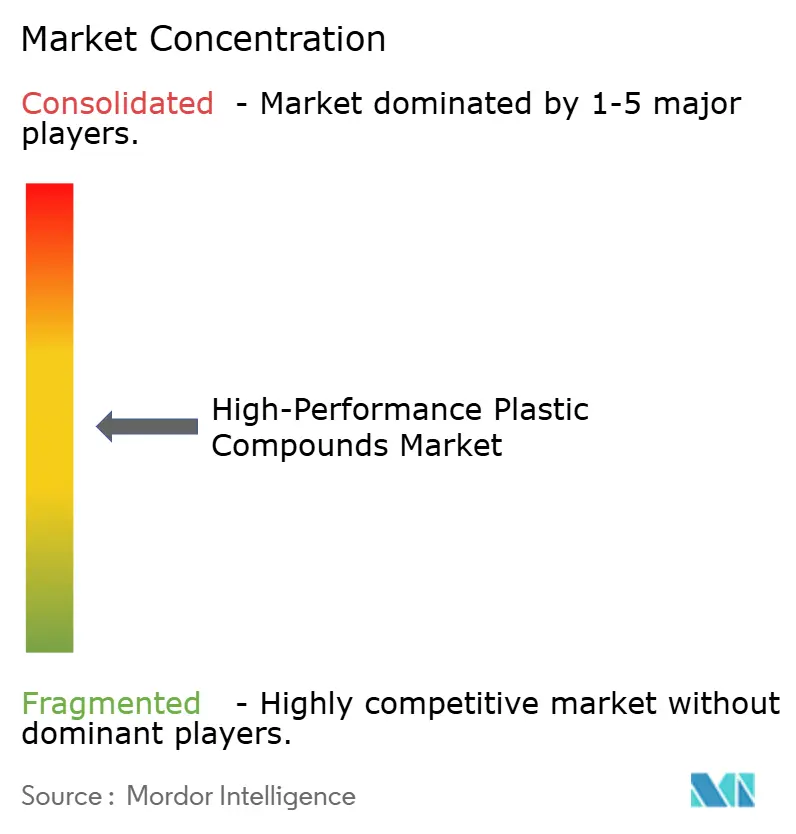
The high-performance plastic compounds market is moderately concentrated, with the top five players including BASF, Syensqo, SABIC, Victrex plc, and Celanese Corporation. Arkema, BASF, Celanese Corporation, DAIKIN INDUSTRIES, Ltd., Evonik Industries AG, Mitsubishi Chemical Group Corporation, SABIC, Syensqo, The Chemours Company, TORAY INDUSTRIES, INC., Tosoh Corporation, and Victrex plc have broad capabilities across specialty polymers or related material systems, while Ensinger, KURARAY PLASTICS CO.,Ltd., Polyplastics Co., Ltd., and RTP Company compete through specialized materials, compounding, and customer-specific support. Competitive strength depends on resin supply, formulation knowledge, global production, processing support, and the ability to help customers complete qualification. The high-performance plastic compounds market favors suppliers that become part of a specification before an original equipment manufacturer begins full production. Approved performance and technical service are therefore more important than resin price in many aerospace, medical, automotive, and electronics uses.
Victrex plc received industry recognition for its low-melt polyaryletherketone polymer in 2025 and a JEC Innovation Award in 2026 for thermoplastic wing-rib composites developed with Daher. The co-development approach can secure material specifications before production volumes are established, while Victrex plc has focused organic-growth investment at 5% to 8% of annual revenue. TORAY INDUSTRIES, INC. completed the National Center for Advanced Materials Performance qualification for Cetex TC1225 in December 2025 and made Federal Aviation Administration-accepted data available to the supply chain. This can lower the qualification burden for aerospace customers and expand adoption of the material. BASF has also developed a non-halogenated flame-retardant polyphthalamide grade for electric vehicle high-voltage connectors.
The high-performance plastic compounds market has an opportunity in recycled content, but no supplier has established a closed-loop route for qualification-grade polyether ether ketone or polyphenylene sulfide that meets aerospace or medical requalification requirements. Ensinger and RTP Company can compete through custom formulations and faster support for low-volume programs, which can have high margins because customers need narrowly specified materials. Emerging Chinese producers are increasing polyether ether ketone production and seeking distribution relationships in Western markets, which can place price pressure on standard grades. Suppliers are using formulation tools, digital simulation, and process analysis to shorten the path from material selection to production approval. Competition will remain shaped by qualification status, technical support, production capacity, and the breadth of each supplier’s material portfolio.
High-Performance Plastic Compounds Industry Leaders
-
BASF
-
Syensqo
-
SABIC
-
Victrex plc
-
Celanese Corporation
- *Disclaimer: Major Players sorted in no particular order
High-Performance Plastic Compounds Market Companies Covered in this Report
- Arkema
- BASF
- Celanese Corporation
- DAIKIN INDUSTRIES, Ltd.
- Ensinger
- Evonik Industries AG
- KURARAY PLASTICS CO.,Ltd.
- Mitsubishi Chemical Group Corporation
- Polyplastics Co., Ltd.
- RTP Company
- SABIC
- Syensqo
- The Chemours Company
- TORAY INDUSTRIES, INC.
- Tosoh Corporation
- Victrex plc
Recent Industry Developments in High-Performance Plastic Compounds Market
- September 2026: Asahi Kasei Corporation introduced development-grade LEONA polyamide resin featuring per- and polyfluoroalkyl substances (PFAS)-free, low-friction and flame-retardant properties. These material advancements support the high-performance plastic compounds market by addressing demanding performance requirements in engineered plastic components.
- April 2026: Teknor Apex Company and DCM Shriram established a joint venture under the PolyTek brand to develop advanced polymer compounds, combining Shriram Polytech’s vinyl-compounding capabilities with Teknor Apex’s formulation expertise. The partnership supports the high-performance plastic compounds market by expanding specialty-compound development and manufacturing capabilities in India.
Global High-Performance Plastic Compounds Market Report Scope
High-performance plastic compounds are engineered polymer formulations designed to deliver enhanced mechanical strength, thermal stability, chemical resistance, and dimensional performance under demanding operating conditions. They combine specialized polymers with reinforcing or functional additives to meet the requirements of advanced industrial and technical applications.
The High-Performance Plastic Compounds Market is segmented by plastic type, additive type, end-use industry, and geography. By plastic type, the market is segmented into polyphenylene sulfide (PPS), polyether ether ketone (PEEK), polyetherimide (PEI), polysulfone, polyphenylsulfone, and polyethersulfone (PSU/PPSU/PESU), fluoropolymer compounds, polyamide-imide (PAI), and other plastic types. By additive type, the market is segmented into glass fiber, carbon fiber, mineral filled, and other additive types. By end-use industry, the market is segmented into automotive, aerospace, medical, industrial, electrical and electronics, and other end-use industries. The report also covers the market size and forecasts for high-performance plastic compounds across 15 countries. For each segment, the market sizing and forecasts have been done on the basis of value (USD).
Segmentation Overview
| Polyphenylene Sulfide (PPS) |
| Polyether Ether Ketone (PEEK) |
| Polyetherimide (PEI) |
| Polysulfone, Polyphenylsulfone, and Polyethersulfone (PSU/PPSU/PESU) |
| Fluoropolymer Compounds |
| Polyamide-Imide (PAI) |
| Other Plastic Types |
| Glass Fiber |
| Carbon Fiber |
| Mineral Filled |
| Other Additive Types |
| Automotive |
| Aerospace |
| Medical |
| Industrial |
| Electrical and Electronics |
| Other End-Use Industries |
| Asia-Pacific | China |
| India | |
| Japan | |
| South Korea | |
| ASEAN Countries | |
| Rest of Asia-Pacific | |
| North America | United States |
| Canada | |
| Mexico | |
| Europe | Germany |
| United Kingdom | |
| France | |
| Italy | |
| NORDIC Countries | |
| Rest of Europe | |
| South America | Brazil |
| Argentina | |
| Rest of South America | |
| Middle East and Africa | Saudi Arabia |
| South Africa | |
| Rest of Middle East and Africa |
| By Plastic Type | Polyphenylene Sulfide (PPS) | |
| Polyether Ether Ketone (PEEK) | ||
| Polyetherimide (PEI) | ||
| Polysulfone, Polyphenylsulfone, and Polyethersulfone (PSU/PPSU/PESU) | ||
| Fluoropolymer Compounds | ||
| Polyamide-Imide (PAI) | ||
| Other Plastic Types | ||
| By Additive Type | Glass Fiber | |
| Carbon Fiber | ||
| Mineral Filled | ||
| Other Additive Types | ||
| By End-Use Industry | Automotive | |
| Aerospace | ||
| Medical | ||
| Industrial | ||
| Electrical and Electronics | ||
| Other End-Use Industries | ||
| By Geography | Asia-Pacific | China |
| India | ||
| Japan | ||
| South Korea | ||
| ASEAN Countries | ||
| Rest of Asia-Pacific | ||
| North America | United States | |
| Canada | ||
| Mexico | ||
| Europe | Germany | |
| United Kingdom | ||
| France | ||
| Italy | ||
| NORDIC Countries | ||
| Rest of Europe | ||
| South America | Brazil | |
| Argentina | ||
| Rest of South America | ||
| Middle East and Africa | Saudi Arabia | |
| South Africa | ||
| Rest of Middle East and Africa | ||
Key Questions Answered in the Report
What is the size of the high-performance plastic compounds market?
The high-performance plastic compounds market size was valued at USD 10.10 billion in 2026 and is estimated to grow from USD 11.01 billion in 2027 to reach USD 17.07 billion by 2032, at a CAGR of 9.17% during the forecast period (2027-2032).
Which plastic type held the largest share in 2026?
Polyphenylene sulfide (PPS) led with a 32.46% share in 2026, supported by automotive, electrical, and industrial uses.
Which additive type is projected to advance fastest through 2032?
Carbon fiber is projected to advance at a 10.66% CAGR through 2032 as aerospace, premium electric vehicles, and robotics require high stiffness with lower weight.
Why are electric vehicles important to demand?
Battery systems, high-voltage connectors, inverters, and motor housings require materials that retain electrical and thermal performance under demanding conditions.