
Polyphenylene Ether (PPE) Market Size and Share
Market Overview
| Study Period | 2021 - 2031 |
|---|---|
| Market Size (2026) | USD 3.27 Billion |
| Market Size (2031) | USD 4.08 Billion |
| Growth Rate (2026 - 2031) | 4.51 % |
| Fastest Growing Market | Asia-Pacific |
| Largest Market | Asia-Pacific |
| Market Concentration | Medium |
Major Players *Disclaimer: Major Players sorted in no particular order Image © Mordor Intelligence. Reuse requires attribution under CC BY 4.0. | |
Polyphenylene Ether (PPE) Market Analysis by Mordor Intelligence
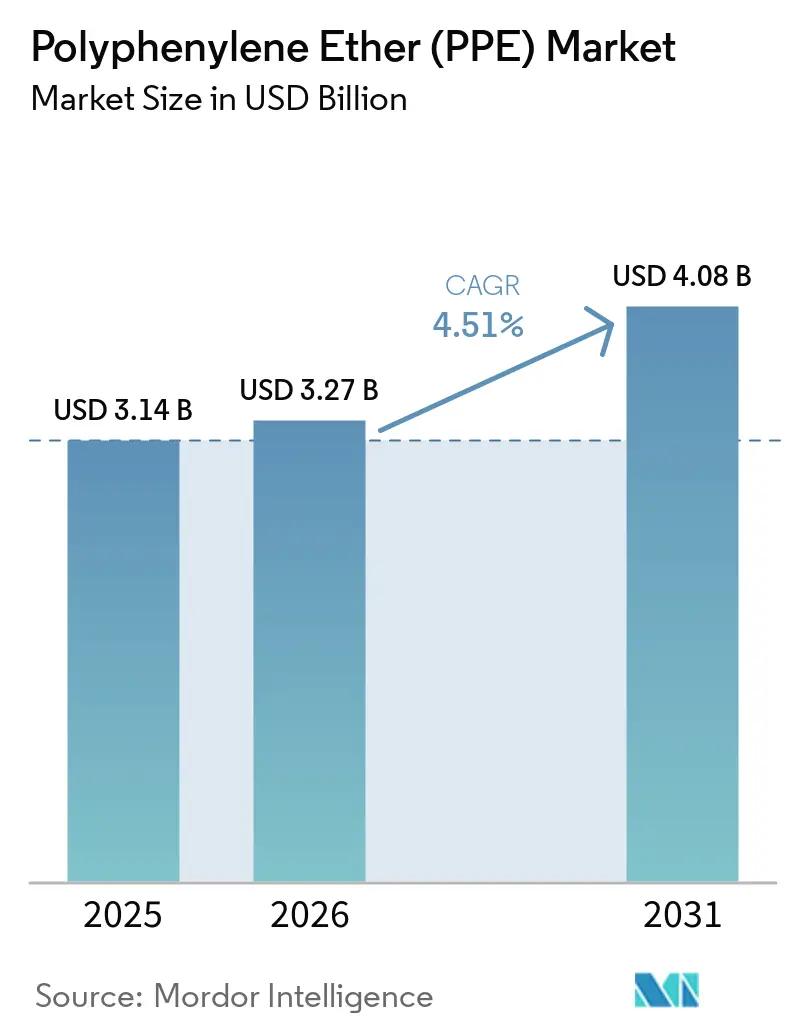
The global Polyphenylene Ether (PPE) market size is projected to expand from USD 3.14 billion in 2025 and USD 3.27 billion in 2026 to USD 4.08 billion by 2031, at a CAGR of 4.51% between 2026 and 2031. The Polyphenylene Ether (PPE) market is supported by growing electric vehicle production, high-frequency electronics, data-center equipment, and 5G communications. These end uses value low dielectric loss, dimensional stability, flame resistance, and low weight. Suppliers are directing development toward grades that meet electrical, thermal, and processing requirements in these applications. Capacity additions for low-loss oligomers and new conductive blends show that producers are preparing for demand from server boards and electric vehicle components[1]SABIC, “SABIC Expands PPE Oligomers Capacity for AI and 5G Data Center PCBs,” SABIC Official News, sabic.com . The Polyphenylene Ether (PPE) market also faces limits from concentrated feedstock supply, long qualification cycles, and competing engineering polymers.
Key Report Takeaways
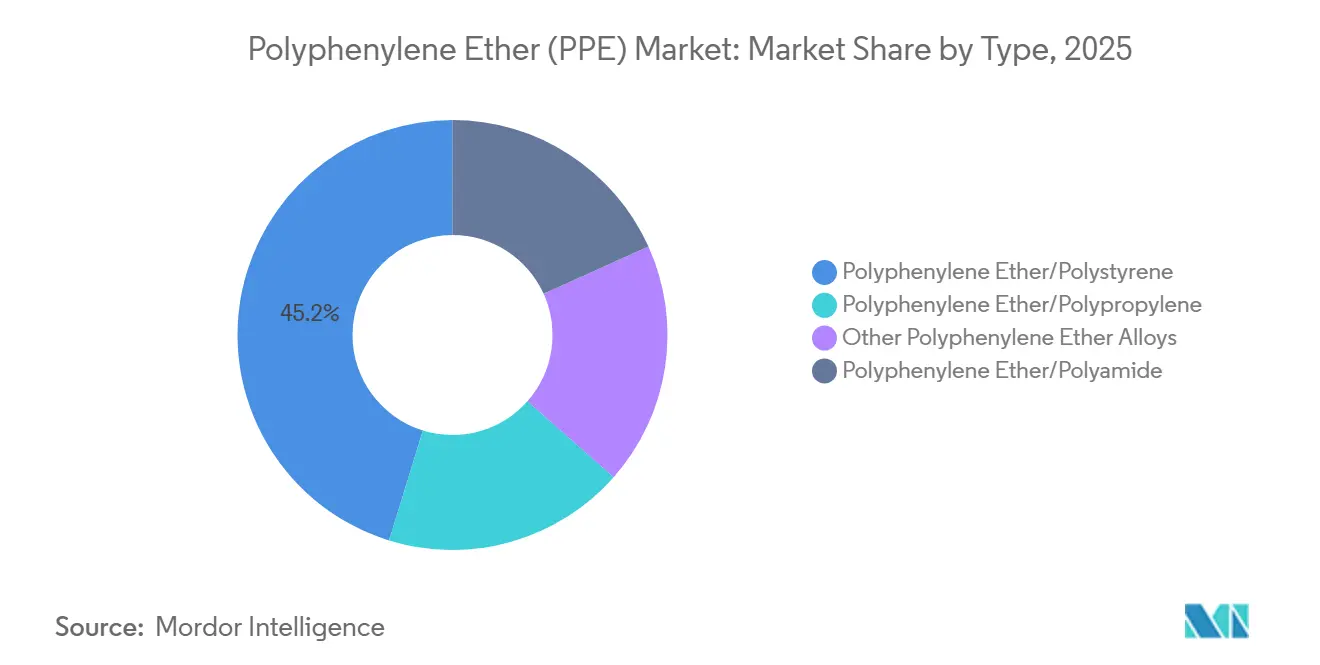
- By type, PPE/Polystyrene held 45.23% revenue share in 2025, while PPE/Polyamide is expected to record the highest projected CAGR at 5.87% through 2031.
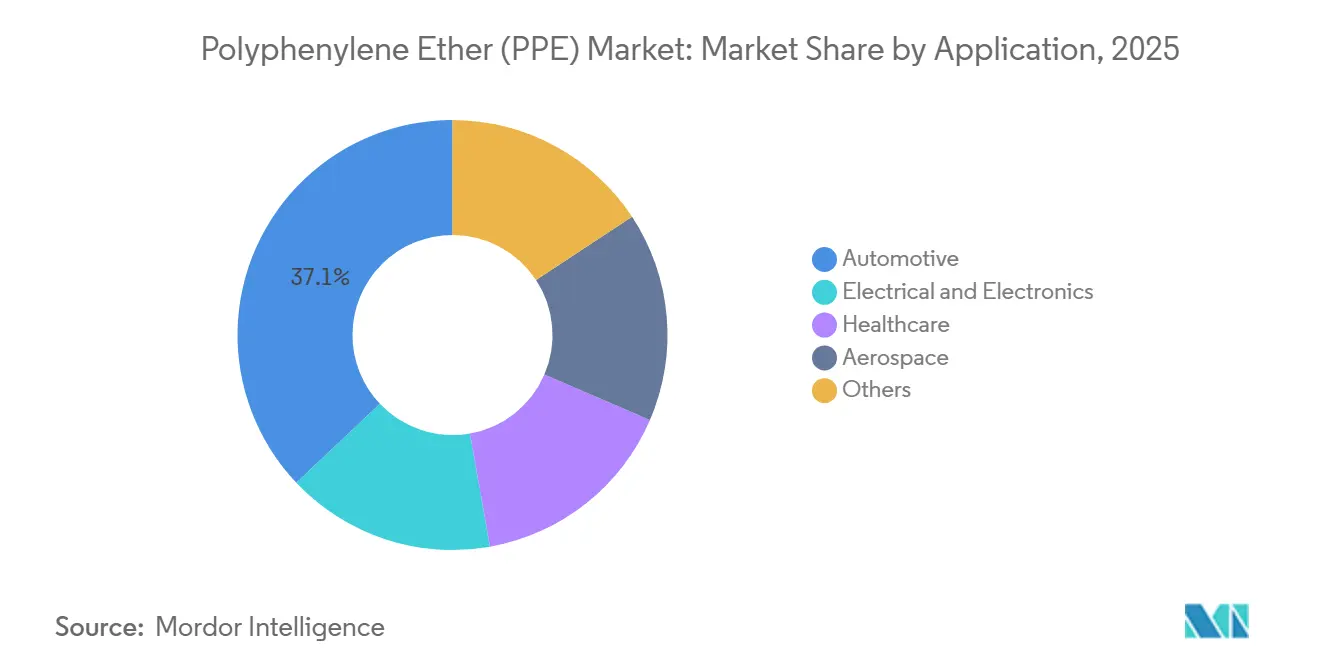
- By application, automotive held 37.06% of the Polyphenylene Ether (PPE) market share in 2025 and is expected to record the highest projected CAGR at 5.66% through 2031.
- By geography, Asia-Pacific accounted for 40.48% of the Polyphenylene Ether (PPE) market share in 2025 and is projected to grow at a 5.43% CAGR through 2031.
Note: Market size and forecast figures in this report are generated using Mordor Intelligence’s proprietary estimation framework, updated with the latest available data and insights as of January 2026.
Global Polyphenylene Ether (PPE) Market Trends and Insights
Drivers Impact Analysis*
| Driver | (~) % Impact on CAGR Forecast | Geographic Relevance | Impact Timeline |
|---|---|---|---|
| Automotive Lightweighting and EV Battery Safety | +1.2% | Global, concentrated in China, Germany, and the United States | Short term (≤ 2 years) |
| Electronics Miniaturization and High-Frequency Connectivity | +1.0% | Asia-Pacific core, with demand in North America and Europe | Medium term (2-4 years) |
| Data-Center Power and Thermal-Management Build-Out | +0.8% | North America, Asia-Pacific, and Europe | Medium term (2-4 years) |
| Halogen-Free Flame-Retardant and Low-Dielectric Grade Adoption | +0.6% | Global, with regulatory pressure in Europe and Japan | Long term (≥ 4 years) |
| Qualification-Ready Local Compounding | +0.4% | Asia-Pacific and the Mexico-North America corridor | Medium term (2-4 years) |
| Source: Mordor Intelligence | |||
Automotive Lightweighting and EV Battery Safety Requirements
Electric vehicle safety requirements are expanding the set of parts that can use PPE-based materials. Battery cell holders, busbar insulators, module covers, and charge-port housings add applications that internal-combustion vehicles did not require. PPE composites can reduce battery module housing mass by up to 35% against aluminum equivalents while providing UL 94 V-0 flame performance without halogen additives. This combination supports vehicle weight reduction while addressing battery-proximal safety needs. The Polyphenylene Ether (PPE) market benefits when vehicle programs specify materials that combine electrical insulation, dimensional stability, and flame performance. The need to validate each grade for vehicle production can still delay broader adoption.
SABIC launched Noryl GTX LMX310 in February 2025 for EV service flaps and other inline-painted exterior parts. The conductive PPE/Polyamide blend showed 85% lower equilibrium moisture absorption than incumbent polyamide grades. SABIC also reported up to 90% lower warpage risk for the material. These properties address exterior components where moisture uptake and finishing quality affect part performance. Validation activity for service flaps, camera housings, and door handles points to a wider role for PPE/Polyamide beyond conventional structural uses. The Polyphenylene Ether (PPE) market is therefore gaining demand from parts that need both an exterior finish and engineering performance.
Electronics Miniaturization and High-Frequency Connectivity
High-frequency connectivity is increasing demand for materials with stable dielectric properties. PPE has a dielectric constant of 2.55-2.65 and a dissipation factor of 0.0008-0.002 at 10 GHz in the supplied technical evidence. These properties support use in high-frequency copper-clad laminates, antennas, radar housings, and related electrical parts. The Polyphenylene Ether (PPE) market is linked to the growing number of small cells, antenna elements, and distributed network nodes. Each of these systems requires precisely molded parts and reliable signal performance. Standard qualification processes remain important because electrical specifications continue to evolve.
Research published in 2024 found that bismaleimide-crosslinked PPE formulations retained low dielectric properties above 100 GHz after 85°C and 85% relative-humidity testing. The findings support the technical basis for future ultra-high-frequency substrate applications. Asahi Kasei positions its XYRON and SunForce foamed PPE products for 5G antenna substrates and dielectric phase shifters. Foaming can further reduce the effective dielectric constant of the material. These developments give the Polyphenylene Ether (PPE) market a role in designs that require low-loss performance without a major change in laminate production methods. Product selection will depend on the balance between dielectric targets, part geometry, and manufacturing requirements.
Data-Center Power and Thermal-Management Build-Out
AI computing has increased the need for server hardware, printed circuit boards, and power-management equipment. Global data-center electricity consumption reached 415 TWh in 2024 and is projected to approach 945 TWh by 2030 [2]International Energy Agency, “Electricity 2025,” International Energy Agency, iea.org . High-layer-count AI server boards use low-molecular-weight PPE oligomers in thermoset copper-clad laminate formulations. These formulations are intended to provide low dielectric loss at the production scale. The Polyphenylene Ether (PPE) market is exposed to this build-out through both circuit-board materials and supporting electrical components. Demand is most relevant where material performance is required at high operating density.
SABIC announced an incremental NORYL SA9000 PPE oligomer capacity expansion in November 2025, with completion targeted for the second half of 2026. The expansion was intended to maintain lead times for AI-server and 5G printed circuit board producers. Higher rack power densities are also driving liquid-cooling systems. Asahi Kasei identifies XYRON grades for power and cooling applications in AI data centers. Coolant pump housings, busway insulation covers, and blanking panels require a combination of hydrolysis resistance, flame performance, and low density. The Polyphenylene Ether (PPE) market can benefit where these functions are needed in the same component.
Halogen-Free Flame-Retardant and Low-Dielectric Grade Adoption
Electronics manufacturers increasingly need flame-retardant materials that also maintain low dielectric loss. This requirement creates demand for PPE grades that meet UL 94 V-0 requirements without halogen-based chemistry. A 2025 study reported that a DOPO-derived flame retardant in a PPE and hydrocarbon resin matrix supported flame resistance and low dielectric loss during thermal-oxidative aging. The result addresses a central formulation challenge for printed circuit board materials. The Polyphenylene Ether (PPE) market is affected by this work because high-frequency performance and compliance criteria must be achieved together. Producers that can balance these requirements may have an advantage in specialized grades.
The supplied research identifies RoHS and REACH requirements as factors that move material selection into the resin formulation stage. Phosphorus-based organophosphate ester systems are used for non-halogenated PPE and polystyrene printed circuit board compounds. Loadings above 15 parts per hundred can reduce mechanical properties by 10-15%, according to the cited study. This trade-off makes lower-loading flame-retardant approaches important for compounders. Japanese material producers and European laminate makers are qualifying halogen-free, low-loss grades against IPC-4101 requirements. The Polyphenylene Ether (PPE) market has an opportunity in applications where compliance and electrical performance are both purchasing criteria.
Restraints Impact Analysis*
| Restraint | (~) % Impact on CAGR Forecast | Geographic Relevance | Impact Timeline |
|---|---|---|---|
| 2,6-Xylenol and Phenol Feedstock Concentration | -0.6% | Global, with upstream risk in Asia and the Middle East | Short term (≤ 2 years) |
| High Qualification Costs and 18-24 Month Design-In Cycles | -0.4% | Global, most acute in North American and European automotive programs | Medium term (2-4 years) |
| Substitution by PEI, PEEK, LCP, PPS, PC/ABS, and Advanced Polyamides | -0.5% | Global | Long term (≥ 4 years) |
| Source: Mordor Intelligence | |||
2,6-Xylenol and Phenol Feedstock Concentration
PPE is produced from 2,6-dimethylphenol, also known as 2,6-xylenol. Phenol and methanol are key upstream inputs for this material chain. The supplier base is narrow because production relies on specialized alkylation and isomer-separation technologies. Raw materials accounted for 60-65% of total PPE production costs in 2025 in the supplied content. This cost structure limits the buffer available when feedstock prices rise. The Polyphenylene Ether (PPE) market remains exposed to price movements in crude oil and natural gas-linked inputs.
The supplied content also describes prior European feedstock constraints related to energy costs and logistics for cresylic acid streams. These conditions extended lead times and tightened quality specifications. Dual sourcing, regional safety stocks, and toll purification can reduce operational exposure. Holding 4-6 weeks of safety stock can also increase working-capital requirements. Smaller compounders may find these measures harder to absorb than integrated suppliers. The PPE sector must balance supply security against cost and inventory discipline.
High Qualification Costs and 18-24 Month Design-In Cycles
Automotive programs often require 18-24 months to qualify a new PPE grade. This duration shifts development spending toward improving materials that already have approvals. IEC 60695-2-12 glow-wire testing can require 12-18 months of certification before access to some electronics applications. These processes limit the speed at which formulators can respond to revised low-loss or low-dielectric specifications. The Polyphenylene Ether (PPE) market is consequently more favorable to suppliers that already have broad approval libraries. New entrants must fund testing before they can compete for many premium applications.
Tier-1 automotive suppliers also require closer process control during twin-screw compounding. The supplied content identifies continuous viscosity profiling and real-time rheology monitoring as added requirements. Technical residency programs can add USD millions to pre-launch expenditures when suppliers support thermal-runaway containment development at OEM sites. These costs strengthen the position of established suppliers with engineering resources and customer relationships. They can also discourage a large number of new grade introductions. The Polyphenylene Ether (PPE) market can therefore concentrate around suppliers with qualification experience even when application demand grows.
*Our forecasts treat driver/restraint impacts as directional, not additive. The impact forecasts reflect baseline growth, mix effects, and variable interactions.
Segment Analysis
By Type: PPE/Polyamide Is Advancing in Automotive Exterior Parts
PPE/Polystyrene held 45.23% of the Polyphenylene Ether (PPE) market size by type in 2025. Its established uses include automotive dashboards, speaker grilles, water-handling fittings, and consumer electronics enclosures. The blend combines low density, dimensional stability, and dielectric properties that have supported long qualification histories. It is also the basis for low-molecular-weight, bifunctional oligomer grades used in thermoset copper-clad laminate systems. SABIC expanded NORYL SA9000 oligomer capacity in 2025 to support AI-server multilayer laminate manufacturers. This activity supports continued demand for PPE/Polystyrene formats in electronics as well as established molded parts.
PPE/Polyamide is forecast to grow at a 5.87% CAGR through 2031, the fastest rate among type segments. The grade provides low moisture absorption, inline paintability, and UL 94 V-0 capability for EV components. SABIC’s Noryl GTX LMX310 product addresses service flaps, camera housings, and door handles that need an exterior finish. PPE/Polypropylene serves water treatment, plumbing infrastructure, and photovoltaic housing uses where lower density and chemical resistance are relevant. Other PPE alloys include thermoset oligomeric formulations that use bismaleimide, benzoxazine, or reactive flame-retardant systems. Bismaleimide-crosslinked PPE has shown stable dielectric properties above 100 GHz, supporting the technical case for future high-frequency substrates.



By Application: Automotive Combines the Largest Position With the Fastest Growth
Automotive accounted for 37.06% of global PPE demand in 2025 and is forecast to grow at a 5.66% CAGR through 2031. Battery-electric vehicles add cell holders, module covers, busbar insulators, and charge-port assemblies that conventional vehicle architectures did not require. These parts need flame resistance, dielectric strength, and dimensional stability during thermal cycling. PPE/Polyamide materials are particularly relevant where painted exterior finishes are also required. UL 94 V-0 at 1.6 mm remains a key qualification requirement for battery-proximal components. This combination of component growth and qualification requirements supports automotive demand in the Polyphenylene Ether (PPE) market.
Electrical and electronics is the second-largest application segment in the supplied material. Low dielectric loss supports use in 5G antenna dipoles, ADAS radar housings, and AI-server multilayer printed circuit boards. Kraton supplies SEBS grades including G1651, G1654, G1650, and G1701 for impact modification in PPE blends. These modifiers can improve toughness and weatherability in automotive exterior panels and cable jacket compounds. Healthcare uses include surgical instruments, drug-delivery housings, and hospital infrastructure components that benefit from steam-sterilization compatibility. Aerospace is the smallest application group and uses PPE in cabin interiors where flame resistance and low outgassing are relevant. Other applications include ultrafiltration membranes and photovoltaic junction-box housings.
Geography Analysis
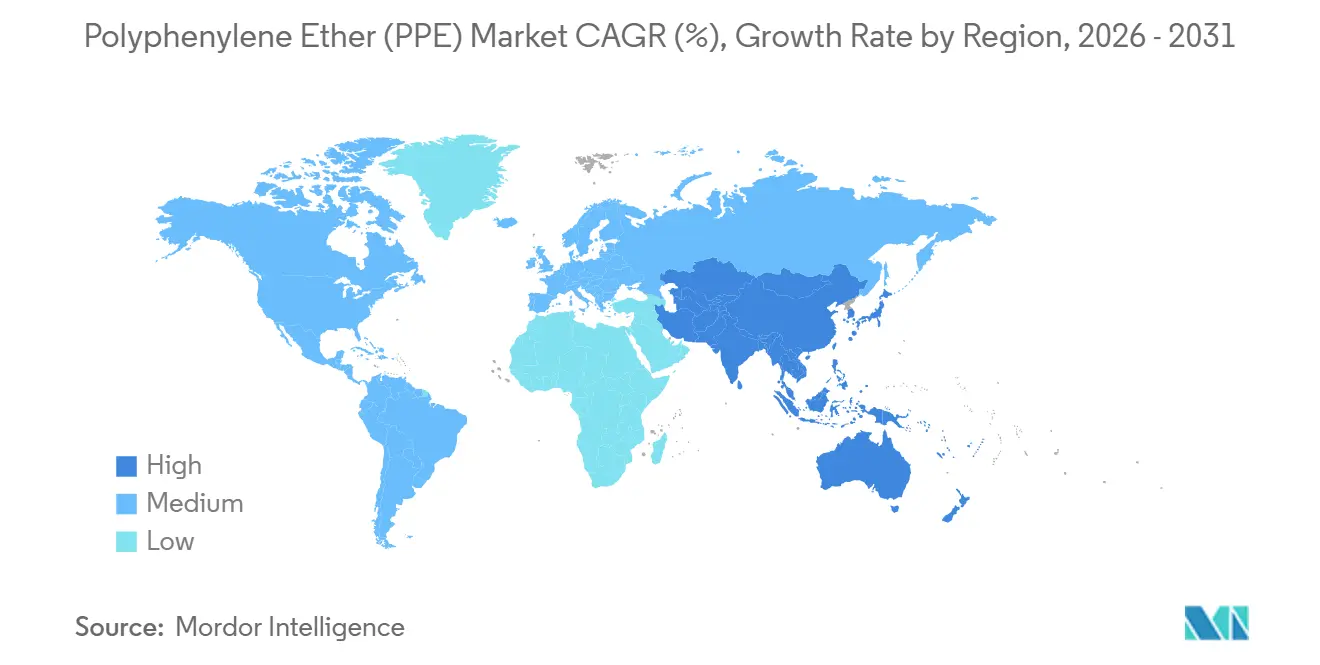
Asia Pacific held 40.48% of global PPE demand in 2025 and is projected to grow at a 5.43% CAGR through 2031. China is a major demand center because of new-energy vehicle production and electronics manufacturing. The supplied research states that China produced 12.8 million new-energy vehicles in 2025. Each EV can use more PPE alloy content than an internal-combustion vehicle because of battery and electrical components. South Korea supports demand through electronics supply chains serving PCB substrates, OLED module housings, and high-density connector assemblies. Japan remains important for material development and specialized compound production.
North America is the second-largest regional market in the supplied content. Automotive programs in Michigan, Ohio, and Tennessee support demand, along with data-center infrastructure in Virginia, Texas, and the Pacific Northwest. Compounding investment in Nuevo León, Chihuahua, and Baja California supports nearshore supply for automotive assembly plants. SABIC’s investments in oligomers and EV-focused Noryl GTX LMX grades address North American and European programs. Europe is supported by automotive suppliers and demand for ADAS radar housings, battery structures, and paintable exterior components. RoHS and REACH requirements also support qualification of halogen-free grades in European applications.
South America is a smaller Polyphenylene Ether (PPE) market centered on Brazil’s automotive assembly base. Vehicle producers in São Paulo and Minas Gerais use compounds in instrument panels, water-handling parts, and electronic housings. Argentina’s economic conditions have constrained manufacturing investment but have not removed demand from chemical and automotive users. The Middle East and Africa remain at an early stage of development for PPE consumption. South Africa’s automotive component clusters account for much of the regional use. Saudi Arabia has a potential feedstock advantage through local petrochemical infrastructure as industrial diversification supports engineering plastics production. Both regions still rely primarily on imports and are expected to build compounding capacity gradually.

Competitive Landscape
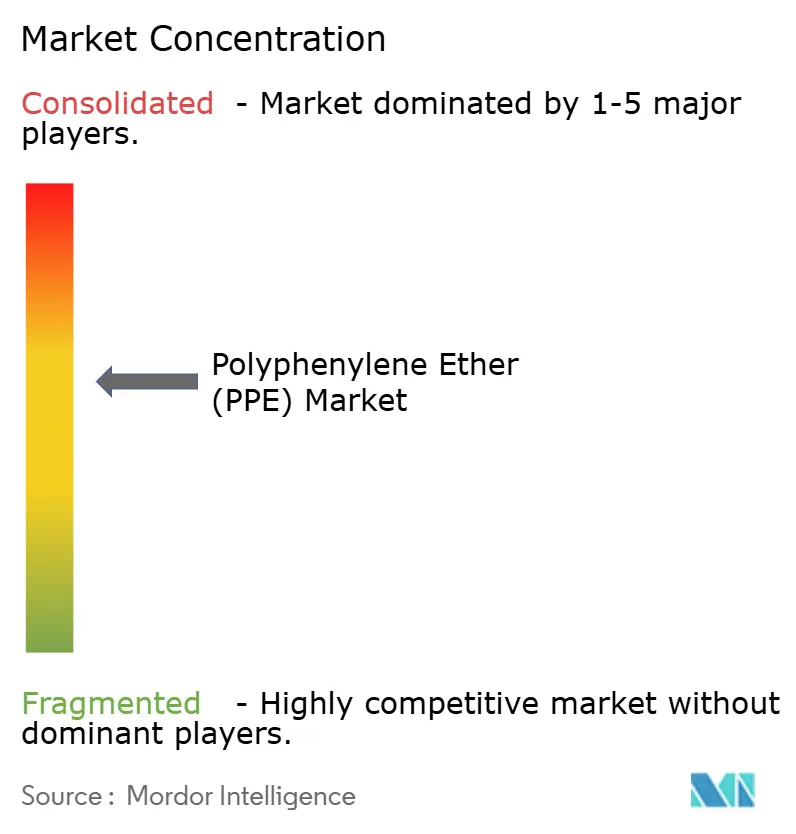
The Polyphenylene Ether (PPE) market is moderately concentrated. SABIC’s Noryl platform and Asahi Kasei’s Xyron platform hold leading positions in this part of the value chain. Global Polyacetal, LyondellBasell, ROMIRA, RTP Company, Ensinger, LG Chem, and Kingfa compete in automotive and industrial applications. Competitive strength depends on product performance, OEM approvals, processing support, and technical development. SABIC expanded NORYL SA9000 oligomer capacity in November 2025 for AI and 5G data-center printed circuit boards. This move supports supply availability for customers who need low-loss thermoset-compatible materials.
Asahi Kasei markets XYRON materials for 5G base stations, including antenna substrates and dielectric phase shifters. It also identifies engineering plastics for AI data-center power and cooling components. SABIC’s February 2025 Noryl GTX LMX310 launch targeted conductive, inline-painted EV exterior components. These examples show a focus on applications where existing material approvals and specialized formulation knowledge matter. Mid-sized compounders can compete through custom development, regional service, and faster project cycles. The PPE sector is therefore competitive across applications even though electronic-grade resin supply has a small group of leaders.
Opportunities remain in healthcare precision parts, aerospace interior formulations, and regional compounding hubs in India, Southeast Asia, and Mexico. These areas require application knowledge and customer qualification support rather than volume alone. Kingfa and other Chinese compounders are pursuing electronic-grade PPE qualification in the supplied content. RTP Company serves regional applications through custom development cycles of 4-6 weeks. This capability can be useful where time to market is more important than using an established high-volume grade. Large producers retain an advantage where customers require extensive approval records and broad technical support.
Polyphenylene Ether (PPE) Industry Leaders
SABIC
Asahi Kasei Corporation
Global Polyacetal Co., Ltd.
BASF
RTP Company
- *Disclaimer: Major Players sorted in no particular order

Recent Industry Developments
- March 2026: Asahi Kasei received publication of patent CN116867835B disclosing a thermosetting PPE composition with improved solubility in general-purpose ketone solvents, enabling better integration with thermoset CCL systems used in high-layer-count AI-server PCBs. The patent directly addresses the technical bottleneck of standard PPE's solubility limitations in production-grade laminate processing solvents, signaling continued investment in thermoset-PPE for AI infrastructure applications.
- December 2025: SABIC announced an incremental production capacity expansion for NORYL SA9000 PPE oligomers, targeting completion in the second half of 2026, to maintain fast lead times for AI-server and 5G base-station PCB manufacturers as demand for high-performance multilayer copper-clad laminates accelerated beyond existing capacity utilization. The expansion builds on earlier capacity increases executed in Asia.


Global Polyphenylene Ether (PPE) Market Report Scope
Polyphenylene ether (PPE), also known as polyphenylene oxide (PPO), is a high-performance engineering thermoplastic valued for its exceptional heat resistance and dimensional stability.
The PPE market is segmented by type, application, and geography. By type, the market is segmented into polyphenylene ether/polystyrene, polyphenylene ether/polyamide, polyphenylene ether/polypropylene, and other polyphenylene ether alloys. By application, the market is segmented into automotive, electrical and electronics, healthcare, aerospace, and others. By geography, the market is segmented into Asia Pacific, North America, Europe, South America, and the Middle East and Africa. The report also covers the PPE market size and forecasts for the PPE market in 15 countries across major regions. For each segment, the market sizing and forecasts have been done on the basis of value (USD).
| Polyphenylene Ether/Polystyrene |
| Polyphenylene Ether/Polyamide |
| Polyphenylene Ether/Polypropylene |
| Other Polyphenylene Ether Alloys |
| Automotive |
| Electrical and Electronics |
| Healthcare |
| Aerospace |
| Others |
| Asia-Pacific | China |
| India | |
| Japan | |
| South Korea | |
| ASEAN Countries | |
| Rest of Asia-Pacific | |
| North America | United States |
| Canada | |
| Mexico | |
| Europe | Germany |
| United Kingdom | |
| France | |
| Italy | |
| NORDIC Countries | |
| Rest of Europe | |
| South America | Brazil |
| Argentina | |
| Rest of South America | |
| Middle East and Africa | Saudi Arabia |
| South Africa | |
| Rest of Middle East and Africa |
| By Type | Polyphenylene Ether/Polystyrene | |
| Polyphenylene Ether/Polyamide | ||
| Polyphenylene Ether/Polypropylene | ||
| Other Polyphenylene Ether Alloys | ||
| By Application | Automotive | |
| Electrical and Electronics | ||
| Healthcare | ||
| Aerospace | ||
| Others | ||
| By Geography | Asia-Pacific | China |
| India | ||
| Japan | ||
| South Korea | ||
| ASEAN Countries | ||
| Rest of Asia-Pacific | ||
| North America | United States | |
| Canada | ||
| Mexico | ||
| Europe | Germany | |
| United Kingdom | ||
| France | ||
| Italy | ||
| NORDIC Countries | ||
| Rest of Europe | ||
| South America | Brazil | |
| Argentina | ||
| Rest of South America | ||
| Middle East and Africa | Saudi Arabia | |
| South Africa | ||
| Rest of Middle East and Africa | ||


Key Questions Answered in the Report
What is the present and projected market size of the Polyphenylene Ether (PPE) market by 2031?
The Polyphenylene Ether (PPE) market is projected to reach USD 4.08 billion by 2031, from USD 3.27 billion in 2026, at a 4.51% CAGR. Demand is linked to electric vehicles, high-frequency electronics, AI data centers, and 5G equipment. Low-loss oligomers are especially relevant for advanced printed circuit board systems.
Which type is growing fastest through 2031?
PPE/Polyamide is the fastest-growing type segment, with a projected CAGR of 5.87% through 2031. Its low moisture absorption, paintability, and UL 94 V-0 performance support use in EV exterior and battery-related components. It is increasingly relevant for service flaps, door handles, and camera housings.
Which application leads demand for polyphenylene ether?
Automotive held 37.06% share in 2025 and is projected to grow at a 5.66% CAGR through 2031. Electric vehicle components add demand because battery-electric platforms use parts that are not present in internal-combustion vehicle architectures. This application also relies on extensive supplier qualification and testing.
Which region is expanding fastest for PPE?
Asia Pacific held 40.48% share in 2025 and is projected to expand at a 5.43% CAGR through 2031. China’s EV production and regional electronics supply chains support demand for specialized compounds and low-loss materials. South Korea and Japan also contribute through their electronics and materials manufacturing capabilities.
Page last updated on:





