
Plastic Resin Market Size and Share
Market Overview
| Study Period | 2021 - 2031 |
|---|---|
| Market Size (2026) | USD 0.82 Trillion |
| Market Size (2031) | USD 1 Trillion |
| Growth Rate (2026 - 2031) | 4.13 % |
| Fastest Growing Market | Asia-Pacific |
| Largest Market | Asia-Pacific |
| Market Concentration | Low |
Major Players *Disclaimer: Major Players sorted in no particular order Image © Mordor Intelligence. Reuse requires attribution under CC BY 4.0. | |
Plastic Resin Market Analysis by Mordor Intelligence
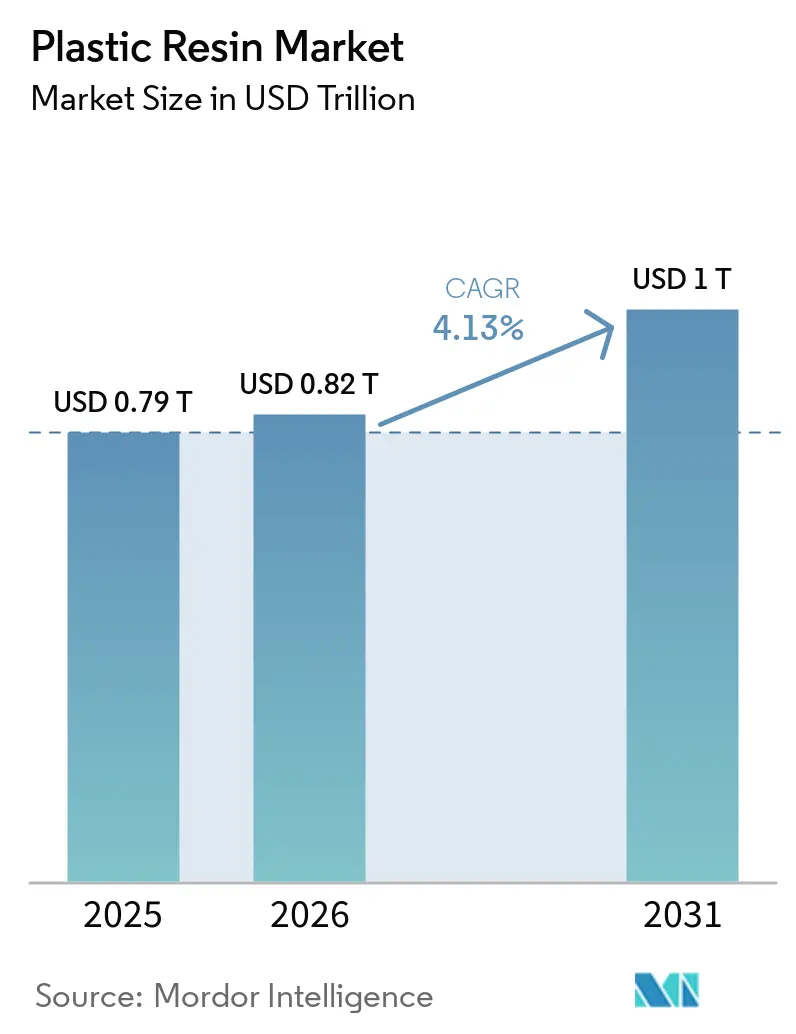
The Plastic Resin Market size was valued at USD 0.79 trillion in 2025 and is estimated to grow from USD 0.82 trillion in 2026 to reach USD 1 trillion by 2031, at a CAGR of 4.13% during the forecast period (2026-2031). Packaging demand remains central, as food safety requirements, e-commerce shipments, and consumer product distribution require films, bottles, closures, trays, and other resin-based formats. Producers are also responding to demand for lighter materials in electric vehicles, electronics, and medical products, where technical performance takes precedence over unit quantity. Recycled-content regulations are shifting purchasing decisions toward documented resin quality, reliable supply, and compliance with regional requirements. This favors suppliers that combine feedstock access, application support, and circular-material offerings. Cost fluctuations in crude oil, naphtha, and energy remain a material risk for producers that depend on naphtha-based cracking.
Key Report Takeaways
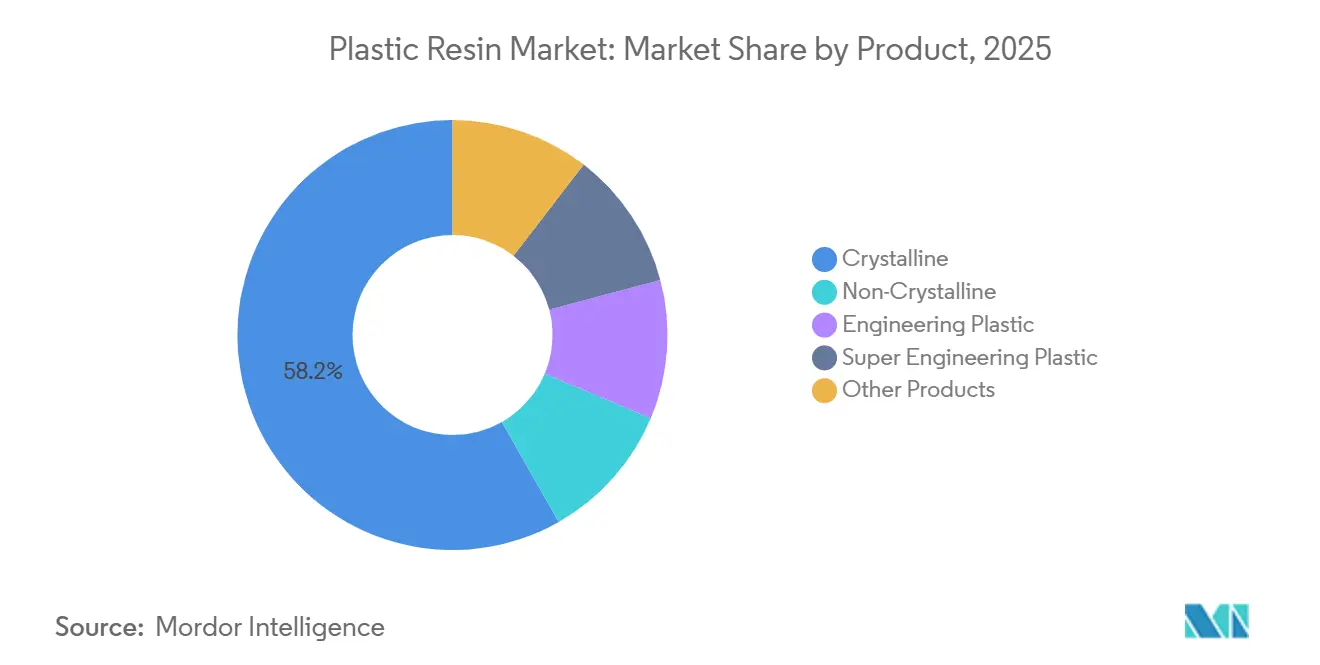
- By product, crystalline resins held 58.23% of the Plastic Resin Market share in 2025, while engineering plastics are forecast to grow at a 5.15% CAGR through 2031.
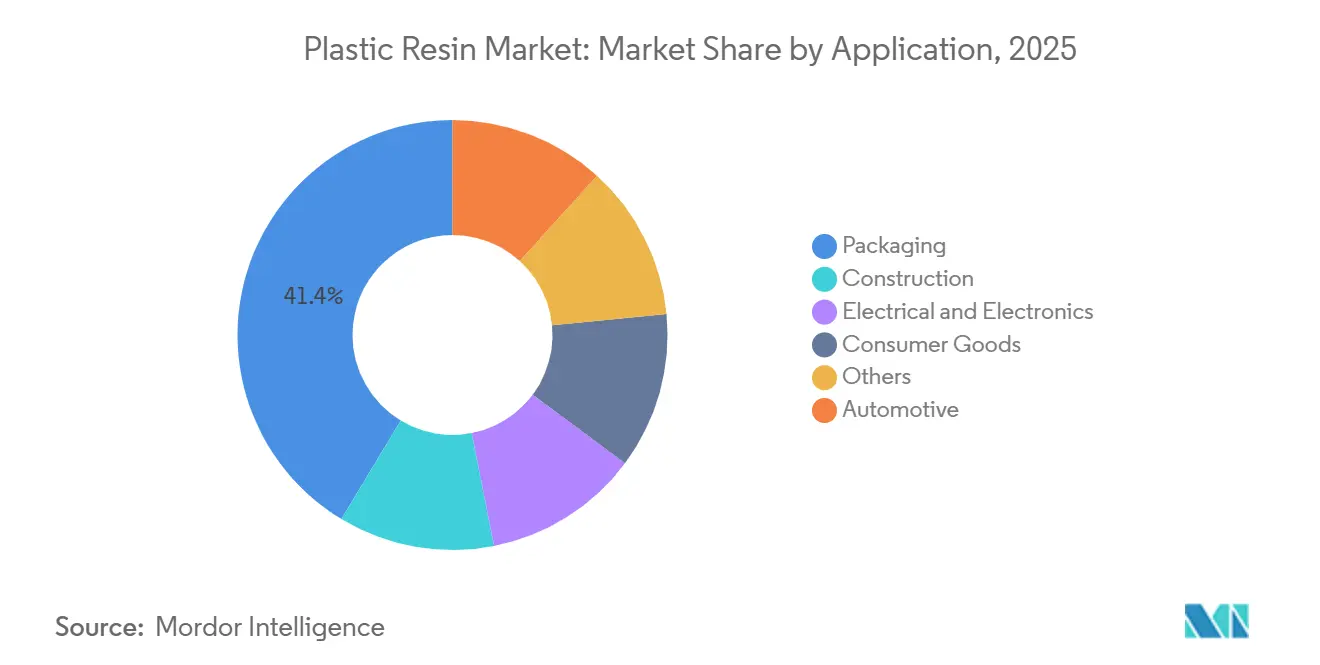
- By application, packaging accounted for 41.36% of the Plastic Resin Market share in 2025 and is forecast to grow at a 5.54% CAGR through 2031.
- By geography, Asia-Pacific held 22.17% of the Plastic Resin Market share in 2025 and is forecast to expand at a 5.06% CAGR through 2031.
Note: Market size and forecast figures in this report are generated using Mordor Intelligence’s proprietary estimation framework, updated with the latest available data and insights as of January 2026.
Global Plastic Resin Market Trends and Insights
Drivers Impact Analysis*
| Drivers | (~) % Impact on CAGR Forecast | Geographic Relevance | Impact Timeline |
|---|---|---|---|
| Packaging, Lightweighting, and Barrier-Performance Demand | +1.0% | Global, with the highest intensity in Europe and North America | Short term (≤ 2 years) |
| Electric Vehicle and Mobility Lightweighting | +0.8% | Asia-Pacific, with effects in Europe and North America | Medium term (2-4 years) |
| Recycled-Content Mandates and Circular-Resin Procurement | +0.7% | Europe, North America, Brazil, and India | Medium term (2-4 years) |
| Capacity Additions and Feedstock Integration | +0.6% | Asia-Pacific, with effects in the Middle East, Africa, and South America | Short term (≤ 2 years) |
| High-Performance Resin Demand in Electronics and Medical Devices | +0.5% | Asia-Pacific and North America | Long term (≥ 4 years) |
| Source: Mordor Intelligence | |||
Packaging, Lightweighting, and Barrier-Performance Demand
Packaging lightweighting has become both a compliance issue and a cost consideration for converters and brand owners. The European Union Packaging and Packaging Waste Regulation entered into force in February 2025 and applies from August 12, 2026. It requires packaging placed on the European Union market to be recyclable in an economically viable way by 2030[1]European Commission, “Packaging Waste,” European Commission, environment.ec.europa.eu.. Packaging designs are therefore moving toward thinner structures, mono-material formats, and resin combinations that retain barrier performance. These changes support demand for Ethylene Vinyl Alcohol (EVOH), Linear Low-Density Polyethylene (LLDPE), and maleic-anhydride-grafted tie-layer grades in applications that previously used more complex laminates. The plastic resin market is affected as supplier qualification increasingly depends on material performance and documentation of recyclability.
Electric Vehicle and Mobility Lightweighting
Battery electric vehicles use 15-25% more resin by weight than comparable internal-combustion platforms. Battery enclosures, power-electronics housings, and lightweight structural components are key sources of this additional demand. Global electric vehicle sales reached 22.7 million units in 2025, according to the International Energy Agency. China's 15.1 kWh per 100 km energy-efficiency requirement, effective in January 2026, supports the use of engineering polymers in vehicle systems. A 10% reduction in vehicle mass can improve driving range by 5-8%, strengthening the economic case for lighter components. Polypropylene and polyamide families accounted for 45-50% of automotive resin consumption by weight, while Polyphenylene Sulfide (PPS) and Polyether Ether Ketone (PEEK) served in smaller high-temperature applications.
Recycled-Content Mandates and Circular-Resin Procurement
Recycled-content requirements have moved from voluntary environmental commitments to legal obligations in several major jurisdictions. Maine requires 25% post-consumer recycled content in plastic beverage containers from January 1, 2026. New Jersey applies 10-20% requirements across selected rigid containers and carryout bags, while California AB 793 sets a 25% target for 2025. India's 2026 rules set rising recycled-content targets for packaging categories, reaching 60% for Category I by 2028-29. Brazil's October 2025 Decree No. 12,688 established minimum recycled-content requirements and reverse-logistics obligations for plastic packaging. These rules raise demand for certified recycled resins, but high-purity supply remains below the level required by regulated buyers.
High-Performance Resin Demand in Electronics and Medical Devices
Semiconductor miniaturization, 5G deployment, and medical device use are increasing demand for engineering and super-engineering polymers. Japan's advanced electronics and precision automotive base supports a shift toward higher-specification resin grades. Chinese producers are prioritizing capacity for PPS, PEEK, and liquid-crystal polymer in new-energy vehicles and semiconductor applications. The U.S. Food and Drug Administration's 510(k) process supports established pathways for PEEK applications in spinal, dental, and orthopedic devices. These applications require thermal stability, dielectric performance, and biocompatibility that commodity grades cannot consistently provide. The plastic resin market therefore offers a differentiated opportunity for suppliers with capabilities in application testing and regulatory support.
Restraints Impact Analysis*
| Restraints | (~) % Impact on CAGR Forecast | Geographic Relevance | Impact Timeline |
|---|---|---|---|
| Crude-Oil, Naphtha, and Energy-Cost Volatility | -0.5% | Global, with acute exposure in Asia-Pacific and Europe | Short term (≤ 2 years) |
| Single-Use-Plastic Restrictions and Virgin-Resin Demand Erosion | -0.4% | Europe, North America, and the Asia-Pacific | Medium term (2-4 years) |
| Recycled-Resin Quality, Availability, and Qualification Gaps | -0.2% | Global | Long term (≥ 4 years) |
| Source: Mordor Intelligence | |||
Crude-Oil, Naphtha, and Energy-Cost Volatility
Naphtha-dependent producers faced significant cost pressure during the Strait of Hormuz disruption in early 2026. Global naphtha export flows fell by 1.2 million barrels per day during this period. Asia's naphtha margin over Brent rose from USD 108 per ton to more than USD 400 per ton within four weeks. Polyethylene prices on the Dalian Commodity Exchange increased 37%, while polypropylene prices increased 38%, from late February to late March 2026. The U.S. Energy Information Administration placed Brent crude at USD 85 per barrel for the third quarter of 2026. As a result, the plastic resin market favors North American ethane-based producers for standard polyolefins when naphtha costs rise sharply.
Single-Use Plastic Restrictions and Virgin-Resin Demand Erosion
Single-use plastic restrictions are reducing demand for certain virgin resin grades, even as total packaging output continues to grow. PlasticsEurope reported a decline in Europe's fossil-based plastics production from 47.3 million tons in 2022 to 43.3 million tons in 2024[2]PlasticsEurope, “Circular Economy Report 2026, Dramatic Slowdown in Plastics Circularity,” PlasticsEurope, plasticseurope.org.. Circular plastics output increased during the same period, but its growth rate slowed materially compared to the previous four-year period. Virgin resin can become cheaper than recycled alternatives when crude oil trades below USD 55-60 per barrel. The U.S. PET recycling sector lost 25% of its capacity during 2025-2026, while imported recycled PET supplied 25% of the domestic market. The resulting gap between required recycled content and qualifying feedstock limits substitution and complicates planning for resin suppliers.
*Our forecasts treat driver/restraint impacts as directional, not additive. The impact forecasts reflect baseline growth, mix effects, and variable interactions.
Segment Analysis
By Product: Crystalline Grades Lead by Output, While Engineering Resins Show Faster Growth
Crystalline resins held 58.23% of the global plastic resin market share in 2025. Polyethylene, polypropylene, PET, and nylon support this position across packaging, textiles, and basic industrial applications. Their semi-crystalline structure offers processability, mechanical strength, chemical resistance, and cost efficiency for high-output converters. These materials remain difficult to replace where price-to-performance requirements are decisive. Non-crystalline resins, including polycarbonate, certain acrylonitrile butadiene styrene (ABS) grades, and polymethyl methacrylate (PMMA), address optical clarity and impact resistance needs. They continue to serve electronics and automotive glazing applications, though with a more limited output base.
Engineering plastics are projected to grow at a 5.15% CAGR through 2031. Electric vehicles, 5G hardware, and medical devices require heat resistance, dielectric stability, and, in some cases, certification for biocompatibility. Super-engineering plastics such as polyether ether ketone (PEEK) and polyphenylene sulfide (PPS) are used in aerospace, semiconductor test equipment, and high-temperature medical devices. Their output is small compared with commodity resins, but their unit values are substantially higher. BASF increased North American prices for Ultramid and Ultraform in June 2026, raising polyamide (PA) compounds by USD 0.14 per pound and polyoxymethylene (POM) products by USD 0.20 per pound. Chinese producers are targeting import substitution for PPS, PEEK, and specialty LCP grades used in new-energy vehicles and semiconductors.



By Application: Packaging Leads in Both Output and Growth
Packaging accounted for 41.36% of the plastic resin market size in 2025. Food and beverage, pharmaceutical, e-commerce, and personal-care channels use resin in films, bottles, closures, trays, and multilayer structures. No other application combines a comparable breadth of demand with such extensive conversion activity. The Packaging and Packaging Waste Regulation (PPWR) application date of August 12, 2026, has increased the need for documented recyclability in packaging supplied to the European Union. Brand owners and converters are rebuilding qualification packages as specifications become more stringent. These changes can shorten existing supply agreements and increase the value of technical support from resin suppliers.
Packaging is also expected to grow at a 5.54% CAGR through 2031, the highest growth rate among all applications in the plastic resin market. Urbanization, e-commerce logistics, and substitution away from glass and metal packaging support this expansion. Automotive demand is shifting toward higher-value materials as electric-vehicle platforms require more lightweight components. Construction uses PVC and PE pipes and polyurethane insulation foam, with demand linked to infrastructure investment. Electrical and electronics applications include antenna housings, circuit board substrates, and high-frequency connectors for 5G infrastructure. Consumer goods remain an important application, but their resin requirements face stronger regulatory pressure due to restrictions on certain plastic formats.
Geography Analysis
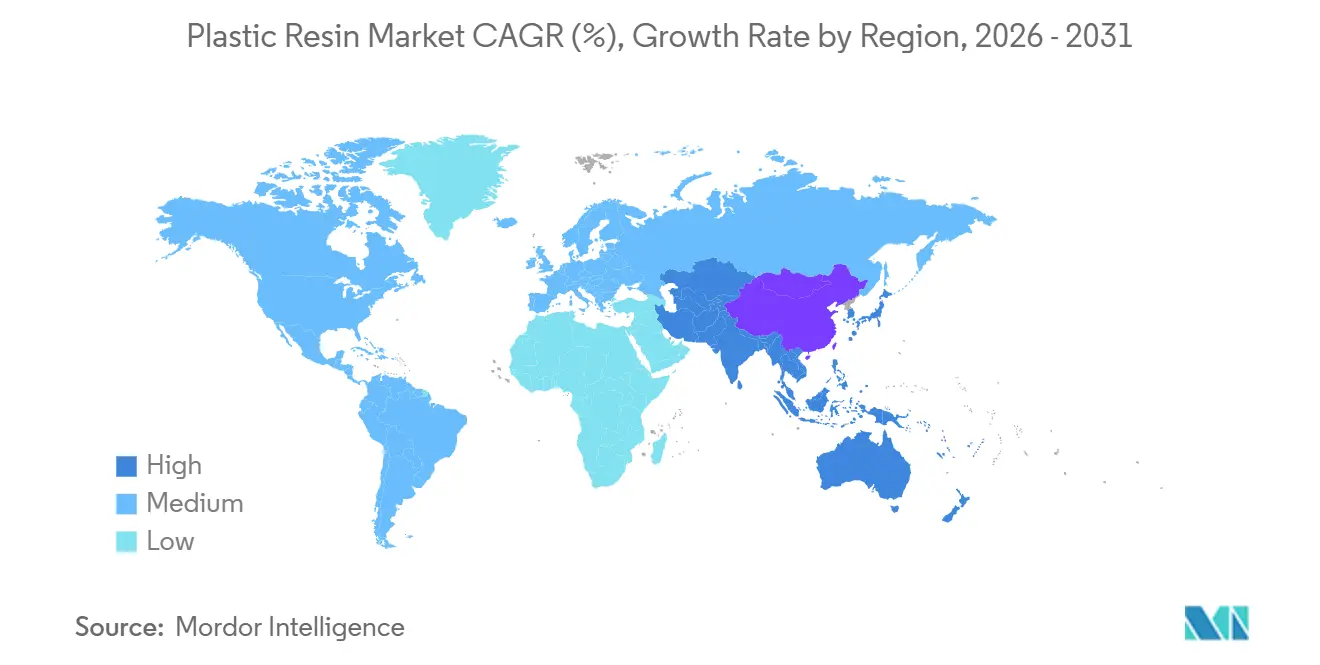
Asia-Pacific held 22.17% of the plastic resin market share in 2025 and is forecast to grow at a 5.06% CAGR through 2031. The region combines basic polymer production in China and India with advanced conversion and compounding in Japan, South Korea, and ASEAN. China is shifting from commodity expansion toward engineering and sustainable grades for new-energy vehicles and semiconductors. China National Petroleum Corporation's (CNPC's) Dushanzi expansion reflects efforts to increase ethylene capacity for this manufacturing base. India is adding domestic PVC capacity, with Reliance Industries and the Adani Group planning a combined 3.5 million tons per year by 2027. Japan is consolidating ethylene-related production while companies prioritize specialty resins and advanced composites.
North America retains a feedstock advantage because U.S. polyethylene and polypropylene production is largely ethane-based. This structure reduced exposure to the naphtha disruption that affected Asian and European producers earlier in 2026. Dow reported USD 12.1 billion in net sales for the second quarter of 2026, up 20% from the prior year. Its polyethylene prices rose 40%, while Packaging and Specialty Plastics revenue increased 27% to USD 6.4 billion. ExxonMobil approved a final investment decision for an additional 120,000 tons per year of Proxxima thermoset resin blending capacity in Louisiana. Canada and Mexico remain closely integrated with the U.S. automotive and consumer packaging supply chains.
Europe faces high energy costs, weaker downstream demand, and more demanding circularity requirements. The Packaging and Packaging Waste Regulation (PPWR) is reshaping resin qualification processes and packaging supply agreements across the region. Fraunhofer UMSICHT identified 65 chemical recycling projects in Europe in October 2025. Eighteen installations were operating, with a combined capacity of 289 kt per year, largely using pyrolysis. Brazil remains South America's core market, supported by Braskem's board-approved USD 800 million expansion in Rio de Janeiro. The project adds 220,000 tons per year of ethylene capacity and is targeted for completion in 2028. Demand in the Middle East and Africa is developing, while SABIC is rebalancing production toward lower-cost Middle Eastern assets.

Competitive Landscape
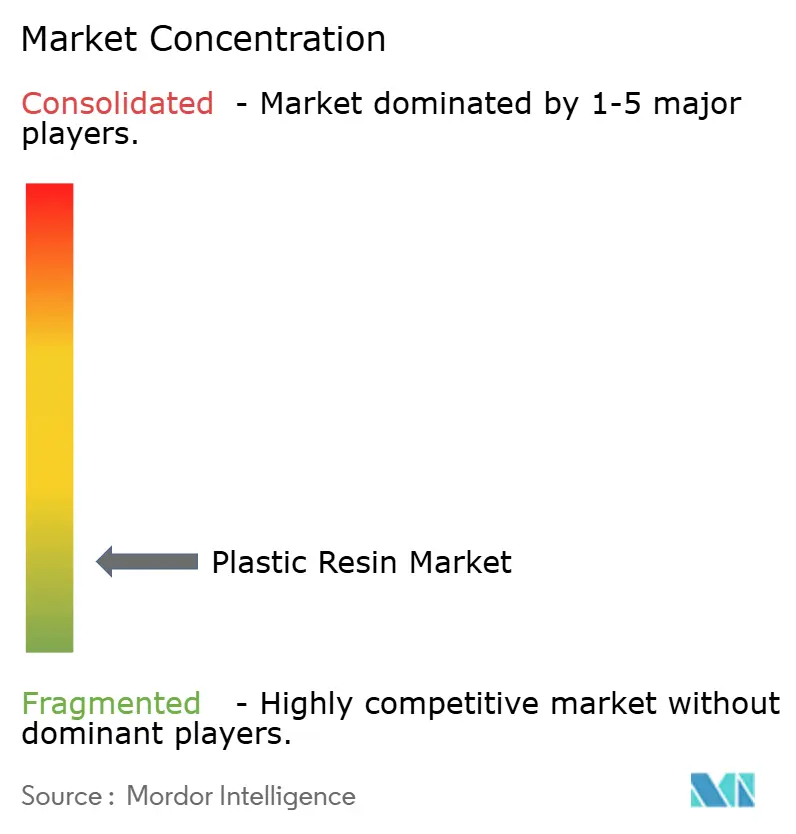
The plastic resin market is fragmented. Dow, LyondellBasell, BASF, SABIC, and ExxonMobil hold significant capacity across standard polyolefins and engineering polymers. Regional compounders and specialty suppliers compete through application knowledge, local service, and differentiated grades. Companies are reducing high-cost European exposure and directing investment toward circular materials, compounding, and cost-advantaged regions. SABIC permanently shut ethylene crackers at Geleen in the Netherlands and Wilton in the United Kingdom. LyondellBasell sold four European olefins sites to AEQUITA in May 2026, creating the independent Velogy platform.
Certified food-contact recycled resin represents a significant commercial opportunity, as global supply remains dependent on third-party recycled feedstock. Buyers increasingly treat regional recycled-content supply as both a supply-security issue and a compliance requirement. LyondellBasell is building a 50,000-tons-per-year MoReTec-1 catalytic pyrolysis plant in Wesseling, Germany. The plant was commercially pre-sold and integrates chemical recycling into polymer production. Eastman Chemical reported that circular revenue doubled in the first half of 2026 compared to the first half of 2025 at its Kingsport methanolysis facility, supporting the commercial viability of molecular recycling as a dedicated revenue source.
SABIC launched a 75% PCR carbon-fiber-reinforced compound for electronics housings in Shanghai in August 2026. The product carries ISCC+ certification and combines recycled content with technical performance. PureCycle received conditional New Jersey approval for recycled polypropylene toward state PCR compliance in May 2026. These developments may expand the pool of certified recycled feedstock for regulated applications. Competition will depend on access to qualifying recycled inputs, consistent technical specifications, and regional production security. The absence of a single global provider with a fully integrated food-contact recycled supply limits near-term concentration in this specialized area.
Plastic Resin Industry Leaders
Dow
Exxon Mobil Corporation
LyondellBasell Industries N.V.
SABIC
BASF
- *Disclaimer: Major Players sorted in no particular order

Recent Industry Developments
- August 2026: Mutares SE & Co. KGaA completed the acquisition of SABIC's Engineering Thermoplastics business in the Americas and Europe for an enterprise value of USD 450 million. The business now operates as NexPoint Materials, functioning as a standalone specialty chemicals platform independent of SABIC's broader portfolio.
- August 2026: ExxonMobil approved a final investment decision to expand Proxxima thermoset resin blending capacity in Louisiana by 120,000 tons per year. The expansion follows the first-phase scale-up completed in 2025, which included a Texas blending facility that became operational in June 2025. The additional capacity is intended to meet rising demand across wind energy, marine, and composites markets.


Global Plastic Resin Market Report Scope
Plastic resin is the raw, unshaped base material, typically in the form of small pellets, granules, or viscous liquid, used to manufacture plastic products. It serves as the foundational input across a wide range of industries, including packaging, automotive, construction, and consumer goods, where it is processed through methods such as injection molding, extrusion, and blow molding to produce finished plastic components and products.
The plastic resin market is segmented by product, application, and geography. By product, the market is segmented into crystalline, non-crystalline, engineering plastic, super engineering plastic, and other products. By application, the market is segmented into packaging, automotive, construction, electrical and electronics, consumer goods, and others. The report also covers market size and forecasts for the plastic resin across 15 countries in major regions. The market sizes and forecasts are provided in terms of value (USD).
| Crystalline | Epoxy |
| Polyethylene | |
| Polyethylene Terephthalate (PET) | |
| Polypropylene | |
| Non-Crystalline | Polyvinyl Chloride (PVC) |
| Acrylonitrile butadiene styrene (ABS) | |
| Polystyrene | |
| Polymethyl Methacrylate (PMMA) | |
| Engineering Plastic | Polyamide |
| Polybutylene Terephthalate (PBT) | |
| Polycarbonate (PC) | |
| Polyurethane (PU) | |
| Polyphenylene Oxide (PPO) | |
| Super Engineering Plastic | Polyphenylene Sulfide (PPS) |
| Polyether Ether Ketone (PEEK) | |
| Polysulfone (PSU) | |
| Polyphenylsulfone (PPSU) | |
| Liquid Crystal Polymer (LCP) | |
| Other Products |
| Packaging |
| Automotive |
| Construction |
| Electrical and Electronics |
| Consumer Goods |
| Others |
| Asia-Pacific | China |
| India | |
| Japan | |
| South Korea | |
| ASEAN Countries | |
| Rest of Asia-Pacific | |
| North America | United States |
| Canada | |
| Mexico | |
| Europe | Germany |
| United Kingdom | |
| France | |
| Italy | |
| NORDIC Countries | |
| Russia | |
| Rest of Europe | |
| South America | Brazil |
| Argentina | |
| Rest of South America | |
| Middle East and Africa | Saudi Arabia |
| South Africa | |
| Rest of Middle East and Africa |
| By Product | Crystalline | Epoxy |
| Polyethylene | ||
| Polyethylene Terephthalate (PET) | ||
| Polypropylene | ||
| Non-Crystalline | Polyvinyl Chloride (PVC) | |
| Acrylonitrile butadiene styrene (ABS) | ||
| Polystyrene | ||
| Polymethyl Methacrylate (PMMA) | ||
| Engineering Plastic | Polyamide | |
| Polybutylene Terephthalate (PBT) | ||
| Polycarbonate (PC) | ||
| Polyurethane (PU) | ||
| Polyphenylene Oxide (PPO) | ||
| Super Engineering Plastic | Polyphenylene Sulfide (PPS) | |
| Polyether Ether Ketone (PEEK) | ||
| Polysulfone (PSU) | ||
| Polyphenylsulfone (PPSU) | ||
| Liquid Crystal Polymer (LCP) | ||
| Other Products | ||
| By Application | Packaging | |
| Automotive | ||
| Construction | ||
| Electrical and Electronics | ||
| Consumer Goods | ||
| Others | ||
| By Geography | Asia-Pacific | China |
| India | ||
| Japan | ||
| South Korea | ||
| ASEAN Countries | ||
| Rest of Asia-Pacific | ||
| North America | United States | |
| Canada | ||
| Mexico | ||
| Europe | Germany | |
| United Kingdom | ||
| France | ||
| Italy | ||
| NORDIC Countries | ||
| Russia | ||
| Rest of Europe | ||
| South America | Brazil | |
| Argentina | ||
| Rest of South America | ||
| Middle East and Africa | Saudi Arabia | |
| South Africa | ||
| Rest of Middle East and Africa | ||


Key Questions Answered in the Report
What is current market size of Plastic Resin Market?
The Plastic Resin Market size was valued at USD 0.79 trillion in 2025 and is estimated to grow from USD 0.82 trillion in 2026 to reach USD 1 trillion by 2031, at a CAGR of 4.13% during the forecast period (2026-2031).
Which product category leads to plastic resin demand?
Crystalline resins led with a 58.23% share in 2025 because they are widely used in packaging, textiles, and industrial applications.
Which application is growing fastest for plastic resins?
Packaging is expected to grow at a 5.54% CAGR through 2031, supported by consumer goods distribution and e-commerce logistics.
Why are recycled resins important to resin suppliers?
Legal recycled-content requirements increase demand for certified material, while a limited supply of high-purity material creates a qualification challenge.
Page last updated on:





