
High-End Copper Foil Market Size and Share
Market Overview
| Study Period | 2021 - 2031 |
|---|---|
| Market Size (2026) | USD 1.16 Billion |
| Market Size (2031) | USD 1.58 Billion |
| Growth Rate (2026 - 2031) | 6.38 % |
| Fastest Growing Market | Asia Pacific |
| Largest Market | Asia Pacific |
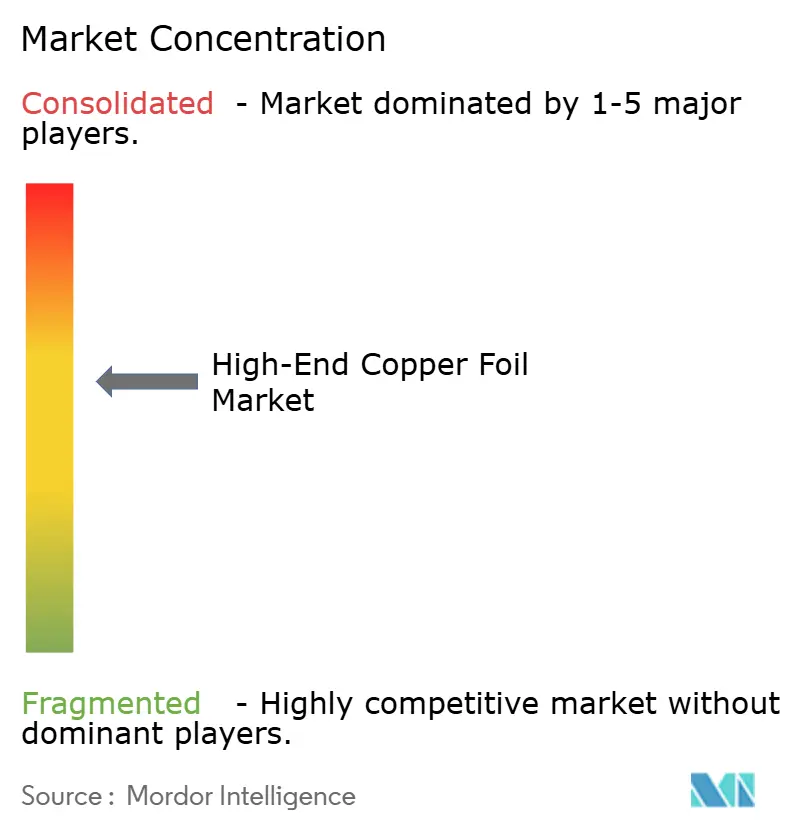
| Market Concentration | Medium |
Major Players *Disclaimer: Major Players sorted in no particular order Image © Mordor Intelligence. Reuse requires attribution under CC BY 4.0. | |
High-End Copper Foil Market Analysis by Mordor Intelligence
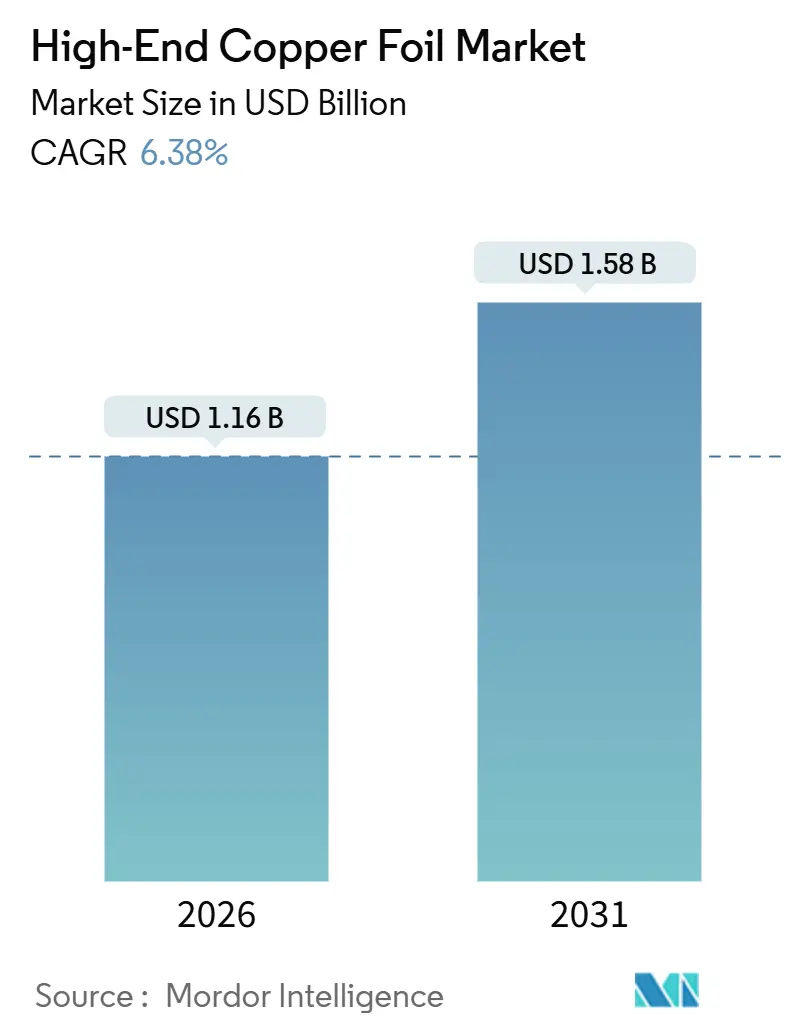
The High-End Copper Foil Market size is estimated at USD 1.16 billion in 2026, and is expected to reach USD 1.58 billion by 2031, at a CAGR of 6.38% during the forecast period (2026-2031). Firm demand for ultra-thin electrodeposited foils in lithium-ion batteries, alongside premium rolled foils for millimeter-wave printed-circuit boards (PCBs), is reshaping profit pools. Automakers are specifying 4 µm current collectors to unlock 5-11% energy-density gains, while data-center operators require ultra-low-profile surfaces to manage 30-300 GHz signal losses. China’s new GB safety standard, effective July 1, 2026, tightens purity and tensile-strength thresholds, compelling local mills to upgrade electrodeposition lines or exit. Finally, North American and European gigafactories are redirecting 15-20% of incremental battery-foil demand to regional suppliers to satisfy domestic-content rules, accelerating capacity announcements in Mexico, Poland, and Hungary.
Key Report Takeaways
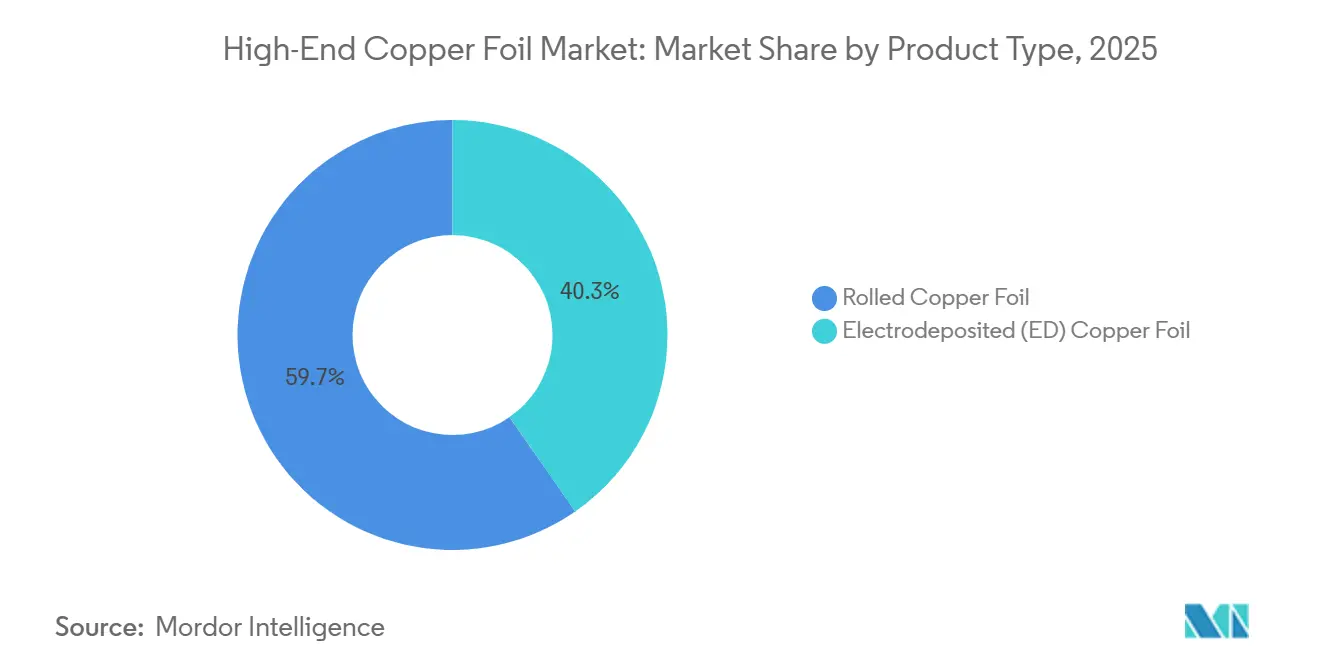
- By product type, rolled copper foil led with 59.67% of 2025 revenue, whereas electrodeposited foil is forecast to advance at an 8.44% CAGR through 2031.
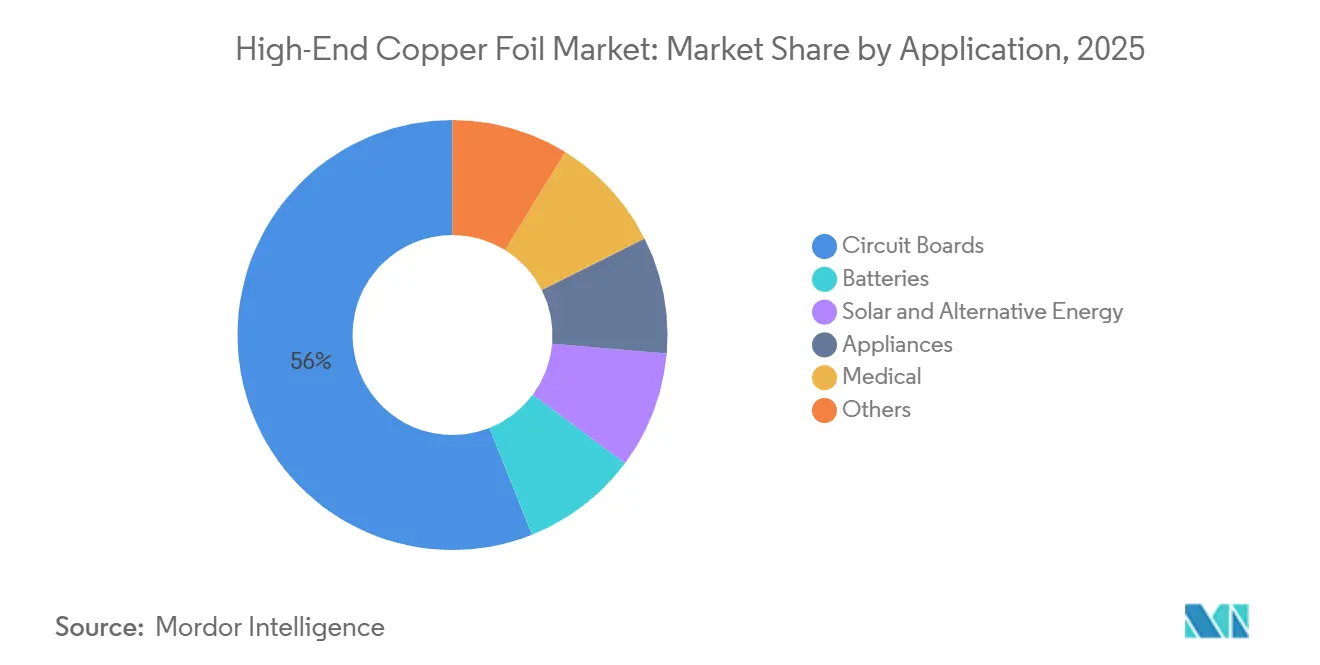
- By application, circuit boards captured 56.02% of 2025 revenue, while batteries record the fastest 14.18% CAGR to 2031.
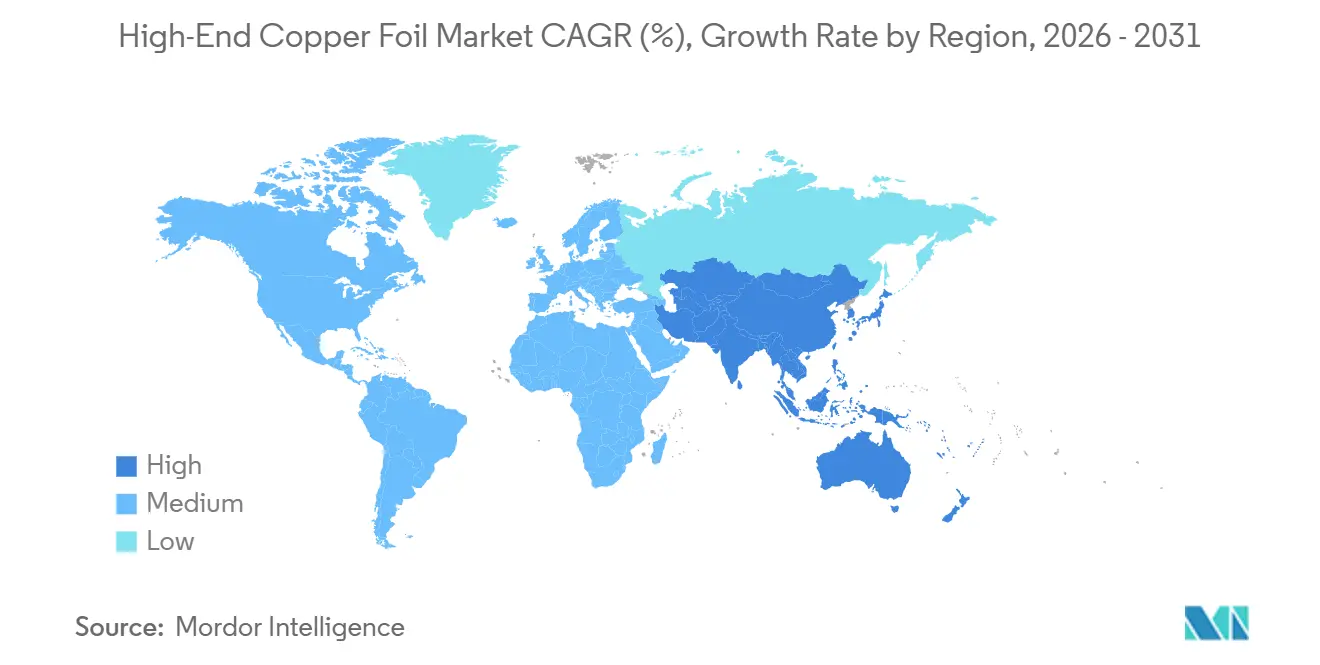
- By geography, Asia-Pacific held 69.60% of 2025 value; the region exhibits the highest 6.72% CAGR through 2031.
Note: Market size and forecast figures in this report are generated using Mordor Intelligence’s proprietary estimation framework, updated with the latest available data and insights as of January 2026.
Market Trends and Insights
Drivers Impact Analysis of High-End Copper Foil Market*
| Driver | (~) % Impact on CAGR Forecast | Geographic Relevance | Impact Timeline |
|---|---|---|---|
| EV Battery Demand for Ultra-Thin High-Purity Foils | +2.1% | Global, with APAC core and spill-over to North America and EU | Medium term (2-4 years) |
| 5G / HPC Push for High-Frequency PCBs | +1.3% | North America, EU, Japan, South Korea | Short term (≤ 2 years) |
| Regional Gigafactory Localisation Wave (North America and European Union) | +1.6% | North America and EU, secondary impact in Mexico and Eastern Europe | Medium term (2-4 years) |
| Closed-Loop Battery-Grade Foil Recycling Initiatives | +0.7% | EU (regulatory-driven), North America (voluntary), emerging in China | Long term (≥ 4 years) |
| Tight Supply of HF PCB Substrates Drives Premium Foil Demand | +0.9% | Global, concentrated in North America, Japan, Taiwan | Short term (≤ 2 years) |
| Source: Mordor Intelligence | |||
EV Battery Demand for Ultra-Thin High-Purity Foils
Every 2 µm reduction in foil thickness lifts gravimetric energy density by 5-6%, spurring OEMs to adopt 6 µm and 4 µm anode collectors. China shipped 1,334 GWh of lithium batteries in 2025 and is on track for 1,622 GWh in 2026, but July 2026 purity mandates will push marginal mills out of the high-end copper foil market. Western gigafactories demand 99.99% purity and sub-1% elongation variance, tilting awards toward Japanese and Korean suppliers. The International Energy Agency warns of a 30% primary-copper shortfall by 2035, intensifying the importance of thin-foil yield management. Premium electrodeposited grades command USD 22-28 per kg versus USD 15-18 for standard 8 µm foils, rewarding mills that master sub-6 µm deposition.
5G / HPC Push for High-Frequency PCBs
Hyperscale data centers upgrading to 800G and 1.6T Ethernet require dielectric constants below 3.5, forcing laminate makers to use ultra-low-profile rolled foils with surface roughness under 0.4 µm. Rogers Corporation’s RO4000 laminate lead times lengthened from 16 to 26 weeks in 2025 because copper-foil supply was constrained. AI accelerator boards lose competitiveness when insertion loss exceeds 1 dB per inch, encouraging buyers to secure foil allocations a year in advance. IPC-6018D design rules now carve out rolled foil for mmWave boards, lifting spot premiums 15-20% above contracts. Integrated suppliers that own both rolling mills and laminate lines capture the value.
Regional Gigafactory Localisation Wave
Samsung SDI and General Motors’ USD 3.5 billion U.S. plant, Volkswagen’s USD 20 billion Ontario project, and Northvolt’s EUR 902 million German facility epitomize the localization wave. Yet North America operated only 18,000 tpa of electrodeposited capacity in 2025, forcing airfreight imports from Asia at 12-15% logistics premiums. Korean and Japanese mills are responding with greenfield lines in Mexico, Poland, and Hungary, redirecting 15-20% of incremental battery-foil demand away from China. Domestic-content credits under the U.S. Inflation Reduction Act and the EU Critical Raw Materials Act underpin the shift.
Closed-Loop Battery-Grade Foil Recycling Initiatives
Redwood Materials reached 100 GWh of recycling capacity in 2025, recovering copper at 99.95% purity and lowering input costs 20-25% relative to virgin metal[1]Redwood Materials, “Closed-Loop Copper Recovery,” redwoodmaterials.com . The EU Battery Regulation mandates 12% recycled copper by 2031 and an 85% collection rate by 2028, driving gigafactories to co-locate scrap reclamation. Umicore and Ascend Elements have signed multi-year offtake deals that shorten copper loops to 30 days. China’s extended-producer-responsibility rules add further impetus, though enforcement varies by province.
Restraints Impact Analysis of High-End Copper Foil Market*
| Restraint | (~) % Impact on CAGR Forecast | Geographic Relevance | Impact Timeline |
|---|---|---|---|
| Copper Price Volatility and Margin Squeeze | -1.4% | Global, with acute impact in China and India | Short term (≤ 2 years) |
| Chinese Over-Capacity-Led Price Wars in Li-Battery Foil | -0.9% | APAC core, spill-over to global commodity segments | Medium term (2-4 years) |
| Sodium-Ion Shift (Al Current Collectors) Cannibalises Copper | -0.6% | China, India, emerging in EU for stationary storage | Long term (≥ 4 years) |
| Source: Mordor Intelligence | |||
Copper Price Volatility and Margin Squeeze
London Metal Exchange spot rose to USD 11,200/t in October 2025, with Q2 2026 forecasts near USD 12,500/t, slashing foil-maker EBITDA by 2-3 percentage points because pass-through clauses lag 60-90 days. Smaller South Asian mills lacking hedge programs posted negative margins in Q3 2025 when premiums widened to USD 280/t. The IEA foresees a structural 30% copper supply deficit by 2035, preserving volatility. Producers are locking multi-year concentrate offtakes and investing in scrap recycling, but benefits accrue only after 18-36 months.
Chinese Over-Capacity-Led Price Wars in Li-Battery Foil
China built roughly 600,000 tpa of electrodeposited capacity by 2024, yet domestic demand consumed only 420,000-450,000 tpa, leaving idle capacity that drove spot prices for 8-10 µm grades down to USD 15-17/kg in 2025. Provincial subsidies have entrenched overinvestment, echoing past solar-panel gluts. Export surges to Southeast Asia and Europe triggered anti-dumping probes, but high-purity and ultra-thin niches remain insulated by stringent quality hurdles. Marginal Chinese mills may consolidate or shift to lower-cost regions.
*Our forecasts treat driver/restraint impacts as directional, not additive. The impact forecasts reflect baseline growth, mix effects, and variable interactions.
High-End Copper Foil Market Segment Analysis
By Product Type:
Rolled Foil Retains PCB Premium, Electrodeposited Scales in BatteriesRolled copper accounted for 59.67% of 2025 value, supported by root-mean-square roughness near 0.35 µm and unrivaled mechanical strength that mitigates skin-effect losses on 30-300 GHz boards. Electrodeposited foil is projected to grow at 8.44% CAGR, driven by battery makers migrating toward 6 µm and 4 µm gauges that electrodeposition can deliver uniformly across 1,350 mm widths. Capital intensity runs above USD 100 million per multi-stage rolling mill, fostering an oligopoly among Japanese and European producers who can charge USD 28-35 / kg for ultra-smooth variants. Conversely, Chinese electrodeposition capacity surged to 600,000 tpa by 2024, sparking price wars in standard 8 µm grades.
Electrodeposited processes allow higher throughput and lower micro-crack risk below 5 µm thickness, an edge as the high-end copper foil market pivots to energy-dense cells. Meanwhile, 5G and AI boards drive pre-booking of rolled-foil allocations 12 months ahead, creating dual supply chains. Integrated rolled-foil mills are forward-integrating into laminates, while electrodeposited specialists co-locate near gigafactories to offer just-in-time delivery. These divergent models illustrate how the high-end copper foil market continues to bifurcate.


By Application:
Circuit Boards Dominate Revenue, Batteries Deliver GrowthCircuit boards commanded 56.02% of revenue in 2025, reflecting entrenched demand in smartphones, automotive ADAS, and industrial controls. Batteries, however, register a 14.18% CAGR through 2031 as EV penetration rises and grid-scale storage accelerates. PCB demand is itself splitting: commodity rigid boards now specify thinner, lower-cost foils, while AI servers and 5G base stations require rolled foil priced at USD 28-35 / kg. Rogers Corporation’s RO4000 substrate backlog illustrates the strain, with lead times ballooning to 26 weeks.
Battery collectors are converging on 6 µm electrodeposited foil with 99.99% purity and ≥350 MPa tensile strength to deliver ≥2,000 cycles. Solar and alternative-energy end uses, such as CIGS thin-film and tandem perovskite modules, require oxidation-resistant foils that tolerate 150-180 °C reflow, creating a niche revenue stream. ISO 13485-qualified medical foils enjoy price insulation because qualification can run 24 months. Miscellaneous uses—RFID, EMI shielding, décor laminates—grow slowly but even out cyclicality, reinforcing the diversified but shifting profile of the high-end copper foil market.
Geography Analysis
APAC High-End Copper Foil Market
Asia-Pacific generated 69.60% of 2025 revenue and is forecast at a 6.72% CAGR through 2031, bolstered by China’s large production share and South Korea’s sub-6 µm expertise. China’s July 2026 GB standard is forcing technical upgrades or exits, squeezing commodity producers but supporting premium price realization. South Korea’s SKC, Solus Advanced Materials, and LS MTRON are scaling capacity in Poland and Malaysia to serve EU and ASEAN gigafactories, while Japanese players prioritize quality in high-purity and rolled niches.
North America and Europe High-End Copper Foil Market
North America and Europe are pivoting toward localization. The high-end copper foil market size for North America is set to expand as the Inflation Reduction Act primes gigafactory investment. Yet only 18,000 tpa of regional electrodeposited capacity existed in 2025, necessitating imports at 12-15% cost premiums until greenfield lines in Mexico and Hungary come online. Europe’s Battery Regulation layers recycled-content mandates that favor co-located recycling, attracting investments from Redwood Materials and Umicore.
South America and MEA High-End Copper Foil Market
South America, the Middle East, and Africa remain import-dependent. Brazil buys about 10,000 t of copper foil yearly for consumer electronics, while Saudi Arabia’s Vision 2030 stimulates data-center builds that demand high-frequency laminates. South Africa’s mining base offers concentrates, but the region lacks foil fabrication, hinting at future semi-finished export models if Southern African battery clusters emerge.

Value Chain Analysis
Upstream inputs center on refined copper cathode and recycled copper, with smelters and recyclers becoming more relevant as copper price volatility and recycled-content requirements rise. Midstream conversion splits into rolled-foil and electrodeposited (ED) foil routes, with both paths depending on tightly controlled surface-treatment chemistries (for HVLP/VLP/RTF finishes) and long equipment-qualification cycles with end customers. Key producers such as Mitsui Kinzoku, Lotte Energy Materials, and Solus Advanced Materials supply into copper-clad laminate (CCL) makers and PCB fabricators for high-frequency boards, while battery-grade ED foil flows to cell manufacturers and gigafactories. Korea Zinc is an example of an upstream metals player linked to this broader ecosystem.
Downstream, high-speed networking and AI server programs are pushing earlier capacity reservation and more direct coordination between end users, CCL makers, and foil suppliers, which reduces flexibility for midstream converters. Supply constraints in ultra-low-profile grades have increased the importance of allocation management and dual sourcing, with HVLP-class copper foil cited as a bottleneck for AI server and networking hardware in 2026. Distribution typically occurs via contracted supply to CCL/PCB accounts and qualified vendor lists for battery lines, but procurement is shifting toward longer-dated commitments and pass-through pricing as input-cost spikes and specialty-grade scarcity ripple across electronics and energy end markets.
Competitive Landscape
The high-end copper foil industry is moderately concentrated: the ten largest producers controlled roughly 57% of 2025 capacity. Rolled-foil supply is quasi-oligopolistic because only Japanese, European, and North American mills own precision rollers that achieve sub-0.4 µm roughness, whereas China’s 600,000 tpa electrodeposited segment is fragmented and price-competitive. Incumbents pursue three tactics. First, vertical integration into laminates to capture PCB substrate premiums. Second, co-location with gigafactories for just-in-time service and logistics savings. Third, backward integration into recycling to hedge copper volatility.
Patent filings for sub-6 µm electrodeposition and reverse-treatment chemistries climbed 22% in 2024-2025, led by Korean and Japanese applicants[2]World Intellectual Property Organization, “Copper-Foil Patent Trends 2025,” wipo.int. White-space opportunities include medical-grade flex circuits requiring ISO 13485 certification and photovoltaic interconnects for tandem perovskites that demand novel alloying for 150-180 °C stability. Regionally, SKC and Solus are adding 25,000 tpa in Poland, Furukawa Electric and Panasonic secured a five-year rolled-foil contract for 800G switches, and Redwood Materials teamed with Ford on a 50 GWh recycling joint venture. Sodium-ion batteries threaten 3-5% displacement as aluminum replaces copper, so incumbents are developing sub-3 µm foils for lithium-metal anodes in solid-state cells, reinforcing the dynamic nature of the high-end copper foil market.
High-End Copper Foil Industry Leaders
SKC
Nuode New Materials Co Ltd
Lotte Energy Materials
JX Advanced Metals Corporation
Mitsui Kinzoku Co., Ltd.
- *Disclaimer: Major Players sorted in no particular order
High-End Copper Foil Market Companies Covered in this Report
- Chang Chun Petrochemical Co. Ltd
- Co-Tech Development Corporation
- Doosan Corporation Electro-Materials.
- FUKUDA METAL FOIL & POWDER CO., LTD.
- Furukawa Electric Co., Ltd
- JX Advanced Metals Corporation
- Kingboard Holdings
- Londian Wason (Shenzhen) Holdings Group Co., Ltd.
- Lotte Energy Materials
- LS MTRON LTD.
- Mitsui Kinzoku Co., Ltd.
- NAN YA PLASTICS CORPORATION
- Nuode New Materials Co Ltd
- SKC
- Solus Advanced Materials
- Sumitomo Metal Mining Co., Ltd.
- Targray Technology International
- UACJ Foil Corporation
- Wieland

Market Opportunities and Future Outlook
The white-space opportunity is most visible in high-frequency PCB foils (HVLP/VLP and reverse-treated variants), where performance thresholds for 800G and 1.6T networking hardware have tightened roughness and loss budgets. In response, buyers have moved upstream to secure allocations. Reported 2026 bottlenecks in HVLP-class foil and 2026 price actions in adjacent copper-foil and resin-coated copper foil categories reinforce that premium electronics demand is driven by specialty grades, qualification depth, and process control, not only nameplate tonnage. This also creates room for producers that can shorten qualification cycles, maintain stable surface profiles across lots, and partner earlier with the CCL/PCB ecosystem to lock in specification positions.
Regionalization adds investable openings for localized supply in North America and Europe, where gigafactory and electronics supply chains are pushing for reduced import dependence and tighter logistics. Government-backed capacity additions also provide a concrete pathway: Canada awarded a CAD 70 million contribution to Volta Energy Solutions for a copper foil plant in Granby, Quebec (targeting start of production by March 2027), while European supply options are being strengthened through expansions such as Solus Advanced Materials scaling output from Hungary. On technology, differentiation remains closely tied to process innovation, including published research on additive chemistry routes to improve thermal stability and reduce pinhole defects in electrolytic copper foil, which aligns with customer requirements for thinner gauges and tighter defectivity control in both battery current collectors and advanced PCBs.
Recent Industry Developments in High-End Copper Foil Market
- July 2026: Lotte Energy Materials announced plans to quadruple its AI circuit-foil capacity to address demand tied to AI servers and semiconductor substrate applications. The announcement points to continued movement by foil suppliers toward higher-margin electronics grades and tighter linkage to hyperscale and advanced packaging supply chains.
- May 2026: Solus Advanced Materials announced expansion in Hungary to scale output, strengthening European copper foil supply for high-end electronics. The move supports regionalization efforts to reduce import dependence and improve logistics for Western European OEMs and packagers.
- July 2024: Solus Advanced Materials began mass production of copper foil for next-generation AI accelerators for a major North American GPU company. Securing approval and starting mass production highlights the growing importance of electronics-grade qualification for high-speed computing hardware and supports premiumization beyond commodity PCB foil.


High-End Copper Foil Market Report Scope and Research Methodology
Market Definition and Coverage
For this study, the high-end copper foil market covers revenue generated from premium-grade copper foils that meet tighter thickness, purity, and performance requirements for advanced electronics and energy storage uses, and it is measured in value terms across major regions.
Scope exclusions: We exclude upstream copper mining and refining, general commodity copper foil that does not meet high-end specifications, and downstream finished components where foil is only a minor input.
Segments Covered in This Report
- By Product Type
- Rolled Copper Foil
- Electrodeposited (ED) Copper Foil
- By Application
- Circuit Boards
- Batteries
- Solar and Alternative Energy
- Appliances
- Medical
- Others
- By Geography
- Asia-Pacific
- China
- Japan
- South Korea
- India
- ASEAN Countries
- Rest of Asia-Pacific
- North America
- United States
- Canada
- Mexico
- Europe
- Germany
- United Kingdom
- France
- Italy
- Spain
- NORDIC Countries
- Rest of Europe
- South America
- Brazil
- Argentina
- Rest of South America
- Middle-East and Africa
- Saudi Arabia
- South Africa
- Rest of Middle East and Africa
- Asia-Pacific
Data Sources, Market Sizing, and Validation
Desk Research
Desk research started with public production and trade signals that can explain where demand is forming and how it shifts over time. We referenced sources such as UN Comtrade for trade flows, USGS for metals context, IEA for battery and EV-related indicators, and International Copper Association materials for industry definitions and application pathways.
To keep assumptions grounded, we also reviewed company filings, investor presentations, press releases, and association websites that discuss capacity additions, qualification cycles, and end-use demand trends. In addition, selected paid database subscriptions were used for company financials and intelligence, patent activity checks, and shipment-level import and export validation where public data was not specific enough. These desk sources are not exhaustive, and other public documents were also reviewed to collect data, validate assumptions, and clarify open questions.
Primary Interviews and Surveys
Primary work was used to confirm what counts as high-end foil in practice and to pressure-test the key drivers behind pricing and volume. We spoke with a mix of foil manufacturers, distributors, and downstream buyers across APAC, EMEA, and the Americas so gaps from desk research could be closed and the model inputs could be aligned to real procurement behavior.
Distribution of primary research fieldwork respondents
| Company type | Respondent position | Region |
|---|---|---|
| Top tier: 28% | CXOs: 13% | APAC: 43% |
| Mid tier: 51% | Functional/Unit leaders: 43% | EMEA: 37% |
| Smaller Players: 21% | Managers: 44% | Americas: 20% |
Market-Sizing & Forecasting
Sizing was built using a top-down and bottom-up approach, where production and trade indicators were used to reconstruct the addressable demand pool and then refined using application split logic. In practical terms, demand was tied back to end uses that consistently require higher performance foil, especially lithium-ion batteries and higher-end circuit boards, and then adjusted for regional manufacturing footprints.
Key inputs included observed EV and battery capacity ramp signals, PCB production and export trends, the mix shift toward thinner foils, and typical pricing spreads between premium and standard foil grades. Where public data was not clean, a selective bottom-up approximation was run using sampled average selling prices multiplied by implied consumption volumes from interviews, followed by gap-handling checks when smaller local supply was not fully visible in public trade records.
For forecasting, scenario analysis was used so growth paths could be adjusted based on battery buildout timing, qualification lead times, and capacity expansion schedules discussed by industry participants. The final forecast was then aligned to what respondents considered realistic adoption rates for higher-end foil grades, rather than assuming a straight-line jump in penetration.
Data Validation & Update Cycle
Outputs were cross-checked against independent signals like regional battery investment cadence, PCB shipment patterns, and published capacity announcements, which helped catch overstatements that can happen when one indicator is taken alone. When variances appeared, assumptions were revisited and, if needed, follow-up calls were triggered to confirm whether the issue was a definition mismatch, a timing shift, or a regional coverage gap.
Before sign-off, the model and key drivers go through a multi-step analyst review so unit logic, currency conversions, and year alignment are consistent. Reports are refreshed annually, and interim updates are made when material events occur, such as major capacity starts, policy changes, or demand shocks. Right before delivery, a final freshness pass is completed so clients receive the latest updated view.
Mordor Intelligence's High End Copper Foil Market Size Compared Against Other Published Estimates
Published market sizes for high-end copper foil often do not match because the boundary of what is counted is not consistent, and the year used as the base can be different. Differences also come from how firms treat pricing, especially when premium thin-foil pricing moves faster than volumes.
By tracking qualification-driven adoption, premium grade price spreads, and year-specific currency conversions, Mordor Intelligence anchors the 2026 value to a defined high-end foil scope, which prevents standard foil volumes from being blended into the total.
Benchmark comparison
| Source | Market Size | Gaps in Research Methodology |
|---|---|---|
| Mordor Intelligence | USD 1.16 B (2026) | |
| Industry Publisher A | USD 0.96 B (2024) | Uses an earlier base year and is centered on electrolytic foil language, which can undercount rolled foil demand tied to premium PCB grades and can apply a flatter price curve. |
| Trade Release B | USD 0.97 B (2022) | Anchors the market to a narrower application split (mainly PCB and batteries) and a shorter forecast window, which can miss newer high-end use cases and later capacity ramps. |
The spread in values mainly follows base-year choice and how tightly high-end specifications are enforced in the count. With clear inclusion rules and inputs that can be rechecked each update cycle, the resulting total stays traceable to repeatable steps rather than one-time assumptions.


Key Questions Answered in the Report
How large is the high-end copper foil market in 2026?
The high-end copper foil market size stands at USD 1.16 billion in 2026 and is projected to reach USD 1.58 billion by 2031.
Which product type holds the largest share?
Rolled copper foil led with 59.67% of 2025 revenue due to its ultra-low-profile surface demanded by high-frequency PCBs.
What is the fastest-growing application through 2031?
Batteries grow at a 14.18% CAGR, supported by rising EV and energy-storage deployments.
Which region shows the highest growth rate?
Asia-Pacific is forecast to grow at 6.72% CAGR as localized gigafactories boost demand for domestic foil supply.
Page last updated on:


 Your data is secure and never sold or shared.


