
Helicobacter Pylori Diagnostics Market Size and Share
Market Overview
| Study Period | 2020 - 2031 |
|---|---|
| Forecast Data Period | 2026 - 2031 |
| Historical Data Period | 2020 - 2024 |
| Growth Rate | 7.11 % |
| Fastest Growing Market | Asia Pacific |
| Largest Market | North America |
| Market Concentration | Medium |
Major Players *Disclaimer: Major Players sorted in no particular order Image © Mordor Intelligence. Reuse requires attribution under CC BY 4.0. | |
Helicobacter Pylori Diagnostics Market Analysis by Mordor Intelligence
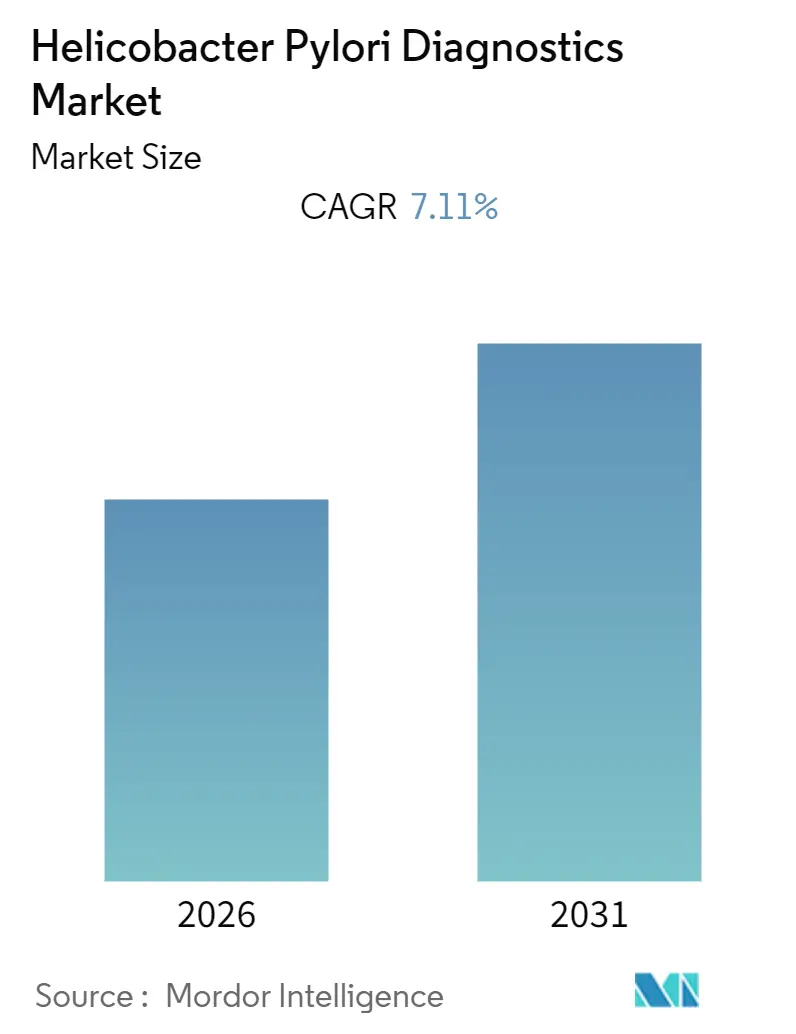
The Global Helicobacter Pylori Diagnostics Market size is expected to register a CAGR of 7.11% during the forecast period (2026-2031).
The outbreak of the COVID-19 pandemic has pushed the medical device industry into action, with a race to develop both therapeutic and preventive devices. Exponentially increasing cases of the coronavirus worldwide are leading to the need for the development of novel treatments, with several clinical trials underway. Meanwhile, the manufacturers of diagnostic devices were highly focused on developing vaccines and drugs, which can also be applied in the diagnosis and treatment of COVID-19, increasing the rate of clinical trials to a great extent. The outbreak of the pandemic increased the cases of gastrointestinal diseases and other infectious diseases. For instance, as per the study titled, "Impact of Gastrointestinal Symptoms in COVID-19: a Molecular Approach" published in November 2020, the gastrointestinal tract gets affected by COVID-19. It also reported that the gastrointestinal tract is considered the replication site for SARS-CoV-2. In addition, it also stated that the severity in patients suffering from COVID-19 increases who are already having gastrointestinal disorders. Helicobacter pylori diagnostics is one of the common diagnostic procedures for gastrointestinal disorders, therefore, the market witnessed a considerable growth during the pandemic.
The rising prevalence of infectious diseases and increasing awareness about the infections among people are the major drivers for the market. The most common infectious diseases caused by bacteria are Tuberculosis, Chlamydia, gonorrhea, other sexually transmitted diseases (STDs), Stomach flu (gastroenteritis), and Urinary tract infections (UTIs). For instance, according to the study titled, "The Global Prevalence of Peptic Ulcer in the World: a Systematic Review and Meta-analysis" published in December 2021, the global prevelence of peptic ulcer was around 8.4% in 2021. Similarly, as per the report published by the Medscape in April 2021, peptic ulcer disease affects approximately 4.6 million people annually in the United States. Similarly, according to the report published by the European Centre for Disease Prevention and Control in March 2021, it was reported that every year around 500,000 sexually transmitted infections are detected in the European Union, European Economic Area (EEA), and the United Kingdom. Since, helicobacter pylori diagnostics are generally recommended for the diagnostic of infectious diseases, therefore, such instances indicate that the market is expected to show significant growth rate over the forecast period.
However, stringent regulatory norms by government may likely to restrain the market growth over the forecast period.
Note: Market size and forecast figures in this report are generated using Mordor Intelligence’s proprietary estimation framework, updated with the latest available data and insights as of 2026.
Global Helicobacter Pylori Diagnostics Market Trends and Insights
Immunoassay Segment is Expected to Witness Growth Over the Forecast Period
An immunoassay is a test that relies on biochemistry to measure the presence and concentration of an analyte. The analyte can be large proteins, antibodies that a person has produced as a result of an infection, or small molecules. Immunoassays are highly sensitive and specific. Their high specificity results from the use of antibodies and purified antigens as reagents. This assay can be used for the diagnosis of a disease directly, by measuring the presence of antigens. In addition, it is a highly selective bioanalytical method that measures the presence or concentration of analytes ranging from small molecules to macromolecules in solution using an antibody or antigen as a biorecognition agent.
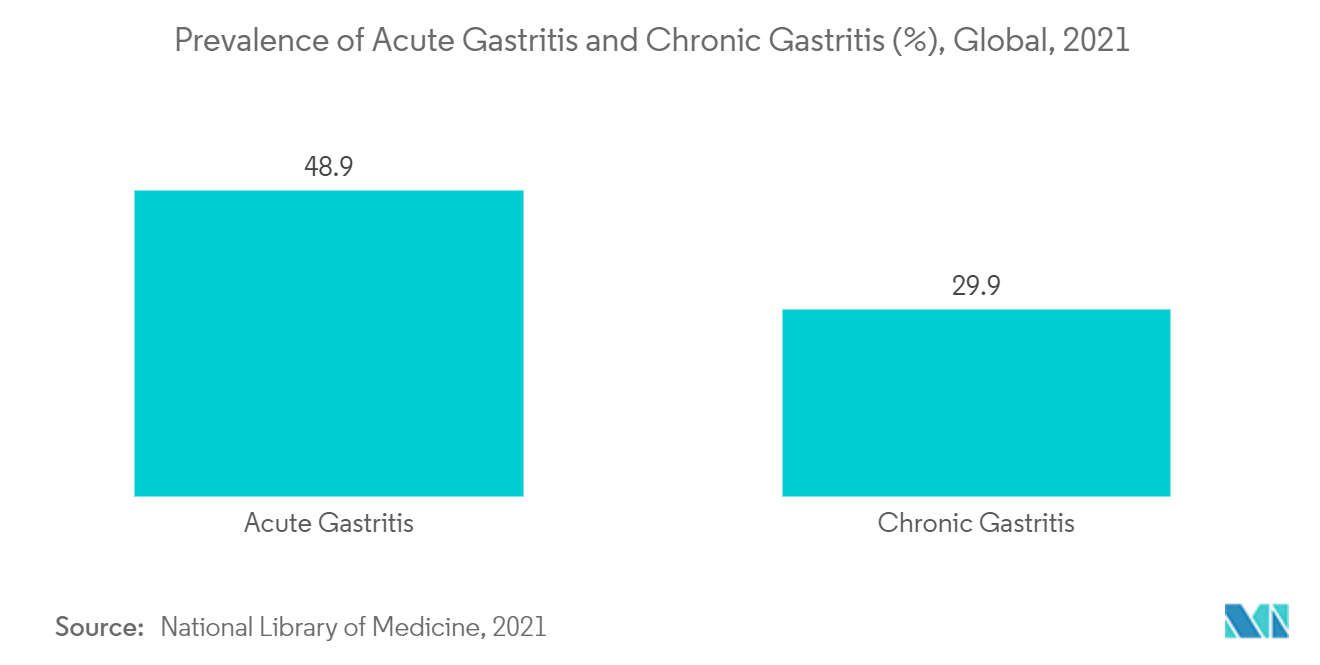
The immunoassay segment holds a significant market share in the helicobacter pylori diagnostics market and is anticipated to show a similar trend over the forecast period due to the presence of several advanced technologies such as the enzyme immunoassays which are used for the detection of antibodies. The rising prevalence of Helicobacter pylori infections and gastritis and technological advancements are the key driving factors in the immunoassay segment. For instance, as per the study titled, "Diagnosis of Helicobacter pylori Infection and Recent Advances" published in August 2021, the prevalence of gastritis was around 50.0%, which was shown from 40.7% to 56.0% and it included 20.0%-30.0% of chronic atrophic gastritis, globally in 2021. It also reported that Helicobacter pylori infection is generally consistent with the prevalence of gastritis and Helicobacter pylori positive gastritis generally accounts for more than 80.0%. Immunoassays are generally used for the detection of such infections, therefore, increasing cases of Helicobacter pylori infection and gastritis are anticipated to propel the segment growth over the forecast period.


North America is Expected to Dominate the Helicobacter Pylori Diagnostics Market
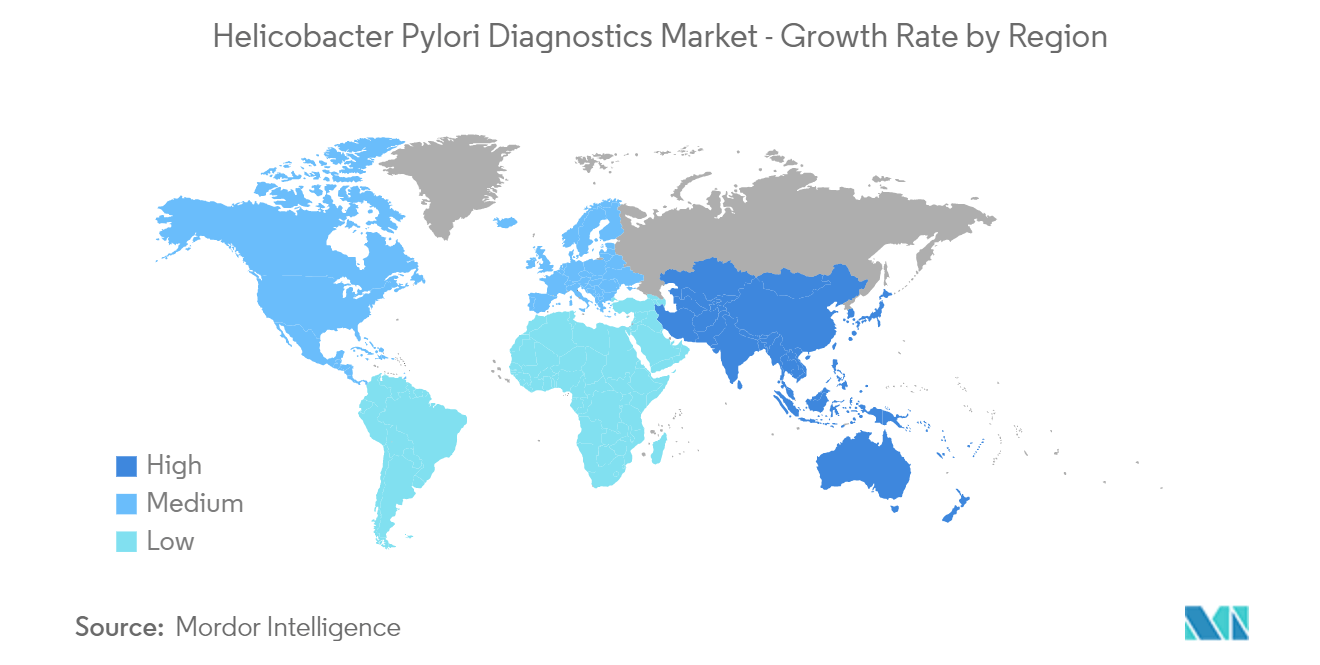
North America is expected to dominate the overall helicobacter pylori diagnostics market over the forecast period. The growth is due to factors such as the increasing number of cases of infectious diseases, increasing awareness of infectious diseases, and new product launches. For instance, in June 2021, Biomerica Inc. announced that it has signed an exclusive five-year distribution agreement with a Canadian partner for the distribution and marketing of Biomerica's new and proprietary Helicobacter pylori test, called hp+detect. The hp+detect product has been developed for the identification and monitoring of helicobacter pylori infection, the leading cause of duodenal and gastric ulcers, and a contributing risk factor associated with gastric cancer. Therefore, such instances are anticipated to propel market growth in the North America region.
Key product launches, high concentration of market players or manufacturer's presence, and acquisition & partnerships among major players, and increasing cases of gastrointestinal disorders in the United States are some of the factors driving the growth of the Helicobacter pylori diagnostics market in the country. For instance, as per the journal published by the Cleveland Clinic Organization in September 2020, acute gastritis affects about 8 out of every 1,000 people in the United States every year. It also reported that chronic, long-term gastritis is less common and it affects approximately 2 out of 10,000 people in the United States every year.
Therefore, owing to the aforesaid factors the growth of the studied market is anticipated in the North America Region.

Regulatory Landscape
In the United States, Helicobacter pylori in vitro diagnostic tests are regulated by the FDA under the medical device framework. As of February 2, 2026, the FDA Quality Management System Regulation (QMSR) aligns 21 CFR Part 820 with ISO 13485:2016 while preserving FDA-specific requirements, affecting documentation, design controls, risk management, and postmarket processes for H. pylori immunoassays, point-of-care tests, and molecular diagnostics.
In the European Union, H. pylori IVDs fall under Regulation (EU) 2017/746 (IVDR), which requires conformity assessment and often involvement of a notified body. When a test functions as a companion diagnostic (CDx), formal consultation with the EMA or national competent authorities adds evidentiary and procedural demands for certain uses and can influence data packages required for market access.
Competitive Landscape
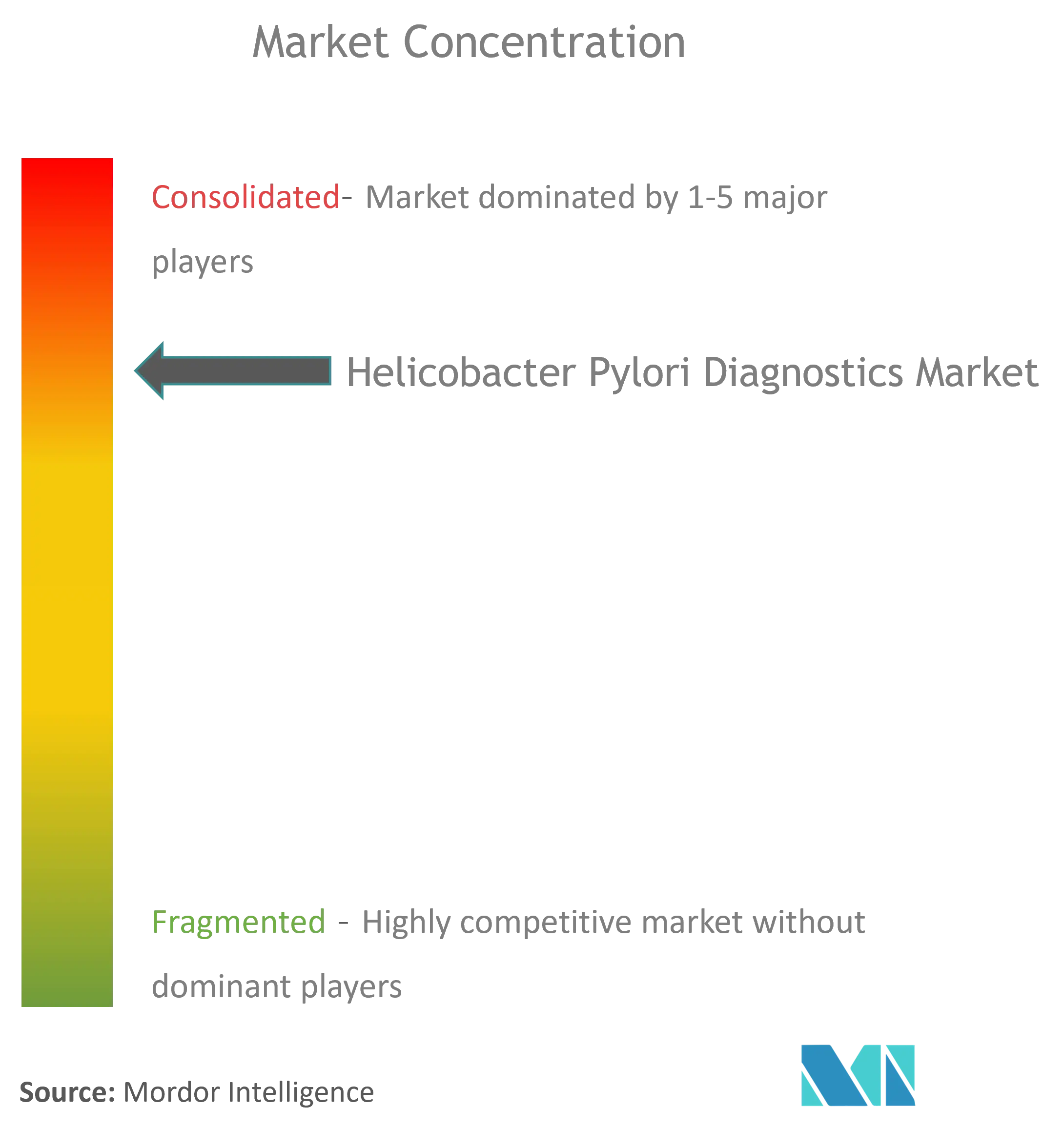
The helicobacter pylori diagnostics market is consolidated and consists of a few major players. In terms of market share, a few of the major players are currently dominating the market. The competitive landscape includes an analysis of a few international as well as local companies which hold the market shares and are well known including Thermo Fisher Scientific, Bio-Rad Laboratories, Quest Diagnostics Incorporate, Meridian Bioscience, F. Hoffmann-La Roche, Biohit Oyj, CorisBioConcept SPRL, CerTest BIOTEC, Epitope Diagnostics, Inc and Exalenz Bioscience Ltd among others.
Helicobacter Pylori Diagnostics Industry Leaders
Thermo Fisher Scientific
Quest Diagnostics Incorporate
Meridian Bioscience
Bio-Rad Laboratories
CerTest BIOTEC
- *Disclaimer: Major Players sorted in no particular order

Market Opportunities and Future Outlook
A whitespace area expands around resistance-informed and multiplex molecular diagnostics for H. pylori. In 2026, peer-reviewed studies report multiplex PCR approaches on stool to detect H. pylori DNA together with antibiotic resistance mutations, and non-endoscopic sample strategies (for example, gastric juice PCR) to detect both infection and clarithromycin resistance, aligning with treatment selection and improving clinical decision-making.
Meanwhile, clinical practice continues to rely on validated non-invasive testing, notably urea breath testing and monoclonal stool antigen assays, including for post-treatment eradication confirmation. This sustains demand for robust immunoassay and breath-test offerings across hospitals, clinics, and diagnostic laboratories. Opportunities center on integrating newer amplification formats (such as isothermal methods coupled to lateral flow readouts) into point-of-care settings while maintaining regulatory-grade performance claims, and on laboratory test menus that add susceptibility or resistance profiling capabilities where antibiotic resistance signals are documented in large reference-lab datasets.
Recent Industry Developments
- February 2026: FDA finalizes alignment of the Quality Management System Regulation with ISO 13485:2016 for IVD manufacturers, establishing a defined compliance trajectory for Helicobacter pylori diagnostics used in clinical workflows. This clarifies documentation and postmarket requirements for H. pylori immunoassays and molecular tests.
- December 2025: European Commission published a proposal aimed at simplifying rules for medical devices and in vitro diagnostic devices, signaling continued policy activity around IVDR transition requirements for H. pylori IVD suppliers.
- February 2024: US FDA finalized amendments transitioning from the Quality System Regulation framework to the Quality Management System Regulation, incorporating ISO 13485:2016 alignment into 21 CFR Part 820. This regulatory milestone created a defined path for IVD manufacturers supporting H. pylori diagnostics.


Research Methodology Framework and Report Scope
Market Definition and Coverage
This market covers the revenue generated from tests and related consumables used to detect Helicobacter pylori infection in clinical settings, including lab-based and point-of-care methods, across major regions.
Scope exclusions: Treatment drugs and eradication therapies, as well as broader gastrointestinal panels that do not specifically report H. pylori testing value, are excluded.
Segmentation Overview
- By Technology
- Immunoassays
- Point of Care (POC)
- Molecular diagnostics
- Others
- By End-user
- Hospitals and clinics
- Diagnostic laboratories
- Others
- Geography
- North America
- United States
- Canada
- Mexico
- Europe
- Germany
- United Kingdom
- France
- Italy
- Spain
- Rest of Europe
- Asia-Pacific
- China
- Japan
- India
- Australia
- South Korea
- Rest of Asia-Pacific
- Middle East and Africa
- GCC
- South Africa
- Rest of Middle East and Africa
- South America
- Brazil
- Argentina
- Rest of South America
- North America
Data Sources, Market Sizing, and Validation
Desk Research
To build the starting data layer, we reviewed public health and epidemiology sources that help frame testing demand and care pathways, such as WHO, the CDC, and national health service guidance pages in key countries. We also used open scientific literature and clinical guideline publications (including ACG and similar medical society guidance) to understand how non-invasive and invasive tests are used, and how repeat testing happens after therapy.
On the supply and adoption side, we referenced sources such as regulatory and product listing information (for example, FDA databases where applicable), company annual reports and investor presentations, and diagnostic laboratory and hospital network publications that describe test menu availability. A paid subscription for company financials and news intelligence, along with patent databases, supported cross-checking of active product pipelines and business mix signals. These desk sources are illustrative, and additional public references were also used for data collection, validation, and clarification.
Primary Interviews and Surveys
Primary work focused on interviews and structured questionnaires with diagnostics lab decision-makers, hospital clinicians involved in GI testing, distributors, and test developers, so gaps from desk research could be closed with practical input. For a global view, inputs were balanced across APAC, EMEA, and the Americas, and we revisited outlier assumptions when regional testing practices or reimbursement signals did not match the model outputs.
Distribution of primary research fieldwork respondents
| Company type | Respondent position | Region |
|---|---|---|
| Top tier: 38% | CXOs: 14% | APAC: 43% |
| Mid tier: 42% | Functional/Unit leaders: 39% | EMEA: 32% |
| Smaller Players: 20% | Managers: 47% | Americas: 25% |
Market-Sizing & Forecasting
Sizing starts from a top-down demand pool build that ties suspected and confirmed dyspepsia and ulcer workups to clinical testing pathways, then adjusts by region-specific access and reimbursement realities that interviews helped validate. The model uses inputs such as H. pylori prevalence ranges, non-invasive versus invasive testing share, test positivity and confirmatory testing patterns, average tests per patient episode, and broad price bands by test type (breath, stool antigen, serology, and biopsy-based methods).
To keep estimates practical, totals are corroborated with selective bottom-up checks, including sampled ASP times test volumes from lab channel discussions, and supplier mix signals from public financial disclosures. Where the two views disagree, we apply adjustments to align with observed channel pricing and utilization. Forecasts use scenario analysis supported by expert consensus on drivers such as guideline-led shifts toward non-invasive testing, molecular adoption in select settings, and changes in reimbursement or screening activity. For smaller countries where bottom-up inputs are limited, proxy assumptions are applied using comparable healthcare utilization and testing intensity indicators, then reviewed again during validation.
Data Validation & Update Cycle
Outputs are validated through triangulation across epidemiology signals, testing pathway assumptions, and price-volume coherence checks, then reviewed across multiple analyst passes before sign-off. If the model shows abrupt jumps that are not supported by published guidance changes, regulatory approvals, or procurement activity, we re-check inputs and re-contact relevant respondents to resolve the variance.
The study is refreshed annually, and interim updates are triggered when material events occur, such as major guideline revisions, notable reimbursement changes, or meaningful new test launches. Before delivery, a final update pass is completed so the numbers and narrative reflect the latest available public signals.
Mordor Intelligence's Helicobacter Pylori Diagnostics Market Size Compared Against Other Published Estimates
Published market sizes for Helicobacter pylori diagnostics often vary because each publisher draws the line differently between H. pylori specific testing and adjacent GI diagnostics, and they also choose different base years and price assumptions. Differences also show up when one estimate is built mainly from epidemiology and care pathways, while another leans more on company mix signals or broad category totals.
Home-testing kits sold directly to consumers sit outside Mordor Intelligence's scope for this market, and that single exclusion can shift the total when other publications bundle retail self-testing with clinical lab and hospital testing. Another common gap comes from how repeat testing is counted after treatment, since some approaches treat retesting as a separate demand unit, while others cap tests per patient episode based on guideline practice patterns and reimbursement limits.
Benchmark comparison
| Source | Market Size | Gaps in Research Methodology |
|---|---|---|
| Mordor Intelligence | USD 0.62 B (2024) | |
| Global Research Publisher A | USD 0.70 B (2024) | Often aggregates broader channel revenue and may include retail self-testing or bundled GI diagnostics, which lifts the 2024 total beyond clinical testing demand alone. |
| Industry Research Publisher B | USD 0.52 B (2024) | Can apply conservative utilization and price bands, and may undercount repeat tests performed in diagnostic labs after eradication therapy, thereby compressing the 2024 value. |
The table shows that the spread is mainly explained by what gets counted as a test event and where the scope line is drawn between clinical diagnostics and adjacent categories. By keeping the model tied to observable care pathways and practical price-volume checks, we can provide a balanced number that is easier for buyers to replicate and stress-test.


Key Questions Answered in the Report
What is the current Global Helicobacter Pylori Diagnostics Market size?
The Global Helicobacter Pylori Diagnostics Market is projected to register a CAGR of 7.11% during the forecast period (2026-2031)
Who are the key players in Global Helicobacter Pylori Diagnostics Market?
Thermo Fisher Scientific, Quest Diagnostics Incorporate, Meridian Bioscience, Bio-Rad Laboratories and CerTest BIOTEC are the major companies operating in the Global Helicobacter Pylori Diagnostics Market.
Which is the fastest growing region in Global Helicobacter Pylori Diagnostics Market?
Asia Pacific is estimated to grow at the highest CAGR over the forecast period (2026-2031).
Which region has the biggest share in Global Helicobacter Pylori Diagnostics Market?
In 2025, the North America accounts for the largest market share in Global Helicobacter Pylori Diagnostics Market.
What years does this Global Helicobacter Pylori Diagnostics Market cover?
The report covers the Global Helicobacter Pylori Diagnostics Market historical market size for years: 2019, 2020, 2021, 2022, 2023 and 2024. The report also forecasts the Global Helicobacter Pylori Diagnostics Market size for years: 2026, 2027, 2028, 2029, 2030 and 2031.
Page last updated on:


 Your data is secure and never sold or shared.


