
Healthcare Wall Coverings Market Size and Share
Market Overview
| Study Period | 2020 - 2031 |
|---|---|
| Market Size (2026) | USD 5.40 Billion |
| Market Size (2031) | USD 6.87 Billion |
| Growth Rate (2026 - 2031) | 4.93 % |
| Fastest Growing Market | Asia-Pacific |
| Largest Market | North America |
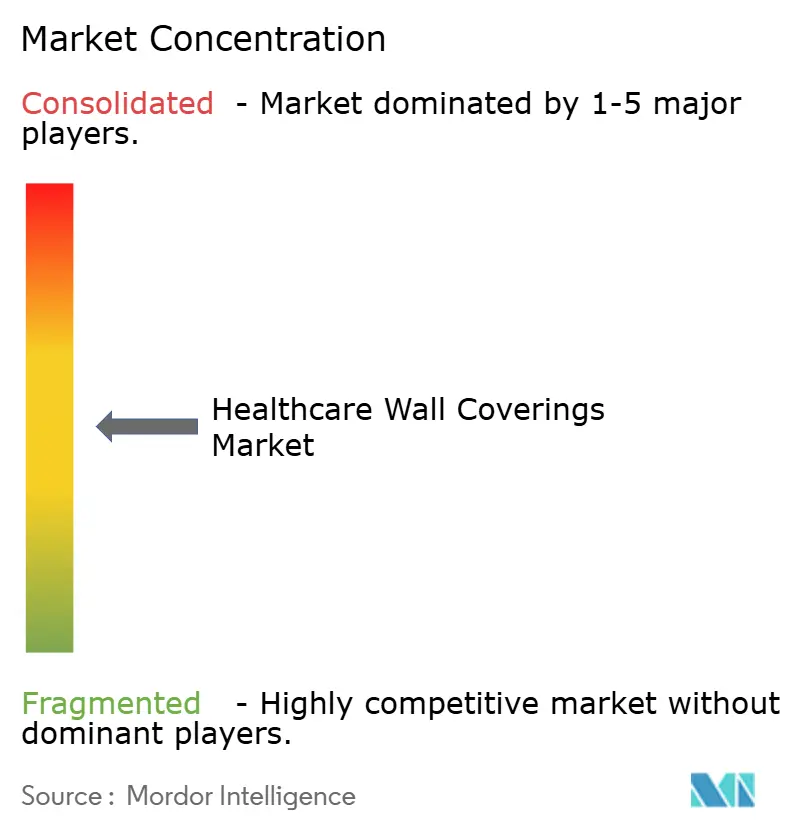
| Market Concentration | Medium |
Major Players
*Disclaimer: Major Players sorted in no particular order Image © Mordor Intelligence. Reuse requires attribution under CC BY 4.0. |
|
Healthcare Wall Coverings Market Analysis by Mordor Intelligence
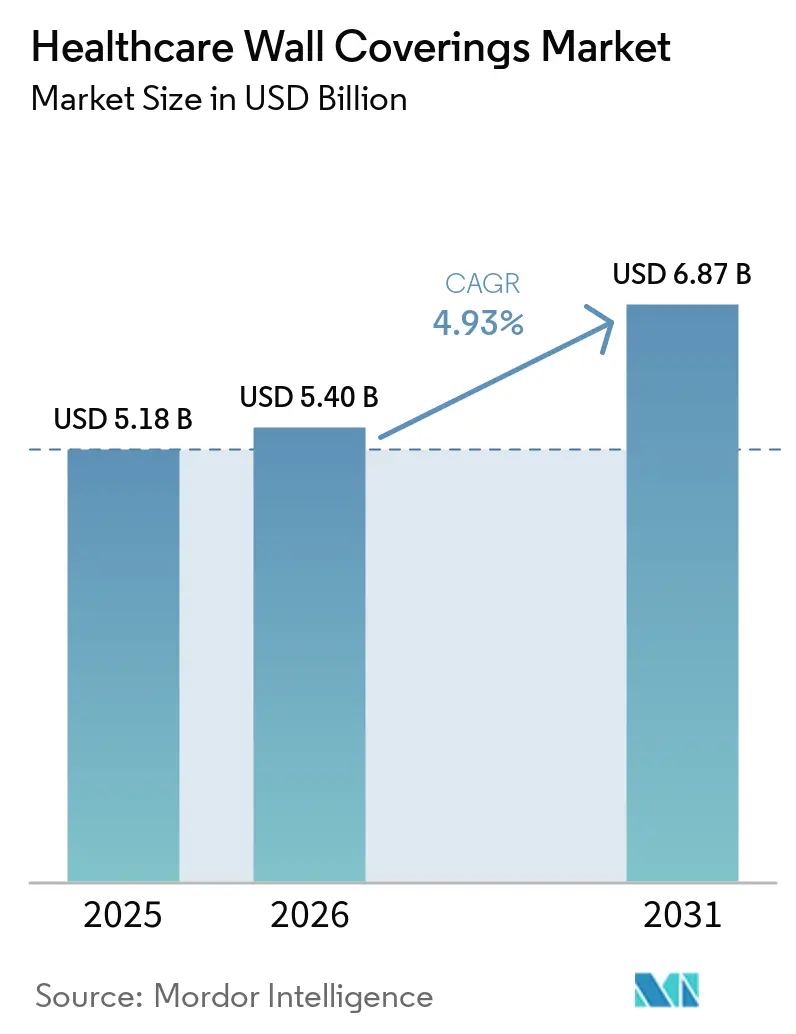
The healthcare wall coverings market was valued at USD 5.18 billion in 2025, is estimated at USD 5.40 billion in 2026, and is forecast to reach USD 6.87 billion by 2031, growing at a 4.93% CAGR during 2026–2031. Infection-control specifications, hospital modernization, and healthcare construction activity support demand for specialized interior finishes. United States healthcare construction spending is running at a seasonally adjusted annual rate of USD 74.5 billion in May 2026, supporting demand for specification-grade interior products[1]U.S. Census Bureau, “Total Construction Spending: Health Care in the United States,” Federal Reserve Bank of St. Louis, fred.stlouisfed.org. The healthcare wall coverings market is shifting from decorative finishes toward systems designed for cleanability, durability, and clinical use. This shift supports higher-value products and longer replacement cycles. Seamless, moisture-resistant retrofit systems are receiving attention because they address renovation demand and the need for continuously cleanable surfaces in isolation rooms and operating rooms.
Key Report Takeaways
- By product type, wallpapers accounted for the largest value share, at 45.83% in 2025, while protective and impact-resistant wall systems are projected to grow at the fastest CAGR of 5.54% during 2026-2031.
- By application, renovation and remodeling accounted for 56.76% of the healthcare wall coverings market size in 2025, while new construction is forecast to expand at a 5.27% CAGR during 2026-2031.
- By distribution channel, indirect sales accounted for 65.48% of the healthcare wall coverings market in 2025, while direct manufacturer sales are forecast to grow at a 5.18% CAGR during 2026-2031.
- North America accounted for the largest value share, at 33.25% in 2025, while Asia-Pacific is projected to grow at the fastest CAGR of 5.73% during 2026–2031.
Note: Market size and forecast figures in this report are generated using Mordor Intelligence’s proprietary estimation framework, updated with the latest available data and insights as of January 2026.
Global Healthcare Wall Coverings Market Trends and Insights
Drivers Impact Analysis*
| Driver | (~) % Impact on CAGR Forecast | Geographic Relevance | Impact Timeline |
|---|---|---|---|
| Expansion of Infection-Control and Cleanability Specifications | +1.2% | Global, the highest enforcement density in North America and Europe | Short term (≤ 2 years) |
| Healthcare Facility Modernization and Renovation Demand | +1.4% | Global, strongest in North America, Western Europe, and mature Asia-Pacific markets | Medium term (2-4 years) |
| Growth of Prefabricated and Modular Healthcare Construction | +0.8% | North America, Australia, Japan, Singapore, the Middle East, and Africa | Medium term (2-4 years) |
| Demand for Durable Wall Protection in High-Traffic Clinical Areas | +0.6% | Global, strongest in high-volume emergency and trauma facilities | Short term (≤ 2 years) |
| Healing-Environment Design and Patient-Centered Interior Programs | +0.7% | North America, Northern and Western Europe, and the Gulf states | Long term (≥ 4 years) |
| Retrofit Demand for Seamless, Moisture-Resistant Surfaces in Aging Facilities | +0.5% | North America, Western Europe, Japan, and Australia | Medium term (2-4 years) |
| Source: Mordor Intelligence | |||
Expansion of Infection-Control and Cleanability Specifications
Infection-control requirements are now a central consideration in the procurement of hospital wall surfaces. In 2023, the Centers for Disease Control and Prevention reported healthcare-associated infections in acute-care hospitals in the United States, with annual treatment costs exceeding USD 4.6 billion[2]Centers for Disease Control and Prevention, “Health Department HAI/AR Programs,” Centers for Disease Control and Prevention, cdc.gov. The World Health Organization reported that 7 in 100 patients in high-income countries acquire at least 1 healthcare-associated infection during hospitalization. The healthcare wall coverings market, therefore, favors materials that can be cleaned effectively and documented against recognized performance standards. A 2026 journal study found that zinc-based antimicrobial wall-covering coatings achieved a 99.8% reduction in E. coli and a 98% reduction in Staphylococcus aureus[3]Manilo, Luis et al. "Gravure Printed Antimicrobial Wallcovering Coatings for Pathogen Reduction," Journal of Coatings Technology and Research, link.springer.com. Products without documented antimicrobial or cleanability performance may be at a disadvantage in hospital tenders.
Healthcare Facility Modernization and Renovation Demand
Renovation activity supports the healthcare wall coverings market because many hospitals need interior upgrades while remaining operational. The 2025 ASHE and Health Facilities Management survey found that 59% of respondents expected more renovation projects in 2025 than in 2024. Renovation projects received 35% of hospital capital budgets in 2024, above the planned 30%, and the estimated share rose to 37% in 2025[4]Health Facilities Management, “2025 Hospital Construction Survey Results,” American Society for Health Care Engineering, hfmmagazine.com. The American Institute of Architects projects healthcare construction spending growth of 2.6% in 2026 and 4.4% in 2027. Large health systems are pursuing replacement facilities, while constrained systems are prioritizing targeted upgrades that improve infection control. This pattern supports seamless vinyl and thermoplastic systems that reduce grout maintenance and moisture-related repair needs.
Growth of Prefabricated and Modular Healthcare Construction
Prefabrication is changing how interior wall systems are specified and installed in clinical facilities. Healthcare construction costs have risen from USD 115-160 per square foot in 1996 to USD 650-850 per square foot in 2026, thereby increasing the value of schedule savings. Modular assemblies can reduce site sequencing requirements and limit disruption during construction. The healthcare wall coverings market benefits where panelized systems combine wall surfaces, electrical routing, and other clinical infrastructure. Such systems have been used in acoustically sensitive care areas and can meet indoor air quality requirements. The procurement model can favor a smaller group of approved manufacturers because integrated assemblies require early technical selection. This change reduces the role of a stand-alone wallpaper installer on projects that use fully engineered wall programs.
Healing-Environment Design and Patient-Centered Interior Programs
Patient-centered design is expanding the range of materials and design choices considered for healthcare interiors. A 2026 systematic review found that biophilic approaches, including nature-inspired imagery and materials, can support stress recovery, reduce perceived pain, and enhance emotional well-being. Healthcare wall coverings can therefore combine clinical performance with visual and acoustic features. Textured non-wovens, custom murals, and fabric-backed acoustic panels have applications in pediatric, oncology, waiting, and behavioral health settings. The healthcare wall coverings market can also benefit from design support, digital libraries, and specification services that accompany premium products. Low-emission credentials remain important when indoor air quality standards guide material selection. These requirements shift competition away from price alone and toward product documentation and design support.
Restraints Impact Analysis*
| Restraint | (~) % Impact on CAGR Forecast | Geographic Relevance | Impact Timeline |
|---|---|---|---|
| High Installation Skill Requirements and Substrate-Preparation Risk | -0.8% | Global, most acute in emerging Asia-Pacific, Middle East, and Africa markets | Medium term (2-4 years) |
| Chemical, Fire, VOC, and Antimicrobial Compliance Complexity | -0.6% | Global, the highest regulatory pressure in Europe and North America | Short term (≤ 2 years) |
| Product and Installation Cost Versus Paint and Conventional Finishes | -1.9% | Global, strongest in South America, Southeast Asia, and Sub-Saharan Africa | Medium term (2-4 years) |
| End-of-Life Recycling Constraints for Multilayer PVC and Composite Panels | -0.7% | Europe, with early effects in North America | Long term (≥ 4 years) |
| Source: Mordor Intelligence | |||
Product and Installation Cost Versus Paint and Conventional Finishes
Higher product and installation costs remain a major constraint for the healthcare wall coverings market. Specification-grade vinyl and thermoplastic systems cost 3-5 times more per square foot installed than premium healthcare-grade paint. They also require substrate preparation, seam sealing, adhesive curing, and trained installers. The United States healthcare construction labor costs are rising by 6-8% annually, placing further pressure on skill-intensive wall installation work. Public-sector facilities in South America, Southeast Asia, and Sub-Saharan Africa can defer specialized finishes when budgets are limited. Lifecycle models can favor durable wall systems over 10-15 years, but many hospital capital budgets operate on 3-5-year planning cycles.
End-of-Life Recycling Constraints for Multilayer PVC and Composite Panels
End-of-life management creates a growing compliance issue for multilayer PVC and composite wall products. VinylPlus Healthcare reported in April 2025 that flexible medical PVC could be recycled up to 6 times without a decline in material quality. This finding supports circular material claims for some healthcare applications. However, mixed-material panels remain difficult to recycle because their components must be separated. The healthcare wall coverings market faces further reformulation pressure where PVC formulations use phthalate groups regulated under REACH. Manufacturers that can demonstrate recycling pathways and compliant formulations may be better placed in European institutional procurement.
*Our forecasts treat driver/restraint impacts as directional, not additive. The impact forecasts reflect baseline growth, mix effects, and variable interactions.
Segment Analysis
By Product Type: Wallpapers Lead, While Protective Systems Gain Ground
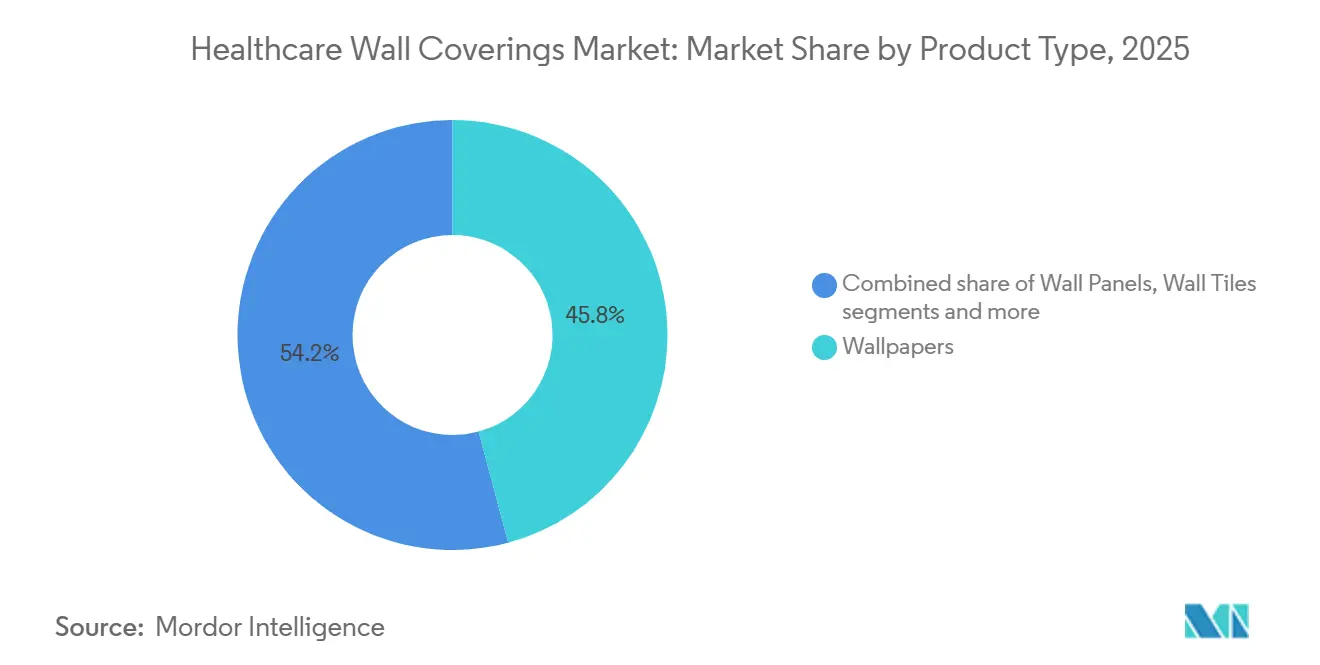
Wallpapers accounted for 45.83% of the healthcare wall-covering market share in 2025, making them the largest product category. Their position reflects the installed base of Type II vinyl across hospitals built between the 1980s and 2010s. Those facilities are entering renovation cycles, creating replacement demand. Vinyl and PVC formulations remain widely used because Type II and Type III products offer durable surfaces for clinical areas. These materials can resist common hospital disinfectants and meet fire-performance expectations in many North American institutional settings. Non-woven wallpapers are gaining popularity because they provide dimensional stability and support digital-print customization.
Protective and impact-resistant systems are the fastest-growing product category, with the healthcare wall coverings market size for this segment forecast to rise at a 5.54% CAGR through 2031. Their appeal is linked to damage from wheelchairs, IV poles, and patient-transport equipment in busy corridors and emergency departments. Acoustic, decorative, and textile panel variants also support patient-facing and sound-sensitive areas. Wall tiles and slabs remain useful in wet rooms, operating rooms, sterile supply areas, and pharmacies. Metal wall coverings serve a specialized role in high-sterilization areas and hospital lobbies.



By Application: Renovation Activity Underpins Baseline Demand
Renovation and remodeling accounted for 56.76% of the healthcare wall coverings market in 2025. Aging hospital buildings in North America and Europe support this demand because many acute-care facilities have been in service for 40-60 years. The 2025 ASHE survey found that renovation absorbed 37% of estimated hospital capital budgets. Renovation work often includes emergency remediation and infection-control upgrades that may not appear in initial capital plans. Active-hospital access limits and varying substrate conditions can increase labor time by 30-50% per square foot.
New construction is forecast to grow at a 5.27% CAGR through 2031, the fastest application rate among healthcare wall coverings. United States hospital and clinic construction starts are projected to reach USD 30.7 billion in 2026, an 11.6% increase over 2025. Hospital bed shortages in the Asia-Pacific and Middle East, and Africa also support greenfield construction. Wall finish specifications can be included in design documents at the programming stage. This early selection can establish product standards for the facility’s operating life.
By Distribution Channel: Distributor Networks Hold Structural Advantage
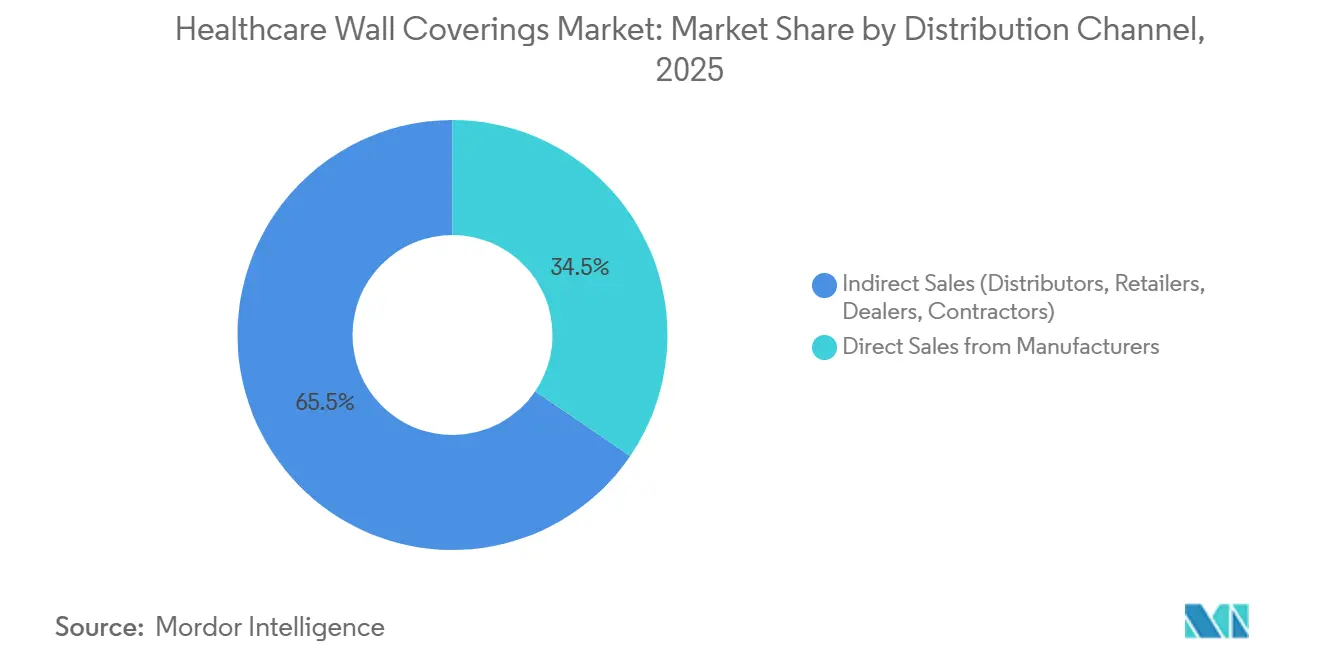
Indirect sales through distributors, dealers, and contractors accounted for 65.48% of the healthcare wall coverings market revenue in 2025. This channel suits project-based procurement, where general contractors rely on established distributors for access to products, estimating information, and trade credit. Distributors can combine products from several manufacturers into a single project submission. Specialty healthcare distributors also maintain product libraries aligned with clinical building requirements. Sustainability certifications can strengthen the position of distributors that carry compliant portfolios.
Direct manufacturer sales are forecast to grow at a 5.18% CAGR through 2031 in the healthcare wall coverings market. Manufacturers are building specification-support teams that work with designers, infection-control specialists, and facilities leaders before formal bids. Direct engagement is particularly relevant for headwall assemblies, modular panels, and full wall-protection programs. These products often need engineering support beyond standard distribution logistics. Futrus uses Corian Healthwall programs to support technical engagement.
Geography Analysis
North America accounted for 33.25% of the healthcare wall coverings market revenue in 2025. The region has strong regulatory enforcement, established product ecosystems, and large acute-care construction programs. The United States healthcare construction spending is at a seasonally adjusted annual rate of USD 74.5 billion in May 2026. Large health systems are building replacement hospitals, while other systems are undertaking targeted infection-control renovations.
Europe is a mature healthcare wall coverings market where compliance and circularity shape material selection. REACH restrictions on phthalate groups and fire-performance requirements create a high barrier to entry for low-grade products. NHS England’s 2025 cleanliness standards specify cleanability expectations for wall and ceiling surfaces. VinylPlus is advancing material passport work as part of the region’s circular-economy agenda. Germany, France, the Nordics, Spain, Italy, and BENELUX support demand through public healthcare renovation cycles.
Asia-Pacific is forecast to grow at a 5.73% CAGR through 2031, giving it the fastest regional outlook in the healthcare wall coverings market. Capacity additions in China, India, Japan, South Korea, Australia, and Southeast Asia support demand for clinical interior products. Singapore’s 2026 institutional demand target is USD 9.03-10.43 billion (SGD 11.6-13.4 billion), including hospital developments with specialized interior fit-outs. Institutional demand is driven mainly by Changi Airport Terminal 5, and the New Tengah General & Community Hospital is among the major projects. India is adding antimicrobial surface specifications to some government hospital procurement frameworks. China is tightening indoor air quality standards for wall materials, while Japan, South Korea, and Australia have established hygiene-focused building practices. The Middle East and Africa remain smaller, but hospital projects and renovation programs in Gulf states, Nigeria, and South Africa are supporting gradual adoption.
Competitive Landscape
The healthcare wall coverings market is moderately concentrated, led by Saint-Gobain, Gerflor, Tarkett, Altro, and Wilsonart, with regional specialists including Crane Composites, Marlite, BioClad, Trovex, Futrus, and NUDO competing below this group. Competition below this group is fragmented among regional specialists, including BioClad, Rearo, Trovex, Futrus, NUDO, Marlite, and Crane Composites. Larger suppliers compete through certification coverage, technical support, and broad healthcare product portfolios. Coordinated wall systems can strengthen supplier relationships by combining preparation, decorative materials, edge protection, and field support.
Futrus showcased its Corian solid surface healthcare portfolio, including the Prima Healthwall (built on HSI's patented rail system), at HCD 2025. Momentum Textiles demonstrates the interest in lower-carbon materials through Circon, a Type II wallcovering made with 70% bio-sourced material and certified GREENGUARD Gold. Wolf-Gordon launched PVC-free RAMPART Resolve for healthcare settings and acquired Andor Willow to expand its architectural surface portfolio. Fundermax has expanded its Max Compact Interior Plus range for wet-area and chemical-exposure healthcare uses.
Seamless retrofit systems for operating rooms and isolation suites remain a focus area because they must provide continuous, fluid-resistant surfaces with limited facility downtime. Bio-based and low-carbon formulations are also receiving attention as material sustainability becomes more relevant to institutional procurement. Digital printing on clinical-grade substrates can help suppliers offer hospital-specific mural and pattern programs. BIM libraries and visualization tools can improve engagement with design firms during the specification process. ANSI/NSF 342 certification can strengthen preferred-vendor positioning for suppliers and distributors with verified sustainability programs. Plant-fiber and bio-resin panels are beginning to enter settings where clinical performance and lower-carbon material credentials are both required.
Healthcare Wall Coverings Industry Leaders
-
Compagnie de Saint-Gobain S.A.
-
Gerflor Group
-
Tarkett S.A.
-
Crane Composites, Inc.
-
Marlite, Inc.
- *Disclaimer: Major Players sorted in no particular order

Recent Industry Developments
- May 2026: Momentum Textiles & Wallcovering launched its first wallcovering alliance program with Haworth, expanding the availability of Circon, its bio-sourced, carbon-neutral Type II vinyl wallcovering.
- October 2025: Futrus unveiled a portfolio of Corian solid surface healthcare solutions at the Healthcare Design Conference + Expo (HCD) 2025 in Kansas City, positioned around infection control, durability, and design adaptability.


Global Healthcare Wall Coverings Market Report Scope
Healthcare wall coverings are manufactured to meet the stringent hygiene, durability, and functional demands of medical environments. The healthcare wall coverings market is segmented by product type, application, distribution channel, and geography. By product type, the market is segmented into wallpapers (vinyl and PVC-based, non-woven, paper-based, fabric and textile, and other materials), wall panels (acoustic, decorative 3D, textile and felt, and wood and plant-fiber), wall tiles and slabs, metal wall coverings, protective and impact-resistant wall systems, and other product types. By application, the market is segmented into new construction, renovation, and remodeling. By distribution channel, the market is segmented into direct sales from manufacturers and indirect sales (distributors, retailers, dealers, contractors). By geography, the market is segmented into North America, South America, Europe, Asia-Pacific, and the Middle East & Africa. The report provides the market size in USD value for all the above-mentioned segments.
| Wallpapers | Vinyl and PVC-Based Wallpapers |
| Non-Woven Wallpapers | |
| Paper-Based Wallpapers | |
| Fabric and Textile Wallpapers | |
| Other Materials | |
| Wall Panels | Acoustic Wall Panels |
| Decorative 3D Wall Panels | |
| Textile and Felt Wall Panels | |
| Wood and Plant-Fiber Wall Panels | |
| Wall Tiles and Slabs | |
| Metal Wall Coverings | |
| Protective and Impact-Resistant Wall Systems | |
| Other Product Types |
| New Construction |
| Renovation and Remodeling |
| Direct Sales from Manufacturers |
| Indirect Sales (Distributors, Retailers, Dealers, Contractors) |
| North America | Canada |
| United States | |
| Mexico | |
| South America | Brazil |
| Peru | |
| Chile | |
| Argentina | |
| Rest of South America | |
| Europe | United Kingdom |
| Germany | |
| France | |
| Spain | |
| Italy | |
| BENELUX (Belgium, Netherlands, Luxembourg) | |
| NORDICS (Denmark, Finland, Iceland, Norway, Sweden) | |
| Rest of Europe | |
| Asia-Pacific | India |
| China | |
| Japan | |
| Australia | |
| South Korea | |
| South-East Asia | |
| Rest of Asia-Pacific | |
| Middle East and Africa | United Arab Emirates |
| Saudi Arabia | |
| South Africa | |
| Nigeria | |
| Rest of Middle East and Africa |
| By Product Type | Wallpapers | Vinyl and PVC-Based Wallpapers |
| Non-Woven Wallpapers | ||
| Paper-Based Wallpapers | ||
| Fabric and Textile Wallpapers | ||
| Other Materials | ||
| Wall Panels | Acoustic Wall Panels | |
| Decorative 3D Wall Panels | ||
| Textile and Felt Wall Panels | ||
| Wood and Plant-Fiber Wall Panels | ||
| Wall Tiles and Slabs | ||
| Metal Wall Coverings | ||
| Protective and Impact-Resistant Wall Systems | ||
| Other Product Types | ||
| By Application | New Construction | |
| Renovation and Remodeling | ||
| By Distribution Channel | Direct Sales from Manufacturers | |
| Indirect Sales (Distributors, Retailers, Dealers, Contractors) | ||
| By Geography | North America | Canada |
| United States | ||
| Mexico | ||
| South America | Brazil | |
| Peru | ||
| Chile | ||
| Argentina | ||
| Rest of South America | ||
| Europe | United Kingdom | |
| Germany | ||
| France | ||
| Spain | ||
| Italy | ||
| BENELUX (Belgium, Netherlands, Luxembourg) | ||
| NORDICS (Denmark, Finland, Iceland, Norway, Sweden) | ||
| Rest of Europe | ||
| Asia-Pacific | India | |
| China | ||
| Japan | ||
| Australia | ||
| South Korea | ||
| South-East Asia | ||
| Rest of Asia-Pacific | ||
| Middle East and Africa | United Arab Emirates | |
| Saudi Arabia | ||
| South Africa | ||
| Nigeria | ||
| Rest of Middle East and Africa | ||


Key Questions Answered in the Report
What is the projected value of healthcare wall coverings in 2031?
The healthcare wall coverings market is forecast to reach USD 6.87 billion by 2031, from USD 5.40 billion in 2026.
Which product category leads healthcare wall coverings?
Wallpapers led with 45.83% revenue share in 2025, supported by the installed base of Type II vinyl in hospitals.
Which healthcare wall product is growing fastest?
Protective and impact-resistant wall systems are forecast to grow at a 5.54% CAGR through 2031.
Why are hospitals selecting specialized wall surfaces?
Infection-control needs, cleanability requirements, durable performance, and renovation activities support the use of specialized materials.
Which application creates the most demand for these products?
Renovation and remodeling accounted for 56.76% of revenue in 2025, while new construction has the fastest application growth outlook at a 5.27% CAGR.
Which region has the strongest growth outlook?
Asia-Pacific is forecast to grow at 5.73% CAGR through 2031 as hospital capacity and clinical construction expand.
Page last updated on:


 Your data is secure and never sold or shared.


