
PVC-Free Wall Coverings Market Size and Share
Market Overview
| Study Period | 2020 - 2031 |
|---|---|
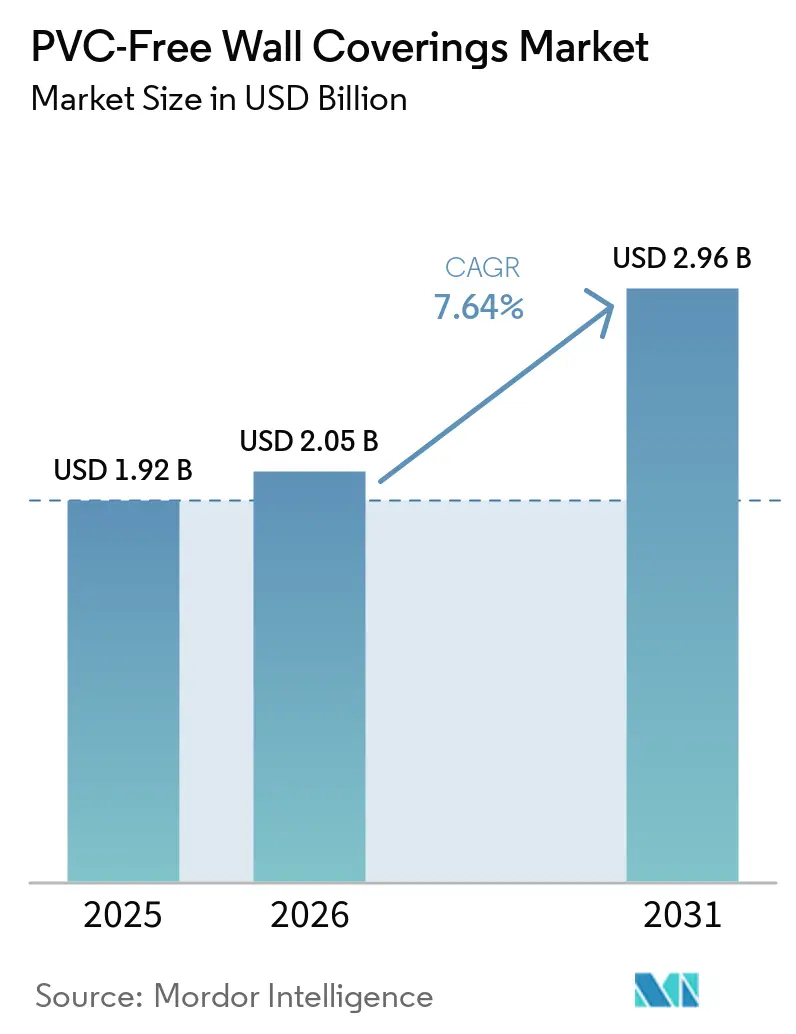
| Market Size (2026) | USD 2.05 Billion |
| Market Size (2031) | USD 2.96 Billion |
| Growth Rate (2026 - 2031) | 7.64 % |
| Fastest Growing Market | Asia-Pacific |
| Largest Market | Europe |
| Market Concentration | Low |
Major Players *Disclaimer: Major Players sorted in no particular order Image © Mordor Intelligence. Reuse requires attribution under CC BY 4.0. | |
PVC-Free Wall Coverings Market Analysis by Mordor Intelligence
The PVC-free wall coverings market size is projected to expand from USD 1.92 billion in 2025 and USD 2.05 billion in 2026 to USD 2.96 billion by 2031, registering a CAGR of 7.6% between 2026 and 2031. The PVC-free wall coverings market includes eco-friendly interior decoration and architectural products manufactured without polyvinyl chloride (PVC). These sustainable alternatives use paper, textiles, or polyolefin blends, such as thermoplastic polyolefin (TPO), along with water-based inks to reduce toxic chemical emissions, harmful volatile organic compounds (VOCs), and environmental waste in residential and commercial spaces. Regulatory attention on halogenated materials, wider use of green building standards, and demand for documented low-VOC finishes support adoption. Healthcare, hospitality, education, and office projects increasingly require material transparency in their interior specifications. These requirements favor products with environmental declarations, health documentation, and proven commercial performance. Suppliers are responding with non-woven, olefin, TPO, and recycled-fiber alternatives that address both performance and materials concerns. Price remains an important limitation because commodity vinyl benefits from established supply chains and familiar installation practices.
Key Report Takeaways
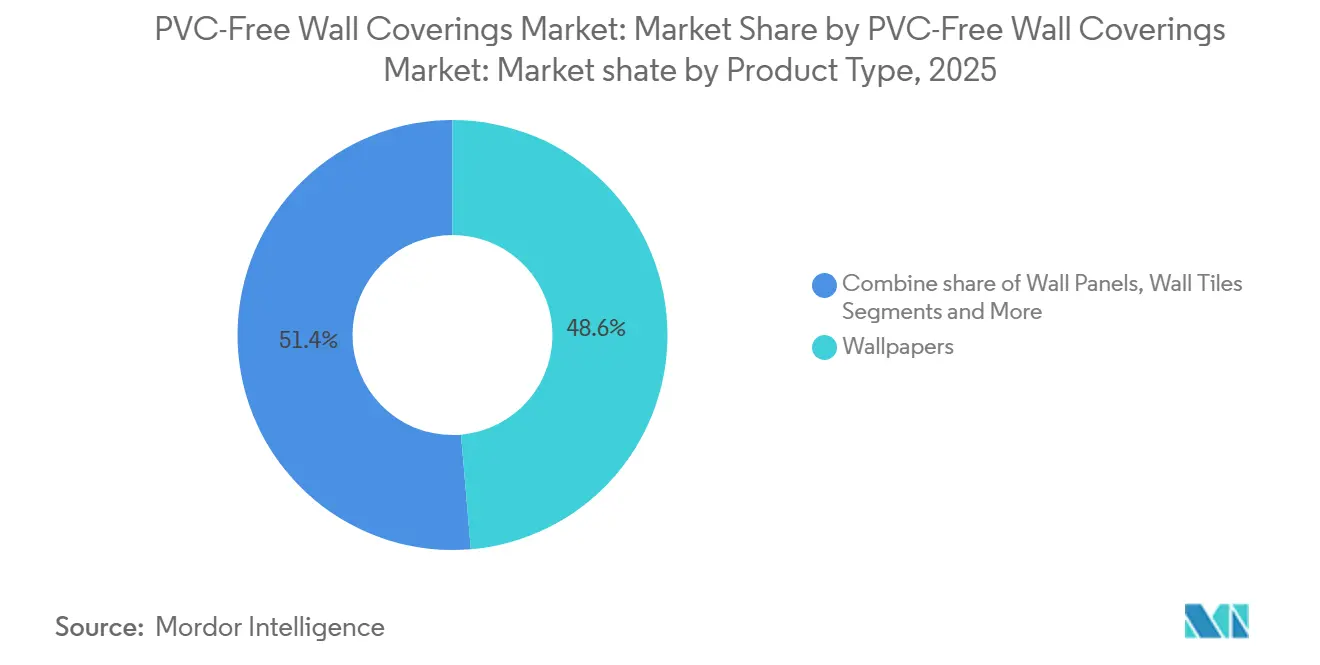
- By product type, wallpapers held 48.6% of the PVC-free wall coverings market in 2025, while wall panels are forecast to grow at a 7.8% CAGR through 2031.
- By construction type, renovation and retrofit accounted for 61.3% of the PVC-free wall coverings market in 2025, while new construction is forecast to expand at a 7.7% CAGR through 2031.
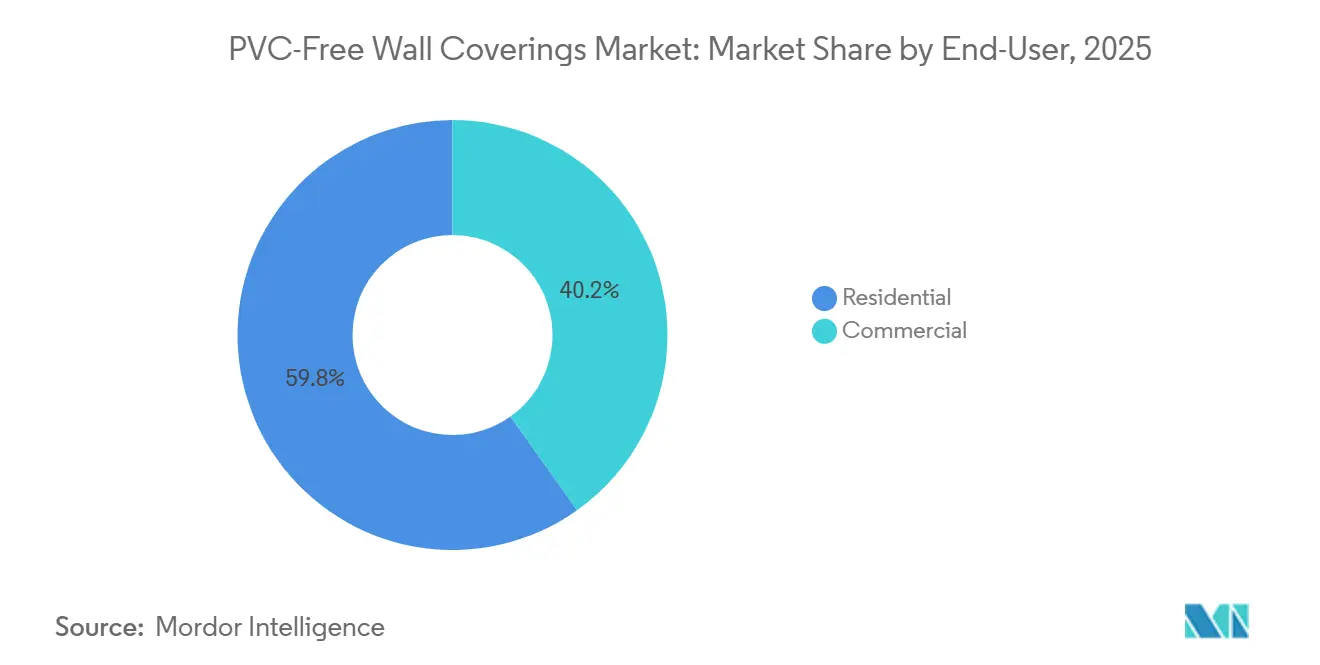
- By end-user, residential held 59.8% of the PVC-free wall coverings market in 2025, while commercial is forecast to advance at an 8.1% CAGR through 2031.
- By distribution channel, B2C channels held 64.5% of the PVC-free wall coverings market in 2025, while B2B channels are forecast to grow at an 8.0% CAGR through 2031.
Note: Market size and forecast figures in this report are generated using Mordor Intelligence’s proprietary estimation framework, updated with the latest available data and insights as of January 2026.
Global PVC-Free Wall Coverings Market Trends and Insights
Drivers Impact Analysis*
| Driver | (~) % Impact on CAGR Forecast | Geographic Relevance | Impact Timeline |
|---|---|---|---|
| PVC Substitution in Health-Conscious Commercial Interiors | +2.1% | North America and Europe, with spillover to the Asia-Pacific | Medium term (2-4 years) |
| Low-VOC and Red-List Material Specifications in Green Buildings | +1.8% | North America, core EU markets, and emerging Asia-Pacific markets | Long term (≥ 4 years) |
| Commercial Renovation and Hospitality Brand Differentiation | +1.2% | Global, led by Europe and Asia-Pacific | Medium term (2-4 years) |
| Digital Printing and Short-Run Customization on PVC-Free Substrates | +0.9% | Global, strongest in North America and the EU | Short term (≤ 2 years) |
| Type II Performance Parity Expanding Non-Vinyl Specification | +0.7% | North America and the EU | Long term (≥ 4 years) |
| Recycled-Fiber and Bio-Based Substrate Innovation | +0.6% | Core EU markets, with spillover to North America | Long term (≥ 4 years) |
| Source: Mordor Intelligence | |||
PVC Substitution in Health-Conscious Commercial Interiors
Healthcare, higher education, and senior living buyers are placing greater weight on indoor air quality and material transparency when selecting wall finishes. This is moving some commercial specifications away from conventional vinyl and toward verified PVC-free alternatives. The ANSI/NSF 342 standard is the wallcovering-specific sustainability assessment used in the United States. It's 2024, and the 2025 revision process considered stronger human health and wellness criteria, according to the Wallcoverings Association and Wolf-Gordon. Approved product lists make this shift durable because the list can guide many projects after a product has been reviewed. Carnegie Fabrics states that its Noragi Stripe alternative contains 80% olefin composite and 20% post-industrial recycled olefin, and is free of PVC, PFAS, and halogenated flame retardants. The PVC-free wall coverings market benefits when more products can meet commercial performance needs without relying on vinyl.
Low-VOC and Red-List Material Specifications in Green Buildings
Green building programs turn environmental targets into documented material requirements for many projects. In 2025, 7,500 commercial projects received LEED certification across 147 million square meters globally, with mainland China, India, and Canada among the leading international locations. These projects create a substantial setting for low-emitting interior materials and product documentation. The PVC-free wall coverings market is supported when such coverings can meet project requirements through declarations and recognized certifications. LEED v4 includes an NSF/ANSI 342 pilot credit that recognizes qualifying wallcoverings as a compliance route. This gives manufacturers a reason to invest in emissions documentation, material disclosure, and verified product attributes. The effect is strongest in projects where sustainability requirements are part of the design brief rather than an optional purchasing preference.
Commercial Renovation and Hospitality Brand Differentiation
Commercial renovation cycles create repeat demand for wall finishes because interiors are renewed more often than building structures. In Europe, the Energy Performance of Buildings Directive requires member states to prepare national building renovation plans. The European Commission reported that 15 member states submitted plans from December 2025 through May 2026[1]. This policy setting supports renovation activities, including upgrades to interior materials. Hospitality projects also use renovation programs to align guest spaces with brand standards and sustainability commitments. Property improvement plans can make wallcovering selection a recurring, managed specification decision instead of a one-time purchase. The PVC-free wall coverings market presents an opportunity, as these programs seek products with documented health, durability, and environmental credentials.
Digital Printing and Short-Run Customization on PVC-Free Substrates
Digital printing allows designers to order project-specific patterns in shorter runs than traditional production methods. This makes customization more accessible for boutique hospitality, offices, residential projects, and small commercial spaces. Ahlstrom displayed its WallStar Digital portfolio at FESPA 2026 in Barcelona, including PVC-free nonwoven substrates for digital printing [2]. The portfolio covers four product tiers and includes pre-pasted and self-adhesive formats. Such formats can reduce the practical barriers to choosing a PVC-free printable substrate. Customization also gives suppliers a way to compete on design flexibility rather than only on material composition. This supports the PVC-free wall coverings market, where buyers require both tailored graphics and lower-plastic-content options.
Restraints Impact Analysis*
| Restraint | (~) % Impact on CAGR Forecast | Geographic Relevance | Impact Timeline |
|---|---|---|---|
| Higher Delivered Cost Versus Commodity Vinyl | -1.4% | Global, most severe in price-sensitive Asia-Pacific and South America | Medium term (2-4 years) |
| Fire, Cleanability, and Impact-Performance Qualification Barriers | -0.9% | North America and the EU | Short term (≤ 2 years) |
| Limited End-of-Life Collection for Multi-Material Wallcoverings | -0.5% | EU markets with high circular economy expectations | Long term (≥ 4 years) |
| Installer Familiarity and Application-Quality Risk | -0.4% | Global, most pronounced in emerging markets | Short term (≤ 2 years) |
| Source: Mordor Intelligence | |||
Higher Delivered Cost Versus Commodity Vinyl
PVC-free products can cost more than conventional vinyl because olefin, non-woven, and bio-based inputs have different cost structures. The gap is important in mid-market hospitality projects in Southeast Asia and residential construction in South America. In these settings, buyers may choose alternatives only when a contract or project requirement calls for them. Commodity vinyl also benefits from established petrochemical supply chains and broad familiarity among installers. The PVC-free wall coverings market, therefore, depends on suppliers narrowing cost gaps without compromising durability or design. Momentum Textiles and Versa presented Circon as a bio-sourced Type II substrate with commercial vinyl price equivalence in selected applications. Products that meet the required performance at a more accessible price can extend adoption to budget-constrained projects.
Fire, Cleanability, and Impact-Performance Qualification Barriers
Healthcare, education, and high-traffic hospitality sites need wallcoverings that meet fire, scrub, and impact requirements. In the United States, commercial wallcoverings may need to meet ASTM E-84 Class A ratings, ASTM F793 classification, and compatibility with hospital cleaning protocols. These requirements create a qualification burden for new PVC-free products. Koroseal states that its Linsey PVC-Free Type II product has a Class A ASTM E-84 fire rating, HPD documentation, and LEED compliance[3]. C/S Group's Acrovyn PVC-Free product also holds an EPD issued in accordance with ISO 14025 and EN 15804+A2, valid through April 2030. Smaller suppliers may find testing and documentation costly, which can limit product choice and slow portfolio development in the PVC-free wall coverings market.
*Our forecasts treat driver/restraint impacts as directional, not additive. The impact forecasts reflect baseline growth, mix effects, and variable interactions.
Segment Analysis
By Product Type: Non-Woven and Natural Substrates Expand Wallpaper Applications
Wallpapers accounted for 48.6% of the value of PVC-free wall coverings in 2025. Their position reflects availability across consumer retail and commercial specification channels. Non-woven products combine dimensional stability, strippability, and compatibility with low-VOC water-based adhesives. They can also eliminate the soak time for some paper-backed products. These application advantages can reduce installation effort during commercial renovation. The category now serves projects that previously favored vinyl for practical handling and replacement needs.
Wall panels are the fastest-growing product type, with the value of PVC-free wall coverings for this segment forecast to grow at a 7.8% CAGR from 2026 to 2031. Wood and plant-fiber panels support hospitality and wellness interiors that favor natural materials. In June 2026, Spinneybeck introduced Søuld Fragments, a modular acoustic wall tile made from Danish eelgrass offcuts[4]. Fabric and textile wallpapers are used in premium hospitality and office projects where tactile finishes are valued. Acoustic panels are used in open-plan workplaces and healthcare settings where sound control matters. Wall tiles, slabs, metal finishes, and protective systems are used in corridors, food service spaces, and care facilities where hygiene and surface life are central requirements.

By Construction Type: Renovation and Design-Stage Decisions Shape Demand
Renovation and retrofit accounted for 61.3% of the PVC-free wall coverings market in 2025. This reflects ongoing commercial refurbishment and the policy-led pipeline of building upgrades in Europe. Wallcoverings in high-traffic commercial spaces are commonly replaced every 7 to 10 years. Each replacement cycle creates a new material and installation decision. Facility managers and interior designers typically make these decisions within defined renovation budgets. This allows suppliers to show how non-vinyl products perform in completed projects.
New construction is forecast to grow at a 7.7% CAGR from 2026 to 2031. Design teams can lock material choices into project documents before procurement begins. Health product declarations, declare labels, and environmental product documentation can therefore influence the product set at an early stage. The PVC-free wall coverings industry benefits when suppliers can meet these requirements before a project reaches the tender stage. Certification and documentation can have value across multiple projects because firms apply their standards repeatedly. This makes design-stage compliance important for long-term access to specifications.
By End-User: Commercial Projects Increase Demand for Documented Materials
Residential retained 59.8% of the share of the PVC-free wall coverings market in 2025. Home improvement activity, DIY projects, professional renovation, and online retail support the segment. Residential buyers often look for affordable prices, a broad range of options, and a straightforward application process. E-commerce platforms also help small contractors and homeowners order short-run, digitally printed products. These routes give suppliers a way to reach buyers who do not use formal commercial specifications. The residential base remains important because it provides volume across retail and online channels.
Commercial is the fastest-growing end-user segment at an 8.1% CAGR through 2031. Healthcare operators, hospitality brands, and corporate occupiers often require documentation for material transparency and indoor environmental quality. Designtex, Koroseal, and Carnegie Fabrics have developed commercial PVC-free lines with fire, scrub, and antimicrobial performance for these settings. Hospitality is a high-velocity specification channel because Property improvement plans govern surface choices during renovations. Some hotel brands increasingly reference NSF/ANSI 342-certified wallcoverings in their brand requirements. This creates repeat specification events at individual properties every 5 to 7 years. The PVC-free wall coverings industry can benefit when manufacturers combine product performance with relationships across architecture, design, and hotel procurement channels.
By Distribution Channel: B2B Channels Serve Higher-Value Project Purchases
B2C channels accounted for 64.5% of the PVC-free wall coverings market in 2025. These channels include hypermarkets, specialty wallpaper stores, home centers, online platforms, and local retail. They serve residential buyers with a wide range of products and accessible price points. Online platforms are an important part of this channel because they support short-run custom wallpaper orders. These services can make tailored products available without traditional minimum order quantities. The broad reach of B2C channels supports category awareness among household buyers and small contractors.
B2B channels are forecast to expand at a 8.0% CAGR from 2026 to 2031. Contractors, installers, interior designers, architects, and institutional procurement teams use this route for commercial buildings and hospitality properties. A single project decision can cover large wall areas and create a higher-value order. NSF/ANSI 342 assesses both manufacturers and distributors, which makes qualified distribution relevant for projects seeking compliance credit. Certified distributors can be better positioned to serve LEED-related and brand-standard project requirements. The channel may therefore favor distributors that can provide product documentation, technical support, and dependable project delivery. These capabilities matter alongside product price in the PVC-free wall coverings market.
Geography Analysis
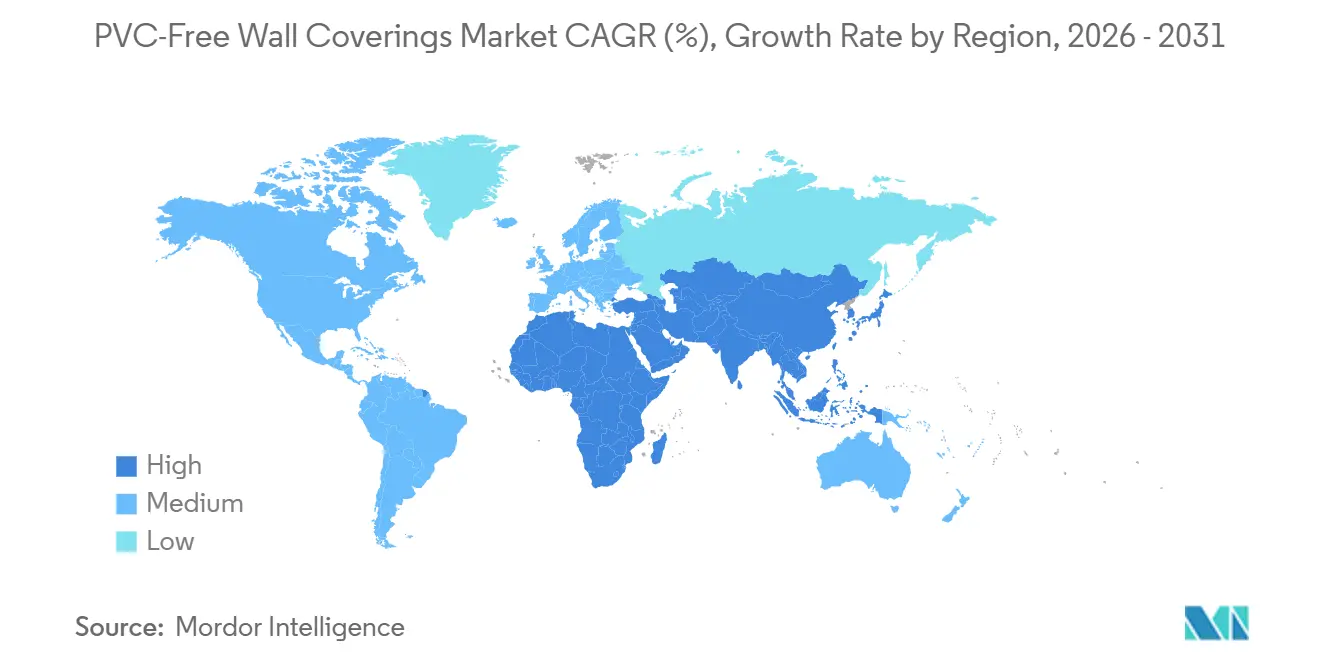
Europe accounted for 37.1% of the PVC-free wall coverings market in 2025. The region has a substantial commercial retrofit base and strong use of building certification systems. The European Commission's assessment of renovation plans shows continued policy attention to building upgrades across member states. Germany, the United Kingdom, and the Nordic countries support demand for non-woven and premium wallcoverings. A.S. Création Tapeten and Marburger Tapetenfabrik have established positions in non-woven wallpaper production. Graham & Brown and Sanderson Design Group serve premium residential and hospitality buyers. Europe remains important because renovation, certification, and materials documentation often reinforce one another.
North America is the second-largest regional contributor to the PVC-free wall coverings market. Demand is supported by commercial office and hospitality renovations, the adoption of LEED, and greater attention to phthalate-containing vinyl. California recorded 470 LEED-certified projects in 2025, representing 98.3 million square feet of certified space. The value of PVC-free wall coverings is also supported by institutional buyers who require documented fire and health testing, as well as cleanability. High-profile renovation projects can raise the visibility of certified materials. Suppliers in the region compete on performance, transparency, documentation, and availability through commercial distributors.
Asia-Pacific is the fastest-growing region, with the value of PVC-free wall coverings forecast to rise at an 8.5% CAGR from 2026 to 2031. Growth is linked to construction activity, the expansion of commercial real estate, and the broader adoption of green building. Price sensitivity limits adoption in some South American residential and mid-market commercial projects. In the Middle East and Africa, hospitality, healthcare, and mixed-use developments create entry points for performance-grade commercial products.
Competitive Landscape
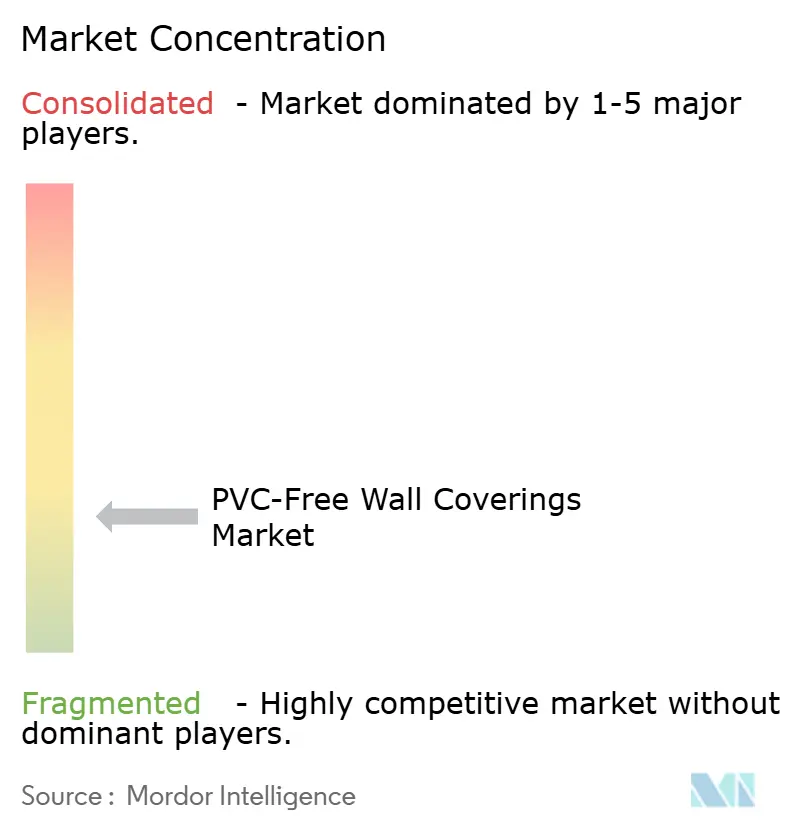
The PVC-free wall coverings market is fragmented. Commercial specification brands and residential wallpaper manufacturers pursue different product and channel strategies. Carnegie Fabrics, Vescom, Koroseal Interior Products, and Designtex focus on olefin, TPO, and recycled-fiber products for healthcare and hospitality projects. Their products must meet Type II performance, fire resistance, cleanability, and material disclosure requirements. Environmental Product Declarations, Health Product Declarations, and NSF/ANSI 342 certification can improve access to documented project requirements. This favors companies that have the technical resources to develop products and maintain documentation. Competition, therefore, extends beyond pattern design to include testing, certification, and specification support.
Vescom's Purefin range is certified for LEED, WELL, BREEAM, and A+ indoor air quality requirements, according to the company. This provides one example of a materials platform designed for several specification systems. C/S Group renewed the EPD for Acrovyn PVC-Free in June 2025, with validity through April 2030. Carnegie Fabrics expanded its Conscious Collection in August 2024 with PVC-free Type II vinyl alternatives containing recycled olefin. These actions show how leading suppliers are using product development and documentation to compete in the PVC-free wall coverings market. They also show that performance verification and transparency are becoming recurring investments.
Bio-based inputs such as flax, hemp, eelgrass, and recycled paper pulp provide room for smaller suppliers to differentiate. These materials can appeal to projects seeking Red List compliance or lower embodied carbon. Digital printing gives residential-oriented companies such as Graham & Brown and Rasch GmbH a route to offer made-to-measure murals and short-run designs. Certification costs can place pressure on smaller manufacturers as standards become more demanding. The PVC-free wall coverings market may therefore see a greater advantage for companies with established compliance systems and distribution relationships.
PVC-Free Wall Coverings Industry Leaders
-
Carnegie Fabrics, LLC
-
Momentum Textiles and Wallcovering
-
Koroseal Interior Products, LLC
-
Vescom B.V.
-
Ahlstrom Oyj
- *Disclaimer: Major Players sorted in no particular order
Recent Industry Developments
- June 2026: Spinneybeck (a MillerKnoll brand) introduced Søuld Fragments, a modular acoustic wall tile crafted from Danish eelgrass offcuts, material collected after it washes ashore as part of the plant's annual life cycle, bringing a fully circular, ocean-sourced bio-material to the commercial wall panel segment. The product extends the Søuld eelgrass collection and demonstrates the viability of marine plant-fiber inputs for certified commercial interior applications
- May 2026: Ahlstrom demonstrated its expanded WallStar® Digital portfolio at FESPA 2026 in Barcelona, showcasing the new Essential range, a 100% PVC-free nonwoven engineered for consistent performance across all digital printing technologies and positioned at accessible commercial price points. The portfolio now spans four tiers: Wallcover, Advance, Essential, and Easy, including pre-pasted and self-adhesive formats, providing digital print substrate coverage without PVC content
Global PVC-Free Wall Coverings Market Report Scope
| Wallpapers | Bio-Based Composite and Plant-Fiber Wallpapers |
| Non-Woven Cellulose and Synthetic Fiber Wallpapers | |
| Paper and Recycled-Fiber Wallpapers | |
| Fabric and Textile Wallpapers | |
| Other Materials | |
| Wall Panels | Acoustic Wall Panels |
| Decorative 3D Wall Panels | |
| Textile and Felt Wall Panels | |
| Wood and Plant-Fiber Wall Panels | |
| Wall Tiles and Slabs | |
| Metal Wall Coverings | |
| Protective and Impact-Resistant Wall Systems | |
| Other Product Types |
| New Construction |
| Renovation/Retrofit |
| Residential |
| Commercial |
| B2C Channels | Hypermarkets and Supermarkets |
| Specialty Wallpaper Stores | |
| Home Centers | |
| Online | |
| Local Shops (unorganized channels) | |
| Other Distribution Channels | |
| B2B Channels (Contractors and Installers, Interior Designers and Architects, Project Procurement and Institutional Sales) |
| North America | Canada |
| United States | |
| Mexico | |
| South America | Brazil |
| Peru | |
| Chile | |
| Argentina | |
| Rest of South America | |
| Europe | United Kingdom |
| Germany | |
| France | |
| Spain | |
| Italy | |
| BENELUX (Belgium, Netherlands, Luxembourg) | |
| NORDICS (Denmark, Finland, Iceland, Norway, Sweden) | |
| Rest of Europe | |
| Asia-Pacific | India |
| China | |
| Japan | |
| Australia | |
| South Korea | |
| South-East Asia | |
| Rest of Asia-Pacific | |
| Middle East & Africa | United Arab Emirates |
| Saudi Arabia | |
| South Africa | |
| Nigeria | |
| Rest of Middle East & Africa |
| By Product Type | Wallpapers | Bio-Based Composite and Plant-Fiber Wallpapers |
| Non-Woven Cellulose and Synthetic Fiber Wallpapers | ||
| Paper and Recycled-Fiber Wallpapers | ||
| Fabric and Textile Wallpapers | ||
| Other Materials | ||
| Wall Panels | Acoustic Wall Panels | |
| Decorative 3D Wall Panels | ||
| Textile and Felt Wall Panels | ||
| Wood and Plant-Fiber Wall Panels | ||
| Wall Tiles and Slabs | ||
| Metal Wall Coverings | ||
| Protective and Impact-Resistant Wall Systems | ||
| Other Product Types | ||
| By Construction Type | New Construction | |
| Renovation/Retrofit | ||
| By End-user | Residential | |
| Commercial | ||
| By Distribution Channel | B2C Channels | Hypermarkets and Supermarkets |
| Specialty Wallpaper Stores | ||
| Home Centers | ||
| Online | ||
| Local Shops (unorganized channels) | ||
| Other Distribution Channels | ||
| B2B Channels (Contractors and Installers, Interior Designers and Architects, Project Procurement and Institutional Sales) | ||
| By Geography | North America | Canada |
| United States | ||
| Mexico | ||
| South America | Brazil | |
| Peru | ||
| Chile | ||
| Argentina | ||
| Rest of South America | ||
| Europe | United Kingdom | |
| Germany | ||
| France | ||
| Spain | ||
| Italy | ||
| BENELUX (Belgium, Netherlands, Luxembourg) | ||
| NORDICS (Denmark, Finland, Iceland, Norway, Sweden) | ||
| Rest of Europe | ||
| Asia-Pacific | India | |
| China | ||
| Japan | ||
| Australia | ||
| South Korea | ||
| South-East Asia | ||
| Rest of Asia-Pacific | ||
| Middle East & Africa | United Arab Emirates | |
| Saudi Arabia | ||
| South Africa | ||
| Nigeria | ||
| Rest of Middle East & Africa | ||
Key Questions Answered in the Report
What is driving demand for PVC-free wall coverings?
Material transparency requirements, low-VOC specifications, green building programs, and commercial renovation activity support demand, especially where project teams require environmental and health documentation before approving interior finishes.
How large is the PVC-free wall coverings market?
The market is projected to grow from USD 2.05 billion in 2026 to USD 2.96 billion by 2031 at a 7.6% CAGR, with demand supported by commercial specification and renovation activity.
Which product category leads PVC-free wall coverings?
Wallpapers led with 48.6% share in 2025, supported by non-woven formats that offer dimensional stability, practical removal, and use across retail and commercial projects.
Which customer segment is growing fastest?
Commercial applications are forecast to grow at an 8.1% CAGR through 2031, driven by healthcare, hospitality, and office specifications that increasingly require documented material attributes.
Which region is growing fastest for PVC-free wall coverings?
Asia-Pacific is forecast to grow at an 8.5% CAGR from 2026 to 2031, supported by construction activity, commercial fit-outs, and wider green building adoption.