
Healthcare Content Management System Market Size and Share
Market Overview
| Study Period | 2020 - 2031 |
|---|---|
| Market Size (2026) | USD 40.31 Billion |
| Market Size (2031) | USD 61.28 Billion |
| Growth Rate (2026 - 2031) | 8.74 % |
| Fastest Growing Market | Asia-Pacific |
| Largest Market | North America |
| Market Concentration | Medium |
Major Players *Disclaimer: Major Players sorted in no particular order Image © Mordor Intelligence. Reuse requires attribution under CC BY 4.0. | |
Healthcare Content Management System Market Analysis by Mordor Intelligence
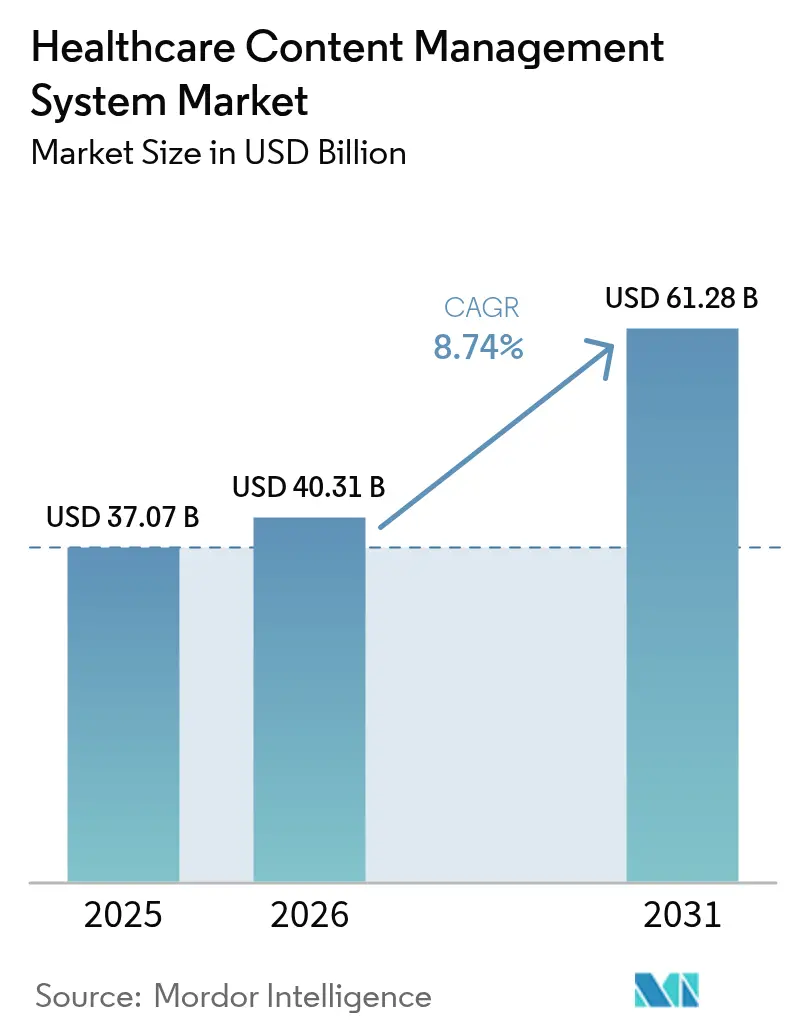
The healthcare content management system market size was valued at USD 37.07 billion in 2025 and estimated to grow from USD 40.31 billion in 2026 to reach USD 61.28 billion by 2031, at a CAGR of 8.74% during the forecast period (2026-2031). Rapid expansion reflects providers’ need to modernize document workflows in response to EHR-driven interoperability mandates, HIPAA/GDPR retention rules that extend data life cycles, and the cost advantages of cloud-based services over on-premise platforms. Added momentum comes from telehealth adoption, which requires real-time access to unstructured content, and from AI-enabled intelligent document processing that automates data capture from clinician notes and imaging reports. Competition intensifies as cloud-native disruptors challenge legacy vendors on scalability, security, and embedded analytics, pushing incumbents to invest in managed services and AI add-ons to defend share. Implementation skills shortages and rising compliance costs encourage healthcare organizations to outsource integration and support, which accelerates the services revenue pool relative to core software licenses. Collectively, these forces confirm a long-run shift from document repositories to cloud-delivered, workflow-centric, and AI-augmented platforms within the healthcare content management system market.
Key Report Takeaways
- By component, software commanded 61.62% of healthcare content management system market share in 2025, yet services are growing fastest at a 9.78% CAGR through 2031.
- By deployment mode, the cloud segment held 53.89% of 2025 revenue; hybrid cloud solutions are expanding at a 10.21% CAGR to 2031.
- By application, clinical content management accounted for a 40.74% share of the healthcare content management system market size in 2025, while AI-enabled intelligent document processing is advancing at an 10.58% CAGR.
- By end user, hospitals and health systems led with 45.89% revenue share in 2025; payers are forecast to grow at an 10.92% CAGR through 2031.
- By geography, North America captured 38.41% of 2025 revenue; Asia-Pacific is the fastest-growing region at an 11.32% CAGR.
Note: Market size and forecast figures in this report are generated using Mordor Intelligence’s proprietary estimation framework, updated with the latest available data and insights as of 2026.
Global Healthcare Content Management System Market Trends and Insights
Drivers Impact Analysis*
| Driver | (~) % Impact on CAGR Forecast | Geographic Relevance | Impact Timeline |
|---|---|---|---|
| Surge in EHR adoption mandates integrated document & imaging workflows | +2.1% | Global, with North America & EU leading compliance | Medium term (2-4 years) |
| Regulatory push for data retention & HIPAA/GDPR compliance | +1.8% | North America & EU primary, APAC emerging | Long term (≥ 4 years) |
| Shift from on-premise to cloud content services lowering TCO | +1.6% | Global, with enterprise adoption in developed markets | Short term (≤ 2 years) |
| Rising telehealth & remote workforce needs real-time content access | +1.4% | Global, accelerated in rural and underserved regions | Medium term (2-4 years) |
| AI-powered Intelligent Document Processing unlocks unstructured clinical data | +1.2% | North America & APAC core markets | Long term (≥ 4 years) |
| Value-based care contracts require longitudinal patient content repositories | +1.0% | North America primary, EU secondary adoption | Long term (≥ 4 years |
| Source: Mordor Intelligence | |||
Surge in EHR Adoption Mandates Integrated Document & Imaging Workflows
The 21st Century Cures Act’s interoperability deadlines now link Medicare reimbursements to seamless data exchange, driving providers to embed imaging and document management directly inside core EHR workflows[1]. Hospitals running Epic or Oracle Health increasingly demand vendor-neutral archives and FHIR-based repositories, forcing content management vendors to swap proprietary interfaces for open APIs that satisfy Merit-based Incentive Payment System metrics. This realignment elevates the healthcare content management system market from compliance utility to clinical workflow enabler, reshaping competitive priorities around latency, embedded analytics, and clinician user experience[2].
Regulatory Push for Data Retention & HIPAA/GDPR Compliance
HIPAA’s six-year minimum retention rule, coupled with state mandates that stretch to ten years, obligates U.S. providers to maintain scalable archives with automated deletion policies, encryption, and audit trails. Across the EU, GDPR adds “right-to-erasure” and data residency provisions that require granular lifecycle controls, steering multinational health systems toward cloud vendors offering region-specific storage nodes and policy engines hl7.org. As compliance complexity rises, buyers reward vendors that embed rules libraries and evidence logging, lifting average selling prices and locking in multiyear subscription contracts within the healthcare content management system market.
Shift from On-Premise to Cloud Content Services Lowering TCO
Academic medical centers report up to 95% infrastructure cost avoidance after retiring mainframe imaging archives in favor of cloud-based object storage and serverless processing. Predictable operating-expense models appeal to value-based care organizations, while automatic patching and disaster recovery satisfy looming HIPAA Security Rule encryption mandates without capital outlays. Consequently, the cloud slice of the healthcare content management system market continues to eclipse on-premise installations even as security assessments prolong procurement cycles.
Rising Telehealth & Remote Workforce Needs Real-Time Content Access
With telehealth stabilizing at 23% of total encounters, clinicians require instant retrieval of longitudinal records from mobile devices and home offices. Persistent workforce shortages push administrative teams to remote models, expanding VPN traffic and elevating zero-trust security in content repositories. Systems that combine federated search, automated redaction, and role-based access win deals where providers must balance accessibility with HIPAA compliance across distributed care settings
Restraints Impact Analysis*
| Restraint | (~) % Impact on CAGR Forecast | Geographic Relevance | Impact Timeline |
|---|---|---|---|
| High upfront migration & integration costs with legacy systems | -1.5% | Global, particularly acute in resource-constrained markets | Short term (≤ 2 years) |
| Data security & privacy concerns slowing cloud deployments | -1.2% | Global, with heightened sensitivity in regulated markets | Medium term (2-4 years) |
| Vendor lock-in risk limits interoperability across imaging platforms | -0.9% | North America & EU, where Epic dominance creates challenges | Long term (≥ 4 years) |
| Shortage of health-IT staff skilled in metadata governance | -0.7% | Global, most severe in APAC and emerging markets | Long term (≥ 4 years) |
| Source: Mordor Intelligence | |||
High Upfront Migration & Integration Costs with Legacy Systems
Full-scale data conversion, interface development, and user re-training push typical six-month deployments beyond USD 10 million for large health systems, delaying ROI and depressing near-term healthcare content management system market spending. Although cloud pay-as-you-go pricing offsets hardware purchases, parallel-run periods inflate labor costs until legacy systems fully sunset.
Data Security & Privacy Concerns Slowing Cloud Deployments
Ransomware attacks against U.S. hospitals rose 94% in 2024, reinforcing board-level scrutiny on off-premise storage and extending vendor due-diligence cycles by months. Shared-responsibility confusion and cross-border residency rules further limit multi-national rollouts, tempering the otherwise strong cloud-driven growth of the healthcare content system management market.
*Our forecasts treat driver/restraint impacts as directional, not additive. The impact forecasts reflect baseline growth, mix effects, and variable interactions.
Segment Analysis
By Component: Services Growth Outpaces Software Dominance
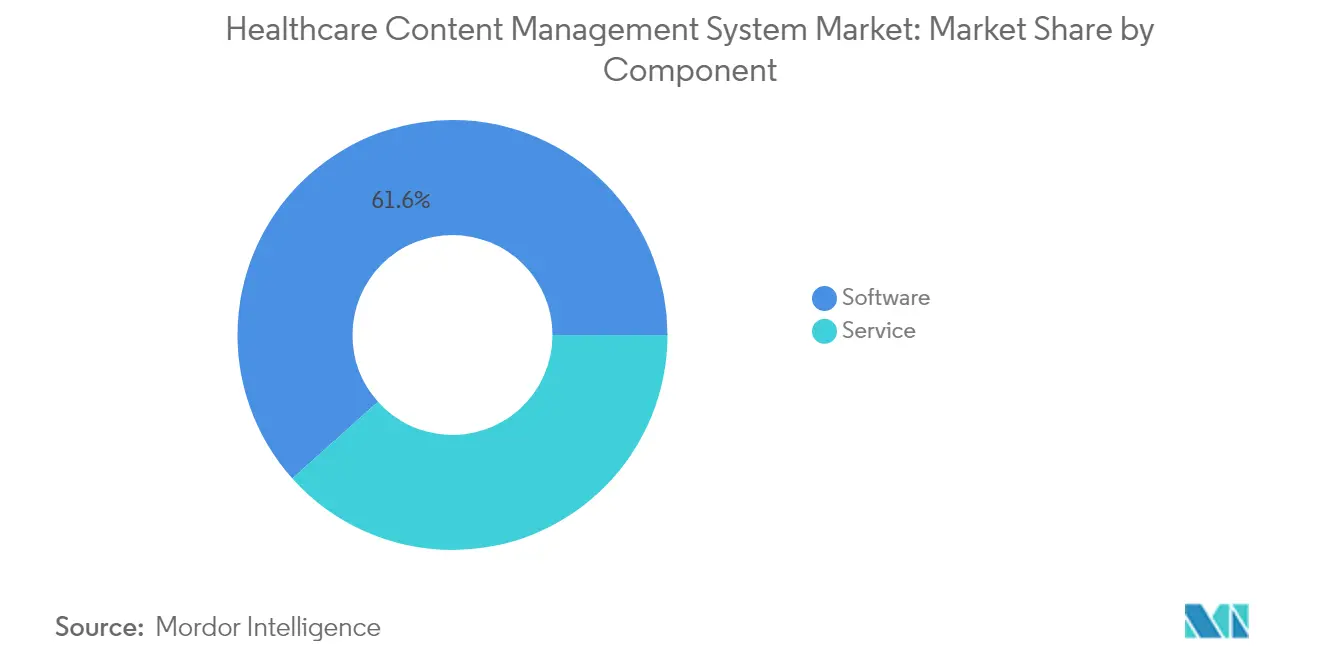
In 2025, software contributed USD 22.84 billion, equal to 61.62% of the healthcare content management system market, while the services slice reached USD 14.23 billion. Professional, managed, and support engagements are expected to add USD 8.42 billion new revenue by 2031 as buyers seek integration, optimization, and compliance outsourcing. The healthcare content management system market size for services is projected to climb at a 9.78% CAGR, reflecting growing reliance on third-party expertise to navigate HIPAA audits and AI model validation.
Healthcare systems adopting image-enabled EHRs typically allocate 45% of project budgets to consulting and training, underscoring why service partners hold center stage in complex deployments. Managed services appeal to mid-tier hospitals lacking 24×7 security operations centers, driving multi-year contracts that stabilize vendor revenue and reinforce platform lock-in within the healthcare content management system market.

By Deployment Mode: Cloud Acceleration Continues Despite Security Concerns
Cloud installations retained 53.89% of 2025 revenue, and are tracking a 10.21% CAGR to 2031—outpacing overall market growth as providers retire aging data centers. Hybrid models—on-premise edge nodes combined with regional cloud zones—account for most new contracts, especially in Europe where GDPR data-sovereignty clauses restrict full public-cloud adoption.
The healthcare content management system market size for cloud deployments capturing two-thirds of total spend, aided by automatic uptime SLAs and built-in AI accelerators unavailable in legacy servers. However, prolonged vendor-risk assessments and cyber-insurance underwriting slow(continued) contract finalization cycles, suggesting security certifications—FedRAMP, HITRUST, ISO 27001—will remain decisive differentiators for cloud vendors.
By End User: Payers Accelerate Adoption for Value-Based Care Support
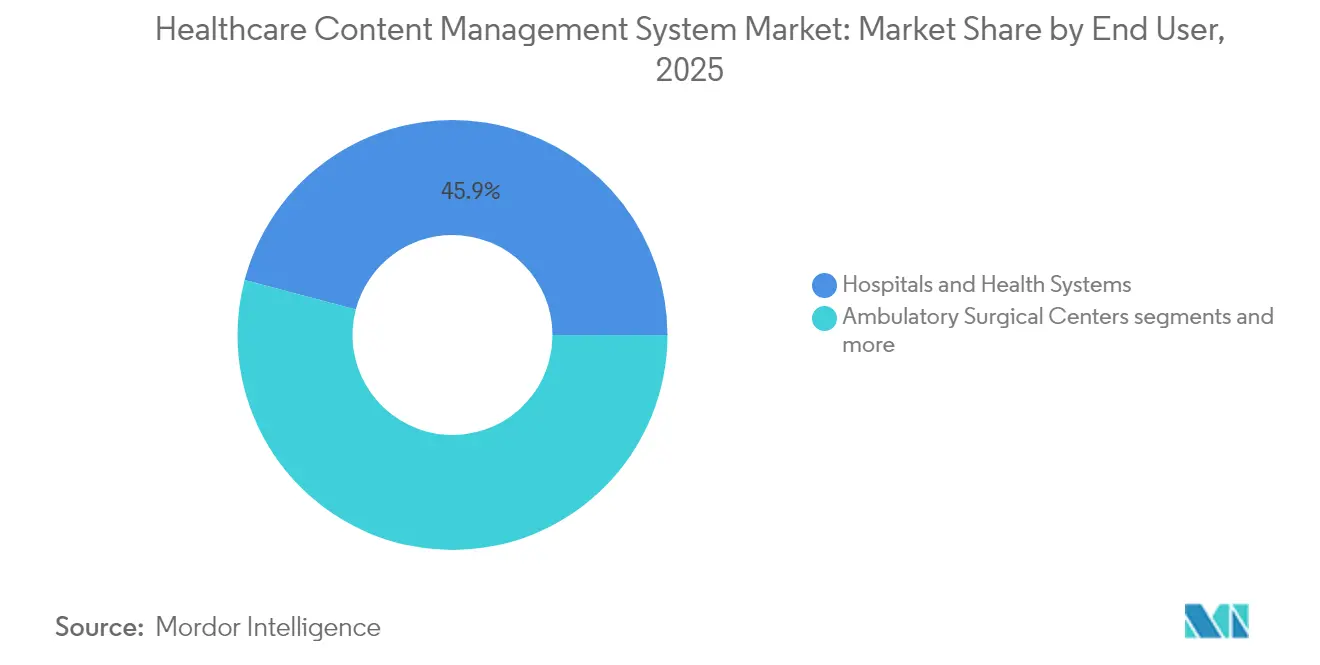
Hospitals and health systems drove 45.89% of 2025 spend, but payer investments are rising at an 10.92% CAGR as insurers seek longitudinal repositories to quantify shared-savings contracts and automate claims touch-points. The healthcare content management system market size attributable to payers could top USD 9.63 billion by 2031 if current digital quality-measure mandates extend beyond Medicare Advantage.
Ambulatory clinics, imaging centers, and long-term care facilities form a long-tail segment with steady but lower growth, often choosing software-as-a-service bundles that combine archiving with e-fax and patient portal modules. These buyers help sustain a fragmented vendor landscape that balances enterprise giants with niche cloud players inside the healthcare content management industry.
By Application: AI-Enabled IDP Disrupts Clinical Content Leadership
Clinical content management retained a 40.74% revenue share in 2025 as radiology, cardiology, and oncology workflows continue to anchor imaging archives jacr.org. Yet AI-enabled IDP is forecast to expand at 10.58% CAGR, narrowing the gap by 2031 as providers automate chart abstraction and prior-authorization documentation. Healthcare content management system market share for IDP-centric solutions could surpass 25% by the end of the forecast period should current adoption curves persist.
Unstructured progress notes, referral letters, and faxed lab reports still account for more than 80% of inbound documents, making AI essential for actionable analytics. Vendors bundling pre-trained clinical language models and explainability dashboards differentiate from commodity storage rivals in the healthcare content management system market.
Geography Analysis
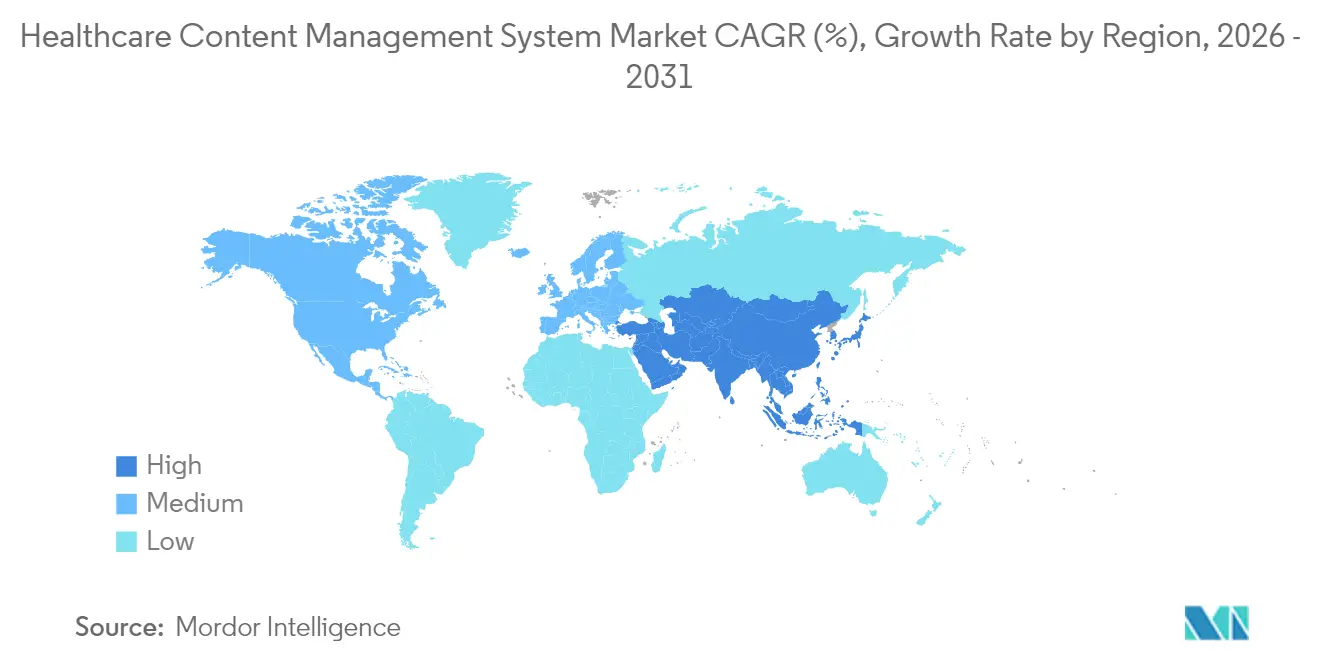
North America contributed 38.41% of 2025 revenue, supported by mature EHR penetration, HIPAA audit activity, and a consolidated hospital landscape that prioritizes integrated clinical-imaging workflows. Multi-factor authentication and encryption mandates, coupled with ransomware fears, sustain demand for zero-trust repositories—a trend expected to keep regional CAGR at 7.74% through 2031.
Asia-Pacific is the fastest-growing territory at 11.32% CAGR, buoyed by national EHR rollouts in India, Thailand, and Australia, plus strong government funding for AI in diagnostics whitecase.com. Public-private telehealth programs in rural provinces add incremental volume, especially for cloud-native vendors licensed to host medical records under evolving local data-sovereignty laws.
Europe delivers mid-single-digit expansion as GDPR compliance and cross-border data-exchange initiatives stabilize buyer demand. Hybrid-cloud architectures dominate new engagements, with sovereign-cloud nodes mitigating residency constraints in Germany, France, and the Nordics hl7.org. Meanwhile, Middle-East markets begin adopting AI-driven repositories tied to medical tourism and national insurance digitization, adding a modest but strategic growth corridor for global vendors.
Regulatory Landscape
Regulation shaping healthcare content management systems focuses on interoperability, administrative simplification, and privacy/security requirements. In the United States, CMS initiatives tied to interoperability and prior authorization continue to push standards-based APIs and data exchange, building on broader federal health IT policy; ONC also advances standards adoption through mechanisms such as the 2026 Standards Version Advancement Process (SVAP), which approves newer interoperability standards for voluntary use starting in late 2026.
Administrative and compliance mandates are also becoming more specific for the documents and transactions that content platforms must store, route, and audit. CMS finalized the HIPAA administrative simplification rule for health care claims attachments transactions and electronic signatures (CMS-0053-F), effective May 26, 2026, with compliance required by May 26, 2028, reinforcing the need for standards-aligned document packaging, retention controls, and auditability in payer and provider workflows. HIPAA and GDPR obligations continue to drive encryption, access controls, lifecycle management, and evidence logging features in content repositories, particularly for cloud and hybrid deployments operating across jurisdictions.
Value Chain Analysis
The value chain spans content capture and ingestion (clinical notes, faxes, images, referrals, and claims documents), normalization and indexing (metadata, coding, and consent), secure storage and lifecycle management (retention, deletion, and audit trails), workflow orchestration (routing, e-signature, prior authorization, and release of information), and distribution and exchange to downstream systems such as EHRs, payer platforms, HIEs, and analytics layers. Standards bodies and interoperability frameworks (HL7 FHIR, IHE integration profiles, and document exchange specifications) influence how vendors productize APIs, document packaging, and identity/access services for cross-organization sharing.
Upstream suppliers include cloud infrastructure and security providers, interoperability toolkits, OCR/IDP and generative AI components, and systems integrators delivering migration, interface development, and managed services. Integration and governance points are recurring bottlenecks, especially legacy migrations, master data alignment, and security assurance for cloud and hybrid environments, which helps explain why professional services, managed services, and validation support make up a larger share of total program spend. Ecosystem coordination efforts such as the CMS Health Technology Ecosystem also shape how the chain operates, emphasizing shared infrastructure and FHIR-based exchange across stakeholders.
Competitive Landscape
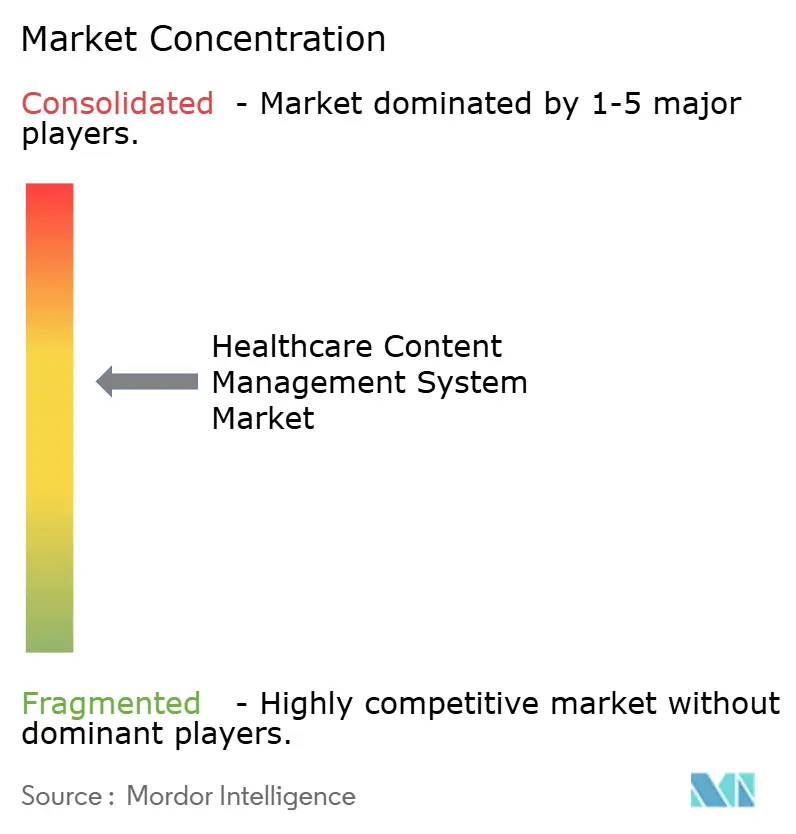
The healthcare content management system market remains moderately fragmented. Hyland, OpenText, IBM, and Microsoft continue to compete head-to-head on enterprise breadth, while Epic, Oracle Health, and athenahealth bundle native repositories with their EHRs to cement account control. Vendors differentiate through:
- Embedded AI and analytics—Hyland’s 2024 IDP release processes 1,000 pages per minute, enabling real-time clinical note abstraction.
- Cloud managed services—OpenText’s Azure-based platform offers 99.99% uptime SLAs and FedRAMP certification, attracting U.S. federal health agencies.
- Interoperability leadership—IBM leverages FHIR gateways and blockchain consent layers to sidestep information-blocking scrutiny and court large IDNs.
Consolidation persists as smaller IDP specialists seek scale. Oracle’s 2025 AI-enabled EHR launch threatens standalone content vendors, as fully integrated platforms promise simplified purchasing and unified governance. Litigation over information blocking increases transparency pressure, nudging competitive differentiation toward open standards and value-added analytics instead of lock-in tactics.
Healthcare Content Management System Industry Leaders
-
Microsoft
-
IBM
-
Hyland Software Inc
-
IQVIA
-
Xerox Corporation
- *Disclaimer: Major Players sorted in no particular order
Market Opportunities and Future Outlook
Enterprise digitization and cloud migration programs create whitespace for platforms that can industrialize ingestion, indexing, and governance of image-heavy and document-heavy archives while staying interoperable with EHR workflows. University Hospitals Birmingham NHS Foundation Trusts' June 2026 partnership with Mizaic to migrate more than 235 million patient record images to the cloud-based MediViewer platform highlights demand for high-volume conversion, lifecycle controls, and cloud-optimized retrieval across multi-site provider groups. Similar programs tend to reward vendors and service partners that combine migration factories with policy-driven retention, auditability, and role-based access aligned to HIPAA and GDPR needs.
A second opportunity sits at the intersection of interoperability maturity and AI-driven productivity. Content platforms that expose standards-based APIs (FHIR-aligned exchange, document references, and identity-aware access) and embed intelligent capture and summarization into clinician and payer workflows can capture budgets tied to productivity gains. HL7 Europe publishing Base and Core FHIR Implementation Guides v2.0.0 in April 2026 (supporting FHIR R4 and R5) adds practical implementation scaffolding for cross-border data initiatives, which increases the premium on vendors that can handle versioning and mapping across heterogeneous systems. In parallel, NHS England moving ahead in June 2026 with a large-scale Microsoft 365 Copilot deployment for staff underscores active allocation toward administrative efficiency, favoring content management offerings that provide governed knowledge sources, provenance, and policy controls so AI tools can operate safely on unstructured clinical and operational content.
Recent Industry Developments
- May 2026: Fujitsu and IBM Japan formalized a collaboration in the healthcare sector to develop a sovereign cloud platform for medical use and to jointly utilize medical AI solutions. The focus on sovereign cloud directly supports healthcare content repositories that must meet data residency and security requirements, strengthening the ecosystem for regulated, in-country hosting and managed interoperability.
- December 2025: IBM released IBM App Connect for Healthcare 13.0.1.0, extending healthcare-specific integration capabilities aligned with IBM App Connect Enterprise 13. Integration accelerators and connectors reduce friction between content management platforms, EHRs, and payer systems, supporting faster deployments and more standardized data movement across hybrid environments.
- October 2024: Microsoft announced general availability of healthcare data solutions in Microsoft Fabric and introduced public preview healthcare application templates in Microsoft Purview. The move reinforces enterprise demand for governed data and content foundations that can support analytics and AI, raising the importance of unified metadata, lineage, and compliance controls in healthcare content management architectures.
Research Methodology Framework and Report Scope
Market Definition and Coverage
This market covers software platforms and related services used by healthcare organizations to capture, store, manage, route, and retrieve clinical and administrative content across workflows, including web and document content where it supports care delivery, operations, and compliance.
Scope exclusions: We exclude general-purpose enterprise content tools that are not sold or configured for healthcare use, along with internal IT labor that is not billed as part of a product or contracted service.
Segmentation Overview
- By Component
- Software
- Services
- By Deployment Mode
- On-premise
- Cloud
- Hybrid
- By Application
- Clinical Content Management
- Administrative / Non-clinical
- Imaging & Diagnostics
- Patient Portals & Engagement
- By End User
- Hospitals & Health Systems
- Ambulatory Surgical Centers
- Diagnostic & Imaging Centers
- Payers / Insurance Providers
- Long-Term Care Facilities
- By Geography
- North America
- United States
- Canada
- Mexico
- Europe
- United Kingdom
- Germany
- France
- Italy
- Spain
- Rest of Europe
- Asia-Pacific
- China
- India
- Japan
- South Korea
- Australia
- Rest of Asia-Pacific
- South America
- Brazil
- Argentina
- Rest of South America
- Middle East and Africa
- GCC
- South Africa
- Rest of Middle East and Africa
- North America
Data Sources, Market Sizing, and Validation
Desk Research
Desk research was used to lock down the market boundary, terminology, and the practical demand signals that explain why healthcare buyers spend on content platforms. We referenced public sources such as the US Department of Health and Human Services for HIPAA guidance, the Office of the National Coordinator for Health IT for health IT adoption and interoperability programs, CMS for provider landscape context, OECD health statistics for system-level indicators, and peer-reviewed journals that discuss unstructured clinical data growth and documentation burden.
On the supply side, we reviewed company annual reports, investor presentations, product documentation, association websites, and reputable press to understand packaging patterns, cloud migration signals, and typical service attach behavior. Where needed, we used paid subscriptions for company financials and intelligence, news and financials, and patent databases to fill gaps around revenue splits and product positioning. The desk research sources listed above are illustrative and not exhaustive, and many other references were also used for data collection, cross-checks, and clarification.
Primary Interviews and Surveys
Primary work focused on validating how healthcare content management buying decisions are made, and which modules and services are counted as core spend versus adjacent functionality. We spoke with a mix of solution providers, implementation and support participants, and end-user stakeholders such as hospital IT, compliance, and operations leaders across the Americas, EMEA, and APAC. This helped us confirm adoption timing, pricing movement, and realistic refresh cycles.
Distribution of primary research fieldwork respondents
| Company type | Respondent position | Region |
|---|---|---|
| Top tier: 32% | CXOs: 14% | APAC: 42% |
| Mid tier: 48% | Functional/Unit leaders: 42% | EMEA: 31% |
| Smaller Players: 20% | Managers: 44% | Americas: 27% |
Market-Sizing & Forecasting
The sizing model starts with a top-down build where healthcare provider digitization and compliance-driven documentation needs are translated into a content-management demand pool, and then applied across regions based on digital maturity and care delivery scale. After that structure was in place, selective bottom-up checks were used to keep totals realistic. These included sampled price-per-user or price-per-site ranges, typical service attach rates during deployments, and reasonableness checks against supplier revenue disclosures where available.
Key inputs for this market included the pace of cloud migrations in provider IT, the share of content that remains unstructured (scanned documents, images, notes), and retention and audit requirements that raise storage and governance needs. We also modeled implementation timelines that influence service revenue timing, and average subscription or maintenance price movement by deployment model. Forecasting was done using scenario analysis supported by expert views, since spending tends to shift in steps when regulations tighten, when hospitals consolidate, or when large migrations get delayed. When bottom-up inputs were incomplete for smaller geographies or private participants, we filled gaps using observed pricing bands, region-level adoption proxies, and conservative service-to-software ratios, then rechecked these assumptions with interview feedback.
Data Validation & Update Cycle
Outputs were validated through multiple passes that compare the modeled totals with independent signals such as provider digitalization programs, reported contract activity, and the expected split between software and implementation services. Large variances were flagged, assumptions were revisited, and follow-up outreach was triggered when pricing, deployment cycles, or currency effects did not match the purchasing behavior described by buyers.
Before sign-off, an analyst review step checks for year-to-year jumps, regional share drift, and any math issues across segments. Final numbers are approved only after the logic is consistent end to end. Reports are refreshed annually, and interim updates are made when material events affect pricing, adoption, or regulatory timelines. Right before delivery, we run a fresh review so the client receives the most current view available at the time of purchase.
Mordor Intelligence's Healthcare Content Management System Market Estimate Compared With Other Published Estimates
Published market sizes for healthcare content management systems can differ materially, even when the topic label is similar, because each source may apply different scope boundaries, pricing logic, and timing for currency and inflation adjustments. Differences also appear when one estimate emphasizes software subscriptions, while another folds in broader services or related digital content categories.
Refresh cadence and currency timing are key gap drivers here. With multi-year contracts, renewals, and implementation cycles, reported values can shift depending on the year used for conversion and how recurring pricing is annualized. By rechecking pricing bands and adoption assumptions at regular intervals, and aligning currency conversion to the sizing year, Mordor Intelligence keeps the 2026 value tied to observable provider deployment activity and realistic subscription ranges.
Benchmark comparison
| Source | Market Size | Gaps in Research Methodology |
|---|---|---|
| Mordor Intelligence | USD 40.31 B (2026) | |
| Industry Publisher A | USD 6.56 B (2025) | Uses an earlier base year and a narrower monetization view that can undercount enterprise deployments, and it is not always clear if services, integrations, and multi-site pricing are fully included. |
| Industry Publisher B | USD 8.70 B (2024) | Covers a broader content management label, but it does not clearly separate healthcare CMS platforms from adjacent content categories, and the pricing method behind the 2024 value is not transparent on what is treated as recurring versus one-time. |
The spread across the three figures mainly reflects timing and what each publisher counts as in-scope revenue, especially around services and how recurring pricing is annualized. Our checks keep the model traceable to adoption pace, deployment cycles, and practical price bands, and variances are reviewed so the totals stay consistent year to year.
Key Questions Answered in the Report
What is the projected size of the healthcare content management market by 2031?
The healthcare content management system market is forecast to reach USD 61.28 billion by 2031 on a 8.74% CAGR trajectory.
Which segment is growing fastest in the healthcare content management system market?
Services are expanding at a 9.78% CAGR because providers need integration, compliance, and AI-training support
How quickly is cloud deployment advancing?
The cloud segment is rising at 10.21% CAGR, driven by lower total cost of ownership and built-in security updates
Why are payers investing in content management solutions?
Value-based care contracts require detailed longitudinal records to calculate shared-savings outcomes, pushing payer CAGR to 10.92%
What role does AI play in modern content management?
AI-enabled intelligent document processing extracts data from unstructured notes and images, cutting manual entry errors and improving coding accuracy, and is the fastest-growing application at 10.58% CAGR