
Gut Health Beverages Market Size and Share
Market Overview
| Study Period | 2021 - 2031 |
|---|---|
| Market Size (2026) | USD 26.22 Billion |
| Market Size (2031) | USD 39.27 Billion |
| Growth Rate (2026 - 2031) | 8.42 % |
| Fastest Growing Market | Asia-Pacific |
| Largest Market | North America |
| Market Concentration | Medium |
Major Players
*Disclaimer: Major Players sorted in no particular order Image © Mordor Intelligence. Reuse requires attribution under CC BY 4.0. |
|
Gut Health Beverages Market Analysis by Mordor Intelligence
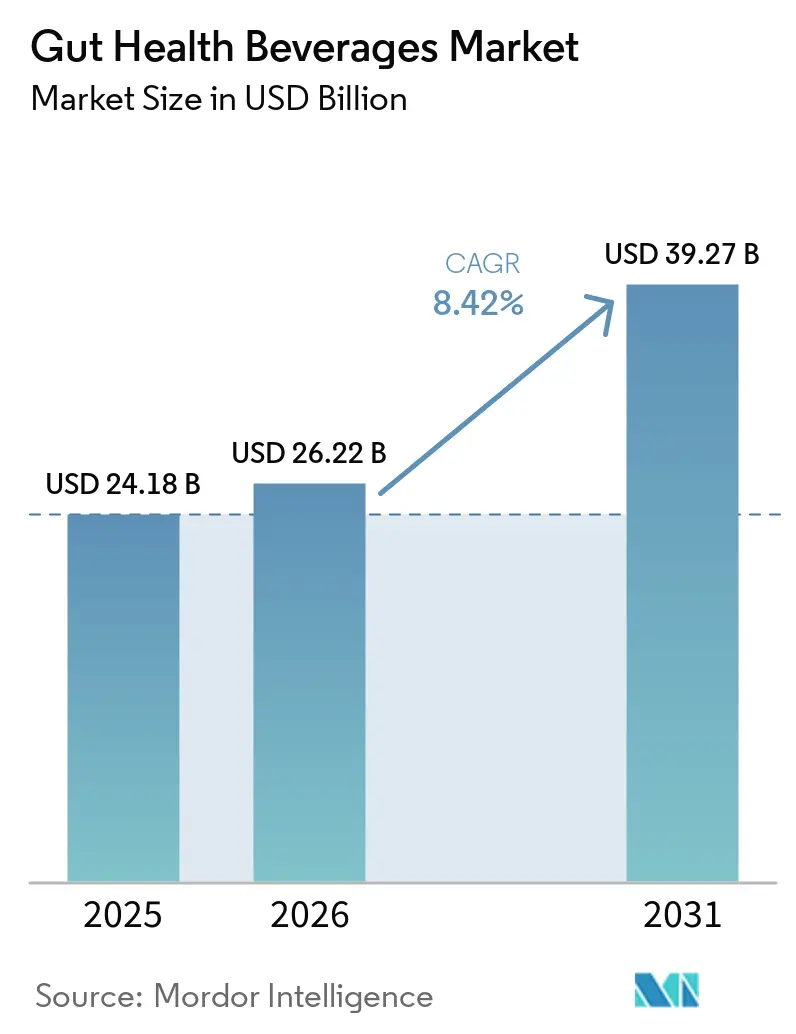
The gut health beverages market size is expected to grow from USD 24.18 billion in 2025 to USD 26.22 billion in 2026 and is forecast to reach USD 39.27 billion by 2031 at a 8.42% CAGR over 2026-2031. The gut health beverages market is expanding steadily as consumers increasingly incorporate functional beverages into their daily wellness and digestive health routines. Growth is driven by rising interest in probiotics, prebiotics, fermented beverages, and other formulations targeting digestive and overall well-being. Product innovation is expanding across dairy-based and plant-based formats, while online and modern retail channels are improving accessibility and brand reach. Growing competition among established beverage companies and emerging brands is further encouraging innovation in formulations, packaging, and positioning.
Key Report Takeaways
- By product type, probiotic beverages held 41.83% of the Gut health beverages market share in 2025, while prebiotic beverages are forecast to grow at a 10.74% CAGR from 2026 to 2031.
- By base type, dairy-based beverages accounted for a 51.67% revenue share in 2025, while plant-based beverages are forecast to grow at a 9.86% CAGR from 2026 to 2031.
- By packaging type, bottles held 54.26% of segment revenue in 2025, while cans are forecast to grow at a 9.58% CAGR from 2026 to 2031.
- By distribution channel, supermarkets/hypermarkets held 40.87% of channel revenue in 2025, while online retail is forecast to grow at a 10.31% CAGR from 2026 to 2031.
- By geography, North America held 32.64% of regional revenue in 2025, while Asia-Pacific is forecast to grow at a 10.52% CAGR from 2026 to 2031.
Note: Market size and forecast figures in this report are generated using Mordor Intelligence’s proprietary estimation framework, updated with the latest available data and insights as of January 2026.
Global Gut Health Beverages Market Trends and Insights
Drivers Impact Analysis*
| Driver | (~) % Impact on CAGR Forecast | Geographic Relevance | Impact Timeline |
|---|---|---|---|
| Growing consumer focus on digestive and gut health | +3.2% | Global | Long term (≥ 4 years) |
| Demand for lower-sugar functional beverage alternatives | +1.4% | North America and Europe | Medium term (2–4 years) |
| Convenience demand for ready-to-drink gut health formats | +1.0% | Global, with early gains in Asia-Pacific and North America | Short term (≤ 2 years) |
| Growing scientific differentiation of probiotic and prebiotic benefits | +0.8% | Global, with advanced traction in Japan and North America | Long term (≥ 4 years) |
| Expansion of functional and fermented beverage availability | +0.7% | Asia-Pacific core, spill-over to Middle East and Africa | Medium term (2–4 years) |
| Rising demand for fiber and prebiotic enriched beverages | +0.5% | North America and Europe | Short term (≤ 2 years) |
| Source: Mordor Intelligence | |||
Growing Consumer Focus on Digestive and Gut Health
Growing consumer awareness of digestive health and its connection to overall well-being is driving interest in foods and beverages positioned around gut health. According to the 2025 International Food Information Council (IFIC) Food & Health Survey, 37% of Americans identified digestive health/gut health as a benefit they seek from foods, beverages, or nutrients, up 7 percentage points from 2022[1]Source: International Food Information Council, "2025 IFIC Food & Health Survey", ific.org. The survey also found that 57% of Americans followed a specific eating pattern or diet in the past year, reflecting broader consumer engagement with intentional dietary choices[2]Source: International Food Information Council, "2025 IFIC Food & Health Survey", ific.org. This shift is supporting interest in probiotics, prebiotics, fiber, and fermented ingredients as consumers increasingly incorporate functional products into everyday diets. As a result, gut health beverages are benefiting from demand for convenient products that combine digestive-health positioning with regular consumption and broader wellness goals.
Demand for Lower-Sugar Functional Beverage Alternatives
Growing efforts to reduce sugar intake are supporting demand for functional beverages that offer health-oriented benefits without high sugar content. According to the 2025 International Food Information Council (IFIC) Food & Health Survey, 75% of Americans reported trying to limit or avoid sugar, with 63% of these consumers specifically targeting added sugars[3]Source: International Food Information Council, "2025 IFIC Food & Health Survey", ific.org. Among those limiting or avoiding sugar, 55% reported choosing water instead of caloric beverages, indicating a preference for lower-sugar beverage options[4]Source: International Food Information Council, "2025 IFIC Food & Health Survey", ific.org. This behavior is encouraging manufacturers to develop gut health beverages with reduced-sugar, low-calorie, and sugar-free positioning while retaining functional ingredients such as probiotics, prebiotics, and dietary fiber. The convergence of sugar reduction and functional wellness preferences is broadening the consumer base for gut health beverages.7
Convenience Demand for Ready-to-Drink Gut Health Formats
Demand for convenient nutrition is driving the adoption of ready-to-drink gut health beverages that can be consumed easily across different daily routines. Consumers increasingly value functional products that require minimal preparation and fit into busy lifestyles and on-the-go consumption occasions. Ready-to-drink formats provide an accessible way to incorporate probiotics, prebiotics, fiber, and other functional ingredients into regular consumption habits. Their portability and ease of use also broaden the appeal of gut health beverages beyond traditional meal occasions. As convenience becomes an important factor in beverage selection, manufacturers are expanding ready-to-drink formats across different product types, flavors, and packaging configurations.
Growing Scientific Differentiation of Probiotic and Prebiotic Benefits
Growing scientific understanding of probiotics and prebiotics is reinforcing consumer and industry interest in their distinct roles in gut health. Clearer differentiation between products designed to introduce beneficial microorganisms and those intended to support existing gut microbiota is encouraging more targeted product development. This expanding scientific foundation is also supporting the use of specific strains, fibers, and ingredient combinations in functional beverage formulations. As research continues to clarify the potential benefits and applications of these ingredients, manufacturers are broadening product portfolios around more clearly defined gut health propositions, contributing to greater formulation diversity and strengthening the functional positioning of gut health beverages.
Restraints Impact Analysis*
| Restraint | (~) % Impact on CAGR Forecast | Geographic Relevance | Impact Timeline |
|---|---|---|---|
| Cold-chain requirements for live-culture beverages | -1.1% | Asia-Pacific (excl. Japan, South Korea), South America, Middle East and Africa | Medium term (2–4 years) |
| Digestive discomfort from high-fiber and prebiotic formulations | -0.4% | Global | Short term (≤ 2 years) |
| Challenges in maintaining viable-culture levels throughout shelf life | -0.7% | Global | Long term (≥ 4 years) |
| Regulatory constraints on gut health and disease-related claims | -0.9% | Europe, with global secondary influence | Long term (≥ 4 years) |
| Source: Mordor Intelligence | |||
Cold-Chain Requirements for Live-Culture Beverages
Cold-chain requirements can constrain the production, storage, transportation, and distribution of gut health beverages containing live cultures. Maintaining appropriate temperature conditions throughout the supply chain increases logistics complexity and operating costs while limiting distribution flexibility in markets with less developed refrigerated infrastructure. Temperature sensitivity can also affect product quality and the stability of live microorganisms during extended transportation or storage. These requirements may make ambient-stable alternatives more attractive in certain markets, although developing such formats can require additional formulation and processing capabilities. As a result, cold-chain dependency remains an important operational consideration for manufacturers and distributors of live-culture beverages.
Digestive Discomfort from High-Fiber and Prebiotic Formulations
High-fiber and prebiotic formulations can cause digestive discomfort for some consumers, particularly when introduced in large quantities or consumed by individuals sensitive to certain ingredients. Effects such as bloating, gas, or changes in bowel habits may reduce consumer willingness to use these products regularly. This presents challenges for manufacturers seeking to increase functional ingredient levels while maintaining a positive consumption experience. Formulation choices, ingredient combinations, and recommended serving sizes require careful consideration to balance functional positioning with consumer tolerance. Digestive sensitivity can therefore limit repeat consumption and hinder broader adoption of high-fiber and prebiotic beverages.
*Our forecasts treat driver/restraint impacts as directional, not additive. The impact forecasts reflect baseline growth, mix effects, and variable interactions.
Segment Analysis
By Product Type: Probiotic Dominance Masking a Prebiotic Inflection
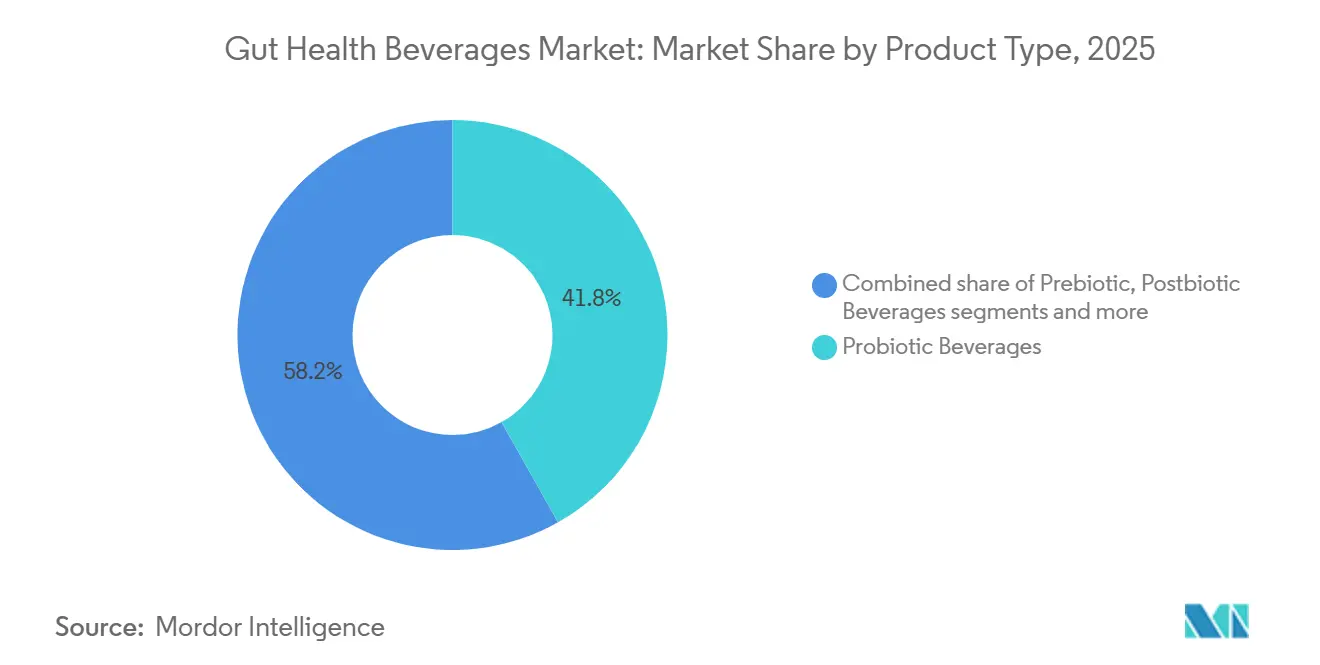
Probiotic beverages accounted for 41.83% of the gut health beverages market in 2025, making it the largest product type. This position is supported by established consumer awareness of probiotics and their association with digestive health. Broad availability across beverage formats and continued product innovation further reinforce the segment's market presence. Established consumption habits and growing interest in functional nutrition are expected to sustain demand for probiotic beverages during the forecast period.
Prebiotic beverages are projected to be the fastest-growing product type, registering a CAGR of 10.74% during 2026–2031. Growth is driven by increasing consumer awareness of prebiotic ingredients and their role in supporting beneficial gut microorganisms. The expanding use of dietary fibers and prebiotic formulations is encouraging manufacturers to introduce more differentiated functional beverage offerings. Growing consumer interest in targeted gut health benefits is expected to further support the segment's expansion through 2031.



By Base Type: Dairy Anchors Value; Plant-Based Rewrites the Growth Story
Dairy-Based Beverages accounted for 51.67% of the gut health beverages market in 2025, making it the largest base type. Its leading position is supported by the established presence of fermented dairy products and widespread consumer familiarity with dairy-based functional beverages. Strong availability across established retail channels and continued demand for probiotic and fermented formulations further support the segment. Dairy-based formats are expected to maintain their leading position throughout the forecast period.
Plant-Based Beverages are projected to be the fastest-growing base type, registering a 9.86% CAGR during 2026–2031. Growth is supported by increasing consumer interest in dairy alternatives and functional beverages that align with changing dietary preferences. Expanding availability of plant-based formulations and greater use of functional ingredients are encouraging manufacturers to broaden their offerings. Continued product diversification and consumer interest in non-dairy wellness products are expected to support segment growth through 2031.
By Packaging Type: Bottles Lead but Cans Reshape the Category's Brand Identity
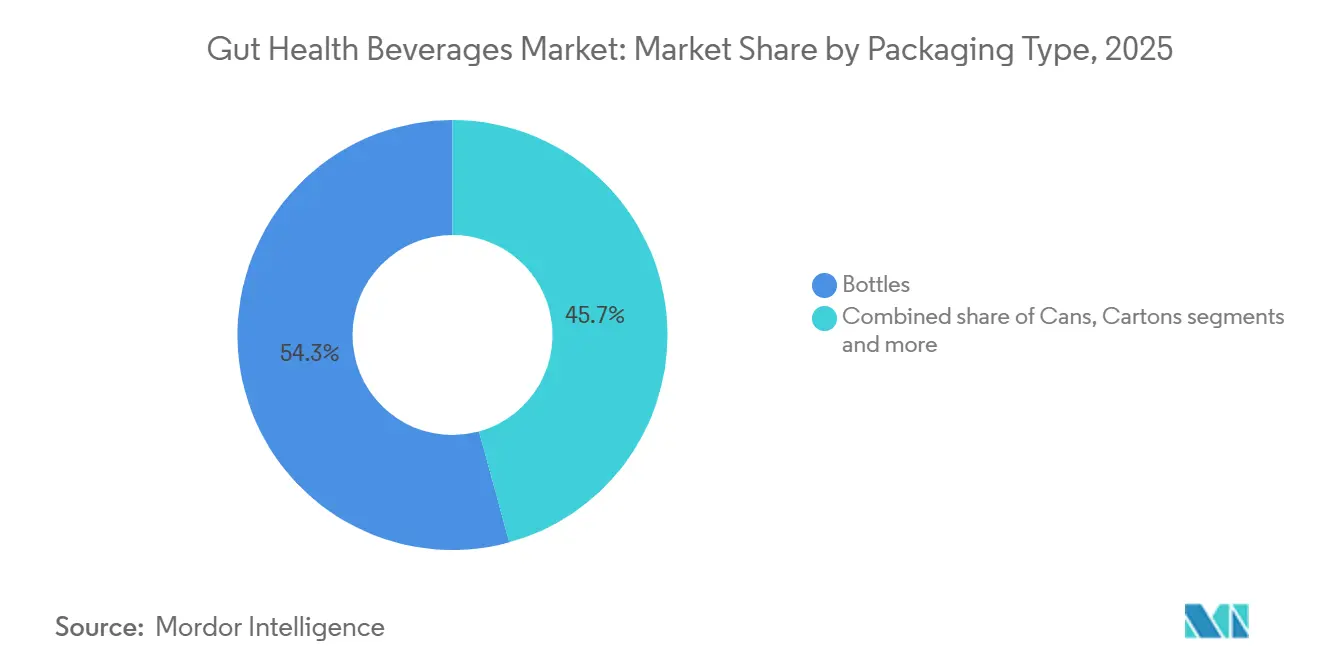
Bottles accounted for 54.26% of the gut health beverages packaging segment in 2025, making them the largest packaging type. Their leading position is supported by widespread use across dairy-based, fermented, and other functional beverage formats. Familiarity, convenience, and compatibility with both refrigerated and shelf-stable products continue to support bottle adoption across the market. Established manufacturing and distribution capabilities further reinforce their position as a widely used packaging format.
Cans are projected to be the fastest-growing packaging type, registering a 9.58% CAGR during 2026–2031. Growth is supported by increasing demand for convenient, portable, and lightweight packaging formats across functional beverages. Their suitability for single-serve consumption and compatibility with a broad range of beverage formulations are encouraging wider adoption. Growing emphasis on packaging efficiency and recyclability is also expected to support the expansion of cans during the forecast period.
By Distribution Channel: Supermarkets Set the Market Share; Online Retail Sets the Trajectory
Supermarkets/Hypermarkets accounted for 40.87% of the gut health beverages distribution segment in 2025, making them the largest distribution channel. Their leading position is supported by broad consumer reach, extensive product assortments, and established infrastructure for both refrigerated and shelf-stable beverages. These channels also provide strong visibility for functional beverage brands and facilitate regular household purchases. Continued expansion of functional beverage offerings within organized retail is expected to support the segment's position during the forecast period.
Online Retail is projected to be the fastest-growing distribution channel, registering a 10.31% CAGR during 2026–2031. Growth is supported by increasing consumer preference for convenient purchasing, broad product availability, and improved access to specialized functional beverage products. Online channels also provide manufacturers with greater opportunities to communicate product attributes and reach targeted consumer groups. Continued development of e-commerce infrastructure and omnichannel purchasing habits is expected to support the channel's expansion through 2031.
Geography Analysis
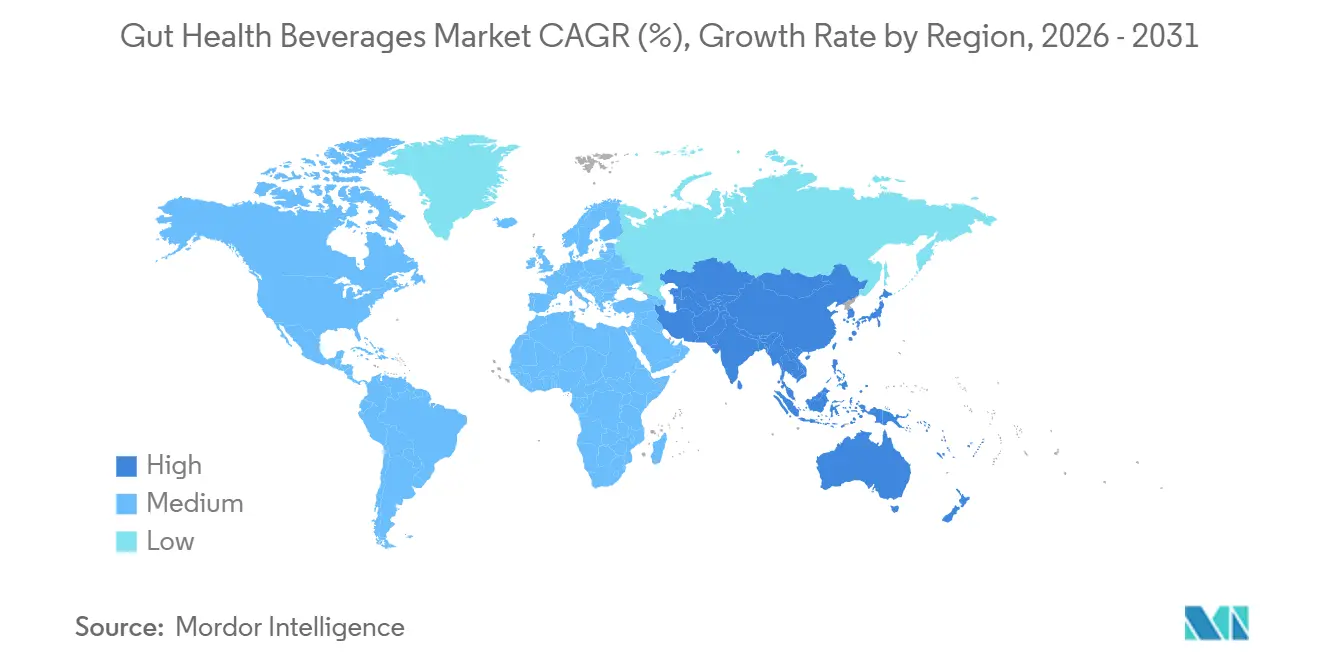
North America accounted for 32.64% of the global gut health beverages market in 2025, making it the largest regional market. Strong consumer awareness of functional nutrition, established demand for digestive health products, and well-developed retail infrastructure support its leading position. The broad availability of probiotic, prebiotic, fermented, and other functional beverage formats further supports market penetration. Continued product innovation and increasing integration of gut health positioning across mainstream beverage categories are expected to sustain regional demand.
Asia-Pacific is projected to be the fastest-growing region, registering a CAGR of 10.52% during 2026–2031. Growth is supported by widespread familiarity with fermented foods and beverages, rising health consciousness, and expanding modern retail and e-commerce infrastructure. Increasing urbanization and improving access to functional beverage products are also broadening the consumer base across developing markets. Continued product diversification and greater availability of both traditional and modern gut health formulations are expected to support regional expansion through 2031.
Europe, South America, and the Middle East and Africa also represent important markets, supported by growing consumer interest in functional nutrition and digestive wellness. Europe benefits from established probiotic consumption and developed functional beverage markets, while South America sees increasing interest in fermented and wellness-oriented beverages. The Middle East and Africa remains an emerging market, where expanding organized retail, e-commerce, and health-focused consumption patterns are supporting adoption. Together, these regions are expected to contribute to global market expansion as manufacturers broaden distribution and introduce products suited to local consumer preferences.

Competitive Landscape
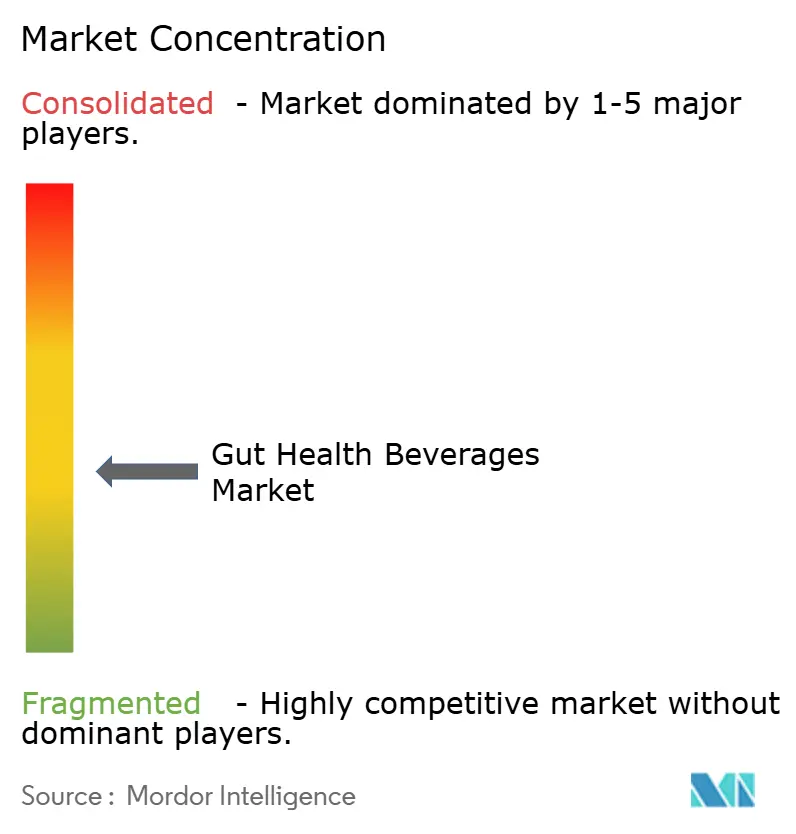
The gut health beverages market is moderately fragmented, with competition spread across large multinational beverage and nutrition companies as well as specialized functional beverage players. Major companies compete through product diversification, brand strength, distribution reach, and continued development of probiotic, prebiotic, and other gut health-focused formulations. The market remains dynamic as established beverage companies expand their functional portfolios while specialized brands strengthen their positions within specific product categories.
Danone S.A., Yakult Honsha Co., Ltd., PepsiCo, Inc., Nestlé S.A., and The Coca-Cola Company are among the major players in the market, competing primarily by broadening their functional beverage portfolios and strengthening consumer reach. These companies leverage established brands, extensive distribution networks, research and development capabilities, and expertise across dairy, fermented, probiotic, and functional beverage categories. Growing emphasis on prebiotic, probiotic, and other differentiated formulations continues to shape product development strategies.
The competitive landscape also includes specialized and emerging companies such as Lifeway Foods, GT's Living Foods, Health-Ade, Chobani, and Olipop, which compete through targeted positioning, product innovation, and differentiated formulations. These players contribute to greater product variety across fermented, probiotic, prebiotic, and plant-based formats. The competitive environment is expected to remain active as companies seek to expand into new functional claims, product formats, and geographic markets while strengthening their presence across both mainstream and specialized retail channels.
Gut Health Beverages Industry Leaders
-
Danone S.A.
-
Yakult Honsha Co., Ltd.
-
PepsiCo, Inc.
-
Nestlé S.A.
-
The Coca-Cola Company
- *Disclaimer: Major Players sorted in no particular order

Recent Industry Developments
- May 2026: Health-Ade launched its Raspberry Lime and Peach Strawberry Lychee kombucha flavors, expanding its probiotic beverage portfolio with fruit-forward offerings. Raspberry Lime was introduced through the brand’s website, while Peach Strawberry Lychee was scheduled for nationwide retail availability in June.
- March 2026: Suja Organic launched Watermelon Love Cold-Pressed Juice and Digestion Goldenberry Wellness Shot, expanding its functional beverage portfolio. The wellness shot combines goldenberry, pear, ginger, probiotics, and prebiotic fiber and was introduced specifically to support gut health, with nationwide availability at Kroger.
- February 2026: PepsiCo launched Pepsi Prebiotic Cola nationwide in the US, offering 3 grams of prebiotic fiber per 12-ounce serving in Original Cola and Cherry Vanilla varieties. The launch extends prebiotic functionality into the mainstream cola category


Global Gut Health Beverages Market Report Scope
The gut health beverages market comprises beverages formulated with functional ingredients such as probiotics, prebiotics, postbiotics, fermented cultures, and other components intended to support digestive and gut health. The market is segmented by product type into probiotic, prebiotic, postbiotic, fermented, and other. By base type, the market is segmented into dairy-based, plant-based, fruit-based, water-based, and tea-based. By packaging, the market is segmented into bottles, cans, cartons, and pouches. By distribution, the market is segmented into supermarkets/hypermarkets, convenience, specialty stores, pharmacies, and online retail. By geography, the market is segmented into North America, Europe, Asia-Pacific, South America, and the Middle East and Africa. For each segment, the market sizing and forecasting have been done in value terms (USD Billion)
| Probiotic Beverages |
| Prebiotic Beverages |
| Postbiotic Beverages |
| Fermented Beverages |
| Other Gut Health Beverages |
| Dairy-Based |
| Plant-Based |
| Fruit-Based |
| Water-Based |
| Tea-Based |
| Bottles |
| Cans |
| Cartons |
| Pouches |
| Supermarkets/Hypermarkets |
| Convenience Stores |
| Specialty/Health-Food Stores |
| Pharmacies/Drug Stores |
| Online Retail Stores |
| North America | United States |
| Canada | |
| Mexico | |
| Rest of North America | |
| Europe | Germany |
| United Kingdom | |
| Italy | |
| France | |
| Spain | |
| Netherlands | |
| Poland | |
| Belgium | |
| Sweden | |
| Rest of Europe | |
| Asia-Pacific | China |
| India | |
| Japan | |
| Australia | |
| Indonesia | |
| South Korea | |
| Thailand | |
| Singapore | |
| Rest of Asia-Pacific | |
| South America | Brazil |
| Argentina | |
| Colombia | |
| Chile | |
| Peru | |
| Rest of South America | |
| Middle East and Africa | South Africa |
| Saudi Arabia | |
| United Arab Emirates | |
| Nigeria | |
| Egypt | |
| Morocco | |
| Turkey | |
| Rest of Middle East and Africa |
| By Product Type | Probiotic Beverages | |
| Prebiotic Beverages | ||
| Postbiotic Beverages | ||
| Fermented Beverages | ||
| Other Gut Health Beverages | ||
| By Base Type | Dairy-Based | |
| Plant-Based | ||
| Fruit-Based | ||
| Water-Based | ||
| Tea-Based | ||
| By Packaging Type | Bottles | |
| Cans | ||
| Cartons | ||
| Pouches | ||
| By Distribution Channel | Supermarkets/Hypermarkets | |
| Convenience Stores | ||
| Specialty/Health-Food Stores | ||
| Pharmacies/Drug Stores | ||
| Online Retail Stores | ||
| By Geography | North America | United States |
| Canada | ||
| Mexico | ||
| Rest of North America | ||
| Europe | Germany | |
| United Kingdom | ||
| Italy | ||
| France | ||
| Spain | ||
| Netherlands | ||
| Poland | ||
| Belgium | ||
| Sweden | ||
| Rest of Europe | ||
| Asia-Pacific | China | |
| India | ||
| Japan | ||
| Australia | ||
| Indonesia | ||
| South Korea | ||
| Thailand | ||
| Singapore | ||
| Rest of Asia-Pacific | ||
| South America | Brazil | |
| Argentina | ||
| Colombia | ||
| Chile | ||
| Peru | ||
| Rest of South America | ||
| Middle East and Africa | South Africa | |
| Saudi Arabia | ||
| United Arab Emirates | ||
| Nigeria | ||
| Egypt | ||
| Morocco | ||
| Turkey | ||
| Rest of Middle East and Africa | ||


Key Questions Answered in the Report
What is the projected value of the gut health beverages sector by 2031?
The gut health beverages market is forecast to reach USD 39.27 billion by 2031, growing at an 8.42% CAGR from 2026, supported by broader everyday demand for functional drinks.
Which gut health beverage product type is growing the fastest?
Prebiotic beverages are forecast to record the fastest growth at a 10.74% CAGR from 2026 to 2031.
Which base type leads demand for digestive wellness drinks?
Dairy-based beverages held 51.67% share in 2025, while plant-based formats are forecast to grow at a 9.86% CAGR through 2031.
Which region is forecast to grow fastest through 2031?
Asia-Pacific is forecast to grow at a 10.52% CAGR from 2026 to 2031, supported by familiarity with fermented drinks and expanding retail access.
Page last updated on:


 Your data is secure and never sold or shared.


