
Detox Drink Market Size and Share
Market Overview
| Study Period | 2021 - 2031 |
|---|---|
| Market Size (2026) | USD 6.05 Billion |
| Market Size (2031) | USD 8.13 Billion |
| Growth Rate (2026 - 2031) | 6.10 % |
| Fastest Growing Market | Middle East and Africa |
| Largest Market | Asia-Pacific |
| Market Concentration | Low |
Major Players
*Disclaimer: Major Players sorted in no particular order Image © Mordor Intelligence. Reuse requires attribution under CC BY 4.0. |
|
Detox Drink Market Analysis by Mordor Intelligence
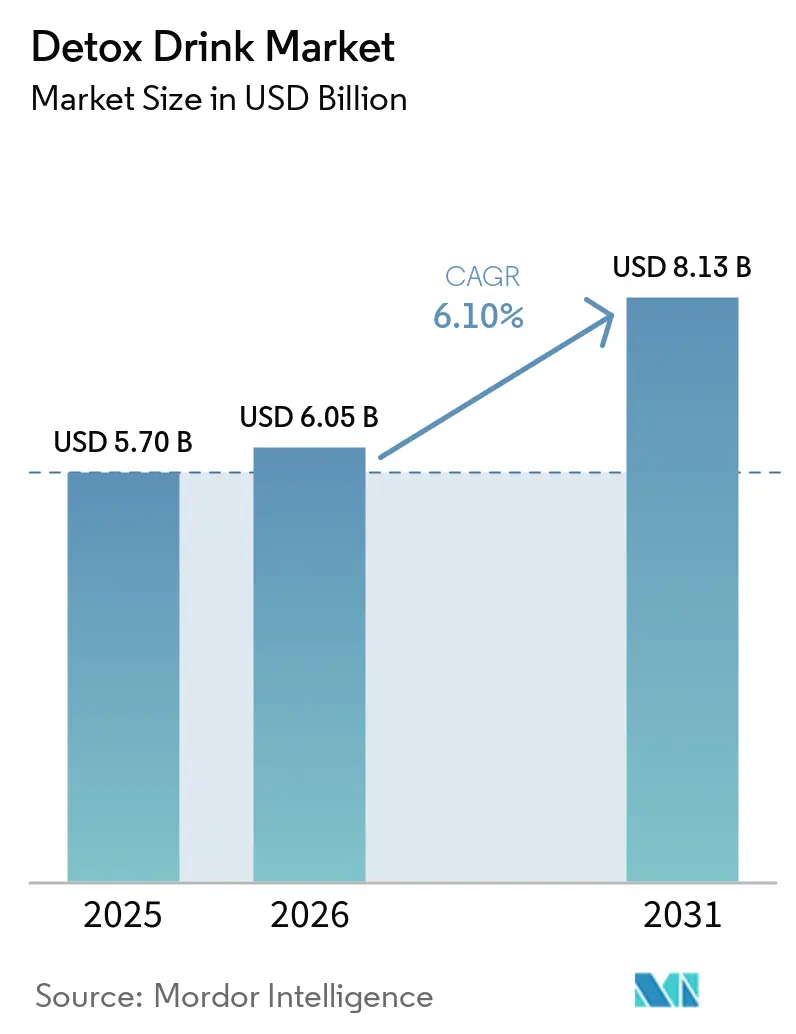
The detox drink market size is expected to grow from USD 5.70 billion in 2025 to USD 6.05 billion in 2026 and is forecast to reach USD 8.13 billion by 2031 at a 6.10% CAGR over 2026-2031. The detox drink market is being shaped by rising interest in preventive wellness, functional beverages, and lower-sugar alternatives as consumers increasingly incorporate health-oriented products into daily routines. Growing awareness of digestive health, hydration, and natural ingredients is supporting demand for beverages positioned around specific wellness benefits. The expansion of clean-label, plant-based, herbal, and functional formulations is further broadening product appeal, while single-serve shots and convenient formats are creating additional consumption occasions. At the same time, online retail and digital wellness commerce are improving access to specialized detox products and supporting direct-to-consumer purchasing. Regulatory scrutiny surrounding health and detoxification claims, alongside premium pricing and taste-related barriers, remains a key consideration for future market development.
Key Report Takeaways
- By drink type, detox juices held 43.72% share in 2025, while detox shots are forecast to record an 8.34% CAGR during 2026-2031.
- By category, conventional products held 73.64% share in 2025, while organic products are forecast to record a 7.82% CAGR during 2026-2031.
- By functionality, digestive health held 23.58% share in 2025, while hydration support is forecast to record a 7.94% CAGR during 2026-2031.
- By packaging type, bottles held 61.74% share in 2025, while pouches and sachets are forecast to record a 7.76% CAGR during 2026-2031.
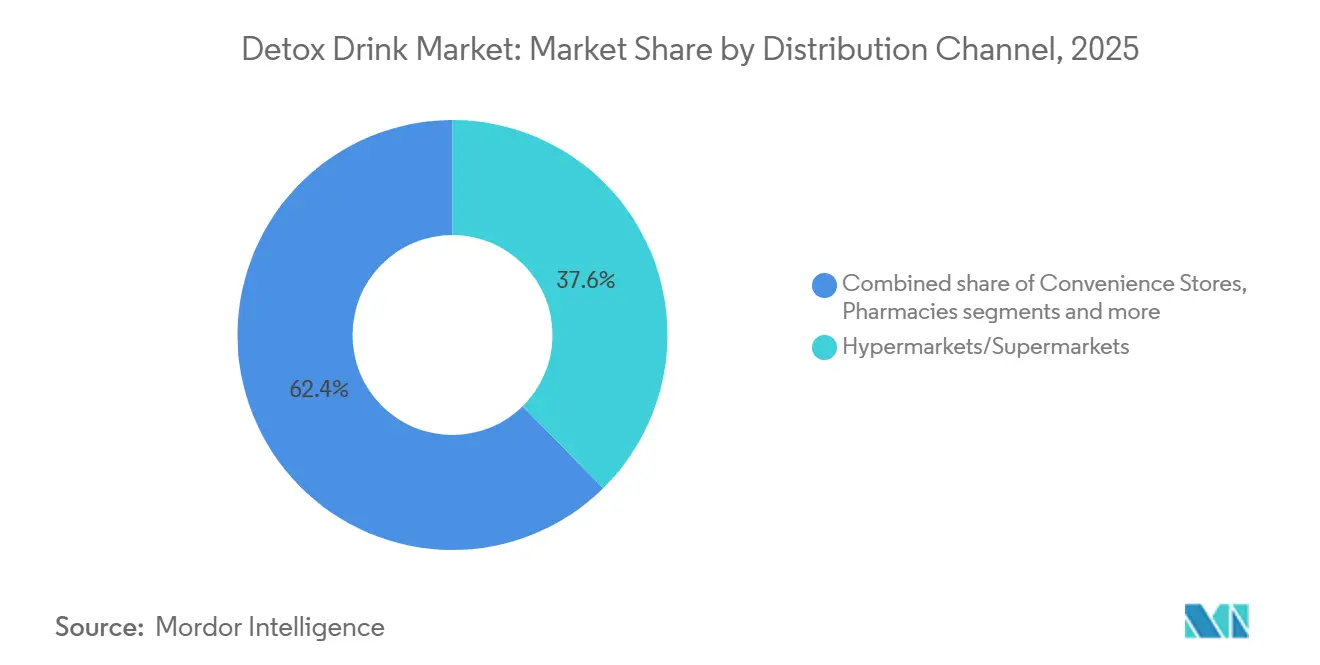
- By distribution channel, hypermarkets and supermarkets held 37.63% share in 2025, while online retail is forecast to record an 8.27% CAGR during 2026-2031.
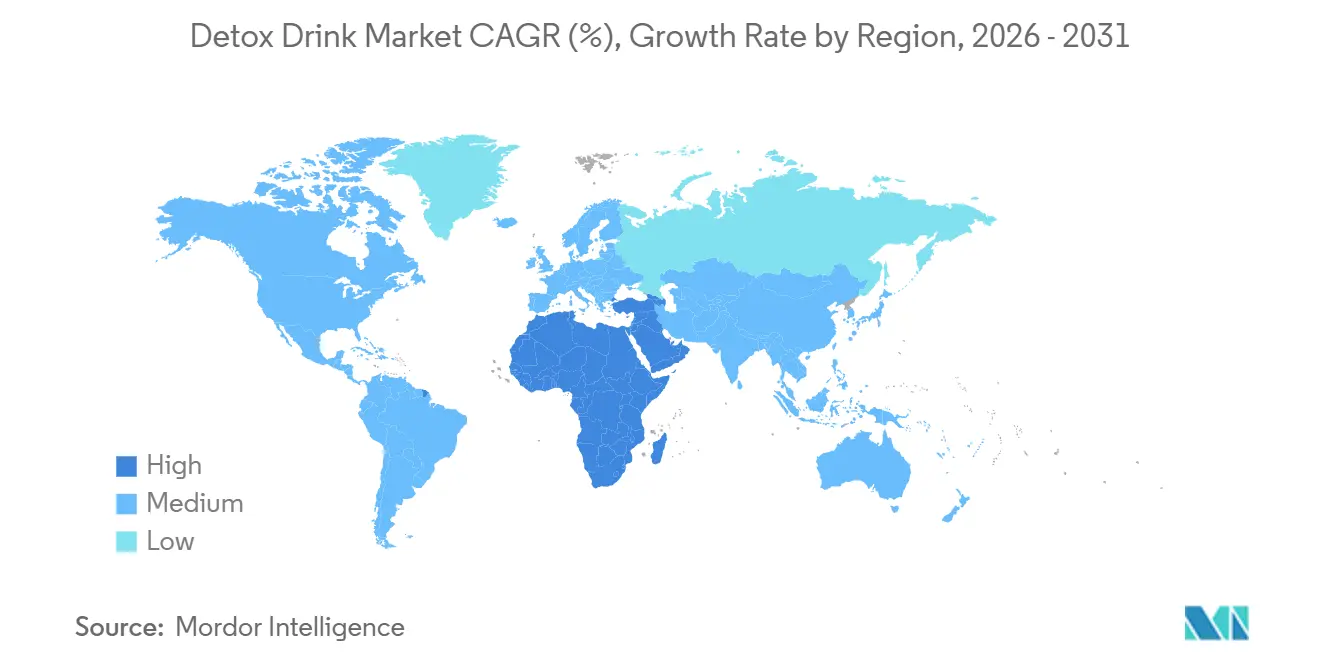
- By geography, Asia-Pacific held 39.41% share in 2025, while the Middle East and Africa is forecast to record an 8.43% CAGR during 2026-2031.
Note: Market size and forecast figures in this report are generated using Mordor Intelligence’s proprietary estimation framework, updated with the latest available data and insights as of January 2026.
Global Detox Drink Market Trends and Insights
Drivers Impact Analysis*
| Driver | (~) % Impact on CAGR Forecast | Geographic Relevance | Impact Timeline |
|---|---|---|---|
| Preventive wellness and functional beverage adoption | +1.8% | Global | Medium term (2–4 years) |
| Clean-label and plant-based formulations | +0.9% | North America and Europe, expanding to Asia-Pacific | Medium term (2–4 years) |
| Growing demand for low-sugar beverages | +0.7% | Global | Short term (≤ 2 years) |
| Mainstreaming of traditional herbal ingredients | +0.6% | Asia-Pacific core, spill-over to Middle East and Africa and South America | Long term (≥ 4 years) |
| Convenience and on-the-go consumption | +0.5% | North America and Europe | Short term (≤ 2 years) |
| Expansion of digital wellness commerce | +0.4% | Global, with early gains in North America and Asia-Pacific | Medium term (2–4 years) |
| Source: Mordor Intelligence | |||
Preventive Wellness and Functional Beverage Adoption
Growing emphasis on preventive health is encouraging consumers to incorporate functional beverages into everyday wellness routines, supporting demand for detox drinks positioned around digestive health, hydration, immunity, and other wellness benefits. The 2025 International Food Information Council (IFIC) Food & Health Survey found that 57% of Americans considered healthfulness impactful in food and beverage purchase decisions, highlighting the continued importance of health-oriented attributes in beverage selection[1]Source :International Food Information Council, "2025 IFIC Food & Health Survey", ific.org. In addition, IFIC reported that approximately 75% of Americans agree that “food is medicine,” indicating a broader tendency to view diet as part of proactive health management[2]Source :International Food Information Council, "IFIC Spotlight Survey: Americans’ Perceptions & Priorities On Healthy Eating", ific.org. This environment is supporting functional beverage adoption as consumers seek convenient products that combine everyday consumption with perceived wellness benefits, creating favorable conditions for detox-oriented formulations.
Clean-Label and Plant-Based Formulations
Demand for clean-label and plant-based beverages is supporting innovation in detox drinks as consumers increasingly seek recognizable ingredients and simpler product formulations. The Good Food Institute reported that 60% of United States households purchased plant-based foods in 2025, demonstrating the established reach of plant-based consumption[3]Source: Good Food Institute, "U.S. retail market insights for the plant-based industry", gfi.org. This broad adoption is encouraging beverage manufacturers to incorporate plant-derived ingredients and emphasize transparent formulation attributes to align with wellness-oriented purchasing preferences. The trend also supports greater experimentation with herbal, botanical, fruit, and vegetable-based detox formulations, expanding the range of products available to health-conscious consumers.
Growing Demand for Low-Sugar Beverages
Growing consumer awareness of the relationship between excessive sugar intake and long-term health outcomes is encouraging a shift toward beverages with reduced or no added sugar. Detox drinks can benefit from this preference because many products are positioned around natural ingredients, lighter formulations, and wellness-oriented consumption occasions. Manufacturers are responding by reducing added sugars, using naturally occurring sweetness from fruits and botanical ingredients, and developing formulations that retain flavor while lowering overall sugar content. This shift is also broadening the appeal of detox beverages beyond dedicated wellness consumers to individuals seeking healthier alternatives for everyday hydration and refreshment.
Mainstreaming of Traditional Herbal Ingredients
Traditional herbs and botanicals are becoming more mainstream in beverages as consumers show greater interest in familiar plant-based ingredients associated with everyday wellness practices. Ingredients such as ginger, turmeric, green tea, and other botanicals are increasingly incorporated into ready-to-drink beverages, allowing manufacturers to combine traditional wellness associations with convenient modern formats. This is particularly relevant to detox drinks, where herbal ingredients can support product positioning around digestion, cleansing, immunity, and general well-being. The incorporation of recognizable botanicals also enables brands to differentiate formulations through ingredient combinations and cultural wellness traditions, broadening the category beyond conventional fruit- and vegetable-based drinks.
Restraints Impact Analysis*
| Restraint | (~) % Impact on CAGR Forecast | Geographic Relevance | Impact Timeline |
|---|---|---|---|
| Regulatory scrutiny of health and detoxification claims | -0.7% | Europe, North America | Medium term (2–4 years) |
| Higher prices of premium and specialized detox drinks | -0.5% | Global, with acute impact in South America and Middle East and Africa | Short term (≤ 2 years) |
| Taste and sensory acceptance challenges | -0.4% | Asia-Pacific core, spill-over to Middle East and Africa | Long term (≥ 4 years) |
| Cold-chain and distribution requirements | -0.3% | Middle East and Africa, South America | Medium term (2–4 years) |
| Source: Mordor Intelligence | |||
Regulatory Scrutiny of Health and Detoxification Claims
Regulatory authorities are applying closer scrutiny to beverage claims that imply detoxification, cleansing, or specific health benefits, requiring companies to ensure that product labeling and marketing remain within permitted boundaries. This can limit the language brands use to communicate product benefits and may require revisions to packaging, advertising, and promotional materials as regulations evolve. For detox drink manufacturers, the challenge is to differentiate products through ingredients, taste, and overall wellness positioning without relying on claims that could be interpreted as medical or therapeutic. Ongoing compliance requirements can also increase the time and resources needed to introduce new formulations and maintain consistent marketing across different markets.
Combined share of Detox Waters, Detox Smoothies segments and moreCombined share of Detox Waters, Detox Smoothies segments and more
Premium and specialized detox drinks often carry higher prices because of their reliance on cold-pressed processing, organic ingredients, functional botanicals, specialized formulations, and more complex production requirements. These cost factors can place detox beverages above conventional juices, flavored waters, and other mainstream beverage alternatives, particularly when products are sold in premium or specialty retail channels. Higher price points may limit trial and repeat purchases among value-conscious consumers and make wider adoption more difficult in price-sensitive markets. The resulting affordability gap can constrain the category's ability to move beyond wellness-focused consumers and into broader everyday beverage consumption.
*Our forecasts treat driver/restraint impacts as directional, not additive. The impact forecasts reflect baseline growth, mix effects, and variable interactions.
Segment Analysis
By Drink Type: Shots Challenging Juice Incumbency at the Margins
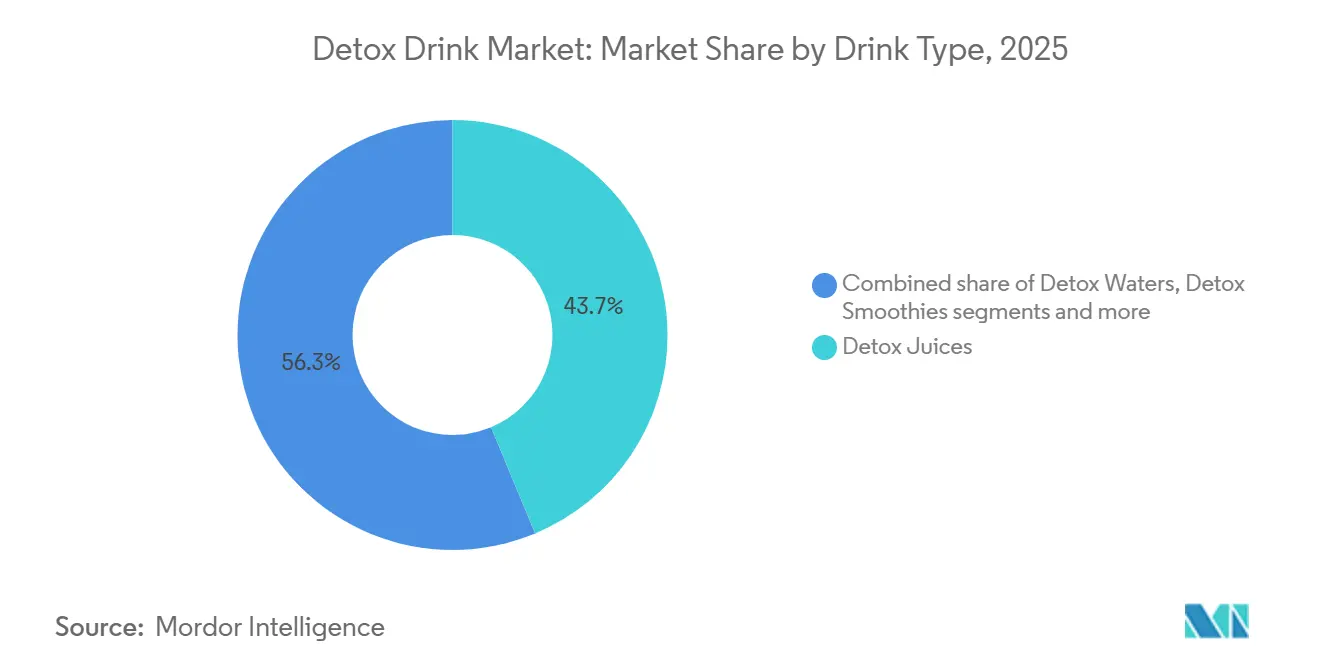
Detox juices accounted for 43.72% of the global detox drink market in 2025, driven by broad retail availability, established consumer familiarity, and the growing presence of cold-pressed and multi-ingredient formulations. Their versatility across fruit- and vegetable-based blends allows brands to address different taste preferences and wellness positioning. Established consumption occasions and increasing product variety continue to reinforce the format's market position. The availability of both mainstream and premium juice-based options further supports its broad consumer reach.
Detox shots are projected to be the fastest-growing drink type, with a CAGR of 8.34% from 2026 to 2031, driven by compact serving sizes, convenient consumption, and concentrated functional ingredients. Their small format allows consumers to incorporate wellness-oriented products into daily routines without purchasing or consuming a larger beverage. Growing interest in concentrated formulations and portable products is creating additional consumption occasions. This combination of convenience and functional positioning is expected to support continued expansion of detox shots.



By Category: Conventional Holds Value While Organic Captures Margin
Conventional detox drinks accounted for 73.64% of the global market in 2025, supported by broader product availability, established consumption patterns, and generally lower prices than specialized alternatives. Their accessibility across mainstream retail channels allows conventional products to reach a wider consumer base and remain suitable for regular consumption. The segment also benefits from a broad range of juice, water, tea, and other beverage formulations. These factors are expected to maintain the leading position of conventional products throughout the forecast period.
Organic detox drinks are projected to be the fastest-growing category, with a CAGR of 7.82% from 2026 to 2031, driven by increasing consumer interest in certified ingredients, transparent sourcing, and cleaner product positioning. Organic certification serves as an additional quality signal for consumers seeking products aligned with natural and wellness-oriented preferences. Improved availability of organic formulations through specialty retailers and online platforms is also expanding access to these products. As manufacturers broaden their certified-organic offerings across different beverage formats, the segment is expected to see incremental demand growth.
By Functionality: Digestive Health Anchors Demand, Hydration Redefines Category Scope
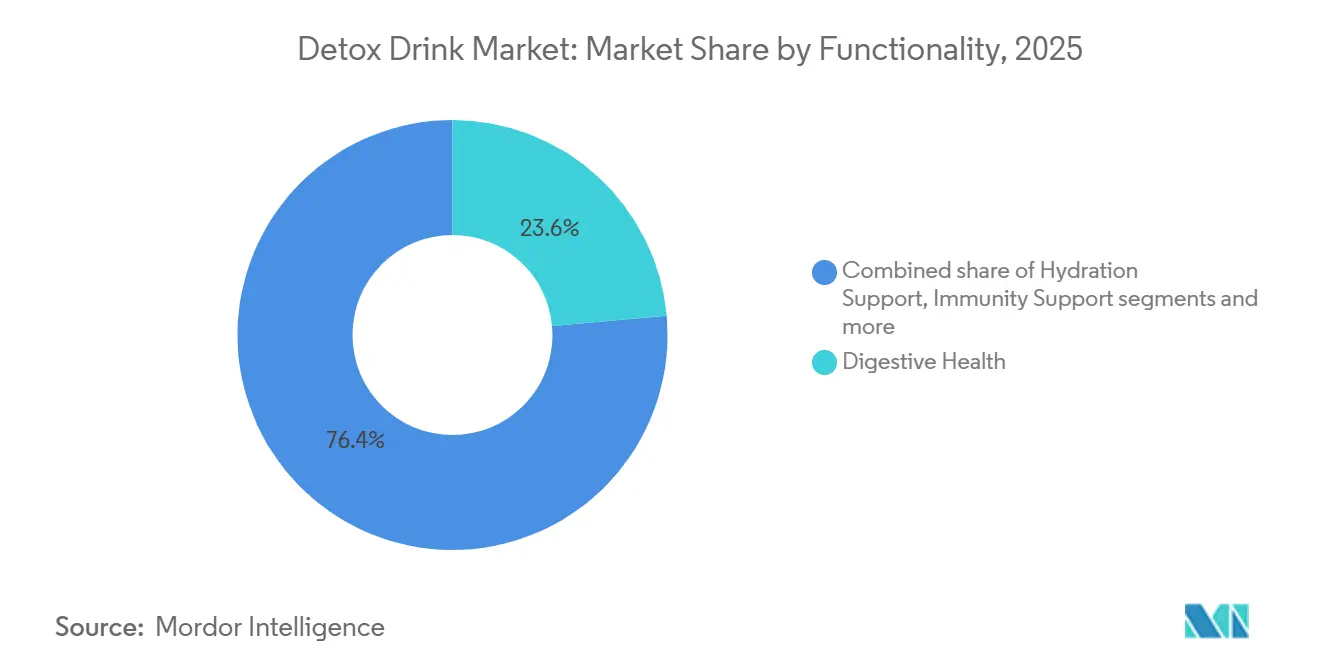
Digestive health accounted for 23.58% of the global detox drink market in 2025, driven by consumer interest in gut health and products associated with digestion and regularity. This functionality aligns with the broader wellness positioning of detox drinks and can be incorporated across juice, tea, shot, and other beverage formats. Formulations featuring ingredients such as ginger, green tea, and botanical extracts further support its widespread adoption. Its applicability across different product formats is expected to sustain its leading position during the forecast period.
Hydration support is projected to be the fastest-growing functionality, with a CAGR of 7.94% from 2026 to 2031, driven by increasing consumer interest in beverages that combine wellness positioning with everyday hydration. Products incorporating electrolytes and other hydration-oriented ingredients appeal to consumers seeking alternatives to conventional sports and hydration beverages. This functionality also creates opportunities for detox drinks to be consumed beyond traditional cleanse-oriented occasions. As manufacturers increasingly combine hydration attributes with botanical and functional ingredients, this segment is expected to gain further traction.
By Packaging Type: Bottles Sustain Scale While Sachets Unlock New Use Occasions
Bottles accounted for 61.74% of the global detox drink market in 2025, driven by their established use across ready-to-drink juices, waters, teas, and functional beverages. Bottles offer practical advantages in preserving product integrity, communicating product quality, and accommodating different serving sizes. Their widespread availability across mainstream and specialty retail channels further reinforces their position as the dominant packaging format. Continued demand for convenient ready-to-drink products is expected to sustain this dominance.
Pouches/sachets are projected to be the fastest-growing packaging format, with a CAGR of 7.76% from 2026 to 2031. Growth is supported by their portability, single-serve convenience, and efficient storage and transportation. These formats are also suited to powdered or concentrated detox products that consumers prepare or consume based on individual preferences. Their compact form makes them suitable for on-the-go consumption and e-commerce distribution, where reduced package volume offers logistical advantages. Growing consumer interest in convenient and flexible packaging is expected to support further adoption during the forecast period.
By Distribution Channel: Physical Retail Sustains Value While Digital Recalibrates Margins
Hypermarkets and supermarkets accounted for 37.63% of the global detox drink market distribution in 2025, supported by their broad consumer reach, extensive product assortments, and ability to accommodate a wide range of ready-to-drink beverages. These outlets provide strong visibility for detox products during mainstream grocery shopping and allow consumers to compare different brands and formulations in a single location. Established retail infrastructure and widespread availability of packaged beverages further reinforce the channel's dominant position. The channel is expected to remain important as detox drinks continue expanding beyond specialized wellness outlets.
Online retail and e-commerce is projected to be the fastest-growing distribution channel, with an 8.27% CAGR from 2026 to 2031. Digital platforms provide consumers with access to specialized formulations, detailed ingredient information, product reviews, and a broader assortment than many physical retail outlets. Subscription models and direct-to-consumer purchasing also support recurring orders for products consumed as part of regular wellness routines. Continued expansion of digital grocery and wellness commerce is expected to strengthen online distribution of detox drinks during the forecast period.
Geography Analysis
Asia-Pacific accounted for 39.41% of the global detox drink market in 2025, supported by established wellness traditions, rising health awareness, and expanding urban consumer bases. India, China, and Japan provide strong foundations through Ayurveda, Traditional Chinese Medicine, and traditional herbal beverage consumption, respectively. Increasing availability of functional beverages through modern retail and e-commerce is improving access to detox-oriented products across the region. Southeast Asian markets, including Indonesia, Thailand, and Singapore, are providing additional opportunities as wellness-oriented beverage consumption expands.
The Middle East and Africa market is projected to be the fastest-growing regional market, with a CAGR of 8.43% from 2026 to 2031, supported by expanding urban populations, developing retail infrastructure, and increasing consumer interest in healthier beverage options. Growing attention to sugar reduction and preventive health is driving demand for functional and wellness-oriented drinks across several markets. Regional ingredients such as black seed, saffron, dates, and moringa also present opportunities for locally relevant detox formulations. Improvements in modern retail and digital commerce are expected to further increase product availability across the region.
North America and Europe represent relatively mature markets for functional and wellness beverages, supported by established retail infrastructure and widespread consumer awareness of health-oriented products. Demand in North America is driven by cold-pressed juices, functional shots, and other ready-to-drink formats, while European markets benefit from longstanding interest in herbal and botanical products. South America remains a developing market, with Brazil, Colombia, and Argentina offering opportunities linked to urbanization and growing interest in naturally derived ingredients such as açaí, camu camu, and yerba mate. Across these regions, product innovation and broader availability through retail and digital channels are expected to support continued market development.

Competitive Landscape
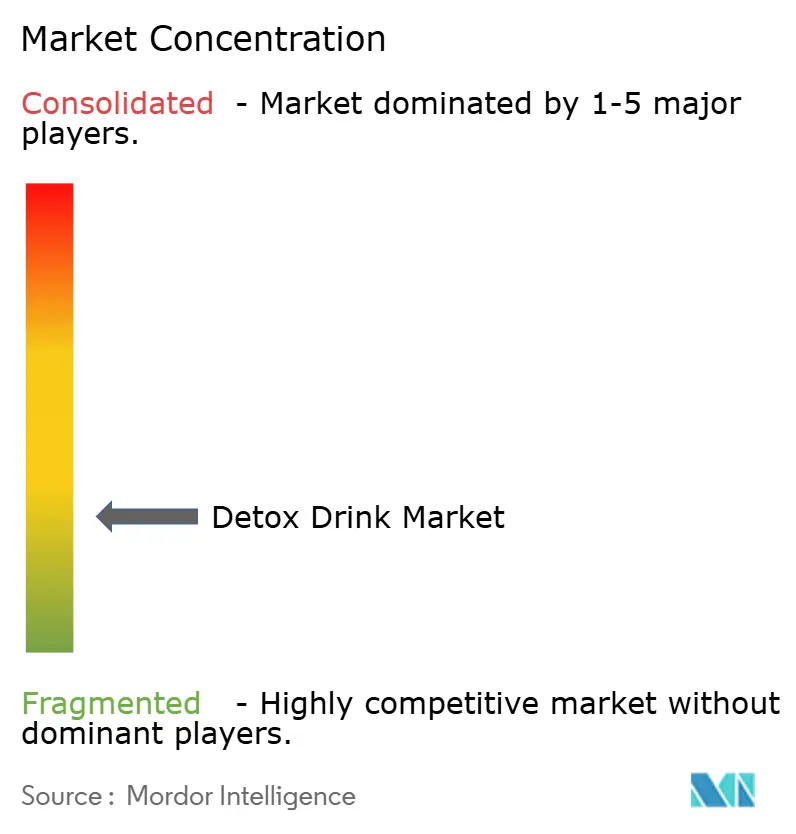
The detox drink market remains fragmented, with competition spanning cold-pressed juice and wellness-shot specialists, Ayurvedic and herbal beverage manufacturers, and established functional tea brands. Pressed Juicery is strengthening its retail presence alongside its juice, cleanse, and wellness-shot portfolio, including the January 2025 launch of its Express Cleanse at more than 200 Target stores and the July 2025 rollout of its Functional Wellness Smoothie Multipack across more than 550 Costco locations. Suja Life is pursuing a broader functional-beverage strategy across Suja Organic, Vive Organic, and Slice, with its products available in more than 37,000 stores in the United States. The company's May 2026 public listing further strengthened its position as a scaled pure-play better-for-you beverage platform.
Established herbal and tea companies are competing through ingredient-led wellness positioning and expansion of functional portfolios. Dabur India Limited is extending its focus on emerging wellness categories through Dabur Ventures, a platform launched in October 2025 with capital allocation of up to INR 500 crore for investments in digital-first businesses across wellness foods, beverages, healthcare, and Ayurveda. Celestial Seasonings expanded its wellness portfolio in July 2025 with an Anytime Wellness range addressing different everyday wellness needs; its portfolio also includes a Detox Blend Dandelion Wellness Tea. Yogi Tea continues to compete through Ayurvedic-inspired herbal formulations and targeted wellness positioning, with its 2025 Berry Vanilla launch receiving recognition as a new product in its category and its 2026 Happy Farming blend linking product development with regenerative agriculture.
Overall, competition is increasingly shaped by functional differentiation, portfolio breadth, retail distribution, and wellness-oriented ingredient positioning rather than by conventional beverage competition alone. Juice and shot specialists such as Pressed Juicery and Suja Life hold an advantage in refrigerated functional beverages and wellness-shot formats, while Dabur, Celestial Seasonings, and Yogi Tea leverage established herbal and wellness credentials across broader product portfolios. This landscape allows both specialized beverage companies and established herbal brands to compete for consumers seeking convenient products associated with detoxification, digestion, immunity, energy, and other everyday wellness needs.
Detox Drink Industry Leaders
-
Pressed Juicery, LLC
-
Suja Life, LLC
-
Dabur India Limited
-
Celestial Seasonings, Inc.
-
Yogi Tea
- *Disclaimer: Major Players sorted in no particular order

Recent Industry Developments
- May 2026: Shotly launched its probiotic-rich Detox Shot in Brazil, combining long-fermented kombucha with matcha-mate, oregano, lemongrass, and mint. The product is positioned around digestive health, microbiota support, and detox-oriented wellness, reflecting the growing use of fermented and botanical ingredients in functional shots.
- February 2026: Wonder Juice expanded its Wonder Green portfolio with Clean Green and Veg8 & Cayenne, two cold-pressed juice blends positioned for daily wellness and detox support. The new products were rolled out through select retailers across the US and the company's online channel
- January 2026: Skinny Boost launched redesigned Skinny Teas canisters for its existing detox tea range, alongside new flavors including Hibiscus Berry and Ginger Peach. The new shelf-ready format was introduced for grocery retail, including H-E-B stores in Texas, expanding the brand’s detox tea offering into a more retail-oriented format


Global Detox Drink Market Report Scope
The detox drink market comprises beverages formulated and marketed to support the body's natural cleansing processes and broader wellness goals. The market includes ready-to-consume detox beverages sold through retail and online channels. The market is segmented by drink type into detox juices, waters, smoothies, shots, teas, and others; by category into conventional and organic; by functionality into digestive health, hydration, immunity, weight management, energy/focus, beauty/skin, and others; by packaging into bottles, cans, tetra packs, pouches/sachets, and others; by distribution channel into hypermarkets, convenience stores, health stores, pharmacies, online retail, and others; and by geography into North America, Europe, Asia-Pacific, South America, and Middle East and Africa. For each segment, the market sizing and forecasting have been done in value terms (USD billion)
| Detox Juices |
| Detox Waters |
| Detox Smoothies |
| Detox Shots |
| Detox Teas |
| Other Detox Drinks |
| Conventional |
| Organic |
| Digestive Health |
| Hydration Support |
| Immunity Support |
| Weight Management |
| Energy/Focus |
| Beauty/Skin Health |
| Other Functionalities |
| Bottles |
| Cans |
| Tetra Packs |
| Pouches/Sachets |
| Other Packaging Types |
| Hypermarkets/Supermarkets |
| Convenience Stores |
| Specialty/Health Stores |
| Pharmacies |
| Online Retail/E-Commerce |
| Other Distribution Channels |
| North America | United States |
| Canada | |
| Mexico | |
| Rest of North America | |
| Europe | Germany |
| United Kingdom | |
| Italy | |
| France | |
| Spain | |
| Netherlands | |
| Poland | |
| Belgium | |
| Sweden | |
| Rest of Europe | |
| Asia-Pacific | China |
| India | |
| Japan | |
| Australia | |
| Indonesia | |
| South Korea | |
| Thailand | |
| Singapore | |
| Rest of Asia-Pacific | |
| South America | Brazil |
| Argentina | |
| Colombia | |
| Chile | |
| Peru | |
| Rest of South America | |
| Middle East and Africa | South Africa |
| Saudi Arabia | |
| United Arab Emirates | |
| Nigeria | |
| Egypt | |
| Morocco | |
| Turkey | |
| Rest of Middle East and Africa |
| By Drink Type | Detox Juices | |
| Detox Waters | ||
| Detox Smoothies | ||
| Detox Shots | ||
| Detox Teas | ||
| Other Detox Drinks | ||
| By Category | Conventional | |
| Organic | ||
| By Functionality | Digestive Health | |
| Hydration Support | ||
| Immunity Support | ||
| Weight Management | ||
| Energy/Focus | ||
| Beauty/Skin Health | ||
| Other Functionalities | ||
| By Packaging Type | Bottles | |
| Cans | ||
| Tetra Packs | ||
| Pouches/Sachets | ||
| Other Packaging Types | ||
| By Distribution Channel | Hypermarkets/Supermarkets | |
| Convenience Stores | ||
| Specialty/Health Stores | ||
| Pharmacies | ||
| Online Retail/E-Commerce | ||
| Other Distribution Channels | ||
| By Geography | North America | United States |
| Canada | ||
| Mexico | ||
| Rest of North America | ||
| Europe | Germany | |
| United Kingdom | ||
| Italy | ||
| France | ||
| Spain | ||
| Netherlands | ||
| Poland | ||
| Belgium | ||
| Sweden | ||
| Rest of Europe | ||
| Asia-Pacific | China | |
| India | ||
| Japan | ||
| Australia | ||
| Indonesia | ||
| South Korea | ||
| Thailand | ||
| Singapore | ||
| Rest of Asia-Pacific | ||
| South America | Brazil | |
| Argentina | ||
| Colombia | ||
| Chile | ||
| Peru | ||
| Rest of South America | ||
| Middle East and Africa | South Africa | |
| Saudi Arabia | ||
| United Arab Emirates | ||
| Nigeria | ||
| Egypt | ||
| Morocco | ||
| Turkey | ||
| Rest of Middle East and Africa | ||


Key Questions Answered in the Report
What is the forecast growth rate for detox drinks through 2031?
The detox drink market is forecast to grow at a 6.10% CAGR from 2026 to 2031, reaching USD 8.13 billion by 2031. Growth is supported by lower-sugar beverage demand, functional product development, and broader digital access.
Which detox drink type is growing fastest?
Detox shots are forecast to grow at an 8.34% CAGR from 2026 to 2031.
What consumer function leads demand for detox beverages?
Digestive health held 23.58% share in 2025, while hydration support is forecast to grow fastest at a 7.94% CAGR.
Which region has the strongest growth outlook?
The Middle East and Africa is forecast to grow at an 8.43% CAGR from 2026 to 2031, while Asia-Pacific held the largest 2025 share at 39.41%.
Page last updated on:


 Your data is secure and never sold or shared.


