
Gold Market Size and Share
Market Overview
| Study Period | 2020 - 2031 |
|---|---|
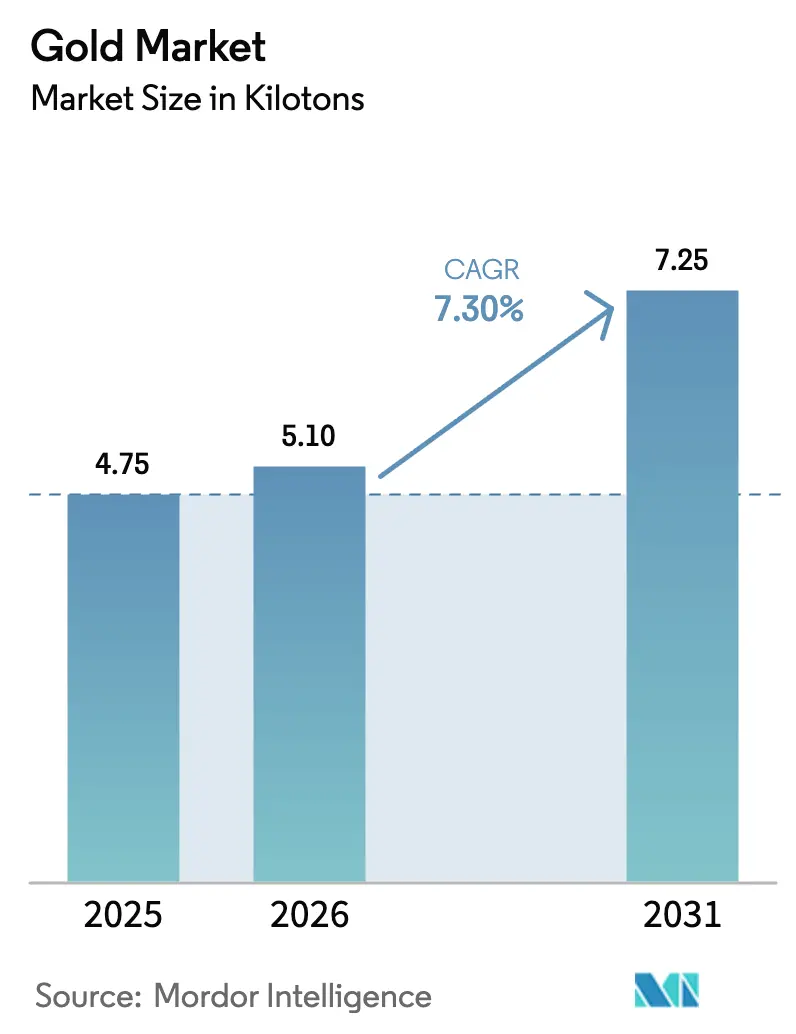
| Market Volume (2026) | 5.1 kilotons |
| Market Volume (2031) | 7.25 kilotons |
| Growth Rate (2026 - 2031) | 7.30 % |
| Fastest Growing Market | Asia Pacific |
| Largest Market | Asia-Pacific |
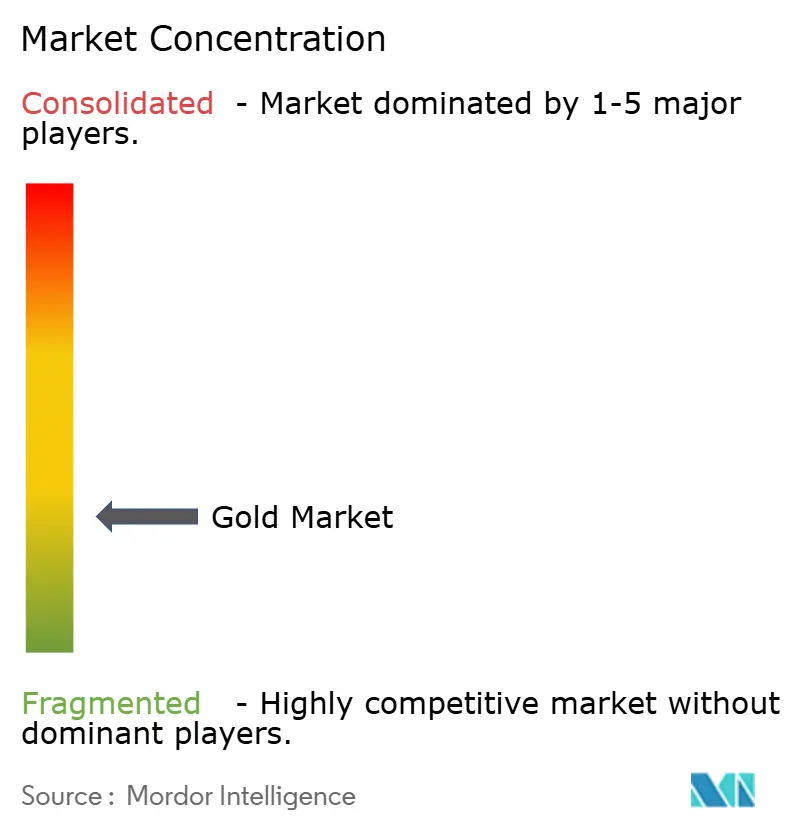
| Market Concentration | Low |
Major Players *Disclaimer: Major Players sorted in no particular order Image © Mordor Intelligence. Reuse requires attribution under CC BY 4.0. | |
Gold Market Analysis by Mordor Intelligence
The Gold Market size market is expected to grow from 4.75 kilotons in 2025 to 5.1 kilotons in 2026 and is forecast to reach 7.25 kilotons by 2031 at 7.30% CAGR over 2026-2031. Robust central-bank accumulation, persistent geopolitical risk, and the expanding role of gold in advanced electronics keep demand rising even as mined supply faces structural cost pressures. Asia-Pacific remains the heartbeat of consumption, while North America and Europe amplify investment flows through exchange-traded products. Recycled volumes accelerate on sustainability mandates, tokenized products broaden retail access, and miners pursue mergers to offset declining ore grades. Across the forecast horizon, disciplined supply management and digital-asset innovation underpin Gold's resilience and support multi-year price strength.
Key Report Takeaways
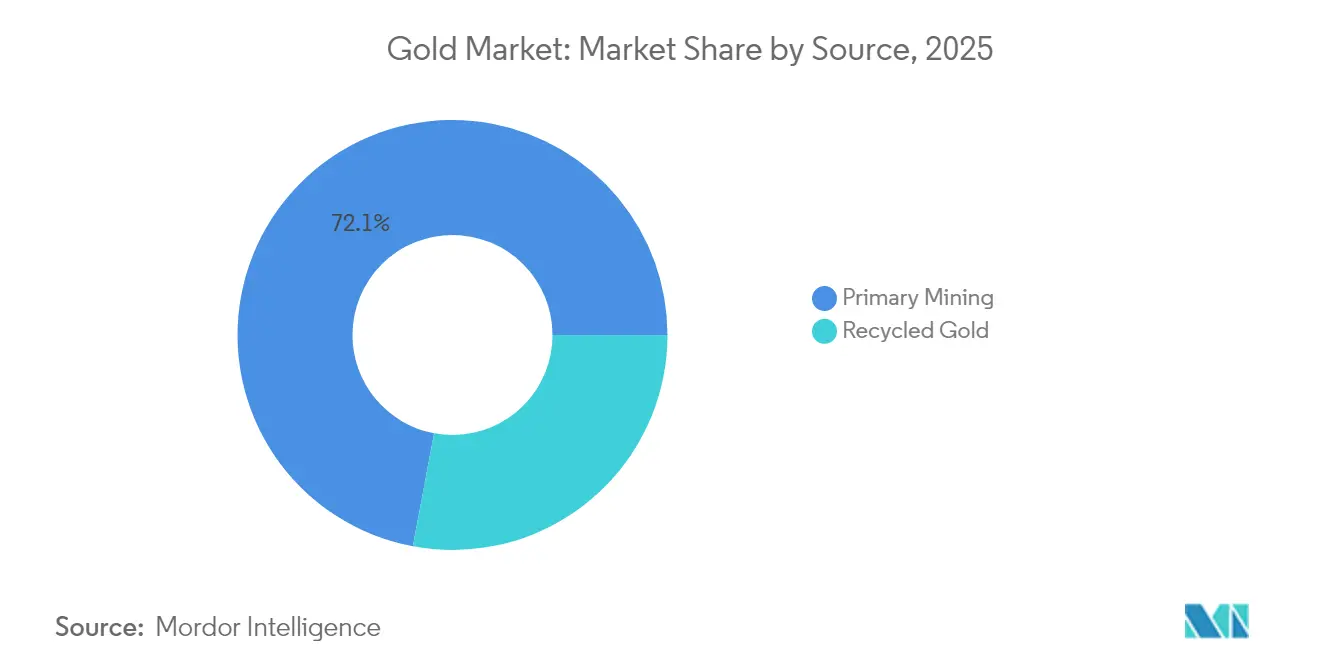
- By source, primary mining led with 72.05% volume share in 2025; recycled gold is forecast to expand at an 7.98% CAGR through 2031.
- By type, alloyed gold accounted for 79.55% share of the Gold market size in 2025, while layered gold applications are projected to grow at a 8.72% CAGR to 2031.
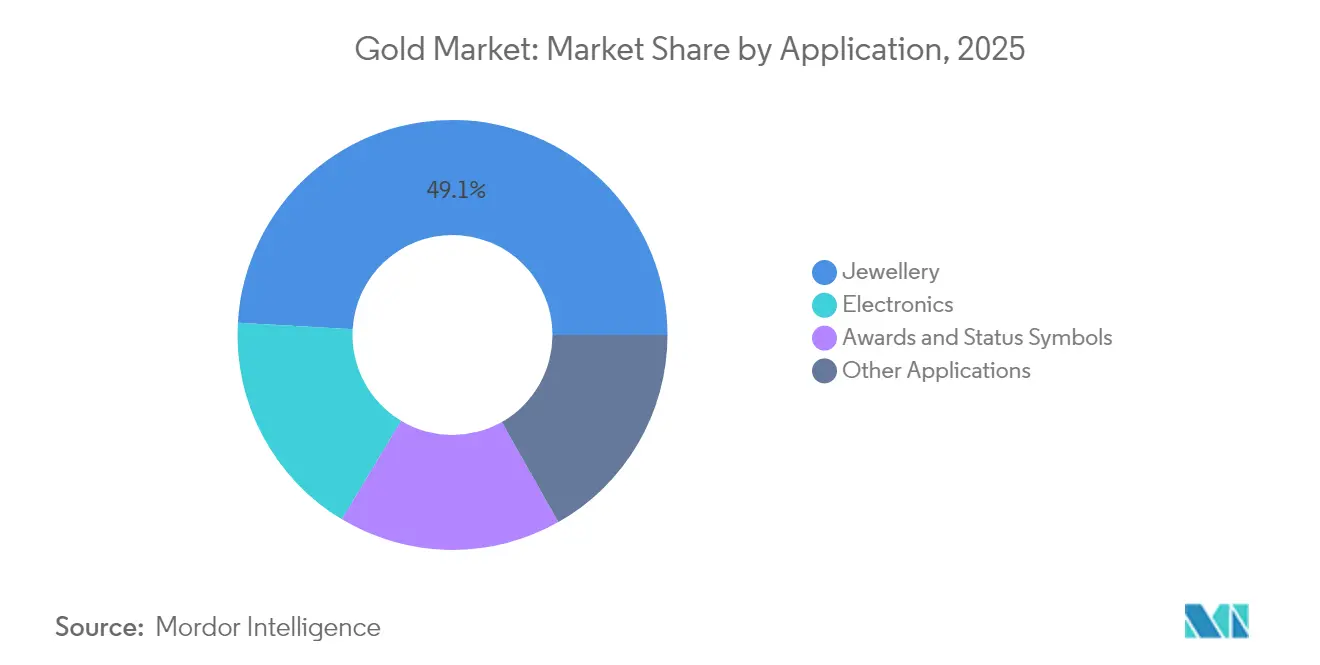
- By application, jewellery held 49.10% of the Gold market share in 2025; electronics is projected to rise at an 8.32% CAGR through 2031.
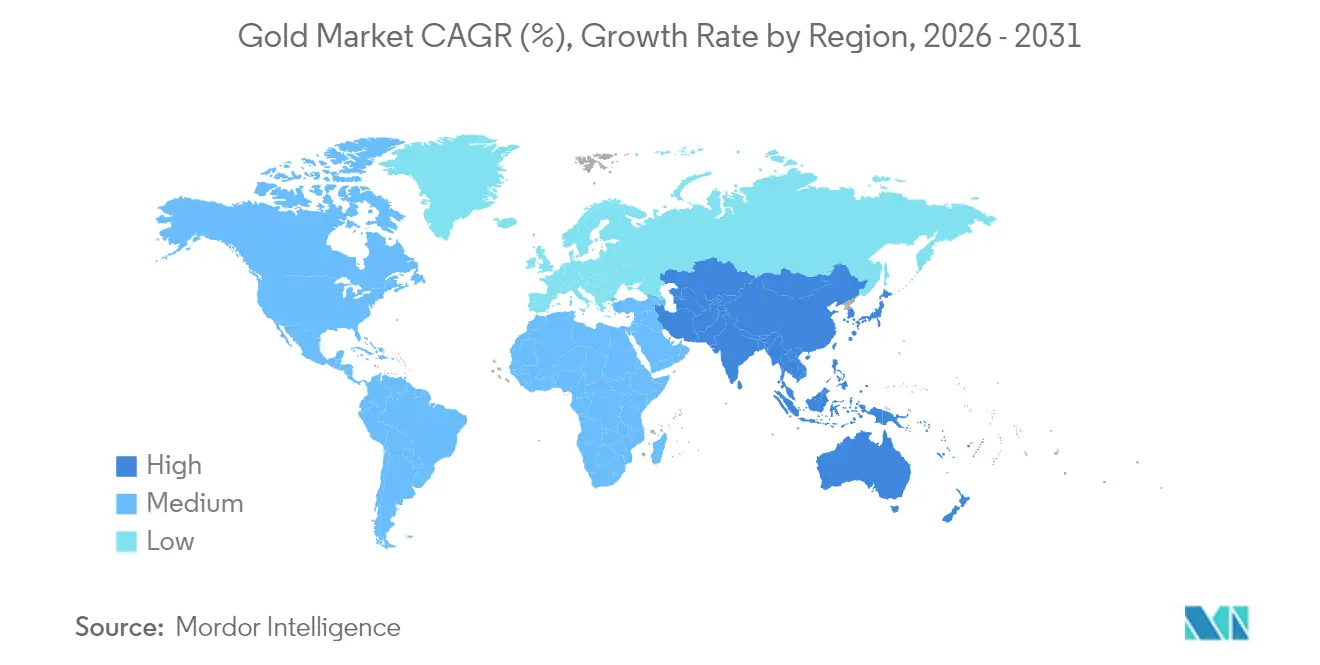
- By geography, Asia-Pacific captured 59.85% of the Gold market in 2025, and the region is advancing at a 8.95% CAGR to 2031.
Note: Market size and forecast figures in this report are generated using Mordor Intelligence’s proprietary estimation framework, updated with the latest available data and insights as of 2026.
Market Trends and Insights
Drivers Impact Analysis of Gold Market*
| Driver | (~) % Impact on CAGR Forecast | Geographic Relevance | Impact Timeline |
|---|---|---|---|
| Surging Retail and ETF Investment Demand in Inflation-hedge Environments | +1.8% | Global, with concentration in North America & EU | Medium term (2-4 years) |
| Central-bank De-dollarization Strategies Accelerating Reserve Diversification | +2.1% | Global, led by APAC and emerging markets | Long term (≥ 4 years) |
| Rising Middle-class Jewellery Demand in India and ASEAN | +1.4% | APAC core, spill-over to MEA | Medium term (2-4 years) |
| AI-Enabled Electronics Driving Ultra-fine Gold Bonding Wire Usage | +0.9% | Global, concentrated in technology hubs | Short term (≤ 2 years) |
| Tokenised Gold Products Expanding Digital Asset Adoption | +0.6% | Asia-Pacific, expanding to global markets | Long term (≥ 4 years) |
| Source: Mordor Intelligence | |||
Surging Retail and ETF Investment Demand in Inflation-Hedge Environments
Persistently high consumer-price levels and doubts over monetary-policy effectiveness have re-anchored gold in diversified portfolios. Gold exchange-traded funds in India attracted INR 112 Billion (USD 1.3 Billion) of net inflows during 2024, the highest annual tally on record [1]World Gold Council, “India Gold ETF Inflows Hit Record,” WORLDGOLDCOUNCIL.ORG. The metal out-performed local equities by 21 percentage points that year, reinforcing its safe-haven status. Portfolio managers in the United States and Europe lifted strategic allocations as real yields turned negative, and survey data show a rising preference for gold when inflation exceeds 4%. Coins and bars remain popular among retail savers seeking physical hedges, and demand proved remarkably inelastic after spot prices broke above USD 2,300 /oz. The structural shift in investment behaviour is expected to keep the market well bid whenever macro volatility spikes.
Central-Bank De-Dollarization Strategies Accelerating Reserve Diversification
Central banks bought more than 1,000 tons of gold in each of the past three calendar years, a historic streak that underscores growing skepticism toward the US dollar’s future dominance. In the World Gold Council’s 2025 survey, 95% of respondents said they would either maintain or increase their bullion holdings, and 43% plan outright additions. China, India, and Turkey led net purchases that together topped 600 tons since 2021, reflecting policy moves to mitigate sanction risk and currency volatility. The dollar’s share of global foreign-exchange reserves slipped to 58.9% by March 2024, its lowest level since modern records began, increasing the attractiveness of gold as a neutral store of value. Active bullion management grew from 37% to 44% of official holdings over 2024-2025, signalling a longer-run structural bid beneath the gold industry.
Rising Middle-Class Jewellery Demand in India and ASEAN
India remained the second-largest gold consumer worldwide in 2025, supported by an expanding middle class and cultural traditions that prioritise gold ornaments during weddings and festivals. Bridal purchases account for roughly half of annual jewellery demand, aided by an average 12 Million weddings each year. New Delhi’s decision to trim import duty from 15% to 6% in 2024 lowered retail prices materially and is projected to add at least 50 tons of incremental demand in the second half of that year. Across ASEAN, rising disposable income and youthful demographics sustain appetite for lightweight contemporary designs that offset higher raw-material costs. Despite cyclical price swings, consumer sentiment surveys reveal that gold remains a preferred store of wealth, underpinning steady volume growth in the gold industry.
AI-Enabled Electronics Driving Ultra-Fine Gold Bonding-Wire Usage
Advanced semiconductor architectures powering artificial-intelligence workloads require ultra-reliable electrical connections, and gold’s unrivalled conductivity and corrosion resistance make it indispensable for bonding wire. Electronics demand for gold rose 9% to 271 tons in 2024 as chip fabricators ramped output of AI accelerators and 5G radios. Smartphone shipments climbed 6%, yet gold content per premium handset increased because higher processing speeds necessitate more robust interconnects. Substitution options are limited after earlier cost-reduction cycles, leading to relatively inelastic industrial demand. Industry consultations indicate that the most sophisticated data-centre processors can contain up to three times the gold used in pre-AI designs. As global compute power doubles every 18 months, technology hubs in East Asia and North America will continue to pull significant volume from the gold industry.
Restraints Impact Analysis of Gold Market*
| Restraint | (~) % Impact on CAGR Forecast | Geographic Relevance | Impact Timeline |
|---|---|---|---|
| Declining Mined Ore-grades Raising AISC Beyond USD 1,450/oz | -1.2% | Global, particularly affecting high-cost jurisdictions | Medium term (2-4 years) |
| ESG-driven Financing Constraints for New Green-field Mines | -0.8% | Global, with emphasis on developed markets | Long term (≥ 4 years) |
| Volatile Import Duties in Key Consuming Nations Curb Jewellery Demand | -0.6% | APAC and emerging markets | Short term (≤ 2 years) |
| Source: Mordor Intelligence | |||
Declining Mined Ore Grades Raising AISC Beyond USD 1,450 /oz
Ore grades continue to fall at mature deposits, forcing operators to process more material to maintain output. Newmont reported its highest cost base in nine years, with all-in sustaining costs at USD 1,651 /oz in Q1 2025, a 29% jump from 2022. Industry-wide all-in sustaining costs (AISC) averaged USD 1,388 /oz in Q2 2024, and North American producers faced an even steeper USD 1,522 /oz. Labour shortages, rising energy prices, and royalty escalators linked to spot quotations intensify cost pressures. Although a record spot price shields margins today, sustained cost inflation squeezes feasibility for marginal pits and accelerates mine closures. Over the medium term, higher cost curves could temper fresh supply and lift the floor under the gold industry.
ESG-Driven Financing Constraints for New Green-Field Mines
Capital allocation now hinges on stringent environmental, social, and governance criteria. Global sustainable investment portfolios reached USD 31 Trillion, and many asset managers restrict lending to projects without credible net-zero pathways. Miners targeting new deposits must prepare robust decarbonisation plans and accept higher upfront expenditure on clean-energy infrastructure. Third-party audits and community-consultation requirements lengthen permitting timelines, while public opposition in developed markets has derailed several projects. Even where resources are high grade, developers struggle to secure equity at viable valuations, shifting attention toward brownfield expansions and recycling alternatives. These financing headwinds could restrain mined output growth and tighten the long-run balance in the gold market.
*Our forecasts treat driver/restraint impacts as directional, not additive. The impact forecasts reflect baseline growth, mix effects, and variable interactions.
Gold Market Segment Analysis
By Source:
Primary Mining Retains Scale Advantage as Recycling AcceleratesPrimary extraction occupied 72.05% of the Gold market share in 2025, confirming that large-scale open-pit and underground mines remain the backbone of supply. The segment benefits from established logistics, skilled labour pools, and long-term offtake contracts that stabilise throughput even when ore grades erode. However, all-in sustaining costs rising above USD 1,388 /oz signal diminishing returns on fresh capital, and companies have intensified exploration around existing hubs to leverage sunk infrastructure.
Recycling, though only 27.95% of supply, is marching forward at an 7.98% CAGR to 2031, the fastest rate of any source segment. The Royal Mint’s South Wales facility processes 4,000 tons of circuit boards annually using patented hydrometallurgical techniques with 99% recovery efficiency . Energy demand for recycling is roughly 300 times lower than for green-field mining, lowering carbon intensity and aligning with Environmental, Social, and Governance (ESG) mandates. Luxury-goods leader Pandora pledged to use 100% recycled precious metals by 2025, creating pull for scrap flows. As more jurisdictions tighten e-waste rules, secondary feedstock will become a strategic pillar in the Gold industry.



By Type:
Alloyed Gold Dominates, but Layered Applications Gain MomentumAlloyed compositions captured the bulk 79.55% share of the Gold market size in 2025 because jewellery, coinage, and many industrial products require mechanical strength and opacity that pure metal lacks. The segment enjoys process familiarity and broad supplier networks, keeping unit costs comparatively low. Automotive sensors and dental alloys also favour alloyed material for wear resistance, sustaining wide demand beyond ornamental uses.
Layered applications are the growth engine, advancing at 8.72% CAGR. Semiconductor packaging, high-frequency connectors, and aerospace sensors demand atomically thin, uniform coatings that only layered deposition can deliver. Technology manufacturers invested heavily in physical-vapor-deposition and electroplating capacity during 2024-2025, responding to AI server orders that doubled quarterly. European Union (EU) automotive-safety directives mandate redundant sensors, further lifting the adoption of layered gold, where failure tolerance must approach six-sigma. As miniaturisation in electronics marches on, the layered-gold niche will claim incremental share from alloyed material within the Gold market.
By Application:
Electronics Momentum Outpaces Jewelry TraditionJewelry remained the largest application at 49.10% of 2025 volume, underpinned by cultural affinity in Asia and the Middle East. Record prices trimmed average gram weights, yet retailers successfully marketed lighter, contemporary pieces to preserve sales volumes. In the gold market, the segment’s resilience is aided by wedding-driven purchases that fulfil social obligations regardless of price.
Electronics achieved the fastest expansion, charting an 8.32% CAGR that reflects insatiable demand for AI-equipped devices and high-speed networking gear. Gold content per advanced graphics-processing unit rose 15% in 2024 because ultra-fine bonding wire ensures signal integrity at higher clock frequencies. Medical devices and aerospace avionics, both severe-environment applications, also require gold for biocompatibility and corrosion resistance. Other uses, from dental implants to bullion-backed credit cards, contribute niche but stable volumes, benefiting from gold’s non-reactive properties. This trend underscores how industrial demand within the gold industry continues to expand.
Geography Analysis
APAC Gold Market
Asia-Pacific held 59.85% of the Gold industry in 2025 and is projected to grow with a 8.95% CAGR through 2031. China mined 403 tons in 2024, retaining pole position in production while its central bank lifted official holdings for the 19th consecutive month. India’s Reserve Bank expanded bullion reserves to 880 tons by July 2025, and consumer demand rebounded once import duties fell. Indonesia, Thailand, and Vietnam posted double-digit percentage gains in jewelry offtake, reflecting rising disposable income and a preference for gold as a liquid savings vehicle.
North America, EMEA and LATAM Gold Market
North America and Europe exhibit mature demand profiles yet see renewed investor interest as real yields gyrate. US-listed gold Exchange Traded Funds (ETFs) added 152 tons during 2024, reversing two years of net outflows, while European funds absorbed 98 tons amid heightened energy-price volatility. Canadian mines contributed 175 t of output, led by the Detour Lake expansion that reached full capacity in Q4 2024. Within the gold industry, the region’s regulatory stability and access to capital markets encourage brownfield expansions that help offset grade decline elsewhere. Latin America and Africa remain pivotal on the supply side. Peru and Brazil delivered a combined 290 tons in 2024, though social protests in Peru intermittently halted logistics movements. Ghana overtook South Africa as the continent’s top producer, shipping 129 tons, aided by streamlined permitting under its 2024 Mining Investment Bill. Several African central banks announced plans to raise gold holdings to at least 10% of reserves, a move that could redirect part of regional output toward domestic vaults rather than export channels. Middle Eastern demand ticked higher as Gulf Cooperation Council states promoted gold-based savings products aligned with Sharia principles, enhancing retail participation in the Gold industry.

Value Chain Analysis
The gold value chain starts with upstream supply from primary mining (72.05% of 2025 volume) and secondary supply from recycled gold (27.95%). Primary flows move from exploration, development, extraction and processing (including cyanide leaching and refining) into doré shipment to refiners, then into bullion, semi-fabricated inputs (bars, grain, wire, plating salts), and finished products across jewelry, electronics, awards/status items, and other industrial uses. With cost and productivity pressures in mining, highlighted by Newmont reporting all-in sustaining costs of USD 1,651/oz in Q1 2025, the focus increasingly shifts to brownfield expansions, shared infrastructure between projects, and portfolio optimization through M&A and joint ventures.
Midstream refining and bullion logistics rely on accredited refineries and vaulting networks that connect miners, recyclers, banks, and fabricators. Responsible-sourcing requirements increasingly drive transaction eligibility and supplier selection. The LBMA Good Delivery List framework uses annual audit processes for listed refiners, while OECD due-diligence guidance sets expectations for mines through end users. Downstream demand splits between physical fabrication (jewelry and electronics, including ultra-fine bonding wire and layered coatings) and financial distribution (bars, coins, and ETPs). Tightening e-waste rules and corporate pledges such as Pandora moving to 100% recycled precious metals by 2025 are accelerating scrap collection, preprocessing, and high-recovery refining capacity, including The Royal Mint facility in South Wales that processes 4,000 tons of circuit boards annually at 99% recovery efficiency.
Competitive Landscape
The Gold market is fragmented in nature. Newmont Corporation and Barrick Mining Corporation still control tier-one assets but struggle with cost inflation, prompting them to rationalise non-core mines. Royal Gold advanced a USD 3.7 Billion double acquisition of Sandstorm Gold and Horizon Copper to deepen its royalty portfolio. Equinox Gold Corp.’s 2025 takeover of Calibre created a 1.2 Million-ounce producer focused on lower-jurisdictional-risk Americas assets, reflecting a strategic pivot toward political stability. Junior developers face capital scarcity under stringent ESG screens, while recycling specialists secure impact-investing funds by highlighting circular-economy credentials. As investors place premiums on sustainability disclosures, companies that combine cost discipline with environmental stewardship are positioned to outperform peers in the evolving gold industry.
Gold Industry Leaders
Agnico Eagle Mines Limited
Newmont Corporation
PJSC Polyus
Barrick Mining Corporation
AnglogoldAshanti
- *Disclaimer: Major Players sorted in no particular order
Gold Market Companies Covered in this Report
- Agnico Eagle Mines Limited
- AnglogoldAshanti
- B2Gold Corp.
- Barrick Mining Corporation
- China Gold International Resources Corp., Ltd.
- Endeavour Mining plc
- Equinox Gold Corp.
- Franco-Nevada Corporation
- FURUKAWA CO., LTD.
- Gabriel Resources
- Gold Fields Limited
- Harmony Gold Mining Company Limited
- Johnson Matthey
- Kinross Gold Corporation
- Lundin Gold Inc.
- Newmont Corporation
- PJSC Polyus
- Zijin Mining Group Co., Ltd.

Market Opportunities and Future Outlook
Recycling-led supply chains create a concrete whitespace as sustainability mandates and traceability requirements translate into procurement changes. With recycled gold at 27.95% of 2025 volumes and growing faster than mined supply, the most immediate opportunities sit in collection and preprocessing for electronics scrap, high-recovery refining, and auditable chain-of-custody that fits OECD due diligence and LBMA responsible-sourcing expectations. Corporate actions that pull recycled content through the value chain, such as Pandora committing to 100% recycled precious metals by 2025, also support expansion of secondary feedstock aggregation, hydrometallurgical processing capabilities, and near-consumer recycling hubs.
On the mined-supply side, funding continues to concentrate on Tier-1 jurisdictions and brownfield expansions that can leverage existing infrastructure and permitting track records. Recent examples include Newmont and Imperial Metals securing CAD 500 million in Canadian government support for the Red Chris expansion and Agnico Eagle outlining a large Ontario investment portfolio, which points to where suppliers of processing equipment, underground development services, and low-carbon power solutions can align with funded project pipelines. At the same time, electronics-driven demand growth (271 tons in 2024 for electronics, up 9% year on year) supports downstream capacity for bonding wire, plating and deposition materials, and high-reliability connector manufacturing, especially in technology hubs where AI accelerator and network hardware output is scaling and gold’s performance attributes limit substitution.
Recent Industry Developments in Gold Market
- July 2026: Agnico Eagle Mines Limited temporarily suspended mining operations at the Barnat open pit at the Canadian Malartic complex following a rock mass movement on July 1, 2026. The disruption highlights geotechnical risk exposure and changes near-term production planning, reducing visibility on short term output guidance. The event requires updated sequencing and contingency planning for Malartic assets.
- July 2026: Agnico Eagle Mines Limited revised full-year 2026 production expectations for the Canadian Malartic complex, estimating a reduction of 60,000 to 80,000 ounces of gold for H2 2026 due to the Barnat pit suspension. The cut directly affects annual gold output and revenue outlook. The update drives changes to capital allocation and rescheduling of mine plans within the Malartic complex.
- April 2026: Agnico Eagle Mines Limited announced acquisition of a 70% interest in Fingold Ventures Ltd. from B2Gold Corp for US$325 million and a collaboration agreement for Nunavut operations. The deal expands its Arctic asset base and strengthens the growth pipeline in stable jurisdictions. The acquisition supports long term production expansion and diversification of Canadian operations.


Gold Market Report Scope and Research Methodology
Market Definition and Coverage
For this methodology, the gold market is defined as the global physical flow of gold by volume, covering mined and recycled supply that is processed and then consumed across end uses such as jewelry and industrial applications.
Scope exclusions: Gold mining equipment, exploration services, and pure financial instruments that do not require physical delivery are excluded.
Segments Covered in This Report
- By Source
- Primary Mining
- Recycled Gold
- By Type
- Alloyed Gold
- Layered Gold
- By Application
- Jewellery
- Electronics
- Awards and Status Symbols
- Other Applications (Dental, Aerospace, etc.)
- By Geography
- Production Analysis
- United States
- Australia
- Brazil
- Burkina Faso
- Canada
- China
- Colombia
- Ghana
- Indonesia
- Kazakhstan
- Mali
- Mexico
- Papua New Guinea
- Peru
- Russia
- South Africa
- Sudan
- Tanzania
- Uzbekistan
- Other countries
- Consumption Analysis
- Asia-Pacific
- China
- India
- Japan
- South Korea
- Rest of Asia-Pacific
- North America
- United States
- Canada
- Mexico
- Europe
- Germany
- United Kingdom
- Italy
- France
- Rest of Europe
- South America
- Brazil
- Argentina
- Rest of South America
- Middle East and Africa
- Saudi Arabia
- South Africa
- Rest of Middle East and Africa
- Asia-Pacific
- Production Analysis
Data Sources, Market Sizing, and Validation
Desk Research
Desk research helped set the base structure of supply, demand, and trade flows before assumptions were built into the model. We relied on public, repeatable sources such as World Gold Council demand and supply series, USGS mineral production statistics, UN Comtrade trade data, and central bank reserve disclosures via IMF or national monetary authorities, which together helped explain where metal is coming from and where it is absorbed.
To cross-check direction and timing, we also used company annual reports and investor presentations, mining regulator publications in major producing countries, and reputable press coverage of mine expansions, shutdowns, and refining constraints. For a few specific checks, paid subscriptions were used for company financials and intelligence, patent databases, and shipment-level import export readings where available. This list is illustrative, and many other public and paid sources were also used for data collection, validation, and clarification.
Primary Interviews and Surveys
Primary work was used to test what desk sources cannot fully confirm, especially the split between mined and recycled supply, the pace of recycling response to price moves, and how demand shifts across jewelry, investment-related bars and coins, and industrial usage. We spoke with upstream and downstream experts, and the inputs were checked across major consuming and producing regions so the final assumptions stayed realistic.
Findings from interviews were then applied as constraints in the model, so any one dataset or single viewpoint did not dominate the totals.
Distribution of primary research fieldwork respondents
| Company type | Respondent position | Region |
|---|---|---|
| Top tier: 38% | CXOs: 17% | APAC: 40% |
| Mid tier: 40% | Functional/Unit leaders: 30% | EMEA: 36% |
| Smaller Players: 22% | Managers: 53% | Americas: 24% |
Market-Sizing & Forecasting
Sizing is built using a top-down logic where global supply and demand series in tonnes are reconstructed, and then reconciled with trade signals and reported category splits before a final total is fixed for the base year. To keep the output grounded, we also ran selective bottom-up approximations, such as sampled refinery and recycling throughput discussions, channel checks on bar and coin activity, and sanity checks using price per ounce movement against implied value direction.
Inputs that mattered most included mined production volumes, recycled gold volumes, central bank net purchases, jewelry fabrication trends, and industrial usage indicators tied to electronics demand. These are then adjusted for reported shifts between visible and OTC flows where relevant. Forecasting leaned on scenario analysis supported by expert consensus on macro drivers such as real interest rates, inflation expectations, and geopolitical risk, because these factors can swing investment demand quickly rather than in a smooth line. Where bottom-up reads were incomplete for smaller flows, gaps were handled through ratio-based allocations anchored to historical shares, and then rechecked with interview feedback.
Data Validation & Update Cycle
Validation is done through multiple checks so that totals in tonnes align with independent signals like reported mine output, recycling totals, and demand category splits, and then the implied movements are compared against the observed gold price environment for the same period. Outliers are flagged and reviewed, and if a variance cannot be explained through a clear driver like a price shock or policy change, the assumption is revisited and the relevant experts are re-contacted.
Before sign-off, the model and key assumptions go through stepwise analyst reviews, followed by a final pass to confirm that definitions, units, and conversions are consistent across regions. The report is refreshed annually, and interim updates are done when material events occur, such as major policy actions, supply disruptions, or sharp shifts in central bank activity.
Mordor Intelligence's Gold Market Size Compared With Other Published Estimates
Published market sizes for gold often do not line up because the same topic gets expressed in different units and even different concepts, such as physical tonnes moved versus US dollar value of demand. Numbers also drift when OTC activity is treated differently, and when authors pick different base-year prices or average price windows.
Gold demand value that includes OTC investment sits outside Mordor Intelligence's scope here, since the report sizes the market in kilotons, which tends to create a wide spread when compared with USD-based demand value headlines that rise and fall mainly with price.
Benchmark comparison
| Source | Market Size | Gaps in Research Methodology |
|---|---|---|
| Mordor Intelligence | USD 5.10 B (2026) | |
| Industry Association A | USD 382.00 B (2024) | Uses annual demand value in USD, which is highly price-driven, and it also reports totals that include OTC investment activity that is not expressed as a physical market volume. |
| Trade Journal B | USD 555.00 B (2025) | Reports USD value of total gold demand including OTC, so the figure expands with price spikes and can look much larger than volume-based sizing even if tonnes change modestly. |
The comparison mainly shows a unit and scope mismatch, rather than a simple disagreement on growth. When figures are stated in USD demand value, the result is dominated by the average price used and whether OTC is counted, while a volume-based model stays tied to mined and recycled tonnes and their end-use absorption. By keeping the inputs traceable to physical flows and checking them against trade and category splits, the final view becomes easier to reproduce and update year to year.


Key Questions Answered in the Report
How Big is the Gold Market?
The Gold market is forecast to grow at a 7.30% CAGR, climbing from 5.1 kilo tons in 2026 to 7.25 kilo tons by 2031.
Which region leads consumption in the Gold market?
Asia-Pacific dominates with 59.85% of volume in 2025 and is also the fastest-growing region at a 8.95% CAGR through 2031.
How large is the recycled Gold segment and how fast is it growing?
Recycled gold supplied 27.95% of global volumes in 2025 and is expanding at an 7.98% CAGR as sustainability mandates gain momentum.
Why is electronics the fastest-growing application for gold?
AI-driven semiconductor demand requires ultra-fine gold bonding wire and layered coatings, pushing electronics-segment volume up at an 8.32% CAGR.
What role do central banks play in the Gold market today?
Central banks have purchased more than 1,000 tons annually for three straight years and 95% plan to maintain or increase holdings, underscoring a long-run structural bid.
Page last updated on:




