
Solar Cooker Market Size and Share
Market Overview
| Study Period | 2020 - 2031 |
|---|---|
| Market Size (2026) | USD 532.28 Million |
| Market Size (2031) | USD 758.99 Million |
| Growth Rate (2026 - 2031) | 7.36 % |
| Fastest Growing Market | North America |
| Largest Market | Asia Pacific |
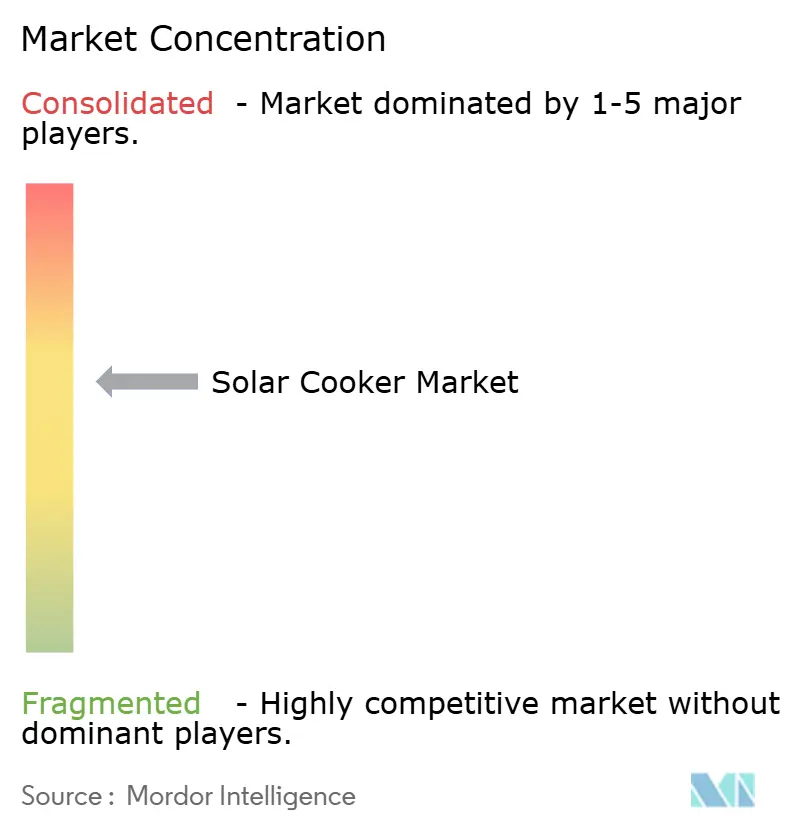
| Market Concentration | Medium |
Major Players *Disclaimer: Major Players sorted in no particular order Image © Mordor Intelligence. Reuse requires attribution under CC BY 4.0. | |
Solar Cooker Market Analysis by Mordor Intelligence
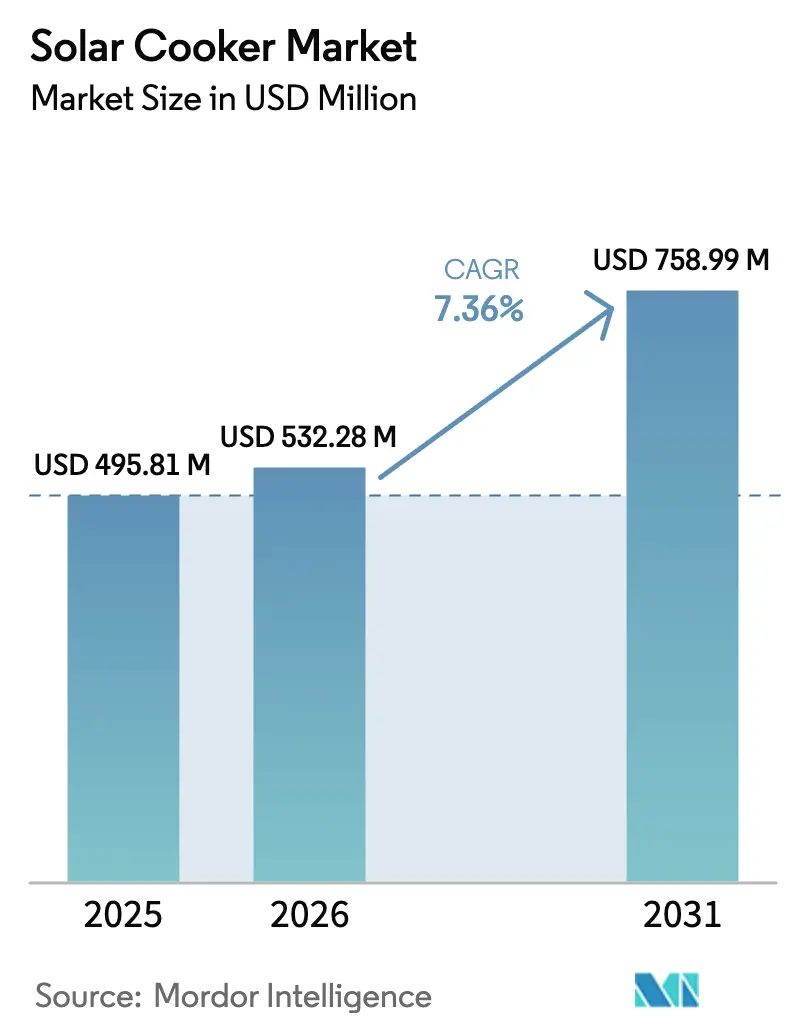
The solar cookers market size was valued at USD 495.81 million in 2025 and estimated to grow from USD 532.28 million in 2026 to reach USD 758.99 million by 2031, at a CAGR of 7.36% during the forecast period (2026-2031). Rising clean-cooking mandates, supportive public policies, and sustained humanitarian procurement combine to accelerate product uptake. Continuous design upgrades—particularly in vacuum-tube and hybrid solar-electric models—elevate cooking temperatures and reduce weather dependence, enhancing user confidence. Institutional buyers increasingly compare the lifetime economics of solar cookers with the healthcare costs of indoor air pollution, strengthening the shift toward cleaner solutions. E-commerce penetration broadens reach into rural and recreational segments, while premium offerings capture consumers willing to invest in reliability and convenience. Technology differentiation, local manufacturing incentives, and evolving micro-finance products further underpin adoption.
Key Report Takeaways
- By cooker type, box cookers led with 34.72% revenue share of the solar cooker market in 2025, whereas vacuum and evacuated-tube designs are projected to expand at a 8.81% CAGR to 2031.
- By end-user, residential consumers held 47.15% demand of the solar cooker market in 2025, while humanitarian and relief camps represent the fastest-growing segment at a 9.46% CAGR through 2031.
- By distribution channel, NGO and aid-agency procurement captured 36.05% of the solar cookers market share in 2025; direct-to-consumer webstores exhibit the highest CAGR at 10.62% to 2031.
- By price range, the USD 75-200 tier accounted for 52.61% share of the solar cookers market size in 2025, but products priced above USD 200 are advancing at a 8.93% CAGR.
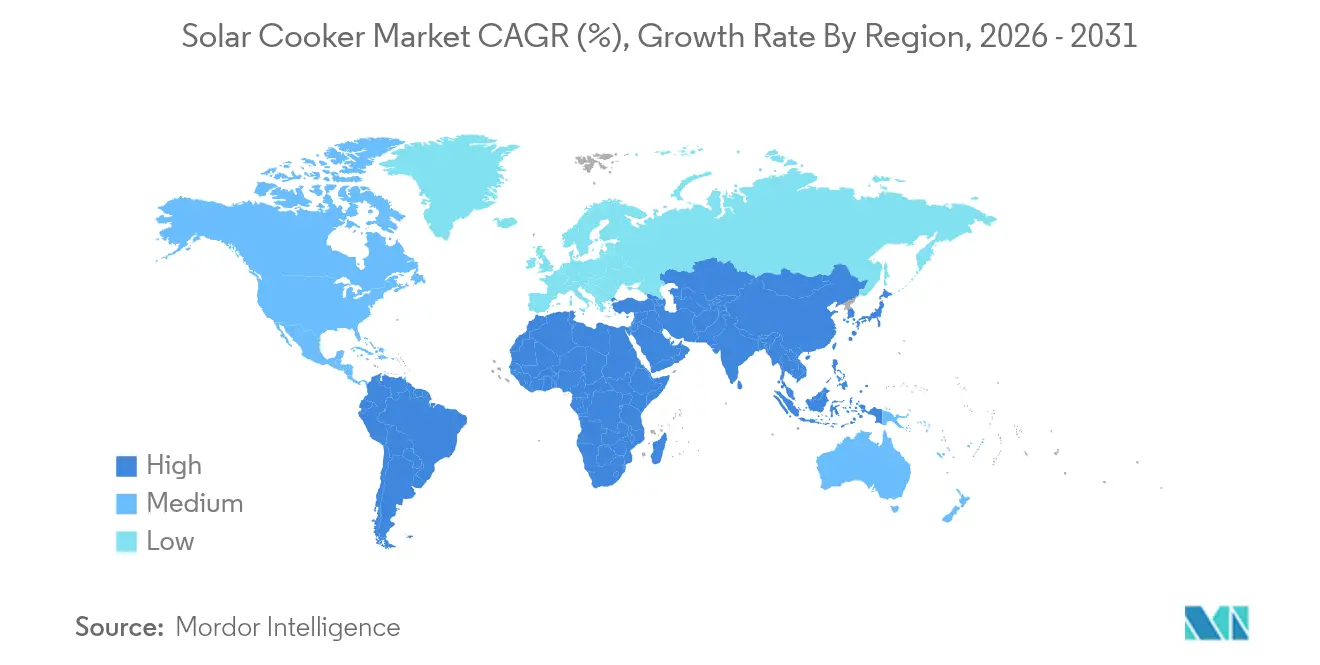
- By geography, Asia-Pacific commanded 42.92% of revenue of the solar cooker market in 2025, while North America is poised for the quickest regional growth at a 9.78% CAGR.
Note: Market size and forecast figures in this report are generated using Mordor Intelligence’s proprietary estimation framework, updated with the latest available data and insights as of 2026.
Market Trends and Insights
Drivers Impact Analysis of Solar Cooker Market*
| Driver | (≈) % Impact on CAGR Forecast | Geographic Relevance | Impact Timeline |
|---|---|---|---|
| Demand for clean-cooking solutions | +2.1% | Sub-Saharan Africa & South Asia | Medium term (2-4 years) |
| Government subsidies & clean-cooking programmes | +1.8% | Asia-Pacific core, spill-over to MEA | Short term (≤ 2 years) |
| High-efficiency vacuum tube & parabolic tech | +1.4% | North America & EU, expanding to APAC | Long term (≥ 4 years) |
| Hybrid solar-electric cookers (PV + battery) | +1.2% | Global, early uptake in developed markets | Medium term (2-4 years) |
| Micro-finance for off-grid e-cooking | +0.9% | Rural Sub-Saharan Africa & South Asia | Long term (≥ 4 years) |
| Community solar-kitchen deployments | +0.7% | Global institutional buyers | Short term (≤ 2 years) |
| Source: Mordor Intelligence | |||
Growing Demand for Clean-Cooking Solutions
Health-related cost awareness, more than climate sentiment, now drives institutional adoption. The Clean Cooking Declaration at the 2024 UNIDO Summit noted that 2.3 billion people lack modern cooking options and that household air pollution causes millions of deaths annually[1]. Hospitals and schools increasingly compare treatment costs for respiratory illness with the two-year payback offered by a quality solar cooker. Multilateral programs such as the Netherlands Enterprise Agency’s Energising Development initiative funnel grants and technical support into early-stage markets. This total-cost-of-ownership lens positions the solar cookers market as an economically rational upgrade rather than an aspirational green purchase.
Government Subsidies & Clean-Cooking Programmes
Policies now integrate manufacturing incentives, financing facilities, and consumer subsidies. India’s Solar Household Scheme and the PM-KUSUM program jointly target 74 GW of distributed capacity, while production-linked incentives lower domestic component costs. Australia’s Small-Scale Renewable Energy Scheme grants tradable certificates and interest-free loans that consumers can bundle with solar cookers. Analysts at IEEFA anticipate that shifting LPG subsidies toward solar-electric cooking could improve India’s energy security [2]. Similar policy mosaics across Southeast Asia and parts of Africa shorten the payback window and widen the solar cookers market.
High-Efficiency Vacuum Tube & Parabolic Tech
Double-walled evacuated tubes are now capable of achieving temperatures above 150 °C even in colder climates, effectively addressing the seasonal performance limitations observed in earlier models. The integration of patented light-guide lens technology significantly enhances energy concentration, ensuring consistent performance regardless of the sun's angle. These technological advancements expand the functional capabilities of solar systems, enabling applications such as baking and roasting that were previously constrained. Furthermore, these developments play a pivotal role in addressing cultural preferences for high-heat cooking methods, thereby broadening market acceptance. Collectively, these innovations represent a substantial leap forward in the efficiency and versatility of solar thermal technologies.
Hybrid Solar-Electric Cookers (PV + Small Battery)
Declining photovoltaic (PV) prices and advancements in compact lithium storage technology are driving the adoption of energy units capable of storing midday energy for evening consumption. ATEC's Internet of Things (IoT) stoves capitalize on carbon markets to generate revenue by monetizing up to 10 GWh of clean cooking energy daily, supported by USD 3.75 million secured through Series A funding. GoSun's hybrid oven, designed to reach temperatures of 550°F under sunlight, incorporates a seamless transition to grid or battery power during periods of insufficient sunlight [3]. The combination of revenue from verified carbon credits and enhanced cooking flexibility positions hybrid solar cookers as a premium segment within the solar cookers market. These developments underscore the growing potential of innovative cooking solutions to address both energy efficiency and sustainability goals in the market.
Restraints Impact Analysis of Solar Cooker Market*
| Restraint | (≈) % Impact on CAGR Forecast | Geographic Relevance | Impact Timeline |
|---|---|---|---|
| High upfront cost vs. legacy stoves | -1.9% | Global, sharply felt in low-income regions | Short term (≤ 2 years) |
| Cultural resistance to solar-only cooking | -1.6% | Traditional rural markets worldwide | Long term (≥ 4 years) |
| Quality variance hurting consumer trust | -1.1% | Emerging markets with weak standards | Medium term (2-4 years) |
| LPG / biogas subsidy competition | -0.8% | Asia-Pacific & Middle East | Medium term (2-4 years) |
| Source: Mordor Intelligence | |||
High Upfront Cost vs. Legacy Stoves
In Malawi, the adoption of solar cookers remains limited due to their high upfront costs, despite offering substantial long-term savings. The negligible purchase price of traditional biomass stoves continues to influence consumer preferences, driven by behavioral economics favoring established fuel sources. Although micro-finance initiatives aim to address affordability challenges, the underdeveloped rural banking infrastructure significantly restricts their scalability. Furthermore, in markets where government subsidies reduce the cost of LPG, the economic appeal of solar cookers diminishes, weakening their competitive positioning. To address price sensitivity among consumers, vendors have responded by introducing cost-effective economy models tailored to these segments.
Cultural Resistance to Solar-Only Cooking
In 2024, a survey in Uganda indicated that clean cooking methods had achieved a household penetration rate of only 3.8%, despite the presence of favorable policy initiatives aimed at promoting adoption. The integration of community demonstrations and hybrid systems, which combine solar energy with battery storage, has emerged as a promising approach to address this challenge. However, the transition to clean cooking technologies often requires a phased implementation, where solar solutions are introduced as a supplementary option rather than a complete replacement for traditional methods. This gradual adoption is particularly critical given that evening meal preparation frequently coincides with reduced daylight availability, limiting the effectiveness of solar energy alone. Additionally, the sustained high-heat requirements of certain cuisines, such as frying or simmering, further underscore the need for hybrid systems to meet diverse cooking demands effectively.
*Our forecasts treat driver/restraint impacts as directional, not additive. The impact forecasts reflect baseline growth, mix effects, and variable interactions.
Solar Cooker Market Segment Analysis
By Cooker Type:
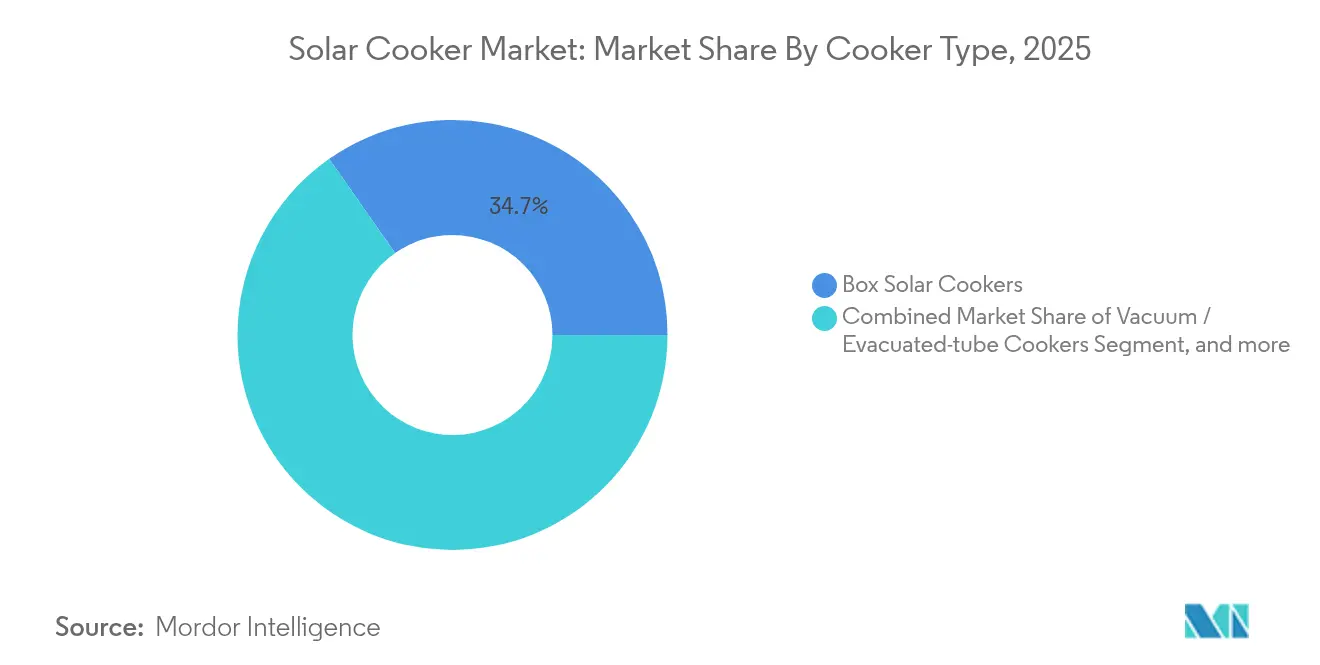
Vacuum Tubes Drive Technology EvolutionVacuum and evacuated-tube models are projected to grow at 8.81% annually, while box cookers are expected to hold 34.72% of the solar cookers market in 2025. Evacuated tubes, with double-glazing technology, retain heat to achieve cooking temperatures of 150 °C–290 °C, surpassing box cookers. This performance enhances baking and roasting capabilities, appealing to diverse culinary needs. Panel and parabolic cookers cater to portability and high-temperature requirements but face limited adoption due to complexity and capacity constraints. These factors position vacuum and evacuated-tube models as key players in the solar cookers market.
Hybrid designs combining vacuum tubes with PV panels and batteries are gaining traction. GoSun’s Sport model, which cooks in 20 minutes under sunlight and folds for portability, exemplifies this trend. The shift toward premium, portable solutions reflects evolving consumer preferences and market innovation. As production scales, cost differences between vacuum tube models and box cookers are narrowing. This trend positions vacuum tube models to challenge box cookers’ dominance before 2031, reshaping the competitive landscape.

By End-User:
Humanitarian Applications Accelerate AdoptionResidential users generated 47.15% of 2025 revenue, but humanitarian and relief camps showcase the fastest 9.46% CAGR. Coordinated procurement bypasses individual financing hurdles: UNHCR’s 2024 Pakistan project solarized 103 schools and 16 clinics, proving multi-facility viability . Such deployments cut fuel costs and indoor smoke, translating into health and budgetary savings for agencies.
The adoption of solar cookers in the hospitality industry and outdoor event management is driven by the dual objectives of enhancing sustainability credentials and reducing operational expenditures. Military organizations are actively testing lightweight parabolic solar cooker kits to minimize logistical challenges associated with fuel transportation. In residential markets, the increasing visibility of solar cooking in camps and school kitchens is fostering greater acceptance and adoption within surrounding communities. This normalization of solar cooking practices is gradually influencing consumer behavior and promoting sustainable energy solutions. The integration of solar cooking technologies across these sectors highlights a growing trend toward cost efficiency and environmental responsibility.
By Distribution Channel:
E-Commerce Transforms Market AccessNGOs and aid agencies accounted for a significant 36.05% market share. However, direct-to-consumer webstores are anticipated to achieve the highest annual growth rate of 10.62%, surpassing all other distribution channels. These online platforms enable manufacturers to directly serve rural and recreational buyers, optimizing supply chain efficiency by minimizing inventory costs. The availability of demonstration videos and peer reviews addresses consumer concerns about product performance, fostering trust in premium-priced models. This shift highlights the growing importance of digital channels in driving market expansion.
Specialty outdoor retailers remain competitive by offering bundled packages that combine solar cookers with camping gear, catering to niche consumer needs. Local workshops continue to thrive by leveraging hands-on demonstrations to convert hesitant households into customers. Hybrid distribution strategies, such as Glenergy’s Kenya-based assembly line, effectively combine advanced technology like GoSun with local labor resources. This approach integrates online marketing with localized support systems, ensuring broader market penetration. Such models underscore the value of blending global innovation with community-level engagement.
By Price Range:
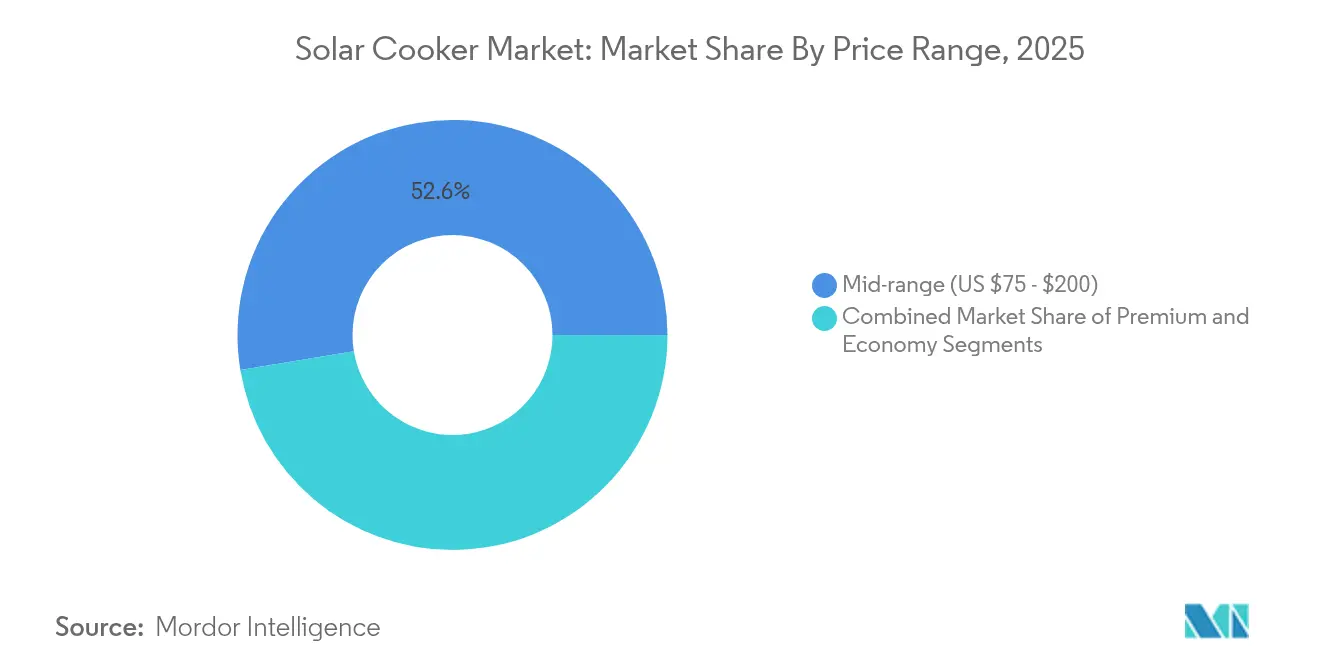
Premium Segment Gains MomentumIn 2025, the mid-range segment, priced between USD 75 and 200, dominated the market, capturing 52.61% of the total demand. Premium products priced above USD 200 are anticipated to grow at a robust CAGR of 8.93%, driven by rising disposable incomes, increasing recreational activities, and the appeal of hybrid functionalities. The higher price point is further validated by innovative offerings like GoSun's Solar Kitchen, priced at USD 999, which integrates cooking, cooling, and device charging into a single solution. This trend highlights the growing consumer preference for multifunctional and high-performance products in the solar cookers market. The premium segment's growth underscores the willingness of consumers to invest in advanced technologies that deliver enhanced utility and convenience.
Economy models priced below USD 75 continue to serve as essential solutions for humanitarian initiatives and low-income households, despite ongoing concerns about product quality. As economies of scale drive down the cost of vacuum tube technology, manufacturers are expected to incorporate select premium features into mid-range models. This development is likely to redefine consumer expectations regarding price-performance ratios in the market. The integration of advanced features into more affordable segments could also intensify competition among manufacturers. Consequently, the solar cookers market is poised for significant transformation, with innovation and cost optimization shaping its future trajectory.
Geography Analysis
APAC Solar Cooker Market
Asia-Pacific retained 42.92% of global revenue in 2025, supported by government clean-cooking initiatives and vast off-grid populations. Yet cultural cooking preferences and limited financing slow penetration despite national solar targets such as India’s 100 GW mission. China’s dominance in component manufacturing reduces system costs, while Japan and Australia show strong recreational and emergency-preparedness demand, especially for premium hybrids.
North America Solar Cooker Market
North America is forecast to expand 9.78% annually through 2031, the fastest worldwide. Growth stems from outdoor recreation, preparedness culture, and robust e-commerce infrastructure. State-level incentives and public recognition, such as California’s commendation of Solar Cookers International, spur awareness. Rising climate-driven grid concerns prompt homeowners to stock alternative cooking systems, further lifting the solar cookers market size in the region.
EMEA and South America Solar Cooker Market
Europe, the Middle East, and Africa reveal mixed drivers. EU customers pair sustainability goals with camping lifestyles, whereas refugee and conflict zones in MEA rely on donor-funded installations. The Azraq camp in Jordan demonstrates solar cooking’s social benefits by reducing the need for firewood collection, improving safety, and livelihood security. South America trails but displays latent potential as economic growth and environmental awareness converge.
Regulatory Landscape
Solar cooker adoption is linked to clean-cooking policy toolkits and product performance standards that help reduce quality variance. In India, the Ministry of New and Renewable Energy (MNRE) promotes solar cooking, while the Bureau of Indian Standards (BIS) specifies requirements for box-type solar cookers under IS 13429 (Parts 1-3), which in turn shapes eligibility for public programs and institutional procurement specifications.
Across international programs and multi-country tenders, test and reporting protocols increasingly reference harmonized cookstove and solar cooking power measurement methods, including ISO 19867-1:2018 and ASAE S580.1, to compare safety, durability, and performance. In Nepal, the Alternative Energy Promotion Centre (AEPC) ties subsidy implementation to vendor qualification by requiring participation through Recognized Competent Firms, reinforcing the role of accredited installers and documented compliance for market access.
Value Chain Analysis
The value chain covers raw materials and components (reflectors, glass, insulation, metals, and for hybrid models PV modules, batteries, controllers, and induction or resistive cooktops), product design and assembly, distribution, and after-sales service. Manufacturing and assembly are often organized around regional clusters (notably in India, Kenya, and South Africa alongside global OEM supply), while upstream sourcing remains exposed to commodity-linked inputs such as aluminum reflective sheeting and, for select parts, concentrated supply from China.
Downstream, last-mile logistics and installation or support capability are often the binding constraints in developing markets. This pushes vendors and partners toward localized assembly, NGO and aid-agency procurement channels, and trained service networks when programs require documented vendor competence. For premium and hybrid segments, the chain increasingly adds digital demand generation (direct-to-consumer webstores and online marketplaces), bundled systems (PV plus storage), and financing or carbon-revenue enablement as part of the go-to-market stack.
Competitive Landscape
The market exhibits moderate competition, with the top five brands collectively accounting for approximately half of the total market share. GoSun secures the leading position by leveraging its patented vacuum-tube heat retention technology, a direct-to-consumer sales strategy, and an expanding portfolio of hybrid products. One Earth Designs ranks as a key competitor, focusing on durable solar concentrators designed for institutional cooking applications. Mid-tier companies, including SunFlair, Haines Solar Cookers, and Solar Oven Society, target specific niche markets. These players primarily address demands for portable solutions and community-oriented cooking systems.
R&D investment centers on efficiency gains, hybrid power integration, and user-friendly form factors. Patent filings covering multi-stage thermal storage and advanced light-guide lenses signal an arms race in heat concentration technology. White spaces remain in defense logistics, cold-weather institutional kitchens, and digitally connected stoves that generate carbon credit revenue.
E-commerce erodes traditional entry barriers, allowing regional start-ups to tap overseas demand quickly. Established leaders respond with localized manufacturing—illustrated by GoSun’s partnership with Glenergy in East Africa—and extended product bundles that integrate cooling or charging functions. The solar cookers market thus balances scale economies with room for agile innovators.
Solar Cooker Industry Leaders
-
GoSun Inc
-
SunFire Solutions
-
Global Sun Oven
-
SunSpot Solar Ovens
-
Solar Brother (SunChef)
- *Disclaimer: Major Players sorted in no particular order
Solar Cooker Market Companies Covered in this Report
- GoSun Inc
- Solar Oven Society
- SunFire Solutions
- Global Sun Oven
- SunSpot Solar Ovens
- Solar Brother (SunChef)
- Solavore
- One Earth Designs (SolSource)
- Haines Solar Cookers LLC
- Rudra Solar Energy
- SunFlair Solar Ovens, LLC
- SolCook
- Cantinawest
- Anuman Solar
- Sun Oven
- One Earth Designs Limited
- California Sunlight Corporation
- Sunrise Global Solar Energy
- Changzhou-Raven New Energy
- Sino-American Silicon Products Inc
Market Opportunities and Future Outlook
Hybridization is creating a defined whitespace where solar cooking is packaged with storage (thermal or electrical) and familiar appliances such as induction stoves. This reduces reliance on direct sunlight and better fits off-grid and institutional use cases. In April 2026, Indian Oil Corporation introduced Surya Nutan, a patented indoor hybrid solar cooking system with thermal storage, and in April 2026, SWELECT Energy Systems launched an off-grid solar cooking solution using PV panels to power standard induction stoves, pointing to productization focused on reliability and indoor convenience.
Scaling also depends on institutional and community deployments, where standardized procurement and serviceability often matter more than the lowest upfront price. In Europe, Solar Brother expanded capacity at its Carnoules site and cited a run-rate of 100 units per week to support demand from schools and campsites, reinforcing institutional and recreational pull for higher-spec systems. Program-led market building continues through partnerships focused on solar-electric cooking access, including the Solar-Electric Cooking Partnership (SOLCO), which set a target of enabling clean solar-powered electric cooking access for 250,000 households by end-2027. This is supporting pilots and financing models that complement humanitarian procurement and direct-to-household distribution.
Recent Industry Developments in Solar Cooker Market
- July 2026: Enersave expands its clean cooking portfolio to include solar powered solutions backed by a results based financing program implemented by GIZ EnDev and Equity Bank Uganda. The expansion broadens access to solar cooking in East Africa and strengthens the market reach for solar consumer products. The financing component reduces upfront costs for customers and enables scale through public private partnerships.
- April 2025: OnePlanet Solar Recycling secured USD 7 million seed funding for a US module recycling plant to process 2 million PV panels annually by 2027. The development supports PV supply chain inputs for solar cookers and promotes material circularity. The funding strengthens domestic input resilience and recyclability for solar cooker manufacturing.
- April 2025: Boviet Solar committed USD 294 million to its first US module factory in North Carolina, adding 2 GW capacity. The expansion provides PV module supply for solar cooker production and underpins new sourcing options for equipment and components. The investment improves module availability and could reduce costs for solar cooker bundles.
Solar Cooker Market Report Scope and Research Methodology
Market Definition and Coverage
For this methodology, the market covers revenue earned from solar cookers sold for cooking food using solar energy, across household, institutional, and other end-use settings. Sales are counted at the point of sale in each country and then built up to a global total.
Scope exclusions: This sizing excludes solar water heaters, solar dryers, and general off-grid solar home systems that are not sold as cooking solutions.
Segments Covered in This Report
- By Cooker Type
- Box Solar Cookers
- Panel Solar Cookers
- Parabolic / Concentrating Cookers
- Vacuum / Evacuated-tube Cookers
- Solar-Electric (PV-powered) Cookers
- By Price Range
- Economy (Less than USD 75)
- Mid-range (USD 75 – USD 200)
- Premium (More than 200)
- By End-User
- Residential
- Commercial (Hospitality, Catering, Outdoor Events)
- Institutional (Schools, Hospitals, Prisons)
- Humanitarian & Relief Camps
- Military & Defense
- By Distribution Channel
- Online Retail Marketplaces
- Specialty Outdoor Retailers
- NGO & Aid-Agency Procurement
- Direct-to-Consumer Webstores
- Local Workshops & Informal Networks
- By Geography
- North America
- Canada
- United States
- Mexico
- South America
- Brazil
- Peru
- Chile
- Argentina
- Rest of South America
- Europe
- United Kingdom
- Germany
- France
- Spain
- Italy
- BENELUX (Belgium, Netherlands, Luxembourg)
- NORDICS (Denmark, Finland, Iceland, Norway, Sweden)
- Rest of Europe
- Asia-Pacific
- India
- China
- Japan
- Australia
- South Korea
- South-East Asia (Singapore, Malaysia, Thailand, Indonesia, Vietnam, Philippines)
- Rest of Asia-Pacific
- Middle East and Africa
- United Arab Emirates
- Saudi Arabia
- South Africa
- Nigeria
- Rest of Middle East and Africa
- North America
Data Sources, Market Sizing, and Validation
Desk Research
Desk work starts by mapping clean cooking needs, solar resource availability, and import dependence for small appliances, so the model has realistic demand and supply anchors. We use public sources such as the International Energy Agency clean cooking access series, the World Health Organization indoor air pollution indicators, the World Bank population and income statistics, UN Comtrade trade flows, and UNIDO industrial performance data to sanity-check direction and scale by region.
We also review government energy program pages, humanitarian procurement notices, standards documentation, and credible press coverage to understand what is being subsidized, procured, and adopted, before setting assumptions. Where available, company filings and investor presentations are used to sense-check product mix and geographic exposure. Paid subscriptions are applied selectively for company financials and patent lookups to confirm activity and pricing logic. The desk research sources listed here are illustrative only, and other public documents and datasets were also used for data collection, validation, and clarification.
Primary Interviews and Surveys
Primary work is used to pressure-test what desk sources cannot show clearly, like effective selling prices by cooker type, seasonality of sales, and the split moving through institutional buying versus retail. We interview and survey manufacturers, distributors, program implementers, and institutional buyers across major regions so assumptions on adoption, replacement cycles, and channel margins can be tightened before finalizing totals.
Distribution of primary research fieldwork respondents
| Company type | Respondent position | Region |
|---|---|---|
| Top tier: 27% | CXOs: 15% | APAC: 42% |
| Mid tier: 57% | Functional/Unit leaders: 28% | EMEA: 31% |
| Smaller Players: 16% | Managers: 57% | Americas: 27% |
Market-Sizing & Forecasting
Sizing uses a blended approach where a top-down demand pool is reconstructed using clean-cooking addressable households, off-grid and fuel-scarce pockets, and program-led procurement signals, and then converted into annual unit potential using realistic adoption and replacement behavior. Results are corroborated using selective bottom-up checks, such as sampled country price points times plausible unit shipments by cooker type, distributor channel checks, and a roll-up of visible institutional tenders where documentation is available.
Key inputs that move the model include solar irradiation suitability by region (as a usage feasibility check), household cooking fuel mix and clean cooking access levels, average selling price ranges by cooker design and capacity, the split between retail and institutional demand, and expected product life and replacement cadence. Where unit information is patchy, gaps are handled by using proxy countries with similar income and cooking-fuel profiles, followed by adjustments validated in calls with local channel participants.
For forecasting, scenario analysis is used alongside a simple multivariate regression layer so adoption can be linked to observable drivers like policy support for clean cooking, consumer purchasing power, and the pace of humanitarian and development-funded distribution. The final forecast path is only accepted once it matches the direction and magnitude that interviewees consider realistic for their near-term pipeline and pricing expectations.
Data Validation & Update Cycle
Validation is done through multiple checks so totals do not rely on a single assumption. Model outputs are compared against independent signals like trade flows for relevant cooker categories, documented program procurement, and region-level affordability ranges, and then obvious outliers are investigated and corrected. When a major variance shows up, we re-check the price and volume drivers and re-contact select respondents to confirm what changed.
Before sign-off, the work is reviewed in steps, first at the model-input level and then at the market-total level, so math issues and logic gaps are caught early. Reports are refreshed annually, with interim updates when material events affect demand, pricing, or supply, and a final pre-delivery review is completed so clients receive the latest updated view.
Mordor Intelligence's Global Solar Cooker Market Size Compared With Other Published Estimates
Published market values for solar cookers often look inconsistent because studies do not always count the same products, the same buyer channels, or the same pricing basis for a given year. Differences also come from how much of the market is assumed to be driven by institutional programs versus organic retail demand.
The main gap comes from whether adjacent solar thermal products and non-cooking solar appliances are counted, where Mordor Intelligence treats only purpose-built cooking solutions and keeps solar water heating out, which pulls totals down versus broader solar-thermal definitions. Another frequent driver is how prices are set, since some estimates apply generic multipliers to shipment tonnage, while others use current retail tags without filtering for discounts, subsidies, and tender pricing by region.
Benchmark comparison
| Source | Market Size | Gaps in Research Methodology |
|---|---|---|
| Mordor Intelligence | USD 495.81 M (2025) | |
| Regional Consultancy A | USD 445.01 M (2024) | Uses a narrower demand capture focused on retail sales, and tends to exclude institution-led and humanitarian procurement volumes that can be material in some regions. |
| Global Consultancy B | USD 2.05 B (2023) | Appears to fold in solar water heaters and other solar thermal equipment, and does not clearly regionalize average selling prices by cooker design, which inflates the value line. |
The comparison shows that the spread is mostly explained by scope choices and pricing conversion methods, rather than a true disagreement on growth direction. By keeping product coverage tied to cooking-only equipment and by checking prices against channel feedback and program buying, our estimate stays traceable to clear drivers that can be revisited as the market evolves.
Key Questions Answered in the Report
What is the current global solar cookers market size?
The solar cookers market size stands at USD 532.28 million in 2026 and is on track to hit USD 758.99 million by 2031.
Which region leads the solar cookers market in revenue?
Asia-Pacific holds the largest share at 42.92% of 2025 revenue, driven by clean-cooking policies and a sizable off-grid population.
Which cooker type is growing fastest?
Vacuum and evacuated-tube cookers post the highest growth, expanding at a 8.81% CAGR through 2031 due to higher thermal efficiency.
Who are the main players in the market?
GoSun, with a commanding share, is followed closely by One Earth Designs, and together they account for nearly one-third of global sales.
Why are hybrid solar-electric cookers gaining popularity?
Falling PV prices and compact batteries allow cooking after sunset and under cloudy skies, addressing the primary limitation of solar-only models.
What restrains wider adoption of solar cookers?
High upfront costs, cultural cooking preferences, and competition from subsidized LPG can slow uptake, especially in low-income markets.