
NFT Gaming Market Size and Share
Market Overview
| Study Period | 2020 - 2031 |
|---|---|
| Market Size (2026) | USD 0.62 Trillion |
| Market Size (2031) | USD 1.21 Trillion |
| Growth Rate (2026 - 2031) | 14.31 % |
| Fastest Growing Market | Middle East |
| Largest Market | Asia Pacific |
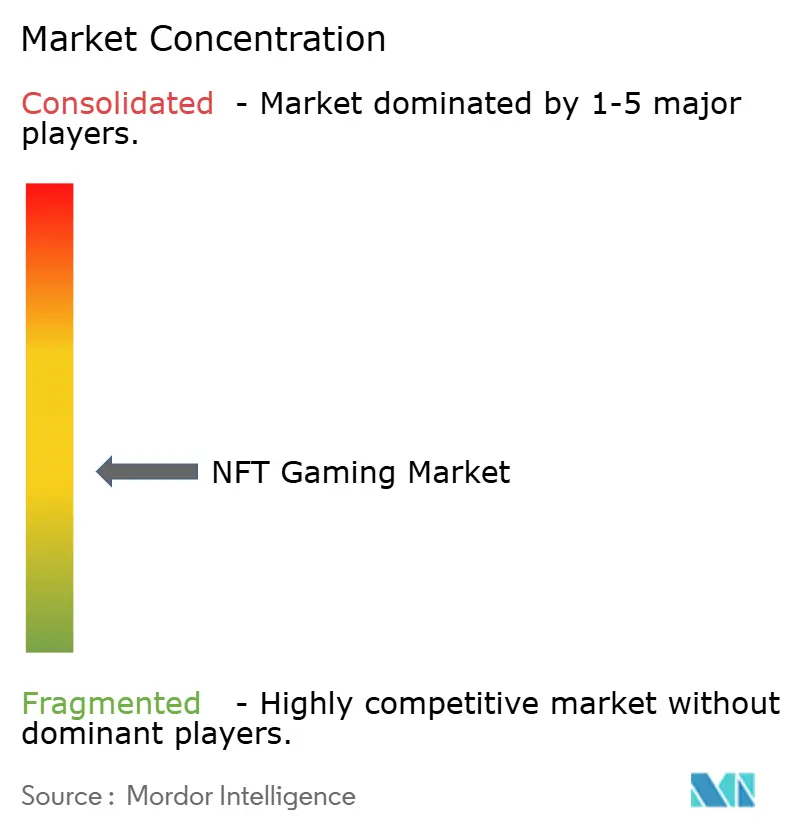
| Market Concentration | Medium |
Major Players *Disclaimer: Major Players sorted in no particular order Image © Mordor Intelligence. Reuse requires attribution under CC BY 4.0. | |
NFT Gaming Market Analysis by Mordor Intelligence
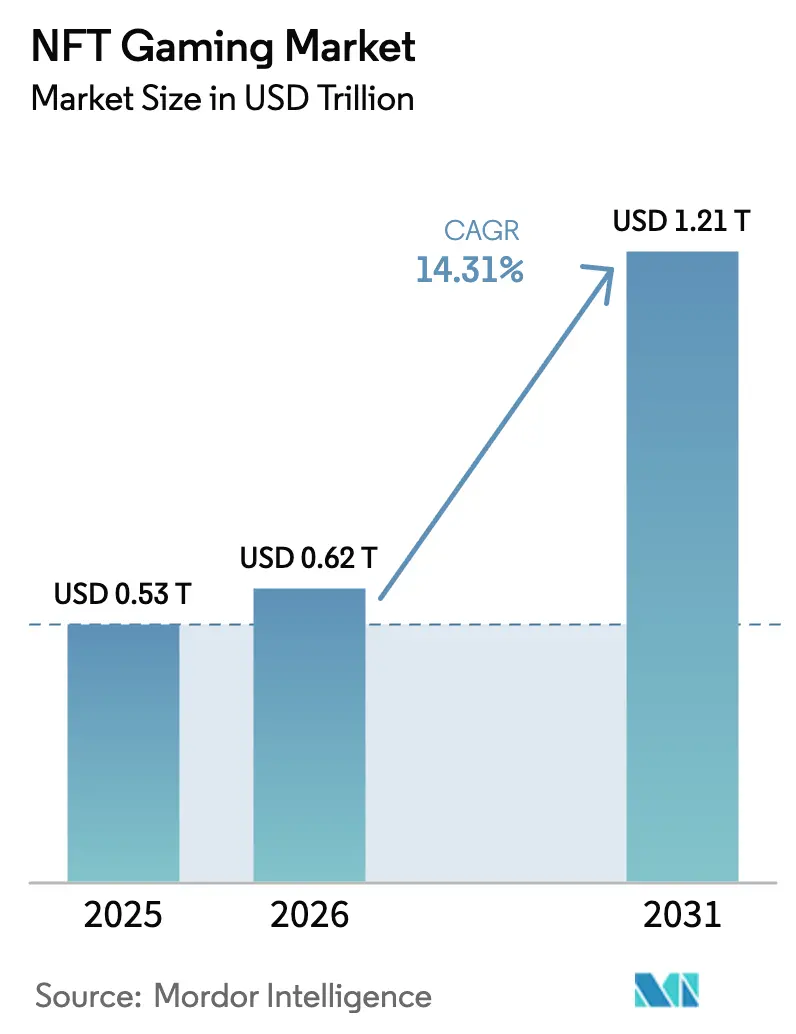
The NFT gaming market size is projected to expand from USD 0.53 trillion in 2025 and USD 0.62 trillion in 2026 to USD 1.21 trillion by 2031, registering a 14.31% CAGR between 2026 and 2031. The rapid growth flows from lower blockchain transaction costs, expanding venture funding, and the shift toward shared publisher-player economics. Layer-2 scaling now supports micro-payments that keep game economies fluid, while the steady rollout of metaverse worlds broadens the addressable audience. Institutional investors are backing studios that can deliver AAA-quality play, cementing confidence that the NFT gaming market is entering a production-grade era. Finally, regional policy clarity in Asia-Pacific and the Middle East is shortening time-to-launch for studios that previously waited on licensing guidance.
Key Report Takeaways
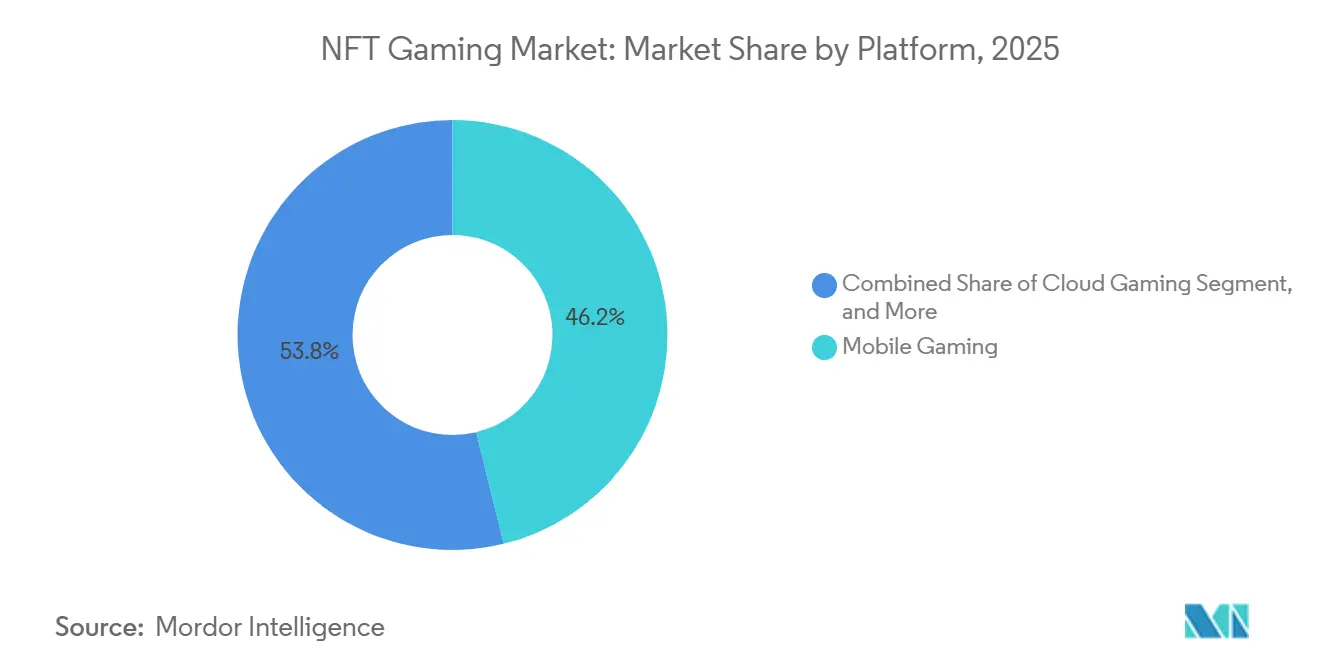
- By platform, Mobile Gaming led with 46.19% of NFT gaming market share in 2025, whereas Cloud Gaming is advancing at a 15.31% CAGR through 2031.
- By game genre, Role-Playing Games captured 38.53% share in 2025, while Simulation titles are on track for the fastest 15.84% CAGR to 2031.
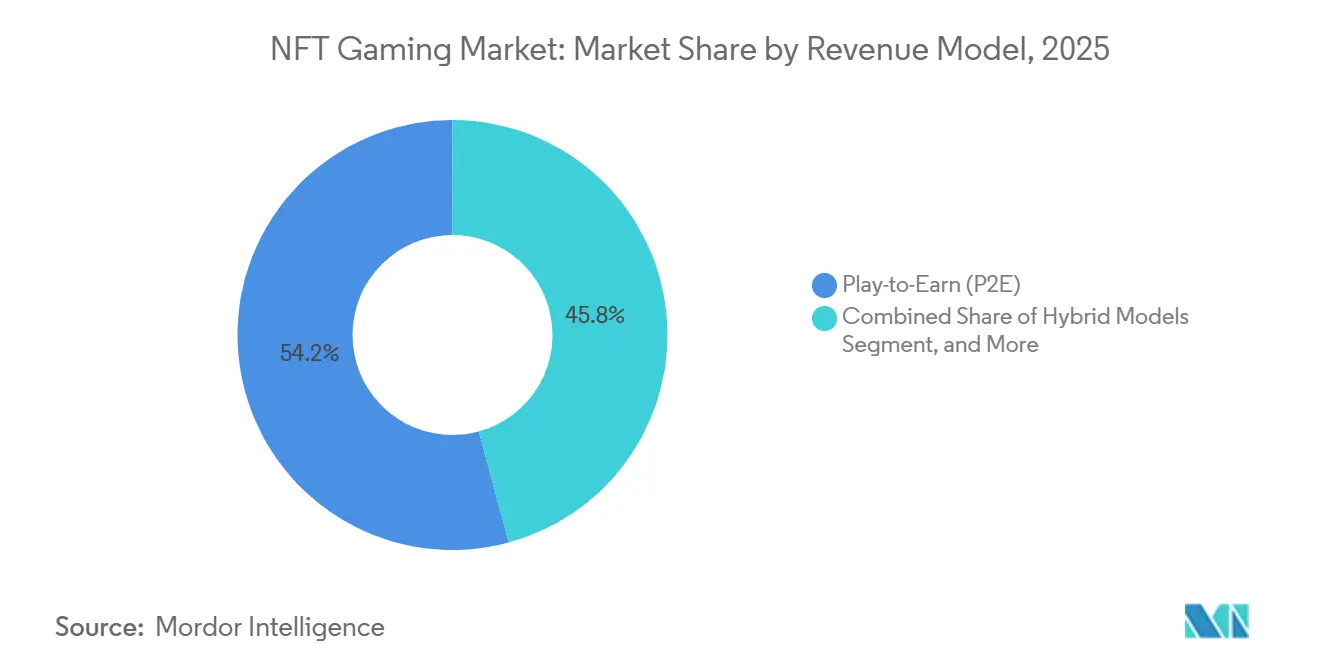
- By revenue model, Play-to-Earn commanded 54.21% share in 2025, yet Hybrid Models combining subscriptions and NFT perks are growing at a 15.18% CAGR.
- By blockchain, Ethereum retained 62.37% share in 2025, and Polygon is the quickest riser at a 15.73% CAGR.
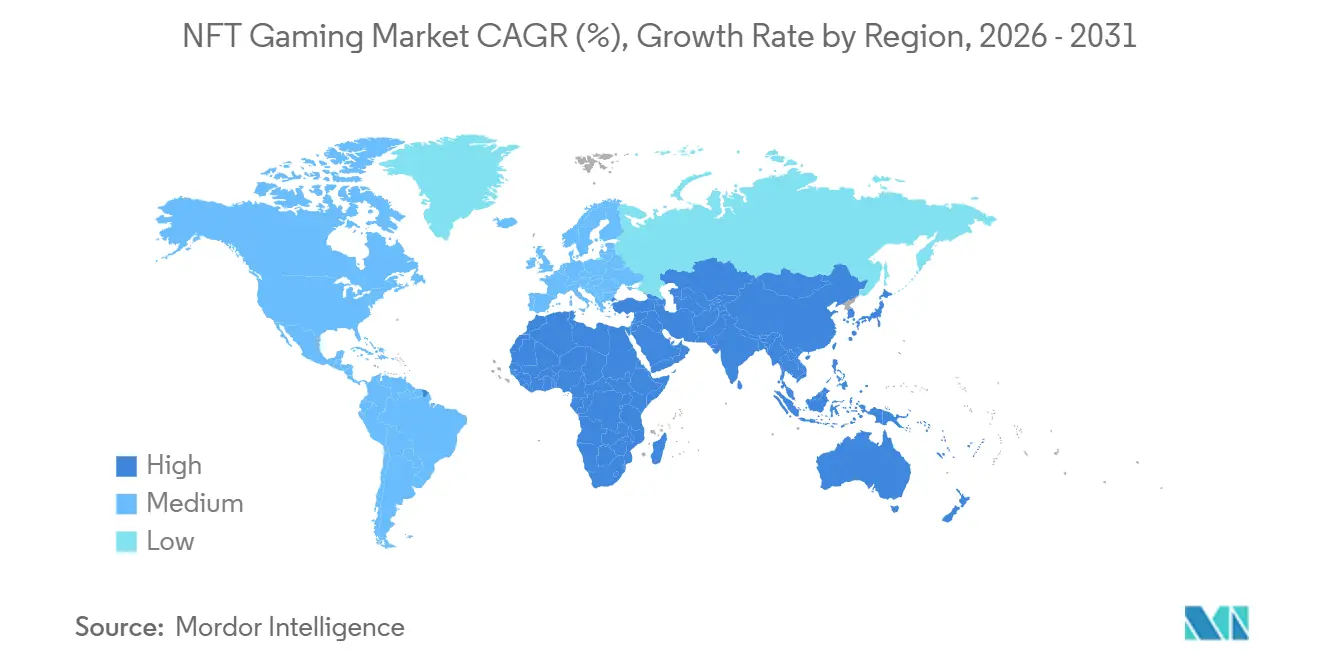
- By geography, Asia-Pacific led with 41.74% revenue share in 2025, while the Middle East is poised for the fastest 15.43% CAGR through 2031.
Note: Market size and forecast figures in this report are generated using Mordor Intelligence’s proprietary estimation framework, updated with the latest available data and insights as of 2026.
Global NFT Gaming Market Trends and Insights
Drivers Impact Analysis*
| Driver | (~) % Impact on CAGR Forecast | Geographic Relevance | Impact Timeline |
|---|---|---|---|
| Shift to Distributed Publisher-Player Value Capture | +3.20% | Global, with early adoption in Asia-Pacific and North America | Medium term (2-4 years) |
| Metaverse Alignment Accelerating Uptake | +2.80% | Global, concentrated in North America, Europe, and Asia-Pacific urban centers | Long term (≥ 4 years) |
| Venture-Capital Funding Inflows to Blockchain Gaming | +2.50% | North America and Europe lead, spillover to Middle East and Asia-Pacific | Short term (≤ 2 years) |
| Rising Play-to-Earn Monetization Preference | +2.10% | Asia-Pacific core, expanding to South America and Africa | Medium term (2-4 years) |
| Layer-2 Scaling Slashing Transaction Costs | +2.40% | Global, immediate impact in Ethereum-dependent ecosystems | Short term (≤ 2 years) |
| Interoperable NFT Standards Enabling Cross-Game Assets | +1.40% | North America and Europe early movers, Asia-Pacific following | Long term (≥ 4 years) |
| Source: Mordor Intelligence | |||
Shift To Distributed Publisher-Player Value Capture
Smart-contract splits now route 10%-30% of secondary-market proceeds back to the players who minted or earned the assets, replacing the one-way revenue flow of traditional free-to-play. Axie Infinity users earned USD 1.3 billion from resale royalties in 2025, a figure that still held even after a 22% price correction.[1]Sky Mavis Investor Relations, “Axie Infinity Annual Report 2025,” skymavis.com Wemade’s Wemix 3.0 titles boosted monthly active users to 4.2 million by adopting a player-favoured 70-30 payout.[2]Wemade Co., “Wemix 3.0 Platform Revenue Distribution,” wemade.com The design philosophy puts retention ahead of upfront monetization because players own the upside. Policymakers have yet to define whether these flows qualify as investment income, creating a temporary gray zone inside the European Union.[3]European Commission, “Markets in Crypto-Assets Regulation,” ec.europa.eu Even so, the mechanism answers long-standing calls for fairer value distribution and is likely to become standard as publishing houses chase higher engagement scores.
Metaverse Alignment Accelerating Uptake
Persistent virtual worlds such as Decentraland and The Sandbox logged 18 million unique wallet connections in 2025, a 34% rise over 2024. Brand tenants like Adidas and Coca-Cola lease digital real estate, giving NFTs utility that lasts outside a single title. Yuga Labs moved USD 420 million in land sales during the March 2025 Otherside mint, showing the purchasing power of cross-IP collectors. The convergence attracts casual spectators who discover gaming through branded events rather than gameplay trailers. Performance bottlenecks persist, evidenced by sub-20 fps rates during peak Decentraland events, but an Unreal Engine 5 migration scheduled for mid-2026 should lift capacity. As metaverse layers mature, they lock in demand for interoperable avatars, weapons, and real estate that travel with the user rather than the app.
Venture-Capital Funding Inflows to Blockchain Gaming
Studios secured USD 3.2 billion across 187 rounds in 2025, a 19% jump that follows a pivot to quality-first, token-second development. Animoca Brands’ USD 110 million raise at a USD 5.9 billion valuation underscored institutional appetite for scaled portfolios. Gala Games’ USD 150 million Series B is earmarked for studio acquisitions, shortening time to market for high-fidelity titles. The top 10 studios, however, absorbed 62% of that capital, leaving smaller teams to rely on token presales that can erode long-term equity. High customer-acquisition costs, averaging USD 47 per wallet in 2025, put pressure on marketing budgets. Still, the funding cycle is aligned with multi-year production timelines, ensuring that headline releases will arrive throughout the forecast window and keep the NFT gaming market in the public eye.
Rising Play-To-Earn Monetization Preference
Global active wallets using play-to-earn climbed to 42 million in 2025, driven by populations in the Philippines, Indonesia, and Brazil who earn USD 180-USD 320 monthly from gameplay. Skill-based tournaments now reward stablecoins to curb token volatility, with Axie Infinity introducing that format in its Homeland expansion. Splinterlands distributed USD 240 million in rewards during 2025, but 68% accrued to the top 5% of players, exposing economic concentration. Netmarble reported 23% higher lifetime value per user after embedding sellable NFT loot into its A3 title. Critics counter that the model turns recreation into gig work; an issue regulator will probe as they weigh tax and labour classifications in the NFT gaming industry.
Restraints Impact Analysis*
| Restraint | (~) % Impact on CAGR Forecast | Geographic Relevance | Impact Timeline |
|---|---|---|---|
| Regulatory Uncertainty Over Digital Assets | -2.10% | Global, acute in North America and Europe, evolving in Asia-Pacific | Medium term (2-4 years) |
| Environmental Criticism of Proof-of-Work Chains | -0.90% | Europe and North America primary, emerging in Asia-Pacific | Short term (≤ 2 years) |
| Token Inflation Undermining In-Game Economies | -1.60% | Global, most visible in Asia-Pacific and South America P2E markets | Short term (≤ 2 years) |
| On-Boarding Friction for Non-Crypto Gamers | -1.30% | Global, particularly acute in North America and Europe traditional gaming markets | Medium term (2-4 years) |
| Source: Mordor Intelligence | |||
Regulatory Uncertainty Over Digital Assets
The Securities and Exchange Commission pursued 14 enforcement actions against NFT games in 2025, extracting USD 340 million in settlements and forcing studios to strip investment language from marketing materials. By contrast, the European Union’s MiCA framework offers a licensing path that balances AML checks with innovation. South Korea approved eight blockchain game operators under rules that mandate segregated wallets and insurance for player deposits, creating a compliance blueprint. Japan now requires NFT marketplaces to register as crypto-asset exchanges if they enable secondary trading, raising overhead for smaller teams. Regions with strict or ambiguous policies impose launch delays, inflating development costs and tempering the NFT gaming market’s otherwise steep growth curve.
Environmental Criticism of Proof-Of-Work Chains
Although Ethereum cut its energy use 99.95% by moving to proof-of-stake, 41% of surveyed gamers in 2025 still cited environmental worries as a barrier. Polygon offset 104,794 tonnes of emissions to reach net-zero operations. Immutable X funds renewable certificates from every fee earned, while Sorare lowered gas per mint by 78% through batch processing. The European Union’s 2026 sustainability directive will require studios to disclose Scope 3 emissions, including power drawn by player devices. Continuous technical refinement and transparent reporting remain critical to mute a narrative that could dampen adoption, especially in eco-conscious European markets.
*Our forecasts treat driver/restraint impacts as directional, not additive. The impact forecasts reflect baseline growth, mix effects, and variable interactions.
Segment Analysis
By Platform: Mobile Ubiquity and Cloud Disruption
Mobile Gaming held a dominant 46.19% share of NFT gaming market size in 2025. Widespread smartphone ownership and wallet integrations inside iOS and Android streamline onboarding. Players gravitate to bite-sized sessions, yet titles such as Mirandus prove that high-fidelity streaming is viable without local crypto wallets. Lower acquisition costs, at USD 34 per install, keep marketing budgets efficient, although churn rates are higher than in PC segments.
Cloud Gaming is forecast to post the fastest 15.31% CAGR, powered by 5G rollouts that push latency under 20 milliseconds. Server-side wallet custody hides blockchain complexity from users, positioning cloud as a bridge for traditional gamers who value convenience. As console platforms hesitate to approve NFT games, cloud services fill the gap by offering cross-device play under a single subscription. Hardware requirements drop for end users, but developers must optimize smart contracts to minimize server costs, shaping a technical agenda that dominates roadmaps through 2031.



By Game Genre: Deep RPGs And Emerging Simulation Economies
Role-Playing Games commanded 38.53% of NFT gaming market share in 2025. Narrative depth encourages players to buy and trade character NFTs, extending engagement cycles that average 47 minutes per session. Long story arcs support seasonal drops, letting publishers monetize without inflating token supply. The immersive format also lends itself to on-chain governance, where holders vote on quest outcomes, increasing community stickiness.
Simulation titles are expanding at a 15.84% CAGR as they tokenize real-world assets inside city builders and farm simulators. Passive income loops draw non-gamer demographics who approach the experience as a light economic sandbox. VulcanVerse players can stake land NFTs that yield resources, adding DeFi-like incentives within a familiar gameplay loop. Balancing advanced economies across thousands of micro-transactions stresses design teams, yet the upside is a scalable audience outside the core RPG fan base.
By Revenue Model: P2E Peaks and Hybrid Resilience
Play-to-Earn dominated with 54.21% share of NFT gaming market size in 2025, but token inflation is tempering retention among later cohorts. Earnings are migrating to competitive modes where skill, not time, generates rewards, a pivot seen in Axie Infinity’s SLP overhaul. The structure still draws populations seeking supplemental income, anchoring network effects that benefit early adopters.
Hybrid Models are rising at a 15.18% CAGR by coupling subscription stability with optional NFT ownership. Summoners War, at USD 9.99 per month, shows that paid passes plus sellable items can lift retention 31% over pure P2E designs. Steady cash flow lets studios plan content cadences without relying on volatile token prices, addressing regulatory critiques that label reward tokens as securities. Hybrid flexibility is set to absorb share from both free-to-play and P2E as studios optimize for lifetime value and compliance.
By Blockchain: Ethereum Scale and Polygon Efficiency
Ethereum retained 62.37% of NFT gaming market share in 2025, buoyed by the network effects of thousands of decentralized applications and seamless DeFi integration. Proof-of-stake reduced energy intensity, softening earlier climate criticisms, yet congestion can still raise gas fees above USD 2, nudging developers toward sidechains.
Polygon is expanding at a 15.73% CAGR, processing 7,000 transactions per second at USD 0.01 gas, a price point that unlocks micro-item economies. Its zkEVM rollup guarantees Ethereum-level security while absorbing mainstream mobile traffic. Cross-chain bridges such as LayerZero allow NFTs to move between Ethereum, Polygon, and Binance Smart Chain, hinting at a future where protocol allegiance matters less than user experience. Fragmentation, however, complicates wallet management and interface design, tasks that will occupy middleware providers over the forecast horizon.
Geography Analysis
Asia-Pacific held 41.74% of 2025 revenue, anchored by South Korea’s clear licensing regime and Japan’s open stance toward blockchain game operators. Studios launch first in these markets because approval timelines are predictable, letting marketing teams coordinate global rollouts. China’s ban on secondary NFT trading forces modified “digital collectible” builds, yet Tencent still attracted 12 million users under the compliant Zhixin Chain model, illustrating that the NFT gaming market can adapt to heavy restrictions.
The Middle East is the fastest-growing region at a 15.43% CAGR through 2031. Sovereign funds placed more than USD 1 billion into Web3 gaming infrastructure during 2025, accelerating studio creation inside Saudi Arabia’s NEOM and the UAE’s Dubai Multi Commodities Centre. Animoca Brands opened an Abu Dhabi base and partnered with Mubadala, giving Arabic developers access to seasoned publishers.
North America delivered 28% of 2025 sales even as SEC actions shook early token launches. Epic Games’ wallet toolkit inside Unreal Engine lowers technical barriers, encouraging traditional studios to experiment without building bespoke chains. Europe, at 19% share, benefits from MiCA, which gives studios a rules-based path to market. South America contributed 7% by leveraging stablecoins that hedge local inflation, while Africa’s 4% share came from Nigeria and South Africa where high mobile penetration meets growing remittance use cases. Each territory presents unique regulatory or infrastructure hurdles, yet the global appetite for ownership-driven play remains consistent, supporting a broadly distributed growth story for the NFT gaming industry.

Competitive Landscape
The NFT gaming market is moderately fragmented, with the top five publishers handling 38% of 2025 transaction volume but more than 200 studios shipping mainnet titles. Sky Mavis, Animoca Brands, and Immutable lead user acquisition thanks to early mover status and large intellectual property catalogues. Animoca executed 18 acquisitions in 2025 to weave cross-game interoperability, creating a moat that relies on shared ERC-1155 assets. Traditional houses such as Ubisoft and Electronic Arts approach cautiously to sidestep the backlash that derailed earlier Web3 pilots.
Technology choices drive competitive separation. Immutable’s zkEVM rollup gave players gas-free micro-payments on 2.4 billion 2025 transactions, while Gala Games’ GalaChain reached 10,000 transactions per second through delegated proof-of-stake. Patent activity supports defensive barriers; Dapper Labs secured seven filings covering cost-saving mint techniques that could command future royalties. Compliance rules under MiCA will favour well-capitalized firms capable of maintaining EUR 350,000 reserves and annual audit cycles, pushing underfunded teams toward partnership or exit.
Switching costs for players remain low because NFTs reside in user wallets, not game servers, so community engagement strategies now rank alongside technical features. Studios distribute governance tokens that give players a say in update roadmaps, cementing loyalty in a landscape where one viral release can redraw market share overnight. The outlook calls for rising consolidation as compliance expenses rise, yet enough white space remains for specialized indies that serve niche communities inside the NFT gaming industry.
NFT Gaming Industry Leaders
Sky Mavis Pte Ltd
Immutable Pty Ltd
Yuga Labs Inc
Animoca Brands Corporation Ltd
Dapper Labs Inc
- *Disclaimer: Major Players sorted in no particular order

Recent Industry Developments
- February 2026: Animoca Brands bought Eden Games for USD 78 million to fold racing IP into its Motorverse ecosystem.
- January 2026: Immutable raised USD 200 million in Series D funding, valuing the firm at USD 3.5 billion.
- January 2026: Enjin shipped Efinity SDK 3.0, enabling cross-chain NFT transfers between Polkadot and Ethereum.
- December 2025: Netmarble launched Seven Knights. Idle Adventure on Polygon and sold USD 18 million in NFTs during month one.


Global NFT Gaming Market Report Scope
The NFT Gaming Market Report is Segmented by Platform (Mobile Gaming, PC Gaming, Console Gaming, Cloud Gaming), Game Genre (Role-Playing Games, Strategy, Simulation, Sports, Other Game Genres), Revenue Model (Play-to-Earn, Free-to-Play with NFT Micro-Transactions, Subscription plus NFT Perks, Hybrid Models), Blockchain (Ethereum, Binance Smart Chain, Polygon, Other Blockchain Protocols), and Geography (North America, South America, Europe, Asia-Pacific, Middle East, Africa). The Market Forecasts are Provided in Terms of Value (USD).
| Mobile Gaming |
| PC Gaming |
| Console Gaming |
| Cloud Gaming |
| Role-Playing Games (RPG) |
| Strategy |
| Simulation |
| Sports |
| Other Game Genres |
| Play-to-Earn (P2E) |
| Free-to-Play with NFT Micro-Transactions |
| Subscription plus NFT Perks |
| Hybrid Models |
| Ethereum |
| Binance Smart Chain |
| Polygon |
| Other Blockchain Protocols |
| North America | United States |
| Canada | |
| Mexico | |
| South America | Brazil |
| Argentina | |
| Rest of South America | |
| Europe | Germany |
| France | |
| United Kingdom | |
| Italy | |
| Spain | |
| Rest of Europe | |
| Asia-Pacific | China |
| Japan | |
| India | |
| South Korea | |
| Australia | |
| Rest of Asia-Pacific | |
| Middle East | Saudi Arabia |
| United Arab Emirates | |
| Turkey | |
| Rest of Middle East | |
| Africa | South Africa |
| Egypt | |
| Nigeria | |
| Rest of Africa |
| By Platform | Mobile Gaming | |
| PC Gaming | ||
| Console Gaming | ||
| Cloud Gaming | ||
| By Game Genre | Role-Playing Games (RPG) | |
| Strategy | ||
| Simulation | ||
| Sports | ||
| Other Game Genres | ||
| By Revenue Model | Play-to-Earn (P2E) | |
| Free-to-Play with NFT Micro-Transactions | ||
| Subscription plus NFT Perks | ||
| Hybrid Models | ||
| By Blockchain | Ethereum | |
| Binance Smart Chain | ||
| Polygon | ||
| Other Blockchain Protocols | ||
| By Geography | North America | United States |
| Canada | ||
| Mexico | ||
| South America | Brazil | |
| Argentina | ||
| Rest of South America | ||
| Europe | Germany | |
| France | ||
| United Kingdom | ||
| Italy | ||
| Spain | ||
| Rest of Europe | ||
| Asia-Pacific | China | |
| Japan | ||
| India | ||
| South Korea | ||
| Australia | ||
| Rest of Asia-Pacific | ||
| Middle East | Saudi Arabia | |
| United Arab Emirates | ||
| Turkey | ||
| Rest of Middle East | ||
| Africa | South Africa | |
| Egypt | ||
| Nigeria | ||
| Rest of Africa | ||


Key Questions Answered in the Report
How large will the NFT gaming market be by 2031?
The NFT gaming market is forecast to reach USD 1.21 trillion by 2031, up from USD 0.62 trillion in 2026.
Which platform is growing fastest inside NFT gaming?
Cloud Gaming shows the highest trajectory, advancing at a 15.31% CAGR through 2031 as 5G cuts latency.
What is the main revenue model shift expected over the next five years?
Hybrid structures that blend subscriptions with optional NFT purchases are expanding at a 15.18% CAGR and are set to overtake pure play-to-earn in growth pace.
Why is Polygon gaining share from Ethereum?
Polygon's zkEVM rollup delivers 7,000 transactions per second at USD 0.01 gas, making micro-transactions economically viable while keeping Ethereum-grade security.
Which region offers the quickest growth opportunity?
The Middle East leads with a 15.43% CAGR to 2031, supported by more than USD 1 billion in sovereign Web3 investments and favorable free-zone policies.
How fragmented is competition among publishers?
Moderate fragmentation persists, with the top five firms holding 38% of 2025 transaction volume and over 200 smaller studios releasing on-chain titles annually.
Page last updated on:


 Your data is secure and never sold or shared.


