
HVDC Converter Station Market Size and Share
Market Overview
| Study Period | 2021 - 2031 |
|---|---|
| Market Size (2026) | USD 7.73 Billion |
| Market Size (2031) | USD 10.85 Billion |
| Growth Rate (2026 - 2031) | 7.01 % |
| Fastest Growing Market | Asia Pacific |
| Largest Market | Asia Pacific |
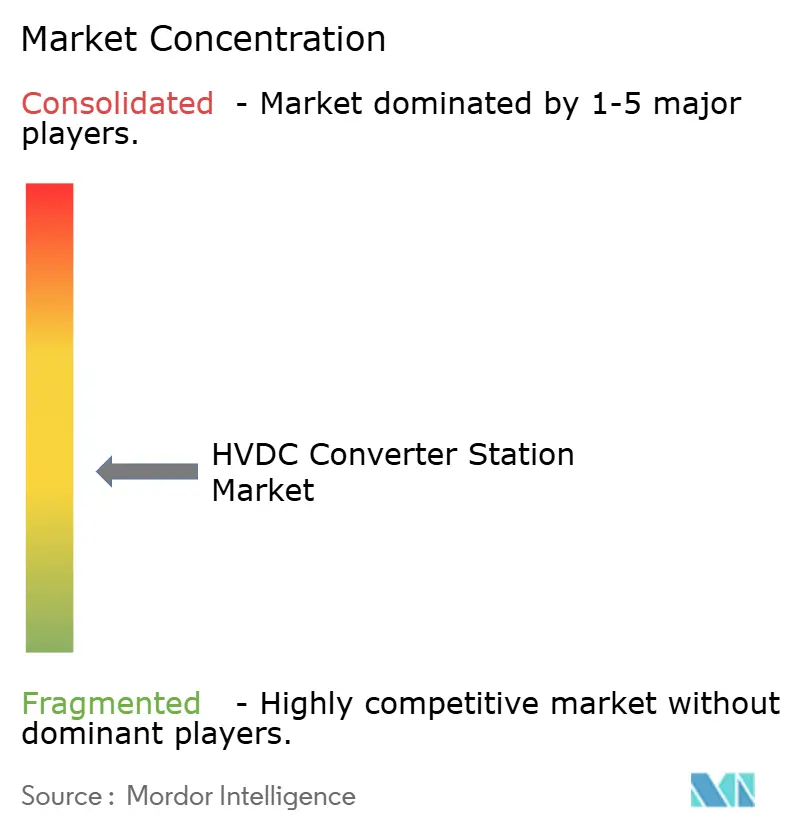
| Market Concentration | Medium |
Major Players *Disclaimer: Major Players sorted in no particular order Image © Mordor Intelligence. Reuse requires attribution under CC BY 4.0. | |
HVDC Converter Station Market Analysis by Mordor Intelligence
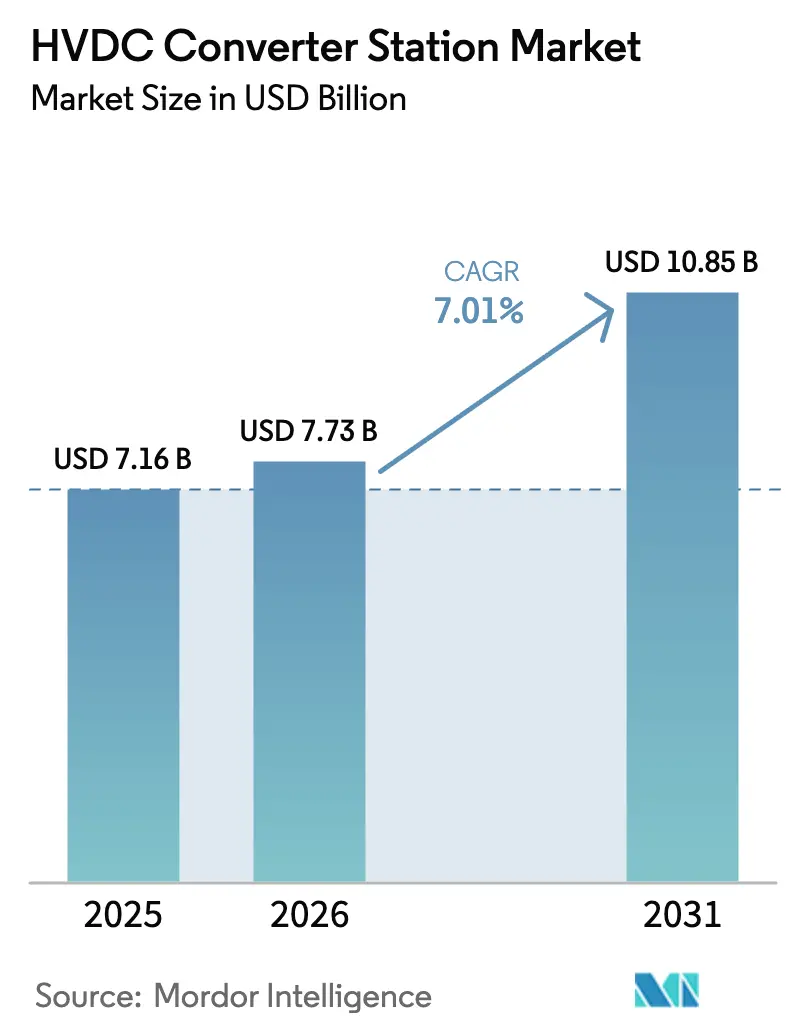
The HVDC Converter Station Market size is projected to expand from USD 7.16 billion in 2025 and USD 7.73 billion in 2026 to USD 10.85 billion by 2031, registering a CAGR of 7.01% between 2026 to 2031.
The growing need to move bulk renewable power across long distances without reactive-power losses, the push to integrate far-from-shore wind farms, and rising cross-border interconnectors are keeping capital commitments buoyant. Line-commutated converters remain the default for ultra-high-voltage corridors because of proven ±800 kV performance, yet voltage-source converters are winning offshore and multi-terminal projects for their black-start and grid-forming capabilities. Component revenue is concentrating in valves as utilities pay premiums for press-pack thyristors and IGBT modules that directly influence converter reliability. Asia-Pacific anchors demand with 45 Chinese UHV links already energized, while Europe is setting the technology pace in meshed DC grids. Competitive intensity is ratcheting up as Chinese OEMs bid 20%-30% below Western incumbents, widening technology-versus-price trade-offs.
Key Report Takeaways
- By technology, line-commutated converters held 59.1% of the HVDC converter stations market share in 2025, while voltage-source converters are forecast to expand at an 8.1% CAGR through 2031.
- By component, valves commanded a 34% share of the HVDC converter stations market size in 2025 and are set to grow at a 7.6% CAGR to 2031.
- By voltage class, the above 800 kV segment is projected to advance at an 8.5% CAGR during 2026-2031.
- By geography, Asia-Pacific accounted for 66.8% revenue in 2025 and is tracking a 7.6% CAGR through 2031.
Note: Market size and forecast figures in this report are generated using Mordor Intelligence’s proprietary estimation framework, updated with the latest available data and insights as of January 2026.
Market Trends and Insights
Drivers Impact Analysis of HVDC Converter Station Market*
| Driver | (~) % Impact on CAGR Forecast | Geographic Relevance | Impact Timeline |
|---|---|---|---|
| Surge in offshore-wind HVDC links | +1.8% | Europe, Asia-Pacific (China, Taiwan, Japan), North America (US East Coast) | Medium term (2-4 years) |
| Cross-border renewable interconnections | +1.3% | Europe (TEN-E corridors), ASEAN, South America (Brazil-Argentina), Middle East (GCC grid) | Medium term (2-4 years) |
| Ultra-high-voltage (±800 kV) roll-out in Asia | +1.5% | Asia-Pacific core (China, India), spillover to Central Asia | Long term (≥4 years) |
| Replacement of aging HVAC lines | +0.9% | North America, Europe (Nordic region, Germany), Russia | Long term (≥4 years) |
| Rise of multi-terminal / mesh DC grids | +1.0% | Europe (North Sea Wind Power Hub), Asia-Pacific (China Southern Grid) | Long term (≥4 years) |
| Grid-forming black-start capability demand | +0.6% | Global, with early adoption in Europe (UK, Germany), Australia | Short term (≤2 years) |
| Source: Mordor Intelligence | |||
Surge in offshore-wind HVDC links
Deep-water projects beyond 100 km now rely on HVDC as AC cables face prohibitive reactive losses. Dogger Bank’s first 1.2 GW phase, energized in 2024 with HVDC Light valves, posted 98.5% round-trip efficiency over a 200 km subsea span.[2] Germany’s 2 GW Ostwind 4, awarded in 2024, uses modular multilevel converters to funnel Baltic wind southward.[3] Taiwan’s 5.6 GW offshore roadmap has already triggered three HVDC awards split between Siemens Energy and Hitachi Energy. Japan entered the subsea arena when Tokyo Electric Power ordered a 1 GW link for Choshi in 2025. The North Sea Wind Power Hub aims for a 10 GW meshed platform by 2035, a scale that requires DC breakers now in early commercial rollout.
Cross-border renewable interconnections
The 1.4 GW Viking Link, energized in 2024, enables the UK to import Danish wind during gales and export nuclear baseload during calms, monetizing average 2024 spreads of EUR 45 per MWh.[4] Europe’s TEN-E rule mandating 15% interconnection by 2030 is prompting projects such as NordLink and LionLink. ASEAN targets 17 GW of HVDC corridors by 2035 to arbitrage Laos hydropower and Thai solar, although financing gaps persist. South America’s 1 GW Brazil-Argentina line set for 2028 balances hydropower variability with Patagonian wind. The GCC is evaluating a 3 GW overlay to knit Saudi renewables into UAE load pockets.
Ultra-high-voltage (±800 kV) roll-out in Asia
China commissioned 45 UHV links by late 2024, including the 2,290 km Hami-Chongqing corridor sending 36 TWh of green power eastward each year. The Ningxia-Hunan and Baihetan-Jiangsu 8 GW bipoles cut coal burn in coastal provinces by 22 million tonnes annually. India tendered a ±800 kV, 6 GW line from Rajasthan to Tamil Nadu in 2025. Hitachi Energy’s 2024 Gansu-Zhejiang award will be the first ±800 kV VSC scheme, merging grid-forming controls with UHV power density. UHVDC trims losses to 3% per 1,000 km, and a single ±1,100 kV bipole can haul 12 GW on a narrower right-of-way than an AC equivalent.
Replacement of aging HVAC lines
North America and parts of Europe face congestion on 50-year-old AC corridors whose thermal limits throttle renewable integration. Utilities are evaluating HVDC overlays that add 2-3 GW of transfer capacity using existing rights-of-way, avoiding costly eminent-domain disputes. Russia’s Rosseti is uprating the Siberia-Urals route to ±500 kV to move hydro to industrial clusters.
Restraints Impact Analysis of HVDC Converter Station Market*
| Restraint | (~) % Impact on CAGR Forecast | Geographic Relevance | Impact Timeline |
|---|---|---|---|
| High CAPEX & permitting cycle | -1.2% | Global, acute in North America, Europe (multi-jurisdictional projects), South America | Long term (≥4 years) |
| Converter-component supply bottlenecks | -0.9% | Global, with acute shortages in IGBT wafers (Asia-Pacific supply chain), transformer steel (Europe) | Medium term (2-4 years) |
| Multi-vendor interoperability risk | -0.5% | Europe (meshed grids), Asia-Pacific (cross-border ASEAN projects) | Medium term (2-4 years) |
| Cyber-security of digital HVDC controls | -0.4% | Global, regulatory pressure highest in Europe (IEC 62351), North America (NERC CIP) | Short term (≤2 years) |
| Source: Mordor Intelligence | |||
High CAPEX & Permitting Cycle
A 2 GW, 1,000 km bipolar link costs USD 2 billion-USD 2.5 billion, half of which is converter stations, deterring utilities with constrained balance sheets. The U.S. Plains & Eastern line secured federal approval in 2016, yet remains unbuilt due to state-level opposition. Europe’s LionLink spent four years in environmental review before its 2025 consent. Brazil-Argentina negotiations over wheeling charges pushed in-service targets from 2027 to 2028. Multilateral banks often become anchor financiers because merchant developers struggle to secure investment-grade ratings without regulated returns.
Converter-component supply bottlenecks
IGBT and transformer supply chains lengthened lead times to 24 months in 2025. Siemens Energy’s Erlangen transformer plant is running at 95% utilization, and ramp-up requires EUR 150 million and three years. China controls 60% of grain-oriented electrical steel, spurring Western OEMs to diversify to Indian and South Korean mills.
*Our forecasts treat driver/restraint impacts as directional, not additive. The impact forecasts reflect baseline growth, mix effects, and variable interactions.
HVDC Converter Station Market Segment Analysis
By Technology:
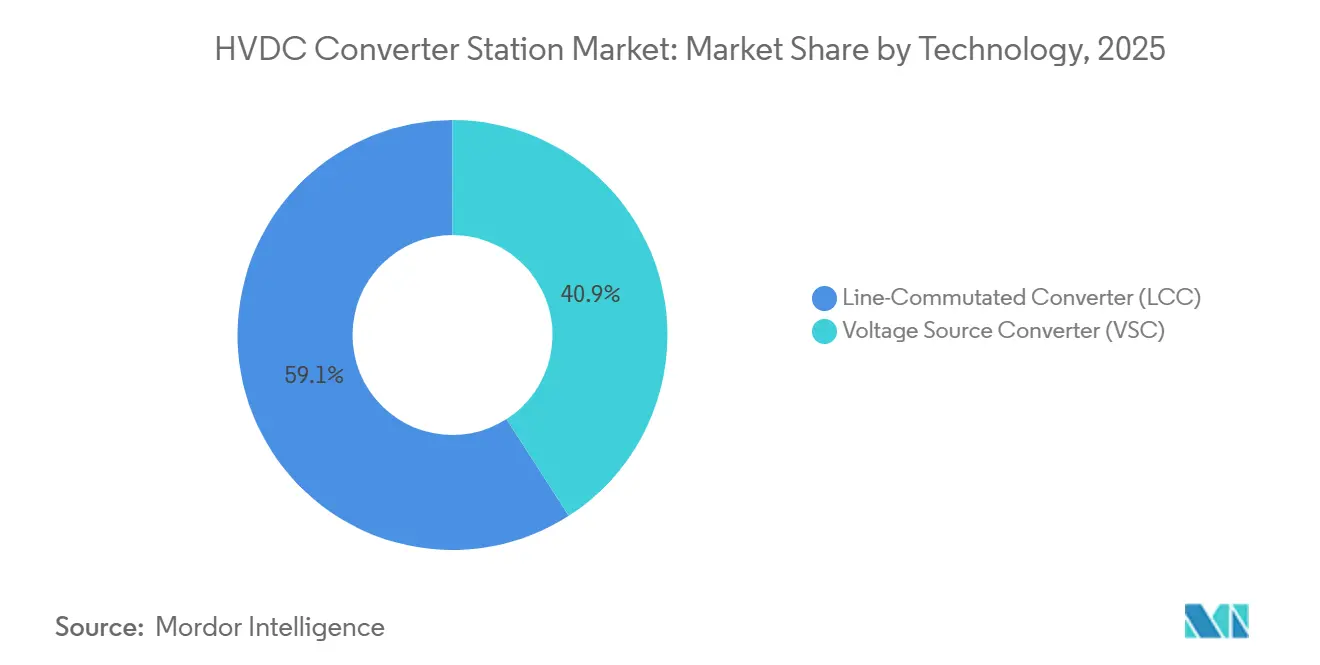
VSC Gains on Grid-Forming DemandVoltage-source converters are forecast to grow at an 8.1% CAGR, faster than the overall HVDC converter stations market, as offshore wind developers and grid planners seek black-start, fast-fault-clearing, and multi-terminal features. Line-commutated converters held 59.1% of the HVDC converter stations market share in 2025 because China’s bulk-transfer corridors rely on ±800 kV thyristor stacks that minimize losses over 2,000 km routes.
Dogger Bank’s 3.6 GW link uses 401-level MMC valves that meet a total harmonic distortion benchmark below 1.5% without filters. Siemens Energy’s East Anglia THREE implementation demonstrates the same grid-forming agility within 200 milliseconds of a blackout. Hitachi Energy’s Gansu-Zhejiang ±800 kV VSC project will test whether voltage-source converters can match UHV power density and erode LCC’s historical cost edge. GE Vernova is exploring hybrid topologies that merge LCC efficiency with VSC controllability, though commercial rollout remains at least three years away.

By Component:
Valve Complexity Drives Revenue ConcentrationValves captured 34% of 2025 component revenue and will grow at a 7.6% CAGR, reflecting the weight utilities place on switching devices that determine reliability and footprint. HVDC converter stations market size for valve systems is expanding as higher voltage classes require more series-connected devices with robust cooling.
A ±800 kV LCC tower contains up to 500 thyristors rated 8.5 kV, 4 kA, and redundancy adds 10% to cost. VSC valves run at 1-2 kHz, demanding liquid cooling worth USD 15 million-USD 20 million per station. Converter transformers account for roughly 25% of station cost and face long order backlogs. Reactors and filters represent up to 20% of LCC sites, whereas VSC platforms often skip them. Prysmian’s 525 kV P-Laser cable achieves 2.6 GW power density, enabling single-cable bipoles that cut installation costs by 30%.
By Voltage Rating:
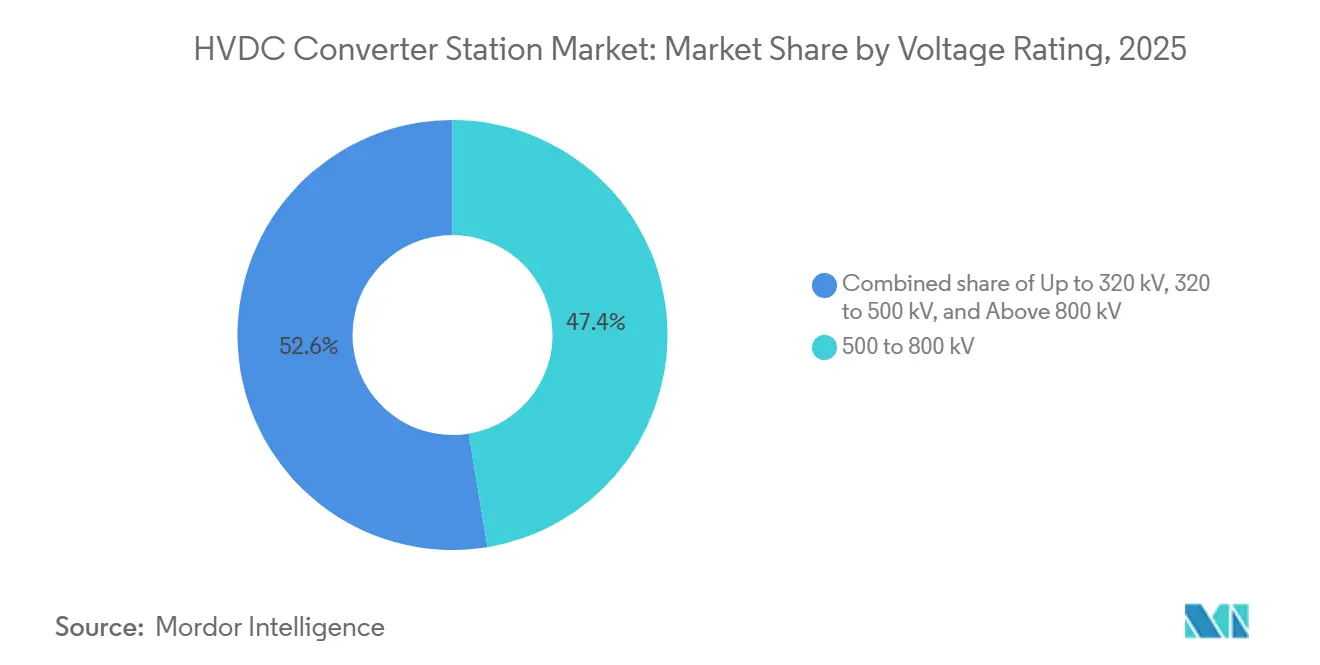
UHVDC Emerges as Asia’s StandardThe 500-800 kV class held 47.4% of the HVDC converter stations market share in 2025 because it balances conductor cost with converter complexity. Above 800 kV is projected to rise at an 8.5% CAGR as China rolls ±1,100 kV schemes into commercial service.
China’s Changji-Guquan ±1,100 kV link, energized in 2024, shifted 12 GW over 3,300 km with only 2.5% losses. India is studying ±800 kV for its 1,800 km solar corridor, where UHVDC would slash right-of-way width. European offshore schemes still favor ±320 kV to ±525 kV VSC, such as East Anglia THREE and Viking Link. UHVDC’s USD 1.2 million per MW capex slows uptake outside Asia, but grid-forming VSC at ±800 kV may close the gap by trimming filter and reactive-compensation costs.
Geography Analysis
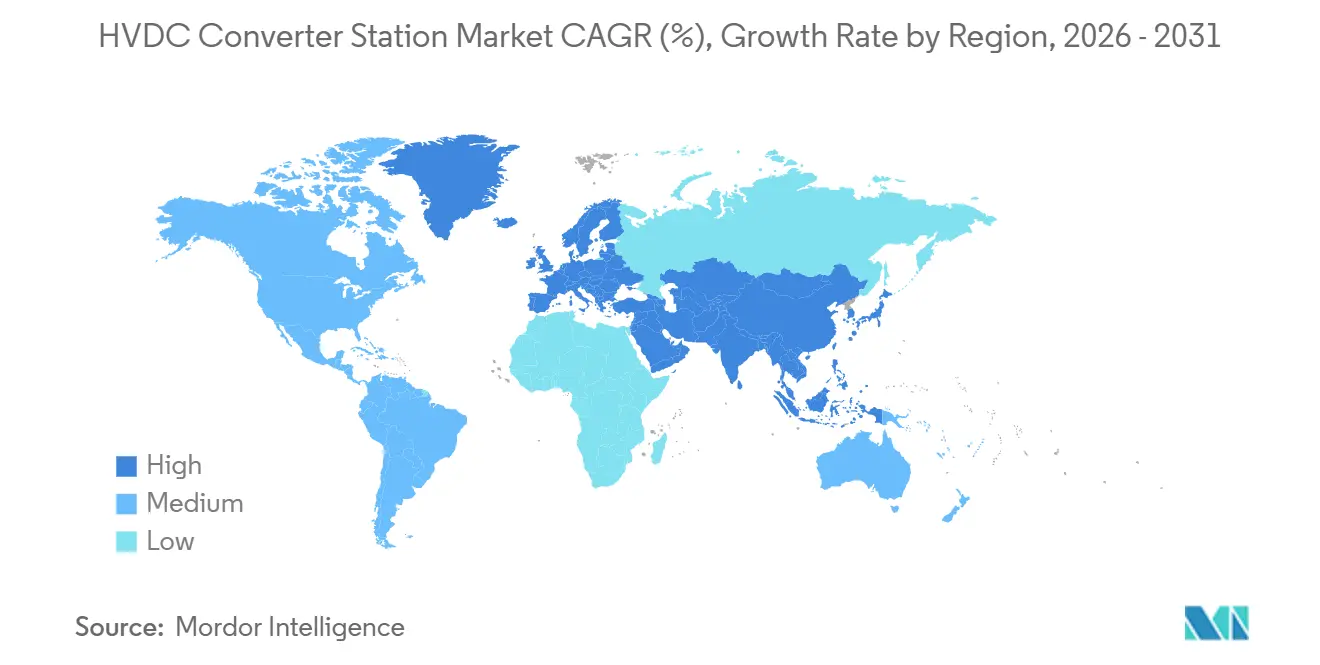
APAC HVDC Converter Station Market
Asia-Pacific accounted for 66.8% of the HVDC converter stations market value in 2025 and is tracking a 7.6% CAGR to 2031. China aims to transmit 1,000 TWh of west-wind and hydro to coastal loads by 2030, implying 30 more ±800 kV corridors and USD 50 billion investment. India’s Green Energy Corridor Phase II adds a ±800 kV, 6 GW Rajasthan-Tamil Nadu link plus a ±500 kV Lakshadweep VSC interconnector. Japan’s 1 GW Choshi subsea line entered service in 2025, signaling a wider 10 GW offshore wind target. South Korea and ASEAN members are moving more slowly as financing and sovereignty issues delay final investment decisions.
Europe HVDC Converter Station Market
Europe represented around 20% of the 2025 converter spend, but leads VSC innovation. The UK’s Dogger Bank, East Anglia THREE, and Sea Link total 7 GW of capacity under HVDC Light or Plus platforms. Denmark’s Bornholm hub will anchor a 3 GW meshed grid in the Baltic by 2030. GE Vernova’s Ostwind 4 contract marks re-entry into offshore HVDC. Nordic interconnectors such as Viking Link and NordLink let countries arbitrage renewables across weather patterns.
The Americas and Middle East HVDC Converter Station Market
North America is accelerating planning but still faces seven-to-ten-year permitting cycles. Grain Belt Express secured all approvals in 2024 for a 4 GW Kansas-Indiana line scheduled for 2028 using HVDC Light. Canada’s 300 MW Montana link and Mexico’s proposed 2 GW Baja-Mexico City corridor illustrate region-wide interest. South America’s Brazil-Argentina interconnector heads toward 2028 while Chile tenders a 500 MW northern solar link. Middle East projects remain nascent, although Saudi Arabia’s 58.7 GW renewable pipeline will likely need a 3 GW HVDC overlay by 2032.
Regulatory Landscape
Policy and technical-rulemaking are tightening around HVDC performance, localization, and grid-code compliance as converter stations become critical enablers for renewable integration and cross-border trade. In Europe, ACER issued a favorable opinion in December 2024 on amendments to the EU Network Code on HVDC grid connection requirements (Regulation (EU) 2016/1447), which raises expectations around grid-forming capability, fault ride-through, and RoCoF withstand for HVDC-connected assets.
Standards and domestic-content rules are also shaping procurement. The IEC published IEC TR 63179:2026 in January 2026, providing planning guidelines for both LCC and VSC HVDC systems, including stability analysis and techno-economic comparison approaches used in project design and evaluation. In India, the Ministry of Power mandated a phased roadmap for minimum local content in HVDC substations (LCC type) in May 2026, targeting 60% by FY2035 with interim milestones (30% by FY2028, 40% by FY2030, and 50% by FY2032), which affects vendor qualification, sourcing strategies, and factory investment decisions.
Competitive Landscape
Hitachi Energy, Siemens Energy, and GE Vernova held roughly 60%-65% of 2025 order intake, yet Chinese players NR Electric, C-EPRI, and Xian XD are expanding abroad with 20%-30% price discounts. Hitachi Energy disclosed a USD 4.2 billion HVDC backlog covering Dogger Bank, Gansu-Zhejiang, and North Sea links. Siemens Energy booked USD 3.8 billion across Bornholm, East Anglia THREE, and Middle Eastern schemes. GE Vernova’s USD 1.4 billion Ostwind 4 award ends a four-year hiatus from offshore HVDC.
NR Electric won a 500 MW VSC link in Southeast Asia in 2025, underpricing Western bids by 25%, though IEC 62351 compliance questions limit traction in Europe. Hitachi Energy and Siemens Energy remain the only vendors with proven 400 kV, 9 kA hybrid DC breakers, causing a bottleneck that can delay meshed projects six to twelve months. Prysmian and Nexans dominate subsea cable supply, while Mitsubishi and Toshiba partner on 8.5 kV thyristors for China’s ±1,100 kV schemes.
HVDC Converter Station Industry Leaders
-
Hitachi Energy
-
Siemens Energy
-
GE Grid Solutions
-
Prysmian Group
-
Mitsubishi Electric
- *Disclaimer: Major Players sorted in no particular order
HVDC Converter Station Market Companies Covered in this Report
- Hitachi Energy Ltd
- Siemens Energy AG
- GE Grid Solutions LLC
- Mitsubishi Electric Corp.
- Toshiba Corp.
- Bharat Heavy Electricals Ltd
- NR Electric Co. Ltd
- C-EPRI Electric Power Eng. Co. Ltd
- Crompton Greaves Ltd (CG Power)
- Prysmian Group
- Nexans SA
- NKT A/S
- State Grid Corp. of China
- TDK Corporation
- LS Electric Co. Ltd
- Hyosung Heavy Industries
- Trench Group (Siemens)
- KAPES (Korea-ABB JV)
- Xian XD Transformer Co.
- TransGrid Solutions
Market Opportunities and Future Outlook
Converter-station opportunity is expanding where governments and TSOs move from concept planning into funded awards for high-capacity corridors and interconnectors, particularly around 2 GW-class offshore hubs, long-distance renewable transfer, and cross-border links. In Europe, procurement activity is visible through 50Hertz awarding Siemens Energy a 2 GW offshore HVDC converter system for North Sea Connector 2 (June 2026) and Terna and STEG signing a EUR 770 million contract with Hitachi Energy for Elmed converter stations connecting Italy and Tunisia (June 2026). These programs continue to support demand for VSC platforms, offshore converter platforms, and high-spec digital controls that align with evolving grid-code requirements.
A second focus area is localized manufacturing and supply-chain resilience for HVDC equipment and key converter-station components, driven by policy and lead-time pressure. India set a phased minimum local content mandate for HVDC substations in May 2026, reaching 60% by FY2035, and OEMs are responding with regional footprint moves, including GE Vernova announcing plans for a USD 200 million HVDC equipment manufacturing plant in Hai Phong, Vietnam (March 2026). With IGBT and transformer lead times stretching to 24 months in 2025 and transformer capacity running tight at major facilities, incremental investment in regional component capacity (transformers, valves, control systems, and testing) and compliance-ready designs, including cybersecurity-aligned digital control architectures, can help compress delivery schedules and improve bid competitiveness.
Recent Industry Developments in HVDC Converter Station Market
- June 2026: Hitachi Energy secured a EUR 770 million contract from Terna and STEG to deliver converter stations for the 600 MW Elmed HVDC interconnection between Italy and Tunisia. The award advances one of the first direct current links between Europe and North Africa and expands the near-term pipeline for cross-border, multi-jurisdiction HVDC converter station delivery.
- December 2025: GE Vernova won a contract from Adani Energy Solutions to supply HVDC technology for a 2.5 GW VSC-based transmission corridor in India. The order underscores the scale shift in India toward multi-gigawatt renewable evacuation schemes and reinforces demand for VSC converter stations aligned with tighter grid stability requirements.
- December 2024: Hitachi Energy signed contracts totaling over EUR 2 billion with Amprion to deliver four converter stations for German HVDC links under Korridor B. The deal adds large, standardized station volumes into the European backlog and supports broader offshore wind and north-south power transfer buildouts that depend on converter-station execution capacity.
HVDC Converter Station Market Report Scope and Research Methodology
Market Definition and Coverage
This market covers the revenues generated from supplying HVDC converter stations that convert electricity between AC and DC for grid transmission and interconnections, counted at the station and major sub-system level across global geographies.
Scope exclusions: It excludes HVDC transmission cables and overhead line construction work, and it also excludes routine O&M services unless they are bundled in the converter station supply contract.
Segments Covered in This Report
- By Technology
- Voltage Source Converter (VSC)
- Line-Commutated Converter (LCC)
- By Component
- Valves
- Converters Transformers
- Harmonic Filter
- Reactor
- Others
- By Voltage Rating
- Up to 320 kV
- 320 to 500 kV
- 500 to 800 kV
- Above 800 kV (UHVDC)
- By Geography
- North America
- United States
- Canada
- Mexico
- Europe
- Germany
- United Kingdom
- France
- Spain
- Italy
- NORDIC Countries
- Russia
- Rest of Europe
- Asia-Pacific
- China
- India
- Japan
- South Korea
- ASEAN Countries
- Australia and New Zealand
- Rest of Asia-Pacific
- South America
- Brazil
- Argentina
- Chile
- Rest of South America
- Middle East and Africa
- Saudi Arabia
- United Arab Emirates
- South Africa
- Egypt
- Rest of Middle East and Africa
- North America
Data Sources, Market Sizing, and Validation
Desk Research
Desk research is used to set the base technical and demand context, then create sanity checks for the model outputs. We rely on public system-planning and grid investment signals, such as energy statistics and policy documents, including International Energy Agency publications, US Energy Information Administration data, national energy regulator materials, and grid and power-system operator updates.
Project announcements and procurement signals are also reviewed, using sources such as official tender portals, transmission operator websites, multilateral development bank disclosures, and customs trade statistics for high-voltage electrical apparatus categories. In parallel, company annual reports, investor presentations, and reputable engineering press are used to understand station build cycles, backlog direction, and typical scope splits between primary equipment and control-protection. Where needed, paid subscriptions for company financial intelligence, patent databases, and shipment-level import-export data are referenced to fill gaps and cross-check timing. These are illustrative examples, and many other public and paid sources were also consulted for data collection, validation, and clarification.
Primary Interviews and Surveys
Primary work is used to pressure-test assumptions that are hard to infer from public data, especially the typical station scope, procurement packaging, and pricing movement by voltage rating and technology type. We spoke with stakeholders across EPC delivery, component supply, utility and grid planning, and project consulting roles to validate regional demand drivers and refine conversion factors used in the model.
Because this is a global market, inputs were checked across APAC, EMEA, and the Americas, so the forecast captures differences in renewables integration pacing, cross-border links, and long-distance bulk transmission build-out.
Distribution of primary research fieldwork respondents
| Company type | Respondent position | Region |
|---|---|---|
| Top tier: 26% | CXOs: 12% | APAC: 48% |
| Mid tier: 60% | Functional/Unit leaders: 38% | EMEA: 33% |
| Smaller Players: 14% | Managers: 50% | Americas: 19% |
Market-Sizing & Forecasting
The sizing starts from a top-down demand pool that is rebuilt using HVDC project commissioning pipelines, interconnector additions, and grid expansion indicators, and then translated into converter station revenue using typical station counts per link and observed cost intensity ranges. Results are corroborated with selective bottom-up checks, such as sampling project award values, approximating average station pricing by voltage class, and doing limited supplier roll-ups where public financial disclosure allows.
Key inputs that shape the model include the share of new transmission investment flowing into HVDC versus HVAC, the split of LCC versus VSC deployments, typical converter station scope by component (valves, transformers, filters, reactors, and controls), voltage rating mix shifts, and lead times from award to commissioning. When public sources provide only partial project values, gaps are handled through normalized cost-per-MW or cost-per-station proxies, which are reviewed again with interview feedback.
For forecasting, scenario analysis is used because project timing can move based on permitting, financing, and grid approvals. The annual path is then smoothed using trend signals from grid plans and announced renewable capacity additions. Where multiple views exist, we align the forward curve to the consensus range heard from primary respondents and to the pace visible in near-term tenders and award pipelines.
Data Validation & Update Cycle
Outputs are validated by checking whether regional totals align with independent signals such as announced HVDC link capacity additions, converter station order pipelines, and implied spend per GW of planned interconnection. Any sharp year-to-year jump is reviewed, and the assumptions behind technology mix, voltage mix, and price movement are rechecked before sign-off.
A multi-step review is followed. The first model build is independently challenged, key inputs are reconciled to the latest public project updates, and primary contacts are re-engaged when an input sits outside the expected range. Reports are refreshed annually, and interim updates are made when there are material events such as large award clusters, policy shifts, or meaningful commodity-driven equipment price swings. Before delivery, a final freshness pass is completed so clients receive the most current view possible.
Mordor Intelligence's Global Hvdc Converter Station Market Size Versus Other Published Estimates
Published market sizes for HVDC converter stations can look far apart because each publisher draws the market boundary differently, and because project timing and pricing assumptions are not handled the same way. The year chosen as the reference point matters as well, since large interconnector awards can pull demand forward or push it out by a year.
HVDC cables and overhead line construction are included in some estimates, and that can expand the total well beyond converter station equipment and sub-systems, which is the scope treated outside Mordor Intelligence's coverage for this study. Differences also come from how voltage rating mix is priced, whether aggressive future award ramps are treated as committed orders, and how currency conversion timing is handled for multi-year projects.
Benchmark comparison
| Source | Market Size | Gaps in Research Methodology |
|---|---|---|
| Mordor Intelligence | USD 7.73 B (2026) | |
| Strategic Market Research A | USD 5.20 B (2024) | Uses an earlier base year and provides limited clarity on station scope, and project timing appears to be averaged without explicit voltage mix and procurement packaging checks. |
| Industry Publisher B | USD 5.20 B (2024) | Pairs a high CAGR with a broad narrative scope that can blend adjacent grid equipment, and the base-year value is not shown alongside a transparent project pipeline or ASP bridge. |
The table shows that the spread is largely explained by what gets counted with a converter station, and by which year is used as the anchor for pricing and awards. By tying the total to observable project pipelines and then cross-checking it with pricing and mix signals, the estimate stays traceable to clear inputs that can be revisited as new tenders and commissioning updates arrive.
Key Questions Answered in the Report
How large is the HVDC converter station market in 2031?
The HVDC converter station market size is projected to reach USD 10.85 billion in 2031 from USD 7.73 billion in 2026.
Which technology is growing fastest within converter stations?
Voltage-source converters are expanding at an 8.1% CAGR to 2031 thanks to black-start, grid-forming, and multi-terminal advantages favored by offshore wind developers.
Why does Asia-Pacific dominate global HVDC spending?
China's rollout of 45 operational UHV corridors and India's new ±800 kV links push Asia-Pacific to 66.8% of 2025 revenue and a 7.6% regional CAGR through 2031.
What is the main cost barrier to new HVDC projects?
Turnkey capital can reach USD 2 billion for a 2 GW, 1,000 km line, while permitting often stretches beyond seven years in multi-jurisdictional corridors.
Which component faces the biggest supply bottleneck?
IGBT valves and custom converter transformers now carry lead times of up to 24 months due to limited semiconductor wafer and electrical-steel capacity.
How concentrated is vendor competition?
A market concentration score of 6 reflects that the top three players hold roughly two-thirds of orders, yet price-competitive Chinese OEMs are gaining share.