
Emerging Non-Volatile Memory Market Size and Share
Market Overview
| Study Period | 2020 - 2031 |
|---|---|
| Market Size (2026) | USD 8.31 Billion |
| Market Size (2031) | USD 18.80 Billion |
| Growth Rate (2026 - 2031) | 17.72 % |
| Fastest Growing Market | Asia-Pacific |
| Largest Market | Asia-Pacific |
| Market Concentration | Medium |
Major Players *Disclaimer: Major Players sorted in no particular order Image © Mordor Intelligence. Reuse requires attribution under CC BY 4.0. | |
Emerging Non-Volatile Memory Market Analysis by Mordor Intelligence
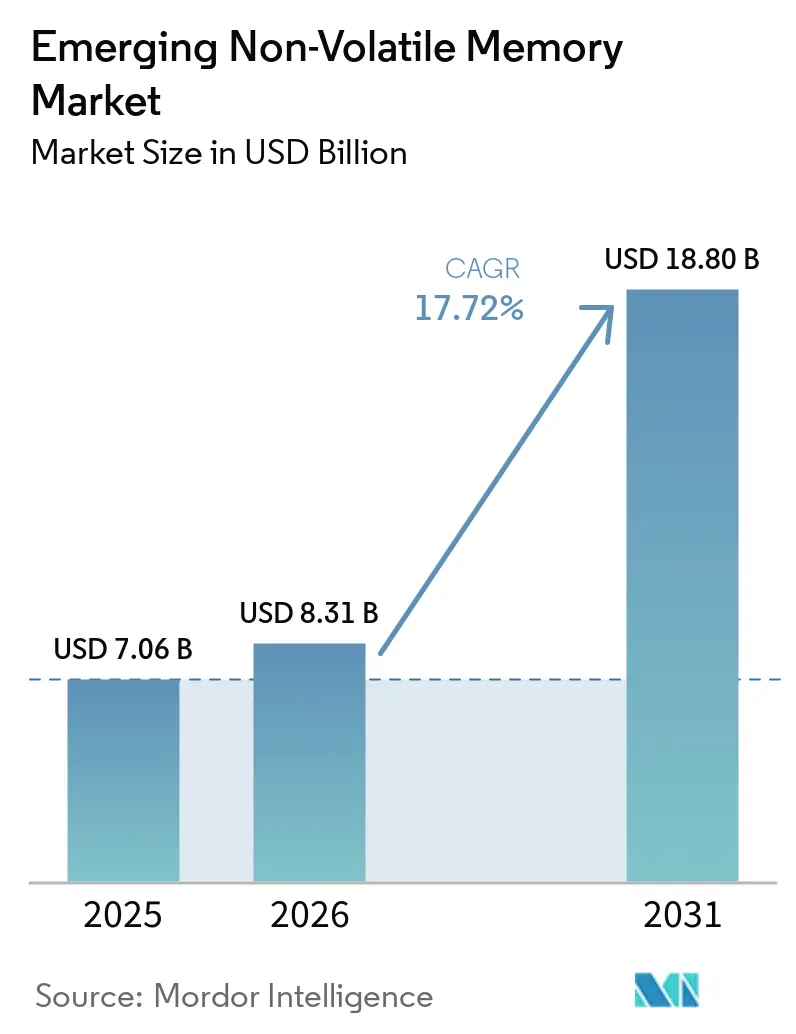
The emerging non-volatile memory market size was valued at USD 7.06 billion in 2025 and estimated to grow from USD 8.31 billion in 2026 to reach USD 18.8 billion by 2031, at a CAGR of 17.72% during the forecast period (2026-2031). Heightened demand for sub-microsecond latency in data-center AI training, the electrification of automobiles, and rising edge-AI inference workloads are accelerating the structural migration away from legacy flash toward magnetoresistive, resistive, phase-change, and ferroelectric technologies. Public-sector incentives under the U.S. CHIPS and Science Act, the European Union Chips Act, and comparable Chinese subsidies are redirecting capital into domestic memory fabs. Meanwhile, the foundry qualification of embedded MRAM at 22 nanometers and below enables designers to consolidate logic and storage on a single die. Automotive electrification is another catalyst, as high-temperature retention and instant-on capability meet the requirements of Advanced Driver Assistance Systems, battery management units, and domain controllers. Competitive strategies center on vertical integration, licensing, and portfolio diversification as incumbent NAND suppliers defend their position against pure-play startups offering drop-in flash replacements across industrial and automotive segments.
Key Report Takeaways
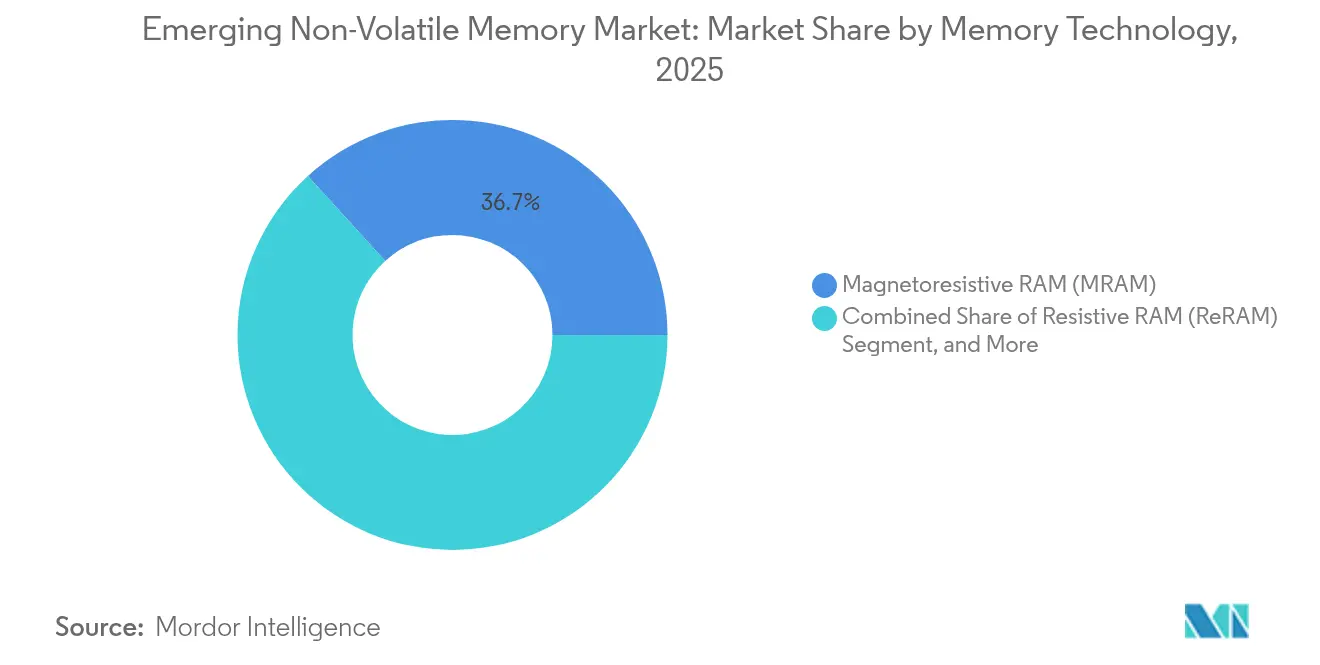
- By memory technology, magnetoresistive RAM led the emerging non-volatile memory market with a 36.74% revenue share in 2025; resistive RAM is forecast to expand at a 20.12% CAGR through 2031.
- By type, stand-alone modules accounted for 63.12% of the 2025 shipments in the emerging non-volatile memory market, while embedded variants are projected to grow at a 18.67% CAGR through 2031.
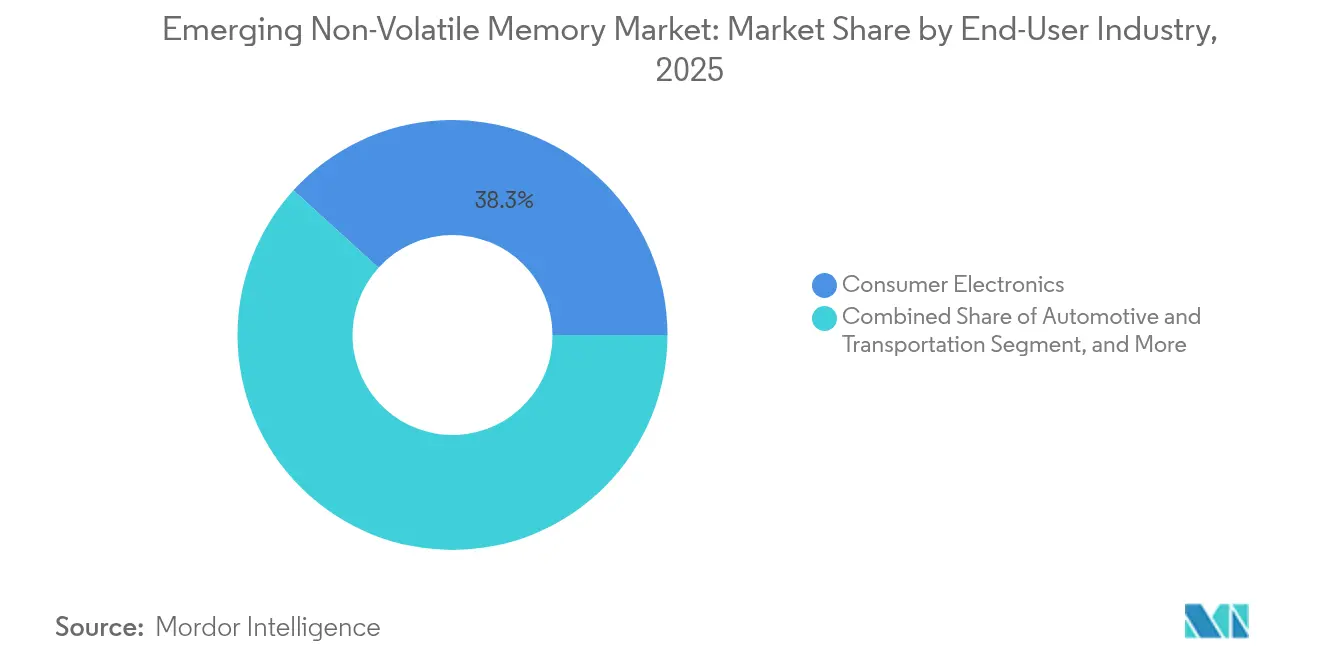
- By end-user industry, consumer electronics accounted for 38.25% of the demand in 2025 for the emerging non-volatile memory market; automotive and transportation are set to advance at a 21.05% CAGR between 2026 and 2031.
- By application, cache memory and enterprise storage captured 43.20% of the 2025 revenue of the emerging non-volatile memory market; mobile phones and wearables are expected to rise at a 21.10% CAGR through 2031.
- By geography, the Asia Pacific region dominated the emerging non-volatile memory market with a 40.35% share in 2025 and is also the fastest-growing region, expanding at a 19.82% CAGR to 2031.
Note: Market size and forecast figures in this report are generated using Mordor Intelligence’s proprietary estimation framework, updated with the latest available data and insights as of 2026.
Market Trends and Insights
Drivers Impact Analysis of Emerging Non-Volatile Memory Market*
| Driver | (~) % Impact on CAGR Forecast | Geographic Relevance | Impact Timeline |
|---|---|---|---|
| Exploding demand for low-latency, high-bandwidth storage in AI data centers | +3.2% | Global, strongest in North America and Asia Pacific | Medium term (2-4 years) |
| Shift toward energy-efficient memory for IoT and wearable devices | +2.8% | Global, led by Asia Pacific consumer-electronics hubs | Short term (≤ 2 years) |
| Automotive electrification and ADAS requiring high-temperature, high-endurance NVM | +3.5% | Europe, North America, Asia Pacific automotive corridors | Medium term (2-4 years) |
| Foundry qualification of embedded MRAM and ReRAM below 28 nm enables flash replacement | +3.1% | Asia Pacific fabs, spill-over to North America | Medium term (2-4 years) |
| Market pull for in-memory compute in edge-AI chips | +2.9% | Global, early adoption in North America and Asia Pacific | Long term (≥ 4 years) |
| Government semiconductor-sovereignty incentives expanding domestic fabs | +2.6% | United States, European Union, China, India | Long term (≥ 4 years) |
| Source: Mordor Intelligence | |||
Exploding Demand for Low-Latency, High-Bandwidth Storage in AI Data Centers
Hyperscale operators running large language models are hitting the memory wall, where the energy used to shuttle data between DRAM and NAND exceeds the energy used for computation. Emerging non-volatile memory supplies sub-100-nanosecond access and byte-addressability, allowing training datasets to persist in place through power cycles and cutting reliance on costly DRAM tiers. Fast persistent-memory technologies form a growing segment of the non-volatile memory market. Samsung’s 1-gigabit spin-transfer-torque MRAM prototype demonstrated 10-nanosecond writes in 2024, validating the latency advantage over NAND.[1] The discontinuation of Intel Optane in 2022 intensified the push toward MRAM and ReRAM tiers. As transformer models scale past one trillion parameters, persistent memory becomes essential for frequent checkpointing, boosting adoption across recommender systems and fraud-detection pipelines.
Shift Toward Energy-Efficient Memory for IoT and Wearable Devices
Battery-constrained devices are replacing serial NOR flash with ferroelectric RAM and MRAM to remove high write currents and erase-before-write overhead. STMicroelectronics disclosed in 2024 that embedded FRAM lowered system energy by 40% in ultra-low-power microcontrollers.[2] Always-on voice assistants and continuous health monitors need instant wake-up and zero standby leakage, benefits that align with FRAM’s sub-microampere standby current. European Union Ecodesign rules, which mandate energy-efficiency labeling, are reinforcing adoption.
Automotive Electrification and ADAS Requiring High-Temperature, High-Endurance NVM
Advanced Driver Assistance Systems, battery-management units, and over-the-air firmware updates rely on memory that retains data at temperatures above 125 °C and withstands 10^9 write cycles. Everspin’s automotive-grade MRAM, qualified to AEC-Q100 Grade 1, demonstrates data retention at 150 °C. Infineon partnered with Everspin in 2024 to integrate 256-megabit MRAM into its AURIX microcontrollers, enabling Level 3 autonomy that requires instant boot and fail-operational redundancy. Compliance with ISO 26262 functional safety standards amplifies the demand for predictable failure modes.
Foundry Qualification of Embedded MRAM Below 28 nm Enables Flash Replacement
TSMC qualified a 22-nanometer embedded MRAM platform for volume production in 2024, letting designers co-integrate logic, SRAM, and non-volatile storage on a single die. GlobalFoundries followed with a 12-nanometer eMRAM process that spans −40 to 125 °C and features a 10-nanosecond write speed. Eliminating external serial flash reduces bill-of-materials costs, board area, and boot latency, especially in secure microcontrollers and edge AI accelerators.
Restraints Impact Analysis of Emerging Non-Volatile Memory Market*
| Restraint | (~) % Impact on CAGR Forecast | Geographic Relevance | Impact Timeline |
|---|---|---|---|
| High fabrication cost and yield challenges at sub-20 nm nodes | -2.1% | Global, most acute where advanced-node capacity is scarce | Short term (≤ 2 years) |
| Lack of unified standards for controller interfaces and software stacks | -1.8% | Global, slowing adoption in enterprise and automotive segments | Medium term (2-4 years) |
| Device-level endurance variability limiting high-write workloads | -1.3% | Global, impacting data-center and industrial applications | Medium term (2-4 years) |
| Supply-chain dependence on critical magnetic and rare-earth materials | -1.5% | Global, heightened risk in single-source regions | Long term (≥ 4 years) |
| Source: Mordor Intelligence | |||
High Fabrication Cost and Yield Challenges at Sub-20 nm Nodes
Emerging non-volatile memory stacks incorporate specialized mask layers and atomic-layer deposition steps, which increase wafer cost by 20%–30% over baseline CMOS. Extreme-ultraviolet scanners, which exceed USD 150 million each, concentrate capacity at a handful of fabs, limiting supply elasticity. Early pilot runs report defect densities two to three times higher than mature NAND processes, postponing cost parity in consumer devices and tempering near-term unit growth.
Lack of Unified Standards for Controller Interfaces and Software Stacks
JEDEC standards, such as NVDIMM-P, address persistent DRAM but omit byte-addressable non-volatile memory, forcing original equipment manufacturers to support proprietary drivers.[3] Fragmentation inflates qualification timelines in safety-critical sectors and hinders multi-sourcing, while only partial progress has been made toward NVMe extensions for persistent memory.
*Our forecasts treat driver/restraint impacts as directional, not additive. The impact forecasts reflect baseline growth, mix effects, and variable interactions.
Emerging Non-Volatile Memory Market Segment Analysis
By Memory Technology:
MRAM Holds the Lead, ReRAM Gains TractionMagnetoresistive RAM accounted for 36.74% of 2025 revenue, supported by qualification in automotive microcontrollers and industrial controllers that demand instant-on capability. Resistive RAM is forecast to grow at a 20.12% annual rate to 2031, as its two-terminal cell structure leverages existing high-k gate tooling. ReRAM’s cost trajectory appeals to fabless designers seeking drop-in flash replacements without the need for magnetic-deposition equipment. Phase-change memory remains a niche option in automotive black boxes and aerospace recorders, which value deterministic writes and radiation tolerance. Ferroelectric RAM retains a role in ultra-low-power microcontrollers and RFID tags, where unlimited endurance offsets density limitations. Cross-point architectures such as 3D XPoint are being repositioned for edge-AI accelerators that must preserve model weights across reboots. Samsung’s 1-gigabit prototype verifies that spin-transfer designs are narrowing the latency gap with spin-orbit-torque variants, reinforcing MRAM’s dominance.
ReRAM’s flexibility in switching materials, such as tantalum oxide, hafnium oxide, and titanium oxide, allows foundries to adapt to node-specific requirements. Weebit Nano’s 2024 partnership with SkyWater to qualify 130-nm ReRAM for radiation-hardened space applications shows suitability for specialty nodes. Ferroelectric RAM’s endurance, exceeding 10^14 cycles, keeps it relevant in smart-meter deployments, where it logs sensor data every few seconds over multi-decade lifetimes. Hybrid designs such as Samsung’s Z-NAND combine MRAM buffers with high-density NAND to extend endurance in write-intensive workloads.

By Type:
Embedded Variants Accelerate as SoC Integration DeepensStand-alone modules contributed 63.12% of 2025 shipments, serving enterprise storage arrays and industrial controllers that value field-replaceable packages. Embedded non-volatile memory is projected to grow at a 18.67% annual rate through 2031, driven by system-on-chip designers eliminating external serial flash to reduce latency and lower power budgets. TSMC’s 22-nm eMRAM and GlobalFoundries’ 12-nm eMRAM platforms allow firmware, calibration data, and neural-network weights to reside on-die. The emerging non-volatile memory market size for embedded applications is projected to expand rapidly as consumer electronics adopt always-on sensing.
Stand-alone modules remain the preferred choice where capacity and serviceability are crucial, such as in storage-area networks and industrial PLCs. Everspin’s 256-megabit MRAM module targets cache tiers where power-fail protection and unlimited endurance outweigh cost premiums. Qualification cycles for embedded variants are longer because foundries must validate thermal stability across the entire process window; however, the savings in board area and assembly cost reinforce the migration trajectory.
By End-User Industry:
Automotive Surpasses Consumer on ADAS PullConsumer electronics captured 38.25% of 2025 revenue, but automotive and transportation are on track for a 21.05% CAGR through 2031 as centralized domain controllers consolidate dozens of control units. The emerging non-volatile memory market supports instant-on, high-temperature retention, and fail-operational requirements inherent in Level 3 autonomy. Enterprise data-center demand, although smaller in revenue, is critical for storage-class memory tiers that bridge DRAM and NAND. Industrial segments favor FRAM and ReRAM for their unlimited endurance in harsh environments, while healthcare applications adopt non-volatile memory for implantable sensors that require data retention across battery changes. Aerospace and defense segments specify radiation-hardened variants, benefiting from ReRAM’s tolerance to single-event upsets.
Automotive demand is exemplified by Infineon’s integration of 256-megabit MRAM into AURIX microcontrollers, meeting instant boot and fail-operational redundancy mandates. Consumer electronics growth slows as smartphone penetration plateaus, but wearables sustain momentum by embedding always-on sensors and voice assistants that need a persistent state without flash latency.
By Application:
Mobile and Wearables Register the Fastest GrowthCache memory and enterprise storage represented 43.20% of 2025 revenue, leveraging MRAM and phase-change buffers that shield NAND from write-intensive workloads. Mobile phones and wearables are forecast to grow at a 21.10% annual rate due to the proliferation of always-on health monitoring and on-device AI inference.
The emerging non-volatile memory market size for mobile and wearables is expected to double as embedded FRAM replaces flash in ultra-low-power microcontrollers. Industrial control and automotive control applications rely on MRAM and FRAM for instant-on states over −40 to 125 °C ranges, while hybrid mass-storage architectures combine NAND with thin MRAM buffers to extend endurance. Secure microcontroller and smart-card deployments utilize ReRAM’s one-time programmable feature as a hardware root of trust.
Geography Analysis
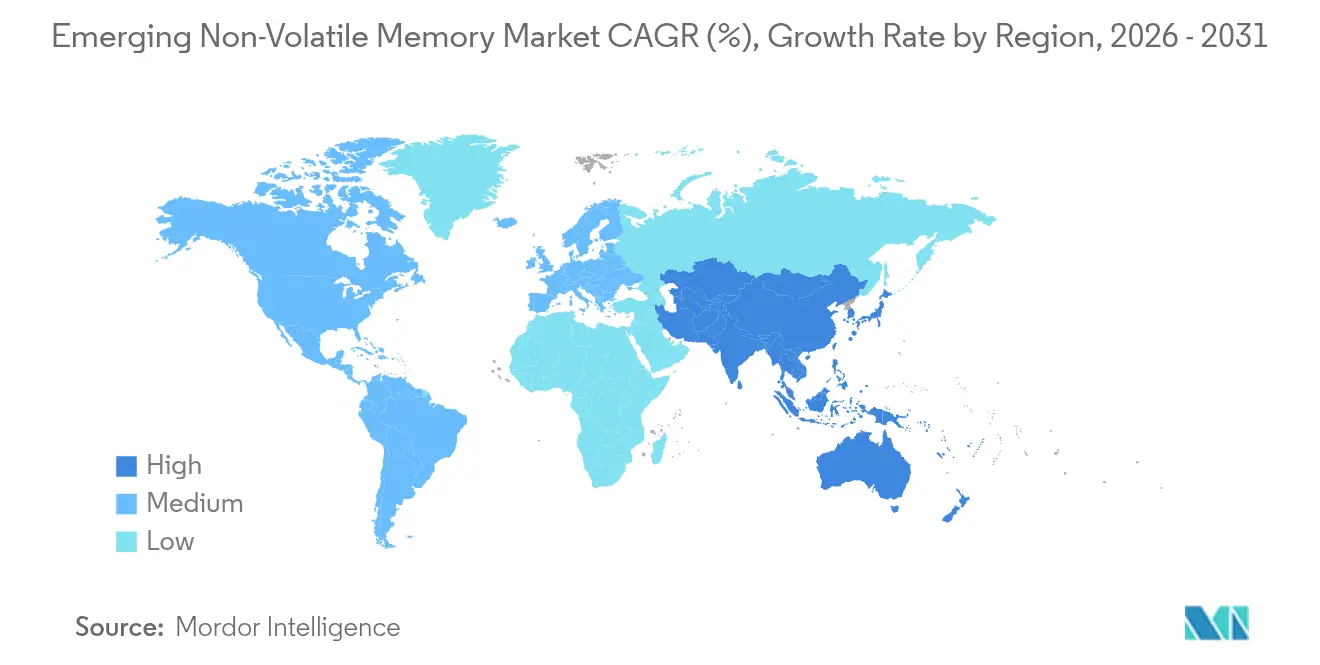
APAC Emerging Non-Volatile Memory Market
The Asia Pacific region held 40.35% of 2025 revenue and is projected to grow at an annual rate of 19.82% through 2031. The region benefits from Samsung and SK Hynix pilot lines in South Korea, TSMC’s 22-nm eMRAM in Taiwan, and state-backed Chinese programs to localize resistive RAM production. Dense consumer-electronics and automotive supply chains reinforce a virtuous cycle of prototype and volume ramp. The emerging non-volatile memory market is further bolstered by the Asia-Pacific's growing adoption of battery-electric vehicles, which require high-temperature, high-endurance storage.
North America and Europe Emerging Non-Volatile Memory Market
North America pursues radiation-hardened memory for aerospace and defense, with GlobalFoundries’ 12-nm eMRAM serving automotive and industrial microcontrollers. The U.S. CHIPS and Science Act allocates funds to domestic fabs, thereby enhancing supply security for defense contractors. Europe leverages the EUR 43 billion Chips Act to expand semiconductor capacity; Infineon and STMicroelectronics are piloting embedded MRAM for automotive electrification. The emerging non-volatile memory market share in Europe rises due to stringent functional-safety standards that favor MRAM.
MEA and South America Emerging Non-Volatile Memory Market
South America, the Middle East, and Africa remain at early adoption stages, focusing on smart grid metering, oil and gas telemetry, and mobile payments. Saudi Arabia’s NEOM project is piloting MRAM-based data loggers for energy management, while African deployments focus on off-grid solar controllers that require low-power, high-endurance memory.
Regulatory Landscape
Export controls and trade enforcement are increasingly shaping the commercialization path for advanced memory and emerging NVM, especially when embedded MRAM and ReRAM are tied to advanced-node manufacturing. In January 2026, the US Department of Commerce, Bureau of Industry and Security (BIS) amended export control parameters for advanced computing semiconductors destined for China and Macau. In May 2026, BIS issued additional guidance clarifying that certain license requirements follow the headquarters of entities in Country Group D:5 or Macau even when those entities operate outside those jurisdictions, tightening compliance screening across global supply chains.
In Europe, semiconductor sovereignty policy continues to influence capacity planning and incentive allocation. In June 2026, the European Commission formally adopted a proposal for Chips Act 2.0 (COM(2026) 504), highlighting strategic dependencies including limited regional manufacturing capacity in memory technologies. Separately, intellectual property and import enforcement remains a factor for memory device supply; in June 2026, the US International Trade Commission initiated a Section 337 investigation related to imported NAND flash and DRAM memory chips, reinforcing the risk of trade disruption for memory components used in enterprise storage and embedded systems.
Value Chain Analysis
The emerging non-volatile memory value chain starts with materials and equipment needed for non-standard memory layers, then moves through wafer fabrication, packaging, qualification, and downstream module and system integration. Upstream, MRAM production depends on specialized magnetic tunnel junction deposition and etch capability, with tool ecosystems led by suppliers such as Applied Materials and Tokyo Electron. Limited availability of these specialized chambers and long lead times for semiconductor equipment can constrain pilot-to-volume ramps.
Foundries and IDMs then integrate MRAM/ReRAM/FRAM/PCM steps into CMOS flows, followed by OSATs and advanced packaging providers that increasingly support heterogeneous integration for memory-plus-logic designs. Midstream partnerships also reflect how IP licensing and foundry enablement are used to reach manufacturable nodes and broaden customer access: Weebit Nano licensed ReRAM to onsemi (January 2025) and later taped out embedded ReRAM test chips at onsemi's 300 mm production fab in East Fishkill, New York (October 2025). On the packaging side, Deca Technologies and Microchip subsidiary Silicon Storage Technology collaborated (September 2025) to develop an NVM chiplet package combining fan-out with embedded memory, reflecting the growing use of chiplets to lower system cost and reduce integration risk versus monolithic designs for automotive and edge-AI SoCs.
Competitive Landscape
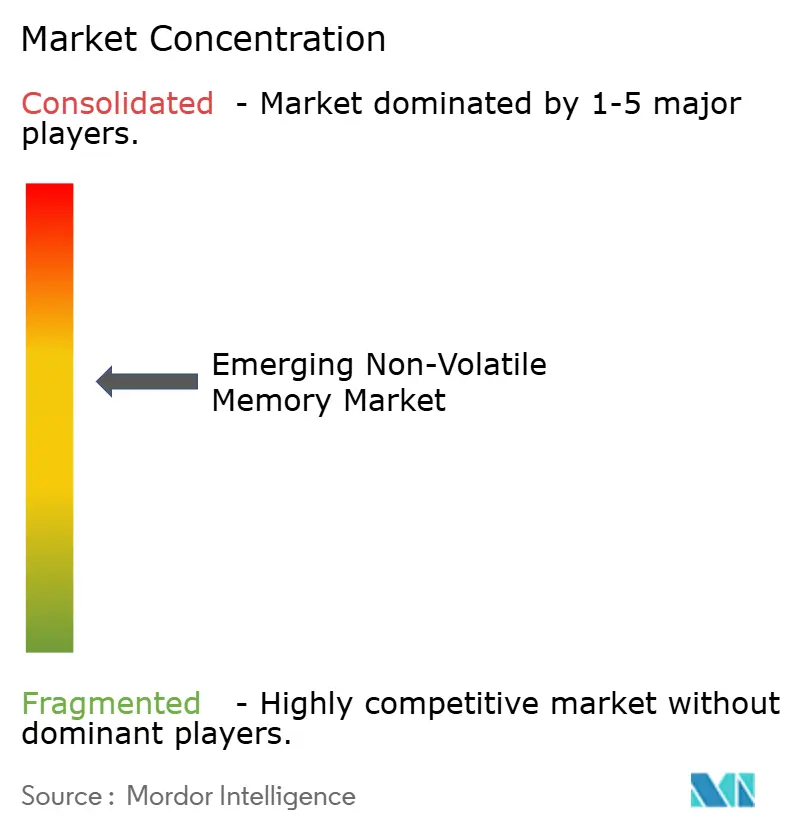
Competition is moderate. Samsung, SK Hynix, Micron, and Kioxia collectively command a share of over 55% of the revenue, leveraging their scale and customer relationships. Pure-play startups such as Everspin, Weebit Nano, Avalanche Technology, and Crossbar license intellectual property and partner with foundries to sidestep fab investments. Technology differentiation drives competition as suppliers race to deliver lower write latency, higher endurance, and wider temperature ranges. Samsung’s 1-gigabit STT-MRAM prototype positions the firm to displace DRAM in persistent cache tiers. Everspin focuses on stand-alone modules for enterprise storage where unlimited endurance justifies price premiums. Foundry partnerships are critical; TSMC’s 22-nm eMRAM and GlobalFoundries’ 12-nm eMRAM provide fabless designers with reliable supply paths.
Standards-body participation also shapes the field as companies influence JEDEC interfaces that could lock in architectural advantages. Vertical integration is emerging: Infineon and Renesas embed MRAM into microcontrollers to secure differentiated automotive portfolios. Patent filings focus on tunnel-junction engineering and selector devices for cross-point arrays, with Samsung, Intel, and TSMC collectively holding more than 40% of the granted MRAM patents as of 2024. The emerging non-volatile memory industry thus balances incumbent scale with startup agility.
Emerging Non-Volatile Memory Industry Leaders
-
Samsung Electronics Co. Ltd.
-
SK Hynix Inc.
-
Micron Technology Inc.
-
Intel Corporation
-
Western Digital Corporation
- *Disclaimer: Major Players sorted in no particular order
Emerging Non-Volatile Memory Market Companies Covered in this Report
- Samsung Electronics Co. Ltd.
- SK Hynix Inc.
- Micron Technology Inc.
- Intel Corporation
- Western Digital Corporation
- Kioxia Holdings Corporation
- Everspin Technologies Inc.
- Crossbar Inc.
- Weebit Nano Ltd.
- Nantero Inc.
- Fujitsu Ltd.
- Texas Instruments Incorporated
- Infineon Technologies AG
- STMicroelectronics N.V.
- Renesas Electronics Corporation
- TSMC (Taiwan Semiconductor Manufacturing Company Limited)
- GlobalFoundries Inc.
- United Microelectronics Corporation
- Avalanche Technology Inc.
- Adesto Technologies Corporation
- Toshiba Electronic Devices and Storage Corporation
- Winbond Electronics Corporation
- NXP Semiconductors N.V.
Market Opportunities and Future Outlook
Embedded memory scaling and qualification at advanced nodes are creating whitespace in edge AI and automotive compute where designers want to eliminate external serial flash while keeping instant-on behavior. Technical progress in 2026 supports this direction: ISSCC 2026 disclosed a 16 nm embedded STT-MRAM macro (168 Mb) with 51.2 Gb/s read throughput aimed at automotive and edge AI use cases, and Samsung reported an 8 nm FinFET embedded MRAM implementation with a mass production yield milestone (April 2026). These proof points widen the set of SoC platforms where emerging NVM competes directly with embedded flash for secure boot code, calibration, and always-on inference state.
Enterprise AI infrastructure also continues to pull storage and memory innovation into higher-performance tiers, creating opportunities for suppliers that can pair endurance and latency advantages with manufacturable cost. For instance, Samsung began mass production of a PCIe 6.0 enterprise SSD (PM1763) optimized for AI infrastructure in July 2026, reinforcing how hyperscale requirements are pushing the storage stack forward and increasing interest in faster, more durable write paths where MRAM/PCM buffers and persistent memory architectures are evaluated. Regional investment and partner ecosystems around memory add support as well: the European Commission's Chips Act 2.0 proposal (June 2026) explicitly frames memory capacity as a dependency gap, while Kioxia and SanDisk started production of 10th-generation 3D flash at the Kitakami Plant Fab2 (K2) facility (July 2026). That continued flash buildout keeps competitive pressure on emerging NVM vendors to focus embedded, high-temperature, and high-endurance segments where flash scaling and endurance trade-offs show up most clearly.
Recent Industry Developments in Emerging Non-Volatile Memory Market
- July 2026: Samsung Electronics began mass production of its PCIe 6.0-based PM1763 enterprise SSD built on 9th-generation V-NAND. The launch targets next-generation AI infrastructure workloads that demand higher throughput and lower latency at the storage layer, raising performance benchmarks that influence adjacent persistent-memory and cache architectures.
- June 2026: NVIDIA and SK hynix announced a multiyear technology partnership to co-develop next-generation memory solutions for NVIDIA AI infrastructure. The collaboration formalizes a roadmap link between leading AI compute platforms and memory suppliers, tightening qualification cycles and supply alignment for high-performance memory subsystems used in data centers.
- April 2026: Samsung Electronics reported a mass production yield milestone for an embedded MRAM design on an 8 nm FinFET process. This progress points to near-term deployment of embedded MRAM within system-on-chip products, boosting secure boot, calibration, and always-on memory for automotive and edge AI applications.
Emerging Non-Volatile Memory Market Report Scope and Research Methodology
Market Definition and Coverage
For this study, the emerging non-volatile memory market covers revenue generated from newer NVM technologies used as stand-alone components or embedded on chips, across end uses like consumer electronics, industrial, enterprise and data center, and automotive.
Scope exclusions: We exclude conventional, mature memory categories that are not positioned as emerging NVM (for example, mainstream NAND and DRAM), and we do not count downstream device system value beyond the memory content.
Segments Covered in This Report
- By Memory Technology
- Magnetoresistive RAM (MRAM)
- Resistive RAM (ReRAM)
- Phase-Change Memory (PCM)
- Ferroelectric RAM (FRAM)
- 3D XPoint / Other Emerging
- By Type
- Stand-Alone
- Embedded
- By End-user Industry
- Consumer Electronics
- Industrial
- Enterprise and Data Center
- Automotive and Transportation
- Healthcare and Medical Devices
- Aerospace and Defense
- Other End-user Industries
- By Application
- Cache Memory and Enterprise Storage
- Mobile Phones and Wearables
- Industrial and Automotive Control
- Mass Storage
- Embedded MCU and Smart Cards
- Other Applications
- By Geography
- North America
- United States
- Canada
- Mexico
- South America
- Brazil
- Argentina
- Rest of South America
- Europe
- Germany
- United Kingdom
- France
- Italy
- Spain
- Russia
- Rest of Europe
- Asia Pacific
- China
- Japan
- India
- South Korea
- Australia
- Rest of Asia Pacific
- Middle East and Africa
- Middle East
- Saudi Arabia
- United Arab Emirates
- Turkey
- Rest of Middle East
- Africa
- South Africa
- Nigeria
- Egypt
- Rest of Africa
- Middle East
- North America
Data Sources, Market Sizing, and Validation
Desk Research
Desk work started with establishing the demand signals and the supply-side capacity context that sit behind emerging memory adoption. We referenced public sources such as semiconductor trade statistics from UN Comtrade, production and industry indicators from the World Bank, and policy and program releases from the US Department of Commerce (including CHIPS-related updates). For technology context, we used standards and technical publications from JEDEC and IEEE.
To translate those signals into a usable model, we also reviewed company annual reports and earnings decks, and collected foundry and packaging announcements reported in reputable press. In parallel, we reviewed technical papers that describe where MRAM, ReRAM, PCM, and FeRAM are being designed in. Where needed, paid subscriptions for company financials and news intelligence, and for patent databases, were used to cross-check the timing of commercialization and major design wins. These desk sources are illustrative, and many other public references were also used for data collection, validation, and clarification.
Primary Interviews and Surveys
Primary work focused on validating what is actually shipping and what is still in qualification, which is a common gap in emerging memory topics. We spoke with a mix of device ecosystem participants, including memory IP and wafer-level stakeholders, module and component channel contacts, and end-user engineering and procurement teams across major regions.
The conversations were used to confirm typical use cases (such as cache, enterprise storage acceleration, and mobile or wearables), the expected attach rate of embedded memory in new nodes, and how pricing moves with density and reliability grades.
Distribution of primary research fieldwork respondents
| Company type | Respondent position | Region |
|---|---|---|
| Top tier: 26% | CXOs: 12% | APAC: 52% |
| Mid tier: 60% | Functional/Unit leaders: 30% | EMEA: 30% |
| Smaller Players: 14% | Managers: 58% | Americas: 18% |
Market-Sizing & Forecasting
Sizing was built using a top-down approach where semiconductor production, design activity, and end-market electronics build indicators were translated into an addressable demand pool for emerging NVM, and then filtered by technology adoption and use-case fit. To keep totals realistic, we corroborated results with selective bottom-up checks, like sampled ASP times estimated bit shipments for stand-alone parts and sampled wafer starts times embedded penetration for key process nodes.
The model used a small set of inputs that can be checked and explained, including embedded versus stand-alone mix, average selling price progression by density, attach rates in target devices, the pace of qualification-to-volume ramps, and regional electronics output trends. Since not every vendor discloses volumes clearly, we handled gaps by using bounded ranges from interviews, and then narrowing them using public signals like announced capacity, process availability, and patent intensity around specific NVM types.
For forecasting, we used scenario analysis supported by expert consensus on adoption timing, because the market can swing based on qualification delays or faster-than-expected design wins. Growth paths were stress-tested against practical constraints like foundry enablement schedules, packaging and test readiness, and end-user reliability requirements before final numbers were signed off by us.
Data Validation & Update Cycle
Outputs were checked against independent signals, such as implied memory content per device category and the expected share of emerging NVM within broader non-volatile memory spend, and then compared with what interviewees described as realistic shipment ramps. Large variances triggered an extra review of key assumptions, usually the pricing slope, penetration timing, or whether a use case was counted as embedded or stand-alone.
A multi-step analyst review was followed so calculation logic, currency conversion timing, and year alignment stayed consistent throughout the workbook. The report is refreshed annually, with interim updates when material events occur (like major node qualifications, policy shifts, or sudden pricing moves), and a final pre-delivery check is done so clients receive the latest view.
Mordor Intelligence's Global Emerging Non Volatile Memory Market Sizing Compared With Other Published Estimates
Published sizes for emerging non-volatile memory can vary a lot because the market still has a mix of pilot volumes and early scale programs, and not everyone treats the same technologies or shipment stages as commercial demand. Differences also come from how embedded memory is counted, what base year is chosen, and how fast pricing is assumed to decline as density improves.
The main gap comes from whether conventional memory categories get blended into the total, where Mordor Intelligence counts only emerging NVM technologies and allocates embedded revenue only when it is tied to qualified production nodes and realistic attach rates by use case.
Benchmark comparison
| Source | Market Size | Gaps in Research Methodology |
|---|---|---|
| Mordor Intelligence | USD 8.31 B (2026) | |
| Trade Publisher A | USD 4.80 B (2025) | Uses an earlier base year and leans on a narrower commercialization view, which tends to undercount embedded deployments that are already moving from qualification to volume production. |
| Industry Aggregator B | USD 3.03 B (2025) | Often applies a tighter technology list and conservative adoption timing, and pricing assumptions are not always reconciled with density mix and reliability-grade premiums across end uses. |
The table shows that the spread is mostly explained by scope choices and adoption timing, rather than a single arithmetic difference. By tying revenue to a defined set of emerging technologies, realistic attach rates, and pricing that is checked with industry contacts, our estimate stays traceable to clear inputs that can be revisited as qualification and volume signals change.
Key Questions Answered in the Report
What is the current value of the emerging non-volatile memory market?
The market stands at USD 8.31 billion in 2026 and is projected to reach USD 18.8 billion by 2031.
Which memory technology leads in revenue share?
Magnetoresistive RAM held 36.74% of 2025 revenue due to early automotive and industrial adoption.
Why is automotive demand rising so sharply?
Centralized domain controllers for Advanced Driver Assistance Systems require instant-on, high-temperature, high-endurance storage, driving a 21.05% CAGR from 2026 to 2031.
Which region generates the largest revenue?
Asia Pacific accounted for 40.35% of 2025 revenue, supported by Samsung, SK Hynix, and TSMC pilot lines.
What is the biggest technical hurdle to wider adoption?
High fabrication cost and yield challenges at sub-20 nm nodes raise wafer prices and slow the path to cost parity with flash.
How concentrated is supplier power?
The four largest vendors control about 55% of revenue, indicating moderate concentration rather than monopoly control.