
Market Overview
| Study Period | 2020 - 2031 |
|---|---|
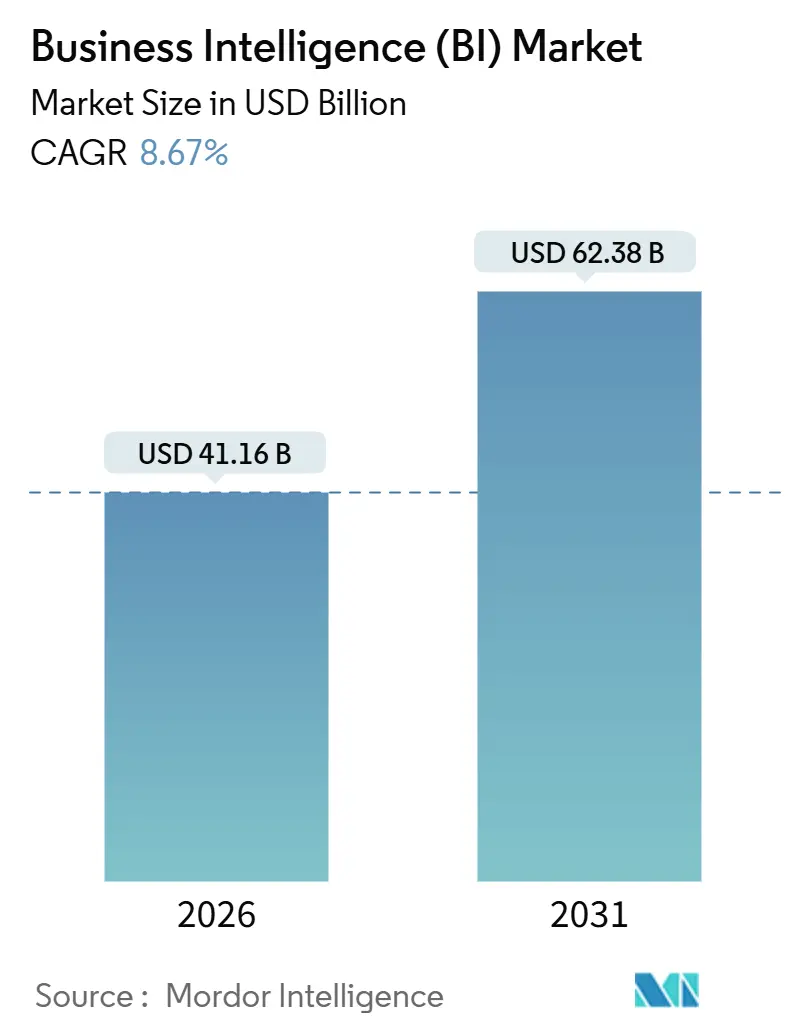
| Market Size (2026) | USD 41.16 Billion |
| Market Size (2031) | USD 62.38 Billion |
| Growth Rate (2026 - 2031) | 8.67 % |
| Fastest Growing Market | Asia Pacific |
| Largest Market | North America |
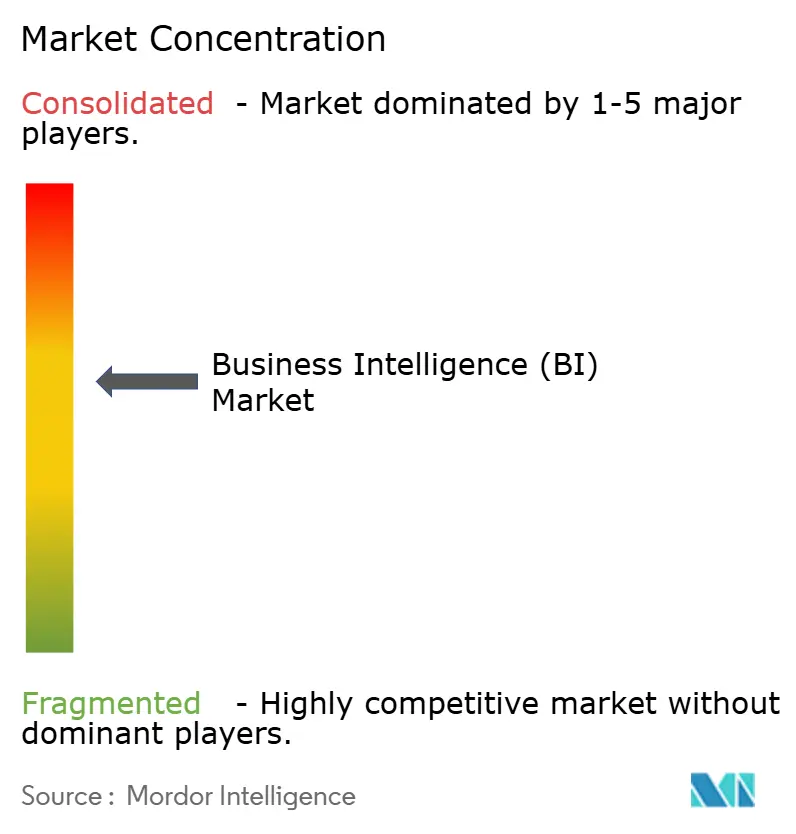
| Market Concentration | Medium |
Major Players *Disclaimer: Major Players sorted in no particular order Image © Mordor Intelligence. Reuse requires attribution under CC BY 4.0. | |
Business Intelligence (BI) Market Analysis by Mordor Intelligence
The Business Intelligence (BI) market size reached USD 41.16 billion in 2026 and is projected to climb to USD 62.38 billion by 2031, registering an 8.67% CAGR. Organizations are replacing periodic reporting with continuous intelligence pipelines that stream semi-structured IoT telemetry, clickstream logs, and sensor data into cloud lakehouses, accelerating insight cycles from days to seconds. Cloud deployment claimed 65.87% revenue in 2025, a position strengthened by hyperscaler GPU-accelerated query engines that compress latency without large capital outlays. Usage-based licensing, composable analytics stacks, and privacy-preserving data clean rooms widen market access for mid-market buyers and digital-native brands. Although talent shortages, multi-cloud egress fees, and country-specific data-sovereignty mandates curb adoption velocity, the Business Intelligence (BI) market continues to broaden across industries and regions as analytics becomes a core element of digital-transformation agendas.
Key Report Takeaways
- By deployment, cloud accounted for 65.87% of Business Intelligence (BI) market share in 2025, and is advancing at a 9.54% CAGR through 2031.
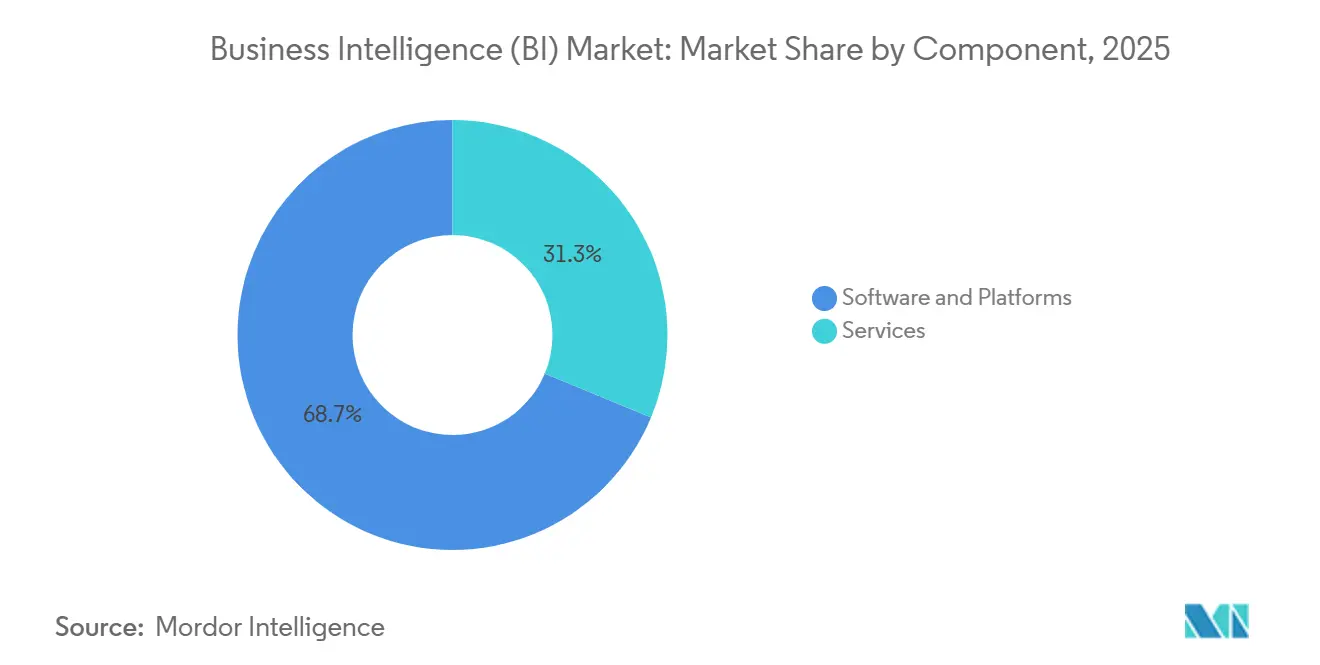
- By component, software and platforms captured 68.73% of Business Intelligence (BI) market size in 2025, whereas services are expanding at a 9.23% CAGR to 2031.
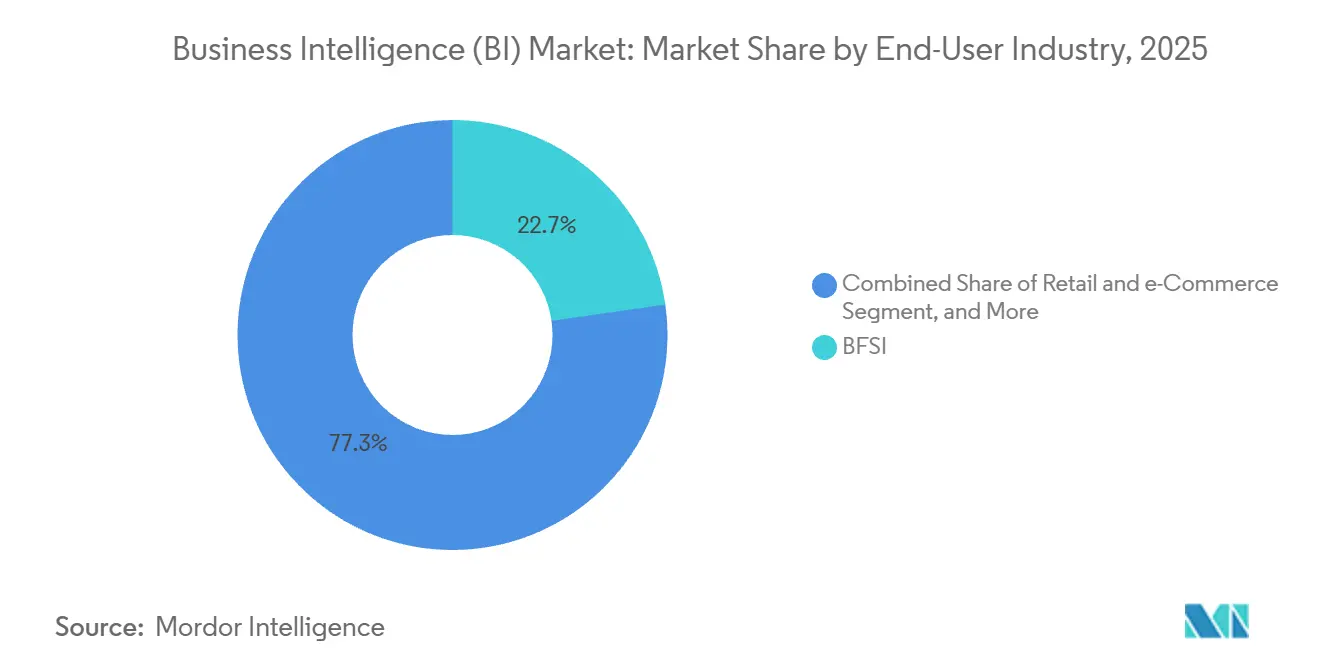
- By end-user industry, banking, financial services, and insurance held 22.74% revenue in 2025; retail and e-commerce are set to post a 10.21% CAGR through 2031.
- By business model, subscription and software-as-a-service generated 60.13% of 2025 revenue, while freemium and usage-based pricing are growing at a 9.67% CAGR through 2031.
- By geography, North America commanded 39.85% of 2025 revenue, yet Asia-Pacific is forecast to register a 10.12% CAGR through 2031.
Note: Market size and forecast figures in this report are generated using Mordor Intelligence’s proprietary estimation framework, updated with the latest available data and insights as of January 2026.
Market Trends and Insights
Drivers Impact Analysis of Business Intelligence (BI) Market*
| Driver | (~) % Impact on CAGR Forecast | Geographic Relevance | Impact Timeline |
|---|---|---|---|
| Cloud-First Analytics Adoption | +2.1% | Global, strongest in North America and Europe | Medium term (2-4 years) |
| Explosion of Semi-Structured IoT Data | +1.8% | APAC manufacturing hubs and North America smart cities | Long term (≥ 4 years) |
| Mainstream Embedded BI in SaaS Apps | +1.5% | Global, led by North America and Europe SaaS vendors | Medium term (2-4 years) |
| Data Clean-Room Partnerships | +0.9% | North America and Europe, spreading to APAC | Short term (≤ 2 years) |
| GPU-Accelerated Query Engines | +1.3% | Early uptake in North America and Europe | Medium term (2-4 years) |
| Rise of Analytics-as-Code and GitOps | +0.7% | North America and Europe engineering-centric firms | Short term (≤ 2 years) |
| Source: Mordor Intelligence | |||
Cloud-first analytics adoption
Enterprises continue to migrate analytic workloads into managed cloud ecosystems because pay-per-second pricing matches spending to actual consumption.[1] Serverless warehouses such as Amazon Redshift Serverless auto-scale to meet thousands of concurrent queries, letting teams finish pilot dashboards in weeks rather than the multi-year timelines once associated with on-premise builds. Google BigQuery’s streaming inserts and Gemini AI integration allow business users to issue natural-language questions that the platform translates into SQL, widening participation beyond specialized analysts. Microsoft Power BI paired with Fabric can refresh visuals whenever new data lands, eliminating nightly batch windows.[2] Financial-services firms maintain hybrid patterns, keeping regulated records on-premise while exploratory models move to the cloud, a deployment style referenced in U.S. supervisory guidance.
Explosion of Semi-Structured IoT Data
Industrial sensors, vehicle telematics, and smart-city networks push daily payloads of JSON, Avro, and Parquet files that traditional relational databases cannot absorb efficiently.[3] Columnar lakehouse engines use schema-on-read to query raw device messages alongside transactional data, enabling predictive maintenance that cuts unplanned downtime by 20-30% in manufacturing trials. Peer-reviewed benchmarks show GPU-accelerated SQL engines delivering 8-60× speed-ups versus CPU systems on TPC-H workloads, reducing end-user wait times to sub-second levels. Snowflake’s VARIANT data type and Databricks Delta Lake illustrate unified storage that hosts structured orders and raw telemetry in a single environment. As 5G coverage expands, edge gateways forward aggregated sensor snapshots to cloud object stores, keeping bandwidth costs manageable while still enabling near-real-time analytics.
Mainstream Embedded BI in SaaS Apps
Software vendors increasingly embed dashboards directly into customer-relationship, finance, and supply-chain applications, eliminating the need to export data into stand-alone tools. Salesforce Tableau Pulse surfaces anomalies inside CRM workflows so sales managers view risk alerts without breaking context. Qlik’s acquisition of Talend created an integration-plus-analytics bundle that white-labels easily for independent software vendors seeking fast time-to-value. Embedded models shorten buying cycles because analytics becomes a premium tier within an existing contract rather than a discrete procurement. The shift also transforms revenue recognition, tying vendor growth to application usage trends instead of seat counts.
Data Clean-Room Partnerships
Third-party cookie deprecation and rising privacy fines spur advertisers to analyze audiences inside cryptographic clean rooms that mask personal identifiers. Google Ads Data Hub, Amazon Marketing Cloud, and Snowflake Clean Rooms let brands overlap first-party customer lists with publisher segments while keeping raw rows hidden. Differential-privacy thresholds protect anonymity, yet high aggregation sometimes obscures niche audience insights, forcing marketers to invest in multiple parallel clean-room integrations. Early adopters report that campaign measurement accuracy recovers to near cookie-era baselines while legal exposure drops materially, encouraging expanded use cases in connected-TV and retail media.
Restraints Impact Analysis of Business Intelligence (BI) Market*
| Restraint | (~) % Impact on CAGR Forecast | Geographic Relevance | Impact Timeline |
|---|---|---|---|
| Shortage of Data-Literate Workforce | -1.4% | Global, most acute in emerging APAC and African markets | Long term (≥ 4 years) |
| Up-Front Integration Cost for Legacy Systems | -1.1% | North America and Europe enterprises with decades-old ERP stacks | Medium term (2-4 years) |
| Escalating Egress Fees in Multi-Cloud | -0.8% | Enterprises distributing workloads across AWS, Azure, and GCP | Short term (≤ 2 years) |
| Data-Sovereignty Clampdowns | -0.9% | China, India, European Union, Middle East and Africa | Long term (≥ 4 years) |
| Source: Mordor Intelligence | |||
Shortage of Data-Literate Workforce
Accenture’s 2025 survey shows only 21% of employees possess functional data skills, leaving 87% of enterprises struggling to fill analyst roles. The World Economic Forum ranks data analysis among the top five future skills through 2030, yet academic programs are not producing graduates fast enough to meet demand. Rising salaries divert budgets away from platform investments into compensation, sometimes delaying new deployments. Low-code tools help but cannot replace human judgment when reconciling conflicting sources or addressing sampling bias. Companies respond with internal academies and certification stipends, yet ramp-up timelines remain lengthy, extending the adoption curve in the Business Intelligence (BI) market.
Up-Front Integration Cost for Legacy Systems
Deloitte’s 2024 technical-debt study found 60% of IT budgets maintain legacy systems rather than fund new analytics. Extracting data from mainframe-based banking cores or COBOL-era ERP packages demands custom middleware that can consume 40-60% of Business Intelligence project budgets. Integration delays reduce executive confidence, heightening the risk that business units adopt shadow BI tools without governance controls. Financial institutions note that modernization requires parallel compliance sign-offs, further inflating cost and time. Vendors now bundle pre-built connectors and migration accelerators, but custom field mapping and data-quality remediation still require specialized consultants, especially for cross-system joins like customer master data reconciliation
*Our forecasts treat driver/restraint impacts as directional, not additive. The impact forecasts reflect baseline growth, mix effects, and variable interactions.
Business Intelligence (BI) Market Segment Analysis
By Component:
Services Sustain Momentum While Platforms ConsolidateServices revenue expanded at a 9.23% CAGR, outpacing the Business Intelligence (BI) market because companies enlist domain experts to design semantic models, optimize query logic, and train citizen analysts. Software and platforms retained 68.73% 2025 revenue as license subscriptions remain foundational, particularly for organizations standardizing on a single visualization layer. Systems integrators differentiate by guaranteeing service-level objectives such as sub-second dashboard latency or 99.9% refresh reliability, monetizing outcome-based contracts rather than billable hours. Managed-service bundles that wrap licenses, cloud infrastructure, and ongoing optimization into usage-based payments reduce capital strain for mid-market buyers, aligning with broader IT shifts toward operating-expense models.
Platform vendors counter competitive pressure by embedding AI copilots that auto-generate visuals and DAX formulas, lowering external consulting needs. Hyperscaler convergence accelerates, as Oracle Autonomous Database and SAP Analytics Cloud combine storage, transformation, and presentation layers to lock in enterprise data estates. Services providers respond by specializing in cross-platform governance, helping multinational clients reconcile multiple BI stacks acquired through mergers. As the Business Intelligence (BI) market size rises, specialist boutiques emerge around vertical use cases such as pharmacovigilance signal detection and retail demand sensing, sustaining a vibrant advisor ecosystem despite platform simplification trends.
By Deployment:
Cloud Dominance Reconfigures Cost StructuresThe cloud segment accounted for 65.87% of 2025 revenue and is advancing at a 9.54% CAGR through 2031. The cloud implementations segment dominates the market because variable compute and serverless warehousing eliminate idle capacity costs while auto-scaling meets unpredictable analytical surges. Continuous ingestion pipelines feed near-real-time dashboards for e-commerce flash-sale monitoring, a capability historically out of reach for on-premise appliances. Nations such as India and Indonesia require local data processing, prompting hyperscalers to launch in-country regions that meet sovereignty mandates and support further growth of the Business Intelligence (BI) market.
On-premises clusters persist in hospitals and banks that cannot move patient records or credit data off-site due to regulatory constraints, resulting in hybrid architectures where sensitive workloads remain on-premises while customer experience experimentation occurs in the cloud. Multi-cloud strategies spread risk across Amazon Web Services, Microsoft Azure, and Google Cloud Platform but incur egress charges that sometimes eclipse compute costs, prompting interest in zero-egress object stores such as Cloudflare R2. Vendors now integrate cost-optimizer dashboards that model query-level spend, helping finance teams predict invoices and avoid sticker shock.
By End-User Industry:
Retail Overtakes Mature Financial ServicesBanking, financial services, and insurance represented 22.74% of 2025 revenue, leveraging longstanding risk analytics and regulatory reporting that mandate granular dashboards. Basel III and upcoming Basel IV requirements force institutions to unify exposure data across trading, lending, and derivatives portfolios, sustaining demand for high-lineage Business Intelligence industry solutions. Retail and e-commerce, however, is set to grow fastest at 10.21% CAGR as omnichannel competition drives sub-100-millisecond personalization across petabyte customer logs.
Retailers merge online clickstream events with store point-of-sale feeds to adjust pricing and inventory dynamically, turning analytics from an after-the-fact report into a live merchandising engine. Manufacturers ingest industrial IoT sensor data to fine-tune maintenance schedules, saving millions in unplanned downtime according to field studies published by Siemens. Healthcare organizations integrate electronic health records and claims to highlight care gaps, informed by the U.S. Food and Drug Administration’s 2024 guidance on real-world evidence. Government agencies adopt dashboards to optimize citizen services, though procurement cycles remain longer due to transparency rules.

By Business Model:
Usage-Based Pricing Shifts Revenue RecognitionSubscription and SaaS licensing generated 60.13% of 2025 revenue as vendors shifted from perpetual seats to annual recurring agreements, aligning incentives with customer success. Freemium and usage-based tiers expand at 9.67% CAGR because they let small teams start at zero cost then upgrade when value is proven, an approach illustrated by ThoughtSpot’s Developer Edition. Vendors monetize advanced scheduling, governance, and machine-learning features inside premium plans, improving dollar retention as deployments mature.
Usage billing correlates spend with query volume, giving finance leaders comfort that costs track benefit, but it also introduces revenue volatility for suppliers, prompting them to build predictive-billing analytics. Seat-based models decline as shadow users exploit dashboard links without paid credentials, eroding realized revenue. Analytics-as-Code workflows connect BI consumption to Git commit counts, spawning developer-oriented pricing that bills per transformation run rather than user logins, a model championed by dbt Cloud.
Geography Analysis
North America Business Intelligence (BI) Market
North America captured 39.85% of 2025 revenue thanks to concentrated hyperscaler data centers that keep dashboard round-trip latency below 10 milliseconds. Mature venture-capital ecosystems fund start-ups offering specialized AI copilots that broaden Business Intelligence (BI) market adoption beyond trained analysts. Only 21% of workers hold analytical competency, limiting platform utilization despite abundant technology. Multi-cloud egress charges occasionally surpass compute spend for data-intensive workloads, forcing architectural redesign to co-locate processing and storage.
APAC Business Intelligence (BI) Market
Asia-Pacific is forecast to log a 10.12% CAGR to 2031 as China targets a 60% digital-economy contribution to GDP by 2025, spurring domestic BI platform investment. India’s Digital India program expands broadband and subsidizes cloud adoption, creating greenfield demand for localized analytics solutions. The Association of Southeast Asian Nations projects its digital economy will reach USD 1 trillion by 2030, with e-commerce and fintech sectors spearheading analytics spend. However, divergent privacy frameworks across China, India, and Southeast Asia require region-specific data residencies, inflating vendor compliance costs.
EMEA and South America Business Intelligence (BI) Market
Europe grows steadily as enterprises embed privacy-by-design analytics to satisfy the General Data Protection Regulation, which levied EUR 1.6 billion in fines during 2023. South America witnesses upticks in Brazil and Argentina as firms digitize operations, but currency volatility slows mega-projects. The Middle East and Africa plant early seeds via smart-city programs in the United Arab Emirates and Saudi Arabia, yet infrastructure gaps and skills shortages constrain near-term scale, making partnerships with regional integrators essential.

Regulatory Landscape
Business Intelligence (BI) deployments increasingly sit inside privacy, AI-governance, and data-sovereignty regimes because modern BI stacks embed genAI assistants, process semi-structured data at scale, and operationalize automated decision support. In the European Union, the EU AI Act introduced obligations for General Purpose AI (GPAI) that became operational on 2 August 2025, shaping how BI vendors package natural-language querying, copilots, and AI-assisted insight generation when those capabilities rely on GPAI models.
Across global rollouts, compliance programs are being mapped to both standards and procurement controls. ISO/IEC 27701:2025 (Privacy Information Management Systems) is used as a common control baseline to support GDPR-aligned governance for BI data pipelines and clean-room style collaboration. In the United States, federal AI governance and procurement direction has been updated via OMB memoranda (M-25-21 and M-25-22), while the March 2026 White House OSTP National Policy Framework for AI Legislative Recommendations highlighted federal-state fragmentation as an active policy issue, pushing multinational vendors to keep policy-driven controls modular across regions and sectors.
Competitive Landscape
The market is moderately concentrated, yet still allows vertical and regional specialists to thrive. Hyperscalers bundle data storage, compute, and native BI in a single console, raising switching costs while simplifying governance; Amazon QuickSight, Microsoft Power BI, and Google Looker Studio exemplify this convergence. Integrated stacks also leverage shared billing and security frameworks, appealing to CIOs consolidating vendor footprints.
Incumbent enterprise software suppliers such as SAP, Oracle, and IBM defend transactional workloads by embedding analytics tightly into their databases, capitalizing on existing administrative familiarity to deter migration. SAP Analytics Cloud employs in-memory calculation engines that read directly from S/4HANA tables, eliminating extract-transform-load steps and reinforcing customer lock-in. IBM’s watsonx.Data integrates with Cognos Analytics, offering a unified metadata layer that streamlines governance for highly regulated industries such as healthcare and banking.
In the long tail, composable Analytics-as-Code vendors attract engineering-led organizations that favor Git-based version control over drag-and-drop interfaces; dbt Labs raised funding to expand its cloud service that manages SQL transformations as code. AI-powered natural-language interfaces democratize analytics, with ThoughtSpot Spotter AI and Alteryx AiDIN able to generate visual answers to spoken questions, though accuracy still requires analyst validation for mission-critical scenarios. Data-clean-room specialists partner with publishers and advertisers, carving space alongside mainstream BI by focusing on privacy-first insight sharing.
Business Intelligence (BI) Industry Leaders
-
SAP SE
-
Oracle Corporation
-
Microsoft Corporation
-
International Business Machines Corporation
-
Salesforce Inc.
- *Disclaimer: Major Players sorted in no particular order
Business Intelligence (BI) Market Companies Covered in this Report
- Microsoft Corporation
- SAP SE
- Oracle Corporation
- International Business Machines Corporation
- SAS Institute Inc.
- Salesforce Inc.
- Amazon Web Services Inc.
- Google LLC
- QlikTech International AB
- MicroStrategy Incorporated
- Domo Inc.
- TIBCO Software Inc.
- Infor Inc.
- Zoho Corporation Pvt. Ltd.
- Teradata Corporation
- Alteryx Inc.
- Sisense Inc.
- ThoughtSpot Inc.
- Yellowfin International Pty Ltd.
- GoodData Corporation
Market Opportunities and Future Outlook
Agentic AI is widening the BI scope from dashboarding into AI-assisted execution inside business workflows, creating whitespace around governed semantic layers, automated data quality controls, and action loops that can be audited. Evidence of this shift is visible in vendor roadmap and platform moves during 2026, such as Oracle introducing an AI-native builder experience for Oracle AI Agent Studio inside Fusion Cloud Applications and Teradata announcing general availability of its Autonomous Knowledge Platform for agentic AI workflows across cloud, hybrid, and on-premises environments. As organizations standardize on cloud-first analytics (cloud held 65.87% of revenue in 2025 in this report scope), opportunities concentrate around consolidating fragmented data estates into lakehouse-oriented foundations that support both SQL BI and retrieval-augmented generation, while keeping lineage and access control consistent.
Regulated and data-intensive verticals provide clear expansion lanes for BI vendors and services partners. BFSI already represented 22.74% of 2025 revenue and continues to demand high-lineage reporting and model governance, while privacy-first advertising and retail media sustain demand for clean-room analytics that keeps raw identifiers protected. Telecom and network operations also represent an adjacent expansion area for embedded BI and copilots, supported by 2026 industry work such as Analysys Mason research on operator AI readiness and enterprise deployments of chat-based tools inside large organizations, reinforcing the need for BI platforms that can operationalize streaming telemetry, unstructured documents, and governed self-service in one environment.
Recent Industry Developments in Business Intelligence (BI) Market
- July 2026: Oracle introduced an AI-native builder experience for Oracle AI Agent Studio within Fusion Cloud Applications, focused on creating agentic applications. The release aligns BI consumption with in-app workflow execution, increasing demand for governed data access, semantic consistency, and embedded analytics inside enterprise suites.
- May 2026: SAP announced an agreement to acquire Dremio to unify SAP and non-SAP data processing by integrating a lakehouse capability with SAP Business Data Cloud. The move strengthens SAP's data foundation for analytics and AI, reducing reliance on external extraction patterns and supporting more unified governance for mixed estates.
- November 2025: Google Cloud added vector search to Looker Studio to support semantic exploration of unstructured documents. This expands BI usage beyond structured reporting and increases competitive pressure around integrated search, RAG-ready metadata, and governance for unstructured content.
Business Intelligence (BI) Market Report Scope and Research Methodology
Market Definition and Coverage
This market covers revenue earned by vendors from business intelligence software and platforms, plus related services that help organizations collect, model, visualize, and share data for decision making across web, desktop, and mobile use.
Scope exclusions: We exclude general-purpose data storage, ETL, and integration tools when they are sold without a BI layer for reporting, dashboards, or analytics.
Segments Covered in This Report
- By Component
- Software and Platform
- Services
- By Deployment
- On-Premise
- Cloud
- By End-User Industry
- BFSI
- IT and Telecommunication
- Retail and e-Commerce
- Healthcare
- Manufacturing
- Government and Public Sector
- By Business Model
- Subscription / SaaS License
- Perpetual License
- Freemium / Usage-Based
- Managed Service / BI-as-a-Service
- By Geography
- North America
- United States
- Canada
- Mexico
- South America
- Brazil
- Argentina
- Rest of South America
- Europe
- United Kingdom
- Germany
- France
- Italy
- Spain
- Russia
- Rest of Europe
- Asia-Pacific
- China
- Japan
- India
- South Korea
- Australia and New Zealand
- Southeast Asia
- Rest of Asia-Pacific
- Middle East and Africa
- Middle East
- Saudi Arabia
- United Arab Emirates
- Turkey
- Rest of Middle East
- Africa
- South Africa
- Nigeria
- Kenya
- Rest of Africa
- Middle East
- North America
Data Sources, Market Sizing, and Validation
Desk Research
We started by mapping the BI vendor landscape and the common ways revenue is recorded, so the size model stays consistent across regions and delivery models. Public sources were then used to anchor macro and industry signals that shape BI spend, including enterprise IT budgets, cloud adoption, and digital transformation intensity.
For inputs, we referred to sources such as US Bureau of Economic Analysis (BEA) and US Census datasets for business activity, World Bank and IMF indicators for GDP and enterprise formation trends, OECD digital economy statistics, and ITU connectivity benchmarks that influence usage readiness. We also reviewed company annual reports, 10-K style filings, investor presentations, earnings call transcripts, and reputable tech press to track product mix changes and pricing direction. Where needed, we used paid subscriptions for company financials and intelligence, news and financials, patent databases, and global contracts and tenders to cross-check vendor footprints and large deal visibility. These sources are illustrative, and we also used additional public references to collect data, validate assumptions, and clarify gaps.
Primary Interviews and Surveys
Next, we validated the desk view through expert interviews and structured surveys with BI vendors, channel partners, system integrators, and enterprise buyers who own analytics roadmaps. Because this is a global market, we kept coverage across APAC, EMEA, and the Americas, so we could test adoption patterns, cloud mix, and average pricing logic before finalizing the model.
Distribution of primary research fieldwork respondents
| Company type | Respondent position | Region |
|---|---|---|
| Top tier: 29% | CXOs: 16% | APAC: 46% |
| Mid tier: 54% | Functional/Unit leaders: 34% | EMEA: 34% |
| Smaller Players: 17% | Managers: 50% | Americas: 20% |
Market-Sizing & Forecasting
Our sizing uses a top-down and bottom-up approach, where overall enterprise software and IT spending signals are reconstructed into a BI demand pool using deployment mix and adoption ratios, then corroborated with selective supplier and channel checks. To keep it practical, we built a top-down demand view tied to indicators such as cloud share in BI deployments, enterprise seat expansion, average contract duration, and the mix between platform subscriptions and services.
The model is shaped by variables including cloud versus on-premise revenue split, subscription versus perpetual licensing mix, attach rates for implementation and managed services, usage expansion patterns (more creators and consumers per account), and vertical intensity in data-heavy industries like BFSI and telecom. Where vendor disclosures were limited, we filled gaps using peer benchmarks from similar vendor profiles and reconciled implied revenue per customer with interview feedback.
For forecasting, we used scenario analysis supported by a light multivariate regression layer, so revenue growth responds to cloud migration pace, macro business confidence, and enterprise analytics adoption. We then tuned assumptions using primary inputs on renewal behavior, pricing changes, and pipeline visibility to keep the forecast realistic rather than overly aggressive.
Data Validation & Update Cycle
Outputs were checked against independent signals such as overall software spend direction, cloud consumption trends, and the observed pace of analytics program rollouts in large enterprises. When variances appeared, we reviewed them step by step, revisiting assumptions behind pricing, cloud mix, or services attach, and re-contacting select respondents if the gap was material.
Before sign-off, the model goes through multiple analyst reviews focused on logic consistency across regions, currency conversion timing, and year-over-year growth sanity checks. Reports are refreshed annually, and interim updates are made when major events materially change demand or vendor monetization. Right before delivery, a final pass is completed so clients receive the latest updated view.
Mordor Intelligence's Global Business Intelligence Bi Vendors Market Size Compared Against Other Published Estimates
Published BI market values often differ because analysts mix software-only views with software-plus-services, and they also treat embedded analytics and cloud consumption pricing in different ways. Differences in base year, currency timing, and how fast subscription pricing is assumed to move can widen the spread.
The main gap comes from scope mixing, where Mordor Intelligence counts services tied to BI deployments and BI platform usage, but avoids inflating totals by adding general data integration or storage products that lack a BI front-end. Another driver is how cloud is treated, since some estimates pull forward aggressive SaaS expansion without checking renewal patterns, contract lengths, and the split between creators and consumers that affects realized revenue.
Benchmark comparison
| Source | Market Size | Gaps in Research Methodology |
|---|---|---|
| Mordor Intelligence | USD 41.16 B (2026) | |
| Industry Research Group A | USD 40.10 B (2025) | This figure is positioned as BI software only, which typically excludes implementation, integration, and support services that many buyers procure alongside platform subscriptions. |
| Industry Publisher B | USD 32.40 B (2025) | This estimate uses a broader BI label but tends to apply more conservative cloud expansion and pricing assumptions, and it may not fully normalize differences in subscription versus perpetual license recognition across vendors. |
Across the table, most of the spread can be traced to what is counted as BI revenue and how recurring subscription value is converted into annual market value. By keeping input variables tied to deployment mix, licensing model, and services attach rates, the final number remains traceable to repeatable steps that can be rechecked each year.
Key Questions Answered in the Report
How large will the Business Intelligence market be by 2031?
Forecasts show the Business Intelligence market reaching USD 62.38 billion by 2031.
Which deployment model is growing fastest within Business Intelligence solutions?
Cloud deployment is expanding at a 9.54% CAGR, outpacing hybrid and on-premise alternatives.
Which sector is projected to adopt Business Intelligence platforms most rapidly?
Retail and e-commerce leads with a 10.21% CAGR as firms seek real-time personalization and inventory optimization.
Why are companies shifting toward usage-based pricing for analytics platforms?
Usage-based plans align costs with actual query volume, lowering entry barriers and eliminating waste from inactive licenses.
What region will drive the bulk of new Business Intelligence spending through 2031?
Asia-Pacific is expected to post the fastest growth, supported by digital-economy mandates in China and India.
How concentrated is the competition among Business Intelligence vendors?
The field is moderately concentrated, with the five largest firms controlling about 45-50% of global revenue.