
Blinds Market Size and Share
Market Overview
| Study Period | 2020 - 2031 |
|---|---|
| Market Size (2026) | USD 7.37 Billion |
| Market Size (2031) | USD 9.47 Billion |
| Growth Rate (2026 - 2031) | 5.14 % |
| Fastest Growing Market | Asia Pacific |
| Largest Market | North America |
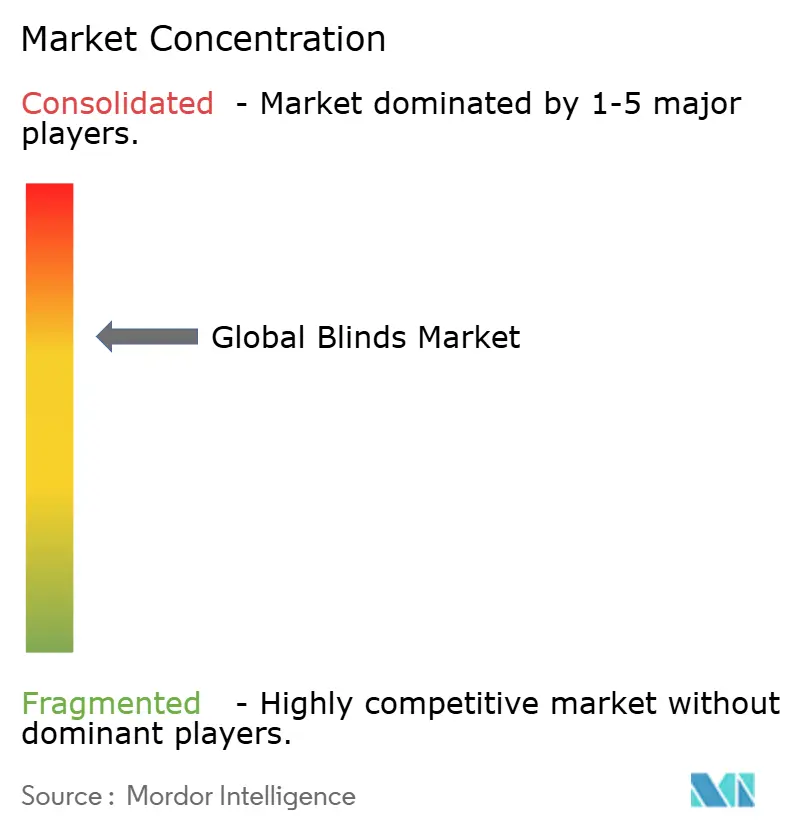
| Market Concentration | Medium |
Major Players *Disclaimer: Major Players sorted in no particular order Image © Mordor Intelligence. Reuse requires attribution under CC BY 4.0. | |
Blinds Market Analysis by Mordor Intelligence
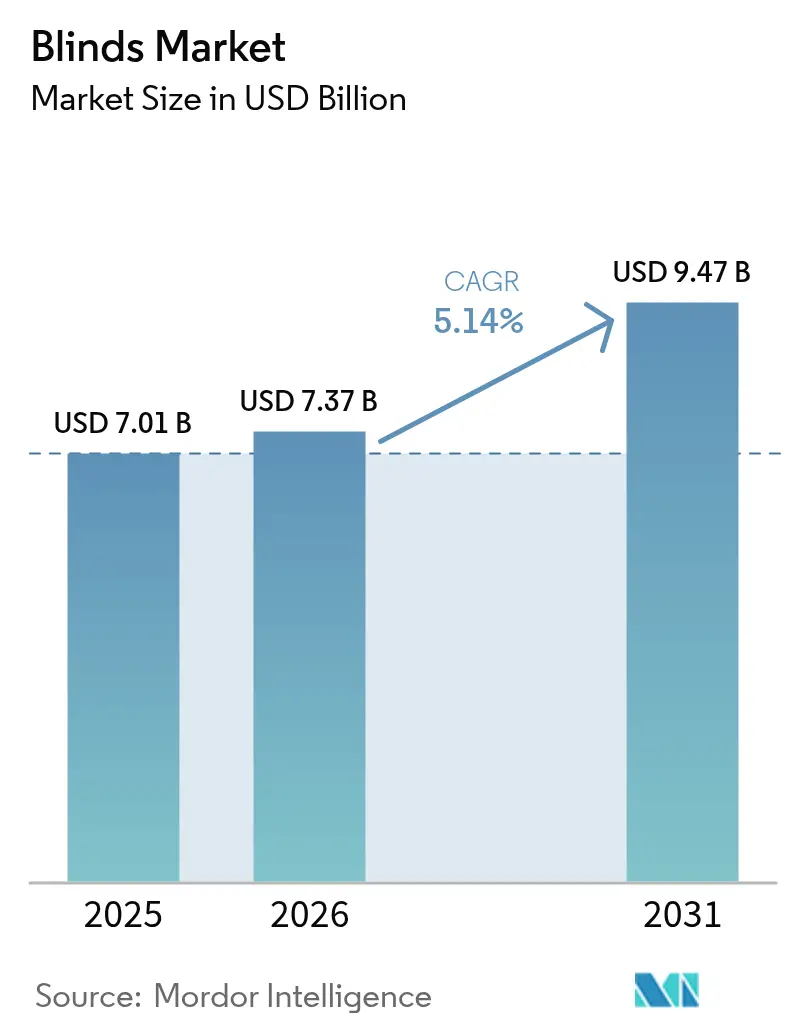
The global blinds market size was valued at USD 7.01 billion in 2025 and estimated to grow from USD 7.37 billion in 2026 to reach USD 9.47 billion by 2031, at a CAGR of 5.14% during the forecast period (2026-2031). Energy-efficiency mandates contained in ASHRAE 90.1-2022 and state codes such as California Title 24 are steering specifications toward motorized and sensor-driven solutions. Post-pandemic remodeling has revived residential demand and commercial real-estate developers are embracing circadian-lighting-ready shading to comply with WELL and LEED requirements. Input price swings for aluminum, wood, and PVC raise cost-management challenges, yet they also accelerate innovation in recycled and bio-based materials. Smart-home platforms, IoT connectivity, and wellness certification together expand the addressable blinds market far beyond its traditional replacement cycles.
Key Report Takeaways
- By product type, roller blinds led with 33.74% of the blinds market share in 2025, while smart blinds are projected to post a 7.39% CAGR through 2031.
- By operation mode, manual systems held 70.42% of the 2025 blinds market size, whereas motorized models are set to grow at an 8.65%CAGR by 2031.
- By material, fabric accounted for 36.78% of the 2025 blinds market size; bamboo and other natural fibers register the quickest rise, expanding 6.55% annually during 2026-2031.
- By application, the residential segment captured 61.34% of the 2025 revenue of the blinds market, while commercial use is forecast to expand at a 5.81% CAGR by 2031.
- By distribution channel, offline retail retained 69.22% of the 2025 revenue of the blinds market, yet online sales are advancing at a 7.08% CAGR through 2031.
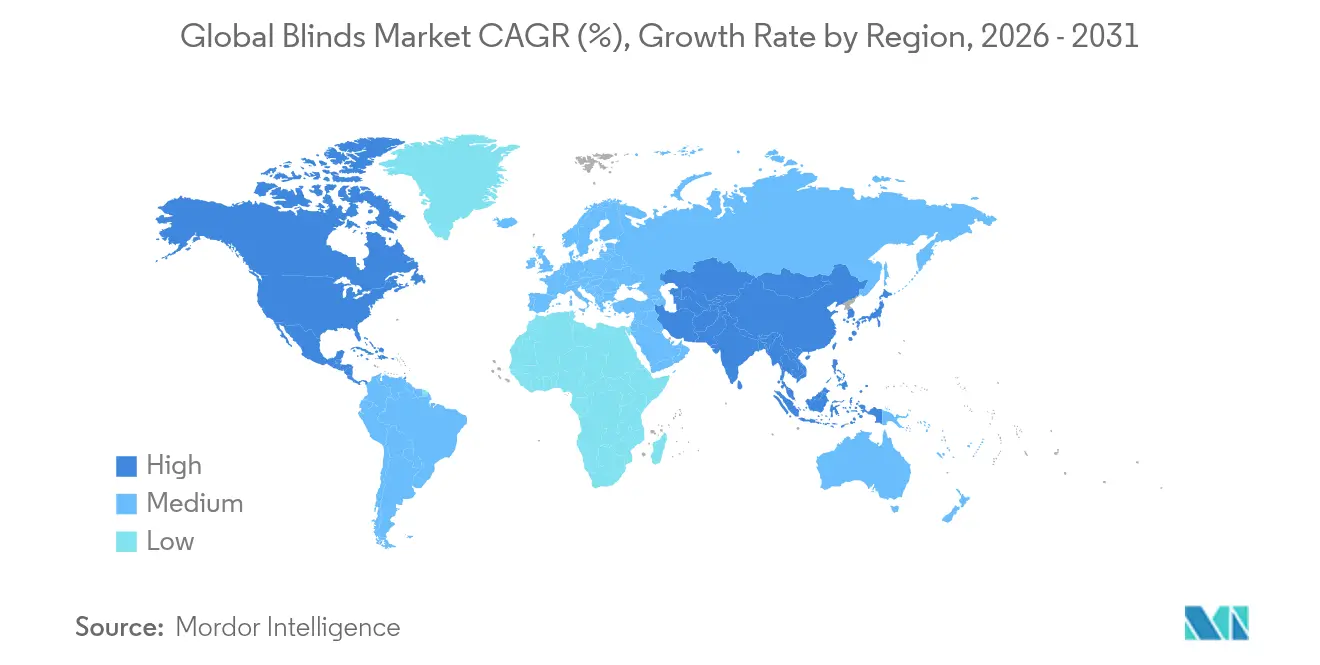
- By geography, North America retained 31.72% of the 2025 revenue of the blinds market, yet Asia-Pacific is advancing at a 6.02% CAGR through 2031.
Note: Market size and forecast figures in this report are generated using Mordor Intelligence’s proprietary estimation framework, updated with the latest available data and insights as of 2026.
Market Trends and Insights
Drivers Impact Analysis of Blinds Market*
| Driver | (~) % Impact on CAGR Forecast | Geographic Relevance | Impact Timeline |
|---|---|---|---|
| Rising smart-home & IoT adoption | +1.2% | Global, led by North America & Europe | Medium term (2-4 years) |
| Energy-efficiency building codes & certifications | +0.8% | North America & Europe, spreading to Asia-Pacific | Long term (≥ 4 years) |
| Post-pandemic residential remodeling surge | +0.6% | North America & Europe | Short term (≤ 2 years) |
| Commercial real-estate expansion & glare standards | +0.5% | Global urban centers, strong APAC pipeline | Medium term (2-4 years) |
| Insurance discounts for fire-rated automated blinds | +0.3% | North America & Europe commercial sectors | Long term (≥ 4 years) |
| Circadian-lighting integration in wellness offices | +0.4% | North America & Europe, emerging in Asia-Pacific | Medium term (2-4 years) |
| Source: Mordor Intelligence | |||
Rising Smart-Home & IoT Adoption
Smart-ready blinds now link natively with voice assistants and multi-protocol hubs, turning shading into a standard node on household or building networks. Vendors embed HDR-based luminance sensors and predictive algorithms that track sun position and occupancy, thereby cutting lighting energy by up to half while boosting visual comfort. National procurement guidelines for federal facilities in the United States stipulate automatic shade controls that maintain daylight autonomy, accelerating specification in public buildings. Subscription models for remote diagnostics and firmware updates create recurring revenue streams that tilt the industry toward service-oriented economics. The shift reinforces consumer expectations that every window covering will eventually be app-controlled.
Energy-Efficiency Building Codes & Green Certifications
California Title 24 and the International Energy Conservation Code raise the bar on solar-heat-gain coefficients and U-factors, effectively nudging architects toward dynamic shading paired with Low-E glazing. ASHRAE 90.1-2022 widens its scope to include on-site renewables, which magnifies the payoff from demand-side daylight harvesting[1]ASHRAE Standing Standards Project Committee, “ANSI/ASHRAE/IES Standard 90.1-2022 – Energy Standard for Buildings Except Low-Rise Residential Buildings,” ashrae.org . Buildings pursuing LEED v4 or WELL v2 achieve multiple points when automated blinds are integrated with daylighting controls, giving premium products a clear compliance advantage. As codes tighten, a two-tier pricing structure is emerging: baseline manual blinds for simple retrofits and high-margin motorized systems that exceed minimum performance thresholds. Manufacturers that document measurable energy savings gain preferred-supplier status on large public projects.
Commercial Real-Estate Expansion & Glare-Control Standards
The demand for WELL-certified offices is driving the adoption of advanced solutions that enhance glare reduction and ensure uniform daylight distribution. Specifiers are increasingly selecting algorithm-driven roller shades designed with façade-specific cut-off angles to meet these requirements. The Asia-Pacific region continues to witness significant growth in Grade-A office space, with millions of square meters added annually, while multinational tenants are integrating wellness standards from North America and Europe into their operations. In the United States, federal regulations mandating view-preserving blinds in new government buildings are influencing broader industry practices. This regulatory shift is creating opportunities for suppliers capable of demonstrating product efficacy through post-occupancy performance studies. Suppliers that successfully validate their solutions are gaining a competitive edge and securing repeat business in this evolving market.
Insurance Discounts Tied to Fire-Rated Automated Blinds
NFPA 701 certification is increasingly written into tenancy agreements for hospitals and high-rise hotels[2]NFPA, “NFPA 701: Standard Methods of Fire Tests for Flame Propagation of Textiles and Films,” nfpa.org . Insurers offer premium reductions to building owners who install motorized blinds that respond to fire alarms by retracting or closing automatically, limiting smoke spread and improving egress visibility. Since compliance testing requires specialized labs, the barrier deters low-cost imports and protects value for recognized brands. As EU and U.S. authorities strengthen fire safety directives, demand shifts toward fabrics and coatings with documented flame-retardant performance. Integration with emergency lighting and alarm systems unlocks additional IoT functionality, elevating shading from mere furnishing to life-safety equipment.
Restraints Impact Analysis of Blinds Market*
| Restraint | (~) % Impact on CAGR Forecast | Geographic Relevance | Impact Timeline |
|---|---|---|---|
| Low-cost substitute curtains & drapes | -0.7% | Global, especially price-sensitive markets | Short term (≤ 2 years) |
| Volatile aluminum, wood & PVC prices | -0.5% | Global manufacturing regions | Medium term (2-4 years) |
| RF-interference hurdles for retrofit motors | -0.3% | North America & Europe | Medium term (2-4 years) |
| Scrutiny of PVC plasticizers in vinyl blinds | -0.4% | Europe initially, widening worldwide | Long term (≥ 4 years) |
| Source: Mordor Intelligence | |||
Low-Cost Substitute Curtains & Drapes
Ready-made curtains dominate rental housing and emerging markets, where budget considerations often overshadow automation. From 2017 to 2021, European imports of curtains rose from USD 1.66 billion to USD 1.97 billion, underscoring the enduring appeal of textile alternatives that seamlessly blend décor and privacy[3]CBI Ministry of Foreign Affairs, “European Market Potential for Window Coverings – 2023 Update,” cbi.eu . These curtains offer a cost-effective solution for households and businesses seeking functional yet aesthetically pleasing window treatments. Natural fiber drapes resonate with eco-friendly trends and come at a lower price point than motorized blinds and their control hardware. Additionally, their straightforward installation process appeals to both short-stay accommodations and DIY renovators, making them a preferred choice in these segments. In response to this challenge, blind manufacturers have begun offering bundled installation services and warranty coverage, a competitive edge that curtains currently lack. This strategic move aims to attract consumers who prioritize convenience and long-term value over initial cost savings.
Volatile Aluminum, Wood & PVC Input Prices
During the same quarter, aluminum coil prices, highly influenced by energy costs, exhibited over 20% volatility, complicating contract negotiations for commercial construction projects. The pricing of PVC inputs, which is directly linked to oil derivatives, remains highly susceptible to supply chain disruptions, significantly impacting extrusion costs for Venetian-slat profiles. Manufacturers are mitigating these risks by adopting dual-sourcing strategies and integrating recycled materials into production processes. However, the persistent price volatility has resulted in deferred capital investments in new production lines, hindering capacity expansion. End-users, in response to these uncertainties, are increasingly demanding fixed-price agreements to manage cost predictability. This shift has extended tendering cycles, adding complexity and length to the procurement process.
*Our forecasts treat driver/restraint impacts as directional, not additive. The impact forecasts reflect baseline growth, mix effects, and variable interactions.
Blinds Market Segment Analysis
By Product Type:
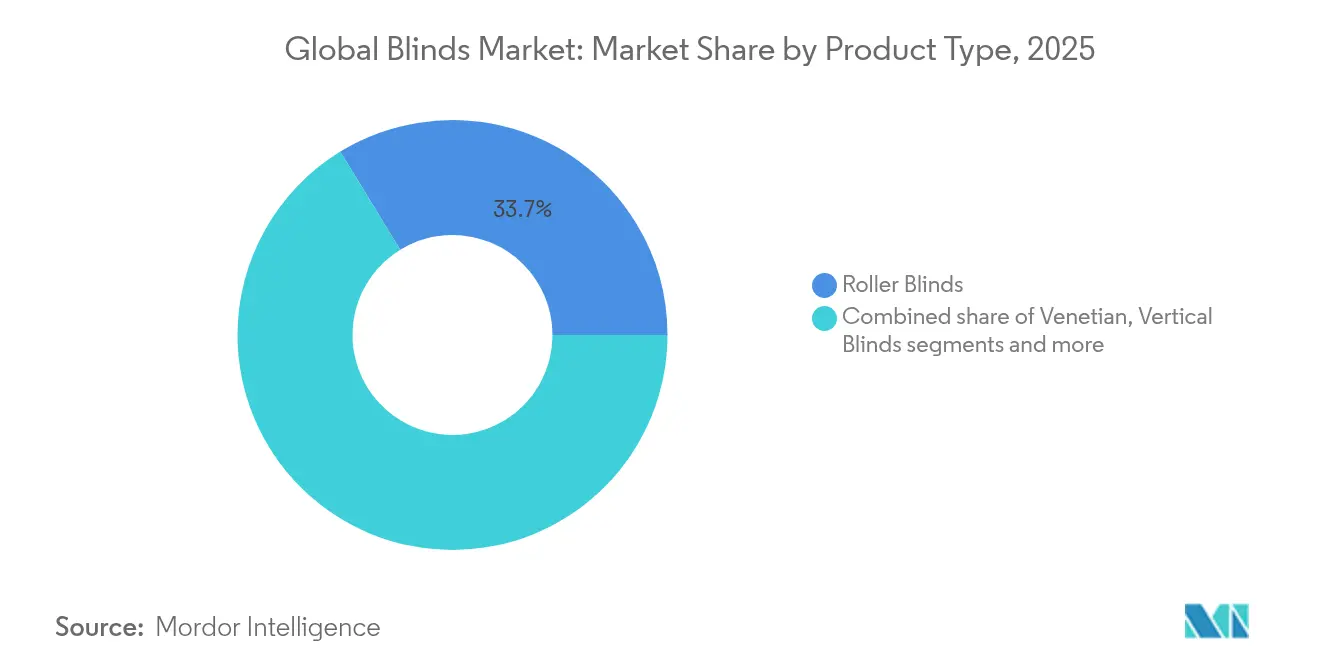
Smart Innovation Accelerates Traditional CategoriesRoller blinds held 33.74% of 2025 revenue, benefiting from minimal stack depth and compatibility with wide glass façades. Enhanced by silent motors and adaptive sensor packages, they now match aesthetics with advanced performance, broadening appeal in both offices and mid-price housing. Smart blinds, though a smaller base today, record a 7.39% CAGR and showcase the fastest uptake among tech-savvy end-users who value app control and automated routines. Field studies reveal that dynamic roller models cut lighting electricity by 50% while sustaining comfortable luminance for 90% of occupied hours, thereby satisfying utility rebates tied to peak-load shaving. The convergence of AI controllers with classical fabrics blurs product boundaries and lifts the overall blinds market beyond commodity status.
Venetian and vertical formats continue to dominate open-plan offices that require angle-specific glare control and outward view preservation. Roman blinds thrive in premium residential interiors where layered textiles create décor depth without compromising functional shading. Pleated cellular variants deliver measurable insulation gains, complementing government incentives for thermal retrofits. Panel tracks occupy a niche in hospitality lobbies and conference partitions, yet they demonstrate above-average margins because of custom printing and wide-panel engineering. Across all categories, the incremental cost of embedded motors and wireless chips is falling, enabling suppliers to pre-wire intelligence even in SKUs that once shipped purely manually; this shift steadily enlarges the addressable blinds market among mid-income consumers.



By Operation Mode:
Automation Transforms User ExperienceManual units still dominate at 70.42% due to low initial cost and simple installation, especially in DIY retail channels. That share is eroding as building codes and corporate ESG policies weigh life-cycle performance over purchase price. Motorized systems, projected to grow 8.65% annually, align with open-plan offices where frequent manual adjustment is impractical, and labor costs outweigh motor premiums within two years of operation. Retrofit innovations such as solar-powered battery tubes and stick-on RF remotes bypass wiring constraints, removing a long-standing barrier to adoption. Compliance with FCC and CE wireless protocols remains a hurdle, but leading brands use modular transceivers that can switch frequency bands to meet regional rules, safeguarding global rollouts.
Smart controllers exploit cloud analytics to predict sun paths and occupancy patterns, driving autonomous schedules that enhance occupant comfort and energy savings. Voice assistants and smart-home dashboards elevate blinds from background furnishings to interactive features, fostering higher replacement interest among tech-oriented households. Facility managers favor open APIs that slot directly into BACnet or KNX networks, ensuring future flexibility. As SaaS dashboards offer energy reports and fault diagnostics, vendors shift revenue toward subscription bundles that bundle maintenance with firmware updates. The evolution from pull cords to predictive algorithms epitomizes how automation amplifies the blinds market value proposition.
By Material:
Sustainability Reshapes Traditional PreferencesFabric retained the largest slice at 36.78% of 2025 revenue because textiles offer broad design latitude and acoustic dampening in open interiors. The sector now explores recycled PET yarns and bio-based water-repellent coatings, positioning blinds as front-line symbols of circular economy commitment. Bamboo, jute, and other natural fibers expand by 6.55% annually, buoyed by consumer desire for renewable décor that visually signals sustainability choices. Wood maintains cachet in high-end residences and boutique hospitality, but price volatility and wildfire-driven supply disruptions motivate some shifts toward engineered composites. Aluminum slats win in commercial towers for durability and slender profiles that reduce motor torque, thereby cutting energy draw.
Vinyl solutions are squeezed by health concerns and fresh limits on plasticizers, yet they remain pertinent in moisture-prone settings like kitchens and bathrooms due to easy cleanability. Manufacturers accelerate research into phthalate-free recipes and post-consumer PVC recovery schemes, responding to tightening EU rules. Engineered hybrids mix refined PVC backing with woven grass faces, bridging durability and eco-aesthetics while diversifying product portfolios. Continuous improvement in pigmentation and UV resistance ensures that sustainable alternatives do not sacrifice colorfastness or dimensional stability. Material strategy, therefore, balances compliance costs, market perception, and functional performance as the blinds market navigates stricter environmental benchmarks.
By Application:
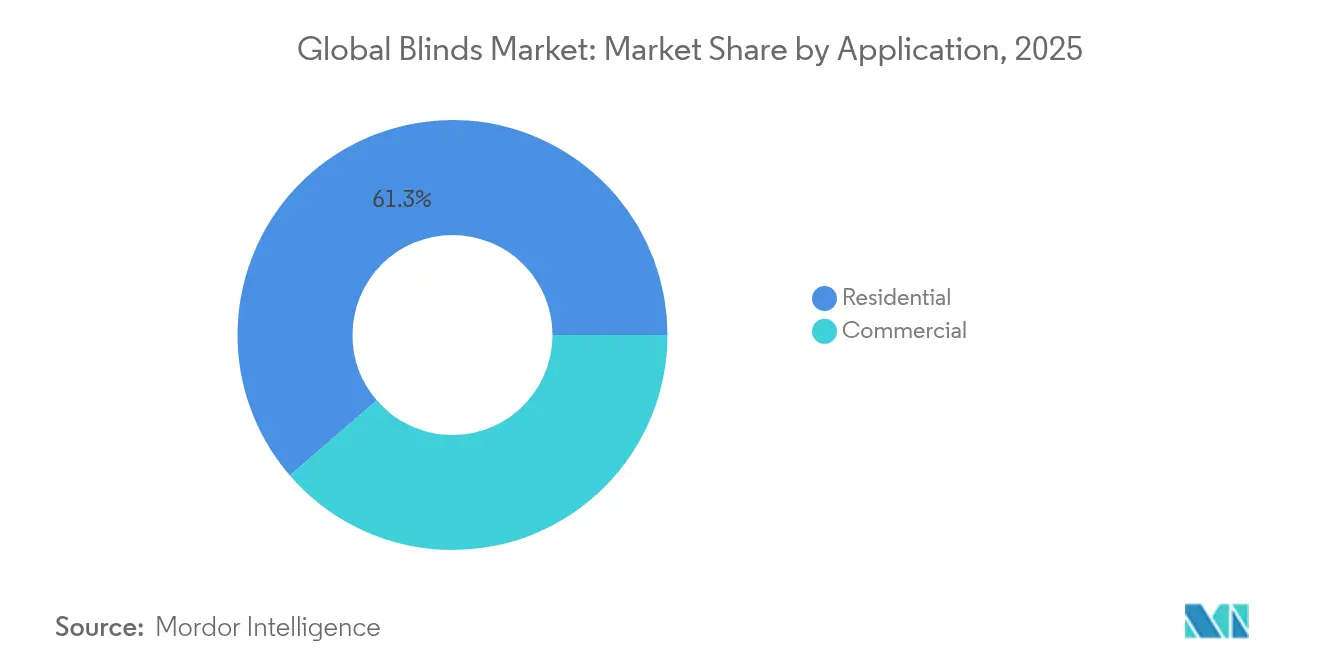
Commercial Growth Outpaces ResidentialResidential installations still generate 61.34% of 2025 revenue because of the vast installed base and frequent décor refresh cycles. Post-pandemic lifestyles drive interest in home offices and wellness features, nudging owners toward light-modulating fabrics that mitigate glare on screens and tune circadian cues. However, commercial premises post the liveliest expansion at 5.81% CAGR as landlords race to achieve WELL and LEED points that command rental premiums. Automated shading pairs with smart glass and HVAC systems in high-rise offices, hotels, and healthcare facilities, where quantified comfort and energy gains bolster investment cases. Hospitals specify fire-retardant fabrics compliant with NFPA 701, while schools integrate blinds that curb solar heat gain and alleviate glare that strains student vision.
Industrial warehouses increasingly deploy durable aluminum or PVC-coated shades to manage skylight heat gain and protect perishable goods from UV exposure. Retail storefronts embrace motorized vertical louvers programmed to showcase daylight merchandise while averting fabric fade. Multi-family developers integrate motorized blinds into amenity packages that differentiate units in competitive rental markets. Meanwhile, institutional retrofits leverage utility rebates that recognize shading as a demand-response asset, locking in predictable payback schedules. Divergent needs across these settings ensure portfolio diversification remains vital for manufacturers to capture the full breadth of the blinds market.
By Distribution Channel:
Digital Transformation AcceleratesOffline outlets maintained 69.22% of 2025 revenue because showroom visits allow tactile evaluation of fabrics, colors, and lift mechanisms. Big-box retailers combine off-the-shelf SKUs with installer networks, making them one-stop choices for time-pressed consumers. Specialty boutiques carve a margin through expert measurement, swatch libraries, and project management, often upselling automation upgrades during in-home consultations. Online pure-plays, although smaller, expand by 7.08% annually due to 3D visualizers, AI-powered sizing guides, and simplified returns. Dropship models connect mills straight to end-buyers, compressing lead times and costs while exposing traditional dealers to margin pressure.
Omnichannel strategies emerge as manufacturers integrate web configurators with in-store pickup and service scheduling. QR-coded sample kits allow digital shoppers to feel materials without entering stores, blending convenience and sensory confirmation. Influencer marketing and social-commerce links drive impulse buys for accessory upgrades such as smart remotes or decorative valances. B2B project portals enable contractors to batch-price tenders and track production milestones, reinforcing loyalty. As logistics partners perfect parcel-level last-mile delivery of bulky blinds, the competitive line between online and offline blurs, widening access for mid-tier brands within the global blinds market.
Geography Analysis
North America Blinds Market
North America commands leadership with a market share of 31.72%, powered by stringent energy codes and a mature aftermarket of homeowners willing to invest in smart-home upgrades. Single-family housing starts reached a 12-month high of 1.50 million units in February 2025, sustaining pipeline demand for new installations. Title 24 and the U.S. federal facility standards formalize automated shading as a compliance pathway, pushing specifiers toward motorized units with documented performance. Remodelers leverage tax incentives and favorable financing to bundle window treatments into broader energy retrofits, ensuring repeat sales in aging housing stock. Canadian provinces follow similar trajectories, with cold-climate emphasis on cellular insulation and edge-seal technologies.
Broader European Markets
Europe is the proving ground for eco-material innovation and circular design principles, with continued growth from USD 1.66 billion in 2017 to USD 1.97 billion in 2021 despite pandemic headwinds. Germany, France, and the United Kingdom anchor demand through a mix of renovation programs and corporate wellness initiatives. Regulation (EU) 923/2023 reshapes product portfolios by outlawing high-lead PVC compositions, steering the blinds market toward natural fibers and recycled metals. Northern and Western Europe showcase advanced daylight-harvesting projects using façade-integrated blinds, while Southern Europe emphasizes solar-heat-gain mitigation. Production clusters in Poland and the Czech Republic provide cost-effective manufacturing that complements regional distribution hubs.
APAC Blinds Market
Asia-Pacific is the fastest-growing territory with a CAGR of 6.02%, driven by rapid urbanization and skyscraper proliferation requiring sophisticated façade solutions. Developers in markets such as China, India, and Southeast Asia import North American and European automation standards to attract multinational tenants. Climate diversity from tropical humidity to temperate monsoons creates demand for wide material palettes ranging from moisture-resistant PVC to reflective aluminum. Domestic smart-home ecosystems integrate locally designed blinds with voice assistants in regional languages, enhancing adoption among middle-income households. Strong e-commerce growth adds momentum, particularly in Japan and South Korea, where compact living spaces favor made-to-measure postal delivery services that expand the overall blinds market.

Regulatory Landscape
Safety and child-hazard rules continue to shape product design and labeling for window coverings in North America. In the United States, the CPSC enforces requirements under 16 CFR Part 1260 for custom and stock window coverings, which in practice pushes suppliers toward cordless designs, short operating cords (up to 8 inches), or otherwise inaccessible cords as a condition for broad retail and project adoption. Canada regulates corded window coverings through Health Canada under the Corded Window Coverings Regulations (SOR/2019-97), setting limits on accessible cord length and loop/perimeter characteristics that influence SKU rationalization and installation guidance.
In Europe, chemical and emissions compliance is increasingly relevant for textile- and polymer-heavy blind constructions. EU REACH restrictions are tightening around substances used in fabrics, coatings, and plastic components, including a formaldehyde emission limit under REACH Annex XVII Entry 77 that becomes effective on August 6, 2026 for textiles and other non-furniture articles. Specifier and retailer certification regimes are also evolving, including updated OEKO-TEX Standard 100 limit values entering into force in June 2026, which prompts manufacturers to adjust finishing chemistries and verification workflows for fabric blinds.
Value Chain Analysis
The value chain spans raw materials and chemical inputs (aluminum slats and extrusions, textile yarns and coatings, wood and composites, PVC/vinyl resins, motors and control electronics), conversion and assembly (weaving/dyeing, slat forming, cutting/sewing, extrusion, motor integration, quality testing), and then distribution into B2C retail and B2B project channels. China remains a major hub with vertically integrated ecosystems that combine fabric manufacturing, hardware, and component supply. Southeast Asia, including Vietnam, Thailand, Indonesia, and Malaysia, has also taken on a larger role in assembly and production.
This hybrid sourcing structure helps manufacturers balance access to specialized automation components with cost and risk diversification, particularly for motorized and smart blinds that depend on electronics supply continuity. Downstream, offline channels (home centers, specialty dealers, installer networks) remain central for measurement-intensive products, while online configurators and direct-to-consumer shipments expand reach for standardized and made-to-measure offerings. In 2025, tariff uncertainty and shifting duty environments increased the importance of inventory planning, dual sourcing, and price-management coordination between brands and overseas factories, while higher freight and energy costs pressured delivered costs. These dynamics reinforce the role of regional finishing, kitting, and last-mile installation partners as manufacturers try to protect lead times, quality consistency, and compliance documentation across markets.
Competitive Landscape
In 2024, five leading players, including Hunter Douglas, Springs Window Fashions, Somfy, Springs affiliates, and Nien Made, accounted for less than half of the industry's revenue, highlighting a moderate concentration. Hunter Douglas expanded its market reach by acquiring Levolor, Kirsch, and 247 Home Furnishings, seamlessly merging a traditional brick-and-mortar presence with nimble e-commerce capabilities. The 2024 acquisition of Azenco further diversified its portfolio into pergolas and exterior sun-control solutions, suggesting potential cross-selling opportunities with interior blinds. Springs Window Fashions reported a 5% increase in its workforce in 2024, signaling an expansion in capacity to better serve home-center chains and commercial contractors. These strategic moves by key players underscore the evolving dynamics of the blinds market, where consolidation and diversification are shaping competitive strategies. The moderate concentration of revenue among these vendors reflects their ability to adapt to changing consumer demands and market trends.
Somfy, leveraging 50 years of expertise in motor-control R&D, has established itself as a leader in wireless shading solutions by licensing connectivity protocols to OEM partners. This approach has created a quasi-standard in the market, enhancing compatibility across devices. The company’s MyLink modules, which integrate seamlessly with voice assistants and leading smart-home hubs, are accelerating the adoption of retrofit solutions. By focusing on innovation and integration, Somfy is addressing the growing demand for smart-home technologies. Meanwhile, regional specialists are differentiating themselves through rapid lead times and locally relevant fabrics. For instance, Australian manufacturers are producing UV-resistant textiles tailored to high-insolation climates, meeting specific regional needs effectively.
Material innovators are capitalizing on the rising demand for sustainable alternatives to PVC by developing advanced composites. Patents on jute-reinforced materials, which retain dimensional stability in humid conditions, are driving innovation in the market. These advancements align with the broader industry shift toward environmentally friendly solutions. Additionally, technology diversification, regulatory expertise, and robust omnichannel logistics are becoming critical factors in determining competitive advantage. As the blinds market transitions from commodity manufacturing to a solutions-oriented ecosystem, companies that prioritize these elements are better positioned to succeed. The focus on sustainability, coupled with advancements in technology and supply chain efficiency, is reshaping the competitive landscape and driving growth opportunities in the market.
Blinds Industry Leaders
Hunter Douglas
Springs Window Fashions
Somfy Systems
Nien Made Enterprise
Hillarys
- *Disclaimer: Major Players sorted in no particular order
Blinds Market Companies Covered in this Report
- Hunter Douglas
- Springs Window Fashions
- Somfy Systems
- Nien Made Enterprise
- Hillarys
- Graber
- Budget Blinds
- 3 Day Blinds
- Warema Renkhoff SE
- Griesser AG
- Luxaflex
- Lutron Electronics
- Vertilux
- ABC Blinds & Awnings
- Alta Window Fashions
- TOSO Co., Ltd.
- Nichibei Co., Ltd.
- Norman Window Fashions
- The Shade Store

Market Opportunities and Future Outlook
Interoperability stands out as a clear whitespace as smart blinds shift from proprietary ecosystems toward more standardized connectivity. Matter 1.0 formally defines the Window Covering cluster (0x0102), enabling common commands for lift, tilt, and absolute positioning and reducing friction for multi-brand installations across smart-home platforms. Momentum is also showing up in certification activity: in February 2026, Eve Systems achieved official CSA-IOT certification for Matter and Thread integration for Eve MotionBlinds firmware version 3.2.1, which supports adoption efforts with integrators and retailers that prefer certified, cross-platform products.
Building-energy compliance and wellness-oriented commercial specifications support continued upgrading from manual to motorized and sensor-driven blinds. Programs and codes referenced by specifiers, including California Title 24, the 2024 IECC, and US federal efficiency rules (10 CFR Part 434), embed automated daylight and shading control concepts into new-build and deep-retrofit decision-making. That alignment brings blinds into broader HVAC and lighting control budgets rather than purely decorative spend. At the same time, materials compliance in Europe, including the REACH formaldehyde emissions effective August 2026, creates room for suppliers that can document low-emission textiles and coatings at scale, especially for projects targeting WELL and LEED points where product declarations and emissions performance influence procurement lists.
Recent Industry Developments in Blinds Market
- July 2026: Hunter Douglas announced expanded compatibility for its PowerView Automation platform to include motorized window treatments from Alta Window Fashions. The initiative broadens the interoperable product set available to dealers and installers using PowerView, supporting mixed-brand projects without forcing a full platform switch.
- September 2025: Springs Window Fashions acquired Wideband Labs, LLC (PowerShades), a US-based manufacturer of smart motorized shades and automation technology. The acquisition strengthens Springs Window Fashions' automation capabilities and accelerates its ability to compete in motorized and smart segments where control electronics and software are key differentiators.
- May 2024: Hunter Douglas acquired Azenco Outdoor to expand its outdoor shading portfolio in North America and Europe. Adding pergolas and related exterior sun-control solutions supports cross-selling with interior blinds and extends Hunter Douglas' presence in adjacent shading applications specified by residential remodelers and commercial developers.


Blinds Market Report Scope and Research Methodology
Market Definition and Coverage
We size the global blinds market as the revenue generated from window-blind products sold for residential and commercial buildings, covering both new installation and replacement demand across major regions.
Scope exclusions: The model excludes curtains, drapes, shutters, and other non-blind window coverings, and it excludes installation labor unless it is bundled in the product selling price.
Segments Covered in This Report
- By Product Type
- Roller Blinds
- Venetian Blinds
- Vertical Blinds
- Roman Blinds
- Pleated / Cellular Blinds
- Panel Blinds
- Smart Blinds
- By Operation Mode
- Manual Blinds
- Motorized / Electric Blinds
- By Material
- Fabric / Textile
- Wood
- Faux Wood / Composite
- Aluminum
- Plastic / Vinyl
- Bamboo & Natural Fiber
- By Application
- Residential
- Commercial
- Offices
- Hospitality (Hotels & Restaurants)
- Healthcare & Institutional
- Industrial & Warehouses
- By Distribution Channel
- B2C/Retail Channels
- Specialty Stores
- Home Improvement Stores
- Department Stores
- Online
- Other Distribution Channels
- B2B/Projects
- B2C/Retail Channels
- By Geography
- North America
- Canada
- United States
- Mexico
- South America
- Brazil
- Peru
- Chile
- Argentina
- Rest of South America
- Europe
- United Kingdom
- Germany
- France
- Spain
- Italy
- BENELUX (Belgium, Netherlands, Luxembourg)
- NORDICS (Denmark, Finland, Iceland, Norway, Sweden)
- Rest of Europe
- Asia-Pacific
- India
- China
- Japan
- Australia
- South Korea
- South-East Asia
- Rest of Asia-Pacific
- Middle East and Africa
- United Arab Emirates
- Saudi Arabia
- South Africa
- Nigeria
- Rest of Middle East and Africa
- North America
Data Sources, Market Sizing, and Validation
Desk Research
Desk research was used to set the market boundary and to anchor the demand pool using repeatable, public signals. Sources reviewed include government construction and housing releases such as the US Census Bureau and Eurostat, trade and macro indicators from the World Bank, energy-efficiency references from the US Department of Energy, and building-code context from groups such as ASHRAE.
We also used company annual reports, investor presentations, and reputable business press to understand pricing direction, channel shifts (offline to online), and product mix changes such as motorized adoption. For cross-checking trade-flow assumptions where relevant, we referred to an import-export shipment-level database subscription and a patents database subscription to track activity around materials and control mechanisms. These examples are not exhaustive, and other public sources and documents were used to collect, validate, and clarify the final dataset.
Primary Interviews and Surveys
Primary work focused on filling gaps that secondary sources cannot answer well, especially around average selling price ranges, channel margins, and how demand splits between renovation and new build. We spoke with manufacturers, distributors, installers, retailers, and procurement stakeholders across the Americas, EMEA, and APAC so that regional pricing, product preferences, and the adoption of motorized blinds could be stress-tested before finalizing the model.
Distribution of primary research fieldwork respondents
| Company type | Respondent position | Region |
|---|---|---|
| Top tier: 35% | CXOs: 20% | APAC: 41% |
| Mid tier: 45% | Functional/Unit leaders: 26% | EMEA: 34% |
| Smaller Players: 20% | Managers: 54% | Americas: 25% |
Market-Sizing & Forecasting
The core sizing logic uses a top-down build where construction activity and renovation demand are reconstructed into an addressable window stock, then adjusted using blinds penetration and replacement cycles. To keep totals realistic, we corroborated the outputs with selective bottom-up checks, including sampled average selling price multiplied by unit volumes from channel conversations, plus supplier and distributor roll-ups where coverage was strong.
Key inputs that shaped the model include residential completions and permits, commercial floor-area additions, renovation spending direction, price movements by material (for example wood, faux wood, and aluminum), and the share shift toward motorized blinds in mid-to-premium ranges. Where unit data was uneven by country, gaps were handled using regional proxies, then normalized using purchasing power and channel mix so the implied price level stayed consistent.
For forecasting, scenario-based projections were used, with assumptions reviewed against expert expectations on construction cycles, remodeling intensity, and product upgrade rates. In each region, expected price progression and the manual versus motorized mix were updated first, and only then were volume trends applied so that value growth did not get overstated.
Data Validation & Update Cycle
Outputs were cross-checked against independent signals, including construction trends, trade direction, and reported company exposure to window coverings, and then variances were investigated before sign-off. When a country showed an unusual spike, the drivers were re-tested by revisiting assumptions such as replacement timing, price points, or channel shares, followed by targeted re-contacts with primary respondents.
Each report is refreshed annually, and interim updates are made when material events occur, such as sharp raw-material swings or major policy changes affecting energy efficiency and shading. Before delivery, an analyst performs a final pass to ensure the latest public indicators and interview learnings are reflected in the tables and narratives.
Mordor Intelligence's Global Blinds Market Size Compared Against Other Published Estimates
Published market values for blinds often differ because each publisher draws the line differently on what counts as a blind, which years are treated as the current base, and how price and volume are projected in the forecast.
Key gaps usually come from scope choices (blinds-only versus blinds plus shades), whether installation and channel services are added into revenue, and how motorized products are priced and ramped over time. Currency conversion timing and the last refresh date also matter, especially when input costs and housing starts change quickly.
Benchmark comparison
| Source | Market Size | Gaps in Research Methodology |
|---|---|---|
| Mordor Intelligence | USD 7.37 B (2026) | |
| Industry Publisher A | USD 8.15 B (2025) | Uses a different base year and often blends adjacent window-covering items into the definition, which can lift the headline value when compared year to year. |
| Industry Publisher B | USD 7.73 B (2025) | Typically groups blinds with shades and applies a broad value growth curve, with less explicit checking of replacement cycles and motorized share by region. |
The benchmark table shows that the spread is driven mainly by year alignment and what is counted inside the product boundary. In Mordor Intelligence's model, the value is limited to blinds products in 2026 terms without adding curtains or other non-blind coverings. With the market tied back to construction activity, renovation replacement, and a priced mix of manual and motorized blinds, the resulting figure stays traceable to clear inputs and can be repeated when assumptions are updated.


Key Questions Answered in the Report
What is the current size of the global blinds market?
The blinds market stands at USD 7.37 billion in 2026 and is projected to reach USD 9.47 billion by 2031.
Which product type generates the largest revenue?
Roller blinds lead with 33.74% of 2025 revenue, driven by versatile applications in both residential and commercial projects.
How fast are smart blinds growing?
Smart blinds register a 7.39% CAGR through 2031, the fastest among all product categories, due to IoT integration and energy-saving algorithms.
Why are motorized blinds gaining popularity in offices?
Motorized systems reduce manual adjustment labor and align with WELL and LEED requirements, supporting an 8.65% CAGR in the operation-mode segment.
How do new EU rules affect vinyl blinds?
Regulation (EU) 923/2023 caps lead content in PVC at 0.10%, compelling manufacturers to reformulate vinyl blinds or shift toward alternative materials.
Which sales channel is expanding most quickly?
Online direct-to-consumer platforms grow at a 7.08% CAGR by offering 3D configurators, rapid shipping, and easy installation guides that appeal to tech-savvy buyers.
Page last updated on:


 Your data is secure and never sold or shared.


