
AI Video Analytics Market Size and Share
Market Overview
| Study Period | 2020 - 2031 |
|---|---|
| Market Size (2026) | USD 6.19 Billion |
| Market Size (2031) | USD 17.23 Billion |
| Growth Rate (2026 - 2031) | 22.72 % |
| Fastest Growing Market | Asia-Pacific |
| Largest Market | North America |
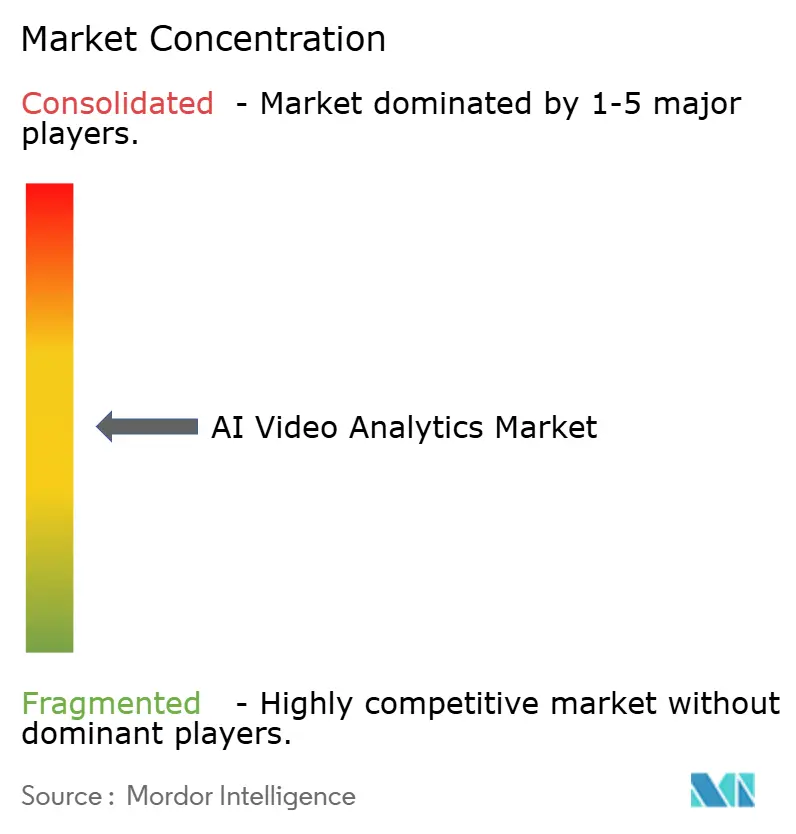
| Market Concentration | Medium |
Major Players *Disclaimer: Major Players sorted in no particular order Image © Mordor Intelligence. Reuse requires attribution under CC BY 4.0. | |
AI Video Analytics Market Analysis by Mordor Intelligence
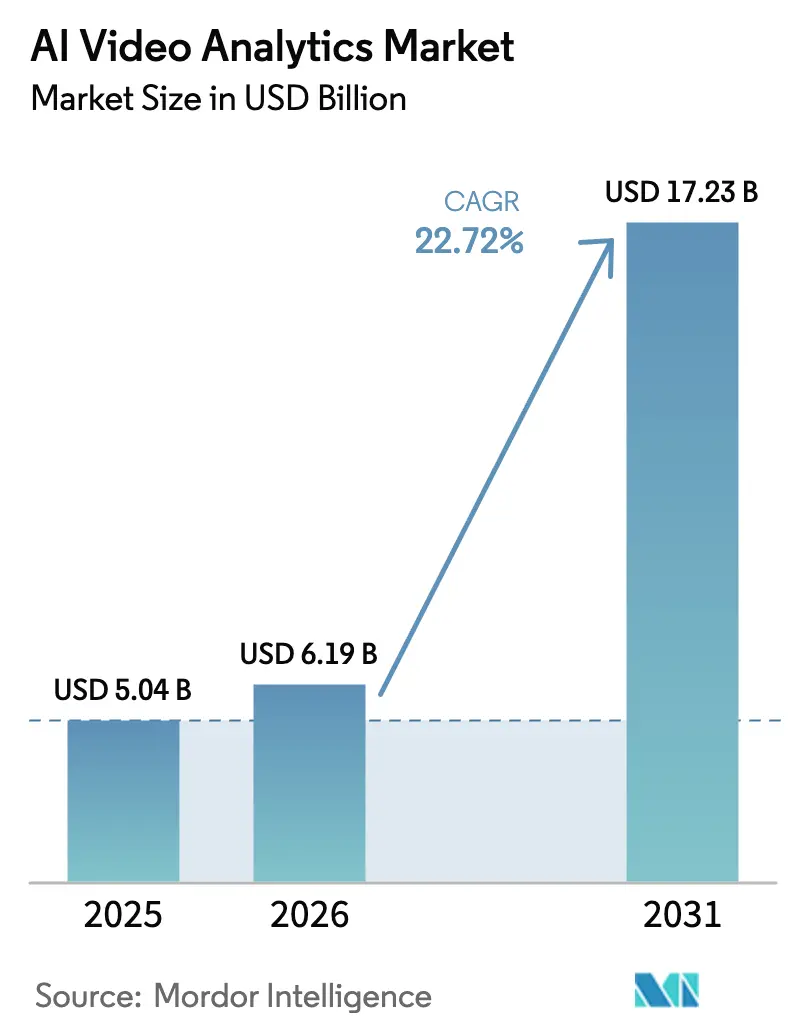
The AI video analytics market size is projected to expand from USD 5.04 billion in 2025 and USD 6.19 billion in 2026 to USD 17.23 billion by 2031, registering a 22.72% CAGR between 2026 and 2031. Heightened smart-city spending, falling edge-AI chipset prices, and tighter privacy rules that move inference away from public clouds are reshaping procurement criteria. Software remains the revenue anchor, yet services are rising fastest as integration complexity and compliance audits strain in-house IT teams. Hybrid and edge architectures are closing the gap on cloud because traffic management, industrial inspection, and healthcare monitoring demand sub-100-millisecond response times. Vendors are responding with federated-learning modules and ISO/IEC 42001-aligned workflows to balance accuracy with privacy mandates.
Key Report Takeaways
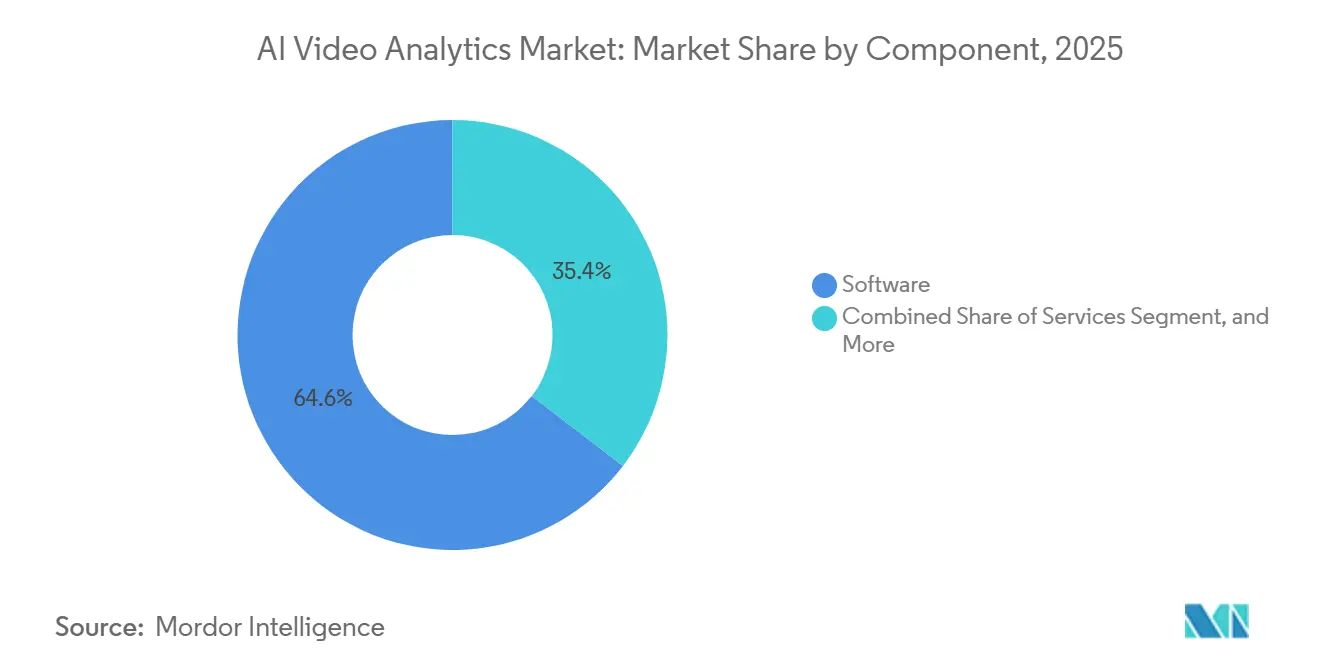
- By component, software led with 64.57% revenue share in 2025, whereas services are projected to grow at a 23.39% CAGR through 2031.
- By deployment mode, cloud accounted for 57.89% of the AI video analytics market share in 2025, while hybrid and edge architectures are forecast to expand at a 23.34% CAGR between 2026 and 2031.
- By analytics type, video content analytics accounted for 42.34% of 2025 sales, yet facial recognition is set to grow at a 23.72% CAGR through 2031.
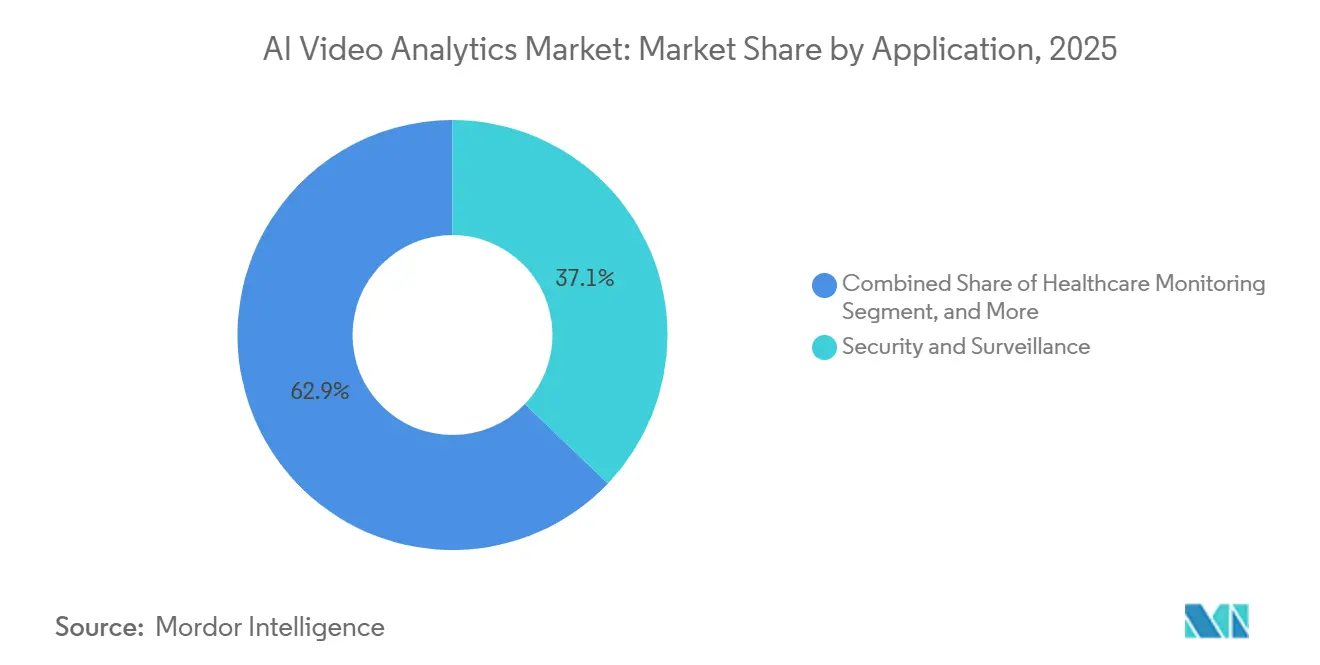
- By application, security and surveillance commanded 37.13% of the AI video analytics market share in 2025, although healthcare monitoring is expected to register a 23.91% CAGR over the forecast period.
- By end user, government and public safety accounted for 28.73% of the AI video analytics market share in 2025, while healthcare organizations are anticipated to post a 24.12% CAGR through 2031.
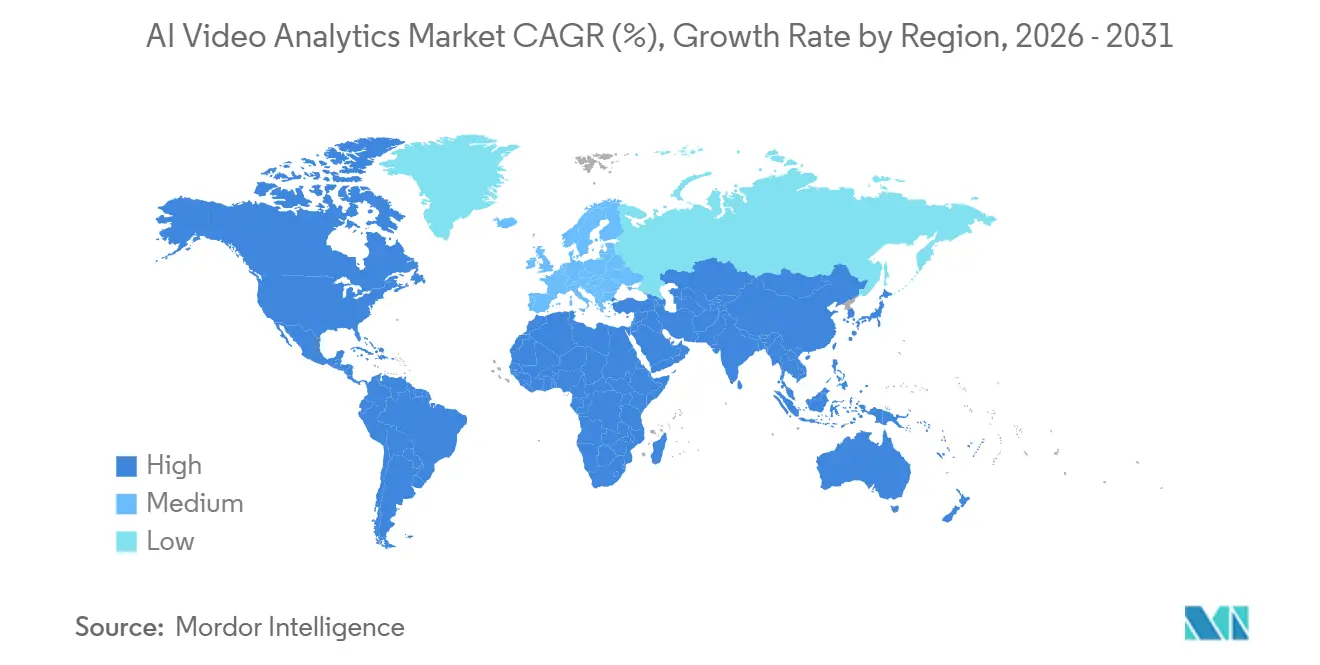
- By geography, North America captured 32.44% of 2025 revenue, whereas the Asia Pacific is projected to grow at a 23.77% CAGR during 2026-2031.
Note: Market size and forecast figures in this report are generated using Mordor Intelligence’s proprietary estimation framework, updated with the latest available data and insights as of 2026.
Market Trends and Insights
Drivers Impact Analysis of AI Video Analytics Market*
| Driver | (~) % Impact on CAGR Forecast | Geographic Relevance | Impact Timeline |
|---|---|---|---|
| Integration of AI-equipped CCTV in Smart-City Projects | +4.2% | Asia Pacific core, spill-over to Middle East and South America | Medium term (2-4 years) |
| Rising Retail and E-commerce Demand for In-Store Behavior Analytics | +3.8% | North America and Europe, early adoption in urban Asia Pacific | Short term (≤ 2 years) |
| Proactive Threat Detection Amid Escalating Security Risks | +3.5% | Global, concentration in North America, Europe and Middle East | Short term (≤ 2 years) |
| Declining Cost of Edge-AI Chipsets | +4.1% | Global, accelerated uptake in Asia Pacific and South America | Medium term (2-4 years) |
| Legislation on Visual Process-Transparency in Industry | +2.3% | Europe and North America manufacturing hubs | Long term (≥ 4 years) |
| Privacy-Preserving Federated Learning Models | +2.9% | Europe and North America, gradual adoption in Asia Pacific | Medium term (2-4 years) |
| Source: Mordor Intelligence | |||
Integration of AI-Equipped CCTV in Smart-City Projects
Municipal programs are moving video analytics from basic surveillance to integrated city-operating platforms. Hangzhou’s City Brain handled more than 1 million video streams in real time by late 2025, optimizing traffic-light cycles and flagging illegal parking. India earmarked USD 1.2 billion in 2025 for AI-enabled surveillance across 100 cities, with edge inference mandated under the Digital Personal Data Protection Act.[1]Ministry of Housing and Urban Affairs India, “Smart Cities Mission Progress Report 2025,” smartcities.gov.in The United Arab Emirates awarded a USD 340 million contract to modernize camera networks in Dubai and Abu Dhabi, aiming to cut emergency-response times by 30% by 2027. Procurement is shifting toward multi-year platform deals that bundle hardware, software, and managed services, favoring vendors with strong systems integration practices.
Rising Retail and E-commerce Demand for In-Store Behavior Analytics
Brick-and-mortar chains use AI vision to track dwell time, heat maps, and shelf engagement, mirroring data granularity long enjoyed by e-commerce. Walmart reported a 15% drop in inventory loss after rolling out camera-based shrinkage analytics in 3,500 U.S. stores.[2]Walmart Inc., “Annual Report 2025,” sec.gov Carrefour’s 2025 deployment across 200 European hypermarkets aims to cut out-of-stock incidents by 20%. Tokyo pilots at 7-Eleven sites lifted same-store sales 7% by aligning stock with real-time demographic insights. Privacy objections under Europe’s GDPR are pushing retailers toward anonymous heat-mapping or consent-based biometric modules.
Proactive Threat Detection Amid Escalating Security Risks
Airports and transit hubs are replacing motion-detection cameras with AI systems that spot suspicious behavior and unattended objects. The U.S. Transportation Security Administration recorded a 40% fall in false alarms at 45 Category X airports after adopting AI analytics.[3]U.S. Transportation Security Administration, “AI-Powered Threat Detection Program Update,” tsa.gov London’s Underground network uses crowd-density models to prevent platform congestion, while Saudi authorities rely on AI cameras during Hajj to reduce medical incidents by 25%. Although predictive capabilities improve safety, demographic bias in facial algorithms, highlighted by NIST tests, remains under scrutiny.
Declining Cost of Edge-AI Chipsets
Price declines in inference accelerators are making on-device analytics viable for smaller organizations. NVIDIA shipped more than 2 million Jetson Orin modules in fiscal 2025 with average selling prices down 18% year-on-year. Intel cut cost-per-inference on its Movidius VPUs by 35% in 2025, widening use cases for sub-USD 200 smart cameras. Ambarella’s CV5 processors drove 60% growth in shipments of traffic and industrial cameras. Cheaper silicon democratizes adoption but forces vendors to compress neural networks, sometimes at the expense of accuracy.
Restraints Impact Analysis of AI Video Analytics Market*
| Restraint | (~) % Impact on CAGR Forecast | Geographic Relevance | Impact Timeline |
|---|---|---|---|
| Data-Privacy Regulation Barriers to Facial Recognition | -2.8% | Europe and North America, emerging in Asia Pacific | Short term (≤ 2 years) |
| High Integration Cost With Legacy CCTV | -2.1% | Global, acute in Europe and North America | Medium term (2-4 years) |
| Model Bias and False-Positive Risk | -1.6% | Global, heightened scrutiny in North America and Europe | Medium term (2-4 years) |
| GPU Supply-Chain Volatility | -1.9% | Global, most severe in Asia Pacific and South America | Short term (≤ 2 years) |
| Source: Mordor Intelligence | |||
Data-Privacy Regulation Barriers to Facial Recognition
New laws are fragmenting biometric deployments. The European Union AI Act requires conformity assessments and human oversight for real-time public-space facial recognition, sharply limiting commercial rollouts. California’s 2025 biometric rules force opt-in consent, prompting some U.S. retailers to turn off facial modules. India’s 2025 data law adds privacy-impact assessments to all biometric processing. China amended its privacy law in 2024 to restrict facial analytics in residential complexes unless residents provide written consent. Resulting compliance costs slow adoption outside law-enforcement scenarios.
High Integration Cost With Legacy CCTV
Analog and first-generation IP cameras lack the horsepower, bandwidth, and cybersecurity safeguards required for AI inference. A 2025 International Association of Chiefs of Police survey found that 62% of U.S. agencies still use hardware that requires USD 800-1,200 in retrofits per camera. Upgrading the United Kingdom’s 5 million public-sector cameras would cost GBP 2.1 billion (USD 2.7 billion). Germany’s Federal Office for Information Security warns that layering AI onto outdated video-management systems creates vulnerabilities under the EU’s NIS2 Directive. Consequently, mature markets facing high retrofit bills adopt AI more slowly than greenfield builds in the Asia Pacific and the Middle East.
*Our forecasts treat driver/restraint impacts as directional, not additive. The impact forecasts reflect baseline growth, mix effects, and variable interactions.
AI Video Analytics Market Segment Analysis
By Component:
Services Gain as Integration Complexity RisesSoftware accounted for 64.57% of 2025 revenue, as platform licenses, analytics engines, and model libraries formed the core of most deployments. Services are expected to post a 23.39% CAGR to 2031, the highest across components, because enterprises rely on third-party integrators for model tuning, CCTV bridgework, and continuous compliance checks. Accenture found that 73% of organizations hired external experts for AI video rollouts lasting 9-14 months. The AI video analytics market size for services could therefore rival software by the end of the forecast period, shifting margin pools away from hardware. Hardware remains essential, especially where specialty thermal or multispectral cameras fetch premium pricing, but commoditization moderates growth.
Recognizing a skill shortage, enterprises are pivoting to services: A Deloitte report reveals that 68% of enterprises lack in-house AI vision capabilities. In response, vendors are increasingly bundling managed services with their hardware offerings. Meanwhile, ISO/IEC 42001 is gaining traction as a foundational certification for liability protection. With customers increasingly favoring outcome-based contracts, recurring revenue models are gaining momentum, further solidifying the dominance of services in the AI video analytics market.



By Deployment Mode:
Hybrid and Edge Close the Gap on CloudCloud deployment accounted for 57.89% of 2025 revenue, owing to elastic scaling and alignment with existing SaaS estates. Yet hybrid and edge solutions are forecast to grow at a 23.34% CAGR, narrowing the gap as smart-city traffic lights, factory inspection lines, and hospital wards require millisecond responses. The AI video analytics market share of hybrid architectures will expand further, as data-sovereignty rules discourage bulk video uploads. Microsoft reported Azure hybrid AI sales doubling in fiscal 2025, while AWS launched Panorama Appliance 2.0 for local processing.
Edge devices handle inference, pushing anonymized metadata to cloud dashboards that supervise model retraining and firmware updates, thereby satisfying GDPR minimization norms. On-premises stacks linger in defense and classified environments but grow slowly because sovereign clouds now meet many security stipulations. This two-tier design becomes the default blueprint for large-scale deployments in the AI video analytics market.
By Analytics Type:
Facial Recognition Surges Despite Privacy FrictionVideo content analytics object detection, motion, and scene analysis captured 42.34% of 2025 revenue and remains foundational. Facial recognition, however, is on track for a 23.72% CAGR owing to airport screening, bank fraud prevention, and automated access control. The AI video analytics market for facial recognition will continue to expand as regulatory clearance aligns with security funding, such as in U.S. ports, where 180 million travelers were processed in 2025. Crowd analytics are growing in retail and event safety, while gesture recognition is gaining healthcare traction in fall detection, steering around biometric constraints.
U.S. Homeland Security boasts matching accuracy rates exceeding 98.5%, leading to swift federal adoption. In contrast, the EU AI Act restricts facial recognition use strictly to law enforcement. In response, vendors are pivoting, offering solutions like post-event forensic modes and on-device encryption to localize personal data. This tug-of-war not only drives continuous innovation but also splinters product roadmaps across different jurisdictions.
By Application:
Healthcare Monitoring Accelerates Amid Staffing ShortagesSecurity and surveillance still delivered 37.13% of 2025 sales, reflecting entrenched demand from public safety and retail loss prevention. Healthcare monitoring is projected to grow at a 23.91% CAGR as hospitals adopt video-based fall detection and vital-sign estimation to offset nursing shortfalls. The American Hospital Association noted 78% of U.S. hospitals faced critical nurse shortages in 2025. Germany’s approval of reimbursement for video fall-detection widens European uptake. As a result, the AI video analytics market size for healthcare could outpace security budgets in select OECD nations.
Traffic management, retail insights, and industrial inspections are experiencing significant growth, driven by advancements in technology and evolving market demands. Retail experiments are increasingly mirroring e-commerce analytics, leveraging data-driven strategies to enhance customer experiences and optimize operations. In the automotive sector, production lines are integrating AI vision systems to meet stringent zero-defect standards, ensuring higher quality and efficiency. Each sector places a strong emphasis on latency-free edge inference, which not only supports real-time decision-making but also strengthens hybrid system designs. This approach enables vendors to diversify their end-market exposure, positioning them to cater to a broader range of industries and applications.
By End-User:
Healthcare Segment Leads Growth as Use Cases DiversifyGovernment and public safety users accounted for 28.73% of 2025 spending, driven by border control and citywide surveillance. Healthcare providers, however, are forecast to log a 24.12% CAGR, outpacing all others as reimbursement policies shift. The U.S. FDA cleared multiple AI video medical devices in 2025, and the WHO warns of a looming 10 million healthcare worker gap by 2030. These pressures prompt hospitals, nursing homes, and home health agencies to embed AI for patient safety and remote care.
Retailers, logistics firms, and manufacturers are increasingly adopting AI video analytics. In 2024, the National Retail Federation reported organized retail crime losses hitting USD 112 billion, spurring a heightened demand for offender detection. Manufacturers are using vision systems to promptly identify anomalies in welding or painting, helping them dodge expensive recalls. This broad-based demand shields the AI video analytics market from the budgetary fluctuations of any one sector.
Geography Analysis
North America AI Video Analytics Market
North America generated 32.44% of 2025 revenue, supported by USD 1.2 billion in federal smart-city grants and retailer pilots that marry computer vision with point-of-sale data. Canada backed municipal deployments with CAD 85 million (USD 63 million) in grants. Mexico’s expanded C5 centers processed more than 50,000 concurrent feeds by late 2025. Widespread edge adoption positions the region for steady, though not fastest, growth.
APAC AI Video Analytics Market
Asia Pacific is expected to post the strongest CAGR of 23.77%. China had over 600 million AI-ready cameras by end-2025, integrated with national ID databases for real-time alerts. India’s Smart Cities Mission deployed AI video analytics in 82 cities, emphasizing edge inference for localization compliance. Japan is committed to AI-based crowd monitoring at major rail hubs to prevent falls. The region’s greenfield projects and large urban populations underpin the sustained expansion of the AI video analytics market.
EMEA and South America AI Video Analytics Market
Europe maintains sizable spending, but stricter privacy curbs slow facial recognition rollouts. Twelve German states paused pilots in 2025, awaiting AI Act guidance. The United Kingdom nonetheless awarded GBP 120 million for AI analytics in transport and critical infrastructure, with algorithmic transparency requirements. Middle Eastern initiatives under Vision 2030 continue despite GPU shortages that briefly stalled tenders. South America and Africa stay smaller as budget and skills gaps temper deployment speed, though cities like São Paulo and Lagos pilot traffic and safety systems.

Regulatory Landscape
Regulation is tightening around biometric and public-space deployments. The EU Artificial Intelligence Act (Regulation (EU) 2024/1689) sets binding rules for AI systems used in security and surveillance, with the key prohibitions under Article 5 applying since 2 February 2025. These include bans on untargeted scraping of facial images from CCTV to expand recognition databases, which directly affects how vendors source and train facial models for video analytics.
Compliance timelines create a split runway for buyers and suppliers. Under the EU AI Act, transparency obligations under Article 50 are scheduled for 2 August 2026, with a grace period for existing systems until 2 December 2026. A May 2026 provisional agreement by EU institutions also defers certain high-risk system obligations (notably Annex III standalone systems) to later dates. At the same time, voluntary governance is becoming more structured in the United States through NIST, which published a Concept Note on 7 April 2026 for a new AI Risk Management Framework profile focused on Trustworthy AI in Critical Infrastructure. This is pushing critical infrastructure operators and vendors to align procurement, documentation, and audit practices for AI-enabled surveillance technologies.
Value Chain Analysis
The AI video analytics value chain starts with sensor and silicon suppliers, including camera OEMs, optics, and edge AI semiconductors, then moves through firmware and video management software (VMS). Model development (training, tuning, and MLOps), deployment infrastructure (edge gateways, on-prem storage, and cloud platforms), and systems integration and managed services follow for monitoring, compliance, and lifecycle operations. Market structure is increasingly coupling camera and edge compute roadmaps with analytics software, supported by long-term supply and co-development agreements such as Hanwha Group and Ambarella signing an LTA valued at over USD 800 million (May 2026) to scale edge AI semiconductor technology across Hanwha product lines.
Downstream, distribution and delivery depend on channel partners, integrators, and platform alliances that package analytics into broader physical security and operational workflows. Honeywell's collaboration with Rhombus (March 2026) to integrate AI-driven cloud video and access control into building automation portfolios and Veritone's partnership with LeoSight (March 2026) to embed AI into public safety data visualization workflows reflect that integration-led direction. Data sovereignty and latency requirements are also shaping infrastructure choices, as partnerships such as VAST Data and TwelveLabs (February 2026) enable customer-managed deployments of video foundation models in on-prem and neocloud environments, reinforcing hybrid architectures for regulated or bandwidth-sensitive deployments.
Competitive Landscape
The top five vendors accounted for roughly 40-45% of 2025 revenue, indicating moderate concentration. Hikvision, Dahua, and Axis leverage camera footprints to bundle analytics but face margin compression as chip commoditization eases entry barriers. Pure-play software firms such as AxxonSoft and Vintra differentiate through retail, healthcare, and industrial models, often partnering with integrators to expand reach. Hyperscale clouds package pre-trained models for one-click adoption but lack the depth of customization for complex, regulated scenarios.
Strategic actions cluster around compliance, verticalization, and M&A. Bosch secured ISO/IEC 42001 certification in 2025, positioning it to court EU customers navigating the AI Act. Motorola Solutions bought Ava Security for USD 300 million to mesh AI video with its command-center suite. NEC landed JPY 12 billion (USD 80 million) in airport deals across India, Thailand, and Indonesia on the strength of its masked-subject accuracy ranking. Edge-optimized startups such as OpenCV.ai introduce federated learning frameworks to ease privacy concerns while still scaling sales through channel alliances.
In healthcare monitoring, retail analytics, and industrial inspection, specialized domain workflows continue to outperform generic vision stacks due to their tailored approach to specific industry needs. Vendors who integrate deep industry-specific expertise with ISO-aligned governance frameworks gain a significant competitive advantage. This is particularly critical as buyers increasingly prioritize not only accuracy but also the mitigation of liability and regulatory risks, which are becoming key decision-making factors in these sectors.
AI Video Analytics Industry Leaders
AxxonSoft Inc.
Axis Communications AB
Bosch Security Systems
Panasonic Holdings Corporation
NEC Corporation
- *Disclaimer: Major Players sorted in no particular order
AI Video Analytics Market Companies Covered in this Report
- Hangzhou Hikvision Digital Technology Co., Ltd
- IndigoVision Group Limited
- AxxonSoft Inc.
- Zhejiang Dahua Technology Co., Ltd.
- Axis Communications AB
- Huawei Technologies
- Bosch Security Systems
- Motorola Solutions
- Canon Inc.
- Honeywell International
- Panasonic Holdings Corporation
- NEC Corporation
- Gorilla Technology Group
- Verint Systems Inc.
- iOmniscient Pty. Ltd.
- Irisity AB (publ)
- Senstar Corporation
- AnyVision Ltd.
- SenseTime Ltd.
- Vintra Inc.
- IntelliVision Ltd.
- OpenCV.ai Ltd.

Market Opportunities and Future Outlook
Opportunities are expanding where procurement is shifting from feature-led pilots toward measurable performance, auditability, and lifecycle governance. The publication of IEC 62676-6:2026, which provides a framework for testing and grading real-time intelligent video content analysis (IVCA) systems across scenarios such as loitering and perimeter intrusion detection, creates room for vendors that can certify outcomes across heterogeneous camera fleets and environments. Tighter rules on biometric processing and transparency, including the EU AI Act timelines around Article 50 in 2026 and enforcement of prohibitions from February 2025, are also steering demand toward privacy-preserving architectures such as edge inference, anonymized metadata pipelines, and federated learning modules that reduce reliance on bulk video uploads.
Platform and model-layer innovation is further creating differentiation opportunities in video search, multi-camera reasoning, and agentic workflows, particularly for large, distributed device bases. In July 2026, Verkada announced a collaboration with NVIDIA to scale its physical AI platform across more than 2.4 million devices, showing how foundation-model and accelerated-inference ecosystems are being pulled into physical security deployments. Investment activity is supporting next-generation video intelligence stacks, with TwelveLabs announcing a USD 100 million Series B round in July 2026 to scale video superintelligence architecture, indicating ongoing funding for advanced video understanding that can be productized for surveillance, safety, and operational analytics.
Recent Industry Developments in AI Video Analytics Market
- May 2026: AxxonSoft released Axxon One version 3.0, adding enhanced AI-powered search and updated security capabilities for its intelligent video management platform. The release supports faster investigation workflows and reinforces software-led differentiation as buyers look for better accuracy, usability, and governance features in multi-site deployments.
- September 2025: Axis Communications launched AXIS Secure Entry for XProtect to unify access control and video surveillance within Milestone environments. The integration strengthens converged security workflows and increases stickiness for deployments that want a single operational layer spanning doors, cameras, and analytics.
- November 2024: Axis Communications announced the ARTPEC-9 chip with enhancements targeted at cloud-based video and AI applications. A new SoC generation expands the compute envelope for on-camera analytics and helps camera vendors push more inference to the edge to reduce bandwidth and improve response times.


AI Video Analytics Market Report Scope and Research Methodology
Market Definition and Coverage
For this study, the AI video analytics market includes revenue earned from software and related services that use AI to interpret video feeds and generate outputs such as alerts, identification, and behavior insights across commercial and public-use settings.
Scope exclusions: We exclude general-purpose video management that does not apply AI-based analytics, and we also exclude purely hardware-only camera sales when analytics software is not part of the sale.
Segments Covered in This Report
- By Component
- Software
- Hardware
- Services
- By Deployment Mode
- On-premises
- Cloud
- Hybrid / Edge
- By Analytics Type
- Video Content Analytics
- Facial Recognition
- Crowd and Behavior Detection
- Automatic Number-Plate Recognition
- Gesture / Action Recognition
- By Application
- Security and Surveillance
- Traffic and Transportation Management
- Retail Customer Insight
- Industrial Quality Inspection
- Healthcare Monitoring
- Other Applications
- By End-User
- Government and Public Safety
- Retail and E-commerce
- Transportation and Logistics
- Manufacturing
- BFSI
- Healthcare
- Other End-Users
- By Geography
- North America
- United States
- Canada
- Mexico
- South America
- Brazil
- Argentina
- Rest of South America
- Europe
- Germany
- United Kingdom
- France
- Italy
- Russia
- Rest of Europe
- Asia Pacific
- China
- Japan
- South Korea
- India
- Australia
- Rest of Asia Pacific
- Middle East and Africa
- Middle East
- United Arab Emirates
- Saudi Arabia
- Turkey
- Rest of Middle East
- Africa
- South Africa
- Egypt
- Rest of Africa
- Middle East
- North America
Data Sources, Market Sizing, and Validation
Desk Research
Desk work sets the boundaries and gives us a starting model that is consistent across regions. We mainly leaned on public sources such as UN Comtrade for trade flows linked to cameras and related electronics, ITU indicators for connectivity readiness, OECD and World Bank macro series for spending and investment context, and NIST publications that help interpret how video analytics is used in security and safety workflows.
On top of these, we reviewed company filings, investor presentations, product notes, and credible press coverage to understand pricing direction, deployment shifts (cloud versus on-premises), and adoption by end-use verticals. Patent databases were also used to sense where innovation is concentrated and to cross-check which analytics capabilities are being commercialized at scale. For company financials and news tracking, we also used a paid subscription database for structured company-level screening and timeline validation. These desk sources are not exhaustive, and we referenced other public materials as well to collect data points, validate assumptions, and clarify open questions during the research.
Primary Interviews and Surveys
Primary interviews and surveys were used to stress-test the model, especially where public data does not clearly show how AI analytics revenue is recognized and bundled. We spoke with a mix of solution providers, channel partners, system integrators, and large end users across major regions, so deployment patterns, typical deal sizes, and adoption pacing by application could be validated and then carried into final assumptions.
Distribution of primary research fieldwork respondents
| Company type | Respondent position | Region |
|---|---|---|
| Top tier: 33% | CXOs: 16% | APAC: 45% |
| Mid tier: 47% | Functional/Unit leaders: 26% | EMEA: 32% |
| Smaller Players: 20% | Managers: 58% | Americas: 23% |
Market-Sizing & Forecasting
Sizing started with a top-down build where spend pools were reconstructed from security and surveillance adoption signals, enterprise digitization readiness, and region-wise rollout patterns for connected cameras and analytics software. Those totals were then corroborated with selective bottom-up approximations, such as sampled ASP ranges multiplied by plausible deployment volumes by vertical, followed by channel checks to see whether the outcome matched what suppliers and integrators see in the field.
A few inputs were treated as the key dials because they explain demand in simple, trackable ways. These include the installed base growth of network-connected cameras, the share of deployments using AI-enabled analytics versus basic motion detection, cloud penetration in video workloads, typical analytics attachment rates in new surveillance projects, and changes in average software and service pricing as features mature. Where bottom-up views were incomplete, for example when revenue is bundled inside broader security projects, we handled gaps by applying conservative attachment and realization factors that were validated through interviews.
For forecasting, we used scenario analysis tied to these demand indicators, since adoption can accelerate or slow depending on public safety budgets, regulation, and the pace at which organizations modernize infrastructure. The scenarios were reviewed with experts by region and end user so growth stays aligned with realistic procurement cycles and deployment constraints.
Data Validation & Update Cycle
Outputs were validated through multiple checks so obvious mismatches do not carry into the final numbers. We compared the model against independent signals such as security spending direction, camera shipment momentum, and cloud workload trends, then investigated any large variances before sign-off.
A second analyst review is applied to the assumptions, math flow, and year-on-year movements, and re-contact is triggered when an input looks out of range for a region, a vertical, or a deployment mode. Reports are refreshed annually, with interim updates when material events reshape pricing, adoption, or regulation. Before delivery, an analyst completes a final pass so clients receive the most current view supported by the latest validated inputs.
Mordor Intelligence's Global AI Video Analytics Market Size Compared Against Other Published Estimates
It is normal to see different market numbers for AI video analytics, because publishers may not count the same revenue streams and may use different geography coverage and timing. Differences can also come from how cloud services are recognized, how bundled projects are treated, and which applications are considered in-scope.
By tracking camera-to-analytics attachment rates and refreshing cloud versus on-premises revenue splits annually, Mordor Intelligence keeps the estimate aligned to AI analytics value realization, instead of counting the broader video surveillance stack. Some sources expand the boundary by including more hardware-heavy surveillance spending or adjacent video management revenue, while others apply aggressive price escalation without sufficient checks against procurement cycles and deployment constraints.
Benchmark comparison
| Source | Market Size | Gaps in Research Methodology |
|---|---|---|
| Mordor Intelligence | USD 6.19 B (2026) | |
| Global Consultancy A | USD 6.83 B (2026) | This estimate appears to use a wider boundary that can roll AI surveillance and broader video surveillance enablement into the same pool, which can lift totals when hardware-led projects are counted with analytics. |
| Trade Journal B | USD 5.50 B (2026) | This estimate is typically built from a narrower set of use cases and tends to apply conservative adoption factors, which can undercount newer deployments like cloud analytics and multi-site enterprise rollouts. |
The spread in the table is mainly explained by where each source draws the line between AI analytics software and services versus adjacent surveillance spending, and by how quickly adoption and pricing are assumed to move. Our approach stays repeatable because it is tied to clear demand indicators, uses interview-backed attachment and pricing logic, and applies step-by-step checks before the totals are finalized.


Key Questions Answered in the Report
How fast is the AI video analytics market expected to grow through 2031?
The market is forecast to rise from USD 6.19 billion in 2026 to USD 17.23 billion by 2031, reflecting a 22.72% CAGR.
Which deployment mode will gain the most ground over the next five years?
Hybrid and edge architectures are projected to expand at 23.34% CAGR as latency-sensitive uses outpace cloud-only models.
Why are services outpacing software in revenue growth?
Enterprises lack in-house skills, so they purchase integration, model tuning and compliance services that are forecast to grow 23.39% CAGR to 2031.
Which application segment is advancing the quickest?
Healthcare monitoring leads with a 23.91% CAGR due to fall-detection and patient-safety rollouts amid global nurse shortages.
What is driving Asia Pacific’s leadership in growth?
Large-scale smart-city investments in China and India and favorable data-localization policies underpin a regional CAGR of 23.77%.
How concentrated is the competitive landscape?
The top five suppliers hold roughly 40-45% of revenue, indicating moderate concentration with space for vertical-focused challengers.
Page last updated on:





